International Journal of Innovative Technology and Exploring Engineering (IJITEE) ISSN: 2278-3075, Volume-8 Issue-7, May, 2019
Abstract: Image Enhancement plays a vital role in digital image processing. In this proposed method of image enhancement based on DWT-SVD, another quality improving parameter is added to improve the overall quality of the enhanced image . This quality factor depends upon the optimized algorithm to be used. The purpose of introducing the quality factor is to reduce the losses introduced by the DWT operation during image enhancement. The experimental results of the proposed method performance will be shown in terms of PSNR, MSE, Mean and Standard Deviation over conventional and state-of-the-art techniques.
Index Terms: Image Enhancement Techniques, Optimization algorithm, DWT-SVD.
1. INTRODUCTION
Remote satellite images have a wide range of uses in many fields like GPS, telecommunication, weather forecasting, deep space exploitation, cable TV. Generally, these satellite images have a thin range of brightness levels and a very low range of intensity values because of low efficiency. so these images have to be processed for a higher quality of visualization. Contrast enhancement techniques are used to enhance the satellite images to improve their visual clarity. In the spatial domain, different types of methods are used for the enhancement of satellite images such as general histogram equalization and local histogram equalization. The optimization algorithm is based on ions motion which uses attraction and repulsion of ions. This optimization algorithm is able to give the best results and is also able to solve the common problems in all optimization algorithms [1].FEP can be used for large search space whereas CEP can be used for small search space. FEP can be used for multi-model at many local minima and CEP can be used for uni-model at few local minima [2]. Contrast enhancement using Cuckoo search algorithm and DWT-SVD for improving the quality of low contrast images. The output will be an enhanced image after going under process. The results are used to calculate some terms like PSNR, Mean, MSE, Standard Deviation [3]. Contrast enhancement using Artificial Bee Colony (ABC) algorithm and DWT-SVD for improving the quality of low contrast images. The output will be an enhanced image after going under process. The results are used to calculate some terms like PSNR, Mean, MSE, Standard Deviation which shows better performance [4]. Image enhancement is done by using DWT and SVD by
Revised Manuscript Received on May 06, 2019
P.Kavya, Electronics & Communication Engineering, KLEF, Guntur, India.
Shaik Zannath Hussain, Electronics & Communication Engineering, KLEF, Guntur, India
S.Phani Kumar, Electronics & Communication Engineering, KLEF, Guntur, India.
decomposing the input image into four sub-bands. The high-frequency components are interpolated and IDWT is used to combine HF and LF components. The results show a better performance than other conventional method [5]. Using Dual-Tree complex wavelet transform and Nonlocal Means filter which is based on resolution enhancement technique are designed which breaks down the LR input image. when compared to DWT, DT-CWT is better and it is shown in some parameters [6]. This paper deals with chromatic components while most of the papers deal with luminance components. when compared with earlier papers the technique proposed in this current paper gave better results [7].
The discrete cosine transform by considering singular frequency components in a unique way provides feasibility. But there are some problems while transforming remote satellite images using discrete cosine transform. So, DWT has been incorporated for contrast enhancement of images for various applications [8].
Commonly data gathered by pixel detectors contains noise like Gaussian noise, speckle noise, Poisson noise and different tools used for the enhancement are unreliable for images [9]. Due to unreliable tools and interference during the data gathering process degrades the quality of the data collected [10]. Due to the above problems, inference and preciseness of humans in understanding these remote satellite images can be affected [11].
Therefore practical applications require enhancement of images. While removing the noise in the images something unintended consequence may occur which results in blurring of image and information can be lost or over brightness may occur [12-15].
The image enhancement is broadly classified into two domains. They are spatial and transform domain. From the last twenty years, wavelet transform domain has been analysed extensively[16-17]. Due to the characteristic features of the wavelets such as sparsity and decomposition efficient approach of thresholding ideas has become easy [18-20]. Optimization techniques based on wavelets has numerous uses in different fields.
In this paper Ions motion algorithm based on wavelets is implemented and SVD is further used for enhancement.
2. FLOWCHART
Optimization Algorithm Based Image
Enhancement Technique Using DWT-SVD
3.METHODOLOGY
In this project we are going to implement the image enhancement technique using DWT-SVD and optimization technique. The optimization here use was Ion Motion Optimization (ION).
3.1 Alogrithm
1) In the very first step, a low complexity multispectral satellite picture has been taken for the handling.
2) Apply the histogram equalization technique for the given input image.
3) After completion of step-2 process calculate the 1st level DWT decomposition technique for each sub band such as Red, Green and NIR band.
4) Apply optimization for each sub band of DWT by using ION Motion algorithm.
5) LL, LH, HL, HH sub bands are been created from the 1st level decomposition.
6) Apply SVD for above steps to calculate the U, ∑, V. To obtaining from and from maximize the elements respectively.
7) Compute the ξ =
8) Calculate the ξ( )
9) Compute the inverse SVD process by using the formula shown below
ISVD = )
10)Obtain the new apply the IDWT for (
, , ) .
11)By doing this process we are getting enhanced images for a given low contrast input images.
ION-Motion Alogrithm
[image:2.595.311.564.221.412.2]Generally ions are nothing but charged particles. Charged particles are of two types one is anions and the other is cations. Anions are negatively charged particles and while cations are positively charged particles. The reaction of ions was shown in the below figure.
Fig. 3.1 Conceptual Model of Anions and Cations. From the above figure we observe that the conceptual model of Anions and Cations. The ions with same charges repel each other and the ions with opposite charges attract each other. Now we are assuming two ions solid phase (intensification) and liquid phase (diversification).
3.2.1 Liquid Phase (Diversification)
In liquid phase the ions motion is having greater freedom when compared to the solid phase. And there are having high attractive forces between the ions and can move freely. It is also called as Diversification.
1) 1) Start the process.
2) 2) Initialize the number of anions and cations. And calculate fitness evaluation of anions and cations.
3) 3) Fitness evaluation of anions and cations is proportional to the objective function. From this objective function the anions move towards the best cations and cations moves towards the best anions it’s depends upon attractive/repulsion forces between them.
International Journal of Innovative Technology and Exploring Engineering (IJITEE) ISSN: 2278-3075, Volume-8 Issue-7, May, 2019
where
= | | and =
| |
= Resultant Attractive force of anions.
= Resultant Attractive force of cations.
5) Update the values of anions and cations by using formula shown below.
= + *
( - )
= + )*
- ).
Where and are best anions and
cations respectively.
3.2.2 Solid Phase (Intensification)
In solid phase the ions are not having free motion when compared to the liquid phase. And the ions vibrate in their position without moving anywhere. It is also called as intensification.
1) In Solid Phase both the anions and cations attract each other. We cannot divide them until we apply any external force on it.
Eg:-Magnets
2) In liquid phase to solid phase where the mean fitness of worth ions is equal or smaller with the best ions.
3) If the above statement satisfies the anions and cations are randomly distributed among the best anions and cations respectively.
4) From the above process we can generate the best solution for the ions of anions and cations.
4. Experimental Results and Analysis
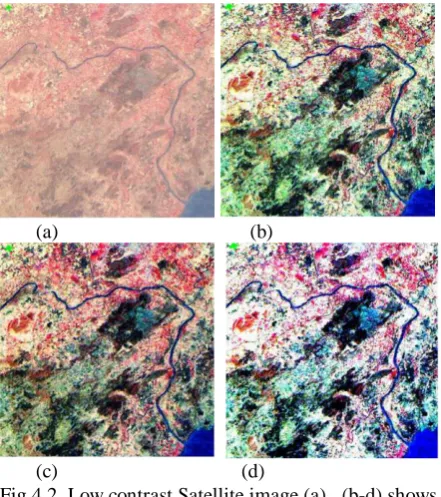
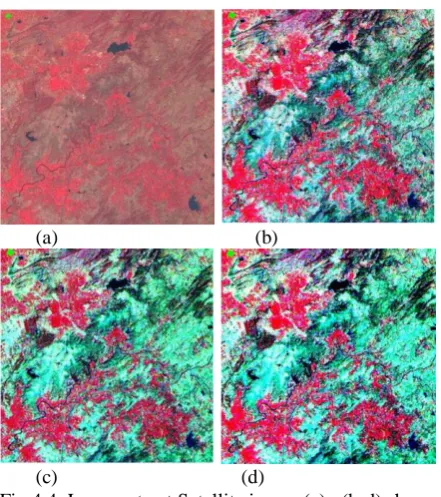
Four set of images has been taken from repository [21-22]. These images are low contrast satellite images which has been enhanced by using three enhancement technique viz, DCT-SVD, DWT , SVD and Proposed DWT-SVD-IMO based enhancement technique.
The enhanced images are shown in Fig.(2-5). The visual quality of the resulted enhanced images clearly shows the robustness of the proposed technique based on optimization technique.
(a) (b)
[image:3.595.311.532.49.184.2]
(c) (d)
Fig.4.1. Low contrast Satellite image (a) , (b-d) shows enhanced contrast images using the technique based on DCT-SVD,DWT-SVD and SVD-DWT-IMO respectively.
(a) (b)
[image:3.595.305.526.227.476.2]
(c) (d)
Fig.4.2. Low contrast Satellite image (a) , (b-d) shows enhanced contrast images using the technique based on DCT-SVD,DWT-SVD and SVD-DWT-IMO respectively
(a) (b)
[image:3.595.43.267.623.747.2](c) (d) Fig 4.3. Low contrast
images using the technique based on DCT-SVD,DWT-SVD and SVD-DWT-IMO respectively.
(a) (b)
[image:4.595.47.268.94.343.2](c) (d)
Fig.4.4. Low contrast Satellite image (a) , (b-d) shows enhanced contrast images using the technique based on DCT-SVD,DWT-SVD and SVD-DWT-IMO respectively.
The qualitative analysis of the resultant images obtained from DCT-SVD,DWT-SVD and the Proposed SVD-DWT based on IMO algorithm has been done using parameters like Mean, Standard Deviation and PSNR.
With improvement in the contrast and Brightness of the original image the parameters like Mean keep on increasing , standard deviation also increases clearly reflecting improvement in contrast. Moreover PSNR keep on decreasing with increase in contrast. The Table-1 shown below clearly reveals the effectiveness of the algorithm.
Images MEAN SD PSNR
1 108.997 4.275e+03 4.125
2 145.828 7.246e+03 4.0215
3 143.265 7.354e+03 4.2555
4 132.256 6.023e+03 3.7856
Table 4.1 Output of DCT-SVD
Images Mean SD PSNR
1
135.024 4.752e+03 3.2362
125.674 4.332e+03 2.8973
139.564 5.162e+03 2.33214
129.567 4.356e+03 2.5612Table 4.2 Output of SVD-DWT
Images Mean SD PSNR
1
134.096 4.8024e+03 3.1242
131.234 8.2541e+03 2.8543
132.45 9.235e+03 2.0114
129.234 6.325e+03 2.325Table 4.3 Output of Proposed IMO based SVD-DWT
4.CONCLUSION AND FUTURE SCOPE
In this paper we have tried to exploit the potential of optimization algorithm in existing image enhancement technique. The input to the SVD is rather than giving directly from DWT LL band, the parameters of LL band has been optimized using IMO algorithm, These optimized parameters improves the quality of input to the SVD, which overalls improves the image contrast. Furthermore in future not only contrast but also optimization of other DWT bands to be incorporated so that losses in edge information can be decreased to its minimum.
REFERENCES
1. Ions motion algorithm for solving optimization problems Behzad Javidy,
Abdolreza Hatamlou, Seyedali Mirjalili, Griffith University, Nathan, Brisbane, QLD 4111, Australia.
2. Evolutionary Programming Made Faster, Xin Yao, Senior Member, IEEE,
Yong Liu, Student Member, IEEE, and Guangming Lin.
3. Cuckoo search algorithm based satellite image contrast and brightness enhancement using DWT–SVD, A.K.Bhandari , V.Soni , A.Kumar , G.K.Singh.
4. Artificial Bee Colony-based satellite image contrast and brightness enhancement technique using DWT-SVD, Ashish Kumar Bhandari, Vivek Soni, Anil Kumar & Girish Kumar Singh.
5. Image enhancement using Wavelet transforms and SVD, Ganesh naga sai
Prasad , Habibullah khan, ,Bhavana.k ,Muralidhar.Ch ,Tulasi sai kiran.Ch.
6. Satellite Image Resolution Enhancement Using Dual-Tree Complex
Wavelet Transform and Nonlocal Means, Muhammad Zafar Iqbal, Abdul Ghafoor, and Adil Masood Siddiqui.
7. Enhancement of Color Images by Scaling the DCT Coefficients Jayanta
Mukherjee, Senior Member, IEEE, and Sanjit K. Mitra, Life Fellow, IEEE. 8. Image Denoising Using Bivariate Stable Distributions in the Complex Wavelet Domain, Alin Achim, Member, IEEE, and Ercan E. Kuruo˘glu, Member, IEEE.
9. Dark satellite image enhancement using knee transfer function and gamma
correction based on DWT–SVD, A. K. Bhandari , Anil Kumar , G. K. Singh ,Vivek Soni.
10. Brightness preserving based on singular value decomposition for image contrast enhancement Randa Atta, Rabab Farouk Abdel-Kader.
11. Contrast Enhancement-Based Forensics in Digital Images, Gang Cao, Yao
Zhao, Senior Member, IEEE, Rongrong Ni, Member, IEEE, and Xuelong Li, Fellow, IEEE
12. Gradient Magnitude Similarity Deviation: A Highly Efficient Perceptual
Image Quality Index, Wufeng Xue, Lei Zhang, Member, IEEE, Xuanqin Mou, Member, IEEE, and Alan C. Bovik, Fellow, IEEE
13. Efficient Contrast Enhancement Using Adaptive Gamma Correction With
Weighting Distribution, Shih-Chia Huang, Fan-Chieh Cheng, and Yi-Sheng Chiu
14. Contour Detection and Hierarchical Image Segmentation Pablo Arbela,
Member, IEEE, Michael Maire, Member, IEEE, Charless Fowlkes, Member, IEEE, and Jitendra Malik, Fellow, IEEE
15. D. Beasley, D. Bull, R. Martin, An Overview of Genetic Algorithms. Part
2, Uni-versity of Cardiff, Cardiff, 1993.
16. D. Beasley, D. Bull, R. Martin, An Overview of Genetic Algorithms. Part
1, Uni-versity of Cardiff, Cardiff, 1993.
17. D. Karaboga, An idea based on honey bee swarm for numerical
optimization, in: Technical Report-TR06, 2005.
18. A. Salman, A. Engelbrecht, M. Omran, Empirical analysis of self-adaptive
differ-ential evolution, Eur. J. Oper. Res. 183 (2007) 785–804
19. Bhuiyan,MIH.,Ahmad,MO,Swamy,MNS. New spatial adaptive wavelet
based method for the de-speckling of medical ultrasound image. In: Proceedings of the IEEE conference on circuits and system,p.2347–2350; 2007.
20. Pizurica A,Philips W. Estimating the probability of the presence of a signal of interest in multi-resolution single and multi-band image de-noising. IEEE Trans. Image Process2006;15(3):654–65.
21. http://www.gauss.ba/en/portfolio/satelitsko-snimanje
International Journal of Innovative Technology and Exploring Engineering (IJITEE) ISSN: 2278-3075, Volume-8 Issue-7, May, 2019
AUTHORSPROFILE
P.Kavya, pursuing B. Tech degree in the department of Electronics & Communication Engineering in KLEF. She recently worked on image processing.
SHAIK ZANNATH HUSSAIN, pursuing B. Tech degree in the department of Electronics & Communication Engineering in KLEF. He recently worked on image processing.