
The discursive construction of literacy in a disadvantaged school
43
0
0
Full text
(2) Chapter 6 The re-construction of the disadvantaged child at school: Teachers' work. 1 would say in some ways that it's a privilege. It's challenging. I kind of feel abused a bit. (Junior primary teacher) Every now and again I have an overwhe lming sense of hopelessness, like god w hat's all this for? (Upper primary teacher) You think you're making a change or you think you arc making an impact and you're not really, which is a pain . Because it affects my Iifc. 1 spend so much time worrying about them and plan ning for them. I think why did they do thaI, that it's stupid. (Upper primary. teacher) They're all aware I think in this economic area they have really gal to do fi ve times mor~ than a child of a middle class arca, because they're beh ind to stan with. I think they'd like the children 10 learn that they'd really, they are able to gel where they want to go, but they may have more input into it. They don't have the resources 10 suppon them at home in lots o r ways. (ESUSpeciaJ education teacher). 6.1 Introduction The statements which lead this chapter signal the contradictions in teachers' accou nts of their work at Banfiel d. They speak of abu se and privilege, challenge and hopelessness. These oppositions ec ho the themes of the previous chapter: chaos versus order, conflict versus harmony. Schooling is constructed as a transformative institution for disadvantaged child populations, who are 'behind to stan with', with lite racy as its principal enli ghtenment tool. Teachers' work, in this con text, is seen as 'pain' and as fu tile when it fail s to produce change in children. This chapter discusses the discursive constructi on of the disadvantaged child and the. re~conslitution. of the disadvantaged child. as literate student. Teacher statements reponed here are taken from a corpus of interview transc ripts. staff meetings and teachers' writing. In interviews I asked teachers to tell me about their students and their work as literacy teachers at Banfield. In responding to my prompts teachers produced different texts,. some focussing upon students, others more upon classroom methods, others upon professional doubts and uncertainties. Teachers did not speak with one voice. Teachers newer to Banfield had more to say about students' home lives, finding it more. Page 182.
(3) Chapter 6 The Re-Construction Of The Disadvantaged Child. 'shocking', than teachers who had taught at the school over an extended period. Those who had taught at Banfield for some time used the interview to express concerns with the effectiveness of their literacy teaching and had less to say about the students. In addition teachers whose own lifeworlds contrasted sharply with those of the school community - specifically, teachers whose own child and adult experiences were middleclass, Anglo and two parent families - made many more statements about their students' homes and families. In analysing teac hers' responses I have worked across the corpus of interview transcripts. In so doing I have drawn out statements which are consti tutive of student subjectivities and the ir relation to school literacies. Foucault argues that discourses 'systematically form the objects about which they speak' (Foucault 1972, p.49). Here I consider how the Banfield teachers' talk produces the literate subjects about which they speak. The products of theories of literacy pedagogy are changed people - changed teachers, changed students. Discourses about literacy are di scourses about people. Discourses do not have un iversal and predictable effects but are assembled in local sites. What is needed therefore are micro investigations which deal with the everyday discourses employed by school-based educalors. T he chapter proceeds in three sections. In section one I discuss teachers' statements about 'these kids', including fami ly and home life; difference; school knowledge; appropriate language behaviour; and individuality. In section two I consider 'the literacy fix' - how literacy is posed as the solution for 'these kids' and the dilemmas teachers face in regard to their practices. In section three I describe the proposition that the school world provides a corrective order for the chaos of the outside community through the reconstitution of the disadvantaged child as the literate student.. 6,2 'These kids'; The discursive construction of the disadvantaged child Modem institutions manage the population in a capillary fas hion, exercising power over individuals through the local management of time and space, surveillance and examinati on. In modern societies institutions monitor, classify and record. Individuals and groups classified as deviati ng from the norm are the subjects of intense study. Schools as 'nurseries of the population' (Foucault, cited by Smart 1983, p.93) have an important function in regulating and monitoring children. Teachers are required to 'know' their students. In a disadvantaged school community, as well as the official ways of knowing, described in chapter five, individual teachers bri ng to bear their di scursive and cultural resou rces in coming to 'know' their students. What counts as relevant infonnation and interpretation of that infonnation relates to teachers' lifeworlds. In other. Page 183.
(4) Chapter 6 The Re-Construction Of The Disadvantaged Child. words. teachers construct versions of normality. grids of specification. which are used to assess each srudent. As well as educational discourses, adjacent discourses, sllch as psychological, religious, legal, medical are deployed in knowing students. These kids' is a label used more widely than Banfield to identify groups of children who are somehow marked out as a group in ways that might be variously defined in different localities. Where schoo ls are concerned 'these kids' usually refers to groups who are seen to be problematic or different from 'normal' kids. In regard to children in schools serving communities Jiving in poverty, sen tences often begin with 'these kids need'; 'these kids lack'; 'these kids cannot' (Badger et al. 1993) constructing a discourse of di sadvantage. Here I explore how the disadvantaged child is constituted in Banfield teachers' talk about 'these kids'.. 6.2.1 Knowing our clients: The epidemiology of the family Some teachers expressed concern, shock and surprise at students' home circumstances and histories. There was a sense of a disea~ed. ~ociely.. an epidemic of chaos caused by. non-functional families. Teachers expressed anxiety about drug related illnesses, alcohol ism, parents breaking up and forming new relationships, physical abuse, lack of physical cleanl iness and general disorder or chaos. The clean, well-organised, healthy nuclear family was the standard by which other families were judged. Poverty and unemployment were rarely mentioned in teachers' explanations of family breakdown. Parents' relationships, behaviours and habits were seen as causal of children'S difficulties. Explanations of children's problems were made alongside the disintegration of families. For example, in one teacher's view, absences from school were related to, but not excused by, a parent's drug habit. M was a heroin baby and she's got some li ver problem but that doesn't, she shouldn't be away as much as she is; she was away thirty days th is term, almost six weeks out of a len week lenn.. Here the social and physical reality of the child's life intrudes into school practices. Illness or former illness should not prevent the child becoming the student. The educational discourse dominates and excludes the physical realities, which are dismissed as the result of family deviance. Before observing in each classroom I asked teachers to tell me about their students. In these accounts parents feature regularly. Parents' life crises were seen as generati ng problems which their chi ldren had to adapt to. Parents who were 'off their heads' with traumas were contrasted with those who were 'stable'.. Page 184.
(5) Chapter 6 The Re-Construction Of The Disadvantaged Child You know it's completely muddled up. Things like access weekends are a connict upon conflict. And P's father's remarried. His father's obviously really intelligent and he's wealthy. And the n there's B [mother] who looks li ke she came out of the gutter mosl of the time, you know the one I mean ... (pause) .... Yeah totally out of her head and lives with some guy who's totally off his head and they're always on again off agai n and all that sort of stuff. He lives two completely different lifestyles; one home he's really stable and the other one is really r..:ra.t;y, bUI he ~CIUS IV adjust quile: well. So you know her mum is an alcoholic? You know her general sloppiness, sort of mess, have you noticed that? ... She's been a bit better about the no shoes and lying on the table and lying on the floor; but she's apparently much better than last year. Her sister's a bit of a streetwalker, a local [name of suburb) streetwalker, only a young girl and urn her mother is a druggie. Her father's very nice and stable and all that but her mother is totally off her head. She lives with her mother and sister and there the emphasis is on being models. Her mother does interesting photography I'm told. I went to his birthday party last Friday night and I had the shock of my life ... Well it's obviously a very warm family, like they're a real family and they're just lovely all of them together and I walked in the house and the lack of cleanliness - it's diabolical. It's just like a tip out the back. There's rubbish everywhere and a green swimming pool that the kids are swimmi ng in and they keep mice in the bathroom. Yes iljust stinks and the house is really grotty and it looks as though it hasn't been washed. Thirty six per cent of Australians are in a situation of some kind of abuse whelher it is j ust verbal. or domestic violence of some kind. I've Ihoughllha\ actually means that one in every three of my children are in that situation and I started to look at it in, sort of compassion. I slaned to think about, I was feeling less abused by it. I also discovered that children's ability to live in a community was fragile.. In these statements teachers construct the commun ity as a threatening and chaotic place. The deviant parent is described as off her head, crazy, out of the gutter, an alcoholic, a druggie. Family situations are described as muddled, conflkt upon conflict, situations of abuse and domestic violence. Houses are described in tenns of lack of cleanliness, like a tip, grotty, diabolical. tn contrast stable parents are described as intel ligent and wealthy. Students from the deviant fami lies are described in terms of no shoes, lying on the table and lyi ng on the floor, fragile. When students' family lives deviare from the norms,legal reli gious and psychological discourses are employed by teachers in know ing and naming the problem (Tyler 1993). The teacher gaze misses little; the smells, the mice in the bathroom, the green pool, the gossip about other family members and their perceived transgressions as streetwalkers, alcoholics, druggies, child abusers. Some children come from thi s 'mher' world, this 'other' li fes tyle, which impinges on teachers' work in producing proper students. In these examples mothers are targets, in a way that is comparable to what Polakow has referred to the characterisation of 'i ncomplete mothers' in her study of single American. Page 185.
(6) Chapter 6 The Re-Construction Of The Disadvantaged Child. mothers and their families living in poverty (Polakow 1993, p. 48). From the disintegration of the family to the cleanliness of the house mothers are held responsible. But these mothers, these deviant mothers are off their heads, living with non-husbands, who are also off their heads, alcoholics, dIUggies, doing interesting photography, not cleaning their houses, not protecting their children from streetwalking, abuse and violence. Even the mother who manages 'a very warm family, like they're a real family and they're just lovely all of them together' is indicted for her lack of cleanliness, a potential threat to the children's health. Mothers are required to display a repertoire of responsible practices in the construction of the stable family home. Blame for chaos is directed towards at the mother. The construction of the deviant mother is infonned by ideologies of tidy houses and healthy, happy, stable families. Class, gender, religious, legal, medical discourses are assembled together in constituting her world as chaotic, as other, and most importantly as dangerous to her children. The child who lives part-time with his stable father seems 'to adjust quite well', but where there is no such stabilising force children are characterised by a general sloppiness as at risk of prostitution, drug addiction and violence. The school then comes to be a site of the 'professional survei llance of the family' (Waitzkin 1991 , p.82). One teacher's reading of a media article on child abuse leads her to generalise the reported percentages in the population to her own classroom. Her assumption, that children in her class are the victims of child abuse, allows her to reconstruct her response to what she judges as deviant behaviour to one of compassion and privilege. Her Catholicism reframes the problem as children to be saved from an evil community. I do not suggest that all teachers spoke in these ways about students, nor that these teachers always spoke in these ways. Some teachers tended to say very little about students as I have already mentioned. Several teachers apologised for what they were saying. but explai ned that I had asked them to tell me 'the way it was'. Perhaps my being there invited 'bad news stories' from the teachers. As researcher I may be unwittingly complicit in producing this kind of talk by providing the space to say what cannot be said at school (Carspecken & Apple 1992). I was there to learn about their context. They told. me about what they found problematic. Teachers mentioned that the way they spoke to me -' like negative comments'· about the students and their families was the object of the principal's severe disapproval. She discouraged what she described as 'seeing students as deficit'. She maintained that labelling children in negative ways could sustai n a cycle of failure. That kind of talk was not allowed at school. How students cou ld be spoken about was contested. In the principal's view, knowing students' histories and current home circumstances should not interfere with teachers' academic expectations for students.. Page 186.
(7) Chapter 6 The Re-Construction Of The Disadvantaged Child The teachers playa vita! role in this of course [ie. 'empowering our chi ldren']. And they need to have very high expectations of children. They need to really believe they have the potential to learn. They need 10 believe Ihal regardless of what happens in the child's home life it won't innuence their capaci ty to learn.. The principal here analytically separates children's home lives fro m their potential to learn. Her argument to teachers is that they need to have very high expectations of children, 'that regardless of what happens in a child's home life it won't influence their capacity to learn'. Here the principal constructs the ch ild in the school world as impervious to outside influences. This depends, however, on the role teachers play, what teachers beJieve and the expectations they hold. Here the principal draws on educational research literature which claims that a key variable in students' school success is teacher expectation. In privileging educational di scourses and practices over children's life worlds, the principal makes a case similar to that made by the teacher who is unwilling to excuse a student's high rate of absences on illness related to parental heroin use.. However the principal makes teachers' expectations pivotal in students' success and failure and produces another lOnd of binary in itself. The home is not the problem, but teacher expectations. Children's learning is the teacher's responsibility. While the principal worked to keep the school as a place for learning and teaching, from the teachers' points of view it often became a centre for crisis counselling. Oflen, with parents there will be some crisis. that's their crisis, that you've got to get pulled out of the room; or [the principal] will come and say, 'So~and~so's suicidal. Can you come to the office and Sr C will take your kids'. And Sr C was supposed to take J's kids, so therefore J can't go anywhere and that also makes people angry, when we're all tired. You think, bloody hell how many more times is this going to happen? Which means your tolerance for kids like V and J j ust goes. Sounds grim doesn't it? The mother rung up SOrt of a bit suicidal and [the principal}was straight around there like a shot and spent a few hours there in the morning. But that was a real shock to me because I thought why did the mother ring the school.. Indeed as the teachers suggest, parents frequently called on the principal for assis tance with relationships, disputes and personal life crises and she always made the time to see them. However, from the teachers' points of view. such crises belong to the parents: 'that's their crisis'. According to the teachers this is not the business of the sc hoo l. The implication is that the school should focus on the child's problems, not the parents. The effects of these 'interruptions' from parents in crisis are seen as disruptions to the school program and teachers' plans. which makes the affected teachers angry and tolerance for prob lem students low. In the second case, where the principal went to the horne of a supposedly su icidal mother, the teacher questio ns why the mother rung the school. Personal and family problems become teacher and principal's work. The implication here is that the parents are calling the wrong agency.. Page 187.
(8) Chapter 6 The Re-Construction Of The Disadvantaged Child. The principal's readiness to become involved in the community is seen to create problems for teachers. Parents corne to threaten what goes on at school not only through producing chaos in the horne, but bringi ng that chaos to school through direct requests fo r help. The teachers' use of 'so-and-so' suicidal' and 'sort of a bit suicidal' is hard to read. On the. one hand the gravity of the si tuation from the parent's perspective is signalled. On the other hand reluctance on the teacher's pan to see it as a school problem perhaps indicates her scepticism. Again the themes are repeated: fami ly chaos - school order. The need for division between family and school is restated. For this teacher parents' lives are not school business.. The boundaries and connections between the school world and of out of school worlds are seen as problematic. Yet teachers see what's goi ng on at home as impi ngi ng directly on the child. When everything has been chaos, the children are wild .. .J f there's something going on at home you can pick it; children are very good thermometers for what's happening. They're really only in school for a very little time. When you look at the rest of the ti me. Then I looked at the hectic lifestyles they lead and what sort of support structures are in place for homework and reading. about taking pride in their work and you know taking pride in their handwriting. All those sorts of things are my values. I also looked at the way they actually curse each other, the way they sel each other up, the way they manipulated each other, the way they really show ... (inaudible) ... about each other and the lack of sense of humour. And I question why there would be such a lack of sense of humour and it's very difficult for some of these children to laugh at themselves and to laugh with, not al. so we laugh at and not with. I thought. Well you know, a sign of someone who's really healthy and the mickey can be taken out of them and really good emotional health. And so eventually I talked 10 [the principal) about what I was thinking and feeling [about ch ild abuse and family violence quoted above] and she absolutely jumped down my throat. She said it was a very dangerous thing to think about and to consider. ... BUllhese children are like Ihat. they are only doing what they know and what they know so well in their lives.. In these statemen ts teac hers explore the effects of 'home' on children at schoo l. One teacher suggests that chaos at home makes children wild, that their school behaviour can be seen as a thermometer by whic h things going on at home can be detected. Here the family is pathologised, the 'home' is viewed as a place of chaos which produces wi ld children. In the second statement another teacher recalls her thoughts about children at home and at. school. She begi ns by pointing oU[ that children are in school only a little time by comparison with their out of sc hool time. This sets the scene for her conclusion that support struct ures for homework and read ing and pride in work - her values - are absent in the home where 'hectic lifestyles' are the order of the day. 'Hectic lifestyles' euphemistically softens the chaos and violence theme spoken abou t on other occasions.. Page 188.
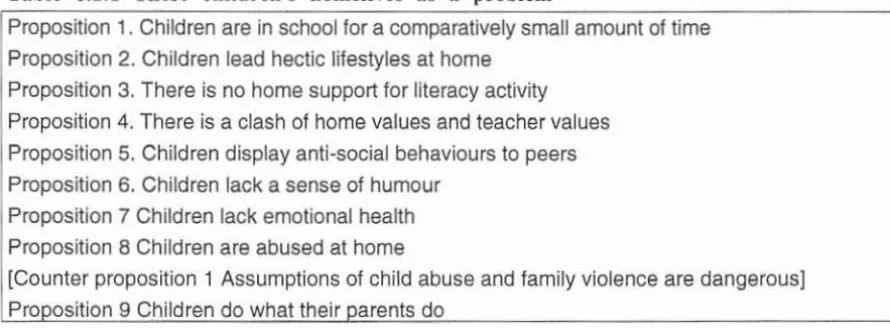
(9) Chapter 6 The Re-Construction Of The Disadvantaged Child. Next she moves to her observations of the ways that the students treat each other: cursing each other, setting each other up and manipulating each other. Here the students are not only seen in opposition to her values but in conflict with each other. Peer relationships become the site of the teacher's gaze. From these observations the teacher concludes that the students lack a sense of humour, that thei r behaviours indicate they laugh at, not with. The teacher interprets this perceived lack of a sense of humour and related behaviour as the sign of a problem, as she puts it 'a sign of someone who's really healthy and the mickey can be taken out of them and really good emotional health'. The implication is that these children do not tolerate having the mickey taken out of them. Her next move is to hypothesise from the collected signs and interpretations that the children in her class, or at least a percentage of them are suffering some form of abuse or violence in the home. In these statements the teacher lays out how her thinking has proceeded. I repeat this sequentially to spell out the propositional links being made and the interplay of discourses in producing pedagogical solutions. T a ble 6.2. 1 T h ese children 's homeli ves as a pro blem Proposition 1. Children are in school for a comparatively small amount of time Proposition 2. Children lead hectic lifestyles at home Proposition 3. T here is no home support for literacy activity Proposition 4. There is a clash of home values and teacher values Proposition 5. Children display anti -social behaviours to peers Proposition 6. Children lack a sense of humour Proposition 7 Children lack emotional health Proposition 8 Children are abused at home [Counter proposition 1 Assumptions of child abuse and family violence are dangerous] Prooosltion 9 Children do what their parents do. In proposition one the teacher makes the seemingly self-evident observation that. compared to the 'rest of the time' (out of school time) children are in school for only 'a little time'. There is a bi nary division between school and home time, though home is implied not stated at this point. In proposition two the teacher comends that the children lead hectic life styles and she connects this to proposition three in which it is implied, but not staled, that no 'support structures are in place for homework and reading and taking pride in their handw riting'. In proposition fo ur she acknowledges a clash between her values and those of the home. In proposition five the teacher reports as though it is uncontestable that the children in her classroom curse each other, set each other up and manipulate each other. Tn proposition six she claims that students lack a sense of humour. Up to this point her interpretations and judgements are reported as thought they ,u-e the result of objective observations, as the facts. In proposition seven there is a shift in that. Page 189.
(10) Chapter 6 The Re-Construction Of The Disadvantaged Child. she reports her analysis and the resulting diagnosis of this series of problem. All of the previous data becomes evidence for proposition eight that children lack emotional health. Her next move, in proposition eight is to theorise that this is caused by abuse in the home, a theory which she reports she has taken to her principal and to which the principal has responded with a counter proposition and warning. Undeterred she maintains her position that the problems the children in her class exhibit at school can be traced to 'their lives', in other words to their parents. Across these interconnected propositions, the teacher's negative judgements of children's family lives, literacy practices, peer relations and emotional health are framed as though it is unquestionable professional knowledge. Drawing on educational, psychological and legal discourses from a middle-class position the teacher constitutes the child as deviant and parents as the objects of blame, 'These children are like that, they are only doing what they know and what they know so well in their lives'. Through this series of interrelated statements, innuendo and euphemisms the teacher constructs the students in her class as problematic. She moves from her judgement of lack of literacy related supports and attitudes on a roller coaster series of hypotheses which culminate in her conclusion that domestic violence is the cause of children's being 'like that'. Thus children who have different values than their teacher's are constructed as the victims of abuse. As the principal argues this is 'dangerous' thinking! Teachers' intellectual bricolage ensures that: [T]he explanatory categories to which they will appeal will be those provided by sensory perceptions, a ragbag of commonsense or taken-for-granted beliefs and folk. psychology ... For example some teachers are inclined to explain comparative lack of academic achievement in working-class schools in terms of extraordinarily unsophisticated deficit theories (Hatton 1988, p.341).. Faced with these children, teachers working in a complex and diverse community draw on commonsense knowledge of a social problem to explain what confronts them in the classroom. In making reference to child abuse the teacher reported above turns to social science explanations from the popular press to understand children's classroom actions. Committed as she is to working in a disadvantaged school, to making these children literate, she nevertheless has problems dealing with behaviour and values which conflict with her cultural and class position. Her response to perceived 'differences' in the classroom is recourse to adjacent professional discourses in order to help her solve the problem which her own practices constlUct. Hence children's social interactions and behaviours are diagnosed as evidence of a deeper problem, a lack of emotional health, which must have an underlying cause, child abuse. Here popular psychology and media rep0l1s of abuse and violence come together as the teacher reads the classroom scenarios which face her.. Page 190.
(11) Chapter 6 The Re-CanstruCtion Of The Disadvantaged Child. It is not that this teacher is not well meaning or caring of these children. but that the discursive resources available to her construct the child, family and community as chaotic, violent and threatening. In her search for an explanation of her students' perceived differences, she slips easily from judgements about literacy in the horne to violence in the horne. Such a response is not unique to this teacher nor this school but part of a wider 'poverty discourse that conceals economic and educational inequalities,. state induced desti tution' (Polakow 1993, p.1 46). Polakow explains how it works in the American context: From maladjusted to culturally deprived; from the family as a tangle of pathology to broken, non-intact, and dysfunctional; from the pauper child as potential criminal to the atrisk student delinquent - this is a discourse embedded in time and in the American ethos. The 'poverty problem' is framed as individual and private, grounded in intrapsychic or intrafamily deficits but not in the politics of distribution, not in state-constructed poverty, nOI in a conception of positive state entitlements withheld from certain of its citizenry. (Polakow 1993, p.103).. The pervasiveness of deficit discourses have also been noted in other studies of literate practices in disadvantaged schools in Australia (Badger et al. 1993; Freebody et a1. 1995). Thus the problem does not reside in the individual teacher but is produced in wider societal discourses and practices. This kind of 'dangerous' thinking is difficult to work against. One of the aims of my own work in this thesis (and in other related projects) is to begin to understand the ways in which suc h deficit discourses are produced in local sites and how school commu nities might actively res ist and produce counter discourses. At Banfield, the beginnings of a potentiall y counter discourse could be seen in teacher's talk of 'difference'.. 6.2.2 'These kids' are different 'Cos I often say that it is different at Banfield, really different and then on the other hand it's nOI different you know. Like [the principal} and 1 have been discussing this one. She says to me, 'Thcy're not really that different are they? 'and you say, 'No'. But on the other hand how come we're always saying that?. In the tex t above a teacher reports her discussions with the pri ncipal about 'differe nce', making it clear that this is an area of uncertainty amongst the school community. Unlike talking 'deficit', talking 'difference' was a valid topic of conversation at Banfield and something the staff explored publ icly. Here a trace of such themes is evident as the teacher repol1s earlier conversations. A close look at the syntax of the passage suggests how difficult it is for the teacher to find the words to positively construc t 'difference'. In her initial statements the impersonal pronoun 'il' is not clearly related to any specified subject. For example, 'it is different at Banfield'. From the context of previous comments the implication is that she is refen'ing to teaching but this is not stated. The teacher reports. Page 191.
(12) Chapter 6 The Re-Construction Of The Disadvantaged Child. that she and the principal talk about this question, whether it's 'really different' teaching at Banfield or not. Because 'difference', as a concept, produces relativity it is difficu h knowing where to put the difference. That is, because difference is produced through comparison the subject of the comparison to which 'different' should be attac hed is not self-ev ident. The teacher recalls the principal's rhetorical question, 'They're not really that different, are they?' Here it is not the experience of teaching at Banfield to which 'different' is attached, but to the students. In addition the insertion of the word 'that' before differe nt suggest that there are degrees of difference. Students may be different but not 'that different'. Although she reports that she agreed with the principal, the teacher raises a key question. If the students are not 'that different' then 'how come we're always saying that?' In other words, why is it that the Banfield staff always talk about their students as 'different'. In interviews teachers frequently made the case that 'these kids are different'. However their discursive and analytical resources for nami ng and describi ng difference meant a slide from difference to defici t mid way through the explanation. In the passages below one teacher contrasts her Banfield students with others she has taught in previous years. Her difficulty with maintaining a positive construction of difference is evident across her cumulative attempts to explain to me how Banfield kids are different than other children she has taught elsewhere. They don't have the latest whiz bang you beaut toys so there's no competition for who's got the best - what are those sorts of things - transformers? And that kind of stuff. They are more interested in animals and real life things and gardens and lhings more accessible I suppose to them. Sport doesn't playa huge part in their life. From what I've noticed anyway. Their leisure time, they're not constantly doing something. Like they haven't got ballet one night and netball the next night. And with their families these kids don't do much with their family. Like they go on a bushwalk and that kind of stuff, picnics. They'll do that or go into the Festival Theatre when there's some free concerts or they'll do that kind of stuff. You know what I mean and they spend a lot of time just hanging around home, hanging around in the streelS.. The teacher begins by contrasting the attributes of the Banfield students with those of students from another school in which she has worked. At her previous school, the majority of children were from working and middle class families, rather than from families living in poverty. The Banfield students don't have the latest toys, so there is no competition for who has the best. These students, the teacher claims, are interested in other thi ngs - animals, real life things, gardens. She generalises that their interests are in 'things more accessible to them'. Then she moves to ot her things that they don't do such as sport and ballet, unlike other students she has taught who are 'constantly doing something'. Her tone here is positive. The competition for toys and children hurried from one after school activi ty to another are aspects of her experience in other school Page 192.
(13) Chapter 6 The Re-Construction Of The Disadvantaged Child. communities which she has not enjoyed. These things don't happen at Banfield . If anything she romanticises children's interest in 'things more accessible', rather than seeing them as aspects of lifestyle in a poor conunun ity. The absence of sport as an interest requi res fu rther comment. A number of material conditions made it very difficuh for students to pru1icipate in sports teams. The small school population meant that finding the students to fie ld teams was difficult. There were no sports fields at Banfield and li mited facilities in the local area. Similarly with ballet or other leisure pursuits, lack of community faci li ties and costs were prohibitive facto rs in students' non-partic ipation, Lack of interest is taken as a natural attri bute or as a cuhural pattern rather than a set of material conditions which preclude people from certai n interests and activities.. The teacher conti nues to explicate what she sees as differences in Banfield students, talking about the family context. Here her statements become contrad ictory, While she clai ms that 'these kids don't do much with their famil y' she then goes on to list a number of things these famil ies do - bushwalks, picnics, free concerts at the Festival Theatre. It's not clear what ki nds of acti vities count, if these don't. Perhaps it is the infrequency of these outings to which she alludes; it is not clear. Next she refers to how time is spent: 'They spend a lot of time just hanging around home, hanging around in the streets', At th is poi nt the posi ti ve tenor of her earlier desc ription is lost. 'l ust hanging around home' or 't he streets' perhaps equates with the 'don't do much wi th their fam ily' argumem made earl ier. The word 'just' signals that hanging arou nd whether at horne or on the streets is not considered of much value, In illustrating, she makes a cultural deprivation argument. But they' ll say, 'Oh being a viol inist that's for darks', or someth ing, 1 mean that's what most kids think but (hey haven't had the experience of seeing lots of different ki nds of people doing different kinds of things.. Here the teac her's concern is that Banfield children reject possible futures. While she acknowledges that most kids might reject such forms of high culture, Banfield children reject these without having seen 'lots of different ki nds of people doing different ki nds of thi ngs'. In the next passage from the same interview she deals with what she sees as the implications of growin g up in Banfield. They don't seem to me, and I don't mean this negatively, but. they don't seem to have a drive or a real fig ht to me. Or maybe that's more ambition. Whereas kids in other schools would be able to tell you what they wanted to do when they grew up and you know they almost mapped out what they were going to do and how they were goi ng to get there, these kids, one or two might, but most of them just, yeah they just feel it's just sort of there and they'll see what happens and if they get there they get lhere, Near enough is good enough sort of thing, I don'( know how to describe what it is. It's just accepting what posit ion they're in and how you can stay there.. Qualifyi ng her comments before she begi ns, 'and I don't mean this negatively' the teacher proposes that Banfield students lack ambition, Her evidence agai n is her Page 193.
(14) Chapter 6 The Re·Construction Of The Disadvantaged Child. contrastive experience of teaching elsewhere. Other kids could articulate ambitions for 'what they wanted to do when they grow up' and map out how they would get there. The unstated assumption here is that the plans for adulthood involve career aspirations. But apart from the exceptional one or two who 'might ', 'these kids' Just sort of fee l it's just sort of there and they' ll see what happens. In con trast ing the Banfield students with other students who are seen as the nann, the teacher proceeds with some diffi culty. Reluctant to be negative, she nevertheless presents an explanation, which identifies students in this disadvantaged primary school already as lacking what it takes 'to get there'. 'To get there', is one of nu mber of vague cliches and unfinished sentences, which begin and trail off: 'don't seem to have a dri ve'; 'what they wan ted to do when they grew up'; 'they'll see what happens'; 'and if they get there they get there'; 'near enough is good enough'. 'There' remains an unspecified point in the fu ture, which can nevertheless be talked about, decided upon and mapped out whilst in primary school. 'There' presumably is the taken-for-granted slale of employmen t and the lifestyles which go with it. While it is hard to describe, as she points out, the teacher develops a 'these kids syndrome' through a series of interlinking hunches and interpretations from which she concludes that these kids accept the position they're in. What had staIted out as appreciation of 'difference' in her earlier slatemen ts, concerning Banfield s tudents' lack of competitiveness and consumerism, becomes deficit when she imag ines children's futures. Students' life trajectories are, with one or two exceptions, likely to mean that they 'stay there'. Impl ied in the teachers' description is that individu al students make a choice. Choice is framed as 'getting there' or 'stayi ng there', where there is not specified. 'Staying there' is 'accepting' material disadvantage, 'Getting there' is having what it takes to get out of Banfield, through having ambition and mapping out one's future. The maintenance of the status quo, in this case relat ive poverty, is seen as the likely scenario for the majority of her students: 'It's just accepting what posi tion they're in and how you can stay there'. The problem of intergenerational poverty is framed as one of individual choice and ambit ion. Give her a lelly and a pizza and she']! be happy.. Settling for the immediately gratifying and easy options - television and fast food - is presented as the problematic choice unexceptional students might make. These kids' are represented as culturally deprived, as not knowing any better, as lacki ng ambition, as accepting their posi tion. Exceptional children at Banfield are those who have a vision of a different future and how they're going to get there, like normal ch ildren in other schools. These exceptional ch il dren show what the individual with the right attitudes, values and drive can do. Thus their less ambitious peers simply make the wrong choices.. Page 194.
(15) Chapter 6 The Re·Construction Of The Disadvantaged Child. Disadvantage is psychologised. Ultimately the responsibi lity rests with the indi vidual children and their families. Deficit discourses rest on the assumptions of voluntarism and bourgeois individualism. They locate the source of pathology in the alleged deficit group, family or individual and hence assume that individuals can be held responsible for the social relations in which they are enmeshed. (Carri ngton 1990, p.14). While this analysis was pervasive amongst several teachers, the principal actively worked against ideological positions and discursive formations which pathologised families disadvantaged by poverty. We need to see them in a very positive way, and I believe that we do that here .... we don' t see [hem as deficit ... they come with some very strong skills ... they may be differcnt than the skills that other children .....we need to build on those and that's the begi nning of a successful literacy program.. The principal's positi ve construction of djfference as a resource counted as official school policy. The teachers at Banfield knew what they were meant to say and how they were meant to feel about their students. Yet there is evidence here that everyday school discursIve practices became sites of contestation betweer. approved versions of 'difference' and the force of deficit.. 6.2.3 'These kids' and knowledge Knowledge was another grid of specification across which Banfield students were examined and repon ed in terms of teacher constructed norms. What Banfield students knew about and what they didn't were problematic for school curriculum. Those kids could tell you an awful lot about their local community. Things they have knowledge about amazed me when I first got therc. They could lell you about crystal healing; they could tell you about naturopaths, you know that kind of thing ... And they cou ld tcll you about different rel igions .. Whcreas the kids at...S t B could tell me a lot more about, TV shows were more important or the latest music or the lalest game or the latest whatever.. Here the teacher repons positively that students' knowledge amazed her when she first arrived. She lists the objects of that knowledge: their local conununi ty, crystal healing, naturopaths, different reli gions. She stops at thi s poi nt, commenting 'you know the kind of thing'. How these objects of knowledge might be grouped together as a 'kind of thjng' is not clear from this text. References in other interviews to 'al ternati ve life styles' may provide a clue here. These children know about things which are amazing to the teacher whose last class knew about TV shows, the latest mus ic or the latest game. Here the teacher begins to construct Banfield children's different knowledge as a positive, if so mewhat surprising, resource. She goes on to point out that these children knew more about politics, the welfare and legal systems than she herself had known at a similar age.. Page 195.
(16) Chapter 6 The Re-Construction Of The Disadvantaged Child They crack jokes about Bob Hawke and Paul Keating all the time which I was sort of amazed at, 'cos I can't imagine, I didn't even know who they were when I was in grade five, six and seven. And they do talk about money. Oh there's one thing they all know aboutchild endowment cheques. They can tell you everything there is to know about how you get them, when you get them, when you can't, you know, how you qualify for them . They know all about the money side of it.. The children's knowledge of political figures and practical knowledge of money including child endowment cheques is the subject of conunent. It is not what other children know about. While the teacher does not criticise these forms of knowledge she treats them as somewhat of a curiosity. By implication these children are strange once again, different from other children she has taught and diffe rent from herself at this age. Perhaps they are not proper children after all, having knowledge of topics often reserved fo r adults! The child endowment cheque is a cheque paid to care-givers which is means tested and depends on the number of dependant children in the family. Given the context, that many families in the school community live below or j ust above the poverty line, the monthly child endowment cheque is likely to be an imp0l1ant event. However the teacher makes no positive co mment about the children's knowledge of money. Neither does she make any negarive comments about these kinds of knowledge. It is stated and left. What is not said suggests that this knowledge is considered separate fro m school knowledge. However it is what the teacher goes on to explain next that provides a clearer account of the kinds of knowledge which teachers might expect children to bring to school. The teacher had decided to use a contract approach to the last few weeks of the term. She selected the Olympic Games as the topic for study. Teacher. Be Teacher. Well I gave them, what like a contract. We'll just do the Olympic contract for the next three weeks and I thought, oh it will be good. We'll discuss steroids; we'll talk about competition; we'll talk about world peace we'll talk about nature in the Olympics and we can really look at what an athlete does and put something fun in it about futuristic Olympics. Well I assumed of course that the kids would be interested in the Olympics. And they weren't? I couldn't, nup, no interest. They didn't really know what it was. J just assumed evelybody would know about it and be interested. It just wasn't part of what they valued; they didn't, you know. J wonder if it's where I come from and that? Athletics at school and you know things that I always loved. I was good at it, so I've always liked the Olympics.. As the teacher explains her rationale for choosing the topic she draws once again on her own childhood experiences. Her interest in the Olympic Games leads her to assume 'that. Page 196.
(17) Chapter 6 The Re-Construction Of The Disadvantaged Child. everybody would know abom it' and be interested. She conflates their lack of interest with their limited knowledge of the Olympics and goes on to explain in (elms of their diffe rent values, putting aside the fact that there are few sporting facilities at Banfield or in the sun'ounding area. In this instance it is possible to see the ways in which differences in know ledges and interests can become problematic sites for teacher decision maki ng about curriculum and assessment of students and their abilities. Students' lack of interest in teacher loved topics, texts or practices can lead to teacher misjudgements about why students might be uninterested and in how to fix what they see as the students' problem. I asked the teacher to explain what she did when faced with the students' unanticipated response to Olympics theme. Teacher. We got out the world map to look at where people corne from and where Barcelona is and that turned into a major, oh my god, I mean - the world - they haven't done much.. Be. So what did they say to you? You know, how did you know that this wasn't working?. Teacher. Oh 'cos their questions were overwhelming, from the amount of 'Where?' 'We can't fi nd information.' 'Where can we get infonnation from?' Like they didn't have the background knowledge to start looking for infonnation.. Teachers' curriculum choices often are selective tradit ions and constructions of their remembered childhood and adult interests. Common knowledge, that turns out not to be so common after all, is often taken for granted in school curriculum topics. In this case the teacher discovered that her assumptions had been incorrect and in the end this topic was all owed to fizzle out with many children not completing the contract. Instances such as this lead to these children being judged as lacking in common knowledge. This raises questions about what should be assumed to be common knowledge in school literacy lessons. These children had already surprised their teacher with their knowledge of politics, money, alternative healing and religion. Yet these or connected topics were not selected for contract work. The teacher chooses a topic she assumes will be fun and of interest and perhaps appropriate for children their age. When the children are not interested their difference becomes a pedagogical problem and they are judged as not having enough 'background knowledge to start looking for information'. Along the way the teacher decides that their general knowledge of the world is limited: 'They haven't done much'. The research contract is abandoned. The problem belongs to the children: their assumed lack of know ledge lack of information skills.. Page 197.
(18) Chapter 6 The Re-Construction Of The Disadvantaged Child. This scenario illustrates how different knowledge becomes problematic in school li teracy lessons, By implication 'normal children' would be interested in and know something about the Olympics; normal chi ldren would probably not know about money, politics, alternative healing and so on, When the children's knowledge base does not match the required starti ng po int the project is abandoned. This has a number of immediate effects on children's opportunities for learning and triggers a chain of responses and evaluations which might reduce futu re opportunities, In this case the opportunity to learn about the topic was withdrawn and along with it the opportu nity to use the contract approach was removed. Further, in regard to specific literacy practices, the opportuni ty to learn informalion skills was cut short. The children were assessed as not able to do this kind of study and the opportun ity to do similar projects in the fu ture was reduced, On this occasion the teacher's account of a project gone wrong demonstrares how classbased and cultural interests may be assumed to be common knowledge or universally val ued. Schools require certain kinds of chi ld appropriate knowledge and d iscount other knowledge, What counts as appropriate school knowledge is then employed in the format ion of school literacies. In this instance the resource-based-Ieam ing contract approach was allowed to fizzle out due to students' lack of immediate interest and background knowledge in the teacher's topic. Such incidents not only have effects on the students but cumulatively lead teachers to engage with certain pedagogies and ignore others so that over time certain kinds of practices may be excluded for 'these kids'. One Banfield teacher decided that because chi ldren's home experiences and knowledge base was restricted she would approach her literacy lessons with a published text as the beginn ing point. Starting with child knowledge and interest was seen as limiti ng. If the teacher were to maintain this belief, her pedagogy will ensure that chi ldren's own knowledge and experiences are absent from literacy lessons. Fortunately this teacher disproved her ow n hypothesis and went on to respect ch ildren's knowledge and include it in innovative ways in classroom publication. Yet the risk always exists that inaccurate assessments of children's knowledge and resources on the bas is of material disadvantage or cu ltural difference will result in a 'pedagogy of poverty' (Haberman 1991) or exclusion from new formations of literacy or access to new technologies, Assessments of chi ldren'S abilities, behaviours and knowledges are often couched in terms of 'appropriateness'. Appropriateness is a term which shields the vested interests in which judgements about language are made, It is taken for granted that the criteria for appropriateness are self-ev ident. Fairclough (l992a) argues that the concept of appropriateness is flawed in two main ways. First, it is based on the misleading assumption that speech communities behave in neat, well defined and prescribed ways. Page 198.
(19) Chapter 6 The Re-Construction Of The Disadvantaged Child. and that the relationships between contexts, purposes and use of language varieties are predictable and clear cu t. However as Fairclough indicates language use is a matter of struggle and indeterminacy. Contexts and purposes do not prescribe the way peop le use language in particular circumstances. Second, Fairclough argues that appropriateness is an 'ideological' category in that it is related to the control of language use by particular social groups. According to Fairclough , the mandatory teaching of Standard English has specific and non-neutral effects, in that 'it uses the educational system to transmit shared values (if not practices) based around the hegemony of a part.icular dialect.' (Fairclough 1992a, p.43). In this way, the use of other languages and dialects is automatically heard as 'inappropriate' and as in need of training and correction. It is to the question of 'appropriate' language and behaviour at Banfield to which I now turn .. 6.2.4 'These kids' and appropriateness Teachers freq uently talked about the ways in whic h Banfield children failed to behave 'appropriately' in different contexts. Staffroom conversation included brief allusions to problem childre n. At the end of the first day of school as teachers chatted informally in the staffroom a child was described as 'a bomb'. Another teacher, announced as she walked in, 'One day of J!' and then continued to her expectant colleagues, 'Wait till he calls you a fucking cunt.'. Several minutes later another child was described as 'a bit of comedy relief. Staffroom talk included many such one-liners. But more often positive stories of children featured in thi s context. Despite indications in the interviews that teachers had numerous concerns about students there were few opportunities for public complaint about students. Some teachers handled this requirement for self-control by using humour to deal with the traumas of the day. For example, when the principal asks one teacher how her day has been she refers to a student and says that the 'cat-o-nine-tails would be appropriate'. In this instance the teacher communicates that it's been a hard day , bu t she 'toughs it out ', suggesting through her joking that she has the situation under control. lnexplicit exaggeration and sarcasm provided a public outlet for dealing with student misbehaviour. Aware that the principal disapproved of negat ive accounts of children, teachers most often maintained their reserve about children's behaviour or reframed their accounts as humorous exaggeration. However in one-lo-one interviews teachers made numerous and extended statements about problems wit.h the student population as a whole and also about individuals. This included accounts of behaviour and ways of talking which they saw as inappropriate. One teacher elaborated on what bothered her about the ways Banfield ch ildren spoke to adults.. Page 199.
(20) Chapter 6 The Re-Construction Of The Disadvantaged Child. Like you go out somewhere and a visitor comes and you have to adjust to that context. they have one way of relating to people and that's it"as if they don't have that adult authority respect for , r have to say 'Yes please', 'Thankyou no' and 'Mr' and 'Mrs', you know all that kind of stuff you did as kids, They don't do that. The way they speak to adults shocks me, horrifies me, I don't like it and I don't think it's right. I see them speak to other parents, they will argue with other parents. You know I remember myself at school and kids in other schools. Parents spoke to them you know it was: 'Yes' , No', No they would argue they're right until they are blue in the face. And you know that kind of really rude. How they speak to [principal] sometimes shocks me too.. In this account the teacher begins to illustrate how students' ways of talking can be considered as appropriate or inappropri ate, . aonronnate ta Ik umre 624 .. A,,"oo roorlate a nd m Appropriate. Adjust to context (visitors, going out) Say 'Yes please', 'Thankyou no' Answer parents with yes or no Stuff you did as kids. Inappropriate. One way of relating to people No respect for adult authority Argue with other parents Really rude How they speak to the principal · shocking. What is at stake here are power relatio ns, The teacher requires students to use forms of politeness as evidence of their respect for authority, adults. other parents, teachers and the principal. Her complaint is that these forms of language use, which she sees as normal - 'all that kind of stuff you did as kids' - are not used by the Banfield students. She moves from the absence of markers of politeness, such as 'Yes please', to her claims that students argue that 'they're right until they are blue in the face'. The issue is not simply one of COITect grammar, but how children should talk with adults, She remembers her own childhood, controlling her speech, using the right forms and Limiting one's comments to adults to 'Yes' and 'No', In comparing how she was expected to talk with adu lts when she was a child with how the Banfield students talk to adults she concludes that the Banfield students' ways of talking are 'that kind of really rude', Thus students' inappropriate language use becomes the subject of moral evaluation. The teacher goes on to give further examples of the ways in which she sees Banfield students' language as. inappropriate. It's not like you're an adult, yOu deserve respect because you're an adult. You'll get it if you earn it from these kids, with the way I sort of see it. I don'! know if that's how they think it. But also if there's visitors to the school they're not, they'll go up and talk to them, You know if the Pope were to come it wouldn't matter. The Pope's no different to the locals at the deli. Do you know what I mean? Beyond Banfield they almost can't see that another world exists.. Warming to her topic the teacher invents a hypothetical situation in order to emphasise her point about 'o ne way of rel ati ng to other people', She argues that the children treat visitors to the school no differently than anyone else, that is, if the Pope were to visit the. Page 200.
(21) Chapter 6 The Re-Construction Of The Disadvantaged Child. school he would be treated no differently than the locals at the delicatessen. Her argument then is that status and authority make no difference to the way Banfield children speak to other people. Being an aduil, a visitor, the Pope does not guarantee respect from these childre n. Il must be earned. She reinforces her point with an account of how the chi ldren might behave on an excursion to the Botanical Gardens, once again returning to more specific instances of language use. The absence of poli te forms is agai n the issue. If we went to the botanical gardens and they had to go up 10 the box office and ask for a ticket, it's not like, 'Excuse me, we are from such and such and we'd tike.' You knOw it's like, 'Hey you got.' It's straight into it.. The argument made by Lhe teacher is similar to that made in sociolinguistic research about language variation and class. However the teacher's claim is not clear-cut; she suggests that students either lack appropriate language resources or that they choose not use them. In either case inappropriate language use is constructed as a personal affront and as a. moral problem: '1 don't like it and I don't think it's right'. Other teachers discussed students' language use. ilS. part of a classroom management. problem of inappropriate behaviour. And so much lime is wasted, like silting wailing fo r children - appropriate behaviours. What's were the appropriate consequences of those actions? If you waste your time what really should I do about it? What should we decide at a class meeting about the consequences of these actions and overtalk, talking while someone else is talking, shouting, calling across the room. and if there is one rule for everybody and one rule for that person, but lots of people have that same notion. So I went to[principaJ] and I said, 'These are the sorts of thing I've discovered', and she said, 'Yes, they're absolutely oul of control'.. Here discourses of work (wast ing time) and behaviour management (appropriate behaviours, consequences of those actions, class meetings, rules) inform the teacher's assessment of appropriate language use in the classroom. The inappropriate forms of classroom talki ng mentioned are 'talking while someone else is talking', 'shouting', 'cal ling out ac ross the room', all behaviours commonly found in other institu tional locations including parliament, staff rooms, sporting events, playgrounds and families. These kinds of language use, however, make classroom management very difficult. Appropriate schoo l language use then, appears to be the kind of talk which makes it easiest for teachers to manage large groups of children in a confined space. Teachers' descriptions of students' language as inappropriate signalled that power relations were at stake, relationships between children and adults, children and parents. students and teachers, students and principal. At issue was not whether students'. Page 201.
(22) Chapter 6 The Re-Construction Of The Disadvantaged Child. grammar was correct but whether their ways of speaki ng demonstrated appropriate respect, docility, obedience, patience and so on in regard to adults. Appropriateness is situationally dependant; however,judgements about 'these kids and appropriate' behaviou r or language use were invariably related to the exercise of power. Accounts of inappropriate behaviour or language were stories about students not displaying enough deference to adults, The resultant teacher anger was often deployed in making professional judgements about students' language proficiency. In this way students' displays of what teachers heard as rudeness could be assessed as evidence of a lack of appropriate language repertoires. The application of 'appropriateness' as a descriptor for language use may be especially dangerous in schools serving diverse and disadvantaged communities as it is intricately connected with ensembles of 'ruling class' (Connell 1985) cultural practices whjch continue to be taken as the desired norm as though they were neutral, universal and non-problematic.. 6.2.5 'These kids' as unique individuals In interviews and general staffrool11 talk Banfield staff frequently spoke of valuing the ind ividual. Indeed th is theme was so prominent that a visiting contract teacher made extended comments about this emphasis on individuality in an interview and in an unsolicited story she wrote about Banfield and its teachers. This school attracts children who are unique, [Uniqueness] is not killed. It is suppressed now and again, but it's not killed, whereas 1 have seen it killed in other schools, but it's nO! here. It is suppressed at times, more for sanity and cooperation and That's not what is expected', and 'We don't do things this way', But it's not that. The child's not made to feel stupid or lesser because of thaI. They just say, 'That' s not appropriate', and, but you're not made to feel like you're the idiot because you do think differently or you do it differently, Vert subtle. The people who worked at the school believed in the individuality and importance of each person. They did their best to provide a caring environment where all were nunured and had room to grow into themselves .. .They first had a gentle cari ng teacher who encouraged a cooperative, quiet, aware classroom. She too fostered the individuality of each and practised acceptance of the uniqueness of each person ... As they worked and learned to cooperate they were always encouraged to make appropriate choices that fostered good relationships without giving up your individuality. (excerpts from an unsolic ited story from ESUSpecial education teacher). The contract teacher makes the argument that even though cooperation and appropriate choices are required Banfield teachers respond to children as unique individuals. The valuing of the individual draws on progressivist discourses which are foregrounded in recent Catholic education policy statements. Individualism becomes a way of teachers framing their responses to pedagogical problems as is evident in the following teacher's account of the first weeks of the school year.. Page 202.
(23) Chapter 6 The Re-Construction Of The Disadvantaged Child The fi rst week I absolutely wondered what I had struck. Why did I wonder that? Weill couldn't believe how as a group I needed to be talking about on task behaviour, what does it look like , what does it sound like and listening behaviour what docs it look like, what does it. cooperation, what's it like. And as the weeks unfolded I discovered many things, but significant things I discovered were, who the people were as people, and individually I felt that there were, there are some very wonderful people in my class, as individuals they are very special. I also discovered that I have very very fragile children in a much higher proponion than I had ever expected.. Staff at Banfie ld made many statements about the importance of knowing the individual. When the teacher above is confronted by a new class which does not matc h her expectations for behaviour as a group she turns to getti ng to know them as individuals, looking for the source of her difficulties and the solu tions in know ing the individual and valui ng them as people. Her problems with them as a student group are sidestepped when she explores them as individuals. She seeks to understand her pedagogical dilemmas through improv ing her knowledge of them as ind ividual people rather than as prob lem students. She finds out that many are fragile and whilst she doesn't explain this at this point it is implied that children's out of school Jives - the lives that make them people - are probiemalic in ways that make them 'fragile'. In. OthCi. statements abom violence and. abuse in children's home Jives 'fragile' is shown to be th is teac her's euphemism for 'abused children'. Children's behaviours at school are attributed to child abuse. Her theory is based on her reading of an article giving statistics about child abuse in Australia. She then accounts for children's aggression towards each other as evidence of their experiencing violence at home. Here getting to know individuals means being able to account for what this teacher ascribes as deviant behaviours at school in ways that locate the origin of the behaviour outside of the institution and oUlside of the chi ld's responsibility. Seeing children as individuals changes how the teacher can come to know her class. The behaviour problem class become individual people, where different know ledges can be applied to the problem in an indiv iduated way. Rather than a class of badly behaved students she now constitutes the students as 'people' and as 'individuals'. When 'discovered' wholistically as people this teacher is able to see them as 'wonderful' and as 'special'. However the focus on the individual also leads to the psychologising of certain ch ildren as 'fragile', chi ldre n who need to be rescued. Thus a discourse of individualism positions the teacher differently in regard to 'disadvantaged chi ldren'. Those children who ach ieve aga inst the odds are seen as exceptional; those who fail are constituted as symptoms of problematic home circumstances. Here the teacher relates to the child as psychologist, soc ial worker, case worker, as re ligious and moral adviser.. Page 203.
(24) Chapter 6 The Re-Construction Of The Disadvantaged Child. A danger with an individualist discourse is that educational and social justice goals are reduced to individual cases. If problems are diagnosed as the problems of individuals responses may be limited accordi ngly. When a discourse of individualism intersects with an epidemiology of the family or deficit explanations for disadvantage there is a risk that inequities in social suuctures which produce the problems are ignored and action and responses are limited to action upon individuals. A further risk is that teachers may become more concerned with their commonsense diagnosis of the source of a child's problem and direct their energies to what they see as the personal at the expense of the academic. And with her it's not so much the academic stuff I'm trying to get out of her, it's just to Start to feel good about your self and work on it. (ESLISpecial education teacher). Here is the danger with teachers psychologising students' perceived problems. When the problem is seen as internal to the individual or the individual's li feworld teachers may abd icate their professional knowledge in order to work on the hypothesised internal problem, In the example above the 'academic snI ff is put aside in order for the teacher to \Vork on self-esteem. It is not that feeling good about oneself is not important, the problem here is that it has been divided from the academic work of school. A child receiving one-on-one or small group help from an ESUSpecial Education teacher has access to academic and intellectual support that is rare in schools. If the teacher directs her attention to the personal, as separate from the child's need to improve English language and literacy, the opportunity for learning has been altered, perhaps squandered. The point here is that 'individuali sm' is particularly open to colonisation by psychological, moral and medical discourses by which the modem individual is known and described. Educational and social justice work can be deflected when the 'disadvantaged problem child' is subjected to common sense diagnosis and treated accordingly in the school. Ironically such a child may receive less access to the educational resources and literacies which the school is responsible for delivering. 6.2.6 Summary. Students fo rm the con text of teachers' work (Mc Laughlin & Talbert 1992)_ The same student is constructed in different ways by different teachers and the teacher's construction of the student impacts on the student's participation and success in that class (McLaughlin & Talbert 1992). If teachers see chi ldren as deviants in their family life they. may construct pedagogical strategies to normalise the student at school. Thus how teachers think about, talk about and understand their students is crucial to students' participation, the pedagogies teachers assemble and their assessments of students. Given. Page 204.
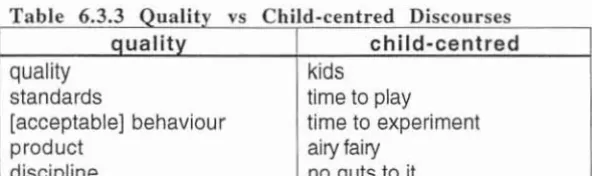
(25) Chapter 6 The Re-Construction Of Th e Disadvantaged Child. that teacher views of students are central, examining categories and language teachers use to describe students is of vital importance. The present study indicates that teachers draw on multiple and contradictory discourses in constructing the disadvantaged child. At Banfield, while teachers spoke about not wanting to be negative, their statements frequently constituted the student as deviant from the norm. These norms were based on chi ldren they had taught elsewhere and upon their own memories of being a chi ld. The Banfield child was then contrasted against the teacher produced nOnTI. The construct 'difference' was also employed in know ing 'these kids'. Accounts of children'S difference were given in relation to their family life, knowledge of the world, language use and behaviour. The disadvantaged child's difference is most often narrated as a problem, what they don't have, what they haven't seen, what they haven't experienced, what they don't know, what they don't say, what they don't do. Dt:spitc: the principal's explicit and continued efforts to work against deficit di scourses, for the most part the child is constructed as in need of repair, rescue, retraining. remodelling, re-consln.lciion. 1 had asked the teachers to tell me abOllt their work, their context, the school communi ty, their students and about what it was like to teach at Banfield. What is of interest here is the analysis the teachers made of what they saw and how they came to understand children's out-of-schoollives. Teachers talked about their students as though they were a homogeneous group, whilst simultaneously giving worst case scenarios to illustrate what these kids were like. It may be as I have suggested earlier that the context of the research interview selectively generated 'bad news stories'. However, what was missing from teachers' accounts of 'these kids' were statements about poverty. unemployment, and the diversity of the commun ity. These silences are significant. Absent from teachers' statements was an analysis of how the material cond itions of socio·economic disadvantage are produced. Without such an analys is teachers locate the blame for children's perceived problems in the dysfunctional family. Childhood experiences of disadvantage become the subject for teachers' moral judgement. Teachers do not live above thei r culture; they too are participants in the pervasive poverty discourse that conceals economic and educational inequalities, state- induced destitution. (Polakow 1993, p.146). Not talking about poverty and unemployment is not restricted to teachers, but is pall of a wider societal discourse which works to maintain the myth that people get what they deserve. At Banfield, schooling was seen as a way of taming the children's worlds.. Page 205.
(26) Chapter 6 The Re-Construction Of The Disadvantaged Child. Education was constructed as an opportunity for empowenne nt and literacy was seen as a centre piece of that transformation.. 6,3 'The literacy fix': Competing discourses in the construction of the literate student In this section I discuss the ways in which Banfield staff talked abollt literacy and the literate student. Literacy was seen as both a problem and a solution for Banfield's disadvantaged students. On the one hand, literacy was yoked with 'empowermenl'. On the other, it was placed within a discourse of 'quality'. I begin by explori ng how empowerment and literacy are configured at Banfield and then move to a detailed explication of what the staff described as issues in teaching literacy to Banfield students.. 6,3,1 Literacy and empowerment One commonly voiced goal professed by staff at Banfield was that of student empowerment. Talk of empowerment drew from educational and religious di scourses (Catholic liberationist philosophy). The pri ncipal's explanation is illustrative. In this school we're really committed to empowering our kids, to get them to act successfully in and on their society. So we would see literacy as part of the wider educational field as a liberating force for these kids to real ly become successfu l in acting on their society and to do that we need to understand our clientele. our children and our parents and where they're coming from.. Here the pri ncipal summarises her vision for the student population: 'learning to act in and on their society'. Literacy is seen as part of a liberating force, as a tool for societal action. Students are variously spoken about as 'our kids', 'them', 't hese kids', 'our clientele', 'our children', These different ways of speaking about the Banfield students signal the competing di scourses at work. 'Our kids' evokes the family or pastoral discourse which the Banfield community worked hard to make part of the school ethos. 'Our clientele' is part of the vocabulary of the markelisation of education, where the student is constitUled as 'customer' and the school as a service provider. 'These kids' implies a prior classification, which identifies them as members of a particular, but unspecified group. 'Them' separates the students from the teachers and places them in a posit ion of the 'other'. Although she resists ii, the principal is herself subject to 'poverty talk' which is 'always a discourse about them' (Polakow 1993, pA3), 'Our clientele' signals another dilemma; they are both ours and not ours. Ultimately they are ours as clients as educators move into the rnarketisation of schooli ng. The separation is rei nforced agai n when the principal defines empowerment as occurring when students 'ac t successfully in and on their society', not our society.. Page 206.
Figure
Related documents
● Arthur Currie: Upon being ordered by Haig to take Passchendaele responded with objection and an accurate estimate of almost 16,000 Canadian casualties for and objective of
The resulting problem is the vehicle routing problem with simultaneous delivery and pickup (VRPSDP), time windows, and three-dimensional loading constraints (3L-VRPSDPTW).. This
The aims of this survey were to: explore patients ’ experiences of living with IPF and how this impacted on their quality of life; determine the availability and impact of
Launched in 2002, Indian Railway Catering and Tourism Corporation had booked merely 27 tickets on the first day of its commencement of e- ticketing service in the country. Now
The paper presented an integrated AHP and WASPAS method for the ranking of speed breaker mechanisms in order to determine the optimum mechanism for effective power
These arguments were also used to prove the Morrey regularity and Hölder continuity for weak solutions to the obstacle problems associated with a single elliptic equation with
The multivariate methods which were applied for the regression of spectral data include: • SMLR: stepwise multiple linear regression til SPCR: stepwise principal component regression
