NATIONAL INSTITUTE OF SIDDHA
Tambaram Sanatorium, Chennai - 47(AFFILIATED TO THE TAMIL NADU DR. M.G.R. MEDICAL UNIVERSITY), CHENNAI - 600 032
NEER PEENISAM
(DISSERTATION SUBJECT)
For the partial fulfillment of the
requirements to the Degree of
DOCTOR OF MEDICINE (SIDDHA)
BRANCH I–MARUTHUVAM DEPARTMENT
ACKNOWLEDGEMENT
I salute with grate thanks to TheTamilnadu Dr. M.G.RMedical University
and Directorate of Indian Medicine andHomeopathy, Chennai, for granting
permission to take this study.
I am thankful to Prof. (Dr). S.Boopathiraj, MD(S), Director, National Institute of Siddha, Tambaram sanatorium, Chennai, for providing me this opportunity to carry out this dissertation work.
It is with great pleasure that I expressed my heartful gratitude to
Prof.Dr.K.Manickavasakam, MD(S), Dean and HOD, Department of Maruthuvam,
National Institute of Siddha, Tambaram sanatorium, Chennai, for his valuable guidance, constant advice and suggestion for carrying out this work in the best possible manner.
I am thankful to prof.Dr.M.Logamanian,MD(S), Superintendent, National Institute of Siddha, Tambaram sanatorium, Chennai, for his valuable advises and helps during this study.
I am deeply indebted to Dr.G.Ujjeevanam, MD(S), Former Lecturer, Department of Maruthuvam, National Institute of Siddha, Tambaram
sanatorium, Chennai, who have sent words of encouragement and suggestions for this study.
I am deeply indebted to Dr. R.Lakshmikantham. MD(S), and Dr.H.Vetha
Merlin kumari MD(S), Lecturers, Department of Maruthuvam, National Institute
of Siddha, Tambaram sanatorium, Chennai, who have sent words of encouragement and suggestions for this study.
I express my thanks to Dr. P.Selva Shanmugam M.D(s), Medical
I am deeply indebted to Mr.P.Jeyapal, M.sc, Asst.Professor (Bio statistics),&
M.Subramanian MSc., Senior Research Officer National Institute of Siddha,
Tambaram sanatorium, Chennai, for his valuable help throughout this study.
I acknowledge my thanks to Prof.Dr.C. Venkataraman, The director, C.L Baid Metha Pharmacy college, Thorappakkom Chennai- 96, For his support for Pharmacological and Phyto chemical study.
I express my sincere thanks to Mr. Thiunavakkarsu Research student, C.L Baid Metha Pharmacy college, Thorappakkom Chennai- 96, For his support for Pharmacological and Phyto chemical study.
INTRODUCTION
The science of medicine must have originated with primitive and fore most as it is of fundamental importance to his happiness, well being and survival and then, must have developed all long, even – since the drawn of civilisation.
Siddha is perhaps the earliest medical science that laid stress on positive health, a harmonious blending of physical, mental, social, moral and spiritual welfare of an individual.
Siddhars have mentioned the functional constitution of the body in a beautiful way. All the things (including man) are made up of five basic elements of Pancha Bootha. (Earth, water, fire, air, and sky). Vatha, Pitha, Kaba constitutes three humours. Which is also formed by the combination of pancha boothas. The functions of vatha, pitha, kaba in the body are indicated to the physician as Naadi (pulse).
During the observation of Naadi, if the three humours are in a ratio of 1: ½:¼, respectively vatha, pitha, kaba, it implies that three is no disease. Imbalance of these ratio is indicates there is disease in the body. Several hundred years ago siddhars the great saints had established the cause of a disease. For example, diet and daily activities of an individual are the main causes of the disease. Food contains six tastes (Sweet, salt, sour, bitter, pungent and astringent). These taste also made up of pancha bootha combination. When we ingest food abnormally it will make imbalance of three humours. Abnormal physical activities also enhances the vatha,pitha, kaba level. They also causes the disease.
Himalayan task, it is clear that modern medicine alone cannot be in a position to help us. Natural compounds may have an advantage over these drugs, because being constituents of living systems. They may be less toxic and hence more acceptable for human applications.
The Indian system of medicine is the best accepted system of medicine and is deep rooted in villages and cities being harmless in nature. The advanced nations of the world are evincing greater interest in the efficacy of this herbal medicine. We all live in this scientific world where everything is approved by the people only when proved scientifically. So it is our prime duty and endeavour to make our siddha system popular all over the world by subjecting the system to proper research by approved scientific parameters.
Many multinational companies and foreign individuals, with on eye on the balance sheet,want not only to learn our medicine but also to patent the effective drugs from our system.
The system needs to be made universally acceptable. These drugs needs recognition and standardization including suitable dosage forms and studies and investigations should be done in pharmacology, Phytochemistry
Pharmaceutics to standardize siddha drugs.
There are four thousand four hundred and forty eight (4448) types of Diseases. Among them peenisam is one of the disease affecting the head. In this research the author has selected Neerpeenisam for doctoral studies. It is one of the types of peenisam. It is miner diseases but give more troublesome in 4th to 6th decades (40yrs – 60yrs) – Our siddha literature clearly states vital
causes for Neerpeenisam which includes changes in the environment, changes of food, habit and so on.
AIM AND OBJECT
1) The main aim of the present study of Neerpeenisam with clinical Study is to collect and review the views and ideas of the ancient siddhars about this disease and also to know efficiency of the trial drug on
Neerpeenisam.
2) Collection of various literatures dealing with definition, aetiology, Classification, sings and symptoms, prognosis, line of treatment, diet control and prevention of Neerpeenisam.
3) To expose the efficiency of siddhar’s diagnostic methods.
4) To have an idea of them incidence of this disease with reference to age,sex, socio economic status, family history and paruvakalam.
5) To study under the topics of mukkutram, poripulangal,udal
thathugal,Ennvagai thervugal, Naadi, Neerkuri and Neikkuri, the changes brought about by this disease in normal conditions.
6) To know the extent to which the correlation (with allopathy system) of Aetiology, classification, sings and symptoms, investigation diagnostic methods and line of treatment.
7) To use modern parameters in the investigation of the disease that enhances to observe the progress of the patient.
REVIEW OF LITERATURE
SIDDHA ASPECTS
The siddha system of medicine deals each and every corner of science. It not only shows the art of healing but also gives the art of living. It throws light on ultimate of goal as attaining the eternal soul.
t˛–D zÁ≈l–D ºÂVF ÿƒF•D ±ºÈVÏ kπx>ÈVF ®ıËB J[Æ ì
-]Ú¬z≈^
In siddha medicine, the human system is mediated by three humoursVatham, pitham and kabam. The three humours are in a ratio of 1:½:¼ respectively. If any one of these three is on the decline, disease results. Ancient siddha literatures classified the diseases under 4448 types. The classification of these disease based on the threedoshic theory. In such a way 1008 diseases are classified in the head and neck. Among them the diseases of nasal origin are 86. The “Neer Peenisam” is one of them.
Before reviewing the specific signs and symptoms of the dissertation topic “Neer Peenisam”, other information regarding definition, aetiology, general signs and symptoms, pathology and nadi nadai of peenisam have been dealt with, since they are common for all types of peenisam.
SYNONYMS
Neerkovai, mookkadaippu,mookkuneer paaichal.
DEFINITION
Peenisam is a disease characterized by redness of the nasal mucous membrane, sneezing, mild conjunctivitis with lacrimation, watery nasal discharge, head ache, frequent discharge of mucous, pus and blood.
[Ref: siddha maruthuvam, Noi nadal Noimuthalnadal,part – ll]
∂§Õm ÿÔV^kVF º>Ô›][ ƒÀsºÈ–D g¬ÁÔl[ º>VÈΩlÚ¬zD ƒÀsºÈ–D √´Õm ¿Ï ÷´›> ¿Ï ºƒÏk>VºÈ
√ˆkm ¿Ï¬ºÔVÁk ÿB[Æ º√´VF› m´Õmº\ ÿkπBVÔ› º>Vu≈VÈVºÈ ÿ>V_KÈ˛_ ∂ºÂÔs>© º√Ú\Vflºƒ gflƒ©√V E´E_ >V[ ¿º´ Ôı¶V_ ∂©√º™ ∂>uz ƒÈ\¸>Ô ÿ\[√VÏ º√flƒ©√V \VÏ∏_ ¿º´u≈∫ Ôı¶V_ AÔwV™ cº´VƒÈ º´VÔÿ\[√VÏ''î
[Ref: Agasthiyar Gunavagadam]
Here Neerkovai is generally defined as the fluid or blood collection in the membranes of the body or under the skin. It is further named according to the localization. Fluid collection in the head is known as salamasthagam.
E´E_ Ô™ÿÈøÕm ÛÁÈBV_ º´VÔD ∂]Ôˆ›m Êμº√VKD E´VF º√VKD ÔV©√|D ŒÚ s> J¬z sBV]î
[Ref: Athma ratchamirtham, T.V.Sambasivam pillai maruthuva agarathi] Heat is increased and affects the head, results in pain which aggrevates the disease and causes purulent discharge with solid substance.
"sk<OkbqVlz<!Kl<lz<uVl<!\zlib<&g<gqz<!fQIhiBl<!
! Lk<Okhqmiq!LcbqSh<H!oliVg<gz{<c!hqv{<cVg<Gl<! ! lx<xuqbikqg<!gqmr<ogiMg<Gl<!ligqz<Ogijp!liqk<KuqPl<! ! fqk<kl<!Ofib<gt<!fqjxf<kqVg<Gl<!fQIh<hQfqsL!oleziOl#!
[Ref: Yugi Vaithiya Kaviyam Page: 222]
AETIOLOGY
I: [SIDDHA MARUTHUVAM, ARUVAI MARUTHUVAM AND NOI NADAL NOI
MUTHALNADAL PART – II]
1. Drinking of very cold water.
2. Exposure to cold air and atmosphere
5. When the body is heat taking bath in cold water, which increases kaba.
6. Eating cold foods.
7. Drinking contaminated water.
8. Suppression of vomiting and shedding tears. 9. Excessive talk and speaking loudly.
10. Excessive sleep or sleeplessness. 11. In association with venereal disease.
12. In yoga, body heat transmitted from moolatharam to head will cause Peenisam.
II. JEEVA RATCHAMIRTHAM (NASIGA ROGA PETHAM)
1. Including in cold air. 2. Nasal blockage by dust. 3. Loud speech.
4. Excessive sleep or sleeplessness 5. Taking bath in cold water daily. 6. Suppressing tears.
7. Lying in uneven bed.
8. Excessive sexual indulgence 9. Suppressing vomiting.
All these activities vitiate vatha, pitha and kaba which accumulate in the nose and cause peenisam.
III. T.V.SAMBASIVAM PILLAI MARUTHUVA AGARATHI
Mucous running off through the nostrils due to an inflammation in the head or cold affection of the nose.
1. Excessive indulgence in sexual intercourse. 2. Body heat is transmitted to head.
3. Entrance of minute particles of dust or smoke into the nostrils. 4. Excessive application of heat or cold.
IV.PATHINEN SIDDHAR NADI SASTHIRAM, GURU NADI (27)
""¨MƒÕ>V[ k´ÈVÆ ÿƒV_Ȭ ºÔt[ º√>x¶[ Ô™ÿÈøD∏ kV•°fi ºƒÏÕm ª–Ú˛ \ıÁ¶lºÈ ÿ>Vz¬Ô©√‚| cÆ]•¶[ kV•k∫ºÔ • Æ›m©∏[–D ~™x¶ º™V|D ¿Ï Ê a´›>D
∏Ω›m kÚ∫ÔVm J¬˛º™V|
º>™Ús kÕ>m º√V_ ÿƒ∫Ô_ EÚ•fi ºƒÏÕm søD ¨M ƒ›][ ÿƒFÁÔBVº\""
The heat and vayu combine together, reach and affect the head, Thereby causing peenisam.
V.SIDDHA MARUTHUVANGA CHURUKKAM
salM_ ¿´¶¬˛_ s>\V™ lÚ›m º´VÔD kaB| ¨Mƒ∫Ô^ kÕ]|D ºÂ›´ º´VÔD ∂ø˛|D E´E_ º´VÔDî
Suppression of tears will cause peenisam
VI. AGASTHIYAR KANMA KANDAM 300
√Ô´§B ¨Mƒ∫ ƒπ´™›º>V|
WÔˆ_ÈV ÿkVÚ>ÁȺÂVF \ıÁ¶z›mD Wƒ\VÔ kÕ> Ô[\D Wƒ\VF¬ ºÔ”
]Ô´ºk ÔVBΩ›> lÁÈ √§›>_
>πÏ ÿÔVøÕm >Áw x§›>_ √‚Á¶ ÿk‚¶_ WÔˆ_ÈV Ø©√§›>_ ºkÏ ÿÔVΩÔ^ ÿk‚¶_ WÁ™° ÿÔ‚| ÊkÿƒÕm >Á™BΩ›>ÈVºÈî
Peenisam is considered as a kanma disease.Pluking leaves, fruits, young shoots, flowers.Cutting barks, roots, twigs.Hurting the animals.All these activities will cause peenisam.
VII. THERAIYAR SEKARAPPA
®ıΩ™ xu≈ s´ı| >´Õ>V[ √ı|· >Vz\u √∫˛™›>V™Õ ]ıΩ≈ ºÈÔV| ÿƒF]≈Èu≈V[ \ıÁ¶ k≈ı| \oÕ]| ºÂVºB ºÂVFÔÿ·ÈVtm ºÂVÿB™ kV|D º√ÿB™ kVΩB ¨MƒºÂVFÔ^ ÊB≈_ ºƒVË>fi E‚ΩÁk ÂV[z º\VF>´ J¬ÁÔ ÿBV ƬztÁ>BV ì.
Lack of taking oil bath twice in eight days leads to dryness in the head causing purulent, watery or blood discharge and nasal lock.
ÔVF>oÈV© >ÁÔ Ôı¶ƒk›Á> ºBV>oÈV]Á¶ •ı¶ƒÈ›>V_ ºk>oÈV©∏Ë ºk>Á™BV¬˛ º√>È>V˛B ¨Mƒ\Vº\ ì
Drinking unboiled water and contaminated water will cause peenisam.
PRODOROMAL SYMPTOMS
1. Itching and irritation in the nose, result in rubbing the tip of the nose, become markedly red, tense and tender.
2. Redness and lacrimation of the eyes.
3. Nasal obstruction may often affect the sonoring of the voice 4. Itching and blockage of ears
5. Difficulty in breathing
6. Profuse watery discharge from the nose
(Noi Nadal Noi muthal Nadal part – II)
CLINICAL FEATURES
I. NAGAMUNIVAR THALAI NOI MARUTHUVAM AND SIDDHAR ARUVAI
MARUTHUVAM
>ÁÈ•∫Ô™›m koÿÔVı| ƒπº√V™V ƒVu§´ı| søD ∂ÁÈ•ÿ\VÚ©º√VºÈV| ÔVK \Æ]©√¶ºk\V≈Vm
WÁÈ•∫ÿÔ¶Vm √ˆÔV´ WB]©√¶ºk ÿƒFmkˆ_
ÿ>VÁÈ•fi ÿƒV[º™VD ¨Mƒxfi ÿƒV_K∫ Ô√VÈ k´‚E•º\î
1. Severe head ache
2. Mucosal nasal discharge 3. Sneezing
4. Dryness of the nostrils 5. Bad odour of the mouth 6. Nasal blockage
7. Heaviness of the head
II.AGASTHIYAR-2000
Ôı¶ xÔ∫ÔV m∫Ô´Ô´› #Ïkm º√VÈ›
mı¶xÕ ]™°D √›] mDtºB >ıßÏ TμÕm \ıÁ¶•∫ Ô™›m ÿÂVÕm kV>xD √ÁÔ¬z\V˛_ xı¶Ô\]¬z \Vº>! J¬z ¿Ï √VFflƒ_ º√VDî
1. Irritation of the throat, face and ears
2. Recurrent sneezing with waterey nasal discharge 3. Heaviness of the head
4. Head ache
III.JEEVA RATCHAMIRTHAM (NASIGAROGA PETHAM)
1. Difficulty in breathing 2. Recurrent sneezing 3. Nasal voice
4. Bad odour in the nose 5. Head ache
IV.ATHMA RATCHAMIRTHAM
3. Heaviness of head and head ache 4. Fever
5. Tastelessness 6. Anosmia
V.GUNAVAKADAM
>ÁÈ•D ko›m ªÆD ÂVEƒπ•D søÕm{|√‚| \ÁÈ•™V>·fl ÿƒ[≈V_ k≈ıº¶l Ƭ˛›]´ı| søD cÁÈ• tÔ°D ÂVu≈x\VD Jº¶ >ıßÏ søÕ]Ú¬zD √Èxfi ÿƒ[Æ J¬ÔÁ¶¬˛_ ¨Mƒÿ\[√VÏ ÿ√ˆºBVº´
1. Head ache
2. Nasal itching and mucosal discharge
3. After few days purulent nasal discharge with bad odour 4. General weakness
5. Nasal obstruction
Ôı¶º\_ xwÕ>V_ ÔVm Ô´Ô´›#Ïkº>º√V_ mı¶º\ mD\Kı¶VF ÿƒVˆÕm>V[ ƒÈxD TμÕm \ıÁ¶•∫ Ô™›m ÿÂVÕm ko•º\V tÔ°\V˛_ √ı|ºƒÏ J¬z ¿ˆ[ √VFflƒÈV ÿ\[™ÈVº\
1. Pain above the neck region and ears 2. Sneezing
3. Profuse watery discharge 4. Heaviness of the head 5. Head ache
CLASSIFICATION OF PEENISAM
I.ACCORDING TO SIDDHA MARUTHUVAM AND NOINADAL NOIMUTHAL
NADAL
Peenisam is classified into nine types. The classifications are, 1. Vali Peenisam
4. Neer Peenisam
5. Kuruthi Peenisam 6. Seezh Peenisam 7. Siraai Peenisam 8. Mulai Peenisam 9. Kazhuthu Peenisam
II.ACCORDING TO ATHMARATCHAMIRTHA SARA SANGIRAGAM
Peenisam has been classified into nine types, 1. Vatha Peenisam
2. Pitha Peenisam 3. Silethuma Peenisam
4. Neer Peenisam
5. Seezh Peenisam 6. Uthira Peenisam 7. Siraai Peenisam 8. Moola Peenisam 9. Kanda Peenisam
III.ACCORDING TO JEEVA RATCHAMIRTHAM
Peenisam has been classified into 18 types. The classifications are 1. Vatha Peenisa Rogham
2. Pitha Peenisa Rogham 3. Silethuma Peenisa Rogham 4. Threedosha Peenisa Rogham 5. Ratha Peenisa Rogham
6. Thusta Peenisa Rogham 7. Athithummal Peenisa Rogham 8. Nasika Shosa Rogham
12. Apeenisa Rogham
13. Nasika theebigai Rogham 14. Boodhi Nasika Rogham 15. Bhuya sira Nasika Rogham 16. Nasika pudaga Rogham 17. Nasa Rasa Rogham 18. Nasi Karputha Rogham
IV.ACCORDING TO T.V.SAMBASIVAM PILLAI MARUTHUVA AGARATHI
Peenisam has been classified into seven types only. The
classifications are,
1. Vatha Peenisam 2. Pitha Peenisam 3. Silethuma Peenisam
4. Neer Peenism
5. Seezh Peenisam 6. Ratha Peenisam 7. Siraai Peenisam
V.ACCORDING TO THANVANTHIRI VAITHIYAM
Peenisam has been classified into ten types. The classifications are, 1. Vatha Peenisam
2. Pitha Peenisam 3. Kaba Peenisam
4. Vatha pitha Peenisam 5. Vatha kaba Peenisam 6. Pitha kaba Peenisam 7. Mukutra Peenisam 8. Sala Peenisam 9. Ratha Peenisam 10. Varatchi Peenisam
I. ACCORDING TO SIDDHAR ARUVAI MARUTHUVAM
Peenisam has been classified into four types only.
2. Kuruthi Peenisam 3. Seezh Peenisam
4. Siraai Peenisam
COLLECTIONS OF NEER PEENISAM
Since the author has selected Neer peenisam as her dissertation subject collection of the same has been complited here from various texts.
I.NOINDAL NOI MUDAL NADAL PART-II
Causes
1. Exposure to cold air 2. Cold waterbath
3. Intake of cold food and cold water
4. Inhalation of air polluted with smoke or dust.
Symptoms
1. Nasal obstruction
2. Watery discharge from the nose 3. Head ache
4. Sometimes associated fever 5. Malaise
6. Tiredness in arm and legs
II. ATHMA RATCHAMIRTHA SARA SANGIRAGAM 1. Watery Discharge from the nose
2. Itching in the occipital region and face due to exposure to cold air and atmosphere
3. Irritation of the nose 4. Frequent sneezing
5. Heaviness of the head and head ache.
III. THANVANTHIRI VAITHIYAM
1. Fever and cough 2. Sneezing
3. Profuse watery discharge from the nose
IV. T.V. SAMBASIVAM PILLAI MARUTHUVA AGARATHI
1. watery discharge from the nose 2. Sneezing in the rainy season 3. Pain in the cervical region.
4. Itching in the occipital region and face
V. IN JEEVA RATCHAMIRTHAM
Peenisam has been classified into 18 types, “Adhi thummal Peenisa Rogham” is one of the type, which can be correlated with the
Symptoms of Neer Peenisam. 1.Recurrent Sneezing
2.Nasal obstruction
MUKKUTRA VERUPADUKAL
When the body heat raises due to the food, habits etc., pitham is vitiated and the level of kabam is increased by the activites and both the pitham and kabam interact and then produce Peenisam. According to some siddha Texts during the process of yoga, the vitiated body heat along with udhana vayu
Reaches the head where it combines with kaba and then forms Peenisam.
NAADI NADAI
1. √ı√V™ ∏›>›]_ ºƒ›m\ ÂVΩ©
√ˆE›>VÈ›] ∑´tÁ·©A ~Á· ÔıÔVm ÂB™ \ÈD ¿Ú\fiƒ^
ÔkBÆ ÿ√VÚ\_ \fiƒ^ ºÂVF ÔıºV° cıº√Vm \Æ›>_ ´›> s©AÚ]>V–D
cÁ· \VÕÁ> ¨MƒxD ´›> T¬ÔD Âı√™V ÔV\VÁÈ ºƒVÁÔ ÿk©A
2. Ôı¶VºBV EºÈu√™›]_ kV> ÂVΩ ÔÈÕ]|˛_ kl Æÿ√VÚ\_ Ô™›> T¬ÔD
cıº¶VºÈV {∫ÔV´fiƒ›] s¬Ô_
cÆ]´‚Áƒ kVF° ko ƒ[M º>V¶D sı¶VºÈ ÷Á·©∏Ú\_ ºƒVÁÔ√Vı| s¶√VÔD s¶ ÛÁk √¬Ô kV>D
]ı|¶V ÂVEÔV ¨¶∫Ô¬Ô_
E´ ºÂVFÔ^ √È°D kÕm E¬zÕ>Vº™î -ƒ>Ô ÂVΩ
PINIYARI MURAIMAI (DIAGNOSIS)
Piniyari muraimai is the method of diagnosing the disease affecting the man. It is based upon three main principles. They are poriyalarithal, pulanal arithal and vinathal.Porigal are considered as the five senses of perception namely Nose, Tongue, Eye, Skin and Ear.
While pulangal are five object of senses. They are smell, taste,sight, sensation and sound. Physician’s pori and pulan are used as the tools for examing the pori and pulan of the patient, respectively.
Vinathal is obtaining the informations that regarding the history of the Disease, the clinical features etc., from the patient or his immediate relatives who are taking care of him, when the patient is not in a position to speak or if thePatient is a child.
The above principles correspond to the methodology of inspection, palpation and interrogation methods of modern medicine in
arriving at a clinical diagnosis of the disease.
Siddhars have developed a unique method of diagnosing the Disease by “En Vaigai thervugal”.
I. NAADI
The three Uyirthathukkal are formed by the combination of Edakalai + Abanam = Vatham
Pinkalai + piranan = Pitham Suzhumunai + Samanam = Kabam
1. Pitha kaba
2. Pitha vatham
3. Vatha kabam
II. SPARISAM
In the case of Neer Peenisam, swelling can be noticed at maxillary region. In few cases fever also occur.
III. NAA
In Neer Peenisam, no abnormality is seen in the tongue.
IV. NIRAM
In Neer Peenisam, mucos membrane of the nose appears, pale blue
violaceous in colour.
V.MOZHI
In the case of Neer Peenisam, decreased resonance due to nasal
congestion can be noticed.
VI. VIZHI
In Neer Peenisam, irritation, Lacrimation and blurring of vision
VII. MALAM
No abnormality is seen in stools.
VIII. MOOTHIRAM
• Neerkuri:
Urine of the Neer Peenisam Patients, straw colour in general and in some cases it may be yellow
• Neikuri:
Prior to the day of urine examination for neikuri the patient is advised to take a balanced diet and the quantity of food must be Propor his appetite. The patient should have a good sleep.
After waking up in the morning, urine is collected in a glass container and is subjected to analysis within disturbing the nature of the neikuri should be noticed in direct sunlight.
LINE OF TREATMENT
Treatment is not only for removal of disease, but for the prevention and improving the body condition also.
This is said as follows,
Kappu (prevention)
Neekkam (Treatment)
Niraippu (Restoration)
The three humours which are responsible for organization, regulation and integration of the bodily structures and their physiological functions are always kept in a stage of equilibrium by word, thought, deed, and food of the individual. The general aetiological factors for constitutional discomfort are said to be incompatible diet, mental, and physical activities.When treating for removal of the diseases, the following principles must be noted.
'"ºÂVF ÂVΩ ºÂVFx>_ ÂVΩBm >ˬzD kVFÂVΩ kVF©√fl ÿƒB_''î
''cu≈V™·°D ∏ËB·°∫ ÔVÈxD Ôu≈V[ ÔÚ]fl ÿƒB_''î- ]Ú¬z≈^
So it is essential to know the disease and the cause for the onset of disease, the nature of the patient, the severity of illiness, the seasons and time of the occurrence of the diseases must be observed.
The line of treatment consist of,
1. Regulation of affected kutram. 2. Drug for the disease
3. Diet and restrictions.
4. special medicine such as pranayama and yoga if necessary
In the case of Neer Peenisam the medicines should be given to normalize the vitiated kaba and pitham. The internal medicines which reduce the vitated kaba should be given. The medicated oil could be used for bathing purpose to reduse the increased heat.
DIET AND RESTRICTIONS
1. Advised not to be in the polluted places and cold environment.
3. Buttermilk, ice cream, lemon juice, chilled drinks should be avoided. 4. Vegetables like suraikkai, poosani, peerkku, pudal etc., that include
kaba should be added.
5. Pepper, karisalai, thoothuvalai, manathakkali, murungaikai, karunai, nellikai should be added.
6. Sleep during day time is avoided and after having oil bath in the morning also.
PRANAYAMA AND YOGA
To live harmoniously, the body and mind should be developed in a balanced way through pranayama and yoga. Regular practice of pranayama and asanas combined with control of the mind will combat negative elements such as ignorce, laziness, inertia and over excitement as well as increasing the will power. Pranayama:
Prana means - Vital force or breath or cosmic energy Ayama means - the control of the prana.
i.e., the control of the vital force by concentration and regulated breathing. The vital force manifests itself in the body as a respiratory function. It is the regulator and animator of the psyche. Pranayama provides a remedy for several of the physical and psychic disturbances of which modern man is the victim. The main object of pranayama is to acquir mastery of the vital force acting within the body.
Regarding Neer peenisam, the following methods of pranayama can be advised to the patients.
1. Rhythmic breathing:
During the first-inhalation takes exactly the same time as exhalation.
During the second -the two take the same amount of time, but there is a pause between inhalation ant exhalations equal to half of the time they each
take.
2.Alternate breathing:
(Nadi-sodhana)
3. Surya Bhedana:
Surya means - sun (Pingalai) Bhedana - to open
Inhale through the right the nostril (produces heat in the body and exhale by the left.
THERAPEUTIC ADVANTAGES
Rhythmic breathing brings health to body and mind. It allows more oxygen into the body and eliminates anxiety by acting on the sympathetic nerve and the thalamus.
Alternate breathing helps to stabilize the mind and increases the mental faculties. It calms and purifies the nerves and helps to cure certain types of head ache.
Surya Bhedana brings the body temperature into equilibrium and controls the function of the catabolism. The powers of digestion are increased and the nervous system is fortified. The sinuses are also cleared.
YOGA
Yoga is regarded a science as well as a method that allows man to live a harmonious life while favouring his spiritual progress through the control of mind and body.
The Asanas are useful not only to revive the body, strengthen the
Nervous system and regenerate the glands, but also to cure physical and mental illness. They bring the human body under complete control of the mind.
Regarding Neer Peenisam, the following asanas can be advised to the patients.
1. Sarvangasana
2. Viparithakarani
3. Yoga mudra
4. Halasana
5. Usartasana
6. Vajjurasana
MODERN ASPECT
PARA NASAL SINUSES
The para nasal sinuses are air containing bony spaces around the nasal cavity and lined by the mucous membrane of ciliated coloumnar epithelium. They develop as mucous diverticula of the nasal cavity and invade the neighbouring bones at the expense of the diploic tissue. The sinuses are arranged in pairs and are named as follows,
Frontal
Ethmoidal
Sphenoidal
Maxillary.They are divided into two groups. Anterior group comprises frontal air sinus, the maxillary air sinus and the anterior ethmoidal air cells.
The posterior group comprises the posterior ethmoidal air cells and the sphenoidal sinus.
The anterior group of sinuses drains into the middle meatus and the posterior group drains into the superior meatus and the spheno ethmoidal recess. The sinuses are present in rudimentary form at birth, except the frontal sinuses which start development two (or) three years after birth. They enlarge rapidly during the ages of 7-8 yrs. (time of eruption of permanent teeth) and then after puberty.
FRONTAL SINUSES
into the medial part of the root of the orbit. Each sinus is triangular in shape. Depth - 2.5cm, Height - 3cm, Breadth - 2.5cm. Absent at birth, fairly developed at 7th to 8th year reach full size only after puberty Capacity: Each sinus has a capacity of about 7cc.
COMMUNICATIONS
It opens into the middle meatus of Nose at the anterior end of the hiatus semilunari’s either through the infundibulum (or) through the fronto nasal duct. The right and left sinuses are usually unequal in size separated by a thin plate of bone. The sinuses are better developed in males than in females. The frontal sinus is lined with coloumnar epithelium.
MAXILLARY SINUSES
It lies in the body of maxilla and is the largest of all the para nasal sinuses. It is pyramidal in shape with its a base directed medially towards the lateral wall of the nose and the apex directed laterally in the Zygomatic process of maxilla. Average measurements of each sinus are as follows,Vertical (opposite 1st mode teeth) - 3.75cm, Transverse - 2.5cm, Antero – Posterior - 3.25cm, Capacity - About 9.5 to 20cc.
The fully developed maxillary air sinus should extend from the first premolar to the third moles teeth. The sinus reaches upto the floor of the orbit and thus occupies practically the whole body of the maxillary bone.
COMMUNICATIONS
ETHMOIDAL SINUSES
There are numerous small inter communicating spaces which lie within the labyrinth of the ethmoidal bone. They are completed by the frontal, Maxillary, lacrimal, Sphenoidal and palatine bones. They lie between the upper part of the nasal cavity and the orbits and are separated from the orbits by extremely their orbital plates of ethmoids. The sinuses are divided into anterior, middle and posterior groups.
SPHENOIDAL SINUSES
These paired sinuses are located within the body of sphenoid bone above and behind the nasal cavity. Each sinus is some what asymetrical and presents the following average measurements.Vertical-2.2cm,
2cm, Depth -2.2cm.
COMMUNICATIONS
Each sinus opens into the spheno ethmoidal recess and hence into the superior meatus of nose.
EXAMINATION OF THE PARANASAL SINUSES
1) Inspection
One should look for swelling and signs of inflammation over the sinuses caused by the infection, osteomyelitis and tumours. With Carcinoma of maxilla one may come across anaesthesia of infra-orbital nerve.
2) Palpation
The tenderness for the paransal sinuses is elicited at the most superficial portion of the sinuses.
Maxillary sinus
Frontal Sinuses
The tenderness is tested by pressing the floor of the frontal sinus in the medial portion, just above the inner canthus of the eye. One should not palpate the anterior wall of the sinus for tenderness as three are 2 layers of bones in the superciliary arch.
Anterior ethmoidal sinuses
The tenderness is tested on the sides of the nose, midway between the inner canthus of the eye and the nasion. Middle and posterior ethmoidal sinuses and the sphenoidal sinuses are deeplysituated and hence they cannot be palpated. It is advantageous to carryout the palpation of the sinuses on both sides simultaneously, as their tenderness can be compared.
Posture test
Difference between maxillary and frontal sinusitis. The patient is examined in the sitting position and the discharge in the nose is wiped out. If the discharge reappears in the middle meatus, it signified that the discharge is from the vertically draining frontal sinus. If discharge does not appear, the patient is made to lie down on his unaffected side with the affected side of the nose at a higher level. If the discharge re-appears, it is from the maxillary sinus
Trans illumination test
SINUSITIS
DEFINITION
Sinusitis is an inflammation of the mucosal lining of sinus cavity. Inflammation may be suppurative or non suppurative.
Age: It usually occurs after the age of 15 years, but it may affect even children aged 5 years.
Sex: It affects both sexes equally.
CLASSIFICATION
Sinusitis
Acute Sinusitis Chronic sinusitis
ACUTE SINSUSITIS
DEFINITION
It is an acute inflammation of the mucosa of paranasal sinuses. If inflammatory process occurs in more than one sinus, it is called multi sinusitis. If all para nasal sinuses are involved it is called Pan Sinusitis.
AETIOLOGY OF SINUSITIS
1. DENTAL SEPSIS
Eg. Periapical abscess, peridontal abscess etc. (or) dental extraction particularly in connection with maxillary sinus, where roots of teeth project into the sinus.
2. TRAUMATIC
3. SWIMMING AND DIVING
Direcdly spread through the ostium.
4.INFECTIONS
a. Bacterial infection
Streptococci Staphylococci Pneumococci
Hemophilus influenzae
Escheriehia coli
Micrococcus Catarrhalis.
Bacillus pteiffer and B.
b. Viral infection
Rhinovirus
Para influenza I and II
Echo 28
Coxsacki A 21
Respiratory Syncytial Virus.
c. Fungal infections
Para coccidiodomycosis
Mucormycosis Rhinosporidiosis Rhinophycomycosis Aspergillosis
Actinomycosis.
6. PREDISPOSING FACTORS
a. Local
Foreign body
Enlarged adenoids
Deviation of nasal septum etc.
b. General
Low general health Chilling
Environmental pollution
Prolonged Exposure to cold
Associated chest infection
PATHOLOGY OF SINUSITIS
The mucosa of sinus shows chronic inflammatory changes. The cilia get damaged by the infection with resultant inadequate drainage of the sinus cavity, particulary the maxillary sinus where the ostium is situated high up in the medial wall. The retained secretions thereby lead to reinfection. Periphlebitis and perilymphangitis may occur, leading to oedema and polyp formation, so called hypertrophic (or) Polypoidal sinusitis.
Sometimes there occurs metaplasia of the ciliated coloumnar epithelium to startified squamous type with interspread papillary hyperplastic epithelial and inflammatory cells producing a picture of papillary hypertropic sinusitis. Occasionally the chronic inflammatory process may induce atrophic changes in the sinus mucosa with increase in sub mucosal fibrous tissue. (Atropic Sinusitis).
CLINICAL FEATURES
1. Patient usually gives history of cold. After 3 to 4 days when symptoms should have diminished, there is exacerbation of symptoms.
3. Head ache and sense of heaviness present over the head.
4. Pain over infected sinus-stabbing (or) aching in character. This is made worse by bending (or) coughing.
5. Rise temperature, malaise and depression.
6. Unpleasant taste with post-nasal discharge is often present.
7. Tenderness over the frontal or the maxillary sinus and overlying soft tissue may be oedematous at times.
INFECTION OF INDIVIDUAL SINUSES
FRONTAL SINUSITIS
Inflammation of the mucous membrane of frontal sinus.
Etiological factors :
1) Allergens
2) Deviated nasal septum
3) Facial trauma
4) Nasal polyps
5) Extension of odontogenic infections
6) Rhino cerebral mucomycosis
7) Nosocomial sinusitis - prolonged nasotracheal or nasogastric intubation associated.
The most common organisms involved include.
1) Haemophilus influenzae
2) Streptococcus pneumonia
3) Streptococcus pyogens
CLINICAL FEATURES
1) Frontal Headache
The earliest sign of the frontal sinus inflammatory change is known as a vaccum frontal headache due to a blockage of the frontonasal duct and absorption of air. Frontal sinus headache is severe in the morning, when the discharge accumulates in the sinuses in the night due to the recumbent posture. As the patient remains upright during the day the head ache reduces.
2) Facial Pain:Typically, pain in the eye, over bride of the nose and frontal region..
3) Oedema : In some cases there may be oedema and puffiness of upper lid.
4) Nasal obstruction
It may be the result of underlying obstructive pathology of the nose like deviated septum, polyposis or hypertrophied turbinates or because of chronic turgescence of the nasal mucosa.
5) Sore throat
Inflammation of airways due to inflammatory mediators like breadykinin cause smooth muscle contraction, resulting in throat pain and hoarseness of voice.
ETHMOIDAL SINUSITIS
1. Head ache: It is usually located between and behind the eye regions (or) radiates to the temporal eye.
2. Nasal obstruction is frequent with loss of sense of smell.
3. There may be oedema over the nasal bones.
SPHENOIDAL SINUSITIS
1. Headach Usually located in the occipital area of the head. The pain may be referred from the occipital region of the mastoid area.
2. The purulent post nasal discharge is a prominent feature of acute sphenoiditis.Vertigo may be present.
MAXILLARY SINUSITIS
It is the commonest of all sinus infection. Infection is usually from the nose or dental sepsis of upper jaw. The roots of the molar teeth lie close to the floor of the maxillary antrum.
CLINICAL FEATURES
1) Pain and tenderness over the cheek area the pain may radiate to the upper teeth and temporal region.
2) Purulent nasal discharge and purulent post nasal drip.
3) Fever, oedematous and inflamed turbinate tissue
4) Headache is often severe.
INVESTIGATIONS FOR ACUTE SINUSITIS
1. Radiology of Para nasal Sinus
It is the most sensitive and specific test. Show haziness of the affected sinus or all sinus. In cases of empyema fluid can be seen in the maxillary sinus.
2. C.T.SCAN
3. Transillumination Test
It is helpful in maxillary and frontal sinusitis.
4. Anterior Rhinoscopy
The nasal mucosa is congested and there may be trickle of pus under the middle turbinate and in the post-nasal space.
5. Nasal swab culture.
6. Serum immunoglobins - IgG., IgA, IgM, Sub.classes.
7. Antibody titres
8. Delayed hypersensitivity tests.
9. Direct sinus aspiration is the only procedure that can provide accurate
information concerning aetiology.
COMPLICATIONS OF SINUSITIS
The para nasal sinuses are situated close to the eyes, brain and nose, and the infection can easily spread from sinuses to orbit and intra cranial cavity giving rise to serious complications.
Nasal complications
1. Chronic rhinitis
2. Secondary atrophic rhinitis 3. Chronic hypertropic rhinitis
4. Nasal polyposis.
Orbital complications:
1. Orbital cellulitis
2. Orbital abscess
3. Retrobulbar neuritis
4. Superior orbital fissure syndrome
Pharyngeal and Laryngeal complications:
1. Granular and Lateral wall pharyngitis 2 Pharyngo Laryngitis and tonsillitis. Ear Complications
1. Eustachian catarrh and Middle ear effussion
2. Chronic suppuractive otitis media.
Intra ear complications:
1. Meningitis
2. Encephalitis
3. Extra dural abscess
4. Sub.dural abscess.
5. Frontal abscess of brain
6. Cavernous sinus thrombosis.
Bony complications:
Osteomyelitis of facial bones.
Miscelleneous:
Mucoceles , Pyoceles, Oro antral fistule
CHRONIC SINUSITIS:
Definition
This is chronic inflammatory process affecting mucosa of various groups of para nasal sinuses. The recurrent attacks of acute sinusitis lead to chronic sinusitis.
Aetiology
1. Nasal obstruction leads to chronic sinus infection (eg),
b) Oedematous turbinates
c) Polyps
2. Recurrent attacks of acute sinusitis and upper and lower respiratory infection.
3. Chronic dental sepsis and associated with lower respiratory infection.
4. Atmospheric pollution
Damp environment and Poor nutrition also leads to chronic sinusitis
5. Inadequate aeration of the sinuses due to allergy and narrowing of the sinus ostium from infection.
CLINICAL FEATURES
1. Nasal obstruction due to oedema of the turbinates and thick mucous tenacious secretions.
2. Sinus infection may set up a chronic rhinitis with nasal obstruction resulting from hyper trophy of the nasal mucosa and turbinates
3. Pain is not a typical feature, but dullache may be present over the sinus concerned.
4. Head ache may be present certain periodicity increasing after rising in the morning, but gradually decreasing as the day goes on or vice verse.
5. Excess nasal discharge secretions usually frank Mucosa and pus are discharged.
6. Epistaxis results from the inflammatory vasodilation in the nose.
7. Disturbance of olfaction
be carcosmia (Unpleasant smell) (or) hyposmia and parosmia in patients with under lying allergic rhinitis.
8. General symptoms include low grade fever, lassitude, mental apathy
and depression may be present.
9. Inflammation and swelling of the Eustachian orifice. Occasionally this may turn into acute otitis media.
10. Pharyngitis may be main symptom and tonsils may become infected.
INFECTION OF INDIVIDUAL SINUSES IN CHRONIC CONDITION
Chronic frontal sinusitis
Chronic infection of the frontal sinus is similar to the acute infection, but the pain and tenderness are less severe.
In recurrent cases, treatment of the obstruction to the drainage of the sinuses by performing submucous resection of the nasal septum or polypectomy is helpful.
Chronic Ethmoidal and sphenoidal sinusitis
Ethmoidal and sphenoidal sinusitis is not common. Ethmoidal sinusitis may cause pain in the eyes or behind the eyes. Sphenoidal sinusitis may produce occipital or central headache. These may result in orbital and infracranial complications.
Chronic Maxillary sinusitis
Chronic infection of the maxillay sinus is similar to acute infection, but the pain and tenderness are mild or absent.
Hawking and dry cought may be present due to post nasal discharge.
INVESTIGATIONS FOR CHRONIC SINUSITIS:
1. RADIOLOGICAL EXAMINATION:
a. Mucosal thickening of the lining mucosa.
b. Opacity (or) Uniform haziness of the maxillary sinus.
c. Polypoid hypertrophy of lining mucosa
d. Osteitis (or) Osteosclerosis.
2. RHINOSCOPY
It will reveal dull colour of nasal mucosa. Trickle of pus is seen under the middle meatus, if the anterior group of sinuses is involved. The anterior end of the middle turbinate may be oedematous and turgescent. Will show pus in the middle meatus in maxillary sinusitis and in the spheno-ethmoidal recess in sphenoidal sinusitis.
3. TRANSILLUMINATION TEST: Is seldom practised now-a-days.
4. NASAL SWAB: Shows increased eosinophill count in allergy variety,
bacteriology shows Streptococcus commonly and also pneumococci.
5. SINOSCOPY
Fibre-optic sinoscope is introduced in maxillary cavity through antrostomy and detailed pathology seen.
6. CT-SCAN: COMPUTED TOMOGRAPY
Computed Tomography is much more sensitive than other routine radiography, particulary for ethmoid and sphenoid disease.
7. MRI: MAGNETIC RESONANCE IMAGE:
TREATMENT
ACUTE SINUSITIS:
The treatment can be discussed in three headings. They are Prophylatic treatment, Medical treatment and Surgical treatment.
A.PROPHYLACTIC TREATMENT
1. Prevention of colds by general treatment.
a. Good Ventilation.
b. Proper humidity.
c. Inherent resistance produced by a healthy life and good mixed diet with sufficient vitamins A, C and D.
d. Flying and swimming with a cold should be avoided.
2. Vaccines:
They are infected sub-cutaneously or intra dermally, taken orally or applied locally to the nasal mucous membrane. There has been decrease in interest over the last decade regarding the use of vaccines.
B. MEDICAL TREATMENT:
1. To control infection by anti biotics.
2. To encourage opening up of the sinus ostium. 3. Symptomatic relief and general treatment.
OPENING UP OF SINUS OSTIUM
a) Nasal congestion. Helps in drainage of sinuses. b) Steam inhalation.
SYMPTOMATIC RELIEF AND GENERAL TREATMENT:
a) Rest - in bed in a warm, well ventilated room.
b) Analgesics - helps to releive the pain.
c) Local heat - by radiant heat or hot water bottle used for 10 minutes
d) Diet - Plenty of fluid and nourishing diet. Vitamins are added. Tobacco and alcohol should be avoided as they congest the nasal mucosa.
e) Mouth care - Should be taken in case of dental sepsis.
C. SURGICAL TREATMENT
Surgical treatment is occasionally needed in acute sinusitis. The sinus is punctured under local anaesthesia and drained out.
TREATMENT OF CHRONIC SINUSITIS
A. Conservative Treatment.
B. Surgical Treatment.
A. CONSERVATIVE TREATMENT:
a. Aggravating factors:
Such as dust, alcohol and tobacco should be avoided. Dry climate holiday, if possible is helpful.
b. Nutrious diet and regular diet habits are helpful.
c. Dental treatment. If various tooth (or) other sepsis.
d. Nasal decongestants and anti histamines.
e. Irrigation of the nose: with normal saline often helps.
f. Displacement theory of proetz: with normal saline often helps.
g. Control of infection:
Antibiotics are usually ineffective, but a course of broad-spectrum antibiotic has to be given (according to sensitivity) in acute excerbations and
following sinus drainage.
h. Short wave diathermy. May give temporary relief but otherwise disappointing result.
B. SURGICAL TREATMENT:
1. Eradication of sinus pathology:
In cases where there is collection of pus in sinus cavity.
a) Sinus puncture and lavage:
helps in removal of pus from sinus cavity and the procedure has to be repeated.
b. Radical Surgery:
If above method fails, then sinus wall has to be opened up and thickened polypoidal lining mucosa has to be removed.
2. Removal of nasal obstruction:
a. Correction of septal deviation. b. Removal of nasal polyps.
MATERIALS AND METHODS
AIMS
a) Primary aim
To determine the therapeutic efficacy of the Siddha drugs Singathi
Chooranam with Chittarathai Kudineer and Dikkamalli thylam for the
treatment of Neer Peenism (Sinusitis)
b) Secondary Aim:
To find out the side effect of the trial drugs, if any
POPULATION AND SAMPLE
The population consists of Neer Peenism patients Cough, sneezing, rhinorrhoea, headache, tenderness in the maxillary and frontal region, and change in the sense of smell satisfying the inclusion and exclusion criteria mentioned below.The sample consists of all Neer Peensism patients attending the OPD of Ayothidoss Pandithar Hospital of NIS chennai-47.
SAMPLE SIZE: The trial size will be 50 patients.
INCLUSION CRITERIA
a. Age 20 to 50 Years.
b. Willing to produce the x-ray report before the start of the trial c. Willing to give blood specimen for investigation when required
d. Willing to be admitted in the hospital for 7 days or willing to attend the OPD once in 2 days for 7 days
EXCLUSION CRITERIA:
Nasal Polyps, tuberculosis with sinusitis, epistaxis, syphilis of nose, tumors of nose, bronchial asthma, fracture of nose.
WITHDRAWAL CRITERIA:
Increase in the severity of headache, insomnia, uncontrolled sneezing, development of severe adverse drug reaction
TRIAL DRUG AND DURATION:
Singathi chooranam 500 mg with 30 ml of chittarathi kudineer .t.d.s for
TESTS AND ASSESSMENTS
(A) CLINICAL ASSESSMENT
Cough, sneezing, rhinorrhoea, headache, tenderness in the maxillary and frontal region, sense of smell.
(B) INVESTICATIONS
1. Blood Test: TC, DC, ESR, Hb
2. X-ray: PNS
3. Urine analysis: Albumin, Sugar, Deposits.
(C) Assessment & Test in Siddha Aspect
Envagai thervugal
Naadi, Sparisam, Naa, Niram, Mozhi, Vizhi, Malam, Moothiram Neer Kuri (Niram,Edai.Manam`,Nurai,Enjal.)Nei Kurai
CONDUCT
Neer peenism patients satisfying the inclusion and exclusion criteria will
be admitted to the trial. Informed consent will be obtained from the patients. Lab investigations will be carried out before and at the end of the trial.
The trial drugs will be issued to the OPD patients for 2 days at a time and the patients will be asked to bring back the unconsumed drugs at each visit and return them. Patients are asked to come for clinical assessments once in 2 days or 7 days. At each visit, a new drug container will be issued to the patients.
FORMS
(A). FORM I
Selection Proforma – It is used before admission to the trial.
(B). FORM II
Assessment Proforma - It is used once in 2 days for 7 days.
ANALYSIS
Reduction in the proportion of patients with signs & symptoms will be tested using paired X2 – test.
OBSERVATIONS AND RESULTS
[image:43.612.88.537.158.711.2]Table 1
OBSERVATION IN 50 NEER PEENISAM PATIENTS,NIS, CHENNAI-47, 2008
S.NO Date O.P./I.P.No Name Age/sex family h/o
1 1/12/2007 AE5071 Saritha 22/F no
2 2/12/2007 AE5546 Reghunathan 21/M yes
3 2/12/2007 AE5506 Yamini 36/F no
4 4-12-2007 AE6170 Prem kumar 26/M no
5 3/12/2007 AE5821 Mathan kumar 25/M no
6 5/12/2007 AE6374 Sridhar 32/M no
7 5/12/2007 AE6399 Venkata giri 33/M yes
8 5/12/2007 AE6400 Thiru kumaran 24/M yes
9 5/12/2007 AE6460 Palani 26/M no
10 5/12/2007 AE6322 Susai mani 36/M no
11 9/12/2007 AE7395 Vimal 27/M no
12 10/12/2007 AE7536 Rajeshwaran 40/M yes
13 10/12/2007 AE7573 Ravi 42/M no
14 10/12/2007 AE7621 Malar vizhi 46/F yes
15 10/12/2007 AE7661 krishna moorthi 32/M no
16 10/12/2007 AE7668 Arivakkan 47/M no
17 19/12/2007 AE9984 Mari 23/M yes
18 19/12/2007 AF.044 Durai raj 26/M no
19 23/12/2007 AF 928 Selva kumar 26/M no
20 23/12/2007 AF.933 Chandra 44/M no
21 23/12/2007 AF.981 Gopinathan 27/M yes
22 29/12/2007 AF1869 Arumugam 29/M no
23 29/12/2007 AF.2275 Lakshmi 28/F no
24 31/12/2007 AG.2397 Neela 28/F yes
25 4/2/2008 AG.3982 Selva kumar 28/M no
26 6/2/2008 AG.4575 Suresh 40/M yes
27 6/2/2008 AG.4504 Ramu 36/M yes
28 10/2/2008 AG7128 Jamuna 40/F no
29 15/4/2008 AI 6952 Gandhi 50/F no
Date O.P/I.P.No Name Age/sex family h/o
31 7/3/2008 AH5013 Vijaya 32/F no
32 10/3/2008 AH5779 Shanthi 22/F no
33 10/3/2008 AH5755 Padmavathy 26/F yes
34 11/3/2008 AH6176 Kamaraj 33/M no
35 11/3/2008 AH6220 Karthirasan 48/M yes
36 12/3/2008 AH6460 Selvaraj 37/M yes
37 12/3/2008 AH6439 Jayanthi 42/F yes
38 12/3/2008 AH6500 Sugumari 40/M no
39 12/3/2008 AH6479 karthi keyan 26/M no
40 18/3/2008 AH8011 Moorthy 43/M no
41 11/10/2007 157 Banu 27/F yes
42 5/12/2007 549 mangaiyar karasi 42/f yes
43 4/2/2008 734 Kasthuri 35/F yes
44 7/2/2008 742 Kaveri 34/F yes
45 12/2/2008 747 Thangamani 30/F yes
46 21/03/2008 810 Asandhamani 30/F yes
47 23/03/2008 820 Gajitha 22/F yes
48 16/04/2008 847 Ghandi 50/F yes
49 19/03/2008 1193 Satish kumar 29/M yes
50 29/03/2008 1217 Murugesan 43/M yes
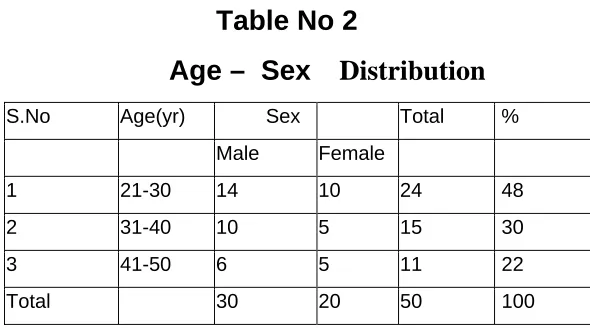
Table No 2
Age – Sex
Distribution
S.No Age(yr) Sex Total %
Male Female
1 21-30 14 10 24 48
2 31-40 10 5 15 30
3 41-50 6 5 11 22
Total 30 20 50 100
[image:44.612.133.428.484.648.2]OCCUPATIONAL REFERENCE
TABLE 3
Sl No Occupational reference Cases Cases
No %
1. House wife 17 34
2. Carpenter 2 4
3. Farmer 4 8
4. Painter 2 4
5. Miscellanneous 25 50
Total 50 100
PIE DIAGRAM 1
OCCUPATIONAL REFERENCE
Miscellanneous, 50%
Painter, 4% Farmer, 8%
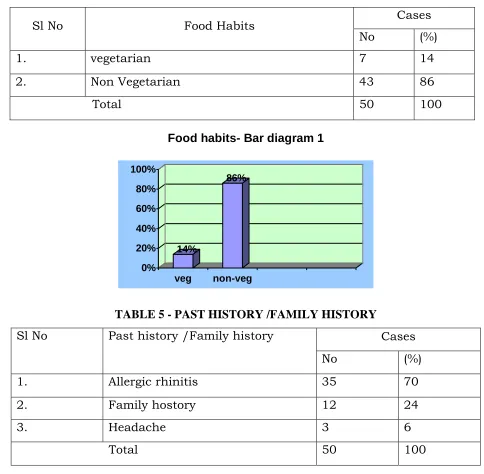
Table-4 DIET HABITS
Sl No Food Habits Cases
No (%)
1. vegetarian 7 14
2. Non Vegetarian 43 86
Total 50 100
14%
86%
0% 20% 40% 60% 80% 100%
veg non-veg
[image:46.612.77.548.88.198.2]Food habits- Bar diagram 1
TABLE 5 - PAST HISTORY /FAMILY HISTORY
Sl No Past history /Family history Cases
No (%)
1. Allergic rhinitis 35 70
2. Family hostory 12 24
3. Headache 3 6
Total 50 100
70%
24%
6% 0%
10% 20% 30% 40% 50% 60% 70%
Rhinitis Family history
Head ache
Table 6 - DISTRIBUTION OF THINAI
Sl No Thinai Cases
no %
1. Kurinchi 4 8
2. Mullai 0 0
3. Marutham 8 16
4. Neithal 38 76
5. Paalai 0 0
Total 50 100
Thinai - pie diagram 2
Kurinji, 16%
Neithal, 8%
Marutham, 76%
[image:47.612.177.457.485.684.2]Kurinji Neithal Marutham
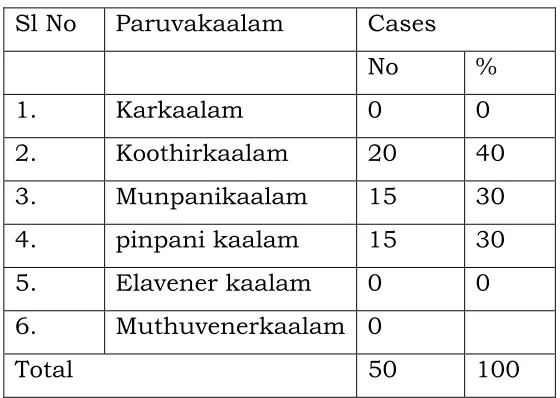
TABLE 7 – PARUVAKAALAM
Sl No Paruvakaalam Cases
No %
1. Karkaalam 0 0
2. Koothirkaalam 20 40
3. Munpanikaalam 15 30
4. pinpani kaalam 15 30
5. Elavener kaalam 0 0
6. Muthuvenerkaalam 0
40%
30% 30%
0% 10% 20% 30% 40%
[image:48.612.82.548.309.738.2]Paruvakaalam Bar diagram - 3
Table 8 – MUKUTRAM
Sl No Mukutram Cases
No %
1. Vatham 5 10
2. Pitham 1 2
3. Kabam 44 88
Total 50 100
0 10 20 30 40 50 60 70 80 90
Vatham Pitham Kabam
MUKUTRAM Bar diagram 4
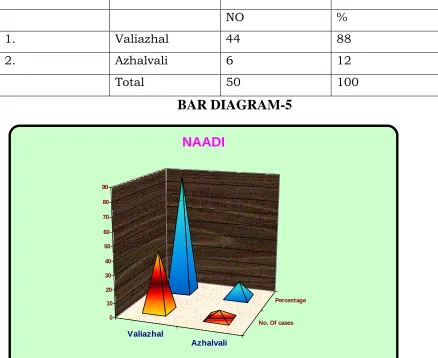
TABLE-9 NAADI
S.NO Naadi Cases
NO %
1. Valiazhal 44 88
2. Azhalvali 6 12
Total 50 100
BAR DIAGRAM-5
Valiazhal
Azhalvali
No. Of cases Percentage
0 10 20 30 40 50 60 70 80 90
Table-10
RESULTS OF SUBJECTIVE PARAMETERS BEFORE AND AFTER
TREATMENT OF 50 NEER PEENISAM PATIENTS, NIS, CHENNAI-47
S.No Sneezing Rhinitis Nasal congest ion Head ache ache Tenderness
present in paranasal sinuses
cough
B A B A B A B A B A B A
1 yes no no no yes no yes no yes no yes no
2 yes no yes no yes yes yes yes yes yes yes no
3 yes no yes no yes yes yes yes no no yes yes
4 yes no yes no yes no yes no yes no no no
5 yes yes yes yes yes yes no no yes no no no
6 yes yes yes no yes yes yes yes yes yes yes yes
7 yes no yes yes yes no yes no no no yes no
8 yes yes yes no yes no yes yes yes no no no
9 yes no no no yes yes yes yes yes no no no
10 yes no no no yes no yes yes yes yes yes no
11 yes no yes no yes no yes no yes no yes yes
12 yes yes no no yes yes yes yes no no yes no
13 yes no yes no yes yes yes yes yes yes yes no
14 yes no yes no yes yes yes no no no yes no
15 yes no yes yes yes yes yes no yes no no no
16 yes yes yes no yes yes yes yes yes no no no
17 yes yes no no yes yes yes yes yes no no no
18 yes no no no yes no yes yes yes no yes no
19 yes no yes yes yes yes yes no yes yes yes yes
20 yes no no no yes no yes no yes no no no
21 yes yes yes yes yes yes yes yes no no no no
22 yes no no no yes no yes no yes no yes no
23 yes no no no yes no yes no no no no no
24 yes no no no yes no yes no yes no yes no
S.NO
Sneezing
Rhinitis
Nasal congestion
Head ache
Tenderness present in para nasal sinuses
cough
26 yes yes no no yes yes yes yes yes no yes no
27 yes yes yes yes yes yes yes yes yes yes yes no
28 yes no no no yes yes yes no yes no yes no
29 yes no yes no yes yes yes no yes no yes no
30 yes no no no yes no yes yes yes no yes yes
31 yes no yes no yes yes yes yes no no no no
32 yes no no no yes no yes yes yes no no no
33 yes no yes no yes no yes yes yes no yes no
34 yes yes no no yes yes yes yes yes no yes no
35 yes no yes no yes no yes yes yes yes no no
36 yes no yes yes yes no yes no yes no yes yes
37 yes no yes no yes no yes no yes no yes yes
38 yes no yes yes yes yes yes yes yes no yes no
39 yes no no no yes no yes no no no no no
40 yes yes yes yes yes no yes no yes no yes no
41 yes no yes no yes no yes no no no yes no
42 yes yes yes no yes yes yes no yes no no no
43 yes no no no yes no yes no yes yes no no
44 yes yes yes yes yes yes yes yes yes no no no
45 yes no yes yes yes yes yes yes yes no yes no
46 yes no yes yes yes yes yes yes yes no yes no
47 yes no yes no yes yes yes yes no no yes no
48 yes yes yes yes yes yes yes yes yes no yes no
49 yes yes no no yes no yes no yes no yes no
50 yes yes yes no yes yes yes yes yes no no no
Note: B - Before treatment
IMPROVEMENT OF SIGNS AND SYMPTOMS
S.NO Parameter BT AT Improved
No %
1. Sneezing 50 16 34 68
2. Rhinorrhoea 31 13 18 58
3. Nasal congestion
50 27 23 46
4. Headache 49 28 21 42
5. Tenderness Present in
PNS
40 8 32 80
6. Cough 32 7 25 78
BAR DIAGRAM -6
0 5 10 15 2 0 2 5 3 0 3 5 4 0 4 5 5 0
R h i n o r r h o e a N a sa l C o n g e st i o n
H e a d a x h e T e n d e r n e ss P r e se n t i n
P N S
C o u g h PARAMETER
B e f o r e T r e a t m e n t A f t e r T r e a t m e n t I m p r o v e d # R EF !
Improvement of signs & symptoms:
1.Sneezing: Out of 50 cases clinical symptoms of sneezing before the treatment, 34(68%) patient relived from sneezing which is statistically significant.
3.Nasal congestion: Out of 50 cases with clinical symptoms of Nasal congestion before the treatment, 23(46%) patient relived from Nasal congestion which is statistically significant.
4.Headache: Out of 49 cases with clinical symptoms of headache before the treatment, 21(42%) patient relived from sneezing which is statistically significant.
5.Tenderness Present in PNS:
Out of 40 cases clinical symptoms of Tenderness Present in PNS before the treatment, 32(80%) patient relived from Tenderness Present in PNS which is statistically significant.
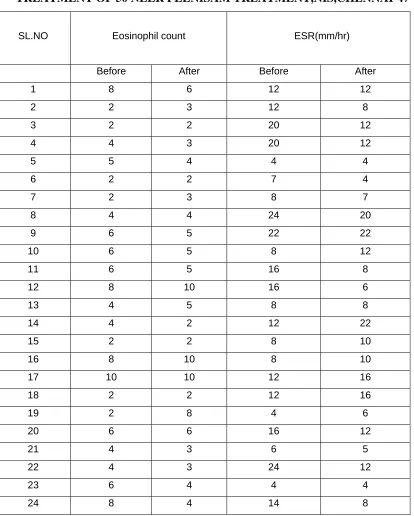
TABLE:12
RESULTS OF OBJECTIVE PARAMENTS BEFORE AND AFTER
TREATMENT OF 50 NEER PEENISAM TREATMENT,NIS,CHENNAI-47
SL.NO Eosinophil count ESR(mm/hr)
Before After Before After
1 8 6 12 12
2 2 3 12 8
3 2 2 20 12
4 4 3 20 12
5 5 4 4 4
6 2 2 7 4
7 2 3 8 7
8 4 4 24 20
9 6 5 22 22
10 6 5 8 12
11 6 5 16 8
12 8 10 16 6
13 4 5 8 8
14 4 2 12 22
15 2 2 8 10
16 8 10 8 10
17 10 10 12 16
18 2 2 12 16
19 2 8 4 6
20 6 6 16 12
21 4 3 6 5
22 4 3 24 12
23 6 4 4 4
[image:54.612.90.504.137.653.2]SL.NO Eosinphil count(%) ESR(mm/hr)
Before After Before After
25 4 3 12 10
26 4 3 14 6
27 4 3 58 24
28 4 4 22 14
29 4 4 28 20
30 6 3 14 8
31 12 6 12 16
32 8 2 28 22
33 6 4 24 18
34 4 4 22 25
35 6 4 12 8
36 4 4 16 12
37 4 4 12 10
38 6 4 8 6
39 2 2 12 6
40 10 6 22 16
41 10 5 18 8
42 2 4 10 14
43 4 3 12 10
44 4 2 12 14
45 4 3 12 8
46 10 6 8 12
47 8 6 20 16
48 3 2 12 8
49 4 4 16 12
Statistical Analysis
Paired ‘T’ test was employed to determine the significane of treatment. ESR:
The average value of ESR before treatment and after treatment were 14.9+ 8.7 and 11.78 + 5.49 respectively. The difference after treatment was statistically significant. (P< 0.001)
EOSINOPHILS:
DISCUSSION
The present study brings on record, the work done on “Neer Peenisam”
by clinical trial of singathi chooranam with “chittrarathai kudineer” and
“Dikkamalli thylam” protocol.
The present work was carried out on “neer peenisam” representing various views of its aetiology, classification, prodormal signs, signs & symptoms, Noi naadal noi mudal naadal, naadinadai & also Dietary,pranyamam, yogasana, varma and head massage prescriptions.
The “neer peenisam” patients are studied with regard to their past
history of Ovammai ( allergic rhinitis, & family history of sinusitis). This is represented by bar diagram.-2
In the “neer peenisam” patients admitted to clinical trail, age & sex distribution presented by table no. 1 & occupational history, distribution of thinai and,incidence in paruvavakaalam, derangement of mukuttram are studied and represented by pie diagram-1,2 and brar diagram 3and4 respectively.
The observation on objective parameters like laboratory investigation particularly, Eosinophil count and ESR (mm/hr) are calculated by statistical method and tested for significance. This is presented in table 11and12.
The observation on subjective parameters such as sneezing Rhinorrhoea, headache, Tenderness present PNS & are also analalysed for statical significance and presented in table No 9and10.
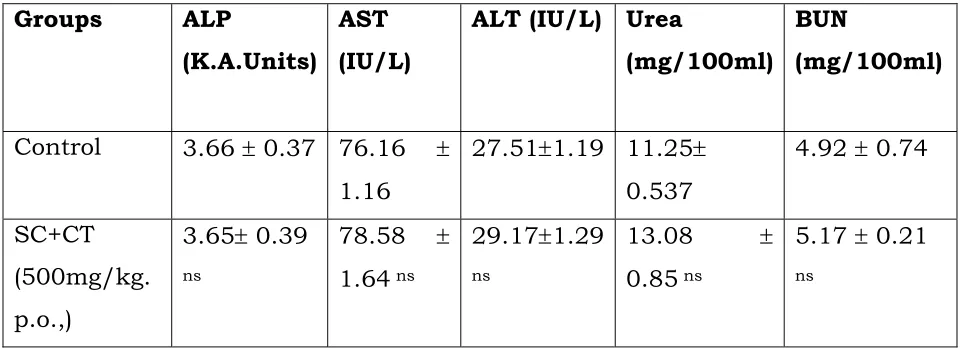
The preliminary biochemical analysis were carried out and presented.
The acute toxicity study of drug “singathi chooranam” with
“chittrarathai kudineer” conducted on rats and recorded.
SUMMARY
The research on “Neer Peenisam” is chosen with an intention to give solace to the patients who are suffering from this disease without any noxious effects. Various literatures having relevant reference to the disease “Neer Peenisam” were collected from both siddha system as well as is in modern system of medicine.
The efficacy of the drugs “singathi chooranam” “chittrarathai kudineer”
and “Dikkamalli thylam” were studied and observed during research. Fifty patients from both sexes of different age groups were selected and treated in the In & Out patient ward of Maruthuvam Department.NIS,Chennai-47.
The patients were treated for 7 days depending upon the severity of the illness further follow up was done for 2 to 4 months for any recurrence. Available investigation in modern medicines were also considered for diagnosis and the progress of the patient was followed by the Performa was prepared accordingly.
The clinical trial conducted with 50 patients. 33 Patients had good relief 12 Had moderate relief and 15 had mild relief. Research findings reveal about the disease and its impact in the body, statistics taken with the help of details in the case sheet, were dealt in detail in observation and results which gave clear knowledge about the disease.
CONCLUSION
When singathi chooranam with chittrarathai kudineer was
administered to the patient along with Dikkamalli thylam for bath, it gives very good result.
Research findings show that65 % of patients were completely cured and also proved clinically.
The trial drugs were very effective to the patients.Cost of the drug is very cheap and free from side effects. So they are useful for long term purpose.
PREPARATION AND PROPERTIES OF TRIAL DRUGS
SINGATHI CHOORANAM
E∫ÔV] Û´D
Raf: Agasthiyar mani 4000 ennum vaithiya chinthamani -I, (P. No; 171,172)
INGREDIENTS:-
1
. ÔuÔ¶Ô E∫˛
(Rhus Suceedenea)
2
. Ôı¶∫Ô›]ˆ
(Solanum Surattense)
3.
Ô|¬ÔVF
(Terminalia Chebula)
4
. g\¬z
(Ricinus Communis)
5.
ĦV\VfiE_
(Nardostachys Jatamanji)
6
. ∑¬z
(Zingiber officinale)
7
. t·z
(piper Nigrum)
8.
]©∏o
(Piper longum)
9.
EÆ º>¬z
(Clerodendron Serrutum)
10
. >V[§¬ÔVF
(Terminalia Bellirica)
11.
÷Õm©A
(Sodium Chloride Impura)
METHODS OF PREPARATION
Above all ingredients were taken into equally and made powder form by rock mortar.
Dosage : 500 mg. three times a day for 7 days Adjuvant : Chittrarathai kudineer
Medicinal use : sinusities, tuberclosis, asthma, hic-cup,primary complex.
1.
ÔÏ¬Ô¶Ô E∫˛
(RHUS SUCEEDENEA)35Family : Anacardiaceae