Systematic evaluation of
patient-reported outcome (PRO) protocol
content and reporting in UK cancer
clinical trials: the EPiC study protocol
Khaled Ahmed,1,2Derek Kyte,1,2Thomas Keeley,1,2Fabio Efficace,3Jo Armes,4 Julia M Brown,5Lynn Calman,6Chris Copland,7Anna Gavin,8Adam Glaser,9 Diana M Greenfield,10Anne Lanceley,11Rachel Taylor,12Galina Velikova,13 Michael Brundage,14Rebecca Mercieca-Bebber,1,15Madeleine T King,15 Melanie Calvert1,2
To cite:Ahmed K, Kyte D, Keeley T,et al. Systematic evaluation of patient-reported outcome (PRO) protocol content and reporting in UK cancer clinical trials: the EPiC study protocol.BMJ Open 2016;6:e012863.
doi:10.1136/bmjopen-2016-012863
▸ Prepublication history for this paper is available online. To view these files please visit the journal online (http://dx.doi.org/10.1136/ bmjopen-2016-012863). Received 1 June 2016 Revised 25 August 2016 Accepted 26 August 2016
For numbered affiliations see end of article.
Correspondence to Dr Derek Kyte; [email protected]
ABSTRACT
Introduction:Emerging evidence suggests that patient-reported outcome (PRO)-specific information may be omitted in trial protocols and that PRO results are poorly reported, limiting the use of PRO data to inform cancer care. This study aims to evaluate the standards of PRO-specific content in UK cancer trial protocols and their arising publications and to highlight examples of best-practice PRO protocol content and reporting where they occur. The objective of this study is to determine if these early findings are generalisable to UK cancer trials, and if so, how best we can bring about future improvements in clinical trials methodology to enhance the way PROs are assessed, managed and reported. Hypothesis: Trials in which the primary end point is based on a PRO will have more complete PRO protocol and publication components than trials in which PROs are secondary end points.
Methods and analysis:Completed National Institute for Health Research (NIHR) Portfolio Cancer clinical trials (all cancer specialities/age-groups) will be included if they contain a primary/secondary PRO end point. The NIHR portfolio includes cancer trials, supported by a range of funders, adjudged as high-quality clinical research studies. The sample will be drawn from studies completed between 31 December 2000 and 1 March 2014 (n=1141) to allow sufficient time for completion of the final trial report and publication. Two reviewers will then review the protocols and arising publications of included trials to: (1) determine the completeness of their PRO-specific protocol content; (2) determine the proportion and completeness of PRO reporting in UK Cancer trials and (3) model factors associated with PRO protocol and reporting completeness and with PRO reporting proportion.
Ethics and dissemination:The study was approved by the ethics committee at University of Birmingham (ERN_15-0311). Trial findings will be disseminated via presentations at local, national and international conferences, peer-reviewed journals and social media
including the CPROR twitter account and UOB departmental website (http://www.birmingham.ac.uk/ cpro0r).
Trial registration number:PROSPERO CRD42016036533.
INTRODUCTION
Patient-reported outcome (PRO) measures are validated questionnaires, self-completed by patients, that provide the patient perspec-tive on physical, functional and psychological
Strengths and limitations of this study
▪ Our review will assist the scientific community in determining how best to improve the way patient-reported outcomes (PROs) are assessed, managed and reported in future cancer trials.
▪ Our review will provide original data regarding the potential factors associated with PRO proto-col quality and PRO reporting.
▪ The review will be limited to UK-led studies adopted to the National Institute for Health Research portfolio, which may limit generalisabil-ity of the results.
▪ Our selection criteria may lead to a cohort of studies that are not fully representative of the field as the trials may, on average, be of a higher quality than those found in the field (they are studies that have successfully completed) and they are more likely to be trials that have yielded a positive result (due to publication bias by journals).
consequences of treatment and the degree and impact of disease symptoms.1 The value of using PROs in cancer clinical trials has been emphasised by major international health-policy and regulatory authorities and by patients with cancer.2–4 PRO results can inform patient choice and clinician decision-making, health technology assess-ment, health economic evaluations, labelling claims and healthcare policy and commissioning.5–8
Patients with cancer value PRO information and may use it to inform complex healthcare decisions.9 10 For instance, PRO trial results can help patients to assess whether survival benefits of a new drug outweigh poten-tial side effects or may assist patients and their clinicians in choosing between treatment options offering similar survival rates.11–15 Given their importance: (1) details regarding PRO assessment should be included in the trial protocol, to ensure appropriate data collection and management;16 17 and (2) PRO results should be fully reported in arising trial publications, to enable timely access by patients, clinicians and policymakers and facili-tate integration of findings into clinical practice.18 However, our recent review of 75 National Institute for Health Research (NIHR) Health Technology Assessment trials19suggests important PRO information is frequently omitted from trial protocols, even where a PRO is the primary outcome of the study. This may lead to impaired data collection and result in poor quality PRO data,
therefore limiting the potential of PRO findings to
effectively inform patient care.20 Furthermore, inter-national research suggests PRO results are poorly reported in trial publications or may not be reported at all.18 21 22 Thus, valuable information that may have a significant impact on treatment decision-making and outcomes may not be available to patients, clinicians and researchers. This would represent a waste of limited healthcare and research resources, which is unethical, and also devalues the contribution of trial participants who spend time and effort providing PRO data.23
This study aims to evaluate the standards of PRO-specific content in UK cancer trial protocols and their arising pub-lications. The specific study objectives are to:
▸ Determine the completeness of PRO-specific protocol content in UK cancer trials.
▸ Determine the proportion of trials reporting PRO
results, that is, the number of trials including PROs in their protocol and subsequently reporting the results in their principal publication.
▸ Determine the completeness of PRO reporting.
▸ Model factors associated with PRO protocol and report-ing completeness, and with PRO reportreport-ing proportion.
▸ Highlight examples of best-practice PRO protocol
content and reporting where they occur.
HYPOTHESES
▸ Trials in which the primary end point is based on a PRO will have more complete PRO protocol and pub-lication components than trials in which PROs are secondary end points.
▸ Publications of trials with more complete PRO proto-col components will have more complete reporting of PROs than those of trials with less complete PRO protocol components.
METHODS AND ANALYSIS Inclusion and exclusion criteria
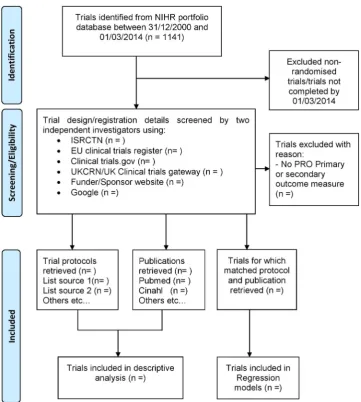
Completed NIHR Portfolio Cancer clinical trials (all cancer specialities/age groups) will be included if they contain a primary/secondary PRO end point. The NIHR portfolio includes UK-led trials, supported by a range of funders, adjudged as high-quality clinical research studies.24 The sample will be drawn from studies com-pleted between 31 December 2000 and 1 March 2014 (n=1141) to allow sufficient time for completion of the
final trial report and publication (figure 1).
Non-randomised trials and trials not completed by the cut-off date (1 March 2014) will be excluded.
Protocol/publication sourcing
Two investigators (TK/KA) will independently search the NIHR Portfolio for eligible trials; disagreements will be resolved through discussion with a third or fourth reviewer (DK/MC). The most up-to-date trial protocol (final version approved by ethics) will be retrieved for review. Following a pilot, it was determined that trial registry information was frequently incomplete, there-fore we plan to search for protocols using a range of resources outlined below:
1. NIHR portfolio; ISRCTN
2. EU Clinical Trials Register/EUdract 3. Clinical trials.gov
4. UKNCRN/UK Clinical trials gateway 5. Funder/Sponser
6. Google
For each protocol sourced, we will retrieve all related subsequent reports/publications either via a direct email to the named trial contact or using recognised
bibliographic databases (eg, MEDLINE, Embase,
CINAHL).
Publications will be sourced via direct contact with the corresponding/first author, or via the Patient-Reported
Outcome Measures Over Time In Oncology
(PROMOTION) Registry (http://promotion.gimema.it/),25 Embase; MEDLINE; Cinahl+; PsycINFO and Cochrane databases.
Data extraction
Two investigators (TK/KA) will independently extract the following data for each included trial, using a prede-signed data extraction form: trial demographics, year of protocol, the name(s)/type(s) of PRO(s) used, whether a PRO was a primary and/or secondary outcome, trial sample size, trial setting (national/international), number of research sites, funding source (including aca-demic and industry supported), cancer specialty and age
24 years inclusive), paediatric). The following data will be extracted from included trial reports/publications and recorded on the same form: year of final report/ publication(s), number of publications and journal/pub-lication source(s).
Checklists
Completeness of the PRO-specific content of trial proto-cols will be assessed using a PRO protocol checklist19 detailing 33 PRO-specific items that are recommended in the literature for inclusion in a trial protocol. Completeness of general sections within each protocol will be assessed using the SPIRIT checklist, as a proxy measure of the overall strength of the protocol.17 26 Completeness of PRO reporting will be evaluated using the CONSORT PRO extension checklist.27 We will also explore the use of the ISOQOL reporting standards checklist. General quality of reporting will be assessed by the 37-item 2010 CONSORT checklist.28
Protocol and publication review
[image:3.595.117.479.45.448.2]Trial protocols and their primary publications ( presenting the principal study findings) will be evaluated in the review/analysis. Subsequent trial publications focused on PRO-specific results will also described. Two investigators (TK/KA) will independently assess the content of the included protocols using the SPIRIT and PRO protocol checklists. The investigators will independently assess con-sistency of the trial protocol/registration information with all subsequent publications to identify any discrepancies in the reporting of PRO trial outcomes. Unreported out-comes will be defined as those prespecified in the trial protocol/registration information but not reported in any subsequent publications.29If a report is available, investiga-tors will assess its completeness using the CONSORT and CONSORT-PRO Extension checklists (and the ISOQOL reporting standards checklist if applicable/feasible).30 Levels of investigator agreement will be determined for each checklist. Disagreements will be resolved through dis-cussion with a third investigator (DK/MC).
Quantitative data analysis
Descriptive analyses will be conducted on the number of SPIRIT and PRO checklist items present in the included trial protocols; on the proportion of incomplete PRO reporting and, where appropriate, on the number of CONSORT and CONSORT-PRO Extension checklist items present in the included in the principal trial publi-cation. CONSORT-PRO checklist scores will also be described for those trials with subsequent PRO-specific publications and time from principal publication to sec-ondary PRO publication will be reported.
PRO protocol and reporting models
To explore factors associated with the inclusion of PRO-specific protocol items, we will perform a
prespeci-fied multiple regression analysis in which the dependent variable will be the‘PRO protocol checklist score’and the independent variables will be (1) year of protocol, (2) whether the PRO was named as a primary or secondary outcome, (3) cancer specialty, (4) participant age group (adult/TYA/paediatric), (5) trial sample size, (6) funding source and (7) the SPIRIT checklist score. We will also perform a logistic regression, using the same covariates, in which the dependent variable will be ‘PRO trial results reported in the principal trial publication (yes/no)’.
To explore factors associated with the inclusion of CONSORT-PRO Extension reporting items, we will perform a prespecified multiple regression analysis in
which the dependent variable will be the
‘CONSORT-PRO checklist score’ and the independent
variables will be (1) the year of publication, (2) whether the PRO was named as a primary or secondary outcome, (3) whether there were single or multiple reports, (4) trial sample size, (5) funding source, (6) journal/publi-cation source, (7) the standard CONSORT checklist score, and (8) the PRO protocol checklist score.
Where the sample size allows, we will attempt to conduct parallel exploratory analysis in which trials with a PRO primary end point are analysed separately from those with secondary PRO end points. All models and covariates will befinalised prior to the data analysis phase.
Sample size calculation
A minimum of 80 protocols and publications will be required to satisfy the sample size requirement for the regression analyses (10 per covariate)31 of trials regard-less of whether PROs are primary or secondary end points.
Ethics and dissemination
The study was approved by the ethics committee at the University of Birmingham (ERN_15-0311) in September 2015. The results of this study will be disseminated via presentations at local, national and international confer-ences, peer-reviewed journals and through social media including the Centre for Patient Reported Outcomes
Research twitter account and the University of
Birmingham departmental website (http://www.
birmingham.ac.uk/cpror), and via the NCRI (including the consumer forum), Macmillan Cancer Support and via international cancer trials groups.
Protocol and registration
The study protocol is registered on PROSPERO
(CRD42016036533), and registration details are available at: http://www.crd.york.ac.uk/PROSPERO/display_record. asp?ID=CRD42016036533.
DISCUSSION
A 2015 review investigated the frequency with which PROs (health-related quality of life) were specified in cancer trial protocols (2000–2003, non-UK) and subse-quently reported in the literature.21Of the 173 included trials, just over half (n=90) included a PRO, but only 35 of these (38%) reported thefindings in an arising publi-cation. However, no evaluation of the quality of PRO protocol/publication content was undertaken, and so the relationship between protocol completeness and reporting could not be assessed.
The current review is therefore necessary to provide a comprehensive representation of the standards of PRO content of protocols in UK cancer clinical trials and to assess whether addressing PRO content in protocols leads to more complete reporting of PROs in subsequent trial publications. Moreover, this systematic review will provide original data regarding the potential factors associated with PRO protocol quality and PRO reporting quality/ proportion. This information will assist the scientific com-munity in determining how best we can bring about methodological improvements in the way PROs are assessed, managed and reported in future cancer trials.
Author affiliations
1Centre for Patient Reported Outcomes Research (CPROR), University of Birmingham, Birmingham, UK
2Institute of Applied Health Research, University of Birmingham, Birmingham, UK
3Health Outcomes Research Unit, Italian Group for Adult Hematologic Diseases (GIMEMA), Rome, Italy
4King’s College London, London, UK
5UKCRC Registered CTU Network, University of Leeds, Leeds, UK 6Department of Heath Sciences, University of Southhampton, Southampton, UK
7NCRI Psychosocial Oncology and Survivorship CSG Consumer member, York, UK
8Queen’s University Belfast, Centre for Public Health, Belfast, UK 9Leeds Institute of Cancer & Pathology, University of Leeds, Leeds, UK 10Sheffield Teaching Hospital NHS Foundation Trust, Sheffield, UK 11University College London, UCL EGA Institute for Women’s Health, London, UK
12University College London Hospital (UCLH), London, UK 13University of Leeds, Leeds, UK
14Queen’s Department of Oncology School of Medicine, Queen’s Cancer Research Institute, Kingston, Ontario, Canada
15Faculties of Science and Medicine, University of Sydney, Sydney, New South Wales, Australia
and MC. KA prepared the first draft of the manuscript. DK, TK, FE, JA, JMB, LC, CC, AGa, AGl, DMG, AL, RT, GV, MB, RM-B, MTK and MC all provided edits and critiqued the manuscript for intellectual content.
Funding This study was supported by Macmillan Cancer Support grant number 15200586.
Competing interests JA, LC, CC, AGa, AGl, DMG, DK and AL are all members of the National Cancer Research Institute Psychosocial Oncology and Survivorship CSG subgroup:‘Understanding and measuring the consequences of cancer and its treatment’. FE receives personal fees from TEVA, Seattle genetics and Bristol Myers Squibb and grants from Lundbeck. GV receives grants from the from National Institute for Health Research and Yorkshire Cancer Research and personal fees from Roche, Genentech, Eisai and Novartis. MC receives personal fees from Astellas Pharma and Ferring and chairs the ISOQOL Best Practice for PROs in Trials Taskforce. Provenance and peer review Not commissioned; externally peer reviewed. Open Access This is an Open Access article distributed in accordance with the terms of the Creative Commons Attribution (CC BY 4.0) license, which permits others to distribute, remix, adapt and build upon this work, for commercial use, provided the original work is properly cited. See: http:// creativecommons.org/licenses/by/4.0/
REFERENCES
1. Dawson J, Doll H, Fitzpatrick R,et al. The routine use of patient reported outcome measures in healthcare settings.BMJ2010;340: c186.
2. Ahmed S, Berzon RA, Revicki DA,et al. The use of patient-reported outcomes (PRO) within comparative effectiveness research: implications for clinical practice and health care policy.Med Care
2012;50:1060–70.
3. DoH.Equity and excellence: liberating the NHS. UK: Department of Health, 2011.
4. Ouwens M, Hermens R, Hulscher M,et al. Development of indicators for patient-centred cancer care.Support Care Cancer
2010;18:121–30.
5. FDA. Guidance for industry: patient-reported outcome measures: use in medical product development to support labeling claims. 2009. http://wwwfdagov/downloads/Drugs/Guidance
ComplianceRegulatoryInformation/Guidances/UCM193282pdf 6. Higginson IJ, Carr AJ. Measuring quality of life: using quality of life
measures in the clinical setting.BMJ2001;322:1297–300. 7. NICE. Guidance on the use of trastuzumab for the treatment of
advanced breast cancer. National Institute for health and care excellence. Technology appraisal guidance [TA34] Published date: 15 March 2002. https://www.nice.org.uk/guidance/ta34
8. EMA. Reflection paper on the use of patient reported outcome (PRO) measures in oncology studies (Draft). European Medicines Agency 2014; Oncology Working Party; Doc. ref. EMA/CHMP/ 292464/2014.
9. Brundage M, Leis A, Bezjak A,et al. Cancer patients’preferences for communicating clinical trial quality of life information: a qualitative study.Qual Life Res2003;12:395–404.
10. Davidson BJ, Goldenberg SL, Gleave ME,et al. Provision of individualized information to men and their partners to facilitate treatment decision making in prostate cancer.Oncol Nurs Forum
2003;30:107–14.
11. Au HJ, Ringash J, Brundage M,et al. Added value of health-related quality of life measurement in cancer clinical trials: the experience of
the NCIC CTG.Expert Rev Pharmacoecon Outcomes Res
2010;10:119–28.
12. Basch E. Toward patient-centered drug development in oncology.
N Engl J Med2013;369:397–400.
13. Blazeby JM, Avery K, Sprangers M,et al. Health-related quality of life measurement in randomized clinical trials in surgical oncology.
J Clin Oncol2006;24:3178–86.
14. Ford HE, Marshall A, Bridgewater JA,et al. Docetaxel versus active symptom control for refractory oesophagogastric adenocarcinoma (COUGAR-02): an open-label, phase 3 randomised controlled trial.
Lancet Oncol2014;15:78–86.
15. Dutton SJ, Ferry DR, Blazeby JM,et al. Gefitinib for oesophageal cancer progressing after chemotherapy (COG): a phase 3, multicentre, double-blind, placebo-controlled randomised trial.
Lancet Oncol2014;15:894–904.
16. Calvert M, Thwaites R, Kyte D,et al. Putting patient-reported outcomes on the‘Big Data Road Map’.J R Soc Med
2015;108:299–303.
17. Chan A, Tetzlaff JM, Gøtzsche PC,et al. SPIRIT 2013 explanation and elaboration: guidance for protocols of clinical trials.BMJ
2013;346:e7586.
18. Brundage M, Bass B, Davidson J,et al. Patterns of reporting health-related quality of life outcomes in randomized clinical trials: implications for clinicians and quality of life researchers.Qual Life Res2011;20:653–64.
19. Kyte D, Duffy H, Fletcher B,et al. Systematic evaluation of the patient-reported outcome (PRO) content of clinical trial protocols.
PLoS One2014;9:e110229.
20. Kyte D, Ives J, Draper H,et al. Inconsistencies in quality of life data collection in clinical trials: a potential source of bias? Interviews with research nurses and trialists.PLoS One2013;8:e76625.
21. Schandelmaier S, Conen K, von Elm E,et al. Planning and reporting of quality-of-life outcomes in cancer trials.Ann Oncol2015;26:1966–73. 22. Efficace F, Fayers P, Pusic A,et al. On behalf of EORTC Quality of
Life Group. PROMOTION Registry. Quality of patient-reported outcome reporting across cancer randomized controlled trials according to the CONSORT PRO extension: a pooled analysis of 557 Trials.Cancer2015;121:3335–42.
23. Chalmers I, Bracken MB, Djulbegovic B,et al. How to increase value and reduce waste when research priorities are set.Lancet
2014;383:156–65.
24. Nisula S, Yang R, Poukkanen M,et al. Predictive value of urine interleukin-18 in the evolution and outcome of acute
kidney injury in critically ill adult patients.Br J Anaesth2015;114:460–8. 25. PROMOTION. Patient-Reported Outcomes Measurements Over
Time In ONcology Fondazione Gimema. 2016 http://promotion. gimema.it/ (accessed Apr 2016).
26. Chan AW, Tetzlaff JM, Altman DG,et al. SPIRIT 2013 statement: defining standard protocol items for clinical trials.Ann Intern Med
2013;158:200–7.
27. Calvert M, Blazeby J, Altman DG,et al. Reporting of patient reported outcomes in randomised trials: the CONSORT PRO extension.
JAMA2013;309:814–22.
28. Schulz KF, Altman DG, Moher D. CONSORT 2010 statement: updated guidelines for reporting parallel group randomised trials.
PLoS Med2010;7:e1000251.
29. Smyth RM, Kirkham JJ, Jacoby A,et al. Frequency and reasons for outcome reporting bias in clinical trials: interviews with trialists.BMJ
2011;342:c7153. .
30. Brundage M, Blazeby J, Revicki D,et al. Patient-reported outcomes in randomized clinical trials: development of ISOQOL reporting standards.Qual Life Res2013;22:1161–75.
31. Babyak MA. What you see may not be what you get: a brief, nontechnical introduction to overfitting in regression-type models.
EPiC study protocol
reporting in UK cancer clinical trials: the
outcome (PRO) protocol content and
Systematic evaluation of patient-reported
Melanie Calvert
Michael Brundage, Rebecca Mercieca-Bebber, Madeleine T King and Diana M Greenfield, Anne Lanceley, Rachel Taylor, Galina Velikova, Julia M Brown, Lynn Calman, Chris Copland, Anna Gavin, Adam Glaser, Khaled Ahmed, Derek Kyte, Thomas Keeley, Fabio Efficace, Jo Armes,
doi: 10.1136/bmjopen-2016-012863
2016 6:BMJ Open
http://bmjopen.bmj.com/content/6/9/e012863 Updated information and services can be found at:
These include:
References
#BIBL
http://bmjopen.bmj.com/content/6/9/e012863
This article cites 26 articles, 9 of which you can access for free at:
Open Access
http://creativecommons.org/licenses/by/4.0/
use, provided the original work is properly cited. See:
others to distribute, remix, adapt and build upon this work, for commercial the Creative Commons Attribution (CC BY 4.0) license, which permits This is an Open Access article distributed in accordance with the terms of
service
Email alerting
box at the top right corner of the online article.
Receive free email alerts when new articles cite this article. Sign up in the
Collections
Topic
Articles on similar topics can be found in the following collections(359)
Patient-centred medicine
(334)
Oncology
Notes
http://group.bmj.com/group/rights-licensing/permissions To request permissions go to:
http://journals.bmj.com/cgi/reprintform To order reprints go to: