Rochester Institute of Technology
RIT Scholar Works
Theses
Thesis/Dissertation Collections
5-1-1999
Asynchronous circuit simulation and design
methodologies
Michael Hevery
Follow this and additional works at:
http://scholarworks.rit.edu/theses
This Thesis is brought to you for free and open access by the Thesis/Dissertation Collections at RIT Scholar Works. It has been accepted for inclusion
in Theses by an authorized administrator of RIT Scholar Works. For more information, please contact
.
Recommended Citation
ASYNCHRONOUS CIRCUIT
SIMULATION AND DESIGN
METHODOLOGIES
by
Michael Hevery
A thesis submitted
in
Partial Fulfillment of the
Requirements for the Degree of
MASTER OF SCIENCE
in
Computer Engineering
Approved by
Principal Advisor:
Dr. Kenneth W. Hsu, Professor
Committee
Member:
_
Dr. Tony H. Chang, Professor
Committee
Member:
_
Dr. Pawel Sniatala, Visiting Assistant Professor
Department of Computer Engineering
Kate Gleason College of Engineering
Rochester Institute of Technology
Rochester, New York
ABSTRACT
The
purpose
of
this
thesis
is
to
examineasynchronous
design
as
a
possible
alternative
to
synchronous
design.
Asynchronous
design
promises
better
power
consumption
and
higher
performance.In
this thesis
an asynchronous simulator capable of
predicting
asynchronous system
performanceis designed. The
simulator
is based
on a
probabilistic
event
driven
modelof
asynchronous elements.The
simulator
is
performance
oriented
only,
and
thus
is
notcapable
offunctional
simulation
orverification.
It
provides
a
highly
abstract view of
the
system.Using
the
simulatorseveral
design
methodologies
were
inspected
and
simulated
for
their
performance.Particular
attention
is
paid
to
differences
between
synchronous
and asynchronousmethodologies.
In
addition several
current
sensor
techniques
were examinedas
a possibleway
ofimplementing
asynchronous
circuit completion
detection.
The
contribution of
this thesis
is definition
ofthe
reasons
why
the
current
sensing
is
not a
feasible way for
completion
detection,
and
the
ability
to
predict
the
asynchronous
CONTENTS
CHAPTER
1
ASYNCHRONOUS CIRCUITS:
THE
PROMISED
LAND
1
1.1
Introduction
1
1.2
Benefits
of
Asynchronous
Circuits
2
1.2.1
Clock Distribution
2
1.2.2
Power Consumption
3
1.2.3
Faster Performance
4
1.2.4
Better Spectral Noise
4
1.3
Simulation
of
Asynchronous Systems
4
CHAPTER
2:EVENT
DRIVEN
SYSTEM MODEL
6
2.1
Clocked
Systems
6
2.2
Event
Driven Systems
6
2.3
Datagrams
7
2.4
Data
Flow Architecture
8
CHAPTER
3:ASYNSIM:
THE ASYNCHRONOUS SIMULATOR
9
3.1
Data
Flow Simulation
9
3.1.1
Performance
Simulation
9
3.1.2
Functional Simulator
10
3.1.3
Architectural Simulation
10
3.2
Architecture
10
3.3
Topology
11
3.3.1
Datagrams
11
3.3.2
Nodes
12
3.3.3
Paths
12
3.3.4
Probabilistic
Delay
Distribution
13
3.4
Request/ Acknowledge Communication Protocol
14
3.4.1
Datagram
Passing
75
3.4.2
Pipeline
(1:1)
15
3.4.3
Split
Pipeline
(1:2)
16
3.4.4
Merged
Pipeline
2:1
18
3.4.5
Cross
Over Pipeline
(2:2)
19
3.4.6
Path
Buffering
19
3.5
Topology
Description Language
20
3.5.1
Syntax
20
3.5.2
Node
22
3.5.3
Path
24
3.5.4
Delay
26
3.5.5
Token Initialization
28
3.5.6
Topology
example:A Simple CPU
29
3.6
Output
30
3.6.1
Event Transcript
31
3.6.2
Path Status
33
3.6.3
Node Status
35
3.7
Simulating Synchronous Systems
36
CHAPTER
4:METHODS
OF IMPROVING ASYNCHRONOUS THROUGHPUT
37
4.1
Synchronous
vs.
Asynchronous
37
4.2
Pipelines
39
4.2.2
Asynchronous
40
4.2.3
Buffered Path
41
4.2.4
Dual Path
Buffering
42
CHAPTER
5:ASYNCHRONOUS
CIRCUIT
COMPLETION
DETECTION
BY
CURRENT
SENSING
44
5.1.1
Function Generation
44
5.1.2
Handshaking
Logic
45
5.2
Completion Signal Generation
byCurrent
Sensing
45
5.2.1
Completion Detection
by
Current
Sensing
46
5.2.2
Probabilistic Distribution ofDelays
47
5.3
Measuring
the
Current Sensor
Quality
48
5.3.1
Voltage
Drop
48
5.3.2
Capacitance
49
5.3.3
Sensing Delay
49
5.3.4
Recovery
Time
49
5.3.5
Max Current
49
5.3.6
Voltage
Drop
per mA49
5.3.7
Quiescent Current Consumption
49
5.4
Different Types
of
Current Sensing Circuits
50
5.4.1
Basic Current Sensors
50
5.4.2
DC
Analysis of Current Sensors
50
5.4.3
Current Sensor
withFeedback
52
5.5
Current
andCapacitance Distribution
53
5.5.7
Power
Consumption
53
5.5.2
Capacitor
/
Resistor
Network Distribution
54
5.5.3
Quiescent Current Consumption
56
5.5.4
Effects
of Gain Bandwidth Product
56
5.6
Time Delay Due
to
Long
SignalLines
57
CHAPTER
6:CONCLUSION
59
REFERENCES
60
APPENDIX
A:
ASYNSIM: SOURCE FTLES
/ SIMULATION
63
A.l.
Asynchronous Pipeline
64
A.7.7.
Topology
64
A.l.
2.
Simulation
65
A.l.
Asynchronous
Pipeline
with
Path
Buffering
67
A.2.1.
Topology
67
A.2.2.
Simulation
68
A.3.
Asynchronous Pipeline
withDual Path Buffering
69
A.J. 7.
Topology
69
A.3.2.
Simulation
70
APPENDK B: CURRENT SENSORS SCHEMATICS
72
LIST
OF
FIGURES
Figure 3.1: AsynSim
usagemodel
11
Figure 3.2: Example
of a
nodewith
paths1 1
Figure 3.3: Example
of
a probabilisticdelay
distribution
13
Figure
3.4: Request /
Acknowledge
protocol14
Figure 3.5: 1:1
pipeline configuration16
Figure 3.6: 1
:2
splitpath
configuration17
Figure
3.7: 2:1 datagram
mergepath
18
Figure 3.8: 2:2 Cross
over
19
Figure 3.9: Path
buffering
20
Figure 3.10: Portion
of a
topology
file
declaring
three
paths(A, B,
Sum)
anda node
(ALU)
21
Figure 3.11:
Topology
file
describing
an
ALU
21
Figure 3.12: Node
attributes
23
Figure
3.13: Path
attributes
24
Figure 3.14: Simple
time
delay
26
Figure 3.15: Time
delay
range27
Figure 3.16: Piecewise linear
delay
distribution
construction27
Figure 3.17: Multilevel
piecewiselinear distribution
construction
27
Figure 3.18: Syntax for
absolute
token
initialization
28
Figure 3.19: Sequential
token
initialization
29
Figure 3.20: Simple CPU
topology
29
Figure 3.21: Simple CPU implemented
as anAsynSim
topology
file
30
Figure 3.22: AsynSim
Even Transcript
results
31
Figure 3.23: Visual
time
representationof
the
Event Transcript
results
32
Figure 3.24: Sample
path status
34
Figure 3.25:
Sample
node status
35
Figure 3.26: Asynchronous
pipeline
36
Figure
3.27: Modified
pipeline
to
support a
clock36
Figure 4.1: Acknowledgment penalty
38
Figure 4.2:
Pipeline
representation
39
Figure 4.3:
Asynchronous
pipeline with
buffered
paths
41
Figure 4.4:
Asynchronous
pipeline with
dual
path
buffering
42
Figure 5.1: Function
generator
45
Figure 5.2:
Handshaking
logic
45
Figure
5.3:
Current
sensors
for
completiondetection
46
Figure 5.4:
Probabilistic
delay
distribution
of
functional
block
47
Figure
5.5: Current
sensors
based
on
(a)
Comparator
(b)
BJT
(c)
Current
mirror
50
Figure 5.6: Voltage
vs. current
DC
response of current sensors
51
Figure 5.7:
Current
sensor with
feedback
52
Figure 5.8:
Voltage
versus current
DC
response of an active current sensor
52
Figure 5.9:
Minimal switching
current consumption configuration
53
Figure 5.11:
(a)
Transistor
schematic(b)
Power distribution
net
(c)
Simplified
54
LIST
OF TABLES
Table 4.1: Pipeline
parameters39
Table 4.2: Performance summary for
an asynchronous pipeline
40
Table 4.3: Performance summary for
an asynchronous pipeline with path
buffering
42
Table 4.4: Performance summary for
anasynchronous pipeline with
dual
path
buffering.
43
GLOSSARY
Asynchronous
page2
A
clockless
design methodology
that
employshandshaking
protocols
to
control
the
flow
ofdata.
AsynSim
page
9
Asynchronous Simulator developed for
this
thesis.
Datagram
page
7
A
package of
data
and state
information
that
is
passedbetween
nodes
Node
page12
A functional block
that
computes a
newdatagram
onits
output(s)
after
consuming
the
datagrams
on
its input(s).
Path
page12
Communication
routefor datagrams.
Synchronous
page
6
Chapter
1:
Asynchronous
Circuits: The
Promised
Land
1.1 Introduction
In
recentyears
the
semiconductorindustry
has
managed
to
consistently improve
the
performanceof
its
products.These improvements have
comein
two
categories:
the
semiconductor
process;
and
the
novel architecturaldesign
of
digital logic. Semiconductor
process
improvements
allow
the
shrinking
oftransistors
which permitsan
increased
number
of
transistors
on
the
same
area
of
silicon.These
improvements
allow
the
architectural
designers
greater
freedom
and
allowfor designs
of
higher
complexity.
However,
increasing
the
number
of
transistors
on a
chip
creates new challenges
that
will
have
to
be
overcome
in
newdesigns. Two
of
these
challenges
are
power
consumption
and clock
distribution. Each
will need
to
be
solved
in
order
to
move
to
the
1.2
Benefits
of
Asynchronous
Circuits
One
technology
that
is promising
to
solve
the
dual
problems of clock
distribution
and power
dissipation
is
asynchronouscircuit
design.
1.2.1
Clock Distribution
Asynchronous
design
eliminates
clocks.The
eliminationof
a
clock within asystem
both
solves and creates
new problems.In
current
synchronousdesigns
a
centralizedclock
is
responsiblefor
synchronizing
all
events.The
synchronizationof
eventsgreatly
simplifies
design
and
makes
it
more predictable.Unfortunately
it
alsocreates problems
ofclock
distribution,
power consumption and clock
skew.
A
clocked system needs
to
constantly
charge and
discharge
the
clock
distribution
network.
Because
this
network needsto trace to
every
flip-flop
or
latch in
the
system
it is
inherently
large
andtherefore
has
a
large
capacitance.Constant charging
and
discharging
of
the
clockdistribution
networkcreates
heavy
currents
and
therefore
consumes
significant
power.
The
constant
presenceof
the
clock signal
is
inefficient,
because
not all
units
in
a system need
the
clockat
alltimes.
For
example
clocking
the
floating-point
unit
(FPU)
in
a processor
is unnecessary
unlessthe
processor
is currently performing
floating
point
arithmetic.
However,
evenif
a processorcan
disable
the
clock
to
some of
its
units,
as
many
modern processors
do,
it
can
only do
so at a coarse
level. No design
can control
which
register
receives
a
clock
and
when,
such
a
fine
control
would
be
inefficient.
Therefore
at
best
the
current modern
designs
can
group
related
functional
blocks
together
In
addition
to
powerconsumption,
clocked systems
face
the
problem of clock
skew.
Having
a
large,
capacitive networkrequires
time
for
a clock edge
to
propagate
to
all
parts ofthe
chip.
This
propagationdelay
is
small,
however
as
the
clock speed
reaching
1 GHz
the
percentage ofthe
whole clock
cycle whichis
taken
up
by
the
clock skew
is
becoming
significant.
Having
a
large
percentage ofthe
clock cycle occupied
by
clock
skew
degrades
the
performance of
the
system.
Asynchronous
systems
attemptto
solve
these
problems
by
the
elimination of
the
clock altogether
from
the
system.
Since
clock signals need
to travel to
all parts
ofthe
chip, the
clockperiod
is limited
by
the
propagation
delay
of
the
clocknetwork.
In
asynchronous
design
no suchlimitation
exists.In
addition,
in
asynchronous
systems,
signals
aretime
independent from
all other signals
within a system.This is
nottrue
in
clocked
systems since
allsignals
aredependent
and must arrive at
their
destination before
the
clock.1.2.2 Power
Consumption
Asynchronous
systems promise
to
be
morepower efficient.
Their efficiency is
mainly due
to
a
lack
of constant
charging
and
discharging
of
the
clock
network.
In
addition,
asynchronous circuits are event
driven
and consume power
only if
an event
needs
to
be
processed.
If
there
is
no event
to
be
processed asynchronous circuits will
stay
idle
consuming leakage
current only.
On
the
other
hand
synchronous circuits perform
"null"
1.2.3 Faster Performance
In
a
synchronous
systemthe
clock
period
must
accommodate
the
worst
case
scenario.
Most
circuits
withina
system willperform
better
and
finish
within
the
clock
period
mostof
the time.
In
additionthe
worst case
delay
might
be
rare,
for
example
it
might occur
in
the
processoronly if
a
certain
instruction is
executed.
If
such
an
instruction
is
rare
the
system
is
underutilizedmost of
the time
and could
be running
at a
higher
frequency. Asynchronous
systems
do
notsuffer
from
these
limitations
since each
element within
the
system runs at
its
own pace.1.2.4 Better
Spectral
Noise
Finally,
asynchronous circuits
offer
better
spectralnoise.
Synchronous
systems
have
a spectral noise with
alarge
peakat
the
clock
frequency. On
the
other
hand
the
noise
in
the
asynchronous system
is
more evenacross
allfrequencies,
this
is mostly due
to
lack
of centralized control.
[15]
1.3
Simulation
of
Asynchronous
Systems
To
further investigate
the
above
claims
of performance
gain
a
"Performance
Simulator"
was
designed
with asynchronous circuits
in
mind.
This
was named
AsynSim
(Asynchronous
Simulator)
and
attempts
to
predict
the
performance
of
a
system
by
simulating
the
flow
of
data
through
it. AsynSim is
not a
functional
simulator,
and
thus
can not
predict
the
correctness of
the
model.
In
addition
AsynSim
is
a
very
high
level
system's
behavior before its
implementation.
The
simulator
is based
on an event
driven
Chapter
2:
Event Driven System
Model
An
eventdriven
system model
is
the
basis for
the
asynchronous
system.
It is
sometimesreferred
to
as a
data flow
model ordata flow
architecture.2.1 Clocked
Systems
In
synchronous systems
the
clockis
the
driving
force.
During
each clock cycle
the
state of
the
system
is known
precisely.In
fact
the
currentstate can
be defined
as
the
current
valueof all
latches
as
well asthe
current valuesof
allinputs. Given
a set
of
known
values
for
the
inputs
and
for
the
latches
there
existonly
one
next
state.
Such
systems
are well
behaved,
because
each clock period creates a well-defined
state.The
state
machines
in
synchronous systems
take
advantageof
this
property
and use
it
to
direct
the
flow
ofdata
through the
system.
2.2 Event
Driven Systems
Event driven
systems on
the
other
hand do
not need a
well-defined state.
In fact
a
Instead in
an event
driven
systemeach
functional
unit
has its
own
state,
suchas
busy,
or
ready.
This
state
defines
whether
the
unitis
able
to
accept
newinput
events.
The
current
state
of an event
driven
system
is defined
by
the
location
of
the
events within
the
system.
The
advantage
of such
a
system
is
that
it only
performs
actions
if
there
is
something
to
do
and
therefore
only
consumes
poweras
needed.
In
addition
an event
driven
system
is
localized,
sinceit only depends
on
the
delays
of
its inputs
and outputs
and
noton
the
delay
of
the
whole system.2.3
Datagrams
In
event
driven
systemsthe
event refersto the
presenceof a
newdatagram
on
the
unit's
input. The
unitconsumes
the
datagram
package
compromising
several
different
individual data
elements.
For
example
an
ALU performing
addition
has
a
datagram
consisting
of
A
operand,
B
operand and an
addition
directive. In
addition
adatagram
might
contain
routing
information
directing
the
result
of
the
addition.
Routing
information is necessary because
eventdriven
systems
lack
a
global
state
that
would
otherwise
direct
the
output of
the
data. Instead
the
data
needs
to
be
able
to
route
itself. A
datagram
together
with
its location
within
the
system
representthe
current state.
Datagram
methodology
is very different from
synchronous
design
methodology
which
usually
has
control and
data
separated.
In
asynchronous systems
this
separation
is
2.4 Data
Flow
Architecture
There
has been
a
lot
of
researchdone in
the
are of
data flow
architectures.
Two
of
which are
Petri
nets and
the
data flow
architecture
for
parallelprogramming
as
developed
by
MIT
[13]. Data flow
architectures
have
the
advantage of
being
decentralized,
which
is
exactly
what an asynchronous system needs.
Data flow
architectures
transfer
control
to
the
data
and
its location
within
the
system
rather
than to
a
centralized
set
of
state
Chapter
3:
AsynSim: The
Asynchronous
Simulator
The
idea behind
the
simulatoris
to
allow
a
performance
analysis
of anasynchronous
system
design. The
simulator consists of a set of nodes and a set of paths
that
interconnect
the
nodes.The
performanceis
obtained
by
measuring
the
time
it
takes
for
the
system
to
process
a
set
of
tokens.
During
the
processing
ofthe tokens the
simulator
takes
into
account
the
delays in
the
paths as well as
the
delays in
the
nodes.
3.1
Data
Flow Simulation
Data flow
simulation
as
presented
in AsynSim
allows
only
a
very high level
simulation
for
use
early in
the
design
process.AsynSim
is
a probabilistic
simulator;
therefore
its
output
is
non-deterministic.
The
power of
the
simulation
is in running
large
token
sets which produce a statistical model of
the
system's performance.
3.1.1
Performance Simulation
The
data flow
simulation allows
the
designer
to
see
the
performance of
the
system
expected
timing
delays
of
the
functional
units specifies
the
probabilities.
The
simulationis
not
highly
accurate
predictionof
how
the
system will
behave
rather
it is
an average
prediction
how
the
system willbehave
most of
the time
given
the
probabilities supplied.
3.1.2 Functional Simulator
The
simulator
is
nota
functional
simulator sincethe
description
of
the
system
is
of
the
highest
level
possible.
Functional
simulationon
the
other
hand
requires a
highly
detail description. The
idea
of
high level
simulationis
to
perform simulations
early in
the
design
process
andto
see
how
the
data
flow
will
behave
before
designing
the
functionality
of
any
ofthe
individual
nodes.
3.1.3 Architectural Simulation
The
simulator
does
allowthe
verificationof
anarchitecture.
It
allows
the
verification
of
deadlock
avoidance.It
can also show whichnodes
areover or
under
utilized
andthus
aidin redesigning
the
system
to
redistribute
the
data flow.
3.2 Architecture
The
AsynSim
overall
usage
model
is
shown
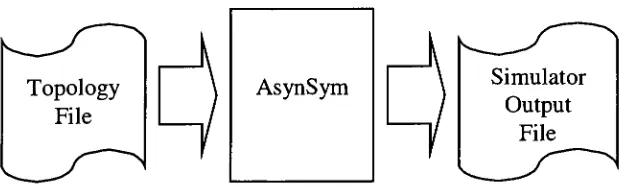
in Figure 3.1. It
consists
of
a
topology
file
which
describes
the
system under simulation
as
the
set of
nodes, paths,
their
interconnections
and a stimulus.
Based
on
the
topology
file AsynSim
then
produces an
Topology
File
AsynSym
Simulator
Output
File
Figure
3.1: AsynSim
usage model.
3.3
Topology
The
topology
file describes
the
system under simulation.
For
examplein Figure
3.2
an asynchronous adder
is
shown.
It
consistsof
two
inputs A
and
B
and an output
Sum. In AsynSim topology, processing
elements
are callednodes
and
connections
between
nodes are called
paths.Therefore Figure 3.2 has
three
paths
(A, B,
Sum)
and one
node
(ALU).
Figure
3.2: Example
of a node with paths.
3.3.1
Datagrams
Datagrams
are
packages
of
data,
its
state,
and
any
other
information
that
is
[image:22.571.78.389.91.189.2]generated on
the
output
ofa
nodeit
creates an event
for
that
path.
Similarly
whenthe
datagram
arrives
at
the
end
ofa path
it
creates
an
event
for
the
destination
node
to
process
it. Datagram
movementsare
responsiblefor
events and
the
events
they
produce
is
what
drives
the
system.Datagrams
observethe
delays
of nodes and paths as
they
travel
through
the
system.In AsynSim
the
datagram's location is
represented
by
atoken.
3.3.2 Nodes
A
node
in AsynSim
represents
a
processing
element.
A
node
has
one or more
inputs
andone or more outputs.
In
addition a node
has
somedelay
associated with
it.
When
adatagram
arrives
onthe
node's
input
and generates anevent,
the
node checks
if
all of
its inputs have
a
datagram
waiting.If
all
inputs have datagrams waiting
and
the
node
is
free,
then the
node
consumes
all
of
the
datagrams
at
once
and
proceeds
to
calculate a new output
datagram
some
delay
later. Once
the
outputdatagram is
generated
it
then
is
passedto the
appropriate output.
The
output
is
a
function
of
the
datagrams just
processed.
The
node remains
in
the
busy
state
untilthe
path
atthe
output acknowledges
the
receiptof
the
datagram.
3.3.3
Paths
Paths
are
responsible
for moving datagrams
around
the
system.
They
arethe
delivery
mechanism
by
which
the
system communicates.
As
this
is
an
asynchronous
system
the
paths must also contain
the
handshaking
protocol.
Each
path
has
a
delay
associated with
it
representing
the
time
it
takes
for
the
datagram,
the
path
is
responsiblefor acknowledging
to the
source node
that
the
datagram
has
been
passed on
successfully.3.3.4
Probabilistic
Delay
Distribution
To
better
approximate
the
delays in
asynchronous
systems, the
delays
in AsynSim
have
a probabilistic
distribution
as shown
Figure 3.3.
2.0
4.0
6.0
Time
(ns)
8.0
Figure 3.3: Example
of a probabilistic
delay
distribution.
In
the
example
in Figure 3.3
the
delay
is
never more
then
8ns
or
less
than
2ns,
while
mostof
the time the
delay
is
around
4ns. These kinds
of
dynamic delays
can
better
approximate
what will
happen in
anasynchronous system.
For
example a ripple
carry
adder might
have
avery
long
worst case
delay
which occurs when
adding
two
numbers
that
will
cause
the
ripple
carry
to
propagate
through
all of
the
bits. Such
cases
however,
are
rare.It is
more probable
that
only
a
few
bits
will generate a
carry
out and
the
carry
out
3.4 Request /
Acknowledge
Communication Protocol
When
the
nodes
arecommunicating
with eachother
they
must
follow
an
established protocol
to
ensurethat
no
data is lost in
the
transmission.
The
protocol
followed in
asynchronous systems
is
the
request/
acknowledge protocol.
Datagram
(A)
Datagram
created,
sent
together
with
request.
(D)
Acknowledge
delay.
(E)
Node 1
becomes
free.
(B)
Request /
Datagram
propagation
delay.
(C)
Waiting
for Node 2
to
become
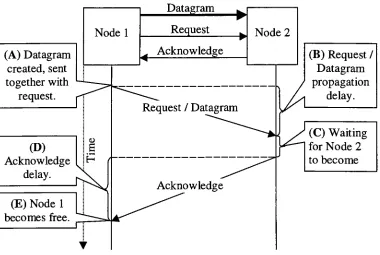
[image:25.571.76.456.189.444.2]Figure
3.4:
Request /
Acknowledge
protocol.Figure 3.4
shows an
interaction
between
two
nodes
andhow
one
datagram flows
from Node 1
to
Node 2. In
the
upper partof
the
Figure 3.4
a physical
interconnection is
shown.
Node 1
has
data
lines
shown
by
the thick
arrowconnecting it
to
node
2. Node 1
also
has
a request
line connecting it
to
Node
2. Node 2 has
an
acknowledge
signal
connecting it
back
to
Node 1.
The
lower
part of
Figure 3.4
shows a
time
representation of
the
event exchange.
First
Node 1
generates a
datagram
and asserts
the
request
line
as
shown
in (A). The
later
they
reach
Node 2
as
shownin (B). This
delay
is known
as request
delay
withinthe
AsynSim.
Once
the
request
arrives atNode
2,
Node 2 may
or
may
not
respondimmediately
with an
acknowledgement.The
delay
in
(C)
is dependent
on
what
stateNode 2 is
in.
If Node 2 is free
then the
responseis
immediate,
if
on
the
other
hand Node 2
is in
the
middle of
calculating
a
datagram
or
is itself waiting for
an acknowledgement
the
delay
in
(C)
might
be longer. At
some
pointNode 2
becomes free
and consumes
the
datagram
produced
by
Node 1
at which
pointit
notifiesNode 1
by
the
acknowledgement
shown
in (C). The
acknowledgement
has
to traverse the
returnpath
to
Node 1
and
is
delayed
as shown
in (D).
Finally
as
Node 1
receivesthe
acknowledgment
it becomes free
and
stops
driving
the
datagram lines. The
process
described
above
is known
asthe
Request
/ Acknowledge Communication Protocol
and
is
used
in AsynSim.
3.4.1 Datagram
Passing
AsynSim follows
the
Request / Acknowledge Communication Protocol in its
simulations
of an
asynchronous
system.
AsynSim
allows
the
designer
to
define
the
request
and acknowledge
delay. In
addition
there
are a
few
other parameters which effect
the
communication path which
handle
allof
the
requests and acknowledgements.
Nodes
are
only
responsible
for
the
consumption and generation
of
datagrams
within
the
system.
3.4.2
Pipeline
(1:1)
A
pipeline
is
the
simplest case of a
data
path.
It
involves
a connection
between
(A)
Datagram
sent.Nodel
(C)
Node
1
becomes
free.
Path
Node 2
(B)
Datagram
received.
[image:27.571.80.456.60.286.2]Figure
3.5: 1:1
pipeline configuration.
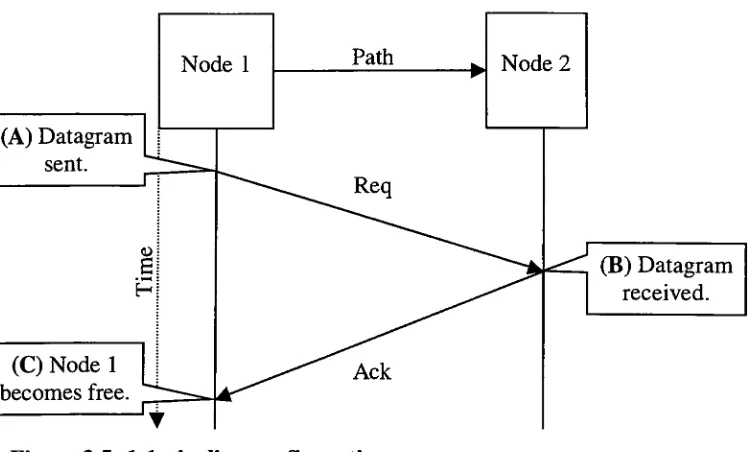
Figure 3.5
shows
the
simplest configurationthat
AsynSim
supports.
A
one
to
one
configuration
is
created
between
the
sender
and receiver.
AsynSim handles
this
as
a
simple
request
/
acknowledge
communication.3.4.3 Split
Pipeline
(1:2)
AsynSim
also supports a
data
path
that
has
more
than
one
destination.
A
split
configuration
is
created
when
a singlenode's
output
is
connected
to
more
than
one
(A)
Datagram
sent.
(C)
Node
1
becomes
free.
Node
2B
(B)
Node
notready,
some [image:28.571.72.491.56.324.2]delay.
Figure 3.6: 1:2
split path configuration.
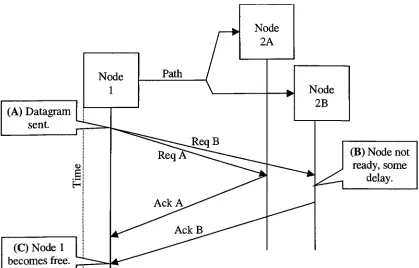
Figure
3.6
shows a single source
node withtwo
destination
nodes.
To
make
the
transition
more
interesting
assume
that
Node 2A is
initially
free
and
Node 2B is
initially
busy. When
the
request arrives
atNode
2A,
because Node 2A is free it is
able
to
respondimmediately
with
an
acknowledgment,
whileNode 2B
requires
more
time
before it
becomes free
and
thus
incurs
some
delay
as
shownin (B). Node 1 does
not
become free
until
it
getsan acknowledgement
from
all of
the
nodes as shown
in (C).
There
exists an alternate mode of
operation,
in
which
the
originating
node waits
for only
one acknowledgment and
only
one
requestis
delivered,
to
the
first
node
that
is
free. This
second mode of operation
is known
as
First Free
Delivery
and
is
useful
in
situations
where
two
nodes
can
perform
the
sameoperations
on
a
datagram
and
to
increase
performance
they
are arranged
in
parallel.For
examplea
CPU
might
have
two
twice
and would
keep
both
of
the
floating-point
unitsbusy. Instead
the
first free
floating
point
unitgets
the
datagram. This
allows
for
parallelprocessing
of
data
with can
improve
overall
throughput.
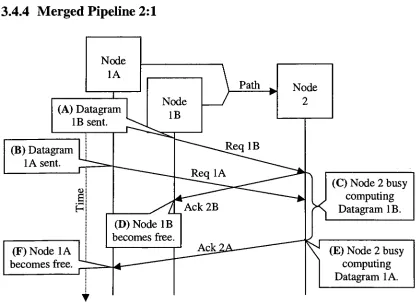
3.4.4
Merged Pipeline
2:1
Node
1A
(A)
Datagram
IB
sent.(B)
Datagram
1A
sent.(F)
Node
1A
becomes
free.
(D)
Node IB
becomes free.
(C)
Node
2
busy
computing
Datagram IB.
(E)
Node 2
busy
computing
Datagram 1A.
Figure
3.7:
2:1
datagram
merge path.
It is
possible
for
two
nodes
to talk
to the
same
destination
node.
In
such a case
the
datagrams
need
to
be
synchronized
to
form
a single
sequentialinput
to
Node 2. AsynSim
supports
this
model and grants
the
acknowledgment
to the
first datagram
that
arrived.
After Node 2
has
processed
the
first datagram it
can process
the
second at which point
the
[image:29.571.69.488.157.460.2]3.4.5
Cross Over
Pipeline
(2:2)
A
cross
over
allows
multiple
sources
to talk
to
multiple
destinations.
In
this
configuration
either each
datagram is delivered
to
each
destination
node or
the
First Free
Delivery
model
canbe
adopted.
Node
1A
\
Path
/
Node
2
^
Node
IB
Node
2
wFigure
3.8: 2:2 Cross
over.
The
acknowledgement and
request paths ofthe
2:2
cross over
follow
those
of
the
2:1
and
1:2
examples,
orare simplified when
First Free
Delivery
is
used.
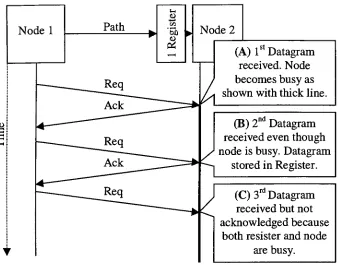
3.4.6 Path
Buffering
Finally
aspecial
feature
ofAsynSim
allows
abuffered
path.
A buffered
path
consists
ofone
ormore registers
before
the
destination
node.
This
register can
latch
the
datagram
and send an acknowledgement
to the
source node even
if
the
destination
node
is
(A)
IsDatagram
received.Node
becomes
busy
as
shown with
thick
line.
,nd
(B)
2
Datagram
received eventhough
node
is busy. Datagram
stored
in Register.
(C)
3rd
Datagram
received
but
not
acknowledged
because
both
resister and node
are
busy.
Figure
3.9: Path buffering.
Path
buffering
allows
better
performancebecause
datagrams
can
be
acknowledged
faster
and
the time
source nodesspend
waiting for
acknowledgements can
be
minimized.More
about
pathbuffering
in
Chapter
4:
Methods
of
Improving
Asynchronous
Throughput.
3.5
Topology
Description
Language
AsynSim
uses a
description language
similar
to
C
to
describe
all
nodes, paths,
and
their
interconnections.
It
also
describes
the
delays
within
the
system.
3.5.1
Syntax
The
language is very flexible
and should allow a
description
of almost all system
[image:31.571.78.416.58.323.2]before
on object canbe further described. This
prevents one
from accidentally
creating
new objects
by
the
misspelling
of an
object'sname.
After
the
object
declaration
the
object's
details
are
described. These details include
delays,
connections
and
special
behavior if
any.
An
example of an
AsynSim
topology
file
with
declarations
is
shown
below.
//
Double
slashis
a comment.//
//
Path
commandlists
all ofthe
pathsin
the
system
//
Notice
the
ft-'on
the
end ofthe
line.
Path{A,
B,
Sum
};
//
Similarly
Node
commanddeclares
node(s)
.Node
{ALU};
Figure
3.10: Portion
of a
topology
file
declaring
three
paths
(A, B,
Sum)
and a
node
(ALU).
A
sampleALU is built in Figure 3.2. The ALU
nodeand
its
paths
have been
declared
and nowthe
interconnections
need
to
be defined
as
shownin Figure 3.11.
//
ALU
(Graphic
is
acomment)
.//
//
-A->|
\
//
>ALU
|
-Sum-->
//
-B->|
/
//
//
Declare
the
paths
Path
(A,
B,
Sum
}
;
//
Declare
the
node
Node
{ALU};
//
Define
the
interconnections.
ALU{
in
={A,
B},
out =
Sum
};
Figure
3.11
represents one of
the
smallest
topology
files
that
will
successfully
pass
through
AsynSim.
Of
course
this
file
will not simulate
anything
but it describes
a
topology
and shows
the
organization of a sample
topology
file.
3.5.2 Node
A
node
is
a
functional
unit ofan asynchronous
design. A
node can
be in
one of
the
three
states.
1)
Initially
the
node
is free
to
perform
calculations.In
the
free
state
the
nodehas
nopending input datagrams
and
is ready
to
startprocessing
assoon as all of
its inputs
are
ready.
2)
Once
allof
the
inputs have
adatagram
presentthe
node entersthe
busy
state.
In
the
busy
state
the
node
is computing
the
result.
This
is
the
only
time
when
the
node
is
being
productive.
A
good
design
willattempt
to
keep
the
node
in
the
busy
state
asmuch
as possible.
3)
Finally,
after
the
node computes
the
resulting datagram it
places
it
on
the
output and
enters a
waiting
state.
In
the
waiting
state
the
node
is
notdoing
anything,
just like in
free
state,
but
unlike
the
free
state
the
nodeis
not
allowedto
accept
inputs. This is
because
the
newly
created
datagram has
not
been
accepted
yet
and
if
a
new
calculation were started
this
datagram
would
be
overwritten.
A
good
design
tries to
minimize
the
waiting
state since a node needs
to
be kept
productive.
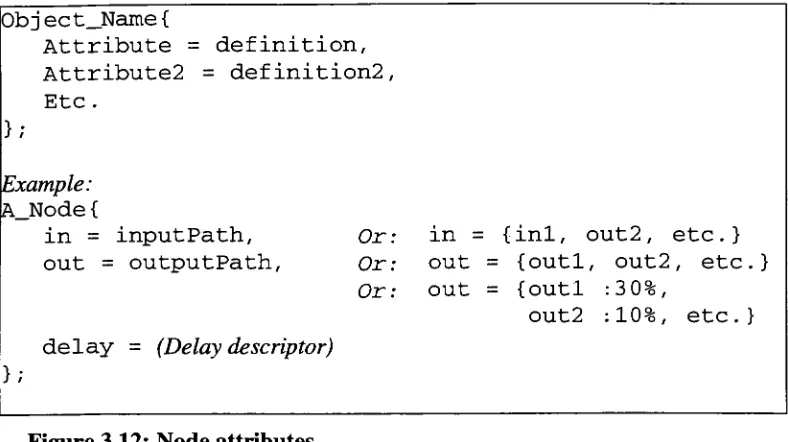
In
addition
a
node
can
have
several
other
attributes
that
further
describe
its
behavior.
Each
attribute
has
an equal sign and a
definition
as shown
Figure 3.12. The
delay
descriptor is
more complicated and
is
explained
in
more
detail later
in
section
3.5.4
Object_Name{
Attribute
=definition,
Attribute2
=def
inition2
,Etc.
};
Example:
A_Node
{
in
=input Path,
Or:
in
=={inl,
out2
,
etc.}
out = output
Path,
Or:
out ={outl,
out2
,etc.}
Or:
out ={outl
:30%,
out2
:10%,
etc.}
delay
-(Delay
descriptor)
};
Figure
3.12: Node
attributes.
Below
arethe
definitions
andthe
functionality
of all of
the
attributes
that the
nodedeclaration
accepts.
3.5.2.1
in
The in
attribute
defines
all of
the
inputs
of
the
node.If
there
is
more
than
oneinput, they
canbe
enclosed
in curly braces.
3.5.2.2
out
The
outattribute
defines
all of
the
outputs of
the
node.If
there
is
more
than
one
output,
they
can
be
enclosed
in curly braces. The
output
datagram from
a node
canbe
assigned
to
one output only.
By
default if
morethan
one
output
exists
the
datagrams
generated
are
assigned
in
a
round
robin
fashion. If
a
random
assignment
scheme
is
desired
then
each output can
be
qualified
witha percentage probability.
In
that
case
the
datagrams
are
assigned
at
random
in
accordance
with
the
probabilities
specified.
If
[image:34.571.71.465.62.283.2]3.5.2.3
delay
The
delay
attribute specifies
the
delay
from
the time
the
datagram
is
consumed
by
the
nodeuntil a new
datagram is
generated onthe
node's output.
It
represents
the
node
delay
andis
specified with a
delay
descriptor,
the
syntax
for
which
is
explained
in
section
3.5.4
Delay.
3.5.3 Path
A
path
is
responsible
for moving
the
datagrams
from
the
source
nodeto the
destination
node.
The
requestand
acknowledgementdelays define
the
communication
speed.
After
a
nodegenerates
adatagram
the
path'sdestination
node
is
notified of
the
request
some
delay
later. If
the
destination
nodeis free
to
accept
a
datagram
then
it
consumes
the
datagram
and sends an
acknowledgesignal
back
to the
originating
node.Once
that
node receives
the
acknowledgment aftersome
delay
it is free
to
generate
a newdatagram.
The remaining
attributes
further define
path
behavior.
Object_Name{
Attribute
==definition,
Attribute2
=def
inition2
,Etc.
};
Example:
A_Path{
req
=delay,
ack =
delay,
token
=token_
initialization,
queueDepth
=depth,
delivery
=/anylall/
};
[image:35.571.69.468.433.647.2]3.5.3.1
req
The
req
attribute
defines
a
delay
between
the
creation of
the
datagram
in
the
node
and
its
arrivalat
the
destination
node.
This
time
delay
is usually
defined
as
the
transmission
delay
of
the
path
between
two
nodes.3.5.3.2
ack
The
ackattribute
defines
a
delay
from
the time the
datagram is
consumed
by
the
destination
nodeuntil
the
path
delivers
the
acknowledgementback
to the
originating
node.
3.5.3.3 token
The
token
attribute allowsthe
pathsto
be initialized
with
datagrams for
simulation.
For further
explanation and
syntax referto
section3.5.4
3.5.3.4
queueDepth
The
queueDepthattribute
defines
the
number ofbuffering
registers
for
datagrams in
the
path.Usually
the
path
does
nothave
registersassociated with
it. It is
possible
for
apath
to
have
asimple
registerto
latch
adatagram
and
thus
free
the
originating
node
evenif
the
destination
node
is
notready
to
a consume
the
datagram.
By
default
the
queueDepth
is 0
and
therefore the
path acts
as
asimple
transmission
line.
There
is
also a special value of
infinity
whichcreates an
infinite
number of
buffering
elements.
3.5.3.5
delivery
The
delivery
attribute
defines
how
the
path
behaves if
there
is
more
than
one
path receives one
copy
ofthe
datagram.
That
is in
the
1:2
configuration
the
two
destination
nodesboth
get a
copy
of
the
datagram
and mustacknowledge
it before
the
source node
can proceed with
processing its
nextdatagram.
However,
specifying
the
any
attribute
for
delivery
tells the
simulator
to
assign
the
datagram
to the
first
available
destination
(First Free Destination). This
is
useful
whenthe two
destination
nodes
are
identical
and
both
can process
the
datagram
in
the
same way.
For
example
aCPU
having
two
floating-point
units where
the
first floating-point
unitto
become free
can process
the
datagram.
3.5.4
Delay
In
AsynSim
the
delays
are
notfixed,
ratherthey
have
a probabilistic
distribution.
The
syntaxfor
defining
the
distribution
is based
on a
tree
configurationwith each
nodehaving
adelay
range and a continuousprobability distribution.
The
simplest
form
of
delay
is
a
constanttime
as
in Figure 3.14. Notice
the
'ns'following
the time.
The AsynSim
understandsfollowing
list
ofsuffixes:
sec, ms, us,
ns, ps,
f
s.3
nsFigure
3.14: Simple
time delay.
It
is
also
possible
to
define
ranges
of
time
as
showin Figure 3.15. Note
the
distinction
between
square
bracket
'['
and
parenthesis
')'. A
square
bracket
implies
that
the
associatedend point of
the
specified
time
is
included in
the range,
while a parenthesis
implies
that
its
associated end point
is
excluded
from
the time
range.
From
the
example
in
Figure 3.15
the
AsynSim
will
randomly
generate numbers
from
3ns (inclusive
to
less
[3
ns,
5ns)
//
space optionalFigure 3.15: Time
delay
range.
It is
also
possible
to
constructany
delay
distribution from
a piecewise
linear
summation of
many
smaller ranges as shown
in Figure 3.16. A
percentage
that
specifies
the
likelihood
of a number within
that
rangebeing
chosen
follows
each
linear
range.
Please
notethat
all percentages must add
up
to
100% for
eachdelay
distribution.
{
[3
ns,
5ns)
:20%,
[5
ns,
6.5ns)
:80%Figure
3.16: Piecewise linear
delay
distribution
construction.
Finally,
piecewise
linear
delay
construction canhave
multiple
levels
ofdelay
ranges
as
shown
in Figure 3.17. In
the
first level
the
delay
is divided into
a
20%
probability from 3
nsto
5
ns
and
an
80% probability in
two
ranges
with
their
own
percentages.
Notice
that the
outer percentages
addup
to
100% (20%
+
80%)
and
the
second
level
percentages also add
up
to
100% (40%
+
60%). Of
course
there
is
no
limit
to
how many levels
a
delay
definition
canhave.
{
[3
ns,
5ns)
:20%,
{
[5
ns,
4ns)
:40%,
[4
ns,
6.5ns)
:60%,
}:80%
Figure
3.17:
Multilevel
piecewise
linear
distribution
construction.
Using
combinations
of
many
small
linear
regions
any
delay
distribution
can
be
3.5.5
Token Initialization
When simulating
a
design in AsynSim it is necessary
to
introduce
datagrams into
system
at specific
times to
simulatethe throughput
of
the
system.
In AsynSim datagrams
are
calledtokens.
The difference between
tokens
and
datagrams is
that
a
datagram
carries
data
to
be
processed,
while
token
is just
a
placeholder.AsynSim is
not
a
functional
simulator
and
therefore
does
not perform
any kind
of operations on
the
data (in fact data
is
absentfrom
the
simulations),
instead
the
focus is
on
how
fast
these
datagrams
move
through the
system.
Therefore in
placeof
datagrams AsynSim
uses
tokens.
Token
initialization
comes
in
two
forms. Absolute
initialization is
a
list
of
tokens
to
be inserted
at
the
given specific
times.
The
otherform is
of sequential
token
streams.
An
example
of
absolute
initialization
is
shownin Figure 3.18. First
at
3ns
tokenl
is introduced into
the
system.
Then
somewhere
between 4ns
and
5ns
asecond
token
token2
willbe introduced. Notice
that time
specifications
arein
the
delay
notation
introduced in 3.5.2.3 delay.
{
name
@
delay,
name
@
delay,
etc.
}
Example:
{
tokenl
@
3ns,
token2
@
[4ns,
5ns]
}
Figure
3.18: Syntax for
absolute
token
initialization.
Initialization
of
tokens
as a
sequentialstream
is
shown
in
Figure
3.19. Note
the
in Figure
3.19
willgenerate
tokens
fast_l,
f
ast_2,
etc.at a rate of
2ns. At
the
same
time
slow_l, slow_2,
etc.
is
generated at a rate of
15
to
25ns.
{
}
name
[from,
to]
every
delay,
name
(from,
to)
every
delay,
etc. . .
Example:
{
fast
[1,100]
every
2ns,
slow
(0,10]
every
[15ns,
25ns]
}
Figure
3.19: Sequential
token
initialization.
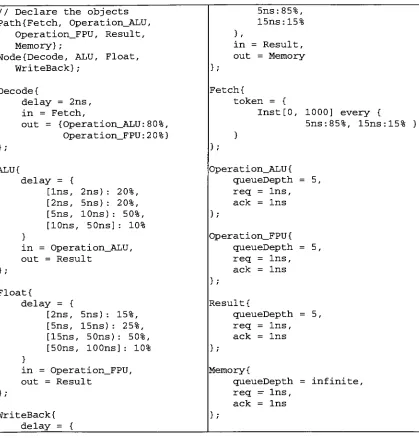
3.5.6
Topology
example:
A
Simple CPU
To
better
explain
how
the
individual
parts of
AsynSim
work
together
a simple
CPU design is
shown
in Figure 3.20.
Instruction
fetch:
85%: hit 5ns
15%:
miss15ns
Op.
queue:Depth 5 inst.
Req/Ack:
Ins
20%: l-2ns
20%
:2-5ns
50%: 5-1 Ons
10-50ns
Memory
Queue depth:
infinite
Result
queue:Depth 5
resultsReq/Ack
Ins
Write back:
85%: hit 5ns
15%:
miss15ns
Figure
3.20: Simple CPU
topology.
The
CPU
of
Figure 3.20 is
represented
in
AsynSim
topology
language
in
Figure
//
Declarethe
objects5ns:85%,
Path
{Fetch,
Operation_ALU,
15ns: 15%
Operation_FPU,
Result,
},
Memory}
;in
=Result,
Node
{Decode,
ALU,
Float,
out =Memory
WriteBack}
;};
Decode
{
Fetch
{
delay
=2ns,
token
={
in
=Fetch,
lnst[0,
1000]
every
{
out =
{Operation_ALU:80%,
5ns:85%,
15ns:15%
}
Operation_FPU
:2 0%
}
};
}
};
ALU{
Operation_ALU{
delay
={
queueDepth =5,
[Ins,
2ns)
:20%,
req
=Ins,
[2ns,
5ns)
:20%,
ack =Ins
[5ns,
10ns)
:50%,
};
[10ns,
50ns]
:10%
}
Operation_FPU{
in
=Operation_ALU,
queueDepth =5,
out =
Result
req
=Ins,
};
ack =Ins
};
Float
{
delay
={
Result
{
[2ns,
5ns)
:15%,
queueDepth =5,
[5ns,
15ns)
:25%,
req
=Ins,
[15ns,
50ns)
:50%,
ack =Ins
[50ns,
100ns]
:10%
}
in
=Operation_FPU,
};
Memory {
out =
Result
queueDepth =infinite.
};
req
-Ins,
ack =
Ins
WriteBack
{
};
delay
={
Figure
3.21:
Simple CPU
implemented
as an
AsynSim
topology
file.
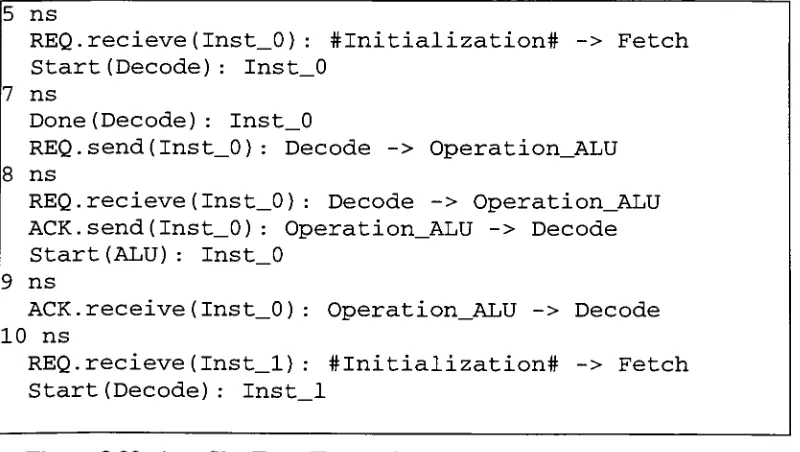
3.6 Output
After
executing
a
topology
file,
AsynSim
returns
the
simulation
results.
The
simulation
results are
divided
into
three
categories.
The Event
Transcript
shows all of
the
[image:41.571.74.493.60.498.2]shows
whichpaths
have
tokens
waiting in
them.
And
finally
Node Status
shows
the
utilization
of
the
nodes.These
results give