Available Online at www.ijcsmc.com
International Journal of Computer Science and Mobile Computing
A Monthly Journal of Computer Science and Information Technology
ISSN 2320–088X
IJCSMC, Vol. 4, Issue. 4, April 2015, pg.335 – 340
RESEARCH ARTICLE
Simulation-Based Performance Evaluation of
Routing Protocols for Parking
Mr. Margil Shah
#1, Prof. Shilpa Serasia
#2, Prof. Hitesh Patel
*3#
Computer Engineering Departmentt, KITRC Opp. Sindband Hotel, Kalol, Gujarat, India
2
*Information Technology Department
Opp. Sindband Hotel, Kalol, Gujarat, India
Abstract— In this paper we are discussed and compare the routing algorithm for VANET with special class for Parking. We are taking one parking lot with few parked vehicles as scenario. We also initiate route-flow from one node to available parking node manually. This scenario can be simulated by SUMO and trace for that is generated. We have tested the trace Network with NS-2 using algorithms like AODV DSR etc. We analyze the network trace and measure the performance like PDR, End to end delay etc.
Keywords— VANET, Parking, Parking lot, AODV, DSR
__________________________________________________________________________
I. INTRODUCTION
We referred papered for Parking in VANET. We found problem regarding parking and solutions for that problem also proposed. We list out few problems and their solutions here. Problems:
1. Lack of use of Technology for parking guidance. 2. Environmental Concerns
3. Parking Space inefficiency 4. Lack of Revenue Management Research Questions:
1. Technology to facilitate search for free parking spots.
2. Optimizing parking for increased revenue generation and efficiency of operations.
II. VANETROUTINGPROTOCOLS
There are many routing protocols available for VANET. Among them all we are working with AODV and DSR for performance analysis.
A. Ad-hoc On demand Distance Vector (AODV)
It is purely On-Demand route acquisition routing protocol. It is better protocol than DSDV network as the size of network may increase depending on the number of vehicle nodes [1].
1) Path Discovery Process: In order to discover the path between source and destination, a route request message (RREQ) is broadcasted to all the neighbours in radio range who again continue to send the same to their neighbours in there radio range, until the destination is reached. Every node maintains two counters: sequence number and broadcast-id in order to maintain loop-free and most recent route information. The broadcast-id is incremented for every RREQ the source node initiates. If an intermediate node receives the same copy of request, it discards it without routing it further. When a node forwards the RREQ message, it records the address of the neighbour from which it received the first copy of the broadcast packet, in order to maintain a reverse path to the source node. The RREQ packet contains: the source sequence number and the last destination sequence number know to the source. The source sequence number is used to maintain information about reverse route and destination sequence number tells about the actual distance to the final node.
2) Route Maintenance: A source node sends a new moving request packet RREQ to find a
new route to the destination. But, if an intermediate node moves from its place, its upstream neighbor noticed the move and sends a message notification failure of the link to each of its active upstream neighbors to inform them about the move to source nodes is achieved. After the detection process is again initiated. [1][2]
B. Dynamic Source Routing (DSR)
It is an On-Demand routing protocol in which the sequence of nodes through which a packet needs to travel is calculated and maintained as an information in packet header. Every mobile node in the network needs to maintain a route cache where it caches source routes that it has learned. When a packet is sent, the route-cache inside the node is compared with the actual route needs to be covered.
1) Route Discovery: The source node broadcasts request-packets to all the neighbours in the network containing the address of the destination node, and a reply is sent back to the source node with the list of network-nodes through which it should propagate in the process. Sender initiates the route record as a list with a single element containing itself followed by the linking of its neighbour in that route. A request packet also contains an identification number called request-id, which is counter increased only when a new route request packet is being sent by the source node. To make sure that no loops occur during broadcast, the request is processed in the given order.
2) Route Maintenance: In the hop by hop acknowledgement at data link layer allows the early detection and retransmission of lost or corrupt packets in the data-link layer. If a transmission error occurs, a route error packet containing the address of node detecting the error and the host address is sent back to the sender. Whenever a node receives a route error packet, the hop in error is removed from the route cache and all routes containing this hop are truncated at that point. When the wireless transmission between two nodes does not work equally well in both directions, and then end-to-end replies on the application or transport layer may be used to indicate the status of the route from one host to the other.
III.PROBLEM STATEMENT
The objective of the work is to compare the performance of the two routing protocols based on On-Demand Behavior for the special case parking, i.e. Ad-hoc On-Demand Distance Vector (AODV), Dynamic Source Routing (DSR), for wireless ad-hoc networks based on the performance and comparison has been made on the basis of their properties like throughput, packet delivery ratio (PDR) and end-to-end delay.
IV.SIMULATION ASSUMPTIONS
A. Parking Lot configuration
The following assumptions are considered when building parking lot:
DOUBLE_ROWS 8 BUS_CAPACITY 30
ROW_DIST 35 TOTAL_CAPACITY 80
SLOTS_PER_ROW 10 CYBER_SPEED 5
SLOT_WIDTH 5 CYBER_LENGTH 9
SLOT_LENGTH 9 WAIT_PER_PERSON 5
SLOT_FOOT_LENGTH 5 OCCUPATION_PROBABILITY 0.5
CAR_CAPACITY 30 BREAK_DELAY 1200
CYBER_CAPACITY 20
We assume CBR (Constant Bit Rate) traffic TCL script:
B. Performance Metrics
1) Packet Delivery Ratio: Packet delivery ratio is a very important factor to measure the performance of routing protocol in any network. The packet delivery ratio can be obtained from the total number of data packets arrived at destinations divided by the total data packets sent from sources.
messages. Therefore, end–to-end delay partially depends on the packet delivery ratio. As the distance between source and destination increases, the probability of packet drop increases. The average end-to-end delay includes all possible delays in the network i.e. buffering route discovery latency, retransmission delays at the MAC, and propagation and transmission delay.
3) Average Throughput: It is the average of the total throughput. It is also measured in packets per unit TIL (Time Interval Length).
V. SIMULATION RESULTS
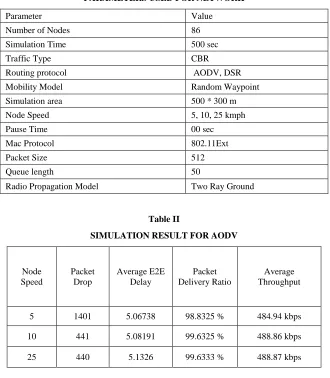
Two On-Demand (Reactive) routing protocols namely Ad-hoc On-Demand Distance Vector Routing (AODV) and Dynamic Source Routing (DSR) are used. The mobility model used is Random waypoint mobility model because it models the random movement of the vehicle mobile nodes.
Table I
PARAMETERS USED FOR NETWORK
Parameter Value
Number of Nodes 86
Simulation Time 500 sec
Traffic Type CBR
Routing protocol AODV, DSR
Mobility Model Random Waypoint
Simulation area 500 * 300 m
Node Speed 5, 10, 25 kmph
Pause Time 00 sec
Mac Protocol 802.11Ext
Packet Size 512
Queue length 50
Radio Propagation Model Two Ray Ground
Table II
SIMULATION RESULT FOR AODV
Node Speed
Packet Drop
Average E2E Delay
Packet Delivery Ratio
Average Throughput
5 1401 5.06738 98.8325 % 484.94 kbps
10 441 5.08191 99.6325 % 488.86 kbps
Table III
SIMULATION RESULT FOR DSR
Node Speed
Packet Drop
Average E2E Delay
Packet Delivery Ratio
Average Throughput
5 6958 249.418 52.2859 % 235.56 kbps
10 1391 9.87452 98.775% 442.81 kbps
25 770 7.79588 99.2921 % 445.13 kbps
VI.ANALYSIS AND RESULTS
The paper shows the realistic comparisons of protocols which are reactive and proactive protocol respectively, and the simulation results agree based on practical and theoretical analysis. The different scenarios were made in the SUMO-0.12.3 and NS2.34. We run the simulation for 500 secs and generate the trace file from which we analyse and calculate the performance metrics as shown above.
A. Speed of node(Car) is varied:
1) E2E Delay: AODV performs well in terms of throughput and PDR as compared to DSR.
2) Packet Loss: In case of DSR, performance is increase gradually with respect to node mobility whereas AODV performs constantly.
3) Packet Delivery Ratio: DSR performs constantly in all conditions whereas AODV performs better than DSR.
4) Throughput: DSR performance well in all conditions as we are simulating in parking lot with very low speed mobility of node. Here AODV will increase the overhead of network by broadcasting the request periodically for updating the routing table.
VII. CONCLUSION
AODV shows the best performance with its ability to maintain connection by periodic exchange of information required for TCP network. AODV performs best in case of packet delivery ratio and throughput as well as in case of Average end to end delay. We measure the result for parking lot having 84 parked cars that will direct the car to vacant slot. Here, we are interested in performance of routing algorithm for low speed mobility in well-defined region (Parking lot). It is already proved by theoretically as well as practically in case of MANET that, AODV perform better in high mobility. But here we are working with well infrastructure with low speed, Thus DSR will perform well than the AODV as very less control packets required to maintain network.
REFERENCES
[1] V. D. Khairnar and K. Kotecha, ―Simulation-Based Performance Evaluation of Routing
Protocols in Vehicular Ad-hoc Network, ‖ IJSRP, vol. 3, issue 10, Oct. 2013
[2] C. Perkins, E. Royer, and S. Das, ―RFC 3561 ad hoc On-Demand distance vector (AODV)
[3] D. Johnson and D. Maltz, ―The Dynamic Source Routing Protocol (DSR) for Mobile Ad
Hoc Networks for IPv4‖,RFC 4728, 1999.
[4] Y. Lin, Y. Chen and S. Lee,‖ Routing Protocols in Vehicular Ad Hoc Networks: A Survey
and Future Perspectives‖, JOURNAL OF INFORMATION SCIENCE AND ENGINEERING,2010
[5] R. Lu, X. Lin, X. Zhu and X. Shen,‖ SPARK: A New VANET-based Smart Parking Scheme
for Large Parking Lots‖,IEEE,2009
[6] H.Kabir,‖Reserch issues on Vahicular Adhoc Network‖, IJETT, 2013
[7] Y. Yuan, J. Luo, W. Yan, T. Zhao, S. Lu,‖ DA2RF: A Data Aggregation Algorithm by
Restricting Forwarders for VANETs‖,IEEE,2014
[8] V. Verroios, V. Efstathiou and A. Delis,‖ Reaching Available Public Parking Spaces in
Urban Environments using Ad-hoc Networking‖
[9] R. Lu, X. Li, T. Luan, X. Liang, and X. Shen,‖ Pseudonym Changing at Social Spots: An
Effective Strategy for Location Privacy in VANETs, IEEE,2012
[10] H. Shi, C. Ma, L.Chen and Z.Ding,‖ IDVR-PFM: A Connectivity-oriented VANET