White Rose Research Online URL for this paper:
http://eprints.whiterose.ac.uk/84399/
Version: Accepted Version
Article:
Bridgeland, T. and Smith, I. (2014) Quadratic differentials as stability conditions.
Publications mathématiques de l'IHÉS. ISSN 0073-8301
https://doi.org/10.1007/s10240-014-0066-5
[email protected] https://eprints.whiterose.ac.uk/ Reuse
Unless indicated otherwise, fulltext items are protected by copyright with all rights reserved. The copyright exception in section 29 of the Copyright, Designs and Patents Act 1988 allows the making of a single copy solely for the purpose of non-commercial research or private study within the limits of fair dealing. The publisher or other rights-holder may allow further reproduction and re-use of this version - refer to the White Rose Research Online record for this item. Where records identify the publisher as the copyright holder, users can verify any specific terms of use on the publisher’s website.
Takedown
If you consider content in White Rose Research Online to be in breach of UK law, please notify us by
TOM BRIDGELAND AND IVAN SMITH
Abstract. We prove that moduli spaces of meromorphic quadratic differentials with simple zeroes on compact Riemann surfaces can be identified with spaces of stability conditions on a class of CY3triangulated categories defined using quivers with
poten-tial associated to triangulated surfaces. We relate the finite-length trajectories of such quadratic differentials to the stable objects of the corresponding stability condition.
Contents
1. Introduction 1
2. Quadratic differentials 13
3. Trajectories and geodesics 22
4. Period co-ordinates 33
5. Stratification by number of separating trajectories 42
6. Colliding zeroes and poles: the spaces Quad(S,M) 56
7. Quivers and stability conditions 65
8. Surfaces and triangulations 75
9. The category associated to a surface 85
10. From differentials to stability conditions 94
11. Proofs of the main results 100
12. Examples 113
References 122
1.
Introduction
In this paper we prove that spaces of stability conditions on a certain class of
tri-angulated categories can be identified with moduli spaces of meromorphic quadratic
differentials. The relevant categories are Calabi-Yau of dimension three (CY
3), and are
described using quivers with potential associated to triangulated surfaces. The
observa-tion that spaces of abelian and quadratic differentials have similar properties to spaces
of stability conditions was first made by Kontsevich and Seidel several years ago. On
the one hand, our results provide some of the first descriptions of spaces of stability
conditions on CY
3categories, which is the case of most interest in physics. On the
other, they give a precise link between the trajectory structure of flat surfaces and the
theory of wall-crossing and Donaldson-Thomas invariants.
Our results can also be viewed as a first step towards a mathematical understanding
of the work of physicists Gaiotto, Moore and Neitzke [13, 14]. Their paper [13]
de-scribes a remarkable interpretation of the Kontsevich-Soibelman wall-crossing formula
for Donaldson-Thomas invariants in terms of hyperk¨ahler geometry. In the sequel [14]
an extended example is described, relating to parabolic Higgs bundles of rank two. The
mathematical objects studied in the present paper are very closely related to their
phys-ical counterparts in [14], and some of our basic constructions are taken directly from
that paper. We hope to return to the relations with Hitchin systems and cluster
vari-eties in a future publication. In another direction, the CY
3categories appearing in this
paper also arise as Fukaya categories of certain quasi-projective Calabi-Yau threefolds.
That relation is the subject of a sequel paper [35].
In this introductory section we shall first recall some basic facts about quadratic
differ-entials on Riemann surfaces. We then describe the simplest examples of the categories
we shall be studying, before giving a summary of our main result in that case, together
with a very brief sketch of how it is proved. We then state the other version of our result
involving quadratic differentials with higher-order poles. We conclude by discussing the
relationship between the finite-length trajectories of a quadratic differential and the
stable objects of the corresponding stability condition.
As a matter of notation, the triangulated categories we consider here are most
natu-rally labelled by combinatorial data consisting of a smooth surface
S
equipped with a
collection of marked points
M
⊂
S
, all considered up to diffeomorphism. Initially
S
will be closed, but in the second form of our result
S
can have non-empty boundary.
The quadratic differentials we consider live on Riemann surfaces
S
whose underlying
smooth surface is obtained from
S
by collapsing each boundary component to a point.
To avoid confusion, we shall try to preserve the notational distinction whereby
S
refers
to a smooth surface, possibly with boundary, whereas
S
is always a Riemann surface,
usually compact. All these surfaces will be assumed to be connected.
We fix an algebraically closed field
k
throughout.
1.1.
Quadratic differentials.
A meromorphic quadratic differential
φ
on a Riemann
surface
S
is a meromorphic section of the holomorphic line bundle
ω
S⊗2. We
empha-size that all the differentials considered in this paper will be assumed to have simple
zeroes. Two quadratic differentials
φ
1, φ
2on Riemann surfaces
S
1, S
2are considered to
be equivalent if there is a holomorphic isomorphism
f
:
S
1→
S
2such that
f
∗(
φ
2) =
φ
1.
Let
S
be a compact, closed, oriented surface, with a non-empty set of marked points
By a quadratic differential on (
S
,
M
) we shall mean a pair (
S, φ
), where
S
is a compact
and connected Riemann surface of genus
g
=
g
(
S
), and
φ
is a meromorphic quadratic
differential with simple zeroes and exactly
d
=
|
M
|
poles, each one of order
6
2. Note
that every equivalence class of such differentials contains pairs (
S, φ
) such that
S
is the
underlying smooth surface of
S
, and
φ
has poles precisely at the points of
M
.
A quadratic differential (
S, φ
) of this form determines a double cover
π
: ˆ
S
→
S
, called
the spectral cover, branched precisely at the zeroes and simple poles of
φ
. This cover
has the property that
π
∗(
φ
) =
ψ
⊗
ψ
for some globally-defined meromorphic 1-form
ψ
. We write ˆ
S
◦⊂
S
ˆ
for the complement
of the poles of
ψ
. The hat-homology group of the differential (
S, φ
) is defined to be
ˆ
H
(
φ
) =
H
1( ˆ
S
◦;
Z
)
−where the superscript indicates the anti-invariant part for the action of the covering
involution. The 1-form
ψ
is holomorphic on ˆ
S
◦and anti-invariant, and hence defines a
de Rham cohomology class, called the period of
φ
, which we choose to view as a group
homomorphism
Z
φ: ˆ
H
(
φ
)
→
C
,
γ
7→
Z
γ
ψ.
There is a complex orbifold Quad(
S
,
M
) of dimension
n
= 6
g
−
6 + 3
d
parameterizing equivalence-classes of quadratic differentials on (
S
,
M
). We call a
qua-dratic differential complete if it has no simple poles; such differentials form a dense open
subset Quad(
S
,
M
)
0⊂
Quad(
S
,
M
).
The homology groups ˆ
H
(
φ
) form a local system over the orbifold Quad(
S
,
M
)
0. A
slightly subtle point is that this local system does not extend over Quad(
S
,
M
), but
rather has monodromy of order 2 around each component of the divisor
parameteriz-ing differentials with a simple pole. It therefore defines a local system on an orbifold
Quad
♥(
S
,
M
) which has larger automorphism groups along this divisor. There is a
natural map
Quad
♥(
S
,
M
)
→
Quad(
S
,
M
)
,
which is an isomorphism over the open subset Quad(
S
,
M
)
0, and which induces an
isomorphism on coarse moduli spaces. Fixing a free abelian group Γ of rank
n
, we can
also consider an unramified cover
Quad
Γ(
S
,
M
)
−→
Quad
♥(
S
,
M
)
In Section 4 we shall prove the following result, which is a variation on the usual
existence of period co-ordinates in spaces of quadratic differentials. For this we need to
assume that (
S
,
M
) is not a torus with a single marked point.
Theorem 1.1.
The space of framed differentials
Quad
Γ(
S
,
M
)
is a complex manifold,
and there is a local homeomorphism
(1.1)
π
: Quad
Γ(
S
,
M
)
−→
Hom
Z(Γ
,
C
)
,
obtained by composing the framing and the period.
In the excluded case the space Quad
Γ(
S
,
M
) is not a manifold because it has generic
automorphism group
Z
2.
1.2.
Triangulations and quivers.
Suppose again that
S
is a compact, closed, oriented
surface with a non-empty set of marked points
M
⊂
S
. For the purposes of the following
discussion we will assume that if
g
(
S
) = 0 then
|
M
|
>
5.
[image:5.612.212.378.436.579.2]By a non-degenerate ideal triangulation of (
S
,
M
) we mean a triangulation of
S
whose
vertex set is precisely
M
and in which every vertex has valency at least 3. To each such
triangulation
T
there is an associated quiver
Q
(
T
) whose vertices are the midpoints of
the edges of
T
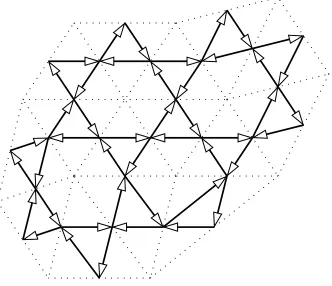
, and whose arrows are obtained by inscribing a small clockwise 3-cycle
inside each face of
T
, as illustrated in Figure 1.
Figure 1.
Quiver associated to a triangulation.
There are two obvious systems of cycles in
Q
(
T
), namely a clockwise 3-cycle
T
(
f
) in
each face
f
, and an anticlockwise cycle
C
(
p
) of length at least 3 encircling each point
p
∈
M
. We define a potential
W
(
T
) on
Q
(
T
) by taking the sum
W
(
T
) =
X
f
T
(
f
)
−
X
p
Consider the derived category of the complete Ginzburg algebra [15, 23] of the quiver
with potential (
Q
(
T
)
, W
(
T
)) over
k
, and let
D
(
T
) be the full subcategory consisting of
modules with finite-dimensional cohomology. It is a CY
3triangulated category of finite
type over
k
, and comes equipped with a canonical t-structure, whose heart
A
(
T
)
⊂ D
(
T
)
is equivalent to the category of finite-dimensional modules for the completed Jacobi
algebra of (
Q
(
T
)
, W
(
T
)).
Suppose that two non-degenerate ideal triangulations
T
iare related by a flip, in which
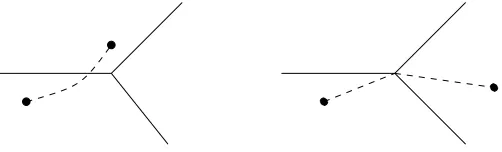
the diagonal of a quadilateral is replaced by its opposite diagonal, as in Figure 2. The
point of the above definition is that the resulting quivers with potential (
Q
(
T
i)
, W
(
T
i))
are related by a mutation at the vertex corresponding to the edge being flipped; see
Fig-ure 2. It follows from general results of Keller and Yang [23] that there is a distinguished
pair of
k
-linear triangulated equivalences Φ
±:
D
(
T
1)
∼
=
D
(
T
2).
Figure 2.
Effect of a flip.
Labardini-Fragoso [27] extended the correspondence between ideal triangulations and
quivers with potential so as to encompass a larger class of triangulations containing
vertices of valency
6
2. He then proved the much more difficult result that flips induce
mutations in this more general context. Since any two ideal triangulations are related
by a finite chain of flips, it follows that up to
k
-linear triangulated equivalence, the
category
D
(
T
) is independent of the chosen triangulation. We loosely use the notation
D
(
S
,
M
) to denote any triangulated category
D
(
T
) defined by an ideal triangulation
T
of the marked surface (
S
,
M
).
1.3.
Stability conditions.
A stability condition on a triangulated category
D
is a
pair
σ
= (
Z,
P
) consisting of a group homomorphism
Z
:
K
(
D
)
→
C
called the central
charge, and an
R
-graded collection of objects
P
=
[
φ∈R
P
(
φ
)
⊂ D
known as the semistable objects, which together satisfy some axioms (see Section 7.5).
For simplicity, let us assume that the Grothendieck group
K
(
D
) is free of some finite
rank
n
. There is then a complex manifold Stab(
D
) of dimension
n
whose points are
stability conditions on
D
satisfying a further condition known as the support property.
The map
taking a stability condition to its central charge is a local homeomorphism. The manifold
Stab(
D
) carries a natural action of the group Aut(
D
) of triangulated autoequivalences
of
D
.
Now suppose that (
S
,
M
) is a compact, closed, oriented surface with marked points, and
let
D
be the CY
3triangulated category
D
(
S
,
M
) defined in the last subsection. There
is a distinguished connected component
Stab
△(
D
)
⊂
Stab(
D
)
,
containing stability conditions whose heart is one of the standard hearts
A
(
T
)
⊂ D
(
T
)
discussed above. We write
Aut
△(
D
)
⊂
Aut(
D
)
for the subgroup of autoequivalences of
D
which preserve this component. We also
define
Aut
△(
D
) to be the quotient of Aut
△(
D
) by the subgroup of autoequivalences
which act trivially on Stab
△(
D
).
The first form of our main result is
Theorem 1.2.
Let
(
S
,
M
)
be a compact, closed, oriented surface with marked points.
Assume that one of the following two conditions holds
(a)
g
(
S
) = 0
and
|
M
|
>
5
;
(b)
g
(
S
)
>
0
and
|
M
|
>
1
.
Then there is an isomorphism of complex orbifolds
Quad
♥(
S
,
M
)
∼
= Stab
△(
D
)
/
Aut
△(
D
)
.
The assumption on the number of punctures in the
g
(
S
) = 0 case of Theorem 1.2 comes
from a similar restriction in a crucial result of Labardini-Fragoso [29]. We conjecture
that the conclusion of the Theorem holds with the weaker assumptions that
|
M
|
>
1
and that if
g
(
S
) = 0 then
|
M
|
>
3. The case of a once-punctured surface is special in
many respects, and we leave it for future research; see Section 11.6 for more comments
on this. The case of a three-punctured sphere is also special, and is treated in Section
12.4.
Away from its critical points (zeroes and poles), a quadratic differential
φ
on a Riemann
surface
S
induces a flat metric, together with a foliation known as the horizontal
folia-tion. One way to see this is to write
φ
=
dz
⊗2for some local co-ordinate
z
, well-defined
up to
z
7→ ±
z
+constant. The metric is then given by pulling back the Euclidean metric
on
C
using
z
, and the horizontal foliation is given by the lines Im(
z
) = constant.
The integral curves of the horizontal foliation are called trajectories. The trajectory
structure near a simple zero and a generic double pole are illustrated in Figure 3. Note
Figure 3.
Local trajectory structure at a simple zero and a generic
dou-ble pole.
that generic double poles behave like black holes: any trajectory passing beyond a
certain event horizon eventually falls into the pole. Thus for a generic differential one
expects all trajectories to tend towards a double pole in at least one direction.
In the flat metric on
S
induced by
φ
, any pole of order
>
2 lies at infinity. Therefore,
assuming that
S
is compact, any finite-length trajectory
γ
is either a simple closed curve
containing no critical points of
φ
, or is a simple arc which tends to a finite critical point
of
φ
(a zero or simple pole) at either end. In the first case
γ
is called a closed trajectory,
and moves in an annulus of such trajectories known as a ring domain. In the second
case we call
γ
a saddle trajectory. Note that the endpoints of a saddle trajectory
γ
could well coincide; when this happens we call
γ
a closed sadddle trajectory.
The boundary of a ring domain has two components, and each boundary component
usually consists of unions of saddle trajectories. There is one other possibility however: a
ring domain may consist of closed curves encircling a double pole
p
with real residue; the
point
p
is then one of the boundary components. We call such ring domains degenerate.
There is a dense open subset
B
0⊂
Quad(
S
,
M
) consisting of differentials (
S, φ
) with
no simple poles and no finite-length trajectories; we call such differentials saddle-free.
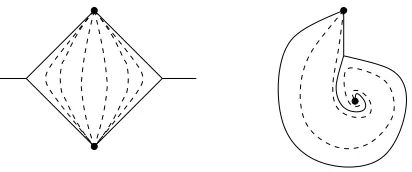
For saddle-free differentials, each of the three horizontal trajectories leaving a given
zero eventually tend towards a double pole. These separating trajectories divide the
surface
S
into a union of cells, known as horizontal strips (see Figure 5). Taking a
Figure 5.
The separating (solid) and generic trajectories (dotted) for a
saddle-free differential; the black dots represent double poles.
single generic trajectory from each horizontal strip gives a triangulation of the surface
S
, whose vertices lie at the poles of
φ
, and this then induces an ideal triangulation
T
of the surface (
S
,
M
), well-defined up to the action of the mapping class group. This is
what is referred to as the WKB triangulation in [14].
The dual graph to the collection of separating trajectories is precisely the quiver
Q
(
T
)
considered before. In particular, the vertices of
Q
(
T
) naturally correspond to the
hori-zontal strips of
φ
. In each horizontal strip
h
ithere is a unique homotopy class of arcs
ℓ
ijoining the two zeroes of
φ
lying on its boundary. Lifting
ℓ
ito the spectral cover gives a
class
α
i∈
H
ˆ
(
φ
), and taken together, these classes form a basis. There is thus a natural
isomorphism
ν
:
K
(
D
(
T
))
→
H
ˆ
(
φ
)
,
which sends the class of the simple module
S
iat a vertex of
Q
(
T
), to the class
α
idefined
by the corresponding horizontal strip
h
i.
Using the isomorphism
ν
, the period of
φ
can be interpreted as a group homomorphism
Z
φ:
K
(
D
(
T
))
→
C
. More concretely, this is given by
Z
φ(
S
i) = 2
Z
ℓi
p
φ
∈
C
,
where the sign of
√
φ
is chosen so that Im
Z
φ(
S
i)
>
0. We thus have a triangulated
category
D
(
T
), with its canonical heart
A
(
T
), and a compatible central charge
Z
φ. This
We refer to the connected components of the open subset
B
0as chambers; the horizontal
strip decomposition and the triangulation
T
are constant in each chamber, although
the period
Z
φvaries. As one moves from one chamber to a neighbouring one, the
triangulation
T
can undergo a flip. Gluing the stability conditions obtained from all
these chambers using the Keller-Yang equivalences Φ
±referred to above eventually leads
to a proof of Theorem 1.2.
1.5.
Higher-order poles.
We can extend Theorem 1.2 to cover quadratic differentials
with poles of order
>
2. Such differentials correspond to stability conditions on
cate-gories defined by triangulations of surfaces with boundary. For this reason it will be
convenient to also index the relevant moduli spaces of differentials by such surfaces, as
we now explain.
A marked, bordered surface (
S
,
M
) is a pair consisting of a compact, oriented, smooth
surface
S
, possibly with boundary, together with a collection of marked points
M
⊂
S
,
such that every boundary component of
S
contains at least one point of
M
. The marked
points
P
⊂
M
lying in the interior of
S
are called punctures. We shall always assume
that (
S
,
M
) is not one of the following:
(i) a sphere with
6
2 punctures;
(ii) an unpunctured disc with
6
2 marked points on its boundary.
These excluded surfaces have no ideal triangulations, and so our theory would be
vac-uous in these cases.
The trajectory structure of a quadratic differential
φ
near a higher-order pole is
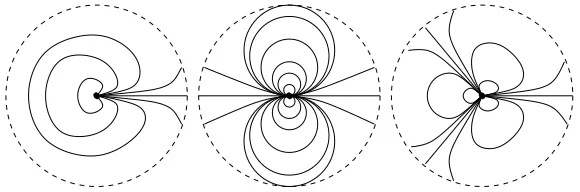
illus-trated in Figure 6; just as with double poles there is an event horizon beyond which
all trajectories tend to the pole, but at a pole of order
k
+ 2 there are, in addition,
k
[image:10.612.250.337.527.613.2]distinguished tangent vectors along which all trajectories enter.
Figure 6.
Local trajectory structure at a pole of order 5.
A meromorphic quadratic differential
φ
on a compact Riemann surface
S
determines a
marked, bordered surface (
S
,
M
) by the following construction. To define the surface
considered as points of the interior of
S
, together with the points on the boundary of
S
corresponding to the distinguished tangent directions.
Let us now fix a marked, bordered surface (
S
,
M
). Let Quad(
S
,
M
) denote the space
of equivalence classes of pairs (
S, φ
), consisting of a compact Riemann surface
S
,
to-gether with a meromorphic quadratic differential
φ
with simple zeroes, whose associated
marked bordered surface is diffeomorphic to (
S
,
M
).
More concretely, the pair (
S
,
M
) is determined up to diffeomorphism by the genus
g
=
g
(
S
), the number of punctures
p
=
|
P
|
, and a collection of integers
k
i>
1 encoding
the number of marked points on each boundary component of
S
. The space Quad(
S
,
M
)
then consists of equivalence classes of pairs (
S, φ
) consisting of a meromorphic quadratic
differential
φ
on a compact Riemann surface
S
of genus
g
, having
p
poles of order
6
2,
a collection of higher-order poles with multiplicities
k
i+ 2, and simple zeroes.
The space Quad(
S
,
M
) is a complex orbifold of dimension
n
= 6
g
−
6 + 3
p
+
X
i
(
k
i+ 3)
.
We can define the spectral cover
π
: ˆ
S
→
S
, the hat-homology group ˆ
H
(
φ
), and the
spaces Quad
Γ(
S
,
M
) and Quad
♥(
S
,
M
) exactly as before. We can also prove the analogue
of Theorem 1.1 in this more general setting.
The theory of ideal triangulations of marked bordered surfaces has been developed
for example in [10]. The results of Labardini-Fragoso [27] apply equally well in this
more general situation, so exactly as before, there is a CY
3triangulated category
D
=
D
(
S
,
M
), well-defined up to
k
-linear equivalence, and a distinguished connected
component Stab
△(
D
).
The second form of our main result is
Theorem 1.3.
Let
(
S
,
M
)
be a marked bordered surface with non-empty boundary. Then
there is an isomorphism of complex orbifolds
Quad
♥(
S
,
M
)
∼
= Stab
△(
D
)
/
Aut
△(
D
)
.
There are six degenerate cases which have been suppressed in the statement of Theorem
1.3. Firstly, if (
S
,
M
) is one of the following three surfaces
(a) a once-punctured disc with 2 or 4 marked points on the boundary;
(b) a twice-punctured disc with 2 marked points on the boundary;
then Theorem 1.3 continues to hold, but only if we replace
Aut
△(
D
) by a certain index
surface is not determined up to the action of the mapping class group by the associated
quiver
Q
(
T
). Secondly, if (
S
,
M
) is one of the following three surfaces
(c) an unpunctured disc with 3 or 4 marked points on the boundary;
(d) an annulus with one marked point on each boundary component;
then the space Quad(
S
,
M
) has a generic automorphism group which must first be killed
to make Theorem 1.3 hold. These exceptional cases are treated in more detail in Section
11.6.
Particular choices of the data (
S
,
M
) lead to quivers of interest in representation theory.
See Section 12 for some examples of this. In particular, we can recover in this way some
recent results of T. Sutherland [37, 38], who used different methods to compute the
spaces of numerical stability conditions on the categories
D
(
S
,
M
) in all cases in which
these spaces are two-dimensional.
1.6.
Saddle trajectories and stable objects.
In the course of proving the Theorems
stated above, we will in fact prove a stronger result, which gives a direct correspondence
between the finite-length trajectories of a quadratic differential and the stable objects
of the corresponding stability condition.
To describe this correspondence in more detail, fix a marked bordered surface (
S
,
M
)
satisfying the assumptions of one of our main theorems, and let
D
=
D
(
S
,
M
) be
the corresponding triangulated category. Let
φ
be a meromorphic differential on a
compact Riemann surface
S
defining a point
φ
∈
Quad(
S
,
M
), and let
σ
∈
Stab
△(
D
)
be the corresponding stability condition, well-defined up to the action of the group
Aut
△(
D
). We shall say that the differential
φ
is generic if for any two hat-homology
classes
γ
i∈
H
ˆ
(
φ
)
R
·
Z
φ(
γ
1) =
R
·
Z
φ(
γ
2) =
⇒
Z
·
γ
1=
Z
·
γ
2.
Generic differentials form a dense subset of Quad(
S
,
M
), and for simplicity we shall
restrict our attention to these.
To state the result, let us denote by
M
σ(0) the moduli space of objects in
D
that are
stable in the stability condition
σ
and of phase 0. This space can be identified with
a moduli space of stable representations of a finite-dimensional algebra, and hence by
work of King [24], is represented by a quasi-projective scheme over
k
.
Theorem 1.4.
Assume that
φ
is generic. Then
M
σ(0)
is smooth, and each of its
con-nected components is either a point, or is isomorphic to the projective line
P
1. Moreover,
there are bijections
0-dimensional components of
M
σ(0)
←→
non-closed saddle trajectories of
φ
;
1-dimensional components of
M
σ(0)
←→
Note that with our conventions, all trajectories are assumed to be horizontal, and
correspond to stable objects of phase 0. In particular, a stability condition
σ
has a
stable object of phase 0 precisely if the corresponding differential
φ
has a finite-length
trajectory. Stable objects of more general phases
θ
correspond in exactly the same way
to finite-length straight arcs which meet the horizontal foliation at a constant angle
πθ
. This more general statement follows immediately from Theorem 1.4, because the
isomorphisms of our main theorems are compatible with the natural
C
∗-actions on both
sides.
Standard results in Donaldson-Thomas theory imply that the two types of moduli spaces
appearing in Theorem 11.6 contribute +1 and
−
2 respectively to the BPS invariants,
although we do not include the proof of this here. These exactly match the
contri-butions to the BPS invariants described in [14, Section 7.6]. In physics terminology,
non-closed saddle trajectories correspond to BPS hypermultiplets, and non-degenerate
ring domains to BPS vectormultiplets.
It is a standard open question in the theory of flat surfaces to characterise or constrain
the hat-homology classes which contain saddle connections. Theorem 1.4 relates this to
the similar problem of identifying the classes in the Grothendieck group which support
stable objects. Here one has the powerful technology of Donaldson-Thomas invariants
and the Kontsevich-Soibelman wall-crossing formula [26], which in principle allows one
to determine how the spectrum of stable objects changes as the stability condition
varies. It would be interesting to see whether these techniques can be usefully applied
to the theory of flat surfaces.
1.7.
Structure of the paper.
The paper splits naturally into three parts.
The first part, consisting of Sections 2–6, is concerned with spaces of meromorphic
qua-dratic differentials. Section 2 reviews basic notions concerning quaqua-dratic differentials,
and introduces orbifolds Quad(
g, m
) parameterizing differentials with simple zeroes and
fixed pole orders. Section 3 consists of well-known material on the trajectory structure
of quadratic differentials. Section 4 is devoted to proving that the period map on
Quad(
g, m
) is a local isomorphism. Section 5 studies the stratification of the space
Quad(
g, m
) by the number of separating trajectories. Finally, Section 6 introduces the
spaces Quad(
S
,
M
) appearing above, in which zeroes of the differentials are allowed to
collide with the double poles.
The second part, comprising Sections 7–9, is concerned with CY
3triangulated
The geometry and algebra come together in the last part, which comprises Sections 10–
12. Section 10 describes the WKB triangulation associated to a saddle-free differential,
and the way it changes as one passes between neighbouring chambers. Section 11
contains the proofs of our main results identifying spaces of stability conditions with
spaces of quadratic differentials. We finish in Section 12 with some illustrative examples.
The reader is advised to start with
§§
2–3, the first half of
§
6, and
§§
7–9, since these
contain the essential definitions and are the least technical. It may also help to look at
some of the examples in
§
12.
Acknowledgements.
Thanks most of all to Daniel Labardini-Fragoso, Andy Neitzke and
Tom Sutherland, all of whom have been enormously helpful. Thanks too to Sergey
Fomin, Bernhard Keller, Alastair King, Howard Masur, Michael Shapiro and Anton
Zorich for helpful conversations and correspondence. This paper owes a significant debt
to the work of Davide Gaiotto, Greg Moore and Andy Neitzke [14].
2.
Quadratic differentials
We begin by summarizing some of the basic properties of meromorphic quadratic
dif-ferentials on Riemann surfaces. This material is mostly well-known, although we were
unable to find any references dealing with the moduli spaces of differentials with
higher-order poles that we shall be using. Our standard reference for quadratic differentials is
Strebel’s book [36].
2.1.
Quadratic differentials.
Let
S
be a Riemann surface, and let
ω
Sdenote its
holomorphic cotangent bundle. A
meromorphic quadratic differential
φ
on
S
is a
mero-morphic section of the line bundle
ω
⊗2S. Two such differentials
φ
1, φ
2on surfaces
S
1, S
2are said to be equivalent if there is a biholomorphism
f
:
S
1→
S
2such that
f
∗(
φ
2) =
φ
1.
In terms of a local co-ordinate
z
on
S
we can write a quadratic differential
φ
as
φ
(
z
) =
ϕ
(
z
)
dz
⊗
dz
with
ϕ
(
z
) a meromorphic function. We write Zer(
φ
)
,
Pol(
φ
)
⊂
S
for the subsets of
zeroes and poles of
φ
respectively. The subset Crit(
φ
) = Zer(
φ
)
∪
Pol(
φ
) is the set of
critical points
of
φ
.
At a point of
S
\
Crit(
φ
) there is a distinguished local co-ordinate
w
, uniquely defined
up to transformations of the form
w
7→ ±
w
+ constant, with respect to which
φ
(
w
) =
dw
⊗
dw.
In terms of an arbitrary local co-ordinate
z
we have
w
=
R p
A quadratic differential
φ
determines two structures on
S
\
Crit(
φ
), namely a flat metric
(called the
φ
-metric) and a foliation (the horizontal foliation). The
φ
-metric is defined
locally by pulling back the Euclidean metric on
C
using a distinguished co-ordinate
w
.
The horizontal foliation is given in terms of a distinguished co-ordinate by the lines
Im(
w
) = constant.
The
φ
-metric and the horizontal foliation on
S
\
Crit(
φ
) together determine both the
complex structure on
S
and the differential
φ
. Note that the set of quadratic differentials
on a fixed surface
S
has a natural
S
1-action given by scalar multiplication :
φ
7→
e
iπθ·
φ
.
This action has no effect on the
φ
-metric, but alters which in the circle of foliations
defined by Im(
w/e
iπθ) = constant is regarded as being horizontal.
In terms of a local co-ordinate
z
on
S
, the length of a smooth path
γ
in the
φ
-metric is
(2.1)
ℓ
φ(
γ
) =
Z
γ
|
ϕ
(
z
)
|
1/2|
dz
|
.
It is important to divide the critical set into a disjoint union
Crit(
φ
) = Crit
<∞(
φ
)
∪
Crit
∞(
φ
)
,
where Crit
<∞(
φ
) consists of
finite critical points
, namely zeroes and simple poles, and
Crit
∞(
φ
) consists of
infinite critical points
, that is poles of order
>
2. We write
S
◦=
S
\
Crit
∞
(
φ
)
for the complement of the infinite critical points.
Note that the integral (2.1) is well-defined for curves passing through points of Crit
<∞(
φ
).
This gives the surface
S
◦the structure of a metric space, in which the distance between
two points
p, q
∈
S
◦is the infimum of the lengths of smooth curves in
S
◦connecting
p
to
q
. The topology on
S
◦defined by this metric agrees with the standard one induced
from the surface
S
.
2.2.
GMN differentials.
All the quadratic differentials considered in this paper live
on compact surfaces and have simple zeroes and at least one pole. Since it will be
convenient to eliminate certain degenerate situations we make the following definition.
Definition 2.1.
A GMN differential is a meromorphic quadratic differential
φ
on a
compact, connected Riemann surface
S
such that
(a)
φ
has simple zeroes,
(b)
φ
has at least one pole,
(c)
φ
has at least one finite critical point.
Given a GMN differential (
S, φ
) we write
g
for the genus of the surface
S
and
d
for
the number of poles of
φ
. The
polar type
of
φ
is the unordered collection of
d
integers
m
=
{
m
i}
giving the orders of the poles of
φ
. We define
(2.2)
n
= 6
g
−
6 +
d
X
i=1
(
m
i+ 1)
,
A GMN differential (
S, φ
) is said to be
complete
if
φ
has no simple poles, or in other
words, if all
m
i>
2. This is exactly the case in which the
φ
-metric on
S
\
Pol(
φ
) is
complete. At the opposite extreme, the differential (
S, φ
) is said to have
finite area
if
φ
has only simple poles, that is if all
m
i= 1.
2.3.
Spectral cover and periods.
Suppose that
φ
is a GMN differential on a compact
Riemann surface
S
, with poles of order
m
iat points
p
i∈
S
. We can alternatively view
φ
as a holomorphic section
(2.3)
ϕ
∈
H
0(
S, ω
S(
E
)
⊗2)
,
E
=
X
i
l
m
i
2
m
·
p
i,
with simple zeroes at both the zeroes and the odd order poles of
φ
. The
spectral cover
1of
S
defined by
φ
is the compact Riemann surface
ˆ
S
=
(
p, l
(
p
)) :
p
∈
S, l
(
p
)
∈
L
psuch that
l
(
p
)
⊗
l
(
p
) =
ϕ
(
p
)
⊂
L,
where
L
is the total space of the line bundle
ω
S(
E
). This is a manifold because
ϕ
has
simple zeroes.
The obvious projection map
π
: ˆ
S
→
S
is a double cover, branched precisely over the
zeroes and the odd order poles of the original meromorphic differential
φ
. There is a
covering involution
τ
: ˆ
S
→
S
ˆ
, commuting with the map
π
. The surface ˆ
S
is connected
because Definition 2.1 implies that
π
has at least one branch point.
We define the hat-homology group of the differential
φ
to be
ˆ
H
(
φ
) =
H
1( ˆ
S
◦;
Z
)
−,
where ˆ
S
◦=
π
−1(
S
◦), and the superscript denotes the anti-invariant part for the action
of the covering involution
τ
.
Lemma 2.2.
The group
H
ˆ
(
φ
)
is free of rank
n
given by
(2.2)
.
Proof. The Riemann-Hurwitz formula applied to the spectral cover
π
: ˆ
S
→
S
implies
that
(2.4)
2ˆ
g
−
2 = 2(2
g
−
2) + (4
g
−
4 +
d
X
i=1
m
i) + (
d
−
e
)
,
where ˆ
g
is the genus of ˆ
S
, and
e
is the number of even
m
i. The group
H
1(
S
◦;
Z
) is
free of rank 2
g
+
d
−
s
−
1, where
s
is the number of simple poles. Similarly, using
equation (2.4), and noting that each even order pole has two inverse images in ˆ
S
, the
group
H
1( ˆ
S
◦;
Z
) is free of rank
r
= 2ˆ
g
+
d
+
e
−
s
−
1 = 8
g
−
6 +
d
X
i=1
m
i+ 2
d
−
s
−
1
.
Since the invariant part of
H
1( ˆ
S
◦;
Z
) can be identified with
H
1(
S
◦;
Z
), the anti-invariant
part
H
1( ˆ
S
◦;
Z
)
−is therefore free of rank
n
.
The spectral cover ˆ
S
comes equipped with a tautological section
ψ
of the line bundle
π
∗(
ω
S
(
E
)) satisfying
π
∗(
ϕ
) =
ψ
⊗
ψ
and
τ
∗(
ψ
) =
−
ψ
. There is a canonical map
η
:
π
∗(
ω
S
)
→
ω
Sˆand we can form the composition
O
Sˆ ψ−−→
π
∗(
ω
S(
E
))
η( ˆE)−−−−→
ω
Sˆ( ˆ
E
)
,
where ˆ
E
=
π
−1(
E
). This defines a meromorphic 1-form on ˆ
S
, which we also denote by
ψ
.
Since the canonical map
η
vanishes at the branch-points of
π
, the differential
ψ
is regular
at the inverse images of the simple poles of
φ
, and hence restricts to a holomorphic
1-form on the open subsurface ˆ
S
◦. By construction
ψ
is anti-invariant for the action of
the covering involution
τ
, and therefore defines a de Rham cohomology class
[
ψ
]
∈
H
1( ˆ
S
◦;
C
)
−called the period of
φ
. We choose to view this instead as a group homomorphism
Z
φ: ˆ
H
(
φ
)
→
C
.
2.4.
Intersection forms.
Consider a GMN differential
φ
on a Riemann surface
S
, and
its spectral cover
π
: ˆ
S
→
S
. Write
ˆ
D
∞=
π
−1(Crit
∞(
φ
))
.
Thus ˆ
S
◦= ˆ
S
\
D
ˆ
∞
. There are canonical maps of homology groups
H
1( ˆ
S
◦;
Z
) =
H
1( ˆ
S
\
D
ˆ
∞;
Z
)
g−−→
H
1( ˆ
S
;
Z
)
h−−→
H
1( ˆ
S,
D
ˆ
∞;
Z
)
.
The intersection form on
H
1( ˆ
S
;
Z
) is a non-degenerate, skew-symmetric pairing, and
induces a degenerate skew-symmetric form
H
1( ˆ
S
◦;
Z
)
×
H
1( ˆ
S
◦;
Z
)
→
Z
,
which we also call the intersection form, and write as (
α, β
)
7→
α
·
β
. On the other hand,
Lefschetz duality gives a non-degenerate pairing
These bilinear forms restrict to the anti-invariant eigenspaces for the actions of the
covering involutions.
For each pole
p
∈
S
of
φ
of even order there is an associated
residue class
β
p∈
H
1( ˆ
S
◦;
Z
)
−,
well-defined up to sign. It is obtained by taking the inverse image under
π
of a small
loop in
S
◦encircling the point
p
, and then orienting the two connected components so
that the resulting class is anti-invariant.
The
residue
of
φ
at
p
is defined to be
(2.6)
Res
p(
φ
) =
Z
φ(
β
p) =
±
2
Z
δp
p
φ,
and is well-defined up to sign.
Lemma 2.3.
The classes
β
p∈
H
1( ˆ
S
◦;
Z
)
−are a
Q
-basis for the kernel of the
intersec-tion form.
Proof. If
p
∈
S
is an even order pole of
φ
, let
{
s
p, t
p}
be the classes in
H
1( ˆ
S
◦;
Z
) defined
by small clockwise loops around the two inverse images of
p
in the spectral cover ˆ
S
.
Similarly, if
p
∈
S
is a pole of odd order
>
3, let
u
p∈
H
1( ˆ
S
◦;
Z
) be the class defined by
a small loop around the single inverse image of
p
. Standard topology of surfaces shows
that there is an exact sequence
0
−→
Z
−→
iZ
⊕k−−→
fH
1( ˆ
S
◦;
Z
)
h−−→
H
1( ˆ
S
;
Z
)
−→
0
,
where the map
h
is induced by the inclusion ˆ
S
◦⊂
S
ˆ
, the map
f
sends the generators
to the classes
s
p,
t
pand
u
prespectively, and the image of
i
is spanned by the element
(1
,
1
, . . . ,
1).
The covering involution exchanges
s
pand
t
p, and fixes
u
p, and we have
β
p=
±
(
s
p−
t
p).
Since the image of the map
i
lies in the invariant part of
H
1( ˆ
S
;
Z
), the elements
β
pare linearly independent. The intersection form on
H
1( ˆ
S
;
Z
)
−is non-degenerate, so the
kernel of the induced form on
H
1( ˆ
S
◦;
Z
)
−is precisely the kernel of the surjective map
h
−:
H
1( ˆ
S
◦;
Z
)
−→
H
1( ˆ
S
;
Z
)
−.
The group
H
1( ˆ
S
;
Z
)
−has rank 2(ˆ
g
−
g
), which by (2.4) is equal to
n
−
e
, where
e
is
the number of even order poles of
φ
. Thus the kernel of
h
−is spanned over
Q
by the
e
2.5.
Moduli spaces.
We now consider moduli spaces of GMN differentials of fixed
polar type. For this purpose we fix a genus
g
>
0 and an unordered collection of
d
>
1
positive integers
m
=
{
m
i}
.
Define Quad(
g, m
) to be the set of equivalence-classes of pairs (
S, φ
) consisting of a
compact, connected Riemann surface
S
of genus
g
, equipped with a GMN differential
φ
having polar type
m
=
{
m
i}
.
Proposition 2.4.
The space
Quad(
g, m
)
is either empty, or is a connected complex
orbifold of dimension
n
given by
(2.2)
.
Proof. Let
M
(
g, d
) be the moduli stack of compact Riemann surfaces of genus
g
with
an ordered set of
d
marked points (
p
1,
· · ·
, p
d). This is a smooth, connected algebraic
stack of finite type over
C
. Choose an ordering of the integers
m
i, and let Sym(
m
)
⊂
Sym(
d
) be the subgroup of the symmetric group consisting of permutations
σ
such that
m
σ(i)=
m
i.
At each point of
M
(
g, d
)
/
Sym(
m
) there is a Riemann surface
S
equipped with a
well-defined divisor
D
=
P
i
m
ip
i. The spaces of global sections
H
0(
S, ω
S⊗2(
D
)) fit together
to form a vector bundle
(2.7)
H
(
g, m
)
−→ M
(
g, d
)
/
Sym(
m
)
.
To see this, note first that if
g
= 0 then we can assume that the divisor
D
has degree
at least 4, since otherwise the vector spaces are all zero, and the space Quad(
g, m
) is
empty. Serre duality therefore gives
H
1(
S, ω
S⊗2(
D
))
∼
=
H
0(
S, ω
S(
D
)
∨)
∗= 0
which proves the claim. It then follows using Riemann-Roch that the rank of the bundle
(2.7) is 3
g
−
3 +
P
di=1
m
i.
The stack Quad(
g, m
) is the Zariski open subset of
H
(
g, m
) consisting of sections with
simple zeroes disjoint from the points
p
i. Since
M
(
g, d
) is connected of dimension
3
g
−
3+
d
, the stack Quad(
g, m
) is either empty, or is smooth and connected of dimension
n
.
The final step is to show that the automorphism groups of the relevant quadratic
dif-ferentials are finite. This claim is clear if
g
>
1 or
d
>
3, because the same property
holds for
M
(
g, d
) (a curve of genus
g
>
2 has a finite automorphism group; a curve of
genus 1 has finitely many automorphisms fixing a given point). When
g
= 0 the claim
is also clear if the total number of critical points is
>
3. Since there is at least one pole,
and the number of zeroes is
P
m
i−
4, the only other possibilities are polar types (1
,
3),
(4), (5) and (2
,
2).
groups are
{
1
}
,
Z
2⋉ C
and
Z
3respectively. In the remaining case (2
,
2) the possible
differentials are
φ
=
r dz
⊗2/z
2for
r
∈
C
∗. Each of these differentials has automorphism
group
Z
2⋉ C
∗. By Definition 2.1(c), a GMN differential must have a zero or a simple
pole; this exactly excludes the troublesome cases (2
,
2) and (4).
Example 2.5.
Consider the case
g
= 1
, m
= (1)
. The corresponding space
Quad(
g, m
)
is empty, even though the expected dimension is
n
= 2
. Indeed, this space parameterizes
pairs
(
S, φ
)
, where
S
is a Riemann surface of genus 1, and
φ
is a meromorphic
differ-ential on
S
having only a simple pole. On the surface
S
the bundle
ω
Sis trivial, so
φ
defines a meromorphic function with a single simple pole. The Riemann-Roch theorem
shows that no such function exists.
We shall often abuse notation by referring to the points of the space Quad(
g, m
) as
GMN differentials, and by denoting such a point simply by
φ
∈
Quad(
g, m
). This
is shorthand for the statement that
φ
is a GMN differential on a compact Riemann
surface
S
, such that the equivalence class of the pair (
S, φ
) defines a point of the space
Quad(
g, m
).
The homology groups
H
1(
S
◦;
Z
)
−form a local system over the orbifold Quad(
g, m
)
because we can realise the spectral cover construction in families, and the Gauss-Manin
connection gives a flat connection in the resulting bundle of anti-invariant homology
groups. Often in what follows we will be studying a small analytic neighbourhood
φ
0∈
U
⊂
Quad(
g, m
)
of a fixed differential
φ
0. Whenever we do this we will tacitly assume that
U
is
con-tractible, and use the Gauss-Manin connection to identify the hat-homology groups of
all differentials in
U
.
2.6.
Framings and the period map.
As in the last section, we fix a genus
g
>
0 and
a collection of
d
>
1 positive integers
m
=
{
m
i}
. Let us also fix a free abelian group Γ
of rank
n
given by (2.2).
As before, we consider pairs (
S, φ
) consisting of a Riemann surface
S
of genus
g
,
equipped with a GMN differential
φ
of polar type
m
=
{
m
i}
. A Γ-framing of such
a pair (
S, φ
) is an isomorphism of groups
θ
: Γ
→
H
ˆ
(
φ
)
.
Suppose (
S
i, φ
i) for
i
= 1
,
2 are two quadratic differentials as above, and
f
:
S
1→
S
2is an isomorphism such that
f
∗(
φ
2
) =
φ
1. Then
f
lifts to an isomorphism ˆ
f
: ˆ
S
1◦→
ˆ
S
◦2
, which is unique if we insist that it also satisfies ˆ
f
∗(
ψ
2) =
ψ
1, where
ψ
iare the
Let Quad
Γ(
g, m
) be the set of equivalence classes of triples (
S, φ, θ
) consisting of a
compact, connected Riemann surface
S
of genus
g
equipped with a GMN differential
φ
of polar type
m
=
{
m
i}
together with a Γ-framing
θ
. We define triples (
S
i, φ
i, θ
i) to be
equivalent if there is an isomorphism
f
:
S
1→
S
2such that
f
∗(
φ
2) =
φ
1and such that
the distinguished lift ˆ
f
makes the following diagram commute
(2.8)
Γ
θ1
~
~
θ2
ˆ
H
(
φ
1)
ˆ f∗/
/