Trapezoidal Approximation of a Fuzzy Number Preserving
the Expected Interval and Including the Core
B. Asady
Department of Mathematics, Islamic Azad University, Arak Branch, Arak, Iran Email: [email protected], [email protected]
Received October 11, 2012; revised November 15, 2012; accepted November 28,2012
ABSTRACT
In this paper, we introduce a method to obtain the nearest trapezoidal approximation of fuzzy numbers so that preserv-ing conditions expect interval and include the core of a fuzzy number.
Keywords: Trapezoidal Approximation; Fuzzy Number; Fuzzy Partition; Fuzzy Approximation; Trapezoidal Fuzzy Numbers
1. Introduction
A R: I 0,1 which satisfies: Trapezoidal fuzzy intervals are often used in practice. Aninteresting problem is to approximate general fuzzy in-tervals by means of trapezoidal ones, so as to simplify calculations. The investigations in this area were started by Ma et al. [1] that proposed the symmetric triangular approximation. Actually, symmetric triangular approxi-mation is a particular case of the trapezoidal approxima-tion that was discussed by many authors including Abbasbandy, Amirfakhrian [2], Abbasbandy and Asady [3], Coroianu [4], Ban [5-8], Grzegorzewski [9-11], Grzegorzewski and Mrowka [12,13], Grzegorzewski, K. Pasternak-Winiarska [14,15] and Yeh [16-21] and other methods same as [22-27]. Although, there are many scholars who have investigated interval, triangular and trapezoidal approximation of fuzzy numbers, but the re-sult of approximation is not always a fuzzy number, sometimes it is not a fuzzy set. For example Grzegor-zewski and Mrowka proposed in [12] a method to find the nearest (with respect to a well-known metric between fuzzy numbers) trapezoidal approximation operator that preserving the expected interval. Unfortunately, there was a gap in the suggested solution which was later im-proved by Grzegorzewski and Mrowka [13] and finally solved by Ban [7] and Yeh [18]. In this paper, we com-bine the ideas proposed in papers [3,12], so that preserv-ing conditions expect interval and include the core of a fuzzy number. In Section 2, we recall some fundamental results on fuzzy numbers. Trapezoidal approximation and examples are in Section 3.
2. Preliminaries
Definition 1. (cf. [28]) A fuzzy number is a fuzzy set like
1) A is the strictly quasi-convex,
2) A x
0 outside some interval
c d,c a b d
, 3) There are real numbers a, b such that and
a) A
x is monotonic increasing on
c a,
, b) A
x is monotonic decreasing on
b d,
,
1,A x a x b. c)
The set of all these fuzzy numbers is denoted by
F R . The -cut, 2 0,1
, of a fuzzy number A is a crisp set defined as
:
A xR A x .
Every -cut of a fuzzy number A is a closed interval
,
A AL AU , where
inf : ,
sup : .
AL x R A x
AU x R A x
The set of all elements that have a nonzero degree of membership in A is called the support of A [27], i.e.
suppA xR A x: 0 .
Definition 2. (complement) The complement of a fuzzy number A is defined as
A x 1 A x
.
A ,
The pair of functions L AU
, , ,
a a a a R
gives a parametric representation of fuzzy number A (see [29]). Another important type of fuzzy numbers was introduced in [23] as follows.
Let 1 2 3 4 such that A
fuzzy number defined as
1 2 3 4.
1 1 2 2 3 3 4 4 f if f if f x aa x a
a x a
a x a
x a , 0,
l r
, , ,
1 2 1 4 4 3 0 i 1 i 0 i l r x a a a A x a x a a
where is denoted by A a a a a1 2 3 4
1, 2, 3, 4
lr and if rl by A a a a a r
. Its parametric form is
,
3
,
0,1L U
l r
a a a a a a
1
l r
, , ,
.1 1
1 2 1 4 4
,A
A A
A popular fuzzy number is the trapezoidal fuzzy num-ber, completely characterized by Equation (1) when
, denoted by A a a a a1 2 3 4
We denotedby F R the set of all fuzzy numbers and FT R
,
L AU
the set of all trapezoidal fuzzy numbers.
Definition 3. For arbitrary fuzzy numbers A,
A A
,
L BU B B and B,
the quantity
1 0 1 0 ,D A B A
2 2 d d L L U U B A B
(2) is the distance between A and B, [3,24,25]. The function
,D A B is a metric in F R
and
F R
,D
is a complete metric space. The expected interval EI A
of a fuzzy number AA AL
,AU
1 1 0 0 d L u A A introduced independently by Dubois and Prade [30] and Heilpern [31]. It is defined by
d , ,A
EI A E A E
(3)
Grzegorzewski [9] shows that the interval EI A
is the nearest interval to the fuzzy number A. Hence in [31] the expected value of a fuzzy number A defined follow-ing as
E
A E
A
1 2
EV A (4) and B. Asady and M. Zendehnam in [32] show that
EV A
R A x: 1
is the best approximation of a fuzzy number A. Finally, let us recall that coreA x .
3. Trapezoidal Approximation of Fuzzy
Numbers
Suppose we want to approximate a fuzzy number by a
trapezoidal fuzzy number. Thus, we use an operator
:
T F R FT R which transforms fuzzy numbers into family of trapezoidal fuzzy number.
Abbasbandy and Asady [3] considered a trapezoidal approximation that includes the -cut superset, i.e.,
T1 core
A coreT A
(5)Grzegorzewski and Mrówka [12] said that an operator
:
T F R FT R
T Afulfills the criterion if for any fuzzy number A its output value preserves the expected interval, i.e.,
T2 EI A EI T A
(6)In this part, we combine ideas proposed in the papers [3,12] to obtain the nearest trapezoidal fuzzy number respect to the original fuzzy number so that it preserves T1 and T2 conditions. Since, any x belongs to the core A
of a fuzzy number A if and only if it does not belong to the complement of A
xcoreA x A
Therefore, for preserving of these points we consider
coreAcoreT A . Also, we are going to preserve the expected interval of the fuzzy number that this additional requirement by the significant role of the expected inter-val is in many situations and applications (see, e.g., [5-11, 33]. Additionally, the propose approach can provide de-cision makers with a new alternative to trapezoidal ap-proximation of fuzzy numbers.
Now, given a fuzzy number B with -cut set
,
BL BU , the problem is to find a trapezoidal
fuzzy number T B t t t t, , ,
1 2 3 4 which is the nearest
to B with respect to metric D and preserves the condi-tions T1 and T2 i.e. we have
1 2 0 1 1 2 2 0min , d
d
L L
U U
D B T B B T B
B T B
(7) Subject to
t t2,3
BL
1 ,BU
1 , (8)
1 1
3 4
1 2
0 0
, d , d ,
2 2 L U
t t t t B B
(9)
2 1 2 1 1 2 0 1 4 4 0 , , L UF h h D B T B
B t t
B t
2 1 2 3 d d , t t t
22 L 1 1
t B h
23 U 1 2
t B h
12 L d t2,
42 U d t3,
(10)
1 1 2
1 1 1 0 0 1 1 2 0 0 3 1 4 0 , 0,
4 d 6 d ,
2 d 6 d ,
1 ,
1 2 d ,
L L
L L
U
U U
h h h
t B B
t B B
t B
t B B
with respect to h1 and h2. Subject to
(11) and (12) and 1 0
t
B (13) and1
0
t
B (14) Clearly, with note to Equations (8), (9), we can say the conditions (11)-(14) are suitable for finding the nearest trapezoidal fuzzy number T B
coreB
to a fuzzy number B with the conditions as the expected interval and
are preserved. Theorem 1: Let B with
T Bcore
-cut set BL
,BU
1 d
3 2 1 d ,
L BL
, be a fuzzy number and
1 1 0 1 0 L d BB
1 d
3 2 1 d ,
U BU
(15)
1 2 0 1 0 U d B B 2 0
0d d
(16)
Case 1: If 1 and then, optimal solution
of problem (10) is
1 2 0
h h
1 0 1 0 d , d L L U U B Band consequently, we have
1 2 3 4 1 2 1 , 1 , 1 2 L U t B t B t B t B
2 0 0 d (17)Case 2: If 1 and d then
1 0 d (18) and d then Case 3: If 20
1 2 2
1 1 0 2 1 1 3 0 0 1 1 4 0 0 0, ,
1 2 d ,
1 ,
2 d 6 d ,
4 d 6 d ,
L L
L
U U
U U
h h d
t B B
t B
t B B
t B B
1 0d 20
(19)
Case 4: If and d then
1 1 2 2
1 1 1 0 0 1 1 2 0 0 1 1 3 0 0 1 1 4 0 0 ,
4 d 6 d ,
2 d 6 d ,
2 d 6 d ,
4 d 6 d ,
L L
L L
U U
U U
h d h d
t B B
t B B
t B B
t B B
(20)
F 1, 2Proof: In order to minimize h h it suffices to minimize function F2
h h1, 2
f h h
1, 2
with thepar-tial derivatives
1 2 1 1 1 2 1 1 0 0 1 2 2 1 1 2 2 2 0 0 41 d 3 2 1 d
3 ,
4
1 d 3
,
2 1 d 3
L L L
U U U
f h h h
h h B B B
f h h h
h h B B B
2 1 2 2 1 2 1 2 2 2 2 1 2 1 2 , , , f h hh f h h
h f h h
h h 2 1 1 2 2 2 4 4 3 4 4 3 0, h d h d 0 h h
(22)
system (10) is 1 2 and the point
0, 0mini-mizes the function F in the Equation (10). Because
1, 2
F h h
0 d
is lower bounded function and has only a critical point. Also, with note to Equations (11)-(14) and optimal solution 1 2 formula (17) is correct.
2) If 1 and d2 are satisfied then the
solu-tions of the system (10) are 0 h h
0
10 h20
Case 1: h , , Case 2: h1 d1, h20
Moreover, since
2 2 1 2 2 2 2 1 2 1 2 1 2 2 0, 0 0, 0 , 0 , 0 f h f h f d h f d h 1 2 0, 0, 8 0, 3 4 0, 3 d d therefore case 2 such that 1 1, 2 minimizes
the function F. Because the Hessian matrix for it is posi-tive definite and for case 1 is not posiposi-tive definite. Also, with note to Equations (11)-(14) and
h d h 0
1 1
h d , h20
Formulae (18) are satisfied. 3) Proof is similar with 2)
4) If 1 and 2 are satisfied then the solu-tions of the system (10) are given by
0
d d 0
10 h20
1 0
h
Case 1: h , ;
Case 2: , h2 d2 ;
Case 3: h1 d1, h20;
Case 4: h1 d1, 2 2
Because the Hessian matrix for of case 4 is positive definite and for others cases are not positive definite, then the solution of case 4 is minimizer and formulae (20) is correct. 2 Now we compare our method with the other works [3,7,20] in following examples.
h d .
Example 1. [7] Let us consider the fuzzy number
1, 2,3,30
2A , in the parametric forms,
1 ,
30 27 , 0,1 .L U
A A
By substitute above equations on the (2) and (3) equa-tions, we obtain the expect interval and core of the fuzzy number A same as follows
5
,12 , core 2, 3 3
EI A A
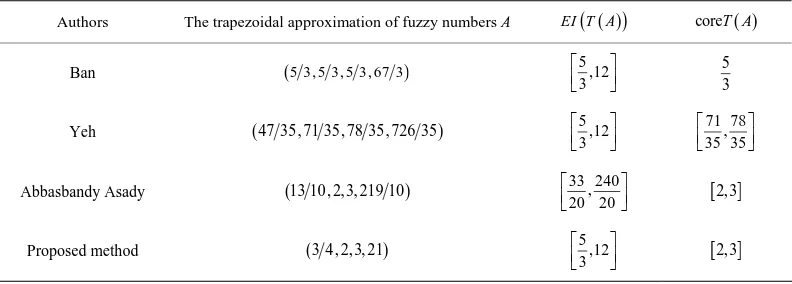
Also, trapezoidal approximation of it by the other methods and proposed method is shown in Table 1.
Clearly, in Table 1, by Ban and Yeh methods, we have
EI A EI T A
core core . andT A
A
and, by Abbasbandy and Asady method, get
EI A EI T A
core core . andA T A
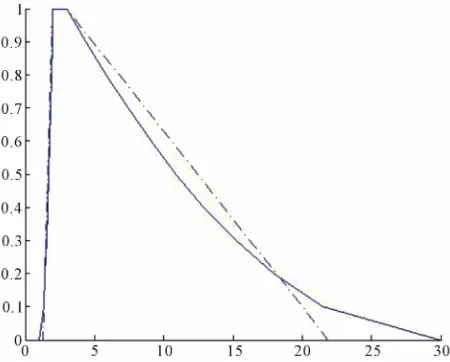
Consequently, with note above results proposed method preserved T1 and T2 conditions (see Figures 1-4).
Example 2. Consider the fuzzy number
10,10,10,14
41 3B
coreT A
[image:4.595.100.496.593.735.2]that the parametric form of it is as follows
Table 1. Comparative results of example 1.
EI T A
The trapezoidal approximation of fuzzy numbers A
Authors 5 3 5 ,12 3
5 3, 5 3, 5 3, 67 3
Ban 71 78 , 35 35 5 ,12 3
47 35, 71 35, 78 35, 726 35
Yeh 2,3 33 240 , 20 20
13 10, 2,3, 219 10
Abbasbandy Asady 2,3 5 ,12 3
3 4, 2,3, 21
Proposed method
Figure 1. The trapezoidal approximation of A by Ban method.
[image:5.595.58.285.93.468.2]Figure 2. The trapezoidal approximation of A by Yeh method.
[image:5.595.61.285.305.491.2]Figure 3. The trapezoidal approximation of A by Abbas-bandy and Asady method.
Figure 4. The trapezoidal approximation of A by prposed method.
10 20 1 4, 14 4
3BL BU .
Clearly, by Equations (2) and (3) the expect interval and core of it are same as follows
6,13 and core 56 5 10, .
EI B B
Also, trapezoidal approximation of the fuzzy number B by the other methods and proposed method is shown in
Table 2.
Clearly, in Table 2 by Ban and Yeh methods,
coreBcoreT B and even coreBcoreT B
(see Figures 5 and 6). But, for Abbasbandy and Asady method, we get EI B
EI T B
. Finally, the results of proposed method are
EI A EI T A
coreA core .and T A
z R
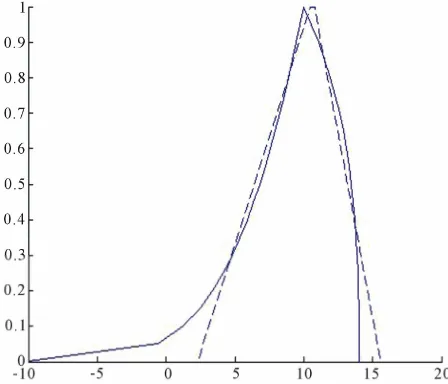
Therefore, we can say that proposed method preserves T1 and T2 conditions in ex-ample 2. (please see Figures 7 and 8).
Theorem 3. Trapezoidal approximation satisfies the following properties.
A
1) Translation invariance: , F R : then we have T A
z
T A
zz R
.
, A
2) Scale invariance: F R : then we have T zA
zT A
.Proof. Proof is similar to proof of Theorem 12 in [7]. Theorem 4. Trapezoidal approximation satisfies the identity property.
1, 2, 3, 4
B b b b b be a trapezoidal fuzzy
Proof. Let
number. By Equations (2) and (3), we get 2 1 1
2
t t
d ,
4 3
2
2
t t
d .
[image:5.595.60.285.525.706.2]Table 2. Comparative results of Example 2.
coreT B EI
proximation of fuzzy numbers B T B
The trapezoidal ap Authors
169 15
6,13 11 15,169 15,169 15, 22115
TB B
Ban
410 54 , 39 5
6,13 90 39, 410 39,54 5, 785
Y
T B
Yeh
17 ,13 3
56 10,
5
3,10,56 5, 74 5
A
Abbasbandy, Asady T B 4
56 10,
5
6,13 2,10,56 5, 74 5
P
Proposed method T B
[image:6.595.60.537.100.533.2]of B by Ba
Figure 5. The trapezoidal approximation n Figure 7. The trapezoidal approximation of B by Abbas-bandy and Asady method.
method.
of B by Ye method.
[image:6.595.62.322.101.488.2] [image:6.595.307.536.516.710.2] [image:6.595.60.284.518.710.2]Case 4) are satisfied, Theorem 1 is applicable.
1, 2, 3, 4
k .
4. Conclusion
In this paper, we have been suggested an interesting ap-proach to trapezoidal approximation of general fuzzy numbers. The proposed method leads to the trapezoidal fuzzy number which is the best one with respect to a tain measure of distance between fuzzy numbers,
We obtain tk bk,
cer-
, D u v .
REFERENCES
[1] Ming Ma, A. Kandel and M. Friedman, “A New Ap-proach for defuzzification,” Fuzzy Sets and Systems 111, No. 3, 2000, pp. 351-356.
, Vol.
doi:10.1016/S0165-0114(98)00176-6
[2] S. Abbasbandy and M. Amirfakhrian, “The Nearest Ap-ric Form,” athematics and Computation, Vol. 172, No. 1,
3 doi:10.1016/j.amc.2005.02.019 proximation of a Fuzzy Quantity in Paramet Applied M
2006, pp. 624-6 2.
and B. Asady, “The Nearest Trapezoidal of a Fuzzy Quantity,” Applied Mathemat-[3] S. Abbasbandy
Fuzzy Number
ics and Computation, Vol. 156, No. 2, 2004, pp. 381-386. [4] L. Coroianu, “Best Lipschitz Constant of the Trapezoidal
Approximation Operator Preserving the Expected Inter-val,” Fuzzy Sets and Systems, Vol. 165, No. 1, 2011, pp. 81-97. doi:10.1016/j.fss.2010.10.004
[5] A. I. Ban, “On the Nearest Parametric Approximation of Fuzzy Number—Revisited,” Fuzzy Sets and Systems, Vol 166, No. 21, 200
doi:10.1016/j.
. 9, pp. 3027-3047.
fss.2009.05.001
[6] A. I. Ban, “Triangular and Parametric Approximations of a Fuzzy Number—Inadvertences and Corrections,” Fuzzy Sets and Systems, Vol. 160, No. 1, 2009, pp. 3048-3058. doi:10.1016/j.fss.2009.04.003
[7] A. I. Ban, “Approximation of Fuzzy Numbers by Trape-zoidal Fuzzy Numbers Preserving the Expected Interval,” Fuzzy Sets and Systems, Vol. 159, No. 11, 2008, pp. 1327- 1344. doi:10.1016/j.fss.2007.09.008
[8] A. I. Ban, L. Coroianu and P. Grzegorzewski, “Trapezoi-dal Approximation and Aggregation,” Fuzzy Sets and Systems, Vol. 177, No. 1, 2011, pp. 45-59.
doi:10.1016/j.fss.2011.02.016
[9] P. Grzegorzewski, “Nearest Interval Approximation of a Fuzzy Number,” Fuzzy Sets and Systems, Vol. 130, No. 3, 2002, pp. 321-330. doi:10.1016/S0165-0114(02)00098-2
[10] P. Grzegorzewski, “Trapezoidal Approximations of Fuzzy Numbers Preserving the Expected Interval—Algorithms and Properties,” Fuzzy Sets and Systems, Vol. 159, No. 11, 2008, pp. 1354-1364. doi:10.1016/j.fss.2007.12.001
, Springer, Berlin, 2010, [11] P. Grzegorzewski, “Algorithms for Trapezoidal Approxi-mations of Fuzzy Numbers Preserving the Expected In-terval, In: B. Bouchon-Meunier, L. Magdalena, M. Ojeda- Aciego, J.-L. Verdegay, R. R. Yager, Eds., Foundations of Reasoning under Uncertainty
pp. 85-98. doi:10.1007/978-3-642-10728-3_5
[12] P. Grzegorzewski and E. Mrówka, “Trapezoidal Approxi-mations of Fuzzy Numbers,” Fuzzy Sets and Systems, Vol. 153, No. 1, 2005, pp. 115-135.
doi:10.1016/j.fss.2004.02.015
[13] P. Grzegorzewski and E. Mrówka, “Trapezoidal Approxi-mations of Fuzzy Numbers—Revisited,” Fuzzy Sets and Systems, Vol. 158, No. 7, 2007, pp. 757-768.
doi:10.1016/j.fss.2006.11.015
[14] P. Grzegorzewski and K. Pasternak-Winiarska, “Weighted Trapezoidal Approximations of Fuzzy Numbers,” In: J. P.
2009, pp. Carvalho, D. Dubois, U. Kaymak, J. M. C. Sousa (Eds.), Proceedings of the Joint 2009 International Fuzzy Sys-tems Association World Congress and 2009 European Society of Fuzzy Logic and Technology Conference, L bon, 2009, pp. 1531-1534.
[15] P. Grzegorzewski and K. Pasternak-Winiarska, “Bi-Sym-metrically Weighted Trapezoidal Approximations of Fuzzy Numbers,” In: Proceedings of 9th International Confer-ence on Intelligent Systems Design and Applications ISDA 2009, Pisa, 30 November-2 December
318-323. doi:10.1109/ISDA.2009.138
[16] R. R. Yager and D. P. Filev, “SLIDE: A Simple Adaptive Defuzzification Method,” IEEE
Systems, Vol. 1, No. 1, 1993, p
Transactions on Fuzzy p. 69-78.
doi:10.1109/TFUZZ.1993.390286
[17] C.-T. Yeh, “A Note on Trapezoidal Approximations of Fuzzy Numbers,” Fuzzy Sets and Systems, Vol
7, 2007, pp. 747-754.
. 158, No. 16/j.fss.2006.11.017 doi:10.10
[18] C.-T. Yeh, “On Improving Trapezoidal and Triangular Approximations of Fuzzy Numbers,” International Jour-nal of Approximate Reasoning, Vol. 48, No. 1, 2008, pp. 297-313. doi:10.1016/j.ijar.2007.09.004
[19] C.-T. Yeh, “Trapezoidal and Triangular Approximations Preserving the Expected Interval,” Fuzzy Sets and Sys-tems, Vol. 159, No. 11, 2008, pp. 1345-1353.
doi:10.1016/j.fss.2007.09.010
[20] C.-T. Yeh, “Weighted Trapezoidal and Triangular Ap-proximations of Fuzzy Numbers,” Fuzzy Sets and Systems, Vol. 160, No. 21, 2009, pp. 3059-3079.
doi:10.1016/j.fss.2009.05.008
[21] W. Y. Zeng and H. X. Li, “Weighted Triangular Ap-proximation of Fuzzy Numbers,” International Journal of Approximate Reasoning, Vol. 46, No. 1, 2007, pp. 137- 150. doi:10.1016/j.ijar.2006.11.001
[22] T. Allahviranloo and M. A. Firozja, “Note on ‘Trapezoi-dal Approximation of Fuzzy Numbers’,” Fuzzy Sets and Systems, Vol. 158, No. 7, 2007, pp. 755-756.
doi:10.1016/j.fss.2006.10.017
[23] S. Bodjanova, “Median Value and Median Interval of a Fuzzy Number,” Information Sciences, Vol. 172, No. 1-2, 2005, pp. 73-89. doi:10.1016/j.ins.2004.07.018
[24] M. Ma, A. Kandel and M. Friedman, “Correction to ‘A New Approach for Defuzzification’,” Fuzzy Sets and Sys-tems, Vol. 128, No. 1, 2002, pp. 133-134.
doi:10.1016/S0165-0114(01)00248-2
0028-5
Number,” Fuzzy Sets and Systems, Vol. 24, No. 3, 1987, pp. 279-300. doi:10.1016/0165-0114(87)9
On the Nearest Parametric [26] E. N. Nasibov and S. Peker, “
Approximation of a Fuzzy Number,” Fuzzy Sets and Sys-tems, Vol. 159, No. 11, 2008, pp. 1365-1375.
doi:10.1016/j.fss.2007.08.005
[27] Y.-R. Syau, L.-F. Sugianto and E. S. Lee, “A Class of Semicontinuous Fuzzy Mappings,” Applied Mathematics Letters, Vol. 21, No. 8, 2008, pp. 824-827.
doi:10.1016/j.aml.2007.09.005
[28] D. P. Filev and R. R. Yager, “A Generalized Defuzzifica-tion Method via Bad DistribuDefuzzifica-tion,” International Journal of Intelligent Systems, Vol. 6, No. 7, 1991, pp. 687-697. doi:10.1002/int.4550060702
[29] R. Goetschel and W. Voxman, “Elementary Fuzzy Cal-culus,” Fuzzy Sets and Systems, Vol. 18, No. 1, 1986, pp.
31-43. doi:10.1016/0165-0114(86)90026-6
[30] D. Dubois and H. Prade, “Operations on Fuzzy Num-bers,” International Journal of Systems Scie
No. 6, 1978, pp. 613-626.
nce, Vol. 9, doi:10.1080/00207727808941724
[31] S. Heilpern, “The Expected Value of a Fuzzy Number,” Fuzzy Sets and Systems, Vol. 47, No. 1, 1992, pp. 81-86. doi:10.1016/0165-0114(92)90062-9
598.
-0
[32] B. Asady and A. Zendehnam, “Ranking of Fuzzy Num-bers by Distance Minimization,” Applied Mathematical Modelling, Vol. 31, No. 11, 2007, pp. 2589-2
[33] S. Abbasbandy and B. Asady, “A Note on ‘A New Ap-proach for Defuzzification’,” Fuzzy Sets and Systems, Vol. 128, No. 1, 2002, pp. 131-132.