o
F
COMPUTING CENTRE
NEWSLETTER
September
1g8O
-
N.
44
s
\
I
o
Cr]
OO
o
o
oo
o
o
I
)
o
o
o
o
o
o
o
_-a
oo
o
o
o
o
o
ooo
7
7
7
Commission of
the
EuroptJOINT
RESEARCH
CENTRE
COl.lTENTS
Dditorial IIote
Un nouvel ordinateur a Ispra
Lrordinat-e.rt IB'r. 3i0/165 du Centre de CaIcuI
QBD llotes
JllD:1anuals
Errata Corrige
Statistics of Coxrputing lnstallatioi, July
Utilisation by Objectives 6 Accounts, Juf.r
Statisties of Batch Processing, JuIy
Statistics of ComDuting Installation, August
Utilisation by Objectives 6 Accounts, August
Statistics of ISatch Processing, AuEust
liistogra:lr of E"tuivalent ?ime Usage
List. of Perscnnel
2 3 4
9 23 21
2ll
25 25 27 28 29 29 30
l-EDITORIAL NOTE.
The conputing centre lleivsletter is published nonthly excePt for
August and December.
It describes devetoprnents, modifications and specific topi-cs in relation to the use of the conPuti,ng installations of the Joint
Research Centre, Ispra Establisl'rrnent.
The aim of tlte ltrevrsletter is to provide information of
importance to the users of the conPuting installations, in a form which is both interesting and readable.
The ilehrsletter also includes articles wiricir are of intellecEual and educational value in order to keep the users informed of ne'r
advances in comPuter science topics.
The Editorial Iloard is composed as follows:
\
J. Pire. ResPonsible Editor. l{. Dowe}I. Technical Editor. C. Pigni.
Edi tors .
ll. de I^IoIde.
Administration and contact address:
]rs. A. Cambon (teI. 73C)
Support to CornPuting
nuilding 36
J.R.C. rsPra Establishment
21020-ISPRA (Varese)
LEGAI I{OTICE:
Iieither the Conmission of the European Communities nor any
f.."o. acting on behalf of the Corunission i,.: responsible for the
irse which might be made of the information in this l{eh'sletter'
-2-t."""$$
ll::ll:.
l:,,i?,,*
UN NOUUEL ORDINATEUR
A
ISPRAJ. Prre
En conolement a notre article naru dans Ie nunero de
,Juillet, nous avons Ie plaisir d r infornter nos
utilisateurs que le materiel AIiDAITL a Dasse Ia douane
de ltEtablissenent le 21 Aout et est entre en fonction le 25 Aout.
Depuis cette date tous les trayaux du Centre de Calcul
sont effectues exclusivement fiar Ia nourrelle unite
centrale.
Aucune modification du logiciel utilisateur nra ete
necessaire; Ia transfon'ration a donc ete executee de
maniere entierenent transDarente.
Nous reviendrons plus lonquement sur la qtrestion dans un p::ochain numero.
.,,",
.""JlJ-*;j,
*,
..S6'-tti,"Sflii
o'"',
,iiiiff
iiii1ii:,
Xl$i*;''eno'
n
,O,f,,,,U
r
,'iffiiii
liiilii::
fii
fiff,",,.".
:
w
r;;{{;{rt
fr
i,#,,,,^
-
' --"'""t,.
L'ORDINATEUR IB" 370/165 DU CENTRE DE CALCUL
Un eoup d'oeil sur le passe.
J. Pire
L'ordinateur I.B.H. 370/165 a ter~iné sa carrière.
Installé en i'.oût 1972 i l a fourni fl années de bons et loyaux services.
Lors de son installation, i l était pourvu ne !lb de r,lél"loire centrale et i l était prévu d'étendre- a 2 !fu cette capacité dans les 6 mois suivant l'installation, c'est-â-dire début 1973.
Les unités périphériques étaient à l'epoque fornées de 2 lecteurs perforateurs de cartes
3 imprimantes à 1200 lignes par ~inutes (encore en service)
1 lecteur de bandes perfor~es
1 perforateur de bandes papier (renvoyé et non xemplac~)
7 unités à bandes magnetiques ~ 9 nistes
1 unité 3 bandes magneti~ues à 7 pistes
1 tambour IDH 2305-1
16 "spindles" 2314 de 25 'legahytes
B "spindles" 3330 ~od. 1 de 100 1\eaabytes, soit une capacité totale en access direct de 1200 !~qabytes
unité de contr8le de télécom~unication gérant environ 30
lignes
Ce matériel était insuffisant sous 3 points de vue: - capacit~ d= la mé~oire centrale
- capacité de~; uni tés à accès direct - gestion de lignes de télécommunication Il a fallu attendre trois ans (1975) avant obtenu pour augmenter la configuration et ce que du nouveaux matériel a pu être installé:
qu'un accord soit n'est qu'en 1976
- le tambour a été remplacé par un IBII 230 5-2
- la mémoire centrale a été progressive~ent agrandie jusqu'à 4 Megabytes
la capacité des unités à disques a progressive~ent été portée
à 4200 Megabytes
- l'unité de contrôle de lignes supporte actuellement une centaine de lignes
-Charge globale
Les figures 1, 2 fournissent qu~l~ues indications concernnnt l'évolution dans le temps du travail effectué par l'ordinateLir. Ces figures fournissent par trimestre la valeur moyenne mensuelle de différents paramètres depuis le dernier trime>tre 1972 (c'est -â-dire immédiatement a~rès l'installation) jusqu'P.n juin 1980 (dP.rnier trimestre complet d'exploitation).
La figure 1 fournie les paramètres suivants: nombre de travaux batch (,T0!3s)
nombre d'I/0
temps équivalent (CPU 7X10 I/ù disques 3x10 I/0 bandes)
temps CPU utilise en batch en mode pro~lème
Il est aisé de voir que le nombre de travaux batch exécutés est passé par un maxim•.1m en 1976-77 et depuis est en décroissance; ceci est dû au fait que les petits travaux sont de plus ~n plus exécutés en mod~ conversationnel (T.S.O.).
Le nombre de I/0 â partir de 1974 fluctue saisonnière~ent mais sans tendance générale notable à l'augmentation ou à la diminution.
- Le temps équivalent produit est regulière.
en augmentation assez - Le temps CPU fo'.lrni marque une augmentation lente jusqu'en fin 1975 car l'exploitation éfficiente de l'unité centrale était empêchée par le nanque de méi"l0ire et d'unités périphériques. Dès 1 'installatio"l du 2ème !~egabyte ( 1976) 1 'utilisiltion de
1 'uni té centrale en batc:1 auqmente rapidement pour atteindre une pointe de' l'ordre de 180h au co.1rs du 1er trimestre 1900. La fiqure 2 reprend l'utilisation de l'unité centrale en mode
problèm~ t~~t en batch qu'en T.s.o. dont la mise en service n'a
co~~ence reellement qu'en 1978.
Bien que l'utilisation du C.P.U. soit encore principalement en mode batch, 10% environ du total est dédié à T.S.O.
Les valeurs indiquées ne se refèrent qu'au problème et non à la charge totale et l'"overhead", c'est-a-dire l'utilisation de pour gérer l'en>emble de l'ordinateur.
travail en mode ne comp;ennent pas l'unite centrale !lous avons pendant quelques jours du mois de JUl.n 1980 et
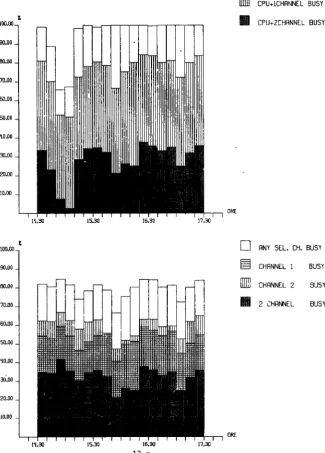
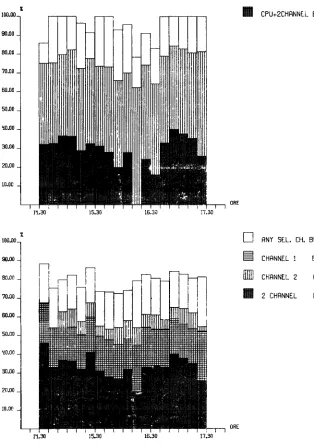
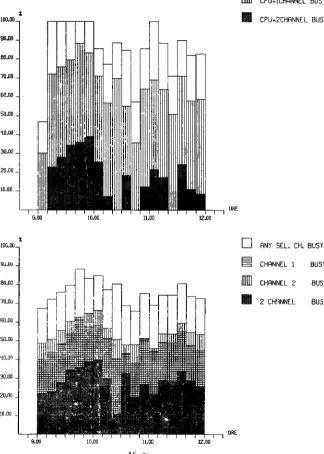
penda~t des périodes de 3 heures mis l'ordin~teur sous contrÔle afin de nous rendre compte de sa charge reelle et non pas seulement de celle résultant du mode problème.
-L'instrument mis en oeuvre est un prograMm~ captant différents paramètres et que nous avions déjà utilisé précedemnent pour tenter d'améliorer le rendement de 1' inst.:lllation (tuning), La charge supplémentaire créée par ce programme de captage est insignifiante (de 1 'ordre de 2;:) .
De façon à réduire au miniiTlum cette charge supnlémentaire nous nous sommes limités à un très petit nonbre de paraMètres
- l'utilisation globale du C.P.U.
- l'utilisation des 2 canaux dédi~s aux unit~s à disques
Les p~riodes mesurées sont:
9.00-12,1)0 14.3'1-17,30 19.30-22,')1) le mardi 10 juin fig.3
le mercredi 11 juin fig.4 fig.S
le jeudi 12 juin fig. 6 fig.7 fig.8 le vendredi 13 juin fig,9 fiq.10 fi'J.11 Quoique la période soit brève
T la variabilite de la charge m~rne pendant des périod~s
similaires de jours différents est assez forte;
- la variabilité de la charge au cours des différentes périodes d'une même journée est fort sensible.
Les graphiques de haut de page comprennent:
- le pourcentage d'utilisation globale de l'unité centrale - le pourcentage de temps pendant lequel l'unité centrale était
active en même temps que au moins un des ?. canaux
- le oourcentage de temps pendant lequel l'unité centrale était active en même temps que les 2 canaux
-Les qr~ohiques de bas de page comnrennent:
le pourcentage de temps pendant lequel au m::Jins un canal était actif
le pource~age de temps pendant lequel le premier cani'll était actif
-
le pourcentage de temps pendant lequel le 2ème canal était actif-
le pourcentage de temps pendant lequel les 2 canaux étaient ·tous 2 actifsLes remarques les plus évidentes sont que au cours de certaines périodes et notamment l'après midi les 2 canaux étaient occupés en même temps pendant 25% du temps ce qui explique évidenment la lenteur de certaines applications conversationnelles pendant ces périodes.
L'unité de calcul était pratiquement saturée (utilisée à 100%) pendant les mêmes périodes.
Le soir l'exécution des gros programmes scientifiques réduisait très fortement l'activité des canaux et l'activité ùu C.P.U. était presque de 100% sauf pour quelques gros programmes particulièrement mal équilibrés (tant6t C.P.U. bound et tantôt
I/0 bound).
Nous ne voudrions pas ennuyer le lecteur par une analyse plus détaillée et nous laissons celle-ci aux soins de ceux qui sont particulièrement intéressés par ce genre de problème.
Notre conclusion est simplement que pendant les heures normales de travail (de 8.30 à 17.30) l'ordinateur était surchargé et ne pouvait plus fournir un service satisfaisant les utilisateurs. Espérons que son successeur sé montrera à la hauteur de la tache.
-
-9-gEEEEEEEEEENEUEEEEEEE
T---r-
-r--T---r--r'
-T--1
cPu
(xl0
2)
5
€
E
E
E
g
E
g
E
g
3g
E
E
E
E
E
g
E
g
E
--r:-*T----r---r-]
*JOBS
(X10
2l
EEEEEEEEEEEgEEEHEgHgE
1000
I/0
(xt0
2)
tseasEEEEEENE$EH$EE$E$EEEs$E$$s&EE
rT-rT
ffi
-rT-r-r-rrrT]_1-r-rTT
r= f) |-- (o
\]
t\) :D T-O
n
Fi=
Tntrl
F-l -! frlx
--l 70=
rna
-t
7) TnIroEt]
c)-{n
t
-a
rn
c=-q
T>O
OU@la
frl Or
'lrTd
H
H
b
9.
c')
l,
C,
I
c,
N
ost
nd3
Hllug
ndl
I
m
0s1
ndl-H3lu8
nd3
0rN0uJN03
(F0-(80
0[! Glt
08It ut'1 0:n
mI
097
tHr uz
Fiq' III
0SPT
to/6/Bo DRLLE oRE e.00 RLLE oRE 12.00tr
m
E
CPU BUSY
CPU+ICHRNNEL BUSY
CPU+2CHBNNEL BUSY
E
n*v sEL. cH. BUSY=t
E CHRNNEL 1 BUSY
[]]]l cunru,rt
2
BUSYE
2 CHFNNEL BUsY100.00 90.00
80])0
mr0
60.00 50.00 10.00 30.00 20.00 10.00
$.00
80.00 70.00
50.00
50.00
r0.d)
30.00 20.00
Fiq.
rvOSPT Lt/6/Bo DRLLE oRE 9.00 BLLE oRr 12.00
90l)0
mfi
70J0
60.00
50J0
10.00 30.00 20.00 10.00
100.00 q'JJU
&r.00
70-00 60.00
50n0
,r0Jl0 .
il00.
mJJo.
E cru
BUS)[]ll
cpu*,crRr.,NEL BUSYE
CPU+2CHBNNEL BUSYE
nur sEL. cH. BlrsyE
cnnruMlI
BUSy []l]n cnnNu.2
BUSYE
zcnnmrr
BUSyFig. V
OSPT
t/6/ao
DBLLE oRE 1,r.30 RLLE oRr 17.30n
m
E
CPU BUSY
CPUTICHRNNEL BUSY
CPUT2CHBNNEL BUSY
D
n^rr srL. cH. BUSY-l
E p19111111 1 BUSY
ffi
crnu*r.z
BUsYE
2 .HRNNEL BUSY90.00
&.00
70.00
60.00 50.00 'r.0.00 30.00 20.00 10,00
100.00 90,00
80.00
70.00 60.00 50.00
,t0l)0
[image:13.411.37.363.126.580.2]Fig. r,r1
OSPT rzzozso DRLLT oRE 0s.00 RLLE 0R[ 12.00
100.00
90.00
8(Lm m.00.
60.00 .
50,00 .
10.00 .
s0.00 .
20.00 .
10.00 .
E c.u
Blr3yffi
cpu*rcHo^rNEL BUSyE
mu.zcHeNNEL BUSyE
n*r sEL. cH. BUS'-t
T= CHflNNIL 1 BUSY
ffi
cHnnrrlz
BUSyE
zcrnrml
BUS',gJ.ud
80.00
m.00
60.00
50.00
90.00
30.00 20.00 10.00
11,00
[image:14.412.46.378.114.584.2]-Fig. VII
O5?T prcrgo DRLLE oRE 1T.30 Rr-Lr
oir
n.gon
m
E
CPU BUSY
CPU+ICHFNNEL BUSY
CPUT2CHHNNLL BUSY
tr
rrNY sEL. cH. BUSY=
cHaNNELr
BUSYm
cHHNNET-z
BUSYE
zcun**r.
BUSY90,00 80.00 70.00 50-00 50.00
10Jt0
4t.00 m.00
10,0c
l0[00 $JIJ 80I0
?0.q)
60J10 50.00 ,t0.00
30J0 m.o0
[image:15.412.37.351.133.577.2]Iriq . tr111
0SFT
12/6/80 DBLLE oRE 19.30 RLLI oRt 22.30ItJ0.0u 90.00 80.00 70.00 60.00
50ff
10.00 30.00 20.00 10.00
10000 9lr,lrc
80.00
m.00
60.00
50-00
1000 30J0 2qm
10.00
E cou
BUSY[]lii
cru.,rnor',NEL BUsYE
cpu,zcnRrNtl BUSYE
ror sEL. cH. BUS\E
cnRruut1
BUSYffi
cnnruua-z
BUsyE
z cnanNrr- BUSy21.30
-Fig. IX
OSPT razouao DHLLE oRE 09.00 BLLE oRE 12.00
r00.o)
9J!0
80.00
70i0
60-00 50.00 .t0.00 30.00 2D.AO 10.00
gU.UU
80.0c
70.0i
80.00
50.0!
,10.c4 30.00
20,0t)
10.00
n .ru
BUSYilil
cpu,rcnRuNEL BUS,E
ce.,*zcHq*Ntl BUSYI
n,.ry sEL. cH. BUsY-=
CHHNNEL1
BUSYM
CHHNNEL2
BUSYE
z cHSNNEL BUsy-r-]
rrl
tlr
llr
1l.m
[image:17.413.41.365.126.580.2]-Ifig. X
OSPT i:zozao DRLLE cRr 11.30 FLLE oRt t?.30
90.00 60.00
70.00
60.cc
50,00
t0J)0
30-0c
m.00
10,00
n cru
BUsYffi
ctu*,arorNEl BUSYE
.pu*zcrRnNEl BUSYI
nrr sEL. cH. BLrsY:
= CHRNNEL t BUSY
m
cHRNNEL2
BUsYE
2 CHRNNEL BUSY100.00 9U.UL 8A.00 ?0.00 60.00 50.00 ,r0.00 30.00 ?0.00
!0,00
16.30
-Pig. Xr
0SPT rauouao DBLLE oRt Ie.30 RLLE oRE 22.30
tr
m
€
CPU BUSY
CPU+ICHHNNEL BUSY
CPU+2CHflNNIL BUSY
E
o^t sEL. cH. BUSYts
cnRlrurr1
BUSYffi
*,n'*u.-.z
B'JSYH
zcmrurrr
BUSYclJ0 80r0 70J0
60.00 50.00 ,10.00 30.00
mff
r0.00
lulm
$J.l
mr0
m.00 60i0
50.00 ,10.00 31.00 20.00 10.00
2t.fi
-OED NOTES
i.
DorcllfntroCuction
In the Newsle'-ter No. 42, llay 1980 sonr: details were given about
the T.u.c.c. o.E.D. E.Jitor whici'r is now available for use on the TSO system. This is the first of an occasional series of articles giving some notes on the use of tl.Ie additional facilities of the QED Editor (as cornnared with the normal EDIT system) .
The ALTER Subcom'nand of QED
The AITER sribcommanrl is one whic\
standard TSO Editor. is not available using the The ALTER subcommani is useC to nodify a record. T\e enlire
record rvilI be displayed at the userrs terminal and tiren the
terminal carriage (or the curscr on a V.D.U.) i,Iill be positioled on the next line at a suitable point to enable the user to
change the string of characters hthich has been requested.
Ful1__s.-pec-i.f ,_cat-igl--",!__t]9}!._r_q3 Subconnand
.
[*
I
f.urriug.-oosition-count)
(ar,rrn)l
ll
I]
ll
ti.,.-ro.t trrne-no.2ll{
|l^ J[ r""i,".r
-](1,""r"o"
no"iti.,,-=t.i,,{
(for full details of
TSO Cornmand Language the syntax notation
see tile IBi4 manuel: Reference lcc28-67321)
-19-Definition of operands
1 ine-no. - 1
specififes the line which is to be altered (or the start of the range of lines when used in conjunction with line-no.-2)
line-no. - 2
specifies the last line of a range of lines to be altered. The specified range of lines are scanned (starting at line-no.-1) until as occurrence of the string (specified in the carriage-position-string operand) is found. The record is displayed and the cursor (or carriage) is then positioned under the string. The user may then enter a replacement
string.
If the AIL operand is specified then this Drocedure is repeated for all occurrences of the specified string r^rithin
the specified range of lines.
*
specifies that the tine to be altered is the line indicated by
the current Line pointer. this is the default if no line (or
range of lines is specified).
count
specifies the number of lines
the posirion indicated by the you vrant to alter, starting atasterisk.
carriage-position-couna .
specifies the numeric position in the displayed record at which the amendment is to beqin (the first character of the
record is position 1). The record is displayed and the cursor
(or carriage) is positioned on the next line^ under the
specified charactei position. The user .uy 'th.r, enter
replacement characters for those irutediately above. Note that if carriage-position-count is specified with a range of lines, then the ALTER will be performed for all of the range of lines. This will occur even if the ALL operand is not given.
-20-carriage-pos i tion-s tring
specifies a character string which is to he locaterl in the
appropriate record(s). The start of this string defines the
position in the record at r+hich the am3ndment is to begin.
The record is displa)red and the cursor (or carr-iaqe) is positioned on the next line under the start of the specified string. The user may then enter replacement characters for these immediately above. The rules for delimiting this string are the same as in the FIND subcommand of EDIT (or 2ED).
ALL
specifies that every line within the specified ranTe of lines which contains the string carriage-position-string should be processed by the AITER subcorunand. Only the f-i-rst occurrence
of a string on any line will be founC. If the ALL operand is omitted and a range of lines is specified, then tlle AITER will
end after the first occurrence of carriage-position-string.
Phvsical Terrninal Considerations
On IBI{ 3270 terminals lines typed by the user are alwa.zs offset !:y one position to the right. Because of this acti\n, it is not convenient to use the ALTER sul)conmand vrith such terminals. llowever, for other terminals (such as 27t+1 and ilazeltine 1500)
the ALTER subconunand witl be nost suitable for manv situations.
-Example
Given the folLowing record (in the data set being edited by
QED) :
0000 50 rJKLrlAtscDEg 8765tt32
To change the string ABCDE to 12345 using the
"carriage-position-stringrr facility the user may enter:
AITER 50 ,/Ats QED will respond with:
IJKLIIABCDEg 8 7 55432
and the place the terninal carriaqe (or cursor) und.er the letter A in ti-le display of record 50.
The user wiIl then enter the strinq 12345.
The new record will then read: rJKLM1234598765432
Thus, the entire sequence would be:
ALTEn 50 /A3 c-.--____
II(LI{ABCDE9B765tt32 lines typed by the user 12345 <
The same result would be obtained by using the
"cariage-position-count" facility in the fotlo'aing vray: ALTER 50
IJI(LI{ABCDEg3755tl32 _Iines tlzped by the user 123q5
-22-OED IIANUALS
i. Dorolt
As already stated in llewsletter No. 42, June 1980 (in tile article "TSO Changes"), it is possible to purchase copies of the
manual "TUCC TSO Editor-QED" from the Conputing SuDPort Library. I{owever, it is aLso possible to obtain directly a Iisting of a
more up to date version of the nanual. This listing, unlike the
actual manual, is printed with only capital letters.
we no$, recommend that users make use of the more accurate
version of the manual from the listing.
Users may obtain a copy of this listing by using the LQEDMAI'I TSO
command procedure in the follor"ring way:
tqedman @
DirA sgr Y-r,$s$r$c.$s$c$R$A.cNrL Nor rlr cArALoG
SAVED
UTILITY DATA SET NOT FREED, IS NOT ALLOCATED
ACCOUIITIIiIG I{UI\4BER = 88889999 :
SPECIFY BOX NO. AND PROGRAIOIERIS NA}IE.
...4.. (3 NUIIERrCS AND rlAX. 15 PJPHAIIUIITRTCS)
aaabbbbbbbbb @3l)
YOUR JOB IS I,IAI{ED ITSOXXXI NAD I{AS BEEiI PASSED TO IIASP.
In this example the user must type his
identification to replace'aaabbl:bbb....'. box number
and
The listing will be produced and placed in the appropriate box.
A copy of tlre listing is available for inspection in the Computing Support LibrarY.
crrata Corrlqe
In the lleusletter l{o.43, JuIy 1?80 in the statistics given on
pages 15 and 16 t:1e month specification slrould read June 1980
and not July 1980.
-23-Statistics of cornrrutihg installation utilization.
Report of con?ui-inq installation e-xploitation for the month of Julrr
General
Number of r.rorking dayrs
I,lork hours from 8.O0 to 24.0Q for
Duration of scheduled naintenance
Duration of unexpected naint-enance
Total n,aintenance tirne
Total exDloitation tine
CtU tine in prob-len rnoCe Batch Processinq
Nunber of jobs Nurnber of cards input Number of lines Drinted
Nunber of cards Dunched
CPU time
Nusrber of I/O (Disk)
IJunber o!..I,/O (Paqnetic tane)
T.S.O
Number of LnGONrs
Number of rnessaqes sent bv terminals
Nunber of messages received b.,, terrninals
CPi; tilae
Nunber of I,/O (Disk) Connect ti:ne
rtrs
Total tiT\e service is available
CPU time
Nunber of I/O (Disk)
YFlr, 197.) 22 ti
1 5. 0^h
22.57h
20..17h rr2.8qh
3^9.16h
1 rt7.80h
YE,rF 1980 23d
1 5. 00h
1 5.84h
3 9. 52h 55.36h
31 2.54h
1e3.54h
7 637
1 555n00
2571 0000
377 000
151.35h
I 9563000 4024000
5637
1 s72558
22882000
1 201 00
131.31h
't 75170nn
3824 noo
2637 3700
1 53503 26700^
854613 1684000
1tt.72h 20.91h
1977000 31 1 8000
1662.89h 2785.8r1h
110.77h 91.55h
1 .77h 1 .38h
5443n0 283000
-Util.isation o! conputer centre' by
accounts for the nonth of .lu1y
objectives and apnropriation
't98C.
rFI' 370l1 55
enuivalent tine in hours
1.20.2 ceneral Serrices - Adnlnistration - Isnra
1.20.3 ceneral Services - Technical - Isnra
1 .3 0.3 Central l,Iorkshoo
1.30.4 L.l!.A.
33001 P.eacior Safetv
33002 Dlutoniun Fuel and Actinide Pesearch
33 003 IIuclear l$aterials
33004 Slfeguards
3301 1 Solar Enerqy
33012 Hydroqen
33013 Desion Studies on Thernonuclear rusion 33021 Environment and Fesources
33030 METRE 33 041 Infornaties
33044 Training
330q5 Support to the Conrmission
33300 ESSOR
1.94.0 Services to External Users
78.82 0.41 0.72
1 89.09
n.21
8.19
9.37
0.05
0.33
21 .99
12.21
3.06
50.80
5.89
4s.83
386.98
7.00
393.98
-25-TOTA],
BATCH PROCESSING DISTPTBIITED BV RFOI.'ESTED COPE }iEIilORY SIZE
NOTE.
All tines are i.n hours.
rrEcruivfl rneans er{ui.ralent.
"Turn" means turn around.
AJ-J- I/A transfers are neasured in 1000ts.
PERCENT,IGE OF JOBS TTIIISHED I\1 LESS THAN
Iror histogram of equival,ent time
1:Ieasc see page 29.
100 200 300 400 500 800 I 000 1200 1400 71 400
No. of jobs Elapsed tirfle
CPU time
nEquiv" tine "Turn" time
r/o (disk) I/o (tape)
2380 77 3.0 24 1.2 21 tt3 1934 2'187 168 22.9 q9 2.5 '5t|21 709 982 156
24 .0
50
4.2
3654 191
1'.t 02
280 59.8 ,l00 3.s 5260 969 175 127
2t+ .3
4n
4.3
2208 't 89
55 1n 2.tl 4 4.5 264 1 8 18 9.0 9 7.5
:,
118 23 7.9 9 5.3 112 2 18 16 4.4 8 6.4 451 3TIIUE 15nn 30mn thr 2hrs 0hrs Shrs lday 2dav 3da.z 5r-ray
$year 197
Syear 'l 98
76 88
6Lt 78 31 25 47 38 93 92 52 51
c9 100 100 100
98 100 1n0 100
-26-Stati.stics of conputino installatj-on utilization,
Renort of conputinq installation exnloj.tatj.on
for the month of Auqust 1900.
General
Nurnber of, vrorking davs
I,lork hours from 8.n0 to 2q.00 for Duration of scheduled maintenance
Duration of unexpected maintenance
TotaI maintenance t.ine
Total exploitation time
CPU time in problem mode
Batch Processinq
Nunb*:r of jobs
Nunber of cards input
Number of lines r:rinted
Number of cards punched
CPU time
Number of I,zO (Disk)
Nunber of l/O (Ilagnetic tape)
T. S.O
Ilumber of LOGONTS
Number of messages sent by terminals
Nurnber of nessaqes receiyed by terminals
CDU tine
Nurnber of I/o (Disk) Connect tine
I}!s
Total ti:ne service is availabLe
CPU time
llumber of IrzO (Disk)
ytr,l !. t 97 C
22d
1 6. noh 1 9.57h
48.1 7h 67.Srlh 244. t 6h
110.97h
sl95 t091700
1 7087500
7 n900 99. 54h
1 5329500
3367200
vIAp I 980
Bd
1 6 .00h
10.34h 9.84h
20. 1 8h
1 07 .82r
34r40h
2491
371 300
7201 000
1 04000
30. 03h 5997000
1 51 5000
1947
1 1 89 1 12000
81 80063091
7
5703009.95h
4.21h1s37200
9s40001 21
4.67h
699.90h1 91
.+0h
30. 90h1.48h
0.16h41
7900
88400 l,IoteIn the month of August tile central service functioned for onl,r
I days (due to air-conditioning maintenance)
3 days were with the IBil 370/155 and 5 days witj] the arrD-cHL
470/v7A.
TIlis explains tl)e unusual and untypical statistics sitown on
Utilisation of comnuter centre by objecti'res and aporonriation
accounts for the nonth of Auqust 1980.
rB}| 370l1 65
eaui'ralent time
in
hours1.20.2 General Serrices - Adninistration - fspra
1.20.3 Gene-ral Services - Technical - fspra
1 .30.3 Central I'Iol:kshon
1.30.4 L.Ir.A.
33001 Reactor Safety
330n2 plutoniu:r Frrel and Actiniale Pesearch
33003 Nuclear lraterials 3300q Safe"ruards
3301 1 Solar Enerqy
33012 Hydroqen
33013 Desiqn Studies on Thernonuclear Fusion
33021 Environnent and Pesources
33030 METBE
33041 fnformatics 33044 Traininq
33045 Support to the Conmission
33300 ESSOR
1.94.0 Services to E<ternal Users
TOTAL
TO?i\L
I .67
0.13
0. 03
115.56
0. 05
2 .18
2.77
0.04
0. 17
3.28
3.85
0.20
9.39
2.09
3.12
81 .54
1 .2tt
82.78
-BATCH PROCESSING DISTRIBTITED BV RFOUESTED COI'E II4II.]iORY SITE
100 200 300 400 600 Bn0 000 1 200 1400 >1 400
No. of jobs Elapsed time
CPU time
"Equiv'tirne "Turn" tir".e
I,/o (disk) I/o (tape)
814 24 0.6 8.9 1.0 73 3 1047 7s7 65 4.1 13 1.4
127 1
145 298 39 5.7 15 3.3
1 265
71 265 5?-o.5 19 3.3 123q i04 140 18 3.8 7 3.3 503 35 26 10 1.4 4.3 27_8 4 0.6 0.5 n.5 1.5 4 2Lt 7 )q q an 89 7 2 0.3 0.0 o.2 1.5 2_6 NOTE.
AIt tines are in hours.
"Ecluiv" rneans equivalent. "Turn" neans turn around.
A11 I/o transfers are measured in tn00rs.
PEPCENTAGE O]' JOBS F'INISHED IlI LESS TI'II}I
HISTOGRAN OF TOTAI. EOTJIV^I ENT IIIIL(IIRS,'
JAN FEB NAP
^PN
NAY JUN JtI. AUG sFP OCI NOV OEC
ProJecred ?orot Torol, For 1979
For 1980 = 3a65 Hours(uslhg qveroge)
ros 3292 xours
-29-TIME 15r.rn 30mn 'lhr 2hrs 4hrs thrs ldav ?dav 3<1av 6day
fiyear 1979
flyear 1 990
36 50
44 59
56 72
81 92 95
82 !1 95
98 100 100 100 98 100 100 100
.ou
lmll**l
REFERETICES TO THE PERSONIIEL/FUIIC?IOI{S OF T}IE CONPU?ING CEN?RE
t'lanaqer of TiIe ComDutinq Centre
Responsible for Usef Registration lls.
ODerations Sector
Responsible for the Conputer Roon Substituted in case of a!:scence by: Responsible for Peripherals
Svstems Group
Responsible for the group
Substituted in case of abscence by:
Responsible for TSO Registration
J.Pire
.i. Ilartbs
A. 3inCa-:los s e tt i
G.llocera
D. Kiinis P. A. ttoini I
C. )aolio
Informatics SupDort Scctor Responsible for the Sector Secretary
Responsible for User Support
ceneral Inf ./Support Library
(f.f.) H.de Wolde
:lrs . G. Iludry
. II.de IIolde l,lrs. A. Canbon
I1c)0m Tele.
1 883 1259 1 873 787
1 a83 1259
1g't1 730
1 370 731
Advisor'., Service/List of Consultants(see ilote 1)
A. Inzaghi
R. Meelhuysen Il.I. de Wolde
NOTE 1. The adyisory service is availabte in the same roon as
the Conputing Support Library(room 1870). Exact details of the
advisory service times for a specific week can be found at the head of any output listing(for that weel-.) .
Any informatics problen may be raised. Ilowever, the servi:e is not designed to help users with problerns rvhich are tireir sole
responsibility. For example, debugging of th-r logic of prosrams
and requests for information which can easilv be retrieved fron available documentation.
If necessary, other competent personnel fron the informatics
division may be contacted by the consultant but not directt!, by
The users should onLy contact the person who is the consultant for that specific day and only durj,ng the specified hours.
Outside the specified hours general information may be requested from t{rs. A. Cambon in the Computing Support
Library.
A. A. Pollicini
I,l. Do'r,re11
-3C-HOIJ TO OBTAIN COT1PUTING CENTRE DOCUIIENTATION.
persons interested in recei.ring copies of tlle Co:nputing Centre
"green books" or in receiving regularl:/ the "Conputing Ccntre Ner^rsletterrr are requested to comolete the appropriate pal:t of the follor^ring form and send it to
:-Ms. A. Canlf,on Support To Computing
Iluilding 36
TeI. 730.
Indicate vrith a (14 whic't options are required.
NA]lE
ADDFTESS
Please add my name to Newsletter mailing list
Please send me copies of the following "green books": JRC-TSO Primer
GRAPHIT
Towards a l{ev, Programming Style LIBRARIAN