COUNCIL OF THE EUROPEAN UNION
Brussels, 7 June 2004
10131/04
ENER 157
COVER NOTE
from: Secretary-General of the European Commission, signed by Ms Patricia BUGNOT, Director
date of receipt: 2 June 2004
to: Mr Javier SOLANA, Secretary-General/High Representative Subject: Commission staff working paper:
The market for solid fuels in the Community in 2002 and 2003
Delegations will find attached Commission document SEC(2004) 692.1
________________________
Encl.: SEC(2004) 692
COMMISSION OF THE EUROPEAN COMMUNITIES
Brussels, 1.6.2004 SEC(2004) 692
COMMISSION STAFF WORKING PAPER
COMMISSION STAFF WORKING PAPER
The market for solid fuels in the Community in 2002 and 2003
CONTENT
1. MARKET OVERVIEW... 4
1.1 INTERNATIONAL COAL MARKET SUMMARY... 4
1.2 STEAM COAL: MARKET SUMMARY... 6
1.2.1 European Demand... 6
1.2.2 Supply into Europe... 7
1.2.3 Freight Increases ... 8
1.2.4 Asian Demand... 9
1.3 COKING COAL – MARKET SUMMARY... 10
1.3.1 EU Coking Coal Demand... 10
1.3.2 Metallurgical Coal Supply to the EU ... 11
1.3.3 Price Trends ... 12
2. THE EU MARKET... 14
2.1 THE ECONOMIC SITUATION IN 2003 AND THE OUTLOOK FOR 2004... 14
2.2 HARD COAL PRODUCTION IN THE EU. ... 15
2.3 EU COUNTRY PROFILES... 18
2.4 THE ACCESSION COUNTRIES ... 23
3. STEAM COAL SUPPLY ... 24
4. COKING COAL ... 28
4.1 DEMAND AND SUPPLY (excluding PCI) ... 28
4.2 PCI COAL... 29
4.3 EXTERNAL SUPPLY OF METALURGICAL COAL ... 30
5. METALLURGICAL COKE... 31
6. FREIGHT MARKET ... 33
7. LIGNITE ... 34
7.2 LIGNITE IN THE ACCESSION COUNTRIES: ... 36
8. PEAT... 37
9. STATE AID TO THE INDIGENOUS HARD COAL INDUSTRY. ... 37
10. Data tables... 41
The following definitions apply in this document:
• Steam coal: coal used for the generation of electricity and heat. • Coking coal: coal used for the production of coke.
• Metallurgical coal: coking coal plus PCI coal used in the steel industry.
• PCI coal: Pulverised Coal Injection: thermal coal injected into the blast furnaces.
This report has been produced using data provided by the Member states in November 2003 and observations from market participants.
1. MARKETOVERVIEW
1.1 INTERNATIONAL COAL MARKET SUMMARY
Although the world production and consumption of coal, both for electricity generation and steel production, is growing at a steady pace, the world economic recession of 2001 and its partial recovery during 2002 saw coal consumption fall in 2002 in all regions except the Far East. However, with the strengthening of the global economy in 2003, coal demand and consumption increased more than forecast in most regions, particularly in the Atlantic Basin.
During the second half of 2003, the international coal market changed dramatically following China’s unexpected and dramatic increase in domestic demand in both the power generation and steel sectors. These events in China were primarily responsible for an escalation in global freight rates not seen in the past 30 years, particularly for deliveries into Europe.
Delivered prices of steam coal into Europe rose from around $34.50 at the beginning of 2003 to over $62 towards the end of the year.
The scale of China’s demand growth for imports of raw materials for its booming steel sector, which became evident at the beginning of Q4, 2003, coupled with a government decision at the end of November 2003 to severely curtail steam coal exports because of chronic domestic supply shortages, has thrown into question the level of future export volumes from China of steam coal, coking coal and coke.
It has also started yet another round of further steep freight rate increases in an already record high market.
With exports from Poland possibly set to fall during 2004 and South African shippers reaching their limits, analysts are forecasting a tightness of supply and continuing high price levels in the coming 12 months for all major coal products – steam coal, coking coal and coke.
The level of production fell slightly in most producing countries, particularly Colombia which reduced output by 2 million tonnes, and to a lesser extent South Africa, in an effort by producers to prop up the continuing fall in market price levels in the first half of 2002 in the hope of recovery.
Coal consumption in the European Union totalled some 251 million tonnes in 2002, of which around 207 million tonnes was steam coal for power and heat generation and 44 million tonnes coking coal for iron, steel and coke manufacturing.
COMPARISON OF THE MAIN FEATURES OF THE SOLID FUEL MARKET (million tonnes)
2001
actual
2002
actual
2002/2001 (%)** HARD COAL
Resources
- Production 78.3 73.8 -5.7
- Recoveries 1.5 1.8 +22.3
- Imports from third countries 192.7 180.0 -6.6
Total 272.5 255.6 -6.2
Deliveries
- To coking plants 45.6 41.9 -8.2
- To power stations* 183.7 185,2 +0.8
- To others 24.9 23.7 -4.9
- Exports to third countries 0.7 0.5 -21.7
Total 254.8 251.3 -1.4
COKE Resources
- Production 34.0 29.3 -14.0
- Imports from third countries 10.4 9.6 -8.3
Total 44.5 38.9 -12.7
Deliveries
- To steel industry 38.9 34.4 -11.4 - Other deliveries within the Community 4.7 4.0 -15.0 - Exports to third countries 0.0 0,4 +814.7
Total 43.6 38.8 -10.9
LIGNITE Resources
- Production and imports 254.1 263.6 +3.7
Deliveries
- To briquetting plants 13.9 13.8 -0.9 - To power stations 239.8 246.4 +2.8 - Others (incl. exports to third countries) 1.7 1.5 -13.1
Total 255.5 261.7 +2.5
PEAT Resources
- Production and imports 13.0 n.a.
Deliveries
- To briquetting plants 0.0 n.a.
- To power stations 8.9 n.a.
- Others (incl. exports to third countries) 3.1 n.a.
Total 11.9 n.a.
1.2 STEAM COAL: MARKET SUMMARY
1.2.1 European Demand
In Europe, 2002 started with a depressed market for steam coal, with low demand and prices hitting lows of $34.50 CIF ARA. Coal stocks were rising, with UK buyers dropping 5 million tonnes of imported tonnage in 2002 to 21.96 million tonnes, following record imports in 2001 of 27.1 million tonnes – up from 13.8 million tonnes in 2000.
Buying in Germany slowed down with steam coal imports falling by 2%, but an increase in coking coal imports kept total imports more or less the same as in 2001 at 31 million tonnes. Spain was the only significant buyer in Europe to increase imports in 2002 because of poor hydro availability, with imports increasing to 19.8 million tonnes from 13.1 million tonnes in 2001. During the course of 2003, however, hydro levels hit almost record highs accounting for around 23% of power generation in the first five months.
As prices continued to fall in North-West Europe during the first half of 2002, Poland announced that it would not sell below $25 per tonne FOB. Delivered ARA price levels bottomed out at around $25.80 per tonne.
Depleting stocks and sudden buyer nervousness that further price decreases would not be sustainable lead to sudden buyer activity in the market in the second half of 2002. Over a period of three weeks, the trend was reversed, with prices increasing over $3 per tonne from around $31.10 per tonne to $34.60 per tonne in early October 2002.
Table 1: Demand for Steam Coal Imports in the EU (in million tonnes)
Country 2001 2002 2003 2004
(estimate) (forecast)
Belgium 5.38 4.38 4.98 4.48
Denmark 6.87 6.07 8.07 7.32
Finland 4.50 4.40 7.15 6.15
France 7.42 8.32 8.82 8.82
Germany 22.52 21.72 22.72 22.72
Greece 0.82 0.82 0.82 0.82
Ireland 2.88 2.88 2.88 2.88
Italy 12.51 13.71 15.21 15.21
Netherlands 11.78 9.08 10.08 9.58
Portugal 5.33 5.53 5.03 5.03
Spain 13.14 19.84 18.34 19.34
Sweden 1.12 1.02 1.22 1.02
UK 27.16 21.96 23.96 26.96
Total 121.43 119.73 129.28 130.33
Source: McCloskey’s Steam Coal Forecaster
Apart from a reduction in Spain’s coal demand due to the return of hydro in the first quarter of 2003, everywhere else in Europe the buyer shortage became more and more acute. With a hot summer throughout Europe increasing the demand for air-conditioning in the second and third quarters and low river levels causing French nuclear power plants to cut generation capacity, coal demand for the additional electricity requirement rose sharply.
In Scandinavia also, where the hydro situation was the opposite of that in Spain, buyers remained active. Prices did not stop increasing, reaching levels of around $62 CIF ARA in early December 2003. This was largely due to the escalating freight rates, which reached historic levels, as well as additional demand in the Atlantic Basin.
1.2.2 Supply into Europe
The supplier response to the increased European growth has been realised most dramatically from Colombia, which increased production by almost 10 million tonnes to around 46 million tonnes during 2003. Of this, around 5 million tonnes has been shipped into Europe as producers strove to take advantage of the lucrative market. The balance has gone into the growing US import market.
Other suppliers have been struggling to meet the European demand growth, with the South African railway infrastructure problems continuing and the ownership changes in Russia affecting the expansion of export volumes.
The coal restructuring programme in Poland which is accelerating production cuts to meet new requirements following the country’s accession into the EU in May 2004, may well lead to exports being cut during 2004-2005. This will undoubtedly create greater supply opportunities, particularly for Indonesian and Australian coal, although Indonesia is reported to be nearing its production capacity limits.
Although the price hikes were not as marked in the Asian region as in Europe up to the end of 2003, Australian and Indonesia FOB levels nevertheless increased in line with additional demand from Japan as buyers built up stocks prior to the introduction of the Coal Tax on October 1. In addition, with the Japanese nuclear plants back in operation, coal demand is expected to dip with additional tonnage available for the European market, probably at lower FOB prices.
Origin of hard coal imports into the European Union
0 50 100 150 200 250
1987 1988 1989 1990 1991 1992 1993 1994 1995 1996 1997 1998 1999 2000 2001 2002*
South Africa USA Colombia Australia Poland Canada China CIS Others Million metric tonnes
Coal imports into EU-15 : by importing Member state
0 40 80 120 160 200
1985 1986 1987 1988 1989 1990 1991 1992 1993 1994 1995 1996 1997 1998 1999 2000 2001 2002*
Belgium Denmark Germany Greece Spain France Ireland Italy Luxembourg Netherlands Austria Portugal Finland Sweden U.K.
Million metric tonnes
1.2.3 Freight Increases
Similarly steel production in China has increased from 180 million tonnes in 2002 to around 210 million tonnes in 2003. With an additional 20 million tonnes of new blast furnace capacity coming on-stream in China in 2004 and the government’s commitment to expansionist policies, it looks unlikely that freights will ease for some time.
Other factors instrumental in keeping freight rates high have been the overall global increase in the seaborne trade of iron ore and grain, and the increase in coal demand in the Atlantic Basin, particularly the rise in import volumes into Europe and the United States.
Nevertheless, during the early part of the fourth quarter of 2003, a majority of market analysts were forecasting that demand and price levels would ease, driven by signs of a lack in demand growth for 2004, particularly in the Far East and also, to a certain extent, in Europe.
1.2.4 Asian Demand
Demand is Asia was looking very low from the 4th quarter of 2003 and into 2004 as Japan was set to cut back on coal imports in 2004 with the re-commissioning of Tokyo Electric’s five nuclear power stations, following their closure for safety reasons.
Japan was also expected to have very high stocks from the 4th quarter 2003 onwards, with buyers building stocks before the coal tax took effect in October 2003. This tax is designed to force power generators to switch to alternative fuels as part of the country’s commitment to the Kyoto Protocol. As a result of this tax, Australia exported an extra 5/6 million tonnes into Japan during 2003.
However, the freight market has remained strong. In addition, there has been a sudden announcement in early December 2003 by key Chinese exporters that they had to cut back heavily on exports, with immediate effect, following government pressure to pump all available supplies into the domestic power generation market. With supply from Indonesia already stretched, this put substantial pressure on Australian producers to sell fast every tonne they could produce, particularly to power generators in Korea and Taiwan, pushing Australian FOB price levels to between $40 and $42 at the beginning of January 2004.It is now highly likely that international prices may remain high for some time to come as international availability becomes more strained.
Coal analysts say that the two main features which have driven up the international demand for steam coal during 2003 - Europe’s historic long, hot summer and the temporary shut-down of Japans’ nuclear power plants - will have increased international demand by almost 40 million tonnes to around 440 million tonnes. This higher than expected demand growth created a growing shortage of supply in the second half of the year, with most exporters unable to keep up with extra shipments.
1.3 COKING COAL – MARKET SUMMARY
For hard coking coal importers, 2002 was a tough year, but perhaps not as difficult as the coming one will prove to be. With freight rates at an all-time high and hard coking coal availability set to become even tighter than recently forecast, hard coking coal prices into Europe are currently estimated to increase to $80 per tonne for 2004/2005 deliveries.
The current scarcity of hard coking coal supplies began during 2002, when seaborne demand grew in line with the expansion of crude steel production. Export supply to EU countries fell by just over 4 million tonnes on 2001 levels, but fortunately, demand was also down by some 3.5 million tonnes during the same period.
While crude steel production was down in the EU and North America, there was a 7% growth, totalling 916 million tonnes, in all other iron making regions, with China accounting for a significant share.
The rate of growth in pig iron output for 2002 was slightly lower than for crude steel, while hot metal output reached close to 596 million tonnes in 2002, or 34 million tonnes above 2001 levels.
World demand for seaborne imported hard coking coal increased over 2 million tonnes in 2002 to 114 million tonnes (excluding semi-soft and semi-hard coking coals), up from 112.5 million tonnes the previous year.
In sharp contrast, world export supply fell by 6.3 million tonnes to only 106.8 million tonnes on 2001 levels, according to statistical data compiled by McCloskey’s Metallurgical Coal Quarterly (MCQ). The biggest export shortfalls came from the United States with over 4 million tonnes, Canada at 3 million tonnes and Australia with almost 1 million tonnes less available for world markets.
1.3.1 EU Coking Coal Demand
World trade for imported coal for coke making, which includes trade in all seaborne and overland coking coal (excluding PCI) was 168.8 million tonnes in 2002, with EU demand totalling 38 million tonnes in 2002 and forecast to be around 36.2 million tonnes in 2003.
However, the effect of further possible reductions in blast furnace capacity within the EU will be to reduce the requirement for imported coal for coke making. By 2005 the EU’s requirement is expected to fall to slightly under 38 million tonnes, compared to 43.2 million tonnes in 2000. This assumes the closure of one more integrated steel mill in the UK during 2004/2005, resulting in a loss of 3 million tonnes of iron making capacity and the associated production of coke. Imported coking coal in the period 2002 to 2005 in the EU is forecast to be fall by 2.5%
Coking coal production in the EU is limited, with Germany the only country producing any substantial amounts of indigenous coking coal. This totalled 5.75 million tonnes in 2002 and is estimated at 5.5 million tonnes in 2003. The UK produces some 500,000 metric tonnes.
The principal driving factor for the fall between 2000 and 2003 was the decline in pig iron output, which fell to 89.484 million tonnes in 2002 from 89.714 million tonnes in 2001. During this period, many European steel mills used increasing amounts of blast furnace coal injection, which meant that one kilogramme of coal replaced 1 kilogramme of coke, or around 1.4 kilogrammes of coking coal that would be required to make the coke. The result is a disproportionate drop in the amount of coking coal used as coal injection goes up.
In the EU, pig iron output increased in 2002, compared to 2001, in France (+10%), Austria (+6.7%), Belgium (+3%), Sweden (+2.5%), Netherlands (+1.4%) and Germany (0.8%). Production decreased by 3.1% in Spain and 13% in the UK with the closure of the 2.5 million tonnes blast furnace at the iron making plant at Llanwern.
A number of large steel companies, such as Arcelor, have published plans outlining that they will not continue operating certain blast furnaces at various points in time during 2004 to 2008. For example, Arcelor intends not to continue production at one or more of its smaller furnaces at plants in Florange.
In Germany there is consideration currently being given by the industry to the possibility of constructing a new coke oven plant close to the North Sea. This would go some way to offsetting possible closures under consideration elsewhere.
Total metallurgical coal usage in the EU fell to 54.6 million tonnes in 2002 from 58 million tonnes in 2001, although it is estimated to increase to 57 million tonnes in 2003. However, it is not likely that the usage will continue to rise due to the fact that most blast furnace operators in the EU aim to decrease the amount of coke usage in the blast furnace, generally referred to as the “coke rate per tonne of hot metal”. This is being achieved by increasing the amounts of PCI coal, with coal replacing coke directly.
Also, with one exception, as there are no plans to build or commission new coke ovens, the projected trend into the future is to import more coke and less coking coal.
1.3.2 Metallurgical Coal Supply to the EU
In calendar 2002 shipments of metallurgical coal to EU countries dropped 14% or 3.2 million tonnes compared with 2001 levels of nearly 20 million tonnes.
Of the four major supplying countries – Australia, Canada, the US and Poland, Australian hard coking coal imports into Belgium, Finland, Germany and the Netherlands were up on 2001 volumes. All other countries took less tonnage, with the UK down by almost 1 million tonnes. Canada’s global metallurgical coal exports dropped 11% to approximately 23 million tonnes in 2002. Deliveries to EU customers fell by 1% on 2001 levels to 5.8 million tonnes
Total US shipments fell 15% or 3.5 million tonnes to 19.5 million tonnes in 2002. The biggest fall was in deliveries to the EU, which dropped 22% to approximately 9.6 million tonnes
1.3.3 Price Trends
As concerns pricing levels and fluctuations in metallurgical coal traded, the 2003/04 delivered levels saw decreases of $2.00 FOB per tonne from the previous year.
Canadian and Australian mid-volatile product fell in the range of $43/46 FOB per tonne for delivery the financial year 2003/04.
Similarly, PCI coal also fell around $2.00 per tonne to $31/33 FOB per tonne in the same timeframe. However, with China becoming an importer for PCI coals, all signs point to a price increase in 2004.
US high volatile metallurgical coke strengthened to around $55 FOB per tonne, while the low volatile product stayed unchanged at $52/53 FOB per tonne.
The higher calorific value 6,700kcal/kg PCI steam coal prices also rose by around $1.00 in 2003 compared to 2002 levels and a further price hike is forecast for 2004 as an increasing number of mills favour the ultra low volatile coals from Australia.
The mills are not only using more PCI coals to replace coke but are also turning to the low volatile coals. This is due to the fact that they get better replacement ratios; they can use more low volatile than high volatile product in the blast furnace and, as a result, use less coke.
Signs started to emerge in the market during the course of 2003 that coking coal prices would increase in 2004 due to the tightness of supply in Australia, the US and Canada. The crucial question in Europe is what US exporters do.
US internal prices are currently high. Although there are indications that US coking coal exports may be strengthening, if coking coal prices stay high in the US, more tonnage may be sold into the domestic market. This will mean that less is available for export, with a repeat of 2002 when similar circumstances caused exports to fall over 3 million tonnes compared to the year before. The sudden rise in freight rates during Q3 and Q4 of 2003 has obviously also had a dramatic effect on the delivered prices of coking coal into the EU. The market was already relatively tight for hard coking coal, as well as PCI and semi-soft product, and it could become even tighter in 2004 and 2005 if China continues to import steel-making raw materials at the rate it has been doing throughout 2003. Many coking coal exporters believe this could be the case, with the market preparing itself for substantial price hikes in the 2004 negotiations.
Supporting this forecast also is the emergence of Russia, the Ukraine and the US as significant coking coal importers. Some suppliers believe that China and the Ukraine could together import around 6 million tonnes in 2004, absorbing nearly all additional export capacity.
Traders and some steel mill operators are also saying that there are indications that coke exports from China could be severely cut back to around 10 million tonnes in 2004 from some 16 million tonnes in 2003. This is already sending coke prices to over $170/$180 per tonne.
Association, China’s iron making capacity is forecast to reach 391 million tonnes by 2010, compared to the 2003 output of about 190 million tonnes.
With the global economic recovery on the back of clear signs of the US economy regaining strength, analysts see good output growth in global iron and steel production in 2004. Apart from the EU, demand also looks strong, with growth for steel expected to reach nearly 5%.
In line with the rise in FOB prices of steam coal in the second half of 2003, PCI coals have also climbed some $3 to $5 per tonne to between $31 and $33 FOB per tonne. Further increases are expected for 2004/5 deliveries into Europe. While Australian low-vol PCI into Europe is expected to rise by about $3 FOB per tonne, South American and South African PCI and semi-soft product is forecast to increase by between $4 and $6 FOB per tonne.
With US domestic coking coal prices maintaining a high of almost $40 per tonne FOR, in normal freight market circumstances this would most certainly take the bulk of US supply off the market. However, with freight differentials for shipments into Europe between the US, Australia and Canada at over $15 per tonne (October 2003 freights from Australia to Rotterdam stood at around $34 per tonne and from the US to ARA at about $20 per tonne), the US may gain some ground in the European market over their Australian rivals, despite capacity constraints.
US hard coking coal FOB prices into Europe are forecast to rise by more than $5 per tonne in 2004/5, to around $55/$58 per tonne. These increases will particularly concerns the high-volatile product, which fetched $60/$63 CIF in 2003/2004.
With a freight increase of some $10 per tonne, from $9.50 to $19.75 per tonne for October 2003, the delivered price of US hard coking coal into ARA could hit $75-$78 per tonne or more to compete with the Australian price levels.
Australian suppliers are also expected to seek FOB increases of around $5 per tonne for most brands and although the Canadians are expected to follow suit, their export recovery is taking longer than expected. With the freight levels seen in the 4th quarter of 2003, this could mean CIF ARA prices of around $80 per tonne for Australian hard coking coal for deliveries into the EU in 2004/2005.
The volume of crude steel production in the EU has fluctuated over the past 4 years. While there was a substantial increase from 155.1 million tonnes in 1999 to 163.2 million tonnes in 2000, production dropped to 159.1 million tonnes in 2002. (Source: Eurostat). With the current recovery in the steel industry, production is forecast to increase again to some 160.6 million tonnes in 2003, with a further increase expected in 2004. (Source: IISI and MCQ).
Table 2. EU Crude Steel Output (million tonnes /year)
COUNTRY 2003 2002
Austria 6.26 6.19
Belgium 11.14 11.34
Denmark 0.00 0.39
Finland 4.77 4.00
France 19.76 20.26
Germany 44.81 45.02
Greece 1.70 1.84
Italy 26.70 26.07
Luxembourg 2.68 2.72
Netherlands 6.57 6.12
Portugal 0.73 0.92
Spain 16.47 16.41
Sweden 5.71 5.75
UK 13.268 11.67
EUTOTAL 160.550 158.689
Source: IISI,MCQ
2. THEEUMARKET
2.1 THE ECONOMIC SITUATION IN 2003 AND THE OUTLOOK FOR 2004
After bottoming out in the first half of 2003, the economies of the euro area and European Union turned around in the second half of the year. EU GDP did not grow at all (quarter on quarter) in the first and second quarters of 2003. The average growth rate for the year as a whole is estimated to have been 0.8%. For the euro area, the rebound was driven by a surge in the growth of exports, while the growth-contribution of domestic demand was negative. World GDP growth is estimated to have been stronger-than-expected at 3.7% in 2003. The momentum of global trade boosted by buoyant world economy partially offset the impact of the strong euro. The contribution of net exports to growth in the second half of the year is neutral. Domestic demand somewhat took over in the last quarter of 2003 as the engine of growth in the last quarter of the year. Investment picked up, breaking a prolonged downward trend. However, lacklustre private consumption provided no impulse to growth, except in countries outside the euro area. A rebound to average growth rates of 2% for the EU is projected for 2004, levelling of at around 2.4% in 2005. Apart from the external stimulus from global demand, the main factors behind the outlook for the recovery include accommodative macroeconomic policy conditions, continued disinflation, supportive financial conditions, and progress in structural reforms.
quarter and declined subsequently. Corporate bond spreads dropped to very low levels in the second half of the year against a background of a return of confidence.
Core inflation hovered around 2% in the course of 2003, after the declining trend of 2002. Headline inflation was also sluggish at around 2% and even temporarily peaked at 2.4% in the first quarter of 2003, reflecting price increases in energy and unprocessed food. The average inflation rate in 2003 was 2.1% in the EU. Inflation is nevertheless expected to decelerate to 1.8% in 2004 as a result of the lagged effects of the euro appreciation and weak domestic price pressures. It should decrease further to 1.6% in 2005.
The European Union unemployment rate stabilised at 8% in the second quarter of 2003. No jobs were lost in net terms in the recent downturn and the performance of the labour market is encouraging in comparison to previous cycles. In line with the gradual nature of the recovery and the usual lagged response of the labour market, more than half a million jobs are expected to be created this year. However, this figure should more than double in 2005 as the recovery gathers pace. The EU unemployment rate is expected to remain broadly stable at 8.1% in 2004, before edging downwards in 2005. Unit labour costs rose above trend in recent years as growth of compensation increased and labour productivity fell. With the recovery gaining momentum, the cyclical pick-up of labour productivity, from 0.5% in 2003 to about 1.4% in 2005, should allow for a deceleration of unit labour costs.
The EU-wide government budget deficitdeteriorated from 2% in 2002 to 2.6% of GDP in 2003. The main explanation for the deterioration in the budgetary position is the cyclical downturn; the budgetary stance in the euro area (measured by the change in the cyclically adjusted primary balance) was broadly neutral in 2003. The deficit is expected to remain stable at 2.6% of GDP in 2004, before declining marginally in 2005.
2.2 HARD COAL PRODUCTION IN THE EU.
Hard coal production in the enlarged EU: 1973-2003
0 50 100 150 200 250 300 350 400 450 500
1973 1974 1975 1976 1977 1978 1979 1980 1981 1982 1983 1984 1985 1986 1987 1988 1989 1990 1991 1992 1993 1994 1995 1996 1997 1998 1999 2000 20012002 *
2003 *
2.2.1 France
Hard coal production in France, under the umbrella of state-owned company Charbonnages de France (CdF), is diminishing rapidly in accordance with the National Coal Pact agreed in 1994. Only some 1.5 million tonnes were being extracted in 2003, roughly comparable to that in 2002. With the closure of the Merlebach mine in the Lorraine in November 2003, only the La Houvre deep mine is still in operation. This is scheduled to close during 2004, with CdF expected to wind up its operation by 2007.
Employment has fallen to 4,071 workers in 2003, from 4,850 in 2002 and 5,935 in 2001. 2.2.2 Germany
As one of Europe’s major coal producers and consumers, Germany’s domestic hard coal production continues to diminish with a total of 29.2 million tonnes produced in 2002, a drop of 3.6% on the previous year. A similar level is expected for 2003.
Parallel to the continuing decrease in production, employment levels in the industry fell to 48,700 in 2002, a drop of 7.4% on the previous year. By mid-2003 employment had dropped further to 46,640.
The German hard coal industry restructuring programme is continuing as planned with 10 deep mines currently in operation. The plan foresees that, by 2005, production to be in the region of 26 million tonnes.
2.2.3 Spain
Spain’s produced 13.6 million tonnes in 2002, down from nearly 14 million tonnes the year before. Opencast production increased from 4.8 million tonnes to just over 5 million tonnes, while underground production decreased by 600,000 tonnes to 8.6 million tonnes.
The main mining regions in Spain are located in the Asturias, Leon and Palencia regions, which contain around 98% of the country’s reserves of hard coal.
Employment in the hard coal sectors dropped to 13,450 workers in 2003, from 13,826 in 2002 and 15,409 in 2001.
2.2.4 United Kingdom
Although prices started strengthening during 2002 from the previous year and have continued to do so throughout 2003, UK coal producers are still facing a number of challenges. Some deep mines have had to close because of geological problems, faults and continued financial losses. The largest of these is the Selby Complex, owned by UK Coal and located in North Yorkshire. Consisting of three related mines, the complex produced a total of more than 7 million tonnes of steam coal per annum, making it the largest coal complex in Europe. The entire operation will close by spring 2004.
During the first six months of 2003, production has maintained a steady pace and is expected to be down by around 3% on the first half of 2002.
Total production estimate for 2003 is expected to be in the order of 28.5 million tonnes, about 1 million tonnes less than the previous year.
Employment has been diminishing from 11,439 in 2001 to 9,578 in 2002 with a further fall to 7,650 in 2003.
Production, imports and gross inland consumption of hard coal: EU-15
251 253 257 248 265 266 281 284 292 293 319 340 336 330 330 344 342 344
0 50 100 150 200 250 300 350
1985 1986 1987 1988 1989 1990 1991 1992 1993 1994 1995 1996 1997 1998 1999 2000 2001 2002*
PRODUCTION IMPORTS Gross inland consumption Million tonnes
Gross inland consumption of hard coal in EU-15
0 50 100 150 200 250 300 350
1985 1986 1987 1988 1989 1990 1991 1992 1993 1994 1995 1996 1997 1998 1999 2000 2001 2002*
2.3 EU COUNTRY PROFILES
2.3.1 Austria
All of Austria’s coal requirements are imported. In 2002 imports totalled 4.1 million tonnes, of which 1.8 million tonnes was steam coal for electricity production. A slight increase is expected for 2003 due to the hot European summer and increased power demand.
Coking coal imports reached 2,3 million tonnes in 2002 with the only consumer being the VOEST-Alpine steel works in Linz and Donawitz.
Lignite production and consumption in 2002 was around 1.4 million tonnes, contributing only some 3% of the country’s total power generation. However, the main producing mine in western Styria is expected to close by the end of 2004, with a further undertaking closing by the end of 2006.
Poland is the main supplier to Austria of both steam and coking coal with imports in 2002 totalling 1.5 million tonnes for steam coal; in excess of 798,000 tonnes for coking coal and some 401,000 million tonnes for coke.
2.3.2 Belgium
Belgium imported a total of 9.7 million tonnes of hard coal in 2002, with steam coal totalling 6.35 million tonnes and coking coal some 3.36 million tonnes. For coking coal this represented a drop from 4.2 million tonnes the previous year due to a decrease in steel production and for steam coal a fall from 8.3 million tonnes in 2001. Main suppliers continue to be South Africa and Australia for steam coal and US and Australia for coking coal.
Belgium’s overall coal burn may come down further in 2003, with the completion of Electrabel’s Twinerg CCGT plant expected in the second half of the year.
2.3.3 Denmark
The two main steam coal importers into Denmark, E2 Energi and Elsam imported a total of 5.9 million tonnes in 2002; Elsam 3.8 million tonnes and E2, 2.1 million tonnes which was basically unchanged from the year before.
For 2003, both companies expect consumption and imports to increase; E2 to 2.8 million tonnes and Elsam to 4.8 million tonnes. The extra consumption of some 1 million tonnes for Elsam is largely due to 0.4 million tonnes being taken by the new 600MW Ensted power plant in Denmark which used to be jointly owned by Elsam and Eon, but is now fully owned by Elsam. The balance of the increase will be due to making up for the lack of hydro power.
As in the case of E2, about 50% of Elsam’s imports come from Poland and Russia and the balance mainly from South Africa and Colombia.
Denmark and at the end of 2003, a decision will be taken as to whether to continue orimulsion deliveries to Denmark or not.
As in the case with Elsam, the rest of E2’s increase is due to lack of hydro energy which persisted well into 2003 following the long, hot European summer. With wind power also down in Denmark and Germany, demand by Denmark’s coal-fired plants may be even greater in 2003 than estimated.
While steam coal imports were well over the 4 million tonnes mark in the first half of 2003, Denmark’s electricity production was nearly 25% higher in the first half of 2003 on last year’s levels, as its power exports continue to increase into northern Scandinavia and Germany.
2.3.4 Finland
Like its other Scandinavian neighbours, Finland has suffered a chronic shortage of hydro power. Coupled with a drop in electricity imports of more than 60% and low coal stocks, this has caused steam coal imports to surge during 2003. Forecasts estimate total steam coal imports for 2003 at more than 7 million tonnes, compared to 4.52 million tonnes in 2002.
Coking coal imports have been increasing to an estimated 1.5 million tonnes in 2003, from 1.26 million tonnes in 2002 and 1.47 million tonnes in 2001. Imports of coke have also gone up from 292,000 tonnes in 2001 to 476,000 tonnes in 2002 with a similar level forecast for 2003. However, with the ongoing steep rise in coke prices on the international market, the 2003 import figure could be lower.
Even though Finland continues to take supplies from a wide range of diverse sources such as South Africa, Indonesia, Colombia and Norway, the main traditional suppliers Poland, with 1.3 million tonnes, and Russia, with 2.4 million tonnes in 2002, continue to hold prime position. Coal, demand in 2004 will depend highly on weather conditions restoring hydro supplies in the Scandinavian region, along with power imports from Norway.
2.3.5 France
With coal-fired electricity production largely replaced by nuclear power, coal makes up only around 5% of the country’s primary energy consumption, with nuclear taking 39% of the share followed by oil 35% and natural gas 15%.
With its domestic production of hard coal now only around 1.5 million tonnes, France imported a total of 17 million tonnes in 2002, an increase of nearly 2 million tonnes on the previous year. About 8 million tonnes was for power generation, some 9 million tonnes for the steel sector and 2 million tonnes for industry.
Key supplying countries were South Africa, Australia and the US. 2.3.6 Germany
However, because of a decrease in power imports and poor nuclear and renewables generation during the summer, it is estimated that coal-burn could increase by about 5% and imports by around 1 million tonnes in 2003.
Even though the transportation of imported coal within Germany experienced difficulties throughout the summer of 2003 because of the severely low river levels, inventories in Germany have been sufficiently high to cope with the problem. The main suppliers to German power stations are Poland, South Africa and Colombia.
Lignite production in 2002 totalled 181.8 million tonnes, of which 168.1 million tonnes went into the power generation market.
2.3.7 Greece
With a large lignite industry, Greece uses only about 1 million tonnes of steam coal for its cement industry, all of which is imported. These imports declined from 1.4 million tonnes in 2001 to about 900,000 tonnes in 2002 and are expected to increase slightly to 1 million tonnes for 2003.
Lignite production is currently about 70 million tonnes per annum from 5 open-cast mines, and this contributes to about 70% to total electricity production.
Greece does not have integrated steel mills so does not import raw iron ore and coking coal for blast furnace production of steel. Instead it produces some 1 million tonnes per annum of crude steel using the Electric Arc Furnace method which involves melting down scrap steel, re-melting it and refining the product.
2.3.8 Ireland
Peat remains the most significant fuel for electricity production in Ireland, with domestic production totalling approximately 5 million tonnes per annum. Between 75% and 80% of domestic peat production is used for power generation and the balance for domestic heating. Around 800-900,000 tonnes of this production comes from the private sector.
The Electricity Supply Board is on target with its modernisation programme of peat generating stations and in 2004 two new power stations will open to replace two smaller and older ones. All the coal used in Ireland is imported. Of the 3 million tonnes imported per annum, some 80% is used at the Monerypoint power plant in County Clare, with the balance used by industry and for domestic heating.
In 2002 Ireland imported about 2.9 million tonnes of steam coal, mostly from Australia, Indonesia, South Africa and Colombia, almost the same volume as in 2001. This volume is estimated to remain fairly steady for 2003.
2.3.9 Italy
Coal burn is expected to increase by more than 1.5 million tonnes in 2003 on the 14 million tonnes total in 2002. All the coal is imported, with Colombia, Australia and Indonesia ranking as main suppliers. Deliveries from South Africa, which stood at around 3.8 million tonnes in 2002, were expected to fall back in 2003 as Italy’s importers intensified their diversification of supply. However, the firm freight market could curtail deliveries from the Far East in favour of South African and Colombian tonnage.
Public objection to the development of new coal-fired power stations continues to gain momentum while, at the same time, the generators, who clearly need to expand generating capacity, are pushing the use of coal for long-term security of supply reasons against the high oil and gas prices. Some oil-fired plant is being converted to coal.
The blackout problems in Italy and in the north of Europe demonstrate the need to strengthen energy networks in Europe, to establish sufficient capacity and to provide alternative transit routes. In this context, the Commission submitted a package of proposals on this question on 10th December 2003.1 Meanwhile, it is forecast that power generation in Italy could remain under pressure throughout 2004 and maybe beyond.
2.3.10 Netherlands
The Netherlands is completely dependent on imports of coal, with a total annual demand of between 12 million tonnes and 13 million tonnes. About 9 million tonnes is used for electricity production, accounting for about one-third of total electricity generation. This level is expected to remain steady for the foreseeable future. However, if coal prices rise substantially, which they have been doing in the second half of 2003 (and particularly during the fourth quarter), then natural gas may increase its share of the market.
In 2002 approximately 5 million tonnes of coking coal and 1.2 million tonnes of PCI coal were imported mainly from South Africa, Indonesia, Colombia and Australia. Although Government figures indicate steam coal imports to be 16.68 million tonnes in 2002, down from a high of 24 million tonnes in 2001, more than 5 million tonnes of these volumes were traded on.
In addition, domestic consumption of imported steam coal dropped by more than 1 million tonnes from the previous year as utility buyers bought from high stockpiles accumulated the previous year.
By far the biggest supplier of steam coal to the Netherlands is South Africa, which totalled almost 7.3 million tonnes in 2002, followed by China with 2.9 million tonnes and Colombia 1.8 million tonnes.
2.3.11 Portugal
With no domestic coal production and its steel industry having closed down in early 2001, Portugal imported 5.6 million tonnes of steam coal in 2002. This is an increase from the 4.8 million tonnes imported the previous year. The estimates for 2003 show a decrease in imports to just over 4.9 million tonnes. About 95% of these imports are for electricity production and are supplied mainly by South Africa and Colombia.
1
2.3.12 Spain
Imports of steam coal totalled nearly 21 million tonnes in 2002, an increase from 15.4 million tonnes in 2001. They are expected to fall to 16.5 million tonnes in 2003 due to the increased availability of hydro.
The decline in imports has been borne mainly by South Africa, dropping from 10.7 million tonnes in 2002 to 9.3 million tonnes in 2003, Australia, dropping from 2.2 million tonnes to 1.3 million tonnes and Indonesia decreasing from 3.2 million tonnes to 2.6 million tonnes. This may be largely also a knock-on effect of the steep rise in freight rates during the second half of 2003. Imports of coking coal totalled 3.788 million tonnes in 2002, compared to 4.235 in 2001. Imported coal continues to be used in blends with locally produced coal and lignite.
2.3.13 Sweden
Most of Swedens’s power is generated by nuclear and hydro, with coal mainly used for district heating. The lack of hydro during the September 2001 to May 2002 “burning season” caused a dramatic increase in steam coal imports in the Scandinavian region, including to Sweden’s EFO, the main coal supplier to the country’s power plants, to generate electricity.
Normally, EFO imports only around 400,000 tonnes/year of steam coal, a marginal figure compared with the larger end users in the region. However, this volume increased to around 700,000-800,000 tonnes over the period July 2002 to June 2003. EFO only imports steam coal from Poland and Russia, with Poland supplying the bulk of the tonnage.
There are three main electricity producers in Sweden. The Swedish Power Board Vatenfall is the biggest generator with the largest number of nuclear power stations and the biggest share of hydro. Sydkraft, which buys some marginal tonnage of coal and Fortum ,who are part-owners of EFO and for whom EFO does all the purchasing. However the main usage for coal is district heating. However, if the price of electricity is competitive, then Fortum can generate electricity in a combined cycle plant.
2.3.14 United Kingdom
Despite the difficulties in the domestic coal industry, coal continues to retain a strong place in the UK’s energy supply and currently accounts for 32% of the UK’s electricity production, just slightly behind gas at 38% and ahead of nuclear at 23%.
Total coal demand in 2002 was 59 million tonnes compared to 64 million tonnes in 2001.
The UK currently produces just under half of its total coal requirements with the balance made up of imports, mainly consisting of steam coal for power generation and coming largely from South Africa, Colombia, Australia, Russia and Poland.
With the steel industry in decline, the diminishing demand for coking coal saw imports fall by around 1.5 million tonnes in 2002 to 6.3 million tonnes.
electricity by 2010 and to increase further to 20% by 2020. It remains to be seen if these ambitious targets will be met. It should be noted that these aims are very similar to those of the Commission which wants to ensure that, by 2020, 22% of the EU’s electricity production comes from renewable sources.
Another major concern for coal producers, as well as for the generators, is the increasing environmental regulations. One of the issues of particular concern to coal producers is the Large Combustion Plant Directive, which has spurred discussions over the approached which should be adopted to meet the targets.
2.4 THE ACCESSION COUNTRIES
2.4.1 Poland
Poland has been a key exporter of hard coal, mainly into the European region, for many years. Total exports have declined from around 31 million tonnes in 1995 to around 22 million tonnes recently. The hard coal industry will have to continue to restructure as Poland enters the EU in the Spring of 2004 and this will have an impact of the level of its coal exports.
Since the mid-1990s, under the government programmes, the main aim has been to achieve gradual pit closures, reduce overall production levels and downsize the workforce, which accounts for some 50% of operational costs.
Of the seven coal corporations which previously existed, producing more than 140 million tonnes per year of steam and coking coal from some 70 mines, today there are three companies producing 102 million tonnes per year from 38 pits plus 2 independent mines. Four of these pits are expected to be closed in the near future. At the same time, the workforce has shrunk from well over 200,000 to around 140,000 in 2002.
In January 2003, the government approved a new restructuring plan for the period from 2003 to 2006 and then revised it in the summer of 2003. Soon after this revision, it announced the intention to close four mines and reduce the workforce by some 35,000 people. However, the number of redundancies was then revised downwards to 25,000.
Although the level of exports has been maintained at around 22 million tonnes per year in the past few years, domestic consumption of both steam and coking coal has steadily diminished to around 75-80 million tonnes per year. The downward trend is forecast to continue to 62 million tonnes per year in 2010 and 59 million tonnes per year by 2020.
At the same time a question mark hangs over the immediate and short-term future of Poland’s export volumes are likely to fall in the coming years.
It has been announced by the exporting agency, Weglokoks, that seaborne trade will halve in 2004 to around 6 million tonnes. While both seaborne and cross-border are set to continue to major customers Germany, Austria, the Czech Republic and the Scandinavian countries, albeit at perhaps lower volumes to some destinations, it is forecast that the only significant future seaborne business to survive will be better quality specialist coals into Scandinavia.
Despite the decrease in production, hard coal will still remain the main source for electricity production.
Poland has also been importing coal in the past few years, mainly from Russia, Belarus, the Czech Republic and the Ukraine, with imports totalling around 2.6 million tonnes in 2002 and about 1.6 million tonnes in 2003.
Although exports of steam coal have been maintained at 20-22 million tonne levels recently, coking coal exports have been gradually falling from 5 million in 1999 to 2.0 million tonnes in 2002 and an expected 2.5 million tonnes in 2004.
2.4.2 The Czech Republic
Coal is still the pillar of the Czech energy resources portfolio, accounting for a 50% share of the country’s total primary supplies. This share was as high as 70% under the central planning period, but has been slowly reduced since 1991under the government’s coal restructuring plan. In 2002 domestic hard coal output reached more than 15 million tonnes and brown coal about 50 million tonnes. The hard coal mines are located in the Upper Silesian Basin and North Moravia, while brown coal is mined from large open-cast pits in Northern Bohemia.
Power utilities, responsible for 60% of total domestic coal production, are the largest consumers, followed by coke ovens 17%, industry 17% and households 3%.
Some 6 million tonnes per year of hard coal and around 1.8 million tonnes per year of lignite are exported to Germany, Poland, Austria, Hungary and Slovakia.
2.4.3 Hungary
Having closed its last hard coal mine in 2003, Hungary produces a total of 14 million tonnes per year of lignite from two open-cast pits and brown coal from underground operations. Lignite, which makes up around 85% of the country’s solid fuel reserves, is the most important indigenous fuel.
Indigenous gas and oil reserves are expected to last about 20 years and made up about 40% and 33% respectively of primary energy consumption in 2002. Coal accounted for 15% and nuclear energy around 10%.
3. STEAMCOALSUPPLY
With the continuing rise in delivered coal prices into Europe, the Northern European producers, Poland and Russia, have not been able to respond by raising exports. With the announcement in September 2003 of further mine closures in Poland, as part of its Coal Restructuring Programme, and Russia’s domestic demand growing, neither supplier has been in a position to take advantage of the lucrative market conditions.
any tightness of supply in the Atlantic market could be made up at short notice by Chinese and Indonesian product, but by the end of 2003, this was no longer so certain.
Table 3: Forecast Supply Availability of Steam Coal (in million tonnes)
Country 2001 2002 2003 2004
Poland 16.00 16.00 16.00 6.50
Russia 23.00 27.50 28.00 27.5
Canada 3.00 1.60 0.85 0.85
US 9.10 5.50 2.60 2.12
Colombia 37.10 35.44 44.94 46.94
Venezuela 8.10 8.10 7.40 8.90
South Africa 68.30 67.75 70.75 72.75
China 71.70 69.55 ? ?
Indonesia 66.60 76.00 88.50 92.00
Australia 86.50 98.60 100.60 104.60
Source: McCloskey Steam Coal Forecaster / Others
3.1 CHINA
At the end of November 2003, the availability of Chinese steam coal for export was suddenly cut following a dictat from the government to exporters to essentially stop exporting. This has raised the whole issue of the shape of future export volumes of Chinese steam coal as well as coking coal and coke.
Severe supply shortages in the southern part of the country forced the government to directly intervene to secure the supplies to 12 domestic generators. The export companies, China Coal, Shanxi Import Export Group and Shenhua were instructed to cancel contractual deliveries for December, 2003.
Electricity generators in Korea, the Philippines and Taiwan were primed to issue tenders for up to 6 million tonnes of steam coal for the first quarter of 2004, with the bulk of this tonnage expected to be supplied by China.
Within the first week of the government announcement, FOB prices and freight rates in Asia took a sharp rise. According to McCloskey’s Coal Report, export FOB prices soared $4 to $38 and domestic prices even further.
As with the sudden steel industry requirement scenario, the international market did not see this situation coming either. The problem appears to have stemmed from China’s railway system being unable to cope with the enormity of domestic demand as well as exports, rather than a failure of production keeping up with demand.
With Indonesia sold out for most of the first half 2004, particularly for bituminous coals, the only realistic alternative supplier to the region is Australia. Within days of the Chinese export cuts being announced, prices in Newcastle rose by about $1.50 to around $32.50 FOB and were expected to keep rising well into 2004.
This situation could have an even greater effect on international prices, for both steam and coking coal into Europe. The unpredicted level of demand in China in both the generation and steel sectors will not only force international freight rates even higher than December 2003 levels, but also push FOB prices for both steam and coking coals higher as export supply is further strained.
3.2 POLAND
European coal buyers as well as freight brokers continue to watch closely what the likely export figures from Poland will be in 2004. Although the export agency Weglokoks states that close to 15 million tonnes will be exported in 2004, of which 1.5 million tonnes is hard coking coal, some buyers and analysts question this figure in view of further mine closures.
Weglokoks has stated that seaborne exports will be halved in 2004 to between 6 million tonnes and 7 million tonnes, and during the second half of 2003 Poland already had to defer some of its 19.5 million tonnes contractual deliveries into the first quarter of 2004. For this reason, there has been no new business booked for delivery in the first quarter of 2004.
However, in early December 2003, Weglokoks was offering steam coal into the export market for delivery from the second quarter of 2004 onwards at over $60 FOB basis 6,000kcal/kg Polish port. But with Panamax rates from Poland to ARA at around $8 per metric tonne at the time, this would have made the offers some $6 above international prices.
In early 2003 Weglokoks had been expecting Polish exports to total about 15 million tonnes in 2004 if there were no further imminent closures, but when Kompania Weglowa announced the closure of four of its mines in September 2003, mining industry sources said this was bound to make a dent in the overall export figure.
Kompania Weglowa, which operates the largest number of mines of the three existing coal corporations, announced it would close four of its 27 mines – Bytom II, Centrum, Polska-Wirek and Boleslaw Smialy. These mines produce a total of 12 million tonnes, of which about 3 million tonnes goes into the export market. These closures could cause exports to shrink to 13-14 million tonnes or even less.
Germany, in particular, stands to be affected more than most of Poland’s customers. Poland is by far Germany’s major coal supplier, with 3.6 million tonnes imported in the first half of 2003 according to Statisches Bundesamt. In comparison, South African imports into Germany totalled 3 million tonnes and Colombian 1.4 million tonnes in the same period.
Polish sources say that if export availability does sink to around 13-14 million tonnes levels, Poland’s cross-border customers will be serviced first and any remaining tonnage will go to seaborne destinations. They indicate that export cutbacks could affect France, which imported some 1.3 million tonnes in 2002 and 1.7 million tonnes in 2003, as well as the UK, which imported 1.24 million tonnes from Poland in 2002 and 1.3 million tonnes in 2003.
The question regarding Poland’s diminishing export availability will be whether Europe’s other major suppliers – Colombia, South Africa and Russia - will be able to sufficiently fill the gap.
3.3 RUSSIA
tonnages of between 1 and 2 million tonnes per year to each country. Although many buyers, sellers and energy analysts say that Russian coal in the medium to long-term will not be able to remain competitive on the international market, it appears that Russia is gearing itself for a greater presence in Europe.
If plans to develop Panamax ports in the Baltic at Ventspils and Riga come to fruition, it will lower the delivered costs of Russian coal markedly and will permit throughput to be expanded, particularly with the development of more mines and the projected production increases. The only question will be the railroad system and whether the high transportation costs ($15 to $20 plus from mine to port) will enable the coal to compete on the world market. Russian industry sources say it will, because there is a serious intention amongst the bodies concerned to keep tariffs at levels which work.
In the continuing strong market, exports should currently be very profitable for Russian suppliers, with around 14-15 million tonnes forecast for the European market during 2003. It is also estimated that an additional 2 million tonnes could be absorbed into Europe in 2004, with the potential for a further 10 million tonnes following the port expansions.
The other side of the story is that there is growing domestic demand in Russia for both steam and coking coal with the recent integration of coal producer and coal consuming companies. With the domestic market always taking preference over exports, this puts the expansion of future export volumes in doubt, especially when international prices drop.
The Scandinavian market is expected to continue as an export priority and supplies to the rest of Europe will depend on price levels and demand growth.
3.4 SOUTH AFRICA
South Africa could also increase its presence on the European market, with additional export tonnage available as current production is far below the upper limits of export capacity.
South Africa’s production increased by more than 3 million tonnes in 2003 to just over 71 million tonnes, from 68 million tonnes in 2002, and is expected to exceed well over 73 million tonnes in 2004. Although South African exports seem to have lost their market position in northern Asia, mainly because of the ongoing high freights, they have held onto their strong position in Europe, particularly in Spain, France and Germany.
Spain imported over 10 million tonnes of South African product in 2002, France around 3 million tonnes and Germany 6.8 million tonnes. These volumes are expected to have risen further in 2003. Further South African production growth will most certainly be accommodated into Europe, but ongoing railway congestion problems will need to be solved for these figures to be realised.
3.5 COLOMBIA
Table 4. Colombian Exports into EU – October 2003 (tonnes)
COUNTRY JAN-OCT.
2003
JAN-OCT
2002
Belgium 147,193 468,069
Denmark 2,164,933 594,258
Finland 0 134,112
France 1,959,868 1,821,986
Germany 542,993 449,106
Greece 0 0
Ireland 299,243 290,346
Italy 1,689,335 1,602,846
Netherlands 5,541,989 6,102,973
Portugal 1,497,445 1,243,125
Spain 1,251,398 928,954
Sweden 41,364 0
UK 2,107,490 1,942,376
EU TOTAL
17,243,251 15,578,151
Source: McCloskey Group
There have been minimal imports of Australian and Indonesian steam coal into the European market in the back half of 2003 due to the ongoing hikes in the freight market.
4. COKINGCOAL
4.1 DEMAND AND SUPPLY (excluding PCI)
In line with the increasing volume of imports of coke is the decrease in imports of coal for coke making. Coking coal imports into the EU have been falling from 43.3 million tonnes in 2000, to 41.6 million tonnes in 2001, 37.7 million tonnes in 2002 and an estimated 36.2 million tonnes in 2003. Again, because of the added coke production capacity in Germany, this is likely to increase to 36.8 million tonnes in 2004.
The only EU countries which produce coal used for making coke are Germany and the United Kingdom. In Germany, the production of coking coal used in coke ovens fell from around 5.75 million tonnes in 2002 to an estimated 5.5 million tonnes in 2003 and 2004, with a further fall to some 4 million tonnes expected in 2005. In the UK, coking coal production is forecast to remain at around 200,000 tonnes through to 2005.
Table 5. Imports of Metcoal for Coke Making into EU (in million tonnes)
Calendar Year
2001 2002 2003
(estimate)
2004 (forecast)
Austria 1,960 1,938 1,882 1,978
Belgium 4,379 4,296 3,024 2,985
Finland 1,297 1,286 1,537 1,603
France 6,974 6,260 6,967 7,359
Germany 4,200 3,377 4,864 5,484
Italy 6,615 5,799 4,457 4,571
Netherlands 3,075 2,953 2,141 2,195
Portugal 97 0 0 0
Spain 3,982 3,560 3,748 3,860
Sweden 1,759 1,548 1,836 1,873
UK 7,263 6,692 5,736 4,859
EU TOT AL
41,602 37,707 36,192 36,766
Source: MCQ
4.2 PCI COAL
Pulverised Coal Injection (PCI) coals are used to displace a proportion of the more expensive coke in blast furnaces. PCI coals consist of a broad range of coals from anthracite to lignite and from low volatile Australian to high volatile Colombian steam coals with some operators blending both types of product. The low volatile PCI coals appear to have a stranglehold in Asia, whereas elsewhere the full range of volatiles is being used.
While the coke making process is operationally expensive, environmentally problematic and requires large capital costs, enabling only coals with coke making properties to be used which command a premium, the use of the PCI product circumvents some of this, enabling operators to use non-coking coals with a substantially lower cost premium and which are operationally simpler to use.
There are limits, however, as to how much PCI can be used as blast furnaces still require a substantial proportion of coke. For example, approximately 500 kilogrammes of carbon-based fuel is used to produce each tonne of hot metal (pig iron). The operational limit of PCI is about 200 kilogrammes of this, with the balance being made up of coke. Nearly all users operate on a higher coke rate and lower PCI rate.
Imports of PCI coals is set to increase in the EU as end users continue to replace high priced coke imports ($170 per tonne plus) with PCI coals ($40 per tonne approx.). PCI imports are also expected to increase in South America and, more significantly, in China as well.
Table 6. Imported Coal for PCI (in million tonnes)
CALENDAR
YEAR
2001 2002 2003
(estimate)
2004
(forecast)
Austria 0 0 0 0
Belgium 1.46 1.55 1.57 1.64
Finland 0 0 0 0
France 2.12 2.32 2.52 2.74
Germany 0.49 1.20 1.50 1.50
Italy 1.36 1.25 1.30 1.32
Netherlands 1.14 1.15 1.19 1.22
Portugal 0 0 0 0
Spain 0.71 0.69 0.69 0.77
Sweden 0.43 0.48 0.53 0.55
UK 0.74 0.74 0.95 0.92
EUTOTAL 8.45 9.38 10.25 10.66
Source: IEA, Other
4.3 EXTERNAL SUPPLY OF METALURGICAL COAL
4.3.1 Australia
Australia is expected to export a total of some 112 million tonnes of metallurgical coal (hard coking coal and PCI coal) in 2003, up from 102.5 million tonnes in 2002.
Seaborne exports of metallurgical coal into the EU fell from close to 20 million tonnes in 2002 to an estimated 17 million tonnes for 2003, according to Australian government and trading sources.
While exports to Belgium and the Netherlands have shown a significant fall of some 15% (576,000 tonnes and 2.0 million tonnes respectively) to the end of the third quarter of 2003 compared to the same period the previous year, exports to France and the UK are growing steadily, totalling 2.8 million tonnes and 2.0 million tonnes respectively at the end of the third quarter of 2003. Exports to Spain dropped by 4% to 1.3 million tonnes in the same timeframe. The overall fall in exports to the EU were largely offset by Australia’s increased volume of metallurgical coal exports to Turkey, Romania, India and China.
For PCI, soft and semi-soft exports, the first six months of 2003 showed exports to the EU falling by more than 8% to just over 900,000 tonnes. However, those to other regions, mainly Asia and North and South America, rose substantially.
4.3.2 United States
In the first half of 2003, shipments to the EU fell by nearly 14% to 4.5 million tonnes on 2002 levels, but increased to other European destinations, South America and the Middle East. These increases pushed up total US exports for the first half of 2003 to close to 11 million tonnes. The gain was not just the strengthening of the US and Canadian dollar, but also the extremely high freight rates which affected the longer haul suppliers.
4.3.3 Canada
Given the negative currency situation for Canadian exporters, shipments fell by some 1.5 million tonnes in the first half 2003 to just over 10 million tonnes. It is forecast that total exports for 2003 will be almost 2.5 million tonnes down on 2002 levels to around 20 million tonnes.
4.3.4 Poland
Poland’s coking coal exports, which totalled around 2.9 million tonnes of both hard and soft coking coal, will be reduced in 2004-5 to 1.5 million tonnes of only hard coking coal. It is not clear where the tonnage will go as negotiations were about to begin in early December 2003. However, it is more than likely it will be distributed between Poland’s traditional customers Finland, Austria, the Czech Republic and Slovakia.
4.3.5 Others
Although Russian coking coal production is reported to have increased over 11% to 26.7 million tonnes, according to MCQ, in the first five months to end of May 2003 compared to the same period the previous year, no exports have been reported into the EU.
Estimates of South African hard coking coal exports to the EU point to an almost 100% increase, from around 980,000 tonnes in 2002 to around 1.8 million tonnes in 2003.
5. METALLURGICALCOKE
The world trade in metallurgical coke currently stands at around 25 million tonnes, with China supplying between 13 and 16 million tonnes per annum.
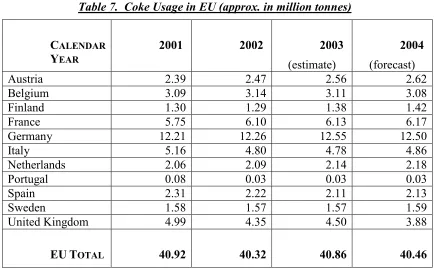
EU imports of metallurgical coke were 9.8 million tonnes in 2001, 10,2 million tonnes in 2002 and an estimated 12,8 million tonnes for 2003. A new coke oven has been commission at the TKS plant in Germany – the only new one in the EU. A large proportion of the coke imports into the EU come from China, in addition to a reasonable amount of intra-EU trade.
The issue over the next 20 years is whether the EU will become wholly dependent on imports or whether new coke ovens will be built. With countries like Poland, a big coke producer, joining the EU, the question will be whether it can produce coke economically enough without subsidies. A number of market observers are doubtful.