0022-538X/79/06-0729/06$02.00/0
Analysis of Proteins of Mouse Sarcoma Pseudotype Viruses:
Type-Specific Radioimmunoassays
for
Ecotropic Virus p30's
STEPHEN J. KENNEL* AND RAYMOND W. TENNANT BiologyDivision, OakRidgeNationalLaboratory,OakRidge, Tennessee 37830
Received for publication24October 1979
Murinesarcoma viruspseudotypeswereprepared byinfection ofnonproducer cells (A1-2), which were transformed by the Gazdar strain ofmouse sarcoma
virus, with Gross (N-tropic), WN1802B (B-tropic), or Moloney (NB-tropic)
vi-ruses. Therespectivehostrangepseudotypesarcomaviruses weredefinedbythe
titration characteristics on cells with the appropriateFv-1 genotype. Proteins
fromvirus progenywereanalyzed bysodiumdodecyl sulfate-polyacrylamide gel electrophoresis. Bands present in both the 65,000- and the 10,000- to
20,000-molecular-weight regions of the gel distinguished the pseudotype viruses from
theirrespective helpers. Furthermore,twoproteinbands were noted in thep30 region of murine sarcoma virus (Gross), onecorresponding to Grossvirusp30, and another of slightly slower mobility. However, since the mobility of the
putativesarcomap30isnearlyindentical to that ofWN1802B,itspresence could
notbeestablishedby sodiumdodecyl sulfate-polyacrylamidegelelectrophoresis.
Type-specificradioimmunoassaysforGrossvirusp30and forWN1802Bp30were
applied for analysis ofpseudotype preparations, and among several ecotropic virusestested, onlythehomologousvirusscored in therespective assay. Byuse
of these assays, pseudotype viruseswerefound to containonly8 to 48% helper-specific p30's; the remainder is presumablyderived from the sarcoma virus.
Cells transformed by defective mammalian
sarcoma viruses have varied contents of viral protein and viral RNA expression (11). Although allhave a rescuable transfornation gene, only somecontain information for certain gag gene proteins(presumablyfrom the "original helper"
orprogenitorvirus), whereas others do not (18).
Thepresence of the viral gag gene is necessary butnotsufficient for expression of these proteins innonproducercells(14); murinesarcoma virus (MuSV) pseudotype viruses, produced by rescue fromnonproducercells,contain gagproteins of
sarcoma origin only ifthe proteins themselves were expressed in the nonproducer cells (11). Passage of the virus pseudotypes to fresh cells
generates nonproducer cells with the same ca-pacity to express gag proteins as the original
nonproducer cell line (1). Hamster cells
trans-formned bytheGazdar strain of mouse sarcoma
virus release noninfectious particles containing mousegs-1antigen(p30).Rescue fromsuchcells
withfeline leukemia virus results inpseudotype virus with feline leukemia virus gp7O but with
mouseandfelinegs-1antigens, whichindicates that thesarcoma virusgenome carries at least a portionofthe gag gene (4, 15). A type-specific radioimmune assay has been developed for two ecotropic mouse retrovirus p30 proteins. The Gross virusstrain(N-tropic), derived from AKR
mice, and WN1802B (B-tropic) virus, derived
from BALB/c mice, were used to rescue the
Gazdar strain ofmouse sarcomavirus from Al-2 cells which had been nonproductively
trans-forned. We report here that these Fv-1
host-rangepseudotypesof the Gazdar strain ofmouse
sarcomaviruscontainmoresarcoma-specificp30
thanhelpervirusp30,althoughinfectioushelper
virusis inexcessbybiologicalassays.
MATERLALS AND METHODS
Viruses and assays.Gross, WN1802B, and Mo-loney viruses were originally obtained from W. P. Roweand JanetHartley (Bethesda, Md.). Pseudotype
viruseswerepreparedfrom nonproducercellswhich weretransformed with Gazdar sarcoma virus (4, 15). Propagationof viruses, XC syncytial plaque assay, and
focus-forming assays were done as previously de-scribed(9).The sources of other virusesareidentified in thetext.
Proteinanalysis.Viruses forprotein analysis were grown on SC-1 cells (9), collected at 24-h intervals, andpurified bysucrosegradient centrifugation as de-scribed elsewhere(Tennant et al.,manuscriptin prep-aration). Sodium dodecyl sulfate-polyacrylamide gel electrophoresis (SDS-PAGE) was done on 4 to 17% acrylamide linear gradient slab gels (8).Pelletedvirus extracted with trichloroacetic acid-etherwasdissolved in 1% SDS, 8 M urea, and 1% 2-mercaptoethanol before itwasappliedtothegel.
729
on November 10, 2019 by guest
http://jvi.asm.org/
Radioimmuneassays.Phosphocellulose chroma-tography and gelfiltrationonUltragelAcA44(LKB) were used for purification of p30's from Gross and
WN1802B viruses solubilized in Triton X-100 (17). These preparations were >90% pure as judged by
stained SDS-PAGEprofilesandinterspecies
radioim-munoassay. Rabbit anta.ato Gross and WN1802B viruseswereproduced by multiple subcutaneousand
intraderma! injections of Tween-disrupted virusesin Freundadjuvant.Virusproteins disrupted byNonidet P-40werecoupledtoSepharose 4Bat1mgof protein perml ofbeadsforantiserumadsorption (8). Serum
wasabsorbed four timesby batchwise incubation of1 mlofserumwith 0.5ml of virusproteinbeads
over-nightat4°Con atumblingapparatus.The finalsera,
diluted 10-foldbytheabsorptionprocess, were
clari-fiedby centrifugationat100,000x gfor 1 h andstored at-200C.
Antisera used fortype-specific radioimmunoassays
were 101p ofafinaldilution of1:120of rabbit antise-rumtoGross virus absorbed with WN1802B proteins (Gross assay) or1:210dilution of rabbit antiserumto WN1802B virus absorbed with Gross virus proteins (WN1802B assay). Interspecies assays ofp30's were
done with p30 purified from Scripps virus and goat antiserumtofelineleukemia virus(OS 268) provided byR. Wilsnackthroughthe Office of Resourcesand Logistics, National CancerInstitute. Targetproteins
wereradioiodinatedwith chloramine-Ttospecific
ac-tivities of 10to20lsCi/,ugandantigen-binding capaci-ties,andradioimmunoassays wereperformedas
pre-viously described (8,16). RESULTS
Type-specific p30 radioimmunoassays.
Rabbit antisera to GrossorWN1802Bviruswere absorbed with viralproteinoftheoppositetype
to remove cross-reactive antibody populations.
Although theserashowsomepreference in
an-tigen-binding capacityfor the immunizing pro-tein before absorption (Table 1), the sera, as
finally absorbed, arespecific for thep30ofthe
immunizingvirus inthatnobinding capacity for thep30of theabsorbing viruscouldbedetected. Homologous radioimmuneassaysfor Gross and
WN1802Bvirusp30'swereestablishedbyuseof these absorbed sera (Fig. 1). Competition of Gross virusp30intheWN1802Bassaywas 200-fold less than that forthehomologousp30(Fig.
TABLE 1.p30antigen-binding capacities ofrabbit antiserum
Binding capacity (yLg/ml) Antiserumto Absorbedwith
Grossp3 WN1802B
p30
WN1802B 50 80
WN1802B Gross <0.1 10.5
Gross 72 27
Gross WN1802B 6.1 <0.1
80
-
60-
40-20
-0
100-_
80-z 60
7
40-z
20-0
100-
80-
60-
40-
20-0
001 0 1o0 10.0 100.0 tOOO.O
INHIBITOR CONCN (ng)
FIG. 1. Radioimmunoassays of ecotropic virus p30's. (A) Goat antiserum to feline leukemia virus reactingwith '25I-labeled p30 from Moloney leukemia virus. Competing virusproteins wereMoloney (0),
WN1802B (0), and Gross (A). (B) Absorbed rabbit antiserum to WN1802B virus reacting with '25I-la-beledp30 from WN1802B virus. (C)Absorbedrabbit antiserum to Gross virus reacting with '25I-labeled p30 fromGross virus.(BandC) Competingpure p3o's from WN1802B (0)orGross(A).
1B), even though these proteins scored equally wellin theinterspeciesassay(Fig. 1A).
Compe-tition pfWN1802B p30 in the Gross assay was
1,000-foldless than that for Grossp30 (Fig. 1C). Sincep30'shavebeenimplicatedastargetsof Fv-1 restriction (3, 6),wesurveyedseveral
eco-tropic viruses of different host ranges to see whether thetype-specific determinant(s) meas-ured by these assayswere relatedtovirus
tro-pism (i.e., do all N-tropic viruses score in the GrossassayanddoallB-tropicvirusesscorein the WN1802B assay?). The results in Table 2 show that this is not thecase.All virusesscoring
in the WN1802B assay do so nearly
quantita-tively. Differences inquantitation betweenp30
detected bytheinterspecies andWN1802B
as-saysweresmall(±20%) unlessassays were
per-formed with labeled p30 preparations thathad been stored for long times. Virus preparations
A Interspecies assay
Mobney (o) WN1802B P30 (e)
GrossvirusP30(a) '
B WN1802B assay
C Grossassay
/
6/o
I IX~
on November 10, 2019 by guest
http://jvi.asm.org/
[image:2.505.64.253.577.664.2]VOL. 30, 1979
TABLE 2.p30 competition radioimmunoassaysof
ecotropic virus isolates
Apparent p30(ng/mJ)b
Vinx8e Fv-1
tro-Interspe- Gross
WN1802B
Psm ciesGross 1,213 1,568 18 N
WN1802B 709 <6 768 B
Moloney 177 8 10 NB
TOR-N 1,488 32 15 N
TOR-B 498 10 10 B
Scripps 62 <6 17 NB
BETH-N no. 1,644 9 15 N
1
BETH-B no. 1,184 6 1,088 B
1
Rauscher 245 21 <8 NB
BTL 365 <6 16 B
ETC18 1,122 <6 1,184 B
M138 2,112 <3 1,600 B
WN1802N 108 <3 2 N
MON-B 1,920 <3 1,184 B
MON-N 1,088 <3 2 N
CCL64-Xeno 370 <3 <1
AKR 1,440 54 23 N
BETH-N no. 1,184 9 5 N
2
BETH-B no. 1,120 <5 1,760 B 2
a
Viruses
tested as infected SC-1cell
supernates. Values in interspecies assay correlate roughly with virustiters.bValues expressed as nanograms permilliliter rela-tive to standard purifiedp30'sof theappropriatetype.
Interspecies assay detects total p30, whereas Gross andWN1802Bassays detectonly p30'scarrying
type-specific determinants.
whosep30 could be detected bythe WN1802B assayweresubsequentlyidentifiedasprogenyof WN1802Bstocks.One exception, M138,was iso-lated from alymphoma of aged BALB/c mice (5). It ispossiblethatthis virusisolate is
iden-tical to WN1802B, because it contains a p30
whichisimmunologicallyindistinguishable from that ofWN1802Band is ofsimilarorigin.Virus
ETC18, which is cloned from WN1802B virus
(12), has a p30 that migrates faster in
SDS-PAGEthan does thep30from its parent stock.
Sinceit competescompletelyandquantitatively
inthe WN1802B assay, thetype-specific
deter-minant(s)measuredby this assayare notrelated
to the large size ofstock WN1802B p30. The
onlyvirus thatscoredsignificantly in the Gross assay was Gross virus. Even the closely related AKR virus showed little cross-reactivity. Thus, both assays measure determinants that are uniquetothe individualvirusand notrelated to
Fv-1tropism.
Pseudotype virus characterization.
MuSV pseudotype viruses fromA1-2were
prop-agatedand titrated for focus formation or XC
plaqueformationonSC-1 cells (Table 3). Each
of thepseudotype preparationshasahigher XC
titerthan focus titer. Proteins from viruses
pu-rified from infected SC-1 cell supernatantswere compared on SDS-PAGE. Figure 2 shows that protein profiles of pseudotype viruses MuSV
(Gross), slot 3; MuSV (Moloney), slot 6; and
MuSV (WN1802B), slot 8differ from those of theirrespectivehelpervirusesGross,slots 2 and
7;Moloney,slot 5; andWN1802B,slots4and9.
Differences are apparent in the 60,000- to
70,000-molecular-weight regionof the gel, where
pro-nounced bands are present in the profiles of
pseudotype preparations [especially MuSV
(Gross), slot 3] but absent from those of the
helper viruses. Furthernore, protein banding
patterns of the MuSVpseudotypes differ from thoseoftXeirhelperviruses in the
low-molecu-lar-weight region of the gel (10,000 to 20,000),
again indicating that sarcoma genome-coded
proteins are present. Finally, adouble band of p30 is noted inMuSV(Gross),slot3.The
faster-migratingband appears identicaltoGross virus
p30 and represents 10 to 30% ofthe total stain intensity, whereasthe slower band has no coun-terpart inthehelper preparation (slot 2) and is
presumably derived fromsarcoma. Nop30
het-erogeneitycanbeseenin theproteinprofilesof
the other two MuSV pseudotypes, since the
helpervirusp30'shave mobilities very similarto
that of the sarcoma virus. To establish that
MuSV (WN1802B) contains two p30's and to
quantitatetherelativeamountsofeach,we
per-formedinterspeciesandtype-specificassayson
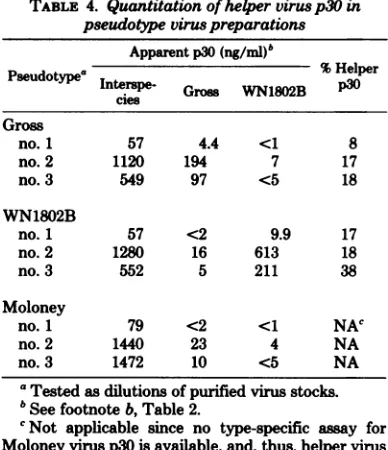
thesameviruspreparation.Table4showsthat
helper p30comprises8 to18%of the totalp30in
MuSV(Gross),which is ingoodagreementwith
estimates fromSDS-PAGEanalysis. Helper p30
represents17to48% of MuSV(WN1802B). As-saysonthefirstexperimentrepresentlow levels of p30, and the two subsequent experiments
indicatethathelpervirusp30contents are 17 to
18%forMuSV(Gross)and38 to48% forMuSV
(WN1802B). Since the
helper
virusp30's give
nearlythe same orslightly highervalues in the
interspeciesasin thetype-specific assay
(Table
2), thedifferencesinvalues obtained in thetwo
assaysfor thepseudotype p30contentsare
rea-sonable estimates of the amount of sarcoma
virusp30present.
DISCUSSION
The mechanism ofhelpervirusrescue of the
sarcoma function is largely unknown. Since
some sarcoma preparationshavenoassociated gag gene (18), it is clear thatsrcgenesarenot
obligatorilylinkedtostructuralproteingenesfor
on November 10, 2019 by guest
http://jvi.asm.org/
732
TABLE 3. Biological assays ofpseudotypes on SC-I cellsa
Focus-forming units or XC plaques atlog,odilution
Virusprepn Assay Titer
1.5 1.8 2.1 2.4 2.7 3.0 3.3 3.6 3.9 4.2 4.5 4.8 5.1 5.4 5.7
MuSV(Gross) Focus 23 10 6 2 1 0 3.0
forming
XCplaques 38 19 12 6 3 1 0 4.0
MuSV Focus TNb TN TN 75 28 12 6 3 1 5.31
(WN1802Fij forming
XCplaques 146 86 37 18 7 3 2 1 5.7
MuSV Focus 57 23 14 8 4 5.3
(Moloney) forming
XC plaques TN TN 60 29 10 5 6.4
Allwork doneat1 cells/wellattimeof infection with1mlof stock virus grown onSC-Icells.Counts are average of two wells in a 4-day assay.
bToonumeroustocount.
[image:4.505.120.403.235.409.2]i- .. ..w
FIG. 2. Acrylamide gradient (4 to 17%) SDS-PAGE analysis of viral proteins stained with Coomassie brilliant blue. Markerproteins slots 1 and 10:phosphorylase A, 96,000; bovine serum albumin, 68,000;
ovalbumin,45,000;myoglobin, 17,000; and horse heartcytochrome c, 12,000. Gross helper virus, slots 2 and 7; WN1802B helper virus, slots 4 and 9; Moloney helper virus, slot 5; MuSV-Gross, slot 3; MuSV-Moloney leukemia virus, slot 6; and MuSV-WN1802B, slot 8.
activity. Helper virus genes must be able to
supply the protein functionsnecessaryfor sar-coma gene transmission. However, since the kindsandamountsofgag geneinformation
pres-entinaparticularsarcoma arepassedtoprogeny
viruses, it follows that thesrcgene mustremain
linked to "original" helper virus genes and
re-combination with rescuing helper virus is not necessaryfortransmission.
Protein profiles of pseudotype preparations studied here are significantly different in the
65,000- as well as 10,000- to
20,000-molecular-weightregions of gels.TheMuSV(Gross) prep-arationalso has two distinct bandsin the p30 region of the gel,oneof which has been identified
withGross virusp30,and the otherof whichis
presumably ofsarcomavirusorigin.
Correlation ofinterspecies and type-specific
radioimmuneassays forp30'softhepseudotype
preparations indicate that less than 50% of the
p30presentis thehelpervirustype.The major-ity of the p30reactivitymustbesarcomavirus specified. This reactivitymaybepresent asp30
determinants on a gag precursor molecule as
well as on sarcoma p30 molecules. It is clear from SDS-PAGE, however, that at least some sarcoma p30 is present in the MuSV (Gross)
preparation.
We cannot determine which p30 helper or sarcomaisassociated withsrcgenevirions,
al-though much indirect evidence indicates that virus proteinsare packagedin a mixed fashion during maturation (10, 13). It is
possible
thatassociationof viral RNA withsarcomap30 gen-erates adefectivevirus and thattheonlyactive virus seen is that small fraction which is
ran-domly associatedwithamajority ofhelperp30.
Thelargeamountofdefectiveparticlesinall
on November 10, 2019 by guest
http://jvi.asm.org/
PSEUDOTYPE VIRUS PROTEINS 733
TABLE 4. Quantitationof helper virus p30in
pseudotyJpeviruw preparations Apparentp30(ng/ml)b
Pseudotypea Interspe-
Gross
WN1802B %HelperP
cies
Gross
no. 1 57 4.4 <1 8
no. 2 1120 194 7 17
no. 3 549 97 <5 18
WN1802B
no. 1 57 <2 9.9 17
no.2 1280 16 613 18
no. 3 552 5 211 38
Moloney
no. 1 79 <2 <1 NAC
no. 2 1440 23 4 NA
no.3 1472 10 <5 NA
aTested asdilutions of purified virus stocks. bSee footnote b, Table 2.
Not applicable since no type-specific assay for
Moloneyvirusp30 isavailable,and, thus,helper virus p30 cannot bequantitated.
type virus preparations could easily accommo-date thismodel.Sincethere is as yet no known function for any of the gag geneproducts, in-dependent tests ofactivityof the helper-versus-sarcomavirusp30'sare notpossible.
It isinteresting to note that although sarcoma
p30is present inlargeramountsthanhelperp30
in both MuSV (Gross) and MuSV (WN1802B)
preparations, theplaquetiter of each is greater
than the focus-forming titer. If p30 src deter-mined focus-formingproperties and p30helper determined XC plaque titer, one should find a correlation of these titers with protein content ofthe pseudotype preparations. However,if
ra-tios of p30 src/p30 helper are compared with
focus-forming titer/XC titer for both
pseudo-types, no quantitative correlation is apparent. Thus, p30 probably does not determine XC
plaqueorfocusformationproperties.The
mech-anism by which pseudotypes can acquire Fv-1
determinantsis not known but involves a
deter-minant other than gp7Osince this virion com-ponent does notdetermineFv-1 host range (7).
Although p30 has been implicated as an Fv-1
determinant,confirmationcannot bemade from
ourstudies.
Although type-specific determinants are
known to exist on
p30's
(2, 12), the extreme specificityoftheseassays was not expected. The Grossassay doesnot detect AKRp30,
although Gross virus was presumably derived from theAKRmouse. TheWN1802B assay iscompletely negative forWN1802N virus isolatedalso from BALB/c mice; furthermore, several other
B-tropic virusesdonot scorein the assay. This in
itself does not preclude p30 as the Fv-1 gene target,since aparticular rabbit antiserum may not recognizeputativeFv-1-specificsites on the molecule. Furthermore, since WN1802B virus p30 is somewhat larger than p30's from other
viruses,it ispossiblethattype-specific
determi-nantsresidein thisareaof theprotein. However,
the fact that ETC18 virus, cloned from WN1802B(12) but withasmaller p30(Tennant
etal.,manuscriptinpreparation),scoresin this
assayindicates that typespecificityof Fv-1 host range is not necessarily associated with the larger-sized p30.
If xenotropic viruses have xenotropic coats
with B-virus gag proteins, as suggested by
Gautschet al. (3), theyshould contain B-virus
p30. Twoxenotropic viruses ofBALB/c origin
didnotcompete in theWN1802B assay, and if
the theoryis correct, these viruses must have
obtained their p30 from a different B-tropic
BALB/cvirus.
M138 virus fromaBALB/clymphomahasa
p30that scores in theWN1802B assay, and since WN1802B virus is an endogenous virus of BALB/cmice,this indicates thatgenetic infor-mationcodingfor thisproteinisactivatedfrom
theendogenousstate.Thesynthesis ofthis
pro-tein, monitored with thetype-specific
radioim-munoassay throughout the BALB/c life-span,
maycorrelatewithleukemogenesis.
Finally, type-specificassaysshould be useful
inidentifyingrecombinant viruses. Virus
prog-eny from a mixed infection can easily be screened fortropismandp30type. These data,
correlated with type-specific assays for other
gag geneproducts,shouldhelp pinpointthe site
ofintragenicrecombination.
Experiments
of thisnature to determine the relationship ofp30 to
Fv-1restrictionarein progress.
ACKNOWLEDGMENTS
Wethank LindaFoote,FrankTsakeres,and FredMyerfor excellenttechnicalassistance,and Norma Kwaak for
manu-scriptpreparations. We appreciatehelpfulcriticisms of W. Yangand A. Brown.
This researchwassponsoredjointly byPublic Health Ser-vice contract 1 CP-6-0500 within the Virus CancerProgramof theNational Cancer Institute underInteragency Agreement 40-365-72and the Division of Biomedical and Environmental Research, U.S. Department ofEnergy, under contract W-7405-eng-26 with the UnionCarbideCorporation.
LITERATURE CITED
1. Aaronson,S.A.,J.R.Stephenson,S.Hino,and S. R. Tronick. 1975.Differentialexpressionofhelperviral structuralpolypeptides incelia transformedby clonal isolates ofwoolly monkey sarcoma virus. J. Virol. 16: 1117-1123.
2. Boiocchi, M.,and R.C. Nowinski.1978.Polymorphism in themajor core protein (p30) of murine leukemia viruses asidentified by mouse antisera. Virology 84:
530-535.
VOL. 30, 1979
on November 10, 2019 by guest
http://jvi.asm.org/
734
3. Gautsch,J.W., J. H.Elder,F.C.Jensen, and R. A. Lerner. 1978. The major core protein ofmammalian type C RNA tumor viruses: a conservedgene product withinterspecies genetic mobility. Proc. Natl. Acad. Sci.U.S.A.75:4170-4174.
4. Gazdar,A. F., E. K. Russell, and J. Minna. 1975. Biologicalproperties of a type C virus isolated from a human x mousehybridcell line (38880). Proc. Soc. Exp. Biol.Med. 149:688-692.
5. Gillespie,G. Y., F.C.Jensen, and S. W. Russell. 1978. B-tropiconcornavirusproduction by BALB/c methyl-cholanthrene-inducedsarcoma cells. Int.J. Cancer 21: 234-238.
6. Hopkins, N., J. Schindler, and R.Hynes. 1977.Six NB-tropic murineleukemiaviruses derived from a B-tropic virus of BALB/c have altered p30. J. Virol. 21: 309-318.
7. Huang, A.S.,P.Besmer, L.Chu,and D.Baltimore. 1973. Growth ofpseudotypes of vesicular stomatitis virus withN-tropic murineleukemia virus coats incells resistant to N-tropic viruses. J. Virol. 12:659-662. 8. Kennel, S.J. 1976.Purification of aglycoproteinfrom
mouseascitesfluid byimmunoaffinity chromatography whichis related to themajorglycoprotein of murine leukemia viruses:immunologic and structural compar-ison withpurified viral glycoproteins. J. Biol. Chem. 251:6197-6204.
9. Otten, J. A., F. E. Myer, R. W.Tennant, and A. Brown. 1978. Effect of the Fv-1 locus in vivo: Host range pseudotypesofmurine sarcoma virus. J. Natl. Cancer Inst. 60:875-880.
10.Pang, R.H.,L A.Phillips,and D. K.Haapala.1977. Characterization ofGazdar murine sarcoma virusby nucleic acidhybridizationandanalysisofviral expres-sion incells. J. Virol. 24:551-556.
11. Parks,W.P., R. S.Howk,A.Anisowicz,and E. M.
Scolnick.1976.Deletion mapping of Moloney type C virus:polypeptide and nucleic acid expression in differ-enttransformingvirusisolates. J.Virol. 18:491-503. 12. Pfeffer, L,T.Pincus, and E. Fleissner. 1976.
Polymor-phism ofendogenousmurineleukemia virusesrevealed by isoelectric focusing inpolyacrylamidegels.Virology 74:273-276.
13.Rein, A., S. V. S.Kashmiri,R.H. Bassin, B.L.Gerwin, and G. Duran-Troise. 1976. Phenotypic mixing be-tween N- orB-tropic murine leukemiaviruses: infec-tiousparticleswith dual sensitivity to Fv-1 restriction. Cell7:373-379.
14. Robbins,K.C.,H.Okabe,S. R.Tronick,R. V.Gilden, and S. A. Aaronson. 1978. Molecular mechanisms involved in thedifferential expression of gag gene prod-uctsby clonal isolates of a primate sarcoma virus. J. Virol.25:471478.
15. Sarma, P. S., T. Log, and A. F.Gazdar.1973.Control of group-specific antigen synthesis by the defective Gazdar murine sarcoma virus genome.Virology 52:568-573.
16. Strand, M., and J. T. August. 1974. Structural proteins ofmammalian oncogenic RNA viruses: multiple anti-genic determinants of the majorinternalprotein and envelope glycoprotein. J. Virol. 13:171-180.
17.Strand, M., andJ. T.August.1976.Structuralproteins ofribonucleicacid tumor viruses. Purification of enve-lope,core,andinternalcomponents.J. Biol. Chem. 251: 559-564.
18.Tronick, S.R.,C.D.Cabradilla, S. A. Aaronson, and W. A. Haseltine. 1978. 5'-Terminal nucleotide se-quencesof mammalian type Chelper viruses are con-served in the genomes ofreplication-defective mam-maliantransformingviruses.J. Virol.26:570-576.
on November 10, 2019 by guest
http://jvi.asm.org/