Open Access
Study protocol
Integrated obesity care management system -implementation and
research protocol
Jean-Patrice Baillargeon
1, André Carpentier
†1, Denise Donovan
†2,
Martin Fortin
†2,3, Andrew Grant
†4, Judith Simoneau-Roy
†5, Denise
St-Cyr-Tribble
†6, Mariane Xhignesse
†3and Marie-France Langlois*
1Address: 1Division of Endocrinology, Department of Medicine, Université de Sherbrooke, Sherbrooke, Québec, Canada, 2Department of Family Medicine, Université de Sherbrooke, Sherbrooke, Québec, Canada, 3Unité de médecine de famille, Centre de Santé et de services sociaux de Chicoutimi, Chicoutimi, Québec, Canada, 4Department of Biochemistry, Université de Sherbrooke, Sherbrooke, Québec, Canada, 5Department of Pediatrics, Université de Sherbrooke, Sherbrooke, Québec, Canada and 6École des sciences infirmières, Université de Sherbrooke, Sherbrooke, Québec, Canada
Email: Jean-Patrice Baillargeon - [email protected]; André Carpentier - [email protected]; Denise Donovan - [email protected]; Martin Fortin - [email protected];
Andrew Grant - [email protected]; Judith Simoneau-Roy - [email protected]; Denise St-Cyr-Tribble - [email protected]; Mariane Xhignesse - [email protected]; Marie-France Langlois* -
* Corresponding author †Equal contributors
Abstract
Background: Nearly 50% of Canadians are overweight and their number is increasing rapidly. The majority of obese subjects are treated by primary care physicians (PCPs) who often feel uncomfortable with the management of obesity. The current research proposal is aimed at the development and implementation of an innovative, integrated, interdisciplinary obesity care management system involving both primary and secondary care professionals.
Methods: We will use both action and evaluative research in order to achieve the following specific objectives. The first one is to develop and implement a preceptorship-based continuing medical education (CME) program complemented by a web site for physicians and nurses working in Family Medicine Groups (FMGs). This CME will be based on needs assessment and will be validated by one FMG using questionnaires and semi structured interviews. Also, references and teaching tools will be available for participants on the web site. Our second objective is to establish a collaborative intra and inter-regional interdisciplinary network to enable on-going expertise update and networking for FMG teams. This tool consists of a discussion forum and monthly virtual meetings of all participants. Our third objective is to evaluate the implementation of our program for its ability to train 8 FMGs per year, the access and utilization of electronic tools and the participants' satisfaction. This will be measured with questionnaires, web logging tools and group interviews. Our fourth objective is to determine the impact for the participants regarding knowledge and expertise, attitudes and perceptions, self-efficacy for the management of obesity, and changes in FMG organization for obesity management. Questionnaires and interviews will be used for this purpose. Our fifth objective is to deliver transferable knowledge for health professionals and decision-makers. Strategies and pitfalls of setting up this program will also be identified.
Published: 10 October 2007
BMC Health Services Research 2007, 7:163 doi:10.1186/1472-6963-7-163
Received: 21 August 2007 Accepted: 10 October 2007
This article is available from: http://www.biomedcentral.com/1472-6963/7/163
© 2007 Baillargeon et al; licensee BioMed Central Ltd.
Conclusion: This project is relevant to health system's decision-makers who are confronted with an important increase in the prevalence of obesity. It is therefore critical to develop strategies allowing the management of obesity in the 1st line setting. Results of this research project could therefore influence health care organization in the field of obesity but also eventually for other chronic diseases.
Background
Obesity – a major health issue
Obesity is a recognized major public health problem identified as an epidemic by the World Health Organiza-tion [1]. As of 2001, nearly 50% of the Canadian popula-tion was reported as being overweight or obese [2]. The prevalence of childhood obesity in Canada has tripled between 1981 and 1996 to reach about 12% [2,3] and there is strong evidence that parental obesity increases the risk of offspring obesity [4]. The direct cost of obesity in Canada was recently estimated at 4.3 billion dollars, in addition to 5.3 billion dollars related to sedentary life-style: this represents 4.8% of our health care system's budget [5].
It is well known that obesity is associated with increased risk for cancer, type 2 diabetes, hypertension, hyperlipi-demia and atherosclerosis, resulting in an increased mor-tality rate [6,7]. Moreover, there is an increased mormor-tality rate in adults who were obese as children, regardless of their adult weight [8]. Therefore, identification and man-agement of obesity must start during childhood and ado-lescence. Nonetheless, moderate weight loss in obese subjects has been proven to markedly decrease the inci-dence of diabetes, lower blood pressure, improve lipid profile and decrease mortality [9-13].
Management of obesity – recommendations
The recently published guidelines on the management of obesity [14-16] include the following essential compo-nents: 1) setting realistic weight loss goals i.e. 5 to 10% weight loss at a rate of 1 pound per week or less; 2) con-tinuous support with frequent visits; 3) emphasis on the long-term maintenance of weight loss; 4) individualized, moderate caloric restriction; 5) individualized regular physical activity; 6) self-monitoring and maintenance of records; 7) individualized behavioural strategies such as stimulus control and stress management; 8) support groups; 9) participant informed consent; and 10) the use of pharmacotherapy and/or surgery in selected cases. The NIH and Canadian Obesity Guidelines [17] strongly encourage the establishment of an interdisciplinary team or, when not possible, referral of patients to such a team.
The Canadian obesity guidelines give evidence-based guidelines for the treatment of pediatric and adolescent obesity. Based on expert opinion [18], treatment
guide-lines have focused on lifestyle intervention for pediatric obesity. Weight loss is encouraged only in severely obese children, and maintenance of body weight with contin-ued linear growth, accompanied by development of healthier lifestyle, should be the ultimate goal [19]. Evi-dence for the efficacy of family-based behavioral approaches in obese adolescents are only available in well-controlled research studies and long-term outcome data are very limited [20,21]. Nevertheless, such approaches seem to be at least as effective as in adults [22,23]. Unfortunately, specific interventions are initiated by primary care physicians in less than 20% of overweight pediatric patients [24], probably because this approach is labor intensive and requires specific knowledge that is not yet easily translated by expert obesity physicians to pri-mary care givers.
Organization of primary health care services in Quebec, Canada
The implementation of Family Medicine Groups (FMGs,
Groupe de Médecine de Famille), is the major organizational
change to have occurred in primary health care services in Quebec in response to the 2000 Clair Commission [25]. Improved accessibility and continuity, interdisciplinarity and patient registration are some of the central principles of this reorganization. Within the FMG context, family physicians are called upon to work closely with nurses to deliver more comprehensive care. This provides further opportunities to improve care for specific conditions that call for interdiscliplinary interventions and warrant life-style modifications. Obesity represents a special challenge that is increasingly addressed in some FMGs [26].
The province of Quebec's Integrated University Health Networks, known as the RUIS (réseaux universitaires
inté-grés de santé), provide the opportunity to access FMGs
within the entire territory of a given RUIS. The Université
de Sherbrooke RUIS caters to a population of over 1 million
people and encompasses a vast territory including the Sherbrooke area, the Montérégie area, and the distant Saguenay/Lac St-Jean region (for teaching and research).
The Université de Sherbrooke RUIS therefore provides a
Considering the growing prevalence of obesity in Canada, the majority of patients should be managed by primary care givers. Unfortunately, primary care physicians (PCPs) often feel that obesity treatment efficacy is poor [27]. As a result, obesity tends to be neglected when compared to other chronic conditions like hypertension and diabetes. When auditing medical records from PCPs, obesity is def-initely underreported and recommendations of weight control intervention are reported even less [28]. This only highlights the need for major changes in medical practice regarding this important health problem.
Interdisciplinary approach to obesity – previous and preliminary results
Considering the significance of obesity and existing rec-ommendations, our group implemented an innovative interdisciplinary approach to obesity care management in 2001. Managed care is an evolving principle stemming from the 1990's reform. According to Graber O'Brian [29], interdisciplinary and collaborative care are important parts of managed care. Our team includes a nurse-clini-cian, a nutritionist, a psychologist, a kinesiologist and sev-eral endocrinologists. The team is coordinated by the nurse-clinician and offers a variety of behavioural approaches to step-wise lifestyle modification using a series of 24 weekly group seminars and individual consul-tations with health professionals every 6 weeks, or as needed. There are no out of pocket costs to the patient in our obesity care management system. To our knowledge, this system is unique in Canada and provides a unique opportunity to evaluate the effectiveness of implementing an interdisciplinary approach to the management of obes-ity without the inherent patient selection biases of special-ized interventions requiring fee-for-service.
A retrospective analysis of > 130 obese patients managed by our interdisciplinary team in 2002 and 2003, revealed that 35% had lost 5% or more of their initial body weight after 6 months in our program (unpublished data). Also, preliminary data from a randomized controlled study in 60 patients with metabolic syndrome shows a mean weight loss of 4.8% at 6 months in our intervention group compared to 0.8% in the control group that was followed by PCPs (data on 41/60 patients) [30]. These results are comparable with those of proven effective interventions to prevent type 2 diabetes [9,10].
Preceptorships and use of electronic tools in obesity care management
Access to our program is unfortunately limited due to financial constraints, with a 2 year waiting list for admis-sion of new patients. In the fall of 2003, we developed, in collaboration with the Continuing Medical Education (CME) Center of the Université de Sherbrooke, preceptor-ships in obesity as a mean of engaging PCPs in obesity
management to: 1) improve their expertise/attitudes toward obesity care and 2) implement more effective obesity management in their milieu. These initial precep-torships consisted in a full day of interactions between small groups of PCPs (3 to 6) and the personnel of our clinic.
Preceptorship evaluations by PCPs were extremely posi-tive, with twenty two out of 23 individuals who would strongly recommend the program to a colleague. What was most appreciated by participants was the privileged contact both with the obesity clinic health professionals and with patients throughout their consultations. Theo-retical notions were reviewed then exemplified through clinical exposure (seeing real patients). This is reported in the literature[31] to effect change in professional practice, and, on occasion, health care outcomes. Indeed, variables that appear to have a positive effect in terms of enhance-ment of physician performance are "the degree of active learning opportunities, learning delivered in a longitudi-nal or sequenced manner and the provision of enabling methods to facilitate implementation in the practice set-ting" [31].
In refining our preceptorships, we identified that coupling the preceptorship with the establishment of a virtual learning community as well as specific tools for the prac-tice setting are key ingredients identified to effect change in practice. Internet based communication, accessed at one's own time in the clinic or at home, or used for same-time meetings, is transforming the continuing
informa-tion environment. eLearning is becoming increasingly
popular and was proven to be at least as effective as clas-sical CME to improve knowledge, and may initiate changes in medical practice [32]. The Université de
Sher-brooke CASSIS (Centre d'Applications du Savoir et du Soutien
en Informatique Santé – Centre for Knowledge Applications
and Health Informatics Support) research collaboration has developed an innovative life-long learning web based architecture in association with its current on-line educa-tional activities with health professionals (certificate pro-gram in Health Informatics; Quebec virtual campus; projects in virtual communities). We saw the opportunity for this web-based learning structure to be implemented in tandem with preceptorships in the proposed project [33].
gained common use where supported by web based com-munications. Virtual learning communities are defined by the cooperative process and are not restricted to structured courses. They follow integrative global objectives and require facilitation and technical expertise if they are to be
sustained. Potential advantages of an eLearning
commu-nity include a more fluid communication across the dif-ferent actors resolving of complex situations; flexibility with respect to different working environments and ethos [34-40].
Hypothesis
We hypothesize that CME based on preceptorships in combination with electronic tools (web site and virtual community) for networking primary care (FMGs) and sec-ondary care health professionals will (a) enhance FMG team members expertise and knowledge; (b) modify atti-tudes and perceptions with respect to obesity and its treat-ment; (c) increase the feeling of self-efficacy of FMG professionals toward the management of obesity; and (d) foster the implementation of nurse-coordinated team management for obesity in primary care settings, and eventually improve access to quality support resources for PCPs and their teams, as well as for overweight or obese individuals.
Objectives and specific aims
The current research proposal aims to further develop, implement, and evaluate the combined preceptorships/ eLearning network for FMGs throughout the RUIS, and to set up an interdisciplinary obesity primary care system. This specific aim is in accordance with many thematic areas identified as being of high priority by the Canadian Institutes of Health Research (CIHR), namely: (1) Linking care across place, time and settings; (2) Linking public health to health services; (3) Nursing leadership, organi-zation and policy; and (4) Timely access to quality care for all. System support for managing obesity and overweight is also one of the three sub-themes identified by CIHR.
Figure 1 represents all aspects of our program with related activities, target groups as well as short-term and long-term outcomes. Each step or outcome level of our research program is associated with the following specific objec-tives:
1. To further develop and implement a preceptorship-based CME for FMG teams, including online education and teaching materials to support nurse-based manage-ment programs in primary care settings;
2. To set up aa a collaborative intra/inter-regional interdis-ciplinary network, including a virtual-community plat-form, to enable on-going expertise update and networking for FMG teams;
3. To evaluate implementation of this integrated obesity care system by assessing the:
a. ability of the preceptorship structure to train 8 FMG teams during the research program,
b. accessibility and utilization of the website and virtual community following preceptorships for FMG team members, and
c. satisfaction of PCPs, nurses, other FMG team members and obesity specialists, with respect to preceptorship training and network system;
4. To assess the impact of the preceptorships and network system on obesity primary care delivery, from the perspec-tive of participating FMG team members and with respect to:
a. knowledge and expertise both for adult and pediatric populations,
b. attitudes toward patients and treatment effectiveness, and
c. perception of self-efficacy;
5. To deliver transferable knowledge on:
a. the potential pitfalls and strategies of setting up precep-torships/website/virtual community network systems to enhance integrated interdisciplinary obesity primary care management,
b. the progressive development of appropriate perform-ance indicator sets assessing obesity care accessibility and delivery, using a Canadian recommended framework.
Methods
Research design
both research designs facilitate the inclusion of all rele-vant stakeholders in the evaluation process.
For the above mentioned reasons, we proposed an action-based research design under objectives 1 and 2 [43]. Action-research enabled us to respond to needs as they occured during the development of our intervention. Such responsiveness is critical to the success and the durability of the project. The progressive iterations of design and evaluation are also essential for successful electronic tool development [44].
The evaluative approach under objectives 3 and 4 was uti-lization-focused [42]. As project managers, we are the pri-mary users of the evaluation results alongside our decision-maker partners. In focusing on the needs of actual primary users, results are expected to be of interest to other second line professionals with respect to primary care support activity planning as well as to decision-mak-ers wishing to adapt a model such as ours to other situa-tions. The logic model, as it stands in Figure 1, divides the project into several components: Recruitment, Tool devel-opment, Preceptorship, Web site and Virtual Community program. Components of the model were further elabo-rated and indicators or standards of activities and out-comes agreed upon with our partners [45].
Participants
Under objectives 1 and 2: Development and implementa-tion of a preceptorship, web site and virtual community, we first identified participating FMGs within the RUIS (clinical and teaching). A FMG was eligible to participate in the proposed study if at least one PCP and one nurse were interested. We plan to recruit a total of 8 FMGs; appropriate regional authorities have approved the pro-posed research project. For each identified FMG, PCPs and nurses will be informed of the study and invited to partic-ipate. All interested FMG team members will be recruited with a maximum of 6 participants per FMG, 48 partici-pants being the capacity limit of our preceptorship pro-gram.
Upon recruitment, participants will complete a needs-assessment questionnaire regarding obesity management and be asked to identify their expectations. An additional questionnaire will review their past experience with respect to obesity management. Preceptorships will be based on the existing format, i.e. a combination of theo-retical and practical CME, and will include common and nurse- or PCP-specific sessions.
Ethical considerations
The proposed research was reviewed and approved by the appropriate institutional Research Ethics Review Boards
Enhancement of integrated, interdisciplinary, primary care management of obesity
Figure 1
Enhancement of integrated, interdisciplinary, primary care management of obesity. •Identify FMGs
•Contact FMG admin. •Recruit participants •Needs assesment
Components:
Activities:
Target Groups:
Short-term outcomes:
Long-term outcomes:
Tools Development Recruitment/Needs
assesment Perceptorship Web site Virtual community
•Didactic portion •Practical portion
•Diffusion of website •Tools for professionals •Tools for patients
•Activation of virtual community platform •Evaluation of precep-torships
•Development of tools - Preceptorship - Website - Virtual comm. •Validation of tools
•FMGs that include nurses in their staff
•Obesity experts •CME experts •PCPs •Nurses •Decision-makers
FMGs participants GMFs participants after preceptorship
•Conformity of the content (norms) •Perceived utility
- experts - PCPs - nurses - Decision-makers •Rate of participants/
eligible •Training objectives
•Rate of completion •Satisfaction
•Utilization frequency •Satisfaction
• Rate of participation • Number of cases discussed • Satisfaction
Medical knowledge
• Accessibility to optimal obesity care • Modified health care
organization •
Attitudes (towards
patients and treatment) Self-efficacy
Knowledge transfer
Obj
ect
iv
es 1 &
2
O
bj
ect
iv
e 3
Ob
j. 4
Ob
according to applicable legislations and the Tri-Council Policy Statement. Research participants will be duly informed and consent will be obtained in writing prior to participation. Ethical considerations raised by the pro-posed research are mainly confidentiality issues. All data will be coded, archived for at least 5 years and then destroyed.
Research tools
A scientific committee will be mandated to recommend modifications to the existing preceptorship program and web site tools based on needs-assessment evaluation and review of participants' experience, in accordance with norms of clinical care and perceived utility. This commit-tee will include obesity experts, CME experts, PCPs, nurses
and our ADRLSSSE (Agence de développement de réseaux
locaux de services de santé et de services sociaux de l'Estrie)
decision-maker co-investigators. Pursuant to our action-research model, decision-makers will be involved throughout program development and implementation, as well as the evaluation process.
We will also develop a website with online tools and vir-tual community network based, in part, on the input of the above-mentioned scientific committee. Network par-ticipants will gather through monthly web-based meet-ings (specific subject overviews, discussion of difficult cases and journal club). The proposed network will be supported by online educational material, specifically designed and aimed at physicians, nurses and patients. FMG nurses will access all necessary resources to imple-ment group seminars and other nurse-based interventions in their milieu through the network. Internet communica-tions will provide for immediate feedback to and from the coordinating team (discussion forum). We have special expertise in the development of online education and the methodologies of virtual communities working with sev-eral partners including the Institute for Knowledge Inno-vation and Technology.
The association of a virtual learning community and a clinical preceptorship into a unified activity is innovative and should be conducive to changes in practice. All dimensions of the lifelong learning architecture [33] apply to this project.
Tools developed will first be validated with one selected FMG and focus groups will subsequently identify any pit-falls and irritating factors that could undermine the implementation of the program. Once again, decision-makers will be invited to actively participate in focus groups and the evaluation process. When program devel-opment is completed and evaluation tools developed, FMG teams will be invited to attend preceptorships based
on their availability. All members of the same FMG will participate together free of charge.
As soon as FMGs begin their participation, we will con-duct a prospective evaluation of the implementation of the preceptorship and network system. Innovative web-based tools will be used for this purpose, as well as more traditional methods. Since evaluation is crucial to the applicability and transferability of results under objectives 4 and 5, decision-makers will be involved early and actively throughout the process. This should ensure that decision-makers are active members of the research team and as such increase the probability that they will use the study results.
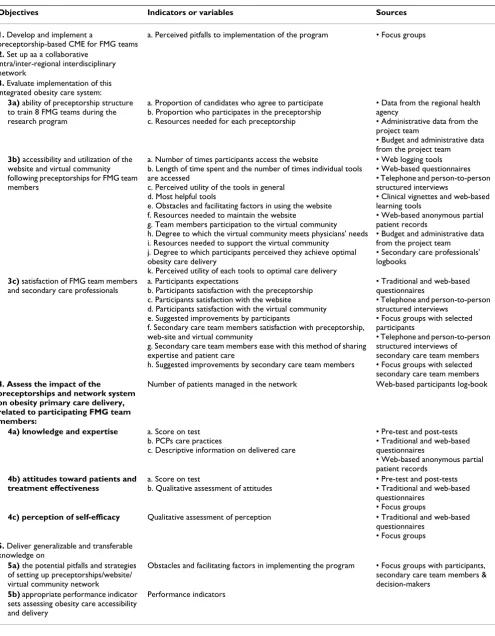
Specific research tools for each objective are summarized in Table 1, which includes corresponding indicators and variables as well as the sources that will be used to obtain required data. We will not detail each of our methods in order to improve the readability of this paper. However, detailed methodologies will be made available to the reader on request by contacting the corresponding author.
Data analysis and variable definition
Data from different sources will be grouped according to the evaluation questions. This triangulation will allow validation of the information gleaned from the different sources. Regarding quantitative data, appropriate descrip-tive statistics will be used to present the results, i.e. means with standard deviations for normally distributed varia-bles, median with inter-quartile ranges for variables not distributed normally, and proportions with 95% confi-dence intervals for categorical variables. These descriptive statistics will be of prime importance to assess conformity with accepted norms in the literature and norms consid-ered acceptable for each target group and decision makers.
Subgroup analyses will be performed to compare for example utilization, satisfaction or perceived utility regarding optimal care delivery among different web-based tools; satisfaction of all participants regarding pre-ceptorship, web-site and virtual community; scores on the different tests before and after preceptorship and after one year of utilization of web-based tools and virtual-commu-nity; etc. Sub-group analyses will be performed using ANOVA tests and repeated-measures ANOVA tests, with HSD Tukey multiple comparison tests.
strate-Table 1: Summary of Methodology and Approach
Objectives Indicators or variables Sources
1. Develop and implement a
preceptorship-based CME for FMG teams
a. Perceived pitfalls to implementation of the program • Focus groups
2. Set up aa a collaborative intra/inter-regional interdisciplinary network
3. Evaluate implementation of this integrated obesity care system:
3a) ability of preceptorship structure to train 8 FMG teams during the research program
a. Proportion of candidates who agree to participate b. Proportion who participates in the preceptorship c. Resources needed for each preceptorship
• Data from the regional health agency
• Administrative data from the project team
• Budget and administrative data from the project team
3b) accessibility and utilization of the website and virtual community following preceptorships for FMG team members
a. Number of times participants access the website
b. Length of time spent and the number of times individual tools are accessed
c. Perceived utility of the tools in general d. Most helpful tools
e. Obstacles and facilitating factors in using the website f. Resources needed to maintain the website
g. Team members participation to the virtual community h. Degree to which the virtual community meets physicians' needs i. Resources needed to support the virtual community
j. Degree to which participants perceived they achieve optimal obesity care delivery
k. Perceived utility of each tools to optimal care delivery
• Web logging tools • Web-based questionnaires • Telephone and person-to-person structured interviews
• Clinical vignettes and web-based learning tools
• Web-based anonymous partial patient records
• Budget and administrative data from the project team
• Secondary care professionals' logbooks
3c) satisfaction of FMG team members and secondary care professionals
a. Participants expectations
b. Participants satisfaction with the preceptorship c. Participants satisfaction with the website
d. Participants satisfaction with the virtual community e. Suggested improvements by participants
f. Secondary care team members satisfaction with preceptorship, web-site and virtual community
g. Secondary care team members ease with this method of sharing expertise and patient care
h. Suggested improvements by secondary care team members
• Traditional and web-based questionnaires
• Telephone and person-to-person structured interviews
• Focus groups with selected participants
• Telephone and person-to-person structured interviews of secondary care team members • Focus groups with selected secondary care team members
4. Assess the impact of the
preceptorships and network system on obesity primary care delivery, related to participating FMG team members:
Number of patients managed in the network Web-based participants log-book
4a) knowledge and expertise a. Score on test b. PCPs care practices
c. Descriptive information on delivered care
• Pre-test and post-tests • Traditional and web-based questionnaires
• Web-based anonymous partial patient records
4b) attitudes toward patients and treatment effectiveness
a. Score on test
b. Qualitative assessment of attitudes
• Pre-test and post-tests • Traditional and web-based questionnaires
• Focus groups
4c) perception of self-efficacy Qualitative assessment of perception • Traditional and web-based questionnaires
• Focus groups
5. Deliver generalizable and transferable knowledge on
5a) the potential pitfalls and strategies of setting up preceptorships/website/ virtual community network
Obstacles and facilitating factors in implementing the program • Focus groups with participants, secondary care team members & decision-makers
5b) appropriate performance indicator sets assessing obesity care accessibility and delivery
[image:7.612.61.556.96.732.2]gies for implementation of the program in general settings (objective 5). Qualitative data are also of prime impor-tance to interpret and understand results obtained from typical quantitative data, and generate hypotheses for future studies.
Significance, Impact and transferability
This research program will deliver transferable knowledge on management of obesity to primary care givers and will identify the potential pitfalls and strategies of setting up preceptorships and integrated interdisciplinary primary care team networks. Importantly, it will also yield impor-tant information on appropriate performance indicator sets for the future assessment of care access and delivery. The data derived from our study could be highly useful to health-system managers in Canada in order for them to implement truly integrated primary care delivery systems and programs targeting the obesity epidemic that we are facing. Date on financial and human resource require-ments will be important for their planning.
The process and outcome measures are relevant and use-ful to a number of health system managers and policy
makers. The ADRLSSSS of Estrie and Saguenay regions, as
well as stakeholders from FMGs and the Public Health Directorate, will be actively involved in this research pro-posal. Our results will impact on the planning, allocation and management of resources as they apply to service organization. Early involvement of decision makers as co-investigators and active participants in our research project considerably increase the likelihood of implemen-tation of changes in our health care system based on the outcomes of the present proposal. Research results are anticipated to be applicable to other institutions and regions of Quebec and Canada because most regions have access to specialists who could support networking with primary care teams. Our evaluation will also allow us to improve our program and, therefore, will also benefit our local health care system.
Knowledge translation and transfer plan
It is worth mentioning that both the research program and the research design of this study are optimal to allow knowledge translation (KT) and application throughout the entire research process. Participants in the study will play an active role in validating the educational and clini-cal tools, discussing themes, applying new knowledge in their practice, and giving and receiving feedback during interdisciplinary and disciplinary team meetings and focus groups. Importantly, the preceptorship experience in itself is a knowledge translation activity for health pro-fessionals.
However, research by itself does little to induce change (except for participants) and thus, results have to be
dif-fused to interested audiences. We have thus reserved a seven-month period exclusively aimed at knowledge transfer. We have access to specialized resources in com-munication from the Centre de recherché clinique Éti-enne-Le Bel to develop an optimal strategy based on KT literature [46-51].
Our research is relevant to: PCPs, nurse coordinators, spe-cialists in various disciplines and associated health profes-sionals, CME departments, public health directorates, health-system decision-makers. The research team mem-bers will thus reach out to these parties through linkage and exchange activities, including presentation of study results at scientific meetings and publication in scientific journals, but also by direct reports to decision-makers and health policy stakeholders. A clear summary of research results, including key messages targeted for each selected audience and synthesized results (divided by themes) will be made available in print and on a web site. Local media will be invited to a press conference. These approaches will first be pilot tested and should increase the use and widen the application of our results.
Our research team is composed of members that have pre-ferred access to various interest groups. The decision-maker co-applicants will be instrumental in making con-tacts with other decision-makers at the provincial and national levels in order to eventually have an impact on health care organization. As already mentioned, the prob-ability is high that our decision-maker co-investigators will appropriate and make use of the results of this study, because they will be involved early and actively in the research. Other members will easily reach specialists, pri-mary care physicians, nurse-coordinators, public health stakeholders, CME departments and organizations; these interventions could impact obesity care delivery and CME delivery.
The results of this study will also be disseminated in med-icine, nursing and other health professional discipline curricula to implicate them at an early stage in their train-ing programs; Faculties of Medicine and Health Sciences will be invited to a web-based presentation of our results. The interdisciplinary-based practice that prevails in the study will be proposed to graduate students as an example of a methodological approach to program evaluation and implementation. Interest groups and community support group will also benefit from website conferences and workshops on the results of this study.
Discussion
This project is relevant to health system's decision-makers who are confronted with an important increase in the prevalence of obesity. It is therefore critical to develop
line setting. Results of this research project could therefore influence health care organization in the field of obesity but also eventually for other chronic diseases.
Should our data show that this integrated obesity care management system is effective in modifying short and long-term outcomes, future studies could concentrate on evaluating health indicators and patient satisfaction with such a system. The development of additional electronic tools for direct patient use may also turn out to be neces-sary. Other avenues of research include assisting other teams and decision makers in the implementation of sim-ilar programs or other research projects that will arise from our knowledge transfer activities.
In view of the limited resources (financial and time) avail-able for the realization of the proposed project, we will not be able to measure the clinical outcomes of patients followed by the research participants. However, we view this application as a first step in the study of the impact of our integrated obesity care system on participating health professionals and their practice. Therefore the study of clinical outcomes of patients cared for by participants in a program, such as the one proposed here, compared to a control group of patients cared for by non-participating physicians, will be the object of a future and grant appli-cation.
Competing interests
The author(s) declare that they have no competing inter-ests.
Authors' contributions
All authors read and approved the final manuscript.
Acknowledgements
This work is supported by the Canadian Institutes for Health Research (CIHR; PHE 78707) and the Fonds de recherche en santé du Québec (FRSQ). JPB is a Junior 2 Clinical Investigator of the FRSQ, AC is a Junior 2 Investigator of the FRSQ, MFL is a senior Clinical Investigator of the FRSQ. MX is the holder of the Chaire Lucie et André Chagnon pour l'usage d'une approche intégrée en prévention de l'Université de Sherbrooke. At the time of the preceptorship she was the director of the CFC office. MF is the holder of the Chaire de recherche sur les maladies chroniques en soins de première ligne de l'université de Sherbrooke. We would like to thank Mrs. Christine Brown for her help in the preparation of this manuscript.
References
1. Obesity: preventing and managing the global epidemic.
Geneva, Report of a WHO consultation on obesity,technical report 894; 1997.
2. Enquête sur la santé dans les collectivités canadiennes, 2000-2001. Statistique Canada; 2001.
3. Tremblay MS, Willms JD: Secular trends in the body mass index of Canadian children. CMAJ 2000, 163:1429-1433.
4. Whitaker RC, Wright JA, Pepe MS, Seidel KD, Dietz WH: Predict-ing obesity in young adulthood from childhood and parental obesity. N Engl J Med 1997, 337:869-873.
5. Katzmarzyk PT, Janssen I: The economic costs associated with physical inactivity and obesity in Canada: an update. Can J Appl Physiol 2004, 29:90-115.
6. Mahoney LT, Burns TL, Stanford W, Thompson BH, Witt JD, Rost CA, Lauer RM: Coronary risk factors measured in childhood and young adult life are associated with coronary artery cal-cification in young adults: the Muscatine Study. J Am Coll Car-diol 1996, 27:277-284.
7. Berenson GS, Srinivasan SR, Bao W, Newman WP III, Tracy RE, Wat-tigney WA: Association between multiple cardiovascular risk factors and atherosclerosis in children and young adults. The Bogalusa Heart Study. N Engl J Med 1998, 338:1650-1656. 8. Must A, Jacques PF, Dallal GE, Bajema CJ, Dietz WH: Long-term
morbidity and mortality of overweight adolescents. A fol-low-up of the Harvard Growth Study of 1922 to 1935. N Engl J Med 1992, 327:1350-1355.
9. Knowler WC, Barrett-Connor E, Fowler SE, Hamman RF, Lachin JM, Walker EA, Nathan DM: Reduction in the incidence of type 2 diabetes with lifestyle intervention or metformin. N Engl J Med 2002, 346:393-403.
10. Tuomilehto J, Lindstrom J, Eriksson JG, Valle TT, Hamalainen H, Ilanne-Parikka P, Keinanen-Kiukaanniemi S, Laakso M, Louheranta A, Rastas M, Salminen V, Uusitupa M: Prevention of type 2 diabetes mellitus by changes in lifestyle among subjects with impaired glucose tolerance. N Engl J Med 2001, 344:1343-1350.
11. Reisin E, Abel R, Modan M, Silverberg DS, Eliahou HE, Modan B:
Effect of weight loss without salt restriction on the reduction of blood pressure in overweight hypertensive patients. N Engl J Med 1978, 298:1-6.
12. Williamson DF, Pamuk E, Thun M, Flanders D, Byers T, Heath C: Pro-spective study of intentional weight loss and mortality in never-smoking overweight US white women aged 40-64 years. Am J Epidemiol 1995, 141:1128-1141.
13. The Diabetes Prevention Program (DPP): description of life-style intervention. Diabetes Care 2002, 25:2165-2171.
14. Clinical Guidelines on the Identification, Evaluation, and Treatment of Overweight and Obesity in Adults--The Evi-dence Report. National Institutes of Health. Obes Res 1998, 6 Suppl 2:51S-209S.
15. Statement AACEACEP: Prevention, Diagnosis, and Treatment of Obesity. Endocrine Practice 1998, 4:297-350.
16. Identification, Evaluation, and Treatment of Overweight and Obesity in Adults NHBLI Obesity education initiative 1998 [http:// www.nhlbi.nih.gov/guidelines/obesity/ob_exsum.pdf].
17. Lau DCW, Douketis JD, Morrison KM, Hramiak IM, Sharma AM, Ur E, for the members of the Obesity Canadian Clinical Practice Guide-lines Expert Panel: 2006 Canadian clinical practice guidelines on the management and prevention of obesity in adults and children. CMAJ 2007, 176:S1-S117.
18. Barlow SE, Dietz WH: Obesity evaluation and treatment: Expert Committee recommendations. The Maternal and Child Health Bureau, Health Resources and Services Admin-istration and the Department of Health and Human Serv-ices. Pediatrics 1998, 102:E29.
19. Eliakim A, Friedland O, Kowen G, Wolach B, Nemet D: Parental obesity and higher pre-intervention BMI reduce the likeli-hood of a multidisciplinary childlikeli-hood obesity program to succeed--a clinical observation. J Pediatr Endocrinol Metab 2004,
17:1055-1061.
20. Epstein LH, Valoski A, Wing RR, McCurley J: Ten-year outcomes of behavioral family-based treatment for childhood obesity. Health Psychol 1994, 13:373-383.
21. Epstein LH, Valoski A, Wing RR, McCurley J: Ten-year follow-up of behavioral, family-based treatment for obese children. JAMA
1990, 264:2519-2523.
22. Robinson TN: Behavioural treatment of childhood and adoles-cent obesity. Int J Obes Relat Metab Disord 1999, 23 Suppl 2:S52-S57.
23. Epstein LH, Valoski AM, Kalarchian MA, McCurley J: Do children lose and maintain weight easier than adults: a comparison of child and parent weight changes from six months to ten years. Obes Res 1995, 3:411-417.
24. Denen ME, Hennessey JV, Markert RJ: Outpatient evaluation of obesity in adults and children: a review of the performance of internal medicine/pediatrics residents. J Gen Intern Med
Publish with BioMed Central and every scientist can read your work free of charge "BioMed Central will be the most significant development for disseminating the results of biomedical researc h in our lifetime."
Sir Paul Nurse, Cancer Research UK
Your research papers will be:
available free of charge to the entire biomedical community
peer reviewed and published immediately upon acceptance
cited in PubMed and archived on PubMed Central
yours — you keep the copyright
Submit your manuscript here:
http://www.biomedcentral.com/info/publishing_adv.asp
BioMedcentral
25. Clair M: Commission d'étude sur les services de santé et les services sociaux. Commission Clair; 2000.
26. Beaulieu MD: L'implantation des Groupes de Médecine de Famille: le défi de la réorganisation de la pratique et de la collaboration interprofessionnelle (Résultats préliminaires de la première année d'observation). 2005 [http://www.med fam.umontreal.ca/chaire_sadok_besrour/ressource/PDF/BulletinIn foGMF.pdf].
27. Foster GD, Wadden TA, Makris AP, Davidson D, Sanderson RS, Alli-son DB, Kessler A: Primary care physicians' attitudes about obesity and its treatment. Obes Res 2003, 11:1168-1177. 28. Bramlage P, Wittchen HU, Pittrow D, Kirch W, Krause P, Lehnert H,
Unger T, Hofler M, Kupper B, Dahm S, Bohler S, Sharma AM: Rec-ognition and management of overweight and obesity in pri-mary care in Germany. Int J Obes Relat Metab Disord 2004,
28:1299-1308.
29. O'Brien G: Critical Thinking in the Nursing Process. In Medical-Surgical Nursing: Assessment and Management of Clinical Problems 6th edition. Edited by: Lewis HD. Missouri, Mosby; 2004.
30. Kamga CN, Carpentier AC, Baillargeon JP, Dionne I, Ardilouze JL, Langlois MF: Treatment of the metabolic syndrome in an interdisciplinary obesity clinic: a randomized controlled study. Obesity Research 2007, 13:A202-A202.
31. Davis D, O'Brien MA, Freemantle N, Wolf FM, Mazmanian P, Taylor-Vaisey A: Impact of formal continuing medical education: do conferences, workshops, rounds, and other traditional con-tinuing education activities change physician behavior or health care outcomes? JAMA 1999, 282:867-874.
32. Wutoh R, Boren SA, Balas EA: eLearning: a review of Internet-based continuing medical education. J Contin Educ Health Prof
2004, 24:20-30.
33. Caron P, Leblanc F, Grant A: Architecture for Implementation of a Lifelong Learning Environment (LOLE). International Jour-nal on E-Learning 2007, 6:313-332.
34. Boland R, Tenkasi R: Perspective making and perspective tak-ing in communities of knowtak-ing. Organization Science 1995,
6:350-372.
35. Bresnen M, Edelman L, Newell S, Scarbrough H, Swan J: Social prac-tices and the management of knowledge in project environ-ments. International Journal of Project Management 2003, 21:157-166. 36. von Krogh G: The communal resource and information sys-tems. The Journal of Strategic Information Systems 2002, 11:85-107. 37. Pan SL, Leidner DE: Bridging communities of practice with
information technology in pursuit of global knowledge shar-ing. The Journal of Strategic Information Systems 2003, 12:71-88. 38. Lave J, Wenger E: Situated Learning: Legitimate Peripheral
Participation. Palo Alto, CA, Institute for Research on Learning; 1990.
39. Brown JS, Duguid P: Knowledge and organization: a social-prac-tice perspective. Organizational Science 2001, 12:198-213. 40. Brown JS, Duguid P: Organizational learning and
communities-of-practice: toward a unified view of working, learning, and innovation. Organizational Science February 1997, 2:40-57. 41. Balfour M, Clarke C: Searching for sustainable change. J Clin
Nurs 2001, 10:44-50.
42. Patton MQ: Utilization-focused evaluation 3rd edition. Thousand Oaks, Sage Publications; 1997.
43. Dick B: You want to do an action research thesis? (1993). 2005 [http://www.scu.edu.au/schools/gcm/ar/art/arthesis.html].
44. Grant A, Plante I, Leblanc F: The TEAM methodology for the evaluation of information systems in biomedicine. Comput Biol Med 2002, 32:195-207.
45. PHRED: A blueprint for public health management: a toolkit for program evaluation. Ontario Ministry of Health; 2004. 46. Anderson M, Cosby J, Swan B, Moore H, Broekhoven M: The use of
research in local health service agencies. Soc Sci Med 1999,
49:1007-1019.
47. Kitson A, Ahmed LB, Harvey G, Seers K, Thompson DR: From research to practice: one organizational model for promot-ing research-based practice. J Adv Nurs 1996, 23:430-440. 48. Landry R, Amara N, Lamari M: Extent and determinants of
utili-zation of university research in public administration. Public Administration Review 2003, 62:191-204.
49. Landry R, Amara N, Lamari M: Utilization of social science research knowledge in Canada. Research Policy 2004,
30:333-349.
50. Lavis JN, Ross SE, Hurley JE, Hohenadel JM, Stoddart GL, Woodward CA, Abelson J: Examining the role of health services research in public policymaking. Milbank Q 2002, 80:125-154.
51. Lomas J: Using 'linkage and exchange' to move research into policy at a Canadian foundation. Health Aff (Millwood ) 2000,
19:236-240.
Pre-publication history
The pre-publication history for this paper can be accessed here: