RESEARCH NOTE
Mother’s Infant and Young Child Feeding
(IYCF) knowledge improved timely initiation
of complementary feeding of children
aged 6–24 months in the rural population
of northwest Ethiopia
Gashaw Andargie Biks
1, Amare Tariku
2, Molla Mesele Wassie
2and Terefe Derso
2*Abstract
Objectives: Appropriate complementary feeding is vital to reduce young child morbidity and mortality. However, it continues as sub-optimal in Ethiopia, and literatures are also scarce. Therefore, this study aimed to determine timely initiation of complementary feeding and associated factors among mothers with children aged 6–24 months in the rural population of northwest Ethiopia. In the community based cross-sectional study, data on child feeding prac-tices, individual and household characteristics were collected in Dabat Demographic Surveillance System site, Dabat District, northwest Ethiopia from 01 May to 29 June 2015. The bivariate and backward stepwise multivariable statistical methods were carried out to identify factors associated with timely initiation of complementary feeding.
Results: About 53.8% [95% CI 45.9, 61.7] and 4.6% [95% CI 1.3, 7.9] of children were found with timely initiation of complementary feeding and had minimum dietary diversity, respectively. The odds of timely initiation of complemen-tary feeding was higher among mothers with medium [AOR = 2.34, 95% CI 1.54, 3.81] and high [AOR = 2.10, 95% CI 1.41, 3.87] mother’s IYCF knowledge. In Dabat district, complementary feeding practice is lower. Thus, efforts should be strengthened to boost mother’s IYCF knowledge.
Keywords: IYCF knowledge, Complementary feeding, Dietary diversity
© The Author(s) 2018. This article is distributed under the terms of the Creative Commons Attribution 4.0 International License (http://creativecommons.org/licenses/by/4.0/), which permits unrestricted use, distribution, and reproduction in any medium, provided you give appropriate credit to the original author(s) and the source, provide a link to the Creative Commons license, and indicate if changes were made. The Creative Commons Public Domain Dedication waiver (http://creativecommons.org/ publicdomain/zero/1.0/) applies to the data made available in this article, unless otherwise stated.
Introduction
Adequate nutrition is essential to ensure optimal health, physical and mental growth of children [1]. Comple-mentary food, a transitional food is intended to meet the particular nutritional or physiologic needs of the young child. As a result, it is universally recommended that mothers should start nutritionally adequate and safe complementary food at the infant’s sixth month [2, 3]. Moreover, World Health Organization (WHO) supports the implementation of Infant and Young Child Feeding
(IYCF) strategy for children aged 6–24 months as a criti-cal element of efforts to address child malnutrition and mortality [2]. Hence, promotion of appropriate comple-mentary feeding prevents 6% of child deaths in countries with high child mortality rate [4], it is of a paramount importance for developing countries, such as Africa and South-Central Asia [5]. A substantial number (2.1 mil-lion) of this mortality is contributed by undernutrition [6].
However, inappropriate complementary feeding prac-tices have been widely documented, and stay as major public health problem in many developing countries [7]. Studies reports from Uganda [8], Ghana [9] and South Africa [10] revealed that more than half of mothers ini-tiated complementary feeding away from sixth month.
Open Access
*Correspondence: [email protected]; [email protected]
2 Department of Human Nutrition, Institute of Public Health, College
of Medicine and Health Sciences, University of Gondar, Po.box: 196, Gondar, Ethiopia
Various reports identified the determinants of timely ini-tiation of complementary feeding practices, and it mainly related to the maternal health care utilization and socio-economic characteristics. Higher maternal educational status, unemployment [11], being married [12], having antenatal care (ANC) and home birthing [11, 12] are sig-nificantly associated with initiation of complementary feeding at the right time, sixth month. Furthermore, male sex of the child and smaller family size are related with increased odds of a timely initiation of complementary feeding [12–14]. However, lower maternal socio-eco-nomic status is inversely associated with timely initiation of complementary feeding [15].
In Ethiopia child undernutrition continues as a criti-cal public health problem [16] and it is an underlying cause for 53% of under five child mortality [17]. Com-plementary feeding practice is also by far suboptimal in the country, according to which 51% of children are given complementary food at 6–9 months of age, and only 4% of young children aged 6–23 months are found with minimum dietary diversity [16]. Conducting a study in an evidence dearth setting is critical to explore informa-tion on complementary feeding practices and its deter-minants especially; no study is conducted in the current study area. Even the previous studies are institution based [11, 13] and done in a smaller scale, districts level [12, 18], which ultimately affects the generalizability of the finding. Therefore to fill the knowledge gap, this study aimed to determine a timely initiation of complemen-tary feeding and associated factors among children aged 6–24 months in HDSS site. The HDSS site is established to represent the rural northwest Ethiopia.
A community-based cross-sectional study was con-ducted in HDSS site from 01 May to 29 June 2015. The site is located in the Dabat District, northwest Ethiopia, and hosted by the University of Gondar. The district has an estimated population size of 145,458 living in 26 rural and four urban kebeles (the smallest administration unit Ethiopia). Currently, six health centers and 29 health posts are providing health services to the residents. The HDSS covers 13 randomly selected kebeles (three urban and ten rural kebeles) in different ecological zones (high land, middle land, and low land). A total of 67,385 inhab-itants are living in these kebeles. The detailed data col-lection system, data quality control, the database, and the study setting of Dabat HDSS are described elsewhere [19].
The study is a part of the original survey which aimed to assess the nutritional status and feeding practice of children aged 6–59 months in Dabat HDSS. Of the total kebeles in the HDSS, eight kebeles were selected by
using lottery method. All mothers with children aged 6–24 months and lived in the selected kebeles of the HDSS were included in the original survey. For house-holds with multiple children, a child was selected ran-domly using lottery method. To estimate complementary feeding practice among mothers with children aged 6–24 months, sample size was calculated using Epi-info version 3.7 by considering the following assumptions; the prevalence of a timely initiation of complementary feed-ing in North Ethiopia was 62.8% [11], 95% level of confi-dence, 5% margin of error, 5% non-response rate, and a design effect of 1.5. Thus, a minimum sample size of 566 was obtained. However, 591 children fulfilling the inclu-sion criteria were found in the original survey, as a result to improve the power of the study, all the eligibles were included in the analysis.
A structured interviewer-administered questionnaire was used to collect data. The questionnaire composed of socio-demographic and economic characteristics, health care, and complementary feeding practice related vari-ables. The questionnaire was first translated from English to Amharic, the native language of the study area, and was retranslated back to English by professional transla-tors. Fourteen data collectors and three field supervisors were recruited for the study. Data collectors and supervi-sors were trained for 2 days. The tool was piloted out of the study area, thus the acceptability and applicability of the procedures and tools were evaluated. All filled ques-tionnaires were daily checked for completeness by the supervisors and the investigators.
Complementary feeding practices were assessed according to the key indicators recommended by WHO and IYCF strategy of Ethiopia. The outcome variable, timely initiation to complementary feeding was defined as a proportion of children (6–24 months) who initi-ated complementary food at sixth month of age [20]. The standardized dietary diversity score tool was used to esti-mate feeding practice of children. To capture the usual dietary habit of children, both a single 24-h and 7 day recall methods were employed. Minimum dietary diver-sity was defined as proportion of children (6–24 months) who received complementary food made from four or more food groups in the previous 24-h [20]. Moreover, minimum meal frequency was determined as proportion of breastfed and non-breastfed children (6–24 months) who received solid, semi-solid or soft food for the mini-mum number of times or more in the 24-h preceding the survey [20].
in the last 7 days preceding the date of survey. Since it shows usual dietary pattern of children, the 7-day quasi food frequency was used to overcome the limitation of 24 h recall method. A mother was asked to report for how many days her child ate any of the above seven food groups in the last 1 week. A score ranging from 1 to 7 was given depending on the number of days the child ate the listed food groups. Accordingly, if the child ate for 1–3 days it was coded as ‘1’, and 4 or more days coded as ‘2’, otherwise, the score ‘0’ was given if the child didn’t eat.
A Principal Component Analysis (PCA) was employed to estimate the mothers IYCF knowledge. Nine questions most of which are tailored from the core IYCF indica-tors were used to determine the mother’s knowledge. In the PCA, the knowledge item questions were summed and ranked into terciles; lowest, medium, and highest. Similarly, household wealth index was computed using a composite indicator for urban and rural residents by con-sidering properties, like selected household assets and size of agricultural land, and PCA was performed to cat-egorize the household wealth status into lowest, middle, and highest.
Data were entered into Epi-info version 3.5.3 and exported to Statistical Package for Social Sciences (SPSS) version 20 for analysis. Descriptive statistics, including frequencies and proportions were used to summarize variables. In order to indentify the factors associated with a timely initiation to complementary feeding, a binary logistic regression model was used. Co-linearity was checked for Household income and other independent variables like IYCF knowledge, antenatal care, and health care access and the result showed that the independent variables have no significant co-linearity. Variables with a p-values of < 0.2 in the bivariable analysis were subjected to multivariable analysis. We followed the method of Hailu et al. [21].
Main text
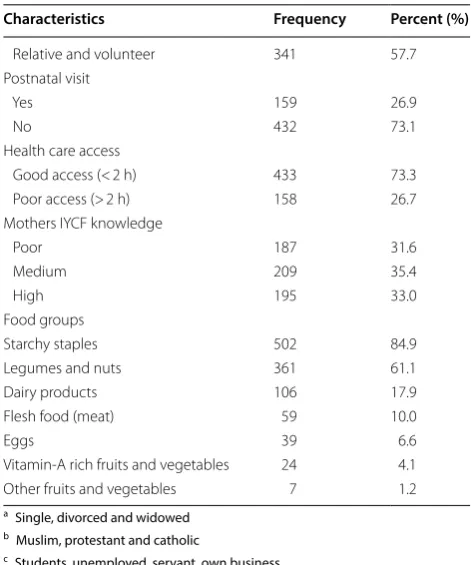
[image:3.595.305.537.124.720.2]A total of 591 mother–child pairs were included for analysis. About two-thirds (66%) of children were in the age group of 12–24 months. More than half of moth-ers were housewives (59.7%) and had no formal educa-tion (70.2%). About 53.8% [95% CI 45.9, 61.7] of children were introduced to complementary feeding at their sixth month of age. Only 4.6% [95% CI 1.3, 7.9] of children consumed food composed of a minimum dietary diver-sity, while about 13.5% of children received the minimum meal frequency in the previous 24-h preceding the date of survey. Almost all of children didn’t eat other fruits and vegetables (98.8%), vitamin-A rich fruits and veg-etables (95.9%) (Table 1). On the other hand, more than three-fourths (81.6%) and nearly two-thirds (60.2%) of
Table 1 Socio-demographic, health and dietary practice of mothers with children aged 6–24 months in the rural population of northwest Ethiopia, 2015
Characteristics Frequency Percent (%)
Age of child (in months)
6–11 201 34.0
12–24 390 66.0
Age of mother (years)
≤ 35 372 62.9
> 35 219 37.1
Marital status
Married 532 90.0
Othersa 59 10.0
Religion
Orthodox Christians 552 93.4
Othersb 39 6.6
Mothers education
No formal education 415 70.2
Primary education 79 13.4
Secondary and above 97 16.4
Fathers education
No formal education 396 67.0
Primary education 103 17.4
Secondary and above 92 15.6
Family size
≤ 4 227 38.4
> 4 364 61.6
Mothers occupational status
Housewife 353 59.7
Farmer 146 24.7
Othersc 92 15.6
Fathers occupational status
Unemployed 28 4.7
Farmer 172 29.1
Othersd 391 66.2
Possession of radio or television
Yes 98 16.6
No 493 83.4
Wealth status
Poor 205 34.7
Medium 187 31.6
High 199 33.7
Antenatal care visits
No antenatal care visit 208 35.2
1–3 visit 251 42.2
≥ 4 visit 132 22.3
Place of delivery
Home 426 72.1
Health institution 165 27.9
Delivery attendant
Health professional 168 28.6
children consumed starchy staples and legumes and nuts for 4–7 days per week, respectively (Fig. 1).
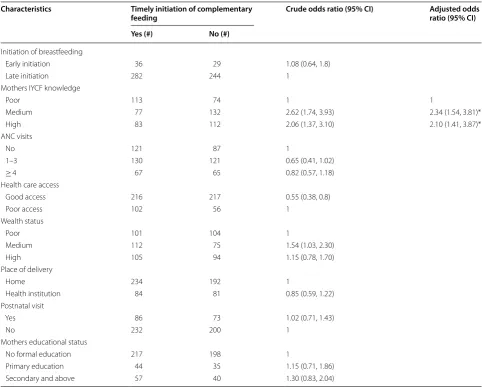
The result of the multivariable logistic regression analysis showed that mothers IYCF knowledge was sig-nificantly and independently associated with timely initiation to complementary feeding. Accordingly, the odds of timely initiation of complementary feeding were higher among mothers with medium [AOR = 2.34, 95%
CI 1.54, 3.81] and high [AOR = 2.10, 95% CI 1.41, 3.87]
IYCF knowledge compared to mothers with poor IYCF knowledge (Table 2).
The prevalence of timely initiation of complemen-tary feeding was 53.8%, and it was consistent with other study findings in Ethiopia (51–62.8%) [11–13, 16] and India (55.1%) [22]. However, it was lower than reports of other developing countries, such as Nepal (70%) [23], Bangladesh (71%) [24], and Sir Lanka (84%) [25]. The observed discrepancy probably relates to differ-ence in place of residdiffer-ence among the study participants and almost all of the mothers were rural inhabitants in
this study. There has been lesser access to education, health care services, and other resources (printed and electronic medias) in the rural settlements [16]. These social inequalities lower the maternal literacy status and access to nutrition education and counseling. In fact improved literacy status and nutrition education are found to positively affect the complementary feed-ing practices [26, 27]. Furthermore, the discrepancy could be attributed to variation in the measurement of initiation of complementary feeding, in which the latter studies assessed initiation of complementary food at 6–8 months of age of the child while it was at sixth month for the former study. Thus, use of the ref-erence period 6–8 months might over estimated the prevalence.
The odds of timely initiation of complementary feed-ing was higher among mothers with medium and higher IYCF knowledge. This finding was supported with another report in East Ethiopia [17]. The plausible explanation could be related to the role of knowledge to empower mother’s to resist external interferences and pressures from traditional faiths and misunderstandings favoring untimely initiation of complementary feeding. Improved health care access gives an added opportunity for mothers to get nutritional counseling thereby to prac-tice the optimal IYCF [28]. The study finding could sup-port to strengthen nutrition education through tailoring with behavioral change and communication components to address the community misconceptions towards IYCF practice.
The prevalence of minimum acceptable dietary diver-sity was very low (4.6%), and it was similar with what was reported from Amhara region, northwest Ethiopia (2%) [18]. However, the finding was lower than the reports from other developing countries, like India (15.2%) [29], Nepal (34%) [23], Bangladesh (41.9%) [24], and Sri Lanka (71%) [25]. This is probably related to lower economic status of the households in the study area, which impairs the households to purchase and offer diversified food to their child. Other studies also noted that, the households socio-economic status and per capita food expenditure was positively associated with dietary diversity [30–32]. In addition, the lower dietary diversity could be due to the monotonous dietary habit of the community in this study area. In Ethiopia including the current study area, complementary food are made from cereals which is usu-ally served with legumes or pulses [16]. In this study, the prevalence of timely initiation of complementary feed-ing and dietary diversity was low. Furthermore, mothers’
Table 1 (continued)
Characteristics Frequency Percent (%)
Relative and volunteer 341 57.7
Postnatal visit
Yes 159 26.9
No 432 73.1
Health care access
Good access (< 2 h) 433 73.3
Poor access (> 2 h) 158 26.7
Mothers IYCF knowledge
Poor 187 31.6
Medium 209 35.4
High 195 33.0
Food groups
Starchy staples 502 84.9
Legumes and nuts 361 61.1
Dairy products 106 17.9
Flesh food (meat) 59 10.0
Eggs 39 6.6
Vitamin-A rich fruits and vegetables 24 4.1
Other fruits and vegetables 7 1.2
a Single, divorced and widowed b Muslim, protestant and catholic
c Students, unemployed, servant, own business d Contract and permanent work
[image:4.595.55.291.99.382.2]IYCF knowledge and health care access were significantly associated with timely initiation of complementary feed-ing. Thus, efforts should be strengthened to boost moth-ers’ IYCF knowledge.
Limitations
As an illustration the cross sectional nature of the study limits measuring the cause and effect relationship between the potential factors and the outcome. Also
*Food Group
Legends:
FG* not given in the previous 7 days
FG given for 1-3 days
FG given for 4-7 days
10.20%
21.70%
75.10%
78.70%
79.40%
92.20%
93.10%
81.60%
60.20%
11.30%
7.60%
3%
1.40%
0.80%
0%
10%
20%
30%
40%
50%
60%
70%
80%
90%
100%
[image:5.595.58.537.87.498.2]there might be a recall and social desirability bias while subjects were requested to give dietary information.
Abbreviations
PCA: Principal Component Analysis; WHO: World Health Organization; ANC: antenatal care; AOR: adjusted odds ratio; COR: crude odds ratio; CI: confidence interval; IYCF: Infant and Young Child Feeding; DDS: dietary diversity score; SD: standard deviation; HDSS: Health and Demographic Surveillance System.
Authors’ contributions
AT conceived the study, developed the tool, coordinated data collection, and carried out the statistical analysis and drafted the manuscript. GAB participated in the design of the study, developed the tool, and coordinated data collection. TD participated in the statistical analysis and drafted the manuscript. MMW participated in the design of the study and drafted the manuscript. All authors read and approved the final manuscript.
Author details
1 Department of Health Service Management and Health Economics,
Insti-tute of Public Health, College of Medicine and Health Sciences, University of Gondar, Gondar, Ethiopia. 2 Department of Human Nutrition, Institute
of Public Health, College of Medicine and Health Sciences, University of Gondar, Po.box: 196, Gondar, Ethiopia.
Acknowledgements
We would like to thank mothers for their willingness to participate in the study. Our appreciation will also go to the university of Gondar and Dabat DHSS site for their financial and material support, respectively.
Competing interests
The authors declare that they have no competing interests.
Availability of data and materials
Data will be available upon request from the correspondence authors.
Consent to publish
[image:6.595.56.539.111.498.2]Not applicable.
Table 2 Factors associated with timely initiation of complementary feeding in the rural population of northwest Ethiopia, 2015
* Significant at p < 0.05
Characteristics Timely initiation of complementary
feeding Crude odds ratio (95% CI) Adjusted odds ratio (95% CI) Yes (#) No (#)
Initiation of breastfeeding
Early initiation 36 29 1.08 (0.64, 1.8)
Late initiation 282 244 1
Mothers IYCF knowledge
Poor 113 74 1 1
Medium 77 132 2.62 (1.74, 3.93) 2.34 (1.54, 3.81)*
High 83 112 2.06 (1.37, 3.10) 2.10 (1.41, 3.87)*
ANC visits
No 121 87 1
1–3 130 121 0.65 (0.41, 1.02)
≥ 4 67 65 0.82 (0.57, 1.18)
Health care access
Good access 216 217 0.55 (0.38, 0.8)
Poor access 102 56 1
Wealth status
Poor 101 104 1
Medium 112 75 1.54 (1.03, 2.30)
High 105 94 1.15 (0.78, 1.70)
Place of delivery
Home 234 192 1
Health institution 84 81 0.85 (0.59, 1.22)
Postnatal visit
Yes 86 73 1.02 (0.71, 1.43)
No 232 200 1
Mothers educational status
No formal education 217 198 1
Primary education 44 35 1.15 (0.71, 1.86)
Ethics approval and consent to participate
Ethical clearance was obtained from the Institutional Review Boards of the University of Gondar. An official permission letter was secured from the Dabat HDSS site. The study did not involve any invasive procedures and reporting of any response for intervention. So, the study posed a low or not more than a minimal risk to the study participants. Accordingly, all eligible mothers were informed about the purpose of the study, and interview was held only with those who agreed to give verbal consent to participate. The right of a participant to withdraw from the study at any time, without any precondition was disclosed unequivocally. Moreover, the confidentiality of information was guaranteed by using code numbers rather than personal identifiers and by keeping the questionnaire locked.
Funding
This study was funded by the University of Gondar. The views presented in the article are of the author and not necessarily express the views of the funding organization. University of Gondar was not involved in the design of the study, data collection, analysis and interpretation.
Publisher’s Note
Springer Nature remains neutral with regard to jurisdictional claims in pub-lished maps and institutional affiliations.
Received: 1 March 2018 Accepted: 10 August 2018
References
1. Marriott BP, White A, Hadden L, Davies JC, Wallingford JC. World Health Organization (WHO) infant and young child feeding indicators: associa-tions with growth measures in 14 low-income countries. Matern Child Nutr. 2012;8(3):354–70.
2. WHO, UNICEF. Global strategy for infant and young child feeding. Geneva: World Health Organization; 2003.
3. WHO U, IFPRI U, Davis U. FANTA: indicators for assessing infant and young child feeding practices. Geneva: World Health Organization; 2008. http:// www.who.int/mater nal_child _adole scent /docum ents/97892 41596 664/ en/. Accessed 25 May 2011.
4. Jones G, Steketee RW, Black RE, Bhutta ZA, Morris SS, Group BCSS. How many child deaths can we prevent this year? Lancet. 2003;362(9377):65–71.
5. Black RE, Victora CG, Walker SP, Bhutta ZA, Christian P, De Onis M, Ezzati M, Grantham-McGregor S, Katz J, Martorell R. Maternal and child undernu-trition and overweight in low-income and middle-income countries. Lancet. 2013;382(9890):427–51.
6. Black RE, Allen LH, Bhutta ZA, Caulfield LE, De Onis M, Ezzati M, Mathers C, Rivera J, Maternal, Group CUS. Maternal and child undernutrition: global and regional exposures and health consequences. Lancet. 2008;371(9608):243–60.
7. Lutter CK, Daelmans BM, de Onis M, Kothari M, Ruel MT, Arimond M, Deitchler M, Dewey KG, Blössner M, Borghi E. Undernutrition, poor feed-ing practices, and low coverage of key nutrition interventions. Pediatrics. 2011. https ://doi.org/10.1542/peds.2011-1392.
8. Mokori A. Nutritional status, complementary feeding practices and feasible strategies to promote nutrition in returnee children aged 6–23 months in northern Uganda. S Afr J Clin Nutr. 2012;25(4):173–9. 9. Solomon Sika-Bright. Ghana: Department of Sociology and
Anthropol-ogy University of Cape Coast; 2010. Jan, Socio-cultural factors influencing infant feeding practicies of mothers attending welfare clinic in Cape Coast. http://www.ifra-niger ia.org/IMG/pdf/Sika.pdf. Accessed 7 April 2014. 10. Thairu LN, Pelto GH, Rollins NC, Bland RM, Ntshangase N. Socio-cultural
influences on infant feeding decisions among HIV-infected women in rural Kwa-Zulu Natal, South Africa. Matern Child Nutr. 2005;1(1):2–10. 11. Shumey A, Demissie M, Berhane Y. Timely initiation of complementary
feeding and associated factors among children aged 6 to 12 months in Northern Ethiopia: an institution-based cross-sectional study. BMC Public Health. 2013;13(1):1050.
12. Yemane S, Awoke T, Gebreslassie M. Timely initiation of complementary feeding practice and associated factors among mothers of children aged from 6 to 24 months in Axum town, north Ethiopia. Int J Nutr Food Sci. 2014;3(5):438–42.
13. Semahegn A, Tesfaye G, Bogale A. Complementary feeding practice of mothers and associated factors in Hiwot Fana Specialized Hospital, Eastern Ethiopia. Pan Afr Med J. 2014;18:143.
14. Basnet S, Sathian B, Malla K, Koirala DP. Reasons for early or late initiation of complementary feeding: a study in Pokhara. Am J Public Health Res. 2015;3(4A):69–75.
15. Wijndaele K, Lakshman R, Landsbaugh JR, Ong KK, Ogilvie D. Determi-nants of early weaning and use of unmodified cow’s milk in infants: a systematic review. J Am Diet Assoc. 2009;109(12):2017–28.
16. Central Statistical Authority [Ethiopia] and ORC Macro. Ethiopia Demo-graphic and Health Survey 2011. Addis Ababa: Central Statistical Agency; 2011. p. 2011.
17. Federal Ministry of Health, Family Health Department Ethiopia. National strategy for infant and young child feeding. Addis Ababa: Federal Ministry of Health, Family Health Department Ethiopia; 2004.
18. Nekatebeb H, Guyon A, Beyero M, Stoecker BJ. Factors related to exclusive breast feeding and dietary diversity of complementary foods: a case study in Amhara region of Ethiopia. FASEB J. 2010;24(734):733. 19. Tariku A, Biks GA, Wassie MM, Gebeyehu A, Getie AA. Factors associated
with prelacteal feeding in the rural population of northwest Ethiopia: a community cross-sectional study. Int Breastfeeding J. 2016;11(1):1. 20. World Health Organization. Indicators for assessing infant and young
child feeding practices part 3: country profiles. Geneva: World Health Organization; 2010.
21. Hailu S, Wubshet M, Woldie H, Tariku A. Iodine deficiency and associated factors among school children: a cross-sectional study in Ethiopia. Arch Public Health. 2016;74(1):46.
22. Sinhababu A, Mukhopadhyay DK, Panja TK, Saren AB, Mandal NK, Biswas AB. Infant-and young child-feeding practices in Bankura district, West Bengal, India. J Health Popul Nutr. 2010;28:294–9.
23. Joshi N, Agho KE, Dibley MJ, Senarath U, Tiwari K. Determinants of inap-propriate complementary feeding practices in young children in Nepal: secondary data analysis of Demographic and Health Survey 2006. Matern Child Nutr. 2012;8(s1):45–59.
24. Kabir I, Khanam M, Agho KE, Mihrshahi S, Dibley MJ, Roy SK. Determinants of inappropriate complementary feeding practices in infant and young children in Bangladesh: secondary data analysis of Demographic Health Survey 2007. Matern Child Nutr. 2012;8(s1):11–27.
25. Senarath U, Godakandage SS, Jayawickrama H, Siriwardena I, Dibley MJ. Determinants of inappropriate complementary feeding practices in young children in Sri Lanka: secondary data analysis of demographic and health survey 2006–2007. Matern Child Nutr. 2012;8(s1):60–77.
26. Hendricks K, Briefel R, Novak T, Ziegler P. Maternal and child characteristics associated with infant and toddler feeding practices. J Am Diet Assoc. 2006;106(1):135–48.
27. Sethi MV, Kashyap S, Seth V. Effect of nutrition education of mothers on infant feeding practices. Indian J Pediatr. 2003;70(6):463–6.
28. Egata G, Berhane Y, Worku A. Predictors of non-exclusive breastfeeding at 6 months among rural mothers in east Ethiopia: a community-based analytical cross-sectional study. Int Breastfeeding J. 2013;8(1):1. 29. Patel A, Pusdekar Y, Badhoniya N, Borkar J, Agho KE, Dibley MJ.
Deter-minants of inappropriate complementary feeding practices in young children in India: secondary analysis of National Family Health Survey 2005–2006. Matern Child Nutr. 2012;8(s1):28–44.
30. Hatløy A, Hallund J, Diarra MM, Oshaug A. Food variety, socioeconomic status and nutritional status in urban and rural areas in Koutiala (Mali). Public Health Nutr. 2000;3(01):57–65.
31. Kennedy G, Ballard T, Dop MC. Guidelines for measuring household and individual dietary diversity. Rome: Food and Agriculture Organization of the United Nations; 2011.