arXiv:0712.1097v1 [cs.AI] 7 Dec 2007
On Using Unsatisfiability for
Solving Maximum Satisfiability
Joao Marques-Silva and Jordi Planes
School of Electronics and Computer Science, University of Southampton, UK {jpms,jp3}@ecs.soton.ac.uk
Abstract. Maximum Satisfiability (MAXSAT) is a well-known optimization pro-blem, with several practical applications. The most widely known MAXSAT algo-rithms are ineffective at solving hard problems instances from practical applica-tion domains. Recent work proposed using efficient Boolean Satisfiability (SAT) solvers for solving the MAXSATproblem, based on identifying and eliminating unsatisfiable subformulas. However, these algorithms do not scale in practice. This paper analyzes existing MAXSATalgorithms based on unsatisfiable subfor-mula identification. Moreover, the paper proposes a number of key optimizations to these MAXSATalgorithms and a new alternative algorithm. The proposed opti-mizations and the new algorithm provide significant performance improvements on MAXSATinstances from practical applications. Moreover, the efficiency of the new generation of unsatisfiability-based MAXSATsolvers becomes effec-tively indexed to the ability of modern SAT solvers to proving unsatisfiability and identifying unsatisfiable subformulas.
1
Introduction
The problem of Maximum Satisfiability (MAXSAT) consists of identifying the largest number of clauses in a CNF formula that can be satisfied. Variations of the MAXSAT include partial MAXSAT and weighted MAXSAT. For partial MAXSAT some clauses (i.e. the hard clauses) must be satisfied whereas others (i.e. the soft clauses) may not be satisfied. For weighted MAXSAT, each clause has a given weight, and the objective is to maximize the sum of the weights of satisfied clauses.
The MAXSATproblem and its variations find a number of relevant practical appli-cations, including design debugging of embedded systems [25] and FPGA routing [30]. Unfortunately, the techniques that have proved to be extremely effective in Boolean Sat-isfiability (SAT) cannot be applied directly to MAXSAT[2, 14]. As a result, most of the existing algorithms [10, 16, 17, 6] implement only a restricted number of techniques, emphasizing bound computation and/or dedicated inference techniques. Despite the ex-tensive research work in this area, existing MAXSATtechniques and algorithms do not scale for large problem instances from practical applications.
This paper reviews previous MAXSATalgorithms based on identifying unsatisfiable subformulas for MAXSAT, proposes key optimizations to one of these algorithms [6], and develops a new algorithm also based on identifying unsatisfiable subformulas. Ex-perimental results, obtained on a wide range of practical problem instances, show that the new MAXSATalgorithms can be orders of magnitude more efficient than the origi-nal algorithms [6], being in general consistently more efficient than previous MAXSAT solvers on instances obtained from practical applications.
The paper is organized as follows. Section 2 briefly introduces the MAXSAT prob-lem and existing algorithms. Afterwards, Section 3 reviews MAXSATalgorithms based on unsatisfiable subformula identification [6]. Section 4 proposes optimizations to these algorithms, and Section 5 proposes a new MAXSATalgorithm. Experimental results on a large sample of problem instances, obtained from a number of practical applications, are analyzed in Section 6. The paper concludes in Section 7.
2
Preliminaries
This section provides definitions and background knowledge for the MAXSATproblem. Due to space constraints, familiarity with SAT and related topics is assumed [21, 4].
The maximum satisfiability (MAXSAT) problem can be stated as follows. Given an instance of SAT represented in Conjunctive Normal Form (CNF), compute an assign-ment to the variables that maximizes the number of satisfied clauses. Variations of the MAXSAT problem include the partial MAXSATand the weighted MAXSATproblem. In the partial MaxSAT problem some clauses (i.e. the hard clauses) must be satisfied, whereas others (i.e. the soft clauses) may not be satisfied. In the weighted MaxSAT problem, each clause has a given weight, and the objective is to maximize the sum of the weights of satisfied clauses.
During the last decade there has been a growing interest on studying MAXSAT, mo-tivated by an increasing number of practical applications, including scheduling, routing, bioinformatics, and design automation [30, 25]. Despite the clear relationship with the SAT problem, most modern SAT techniques cannot be applied directly to the MAXSAT problem [2, 14]. As a result, most MAXSAT algorithms are built on top of the stan-dard DPLL [3] algorithm, and so do not scale for industrial problem instances [10, 16, 17, 6]. The most often used approach for MAXSAT(e.g. most of the solvers in the MAXSATcompetition [1]) is based on a Branch and Bound algorithm, emphasizing the computation of a lower bound and the application of inference rules that simplify the instance [10, 16, 17]. Results from the MAXSAT competition [1] indicate that solvers based on Branch and Bound with additional inference rules are currently the most effi-cient MAXSATsolvers, outperforming all other existing approaches.
problem is obtained by subtracting from the number of clauses the solution of the PBO problem.
Despite its simplicity, the PBO formulation does not scale for industrial problems, since the large number of clauses results in a large number of blocking variables, and corresponding larger search space. Observe that, for most instances from practical ap-plications, the number of clauses largely exceeds the number of variables. For the re-sulting PBO problem, the number of variables equals the sum of the number of variables and clauses in the original SAT problem. Hence, the resulting instance of PBO has a much larger search space than the original instance of SAT.
Besides the PBO model, a number of alternative algorithms exist for MAXSAT. Ex-amples include,OPT-SAT[8] andsub-SAT[30].OPT-SATimposes an ordering on the Boolean variables on an existing SAT solver. Experimental results for MAXSAT indi-cate that this approach is slower than a state-of-art PBO solver, e.g.minisat+[5], and so it is unlikely to scale for industrial problems. On the other hand,sub-SATsolves a relaxed version of the original problem, hence the exact MAXSATsolution may not be computed. Moreover, the experimental comparison in [6] suggests that sub-SAT is not competitive with unsatisfiability-based MAXSAT algorithms. Other approaches have been proposed [9], that are based on the relation of minimally unsatisfiable sub-formulas and maximally satisfiable subsub-formulas [18, 9]. However, these approaches are based on enumeration of maximally satisfiable subformulas, and so do not scale for in-stances with a large number of unsatisfiable subformulas. As a result, for most inin-stances only approximate results can be obtained. More recently, an alternative approximate approach to MAXSAThas been proposed [25]. The motivation for this alternative ap-proach is the potential application of MAXSATin design debugging, and the fact that existing MAXSATapproaches do not scale for industrial problem instances. However, this approach is unable to compute exact solutions to the MAXSATproblem.
The next section addresses MAXSAT algorithms that use the identification of un-satisfiable subformulas. Modern SAT solvers can be instructed to generate a resolution refutation for unsatisfiable formulas [32]. The resolution proof is usually represented as a proof trace, which summarizes the resolution steps used for creating each clause learnt by the SAT solver. Besides resolution refutations, proof traces allow identifying unsat-isfiable subformulas, which serve as the source for the resolution refutation. A simple iterative procedure allows generating minimal unsatisfiable subformulas (MUS) from computed unsatisfiable sub-formulas [32]. All modern conflict-driven clause learning (CDCL) SAT solvers can be easily adapted to generate proof traces, and indirectly, unsatisfiable sub-formulas.
3
Unsatisfiability-Based MaxSat Algorithms
Algorithm 1 The MAXSATalgorithm of Fu&Malik
MSU1(ϕ)
1 Clauses of CNF formulaϕare the initial clauses 2 Clauses inϕare tagged non-auxiliary
3 ϕW ←ϕ Working formula, initially set toϕ
4 while true
5 do(st, ϕC)←SAT(ϕW)
6 ϕCis an unsat core ifϕW is unsat
7 if st=UNSAT
8 then BV ← ∅
9 for eachω∈ϕC
10 do ifωis not auxiliary
11 thenbis a new blocking variable
12 ωB←ω∪ {b} ωBis tagged non-auxiliary
13 ϕW ←ϕW − {ω} ∪ {ωB}
14 BV ←BV ∪ {b}
15 ϕB←CNF(
P
b∈BV b= 1) One-Hot constraint in [6]
16 ϕw←ϕW ∪ϕB Clauses inϕBare tagged auxiliary
17 else Solution to MAXSATproblem 18 ν← |blocking variables w/ value 1| 19 return|ϕ| −ν
of blocking variables is to associate blocking variables only with clauses that are part of unsatisfiable subformulas. However, it is not simple to identify all clauses that are part of unsatisfiable subformulas. One alternative is the identification and relaxation of unsatisfiable subformulas.
This section describes the unsatisfiability-based MAXSATalgorithm described in [6]. In what follows this algorithm is referred to asmsu1(Fu&Malik’s MAXSATalgorithm based on unsatisfiable subformulas). It should be observed that the original algorithm was proposed for partial MAXSAT, but the modifications for the plain MAXSAT prob-lem are straightforward.
Algorithm 1 summarizes Fu&Malik’s [6] MAXSATalgorithm. The algorithm itera-tively finds unsatisfiable cores (line 5), adds new blocking variables to the non-auxiliary clauses in the unsatisfiable core (line 12), and requires that exactly one of the new blocking variables must be assigned value 1 (line 15). This constraint is referred to as the One-Hot constraint in [6]. The algorithm terminates whenever the CNF formula is satisfiable, and the number of assigned blocking variables is used for computing the solution to the MAXSATproblem instance.
A proof of correctness of algorithmmsu1is given in [6]. However, [6] does not ad-dress important properties of the algorithm, including the number of blocking variables that must be used in the worst case, or the worst-case number of iterations of the algo-rithm. This section establishes some of these properties. In what follows,ndenotes the number of variables andmdenotes the number of clauses.
Proposition 1. During the execution of Algorithm 1, non-auxiliary clauses can have
multiple blocking variables.
Proof:Consider the following example CNF formula:
(x1)∧(¬x1∨ ¬y1)∧(y1)∧(¬x1∨ ¬z1)∧(¬y1∨ ¬z1)
(x2)∧(¬x2∨ ¬y2)∧(y2)∧(¬x2∨ ¬z1)∧(¬y2∨ ¬z1)
(z1∨z2)∧(z1∨ ¬z2)
One possible execution of the algorithm follows. Identify core(x1)∧(¬x1∨¬y1)∧(y1).
Add blocking clauses, respectivelyb1, b2, b3, and requireb1+b2+b3= 1. Identify core
(x2)∧(¬x2∨ ¬y2)∧(y2). Add blocking clauses, respectivelyb4, b5, b6, and require b4+b5+b6= 1. Identify core(x1∨b1)∧(y1∨b3)∧(¬x1∨ ¬z1)∧(¬y1∨ ¬z1)∧(z1∨ z2)∧(z1∨¬z2)∧ϕe, whereϕedenotes clauses from encodingb1+b2+b3= 1in CNF.
Add blocking clauses to non-auxiliary clauses, respectivelyb7, b8, b9, b10, b11, b12, and
requireb7+b8+b9+b10+b11+b12 = 1. At this stage, some of the non-auxiliary
clauses have two blocking variables, e.g.b1andb7are associated with(x1).
Proposition 2. During the execution of Algorithm 1, for iterationj, exactlyj−1 block-ing variables must be assigned value 1, or the formula is unsatisfiable.
Proof:Observe that each iteration adds a constraint requiring the sum of a set of new blocking variables to be equal to 1. Hence, at iterationj, eitherj−1blocking variables are assigned value 1, or the formula is unsatisfiable.
Proposition 3. During the execution of Algorithm 1, ifϕW is satisfiable, at most 1 of the blocking variables associated with a given clause can be assigned value 1.
Proof:Each blocking variable is associated with a clause as the result of identifying an unsatisfiable core. Consider clauseωithat is part of two coresc1andc2, each adding to ωia blocking variable, respectivelybi,1andbi,2. Assume that the formula could be
sat-isfied such thatωiwould have the two blocking variablesbi,1andbi,2assigned value 1.
This would imply that both coresc1andc2could be deactivated by blocking clauseωi.
But this would also imply that the second corec2could not have been identified, since
assigningbi,1would deactivate corec2; a contradiction.
This result allows deriving an upper bound on the number of iterations of Algo-rithm 1.
Proposition 4. The number of iterations of Algorithm 1 isO(m).
the same clause. Hence, at iterationm+ 1all clauses must be satisfied by assigning a blocking variable to 1. Hence, the number of iterations of Algorithm 1 isO(m).
It should be observed that the algorithm will never executem+ 1 steps. Indeed, for arbitrary CNF formulas, at least half of the clauses can be trivially satisfied [12], and so the number of iterations never exceeds m2 + 1. Moreover, the upper bound on the number of iterations serves for computing an upper bound on the total number of blocking variables.
Proposition 5. During the execution of Algorithm 1, the number of blocking variables
isO(m2)in the worst case.
Proof:From Proposition 4 the number of iterations isO(m). In each iteration, each un-satisfiable core can have at mostmclauses (i.e. the number of original clauses). Hence the result follows.
The previous result provides an upper bound on the number of blocking variables. A tight lower bound is not known, even though a trivial lower bound isΩ(m).
4
Optimizing Unsatisfiability-Based M
AXS
ATAlgorithms
This section proposes improvements to Fu&Malik’s MAXSATalgorithm [6] described in the previous Section. The resulting algorithm is referred to asmsu2.
4.1 Encoding Cardinality Constraints
The one-hot constraint used inmsu1[6] corresponds to the well-known pairwise encod-ing for Equals 1 constraints [7], i.e. cardinality constraints of the formPri=1bi = 1. Usually, Equals 1 constraints are encoded with two constraints, one AtMost 1 con-straint (i.e.Pri=1bi ≤ 1) and one AtLeast 1 constraint (i.e.
Pr
i=1bi ≥ 1). It is also well-known that the pairwise encoding requiresr(r−1)
2 + 1clauses, one clause for the AtLeast 1 constraint, and r(r−1)
2 binary clauses for the AtMost 1 constraint. Hence, the quadratic number of clauses results from encoding the AtMost 1 constraint. For larger, as is often the case for the MAXSATproblem, the pairwise encoding can require a pro-hibitively large number of clauses. For example, for an unsatisfiable core with 10,000 clauses, the resulting AtMost 1 constraint is encoded with 49,995,000 binary clauses. For practical applications, unsatisfiable cores are likely to exceed 10,000 clauses. As shown in Section 6, in many cases, the pairwise encoding of an AtMost 1 constraint exhausts the available physical memory resources.
formula. For the AtMost 1 constraint, the BDD-based encoding of a cardinality con-straint is linear inn[5]. For the results in Section 6, the most significant performance gains are obtained from using a BDD-based encoding for AtMost 1 constraints, using Tseitin’s encoding and Plaisted&Greenbaum’s polarity optimizations.
One final remark is that Fu&Malik’s algorithm will also work if only AtMost 1 constraints are used instead of Equals 1 constraints. This allows saving one (possibly quite large) clause in each iteration of the algorithm.
4.2 Blocking Variables Associated with each Clause
Another potential drawback of Fu&Malik’s algorithm is that there can be several block-ing variables associated with a given clause (see the analysis of Algorithm 1, includblock-ing Propositions 1 and 5). Each time a clauseωis part of a computed unsatisfiable core, a new blocking variable is added toω. Observe that correctness of the algorithm re-quires that more than one blocking variable may be associated with each clause. On the other hand, despite the potentially large (but at most linear inm) number of blocking variables associated with each clause, at most one of these additional blocking variables can be used for actually preventing the clause from participating in an unsatisfiable core (see Proposition 3).
A simple improvement for pruning the search space associated with blocking vari-ables is to require that at most one of the blocking varivari-ables associated with a given clauseωcan be assigned value 1. For a given clauseωi, letbi,jbe the blocking variables associated withωi. As a result, the condition that at most 1 of the blocking variables of ωiis assigned value 1 is given by:
X
j
bi,j≤1 (1)
In general, the previous condition is useful when Algorithm 1 must execute a large number of iterations, and many clauses are involved in a significant number of unsatis-fiable cores.
Example 1. Consider the example given in the proof of Proposition 1. In the third it-eration of the algorithm, the first clause(x1)has been modified to(x1∨b1∨b7). As a result, the CNF encoding of the additional constraintb1+b7 ≤ 1can be added to the CNF formula. Since this is an AtMost 1 constraint, the encoding proposed in the previous section can also be used.
5
A New Unsatisfiability-Based M
AXS
ATAlgorithm
Algorithm 2 A new MAXSATalgorithm
MSU3(ϕ)
1 ϕW ←ϕ Working formula, initially set toϕ
2 UC← ∅
3 while true Phase 1: Identify disjoint cores 4 do(st, ϕC)←SAT(ϕW) ϕCis an unsat core ifϕW is unsat
5 if st=UNSAT
6 then ϕW ←ϕW −ϕC
7 UC←UC∪ {ϕC}
8 else break Move to 2nd loop
9 BV← ∅
10 for eachϕC∈UC Add blocking variables
11 do for eachω∈ϕC
12 dobis a new blocking variable
13 BV ←BV ∪ {b}
14 ϕW ←ϕW∪ {ω∪ {b}}
15 λ=|UC| Lower bound on true blocking variables
16 ϕB←CNF(Pb∈BV b=λ)
17 ϕW ←ϕW∪ϕB Current cardinality constraint
18 while true Phase 2: Increment lower boundλ 19 do(st, ϕC)←SAT(ϕW) ϕCis an unsat core ifϕW is unsat
20 if st=UNSAT
21 then λ←λ+ 1
22 for eachω∈ϕC
23 do ifωhas no blocking variable
24 thenbis new blocking variable
25 ωB←ω∪ {b} ωBis tagged non-auxiliary
26 ϕW ←ϕW − {ω} ∪ {ωB}
27 BV ←BV ∪ {b}
28 ϕW ←ϕW−ϕB
29 ϕB←CNF(
P
b∈BV b=λ) New cardinality constraint
30 ϕW ←ϕW∪ϕB Clauses inϕBare tagged auxiliary
31 else return|ϕ| −λ Solution to MAXSATproblem
addresses the problem of computing the number of blocking variables that must be as-signed value 1. The objective of the first phase is to simplify identification of disjoint unsatisfiable cores.
Algorithm 2 shows the new MAXSATalgorithm. The first phase of the algorithm is shown in lines 3 to 8. During this phase disjoint cores are identified and removed from the formula. The first set of blocking variables are associated with each clause in an unsatisfiable core in lines 9 to 14. The second phase of the algorithm is shown in lines 18 to 31. During this phase the lower bound on the number of blocking variables assigned value 1 is iteratively increased until the CNF formula becomes satisfiable. For each identified unsatisfied core, a unique blocking variable is associated with non-auxiliary clauses that do not have a blocking variable. The cardinality constraintPbi = k is encoded with one AtLeastk(Pbi≤k) and one AtMostk(
P
Tseitin’s transformation [28] and including the polarity optimizations of Plaisted and Greenbaum [24, 5]. In this case the size of the representation ifO(r·k), whereris the number of variables [5] andkis the cardinality constraint bound.
Despitemsu3guaranteeing that the number of blocking variables never exceedsm, there are a few potential drawbacks. The AtLeastkand AtMostkcardinality constraints used bymsu3are significantly more complex to encode than the simple AtMost 1 con-straint used bymsu1andmsu2. As a result,msu3is expected to perform better when the MAXSATsolution is not far from the total number of clauses.
As mentioned earlier for msu1, Algorithm 2 can use AtMost k cardinality con-straints instead of Equalskconstraints. Finally, algorithmmsu2also allows evaluating whether two phases can be useful for solving MAXSAT. Clearly, the algorithm could easily be modified to also use only one phase.
6
Experimental Evaluation
This section evaluates a number of MAXSATsolvers on industrial test cases. Most in-stances are obtained from unsatisfiable industrial inin-stances used in past SAT competi-tions [15] or available from SATLIB [11]. The classes of instances considered were the following:
1. Bounded model checking sintances from IBM [31]. The problem instances were restricted to unsatisfiable instances, up to 35 computation steps, for a total of 252. 2. Instances from the parametrized pipelined-processor verification problem [19]. The
problem instances were restricted to the smallest 58 instances.
3. Verification of out-of-order microprocessors, from UCLID [13]. 31 unsatisfiable instances were considered.
4. Circuit testing instances [11]. 228 unsatisfiable instances were considered. 5. Automotive product configuration [27]. 84 unsatisfiable instances were considered.
In addition, instances from design debugging [25] (29 unsatisfiable instances) and FPGA routing [30] (16 unsatisfiable instances) were also considered. These MAXSAT instances are known to be difficult, and most have no known MAXSATsolutions. As a result, the total number of problem instances used in the experiments was 698.
The MAXSAT solvers considered were the following: the best performing solver in the MAXSAT 2007 evaluation [1], maxsatz [16, 17], a PBO formulation of the MAXSATproblem solved withminisat+, one of the best performing PBO solvers [5, 20], an implementation of the algorithm based on identification of unsatisfiable cores (msu1) [6],msu1with the improvements proposed in Section 4 (msu2), and the new MAXSATalgorithm described in Section 5 (msu3).msu1,msu2andmsu3are built on top of the same unsatisfiable core extractor, implemented withminisat1.14 [4].
0 200 400 600 800 1000
0 100 200 300 400 500 600 700
C
P
U
ti
m
e
instances
maxsatz pbo msu1
[image:10.612.189.425.120.311.2]msu2 msu3
Fig. 1. Run times on all instances
Table 1. Number of aborted instances, out of a total of 698 instances
MAXSATsolver maxsatzPBOmsu1 msu2 msu3 Aborted instances 564 261 228 84 82
With respect to the PBO model,minisat+was configured to use sorters for the cost function. The reason for using sorters is that for many problem instances the use of BDDs would exhaust the available physical memory.
The results for all MAXSAT solvers on all problem instances were obtained on a Linux server running RHE Linux, with a Xeon 5160 3.0 GHz dual-core processor. For the experiments, the available physical memory of the server was 2 GByte. The time limit was set to 1000 seconds per instance.
Figure 1 plots the run times of each solver sorted by increasing run times. As can be observed, the performance difference for the MAXSATsolvers considered is significant. msu2andmsu3solve many more problem instances than any of the other solvers. As can also be observed in Figure 1,msu1exhibits a sharp transition between instances it can solve and instances it is unable to solve. The reason is due to the size of the computed unsatisfiable cores. For the more complex instances, the size of the cores is significant, and somsu1most often aborts due to excessive memory requirements.
A summary of the number of aborted instances is shown in Table 1. Over all in-stances, msu2aborts 2 more instances thanmsu3(respectively 84 vs. 82), and both abort significantly less instances than any of the other solvers. msu1 aborts 146 more in-stances thanmsu3and 144 more instances thanmsu2. Somewhat surprisingly, the PBO model performs reasonably well when compared with msu1. As might be expected, maxsatzaborts most industrial instances.
10−2
10−1
100
101
102
103
10−2
10−1
100
101
102
103
m
ax
sa
tz
msu1
10−2
10−1
100
101
102
103
10−2
10−1
100
101
102
103
p
b
o
[image:11.612.126.466.119.283.2]msu1
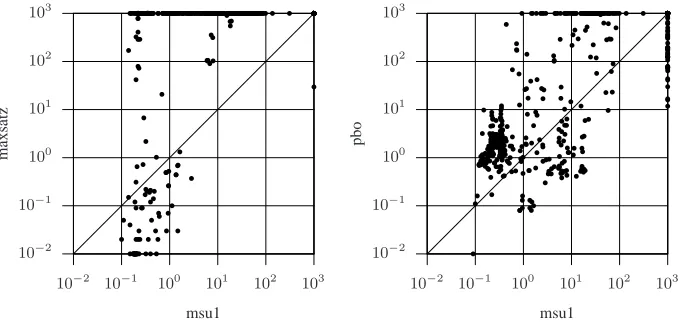
Fig. 2. Scatter plots on all instances maxsatz and PBO vs.msu1
significantly better thanmaxsatz. In contrast,msu1does not clearly outperform PBO. This is in part explained by the quadratic encoding of AtMost 1 constraints inmsu1, which causes a significant number of instances to abort. In addition, the PBO model uses the most recent version ofminisat+, whereas the unsatisfiable core extractor used in all versions of themsualgorithm is based onminisat1.14.
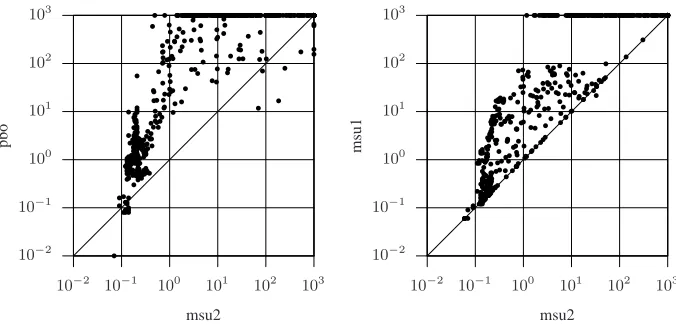
Figure 3 comparesmsu2against PBO and msu1. The performance difference is clear.msu2outperformsmsu1in almost all problem instances. For a very small number of examples, msu1can outperformmsu2, but the differences are essentially negligi-ble, never exceeding a small percentage of the total run time.msu2also clearly out-performs PBO, aborting a fraction (close to 20%) of the instances aborted by PBO. However, a few outliers exist, and these are explained by the fact that PBO uses the most recent version ofminisat+, andmsu2uses an unsatisfiable core extractor based onminisat1.14.
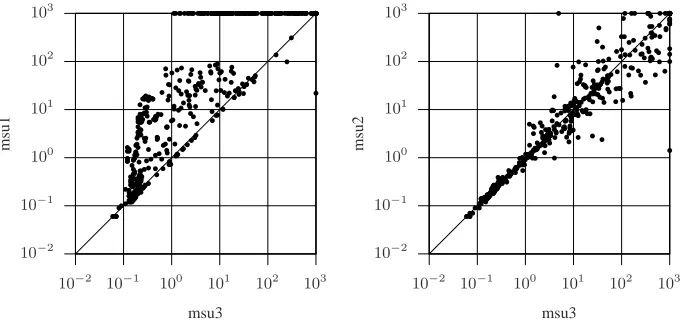
Figure 4 comparesmsu3againstmsu1andmsu2.msu1performs significantly worse thanmsu3, with a few outliers, only one of which is relevant. In contrast,msu2andmsu3 perform similarly, even thoughmsu2usually exhibits smaller run times. Nevertheless, the results also suggest thatmsu3can be an interesting alternative tomsu2for a reason-able number of problem instances.
10−2
10−1
100
101
102
103
10−2
10−1
100
101
102
103
p
b
o
msu2
10−2
10−1
100
101
102
103
10−2
10−1
100
101
102
103
m
su
1
[image:12.612.126.464.118.282.2]msu2
Fig. 3. Scatter plots on all instances, PBO and msu1 vs. msu2
solves 2,msu3solves 1, and maxsatzsolves 1. It is well-known that SAT instances from FPGA routing have specific structure, that makes them quite difficult for SAT solvers [23, 30]. This in part explains the results of all MAXSAT solvers on these in-stances.
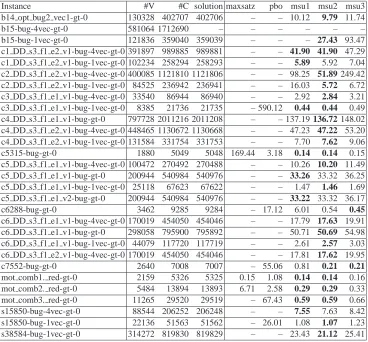
For the design debugging instances the results are quite different. Table 6 shows the CPU times for all MAXSAT solvers on all design debugging instances [25]. As before, the unsatisfiability-based MAXSATalgorithms perform remarkably better than the other algorithms,maxsatz and the PBO model. In addition, and also as before, msu2is the best performing algorithm, and aborts only one instance.msu3also aborts only one instance, but in general performs worse than msu2. Finally,msu1aborts 2 instances, and performs worse thanmsu2for almost all instances. For instances with large unsatisfiable cores (e.g. b15-bug-onevec-gate-0) the linear encoding used inmsu2 ensures manageable size representations of the AtMost 1 constraints. The same holds true tomsu3, for small values ofk. In contrast,msu1uses a quadratic encoding and so it often aborts instances with large unsatisfiable cores. Moreover, for instances requiring the identification of several unsatisfiable cores sharing common clauses, the additional constraints proposed in Section 4.2 are useful formsu2. It should be observed that the only design debugging instance that is aborted by bothmsu2andmsu3is also aborted by the unsatisfiable core extractor, again suggesting that performance of unsatisfiability-based MAXSATsolvers is indexed to the efficiency of SAT solvers.
7
Conclusions
Recent work has shown that MAXSAT has a number of significant practical applica-tions [25]. However, current state of the art MAXSATsolvers are ineffective on most problem instances obtained from practical applications.
unsat-10−2
10−1
100
101
102
103
10−2
10−1
100
101
102
103
m
su
1
msu3
10−2
10−1
100
101
102
103
10−2
10−1
100
101
102
103
m
su
2
[image:13.612.125.466.119.284.2]msu3
Fig. 4. Scatter plots on all instances, msu1 and msu2 vs. msu3
isfiable subformula identification. Moreover, the paper develops improvements to exist-ing algorithms and proposes a new MAXSAT algorithm. The proposed improvements (msu2) and new algorithm (msu3) provide significant performance improvements, and allow indexing the hardness of solving practical instances of MAXSATto the ability of modern SAT solvers for proving unsatisfiability and identifying unsatisfiable sub-formulas. The algorithms described in this paper are by far the most effective for in-stances obtained from practical applications, clearly outperforming existing state of the art MAXSATsolvers, and further improvements are to be expected.
Despite the promising results of the new MAXSATalgorithms, a number of research directions can be envisioned. As the experimental results show, the role of encoding car-dinality constraints is significant, and an extensive evaluation of alternative encodings should be considered. The unsatisfiable core extractor is based onminisat 1.14. A core extractor based a more recent SAT solver is expected to improve the efficiency ofmsu1,msu2andmsu3. Finally, the problem instances for the FPGA routing prob-lem are still challenging, even though the new MAXSATalgorithms can solve some of these instances, and so motivate the development of further improvements to MAXSAT algorithms.
Acknowledgement. This work is partially supported by EU project IST/033709 and
by EPSRC grant EP/E012973/1.
References
1. J. Argelich, C. M. Li, F. Many`a, and J. Planes. MaxSAT evaluation. www.maxsat07.udl.es. 2. M. L. Bonet, J. Levy, and F. Many`a. Resolution for Max-SAT. Artificial Intelligence,
171(8-9):606–618, 2007.
3. M. Davis, G. Logemann, and D. Loveland. A machine program for theorem-proving.
Table 2. Results for design debugging instances
Instance #V #C solution maxsatz pbo msu1 msu2 msu3
b14 opt bug2 vec1-gt-0 130328 402707 402706 – – 10.12 9.79 11.74
b15-bug-4vec-gt-0 581064 1712690 – – – – – –
b15-bug-1vec-gt-0 121836 359040 359039 – – – 27.43 93.47
c1 DD s3 f1 e2 v1-bug-4vec-gt-0 391897 989885 989881 – – 41.90 41.90 47.29 c1 DD s3 f1 e2 v1-bug-1vec-gt-0 102234 258294 258293 – – 5.89 5.92 7.04 c2 DD s3 f1 e2 v1-bug-4vec-gt-0 400085 1121810 1121806 – – 98.25 51.89 249.42 c2 DD s3 f1 e2 v1-bug-1vec-gt-0 84525 236942 236941 – – 16.03 5.72 6.72 c3 DD s3 f1 e1 v1-bug-4vec-gt-0 33540 86944 86940 – – 2.92 2.84 3.21 c3 DD s3 f1 e1 v1-bug-1vec-gt-0 8385 21736 21735 – 590.12 0.44 0.44 0.49 c4 DD s3 f1 e1 v1-bug-gt-0 797728 2011216 2011208 – – 137.19 136.72 148.02 c4 DD s3 f1 e2 v1-bug-4vec-gt-0 448465 1130672 1130668 – – 47.23 47.22 53.20 c4 DD s3 f1 e2 v1-bug-1vec-gt-0 131584 331754 331753 – – 7.70 7.62 9.06
c5315-bug-gt-0 1880 5049 5048 169.44 3.18 0.14 0.14 0.15
c5 DD s3 f1 e1 v1-bug-4vec-gt-0 100472 270492 270488 – – 10.26 10.20 11.49 c5 DD s3 f1 e1 v1-bug-gt-0 200944 540984 540976 – – 33.26 33.32 36.25 c5 DD s3 f1 e1 v1-bug-1vec-gt-0 25118 67623 67622 – – 1.47 1.46 1.69 c5 DD s3 f1 e1 v2-bug-gt-0 200944 540984 540976 – – 33.22 33.32 36.17
c6288-bug-gt-0 3462 9285 9284 – 17.12 6.01 0.54 0.45
c6 DD s3 f1 e1 v1-bug-4vec-gt-0 170019 454050 454046 – – 17.79 17.63 19.91 c6 DD s3 f1 e1 v1-bug-gt-0 298058 795900 795892 – – 50.71 50.69 54.98 c6 DD s3 f1 e1 v1-bug-1vec-gt-0 44079 117720 117719 – – 2.61 2.57 3.03 c6 DD s3 f1 e2 v1-bug-4vec-gt-0 170019 454050 454046 – – 17.81 17.62 19.95
c7552-bug-gt-0 2640 7008 7007 – 55.06 0.81 0.21 0.21
mot comb1. red-gt-0 2159 5326 5325 0.15 1.08 0.14 0.14 0.16
mot comb2. red-gt-0 5484 13894 13893 6.71 2.58 0.29 0.29 0.33
mot comb3. red-gt-0 11265 29520 29519 – 67.43 0.59 0.59 0.66
s15850-bug-4vec-gt-0 88544 206252 206248 – – 7.55 7.63 8.42
s15850-bug-1vec-gt-0 22136 51563 51562 – 26.01 1.08 1.07 1.23
s38584-bug-1vec-gt-0 314272 819830 819829 – – 23.43 21.12 25.41
4. N. Een and N. S¨orensson. An extensible SAT solver. In International Conference on Theory
and Applications of Satisfiability Testing, May 2003.
5. N. Een and N. S¨orensson. Translating pseudo-Boolean constraints into SAT. Journal on
Satisfiability, Boolean Modeling and Computation, 2, March 2006.
6. Z. Fu and S. Malik. On solving the partial MAX-SAT problem. In International Conference
on Theory and Applications of Satisfiability Testing, pages 252–265, 2006.
7. I. Gent. Arc consistency in SAT. In European Conference on Artificial Intelligence, pages 121–125, July 2002.
8. E. Giunchiglia and M. Maratea. Solving optimization problems with DLL. In European
Conference on Artificial Intelligence, pages 377–381, 2006.
9. ´E. Gr´egoire, B. Mazure, and C. Piette. Boosting a complete technique to find MSS and MUS thanks to a local search oracle. In International Joint Conference on Artificial Intelligence, pages 2300–2305, 2007.
10. F. Heras, J. Larrosa, and A. Oliveras. MiniMaxSat: a new weighted Max-SAT solver. In
2007.
11. H. Hoos and T. St¨utzle. SATLib. http://www.satlib.org/.
12. D. S. Johnson. Approximation algorithms for combinatorial problems. In ACM Symposium
on Theory of Computing, pages 1–9, 1973.
13. S. K. Lahiri, S. A. Seshia, and R. E. Bryant. Modeling and verification of out-of-order microprocessors in UCLID. In Formal Methods in CAD, pages 142–159, 2002.
14. J. Larrosa, F. Heras, and S. de Givry. A logical approach to efficient Max-SAT solving.
Artificial Intelligence, 2007. In press.
15. D. Le Berre, L. Simon, and O. Roussel. SAT competition. www.satcompetition.org. 16. C. M. Li, F. Many`a, and J. Planes. Detecting disjoint inconsistent subformulas for computing
lower bounds for Max-SAT. In National Conference on Artificial Intelligence, 2006. 17. C. M. Li, F. Many`a, and J. Planes. New inference rules for Max-SAT. Journal of Artificial
Intelligence Research, 2007. In press.
18. M. H. Liffiton and K. A. Sakallah. On finding all minimally unsatisfiable subformulas. In
International Conference on Theory and Applications of Satisfiability Testing, pages 173–
186, June 2005.
19. P. Manolios and S. K. Srinivasan. A parameterized benchmark suite of hard pipelined-machine-verification problems. In Advanced Research Working Conference on Correct
Hardware Design and Verification Methods, pages 363–366, October 2005.
20. V. Manquinho and O. Roussel. Pseudo-Boolean evaluation. www.cril.univ-artois.fr/PB07. 21. J. P. Marques-Silva and K. A. Sakallah. GRASP: A new search algorithm for satisfiability.
In International Conference on Computer-Aided Design, pages 220–227, November 1996. 22. M. Moskewicz, C. Madigan, Y. Zhao, L. Zhang, and S. Malik. Engineering an efficient SAT
solver. In Design Automation Conference, pages 530–535, June 2001.
23. G.-J. Nam, K. A. Sakallah, and R. A. Rutenbar. Satisfiability-based layout revisited: Detailed routing of complex FPGAs via search-based boolean SAT. In International Symposium on
Field-Programmable Gate Arrays, February 1999.
24. D. A. Plaisted and S. Greenbaum. A structure-preserving clause form translation. Journal
of Symbolic Computation, 2(3):293–304, September 1986.
25. S. Safarpour, H. Mangassarian, A. Veneris, M. H. Liffiton, and K. A. Sakallah. Improved design debugging using maximum satisfiability. In Formal Methods in Computer-Aided
De-sign, November 2007.
26. C. Sinz. Towards an optimal CNF encoding of boolean cardinality constraints. In
Interna-tional Conference on Principles and Practice of Constraint Programming, pages 827–831,
October 2005.
27. C. Sinz, A. Kaiser, and W. K¨uchlin. Formal methods for the validation of automotive product configuration data. Artificial Intelligence for Engineering Design, Analysis and
Manufactur-ing, 17(1):75–97, 2003.
28. G. S. Tseitin. On the complexity of derivation in propositional calculus. Studies in
Con-structive Mathematics and Mathematical Logic, Part II, pages 115–125, 1968.
29. J. P. Warners. A linear-time transformation of linear inequalities into conjunctive normal form. Information Processing Letters, 68(2):63–69, 1998.
30. H. Xu, R. A. Rutenbar, and K. A. Sakallah. sub-SAT: a formulation for relaxed boolean satisfiability with applications in routing. IEEE Trans. on CAD of Integrated Circuits and
Systems, 22(6):814–820, 2003.
31. E. Zarpas. Benchmarking SAT solvers for bounded model checking. In International
Con-ference on Theory and Applications of Satisfiability Testing, pages 340–354, June 2005.
32. L. Zhang and S. Malik. Validating SAT solvers using an independent resolution-based checker: Practical implementations and other applications. In Design, Automation and