UNIVERSITY OF SOUTHERN QUEENSLAND
G
G
E
E
O
O
G
G
R
R
A
A
P
P
H
H
I
I
C
C
I
I
N
N
F
F
O
O
R
R
M
M
A
A
T
T
I
I
O
O
N
N
S
S
Y
Y
S
S
T
T
E
E
M
M
B
B
A
A
S
S
E
E
D
D
M
M
A
A
N
N
U
U
R
R
E
E
A
A
P
P
P
P
L
L
I
I
C
C
A
A
T
T
I
I
O
O
N
N
P
P
L
L
A
A
N
N
N
N
I
I
N
N
G
G
A Dissertation submitted by
Badri Bahadur Basnet, M. Eng.
For the award of
D
D
O
O
C
C
T
T
O
O
R
R
O
O
F
F
P
P
H
H
I
I
L
L
O
O
S
S
O
O
P
P
H
H
Y
Y
CERTIFICATE OF DISSERTATION
I certify that the ideas, investigations, analysis, results, discussions, and conclusions
reported in this dissertation are entirely my own work, except where otherwise
acknowledged. I also certify that the work is original and has not been previously
used to earn academic awards.
Date: ……/……/… …
Signature of Candidate – Badri B Basnet
ENDORSEMENT
Date: ……/……/… …
Signature of Supervisor (1) – Dr Armando A Apan
Date: ……/……/… …
iii
ABSTRACT
The disposal of animal waste has become a problem in many parts of the world due
to the rapid growth in the number and the size of intensive animal industries. Safe
waste disposal sites are rarely available and the relocation and/or treatment of animal
waste is seldom economically viable. The reuse of animal waste for energy recovery
and re-feeding is also not popular. Animal waste is a valuable source of plant
nutrients and a very good soil conditioner, and has been commonly applied as
fertiliser to agricultural fields. However, due to the increasing oversupply of animal
waste in recent years, it has often been applied in excess to the agricultural fields.
Excessive application of animal waste, without due consideration of its implications,
is a serious concern. The run-off and leaching losses of nutrients from the fields
fertilised with animal waste have contributed significantly to the eutrophication and
toxic blue-green algae blooms in surface water systems and nitrification of ground
water systems. It has also led to nutrient imbalances in the soils and odour pollution
to the surrounding communities. The animal waste, which is a valuable source of
plant nutrients, has thus become both an economic and environmental burden, and
there is a need to develop a strategy for its sensible use as a fertiliser in agricultural
fields.
Sensible use of animal waste involves the consideration of all the agricultural,
environmental, social, and economical limitations. A rational method of achieving
where it can be relocated and applied economically, limit the application rates to a
safe level, and observe appropriate manure management practices. This study
addressed each of these components by developing a comprehensive manure
application plan (MAP) for the site-specific use of animal waste as fertiliser in
agricultural fields.
Various geographic information systems (GIS) based techniques, including a
weighted linear combination model and map algebra based cartographic modelling,
were employed to achieve the goal. The appropriateness of the existing techniques
and procedures were evaluated and modified to meet the current input requirements.
New methods of analysis were devised as necessary. The Westbrook sub-catchment
of the Condamine River catchment in south-east Queensland was selected as the
study area. The sub-catchment covers 24,903 hectares and contains 39 intensive
animal industries. The catchment is also a part of the Murray-Darling Basin, which
has been suffering from toxic blue green algae blooms recurrently since 1991.
This study identified that only about one-fifth of the sub-catchment area is suitable
for animal waste application. Depending on the method of site suitability analysis
and the number of input factors used the suitable area ranged between 16 and 22
percent. This comparatively small area is mainly due to the presence of a large
proportion of non-agricultural areas in the sub-catchment. The suitable areas were
also found to have various degrees of suitability for waste application. However, the
degree of site suitability was affected by the number of input factors used in the
analysis, the weighting of the factors, and the method of factor attribute
v
Conventional methods of weighting input factors were found to be cumbersome and
not particularly suitable. Hence, this study developed a new ‘objective oriented
comparison’ method of factor weighting. Standardisation of input factors using a
continuous, rather than discrete, classification (ie fuzzy set) method was found to be
more consistent in degree of suitability determination. The discrete classification of
factor attributes into classes of different numbers and sizes, and the weighting of
classes to a sum of one, were identified as a limitation in using this standardisation
method. A new ‘weight adjustment’ method was devised and demonstrated to reduce
factor-weighting biases.
The suitable sites, degree of site suitability, and other relevant spatial and non-spatial
information were processed within a GIS framework to develop a comprehensive
manure application plan. The inherently high presence of available phosphorus in the
soils of the study area was recognised and the P2O5 content in the manure was used
as the basis for determining manure application rates. A complimentary nitrogen
supply map was also generated. Manure management practices applicable to the
LIST OF PUBLICATIONS ARISING FROM THIS WORK
Basnet, B B, Apan, A A and Raine, S R (2000). Selecting Sites Suitable for Animal Waste Application Using a Vector GIS. Proceedings of the Society of Engineering in Agriculture (SEAg) Conference, 2-5 April, Adelaide, Australia.
Basnet, B B, Apan, A A and Raine, S R (2001). Selecting Suitable Sites for Animal Waste Application using a Raster GIS. Environmental Management, 28 (4), p.519-531. DOI: 10.1007/s002670010241.
Basnet, B B, Apan, A A and Raine, S R (in press). Geographic Information System Based Manure Application Plan. Journal of Environmental Management, volume 64. DOI: 10.1006/jema.2001.0484
vii
ACKNOWLEDGEMENTS
I wish to sincerely thank my supervisors Dr Armando A Apan and Dr Steven R
Raine who have contributed equally and complemented each other in guiding me
throughout this study. This study would not have been possible without their
continuous guidance, supervision, encouragement, and support. I would also like to
thank the Faculty of Engineering and Surveying for providing a scholarship for this
work. My thanks are also extended to the staff members of the Faculty and the Office
of Research and Higher Degrees for their continuous support.
I wish to extend my thanks to Mr Mark Schuster (Toowoomba City Council) for
providing some of the more important datasets, organising field visits, and giving
valuable advice. I also wish to thank the members of the AgWise research group for
their constructive comments and suggestions, and to acknowledge the assistance of
Mr Andrew Biggs, Mr Steve Donald (Department of Natural Resources), and Mr Bill
Mills (Department of Primary Industries) in data acquisition. I would also like to
acknowledge the Environmental Protection Agency (Queensland) and Australia
Surveying and Land Information Group for making relevant information available.
Finally, I wish to express my sincere thanks to my wife Bhagabati, son Prajwal and
daughter Prasamsa for their continuous encouragement and support throughout this
study. I would not have been able to complete this work without them allowing me to
carry on with the project work, often at the expense of more important parental
TABLES OF CONTENTS
1 GENERAL INTRODUCTION 1
1.1 Problem statement 1 1.2 Aim 4
1.3 Research approach 5
2 REVIEW OF LITERATURE 6
2.1 Introduction 6 2.2 Animal waste and the environment 6
2.3 Utilisation of animal waste 10
2.4 GIS as a tool for manure management 15 2.4.1 GIS and spatial analysis 15 2.4.2 Location modelling for waste application 18 2.4.3 Degree of site suitability for site-specific decision making 20 2.4.4 Application of GIS for site-specific manure management 22 2.5 The objectives 23
3 COMMON RESEARCH METHODS 25 3.1 Introduction 25
3.2 Study area 25 3.2.1 Using a sub-catchment as the study unit 29 3.2.2 Structuring the digital elevation model of the study area 30 3.2.3 Delineating the sub-catchment 34 3.3 Selection of input factors 35
3.4 Data acquisition and pre-processing 36
3.5 Site suitability evaluation 41
4 SITE SUITABILITY ANALYSIS 43
ix
4.2 Selecting Sites Suitable for Animal Waste Application 43 4.2.1 Vector-based site suitability analysis 44 4.2.2 Raster-based site suitability analysis 44 4.2.3 Objectives 46
4.3 Materials and methods 47 4.3.1 Comparison of vector- and raster-based analyses 47 4.3.2 Field validation of suitability measurements 50 4.3.3 Sensitivity analysis 51 4.3.4 Weighting of input factors 56 4.4 Results 58 4.4.1 Comparison of vector- and raster-based analyses 58 4.4.2 Field validation of sites identified using the raster-based WLC
method 61 4.4.3 Sensitivity analyses 62 4.4.4 Evaluation of the OOC method 65 4.5 Discussion 66
4.5.1 Comparison of vector and raster methods of site suitability
analysis 66 4.5.2 Sensitivity analysis (degree of site suitability) 70 4.5.3 Objective oriented method of factor weighting 73
4.6 Conclusion 74
5 ASSESSING THE DEGREE OF SITE SUITABILITY 76
5.1 Introduction 76
5.3.2 Standardisation using continuous rescaling 95 5.3.3 Comparing the classification and rescaling methods of
standardisation 96
5.4 Results 98 5.4.1 Effect of factor attribute classification 98 5.4.2 Effect of factor attribute rescaling 101 5.4.3 Comparison between the methods of standardisation 102 5.5 Discussion 106 5.5.1 Standardisation of factors using the classification method 106 5.5.2 Standardisation of factors using rescaling method 112 5.5.3 Factor attribute classification versus rescaling 114 5.6 Conclusion 115
6 DEVELOPING A MANURE APPLICATION PLAN 117 6.1 Introduction 117
xi
6.4.3 Manure allocation and manure nutrient (P2O5) contents 134
6.4.4 Manure application plan 136 6.4.5 Nitrogen application from manure sources 138 6.4.6 Maximum manure application rates 138
6.5 Discussion 141 6.5.1 Suitability measurements 141 6.5.2 Crop nutrient requirements 142 6.5.3 Manure allocation map 143 6.5.4 Manure application plan 144 6.5.5 Adoption of the manure application plan 147 6.6 Conclusions 151
7 GENERAL DISCUSSION 153
8 CONCLUSION 157
9 REFERENCES 162
10 APPENDICES 170 10.1 Appendix A. Datasets used in catchment delineation 170
10.2 Appendix B. Input factors 174 10.3 Appendix C. Classification of input factors 186
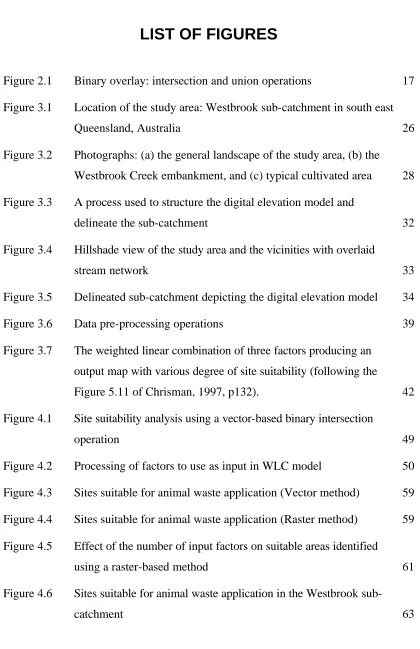
LIST OF FIGURES
Figure 2.1 Binary overlay: intersection and union operations 17
Figure 3.1 Location of the study area: Westbrook sub-catchment in south east Queensland, Australia 26
Figure 3.2 Photographs: (a) the general landscape of the study area, (b) the
Westbrook Creek embankment, and (c) typical cultivated area 28
Figure 3.3 A process used to structure the digital elevation model and
delineate the sub-catchment 32
Figure 3.4 Hillshade view of the study area and the vicinities with overlaid
stream network 33
Figure 3.5 Delineated sub-catchment depicting the digital elevation model 34
Figure 3.6 Data pre-processing operations 39
Figure 3.7 The weighted linear combination of three factors producing an output map with various degree of site suitability (following the
Figure 5.11 of Chrisman, 1997, p132). 42
Figure 4.1 Site suitability analysis using a vector-based binary intersection
operation 49
Figure 4.2 Processing of factors to use as input in WLC model 50
Figure 4.3 Sites suitable for animal waste application (Vector method) 59
Figure 4.4 Sites suitable for animal waste application (Raster method) 59
Figure 4.5 Effect of the number of input factors on suitable areas identified
using a raster-based method 61
Figure 4.6 Sites suitable for animal waste application in the Westbrook
xiii
Figure 5.1 Schematic representation of the effect of classification on cell
values 81
Figure 5.2 The process of factor attribute standardisation using both discrete classification and continuous rescaling methods 84
Figure 5.3 Classification of factor attributes into different numbers of classes 88
Figure 5.4 Examples of input factors with attribute classified into class of
different sizes 90
Figure 5.5 Weighted average as a function of the method of standardisation 103
Figure 5.6 Effect of the number of classes on the degree of site suitability 107
Figure 5.7 Linear combination of input factors with varying class weights 107
Figure 5.8 Adjustment of weight to compensate the division of weight due to factor attribute classification (modification of Figure 5.6) 110
Figure 5.9 Effect of class sizes on the dispersion and skewing of the cell
values 112
Figure 6.1 Manure application plan development process for site-specific
application of manure in agricultural fields 124
Figure 6.2 Overall suitability of sites for animal waste application 130
Figure 6.3 Crop distribution and nutrient (P2O5) requirement to achieve target
yield in the sub-catchment 133
Figure 6.4 Application area of the various manure types in the Westbrook sub-catchment (Total application area = 21.4 % of the sub-sub-catchment) 134
Figure 6.5 Proposed allocation of manure and manure nutrient (P2O5) content
in the Westbrook sub-catchment 135
Figure 6.6 Suggested manure application plan for Westbrook sub-catchment 137
xv
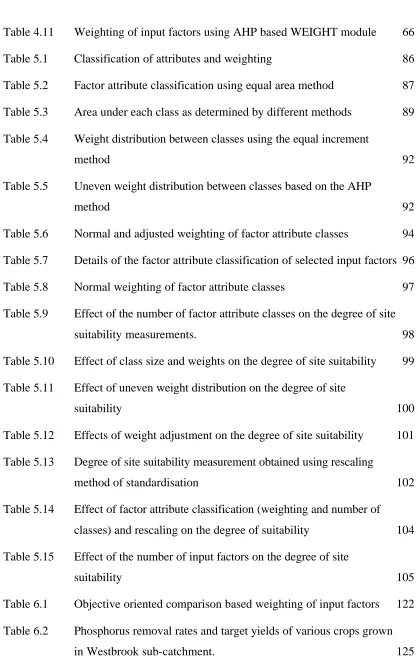
[image:15.595.113.533.99.760.2]LIST OF TABLES
Table 2.1 Commonly available software programs for the calculation of
manure application rates 14
Table 3.1 Selection of input factors for the site-specific manure management 35
Table 3.2 Data acquisition: sources, formats, scale, and uses 37
Table 3.3 Exclusionary criteria applied to input factors selected for site suitability determination for animal waste application in
agricultural fields 40
Table 4.1 Input factors and potentially suitable area for each input factor 48
Table 4.2 Questionnaire for field assessment of site suitability 51
Table 4.3 Classification and weighting of factor attributes for raster-based
site suitability analysis 53
Table 4.4 Example of the pair-wise comparison matrix for class weight
determination associated with the “proximity to stream” factor 54
Table 4.5 Objective oriented comparison (OOC) method of weighting input factors 58
Table 4.6 Site suitability measurements as affected by the number of input
factors in vector and raster methods 60
Table 4.7 Error matrix and Kappa index of agreement 61
Table 4.8 Summary of the WLC method based site suitability analysis 62
Table 4.9 Effect of the number of input factors in the areal extent and the
degree of site suitability for animal waste application 64
Table 4.10 Effect of factor weights on degree of site suitability for animal
Table 4.11 Weighting of input factors using AHP based WEIGHT module 66
Table 5.1 Classification of attributes and weighting 86
Table 5.2 Factor attribute classification using equal area method 87
Table 5.3 Area under each class as determined by different methods 89
Table 5.4 Weight distribution between classes using the equal increment
method 92
Table 5.5 Uneven weight distribution between classes based on the AHP
method 92
Table 5.6 Normal and adjusted weighting of factor attribute classes 94
Table 5.7 Details of the factor attribute classification of selected input factors 96
Table 5.8 Normal weighting of factor attribute classes 97
Table 5.9 Effect of the number of factor attribute classes on the degree of site suitability measurements. 98
Table 5.10 Effect of class size and weights on the degree of site suitability 99
Table 5.11 Effect of uneven weight distribution on the degree of site
suitability 100
Table 5.12 Effects of weight adjustment on the degree of site suitability 101
Table 5.13 Degree of site suitability measurement obtained using rescaling
method of standardisation 102
Table 5.14 Effect of factor attribute classification (weighting and number of
classes) and rescaling on the degree of suitability 104
Table 5.15 Effect of the number of input factors on the degree of site
suitability 105
[image:16.595.110.528.103.774.2]Table 6.1 Objective oriented comparison based weighting of input factors 122
xvii
Table 6.3 Nutrients contained in various types of solid and liquid animal
waste (source: OSU, 1992) 127
Table 6.4 Value attributes of environmental suitability map (expressed as a
fraction). 131
Table 6.5 Cropping area and crop nutrient (P2O5) requirements to achieve
target yields of various crops grown in the Westbrook
sub-catchment 132
Table 6.6 Maximum application rates of various manure types 140
Table 6.7 Areas under different degree of site suitability categories 140