Queering practice-led research: Subjectivity, creative practice
and performative research
Dallas J. Baker
PhD Candidate, Griffith University and School of Arts and Social Sciences, Southern Cross University
Abstract: Practice-Led Research (PLR) is gaining increasing acceptance in the tertiary sector as a valid, rigorous and innovative research methodology in the creative arts (Smith & Dean 2009, Green 2007).This is the result of an ongoing debate and discussion led, for the most part, by university academics in creative arts disciplines seeking to have creative works acknowledged as research outputs (Smith & Dean 2009, Barrett 2004, Bolt 2004, Haseman & Mafe 2009, Krauth 2002, Lycouris 2000, Marshall & Newton 2000).
So far, much of this discussion and debate about PLR in the arts and creative industries has been about what constitutes research (Smith & Dean 2009, Allen 2006, Haseman 2006). This paper, in contrast, discusses what constitutes ‘practice’ and describes a form of PLR that is influenced by Queer Theory. This queered PLR foregrounds subjectivity as a practice in itself and views both creative practice and critical research as components in an ‘ethics of the self’ (Foucault 1978) or ‘self-bricolage’ (Rabinow 1997). In other words, this paper positions subjectivity as the core practice leading both research and creative endeavour whilst simultaneously seeing creative practice, research and subjectivity as intertwined and mutually informing each other. In this way, a queered PLR can be seen to reframe creative practice and critical research as an ethical intervention into subject formation and knowledge production.
The pairing of PLR and Queer Theory is innovative and is suggested by the primacy of gender and sexual subjectivity (or identity) to much work and practice in the creative arts; which itself reflects an increasing primacy of gender and sexual identity in the contemporary world (Weeks 1998: 35). This pairing also arises out of the author’s own creative practice in the field of creative writing which grew out of an individual wish to discuss, understand, express, explore and describe gender and sexual difference.
This queering of Practice-Led Research has the potential to innovate research in the creative arts by providing a methodology for bringing together the diverse threads of subjectivity, creative practice, critical research and performativity (Butler 1990) into a coherent whole. Furthermore, a queered PLR may give the creative arts researcher innovative tools to enrich creative practice, diversify research and increase points of connection with disparate creative artefacts or products. A queered PLR is also envisaged as a dynamic and performative pathway to new knowledges.
Introduction
Practice-Led Research (PLR) is gaining increasing acceptance in the tertiary sector as a valid, rigorous and innovative research methodology in the creative arts (Smith & Dean 2009, Green 2007).This is the result of an ongoing debate and discussion led, for the most part, by
So far, much of this discussion and debate about PLR in the arts and creative industries has been about what constitutes research (Smith & Dean 2009, Allen 2006, Haseman 2006). This paper, in contrast, discusses what constitutes ‘practice’ and describes a form of PLR that is influenced by Queer Theory. This queered PLR foregrounds subjectivity as a practice in itself and views both creative practice and critical research as components in an ‘ethics of the self’ (Foucault 1978) or ‘self-bricolage’ (Rabinow 1997). In other words, this paper positions subjectivity as the core practice leading both research and creative endeavour whilst
simultaneously seeing creative practice, research and subjectivity as intertwined and mutually informing each other.
The pairing of PLR and Queer Theory is innovative and is suggested by the primacy of gender and sexual subjectivity (or identity) to much work and practice in the creative arts; which itself reflects an increasing primacy of gender and sexual identity in the contemporary world (Weeks 1998: 35). This pairing also arises out of the author’s own creative practice in the field of creative writing which grew out of an individual wish to express, explore and describe gender and sexual difference.
This queering of Practice-Led Research has the potential to innovate research in the creative arts by providing a methodology for bringing together the diverse threads of subjectivity, creative practice, critical research and performativity (Butler 1990) into a coherent whole. Furthermore, a queered PLR may give the creative arts researcher innovative tools to enrich creative practice, diversify research trajectories and increase points of connection with disparate creative artefacts or products. A queered PLR is also envisaged as a dynamic and performative pathway to new knowledge.
This paper is heavily influenced by the later work of Michel Foucault, in which the French philosopher advocated the adoption of Classical Greco-Roman conceptions of philosophy as a way of life implemented in order to effect a transformation of the self. Foucault (1986b) called this process of applying philosophy as a way of life an ‘ethics of the self’. The article explores how a queered PLR process or methodology can be applied as part of an ethics of the self (self-bricolage) that can effect concomitant transformations of subjectivity, creative practice and research.
Defining practice-led research
There are as many definitions of Practice-Led Research as there are practitioners in the field. Rather than attempt to create a universal definition of PLR, and thus codify and limit the range of methodologies and knowledges on which it draws, a number of practitioner
researchers in the field have advocated that PLR be seen as multidisciplinary (Smith & Dean 2009, Stewart 2001) and have argued for a kind of radical disciplinary openness (Stewart 2001). Having said that, a core attribute of PLR is its ‘insistence that research outputs and claims to knowing must be made through the symbolic language and forms of… practice’ (Haseman 2006: 4). Smith & Dean have presented the following loose description of PLR that is also useful:
PLR is epitomised by the artefact and exegesis model used in academic settings (Smith & Dean 2009, Arnold 2007 and 2005, Milech & Schilo 2004, Barrett 2004). In this model, a creative artefact is produced in concert with a critical component (exegesis) that describes or explores the creative process or themes expressed in the creative work. Generally, the
exegesis resembles a more traditional research paper in the Humanities and uses critical theories and standard academic methodologies. In PLR projects, the creative component and exegesis are seen to be research outputs of equal value and as two aspects of a single, unified whole. This is in accord with Scrivener (2000) who argued that theory and practice are ‘inextricably linked and mutually dependent’ (1).
Performative research
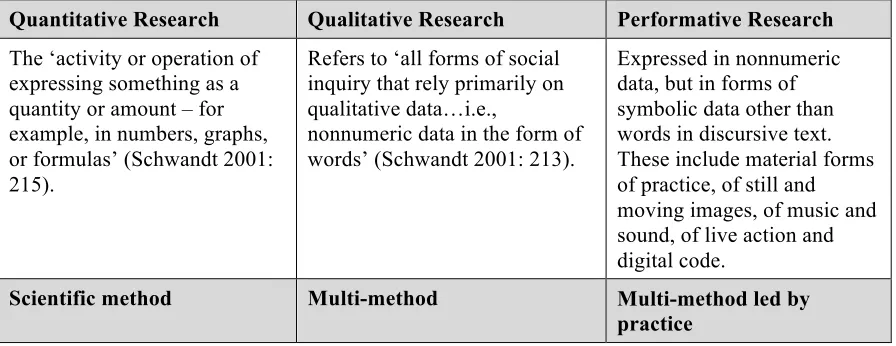
Haseman (2006: 1) argues that PLR should be understood as ‘a research strategy within an entirely new research paradigm - Performative Research’ (emphasis mine). Performative Research differs significantly from traditional research strategies (see Figure 1). In
Performative Research an emphasis is placed on ‘research outputs and claims to knowing’ being made through ‘the symbolic language and forms of… practice’ (Haseman 2006: 4).
Haseman defines the performative as ‘utterances that accomplish, by their very enunciation, an action that generates effects’ (2006: 6). A performative utterance—exemplified by the statements ‘I pronounce you ...’ or ‘I do…’ spoken at marriage ceremonies—is ‘itself an act that performs the action to which it refers’ (Pratt 2009). This utterance enacts what it names (Pratt 2009). As Haseman clarifies, this utterance ‘performs itself and in the course of that performing becomes the thing done’ (2006: 6). In Performative Research then, ‘the symbolic data works performatively. It not only expresses the research, but in that expression becomes the research itself’ (Haseman 2006: 6).
Quantitative Research Qualitative Research Performative Research
The ‘activity or operation of expressing something as a quantity or amount – for example, in numbers, graphs, or formulas’ (Schwandt 2001: 215).
Refers to ‘all forms of social inquiry that rely primarily on qualitative data…i.e.,
nonnumeric data in the form of words’ (Schwandt 2001: 213).
Expressed in nonnumeric data, but in forms of symbolic data other than words in discursive text. These include material forms of practice, of still and moving images, of music and sound, of live action and digital code.
[image:3.595.86.534.440.613.2]Scientific method Multi-method Multi-method led by practice
Figure 1: Research Paradigms. Adapted from Haseman (2006: 6).
Haseman appropriates the term ‘performative’ from J.L. Austin’s speech act theory, as does Judith Butler. Haseman uses the term performative in much the same way that Austin intended it to be used – to describe acts of speech that, in their enunciation, accomplish the action they describe (Austin 1970). Austin later extended his notion of the performative to include all acts of speech (1970: 147). Haseman’s innovation is to further extend the performative to incorporate the act of writing.
Judith Butler (Kosofsky Sedgwick 2003). In this deconstructive/queer lineage, there has been an emphasis on decoupling Austin’s performative from ‘its localized dwelling in a few
exemplary utterances or kinds of utterance and showing it instead to be a property of language or discourse much more broadly’ (Kosofsky Sedgwick 2003: 5). Judith Butler, in particular, has extended the notion of the performative to encompass a broader range of ‘acts’, such as the habitual and stylized acts (or gestures) of gender and the practices (or acts) of subjectivity. Haseman does not engage with Butler’s queer adaptation and re-theorisation of the
performative. This is despite the fact that Butler is the principle and most influential
contemporary theorist in the field of performativity. Therefore, a queered PLR addresses this oversight by bringing together Haseman’s (2006) notion of performative research and Butler’s (1990, 1993) notion of the performativity of subjectivities, genders and sexualities.
Butler has elaborated the notion of performativity in relation to gender and norms of
heterosexuality (1990, 1993). Butler argues that gender is a performance without ontological status when she writes: ‘There is no gender identity behind the expression of gender;
…identity is performatively constituted by the very “expressions” that are said to be its results’ (1990: 25). For Butler (2004), performativity describes how what might be assumed to be an internal essence to something such as gender or subjectivity is ‘manufactured through a sustained set of acts, posited through the gendered stylization of the body’ (94). Hence, genders, sexualities, subjectivities and identities can all be seen as equally performative; as manufactured through a sustained set of acts (some of them cognitive) enacted through the racial, gendered and sexual stylization of bodies. Queer theories of performativity draw on and align with Poststructural conceptions of identity in which identity/subjectivity is seen as multiple, changing and fragmented (Sarup 1996). In this way, Queer Theory re-conceives gendered identities and sexualities as plural, varying, fragmented and produced in, by and through discourse.
Performative subjectivities are socio-culturally and historically embedded; they are ‘citational chains’ and their effects depend on social conventions (Pratt 2009). According to Butler, gender and sexual norms and subjectivities are produced, disseminated and reinforced through repetitions of an ideal such as the ideal of ‘woman’ or ‘man’ (Pratt 2009). As the
heteronormative ideal is a fiction and thereby ‘uninhabitable’, there is room for human agency, disidentification (or counter identification) and resistance (Pratt 2009). In the context of a queered PLR, this disidentification and resistance is undertaken by producing texts that resist heteronormative gendering and present queer models of gender and sexual subjectivity as performative.
The notion of performativity impacts on a queered PLR in multiple ways. The completed creative and critical components can be seen as performative research outputs (Haseman 2006) and the queered PLR projects are likely to produce discourses in which performative subjectivities are explored. In effect, a queered PLR can be seen to be exploring the notion of self and subjectivity through the creative arts; in effect, demonstrating the ways that creative artefacts constitute and deploy sexual and gender subjectivities and vice versa.
Subjectivity as practice: Performative self-bricolage
Much PLR scholarship theorises practice in terms of the unconscious and/or the creative ‘impulse’, usually with reference to psychoanalytic theories (Curtis 2009, Hecq 2008, Brown 2008, Brophy 2006 &1998, Harris 2001). In contrast, a queered PLR distances itself from the sometimes ‘essentialist’ tendencies of psychoanalytic discourse and instead theorises practice (writing, research, subjectivity) in terms of performativity. By theorising creative practice as performativity, it is possible to displace the entrenched and essentialist Romantic model of creative genius (Sawyer 2006, Montouri & Purser 1995, Weisberg 1993) whilst
simultaneously disrupting the notion that discursive subjectivities appearing within creative artefacts are representations of the internal, stable identity of the creator. Instead, creativity as performativity foregrounds the appearance of subjectivities within creative artefacts as a deployment or intervention into discourse for a critical or creative purpose. Hence, the
inscription of queer subjectivities into creative works should not be seen as a reflection of the creator’s identity, a representation of some imagined ‘internal’ self, but rather as a deliberate inscription and dissemination of non-normative discursive subjectivities.
In the field of literature, Elizabeth Stephens (2009)—in an analysis of the writing practices of Jean Genet—posits that a queered writing practice ‘reframes its homoeroticism so that this is no longer seen as the expression of a queer exteriority – of a perverse author whose intentions determine the meaning of the text – but rather as a dynamic mobilised within that text’ (19).
Stephens (2009) goes on to state that queer writing ‘provides a way to maintain the centrality of sex and eroticism to the narrative without positioning these as the coherent expression of a stable sexual identity’ (19) and that ‘queer writing need neither naturalize nor negate the role (or queerness) of the writer’ (20).
The same can be said for all creative arts, the centrality of (queer) sex and eroticism to a creative artefact need not position these as the coherent expression of a stable sexual identity but rather be understood as a deliberate inscription and dissemination of non-normative discursive subjectivities.
The intent in understanding creative practice, research, critical engagement and subjectivity as mutually dependant performative practices is to explore the tensions or cohesions between creative and critical research and writing on one hand and subjectivity or identity on the other. Foucault once wrote that who one is emerges out of the problems with which one struggles (Rabinow 1997: xix). Foucault advocated an ongoing investigation or struggle with the self – an ongoing assembly and disassembly of subjectivity – that constituted a kind of
self-bricolage; a making and re-making of subjectivity that can be seen as an aesthetic struggle towards an artistic ideal (Rabinow 1997).
It could also be said that the creative artefact emerges from this struggle as well. The purpose of this creative self-bricolage is to make philosophy a way of life, and an aesthetics. In this sense, subjectivity itself can be seen as an aesthetic practice; the making of the self is an art. In fact, much of the work of self-(re)making has traditionally occurred in the creative arts which have historically been a domain of self-enquiry, self-exploration and self
Creative writing: An exemplar of performative self-bricolage
Creative Writing as a discipline offers a clear example of the relationship between discourse and the constitution of subjectivities. John Ambrosio, citing Faust, describes how writing acts on and with subjectivity when he argues:
As a form of reflection and experimentation, writing is a technology of ethical self-formation that views the subject as a work of art and the self as an artefact, as an ongoing work in progress. When conjoined with a philosophical “attitude of resistance that incites new ways of thinking about the forms of experience”, writing enables individuals to begin to “question and modify those systems which make only particular kinds of action possible.
Queer Theory is such a ‘philosophical attitude of resistance’ that ‘incites new ways of
thinking about the forms of experience’ (Faust 1988: 188) and makes a wider range of actions and performativities possible.
One of the principal examples Foucault (1986) gave of a technique of the self, implemented to produce a desired or altered/transformed subject, was confessional (or reflexive) writing (8-9). For Foucault, this writing produced the desired subject through a process of self-analysis, of probing for the ‘reality’ of the self in order to construct a subjectivity in line with one’s ethics (Ambrosio 2008). To put it simply, for Foucault certain kinds of writing are a practice
involved in the production and maintenance of the self. This can be said to be more so when that writing is informed and/or organised by a philosophy of some kind that is applied as a way of life (Faust 1988).
According to Foucault (1988), ‘there is no sovereign, founding subject, a universal form of subject to be found everywhere’ but rather the subject/subjectivity is ‘constituted through practices of subjection, or, in a more autonomous way, through practices of liberation, of liberty… on the basis, of course, of a number of rules, styles, inventions to be found in the cultural environment’ (50-51). There is no ‘authentic, foundational or necessary self waiting to be discovered and liberated’ (Ambrosio 2008: 253). Subjectivity (in particular sexual subjectivity) is constituted in the interplay and correlation between ‘types of understanding, forms of normativity and modes of relation to oneself and others’ (Foucault 1986: 4). Furthermore, ‘subjects can occupy a variety of positions both “subject to” discipline and capable of “self-constitution”; albeit within the resources offered by his/her culture, society and social group’ (Foucault cited in Bailey 2005: 122).
In this sense, self-bricolage through writing is a practice of liberty or ‘practice of the self’ that, as an aspect of the queer cultural environment, informs and alters the way subjects actively constitute themselves. In other words, creative and critical texts arising out of a queered PLR are ‘models’ that strongly influence the ongoing becoming of queer subjectivities.
Drawing on Foucault, Judith Butler writes that ‘to understand identity as a practice, and as a signifying practice, is to understand culturally intelligible subjects as the resulting effect of a rule-bound discourse that inserts itself in the pervasive and mundane signifying acts of
linguistic life’ (1990: 184) (original emphasis). Subjectivity, like creative writing, is a practice that is dynamic, reflective and creative.
words, an experience of a non-normative subjectivity in discourse or creative text can, to use Butler’s terminology, ‘undo’ one’s personhood and facilitate the emergence of a new
subjectivity. Foucault described a similar process by which new subjectivities formed through the ‘appropriation, the unification, of a fragmentary and selected already said’ (cited in
Rabinow 1997: 209). In the context of Queer Theory, this process of undoing and/or
(re)constituting subjectivities is an act of resistance against heteronormativity. This resistance, this re-making of identity, is not without limits or challenges; it is not total voluntarism
(Butler 2004). As Ambrosio (2008: 255), pointing to some of these challenges and constraints, argues:
We cannot transform ourselves through a simple act of knowing, through critical reason
or reflection alone, but only by risking who we are, by… seeking out and testing
ourselves in situations that illuminate the contours of our subjectivity, that destabilize our certainties…. Transforming the self requires that we act with personal courage and develop a tolerance for uncertainty and vulnerability. (original emphasis)
This exposure to new subjectivities or discourses (the ‘already said’) can occur at the point of reception but also, significantly, in the performative moment of production. The practice of writing can provide ‘a means by which individuals… transform themselves, reconstitute themselves as ethical subjects through reading, …reflection, and practical experimentation’ (Ambrosio 2008: 265). This process of ‘undoing’ in which new subjectivities emerge can be described as a ‘queering of the self’.
It can be extrapolated then that a ‘queering of the self’—facilitated by exposure to Queer Theory in the context of PLR—can enrich and inform writing (or arts) practice and research; in effect bringing them into operation as a mutually interconnected self-bricolage. This queering of the self/subjectivity is in effect a denaturalising of the self – a decoupling of identity from notions of the natural. In other words, a queered self is one in which subjectivity and identity are not conceived as somehow natural and stable but rather understood to be ambiguous, ephemeral, fluid and largely produced by discourse in relationship with socio-cultural factors. This conception of the self and subjectivity opens up the possibility of the writer-researcher occupying a wider range of reading and writing ‘positions’ in ways that enrich both the creative act and research processes.
A queered PLR provides writer-researchers with tools to explore notions of sexual and gender difference in ways that produce more than a theoretical understanding. As Michel Foucault (1978) has argued, in his groundbreaking text The History of Sexuality, any strategy aimed at resisting the discursive mechanisms of power that are engaged in the deployment of a
narrowly defined sexuality, including mechanisms of repression, must involve a transgression of laws, a dismantling of prohibition and an ‘irruption of speech’ (5). Therefore, Foucault writes, ‘one cannot hope to obtain the desired results simply from… a theoretical discourse, however rigorously pursued’ (1978: 5). Thus, it is apparent that using non-theoretical ways of communicating the knowledges produced in such research and practice are appropriate and a means of enabling queer writer-researchers a voice that resists heteronormative discourse.
Conclusion
This paper discussed the notion of a queered Practice-Led Research that positions subjectivity as the core practice leading both research and creative endeavour. This queered PLR views both creative practice and critical research as components in an ‘ethics of the self’ (Foucault 1978) or ‘self-bricolage’ (Rabinow 1997).
The paper also touched on how, in a queered PLR, creative and critical practice often emerges from creative researchers’ intention to discuss, understand and describe gender and sexual difference. This is not to say that a queered PLR is only useful for creative/critical projects exploring sexualities or a tool only for queer researchers/practitioners. One possible (perceived) limit or objection to the use of a queered PLR as a model for PLR in general is that it may not be appropriate for non-queer creative researchers. For me, Queer Theory has salience for creative researchers irrespective of their genders or sexualities. Queer Theory is often misunderstood as a vehicle solely for LGBT subjects to investigate the specificity of their experience and culture. In contrast, Queer Theory can be seen as an, as yet, untravelled field of enquiry for non-LGBT academics and students. After all, we are all implicated in the performativity of sexualities and genders, irrespective of the identity categories to which we subscribe. Furthermore, Queer Theory has valuable contributions to make in the
deconstruction and analysis of, among other significant research areas, race, class, age, temporality and space.
There are certain limits to positioning subjectivity as a core element to creative arts led research. It is crucial that the model of subjectivity used in a subjectivity-centred PLR is not one that entrenches rather than disrupts the notion of subjectivity as stable, lasting and unified. For a queered PLR to be effective, the model of subjectivity deployed must be one that destabilizes the notion of identity/subjectivity as unitary, fixed and somehow natural. A subjectivity-centred approach that views identity as natural and inherent to the subject, and sees the creative artefact as a direct reflection of the creator’s identity, is little more than a return to the Romantic model of the creative genius.
The methodology most appropriate for queered PLR projects has been described as a kind of performative bricolage; a complex and performative process drawing on multiple disciplines, methodologies, theories and knowledges in which subjectivity, creative practice and critical research combine to produce interdisciplinary artefacts (creative and critical arts) that foreground the performative nature of gender and sexual difference.
A queered PLR takes the form of traditional research teamed with reflective investigations undertaken in the practice aspects (creative endeavour, self-bricolage). Within a queered PLR, new knowledge concerning sexual and gender difference as performativity is produced
through reflexivity as well as in the performative act of writing or producing art.
The paper used Creative Writing as an exemplar of the relationship of creative endeavour and discourse to the constitution of subjectivities. Indeed, as Haseman (2006) has demonstrated, the act of writing itself is performative and, in that it produces discourse, is a process through which subjectivities are constructed and disseminated in self-bricolage. With this in mind, the production of creative and narrative textual artefacts that present and describe performative genders, sexualities and identities is a highly appropriate methodology for exploring
performative subjectivities themselves.
easily been used. A queered PLR can be applied in any creative arts led research practice. Research into the specific ways that a queered PLR might be applied in other creative disciplines, such as the visual arts or drama, needs to be undertaken by expert researcher-practitioners working within those disciplines.
Finally, there is a scarcity of PLR scholarship on the relationships between creative practice, research and subjectivity. Future scholarship needs to be undertaken to explore the nuanced relationships between subjectivities and creative arts consumption and production. This can be done, in part, by employing a form of PLR that is influenced by Queer Theory, in
particular the notions of performativity and self-bricolage.
References
Allen, C. 2006. “Academic Research and Creative Writing: Redrawing the Map and Finding One's Allies (and avoiding the Corbett phenomena).” TEXT 10 (2). Accessed 15
September 2010. http://www.textjournal.com.au/oct06/owen.htm
Ambrosio, J. 2008. “Writing the Self: Ethical Self-Formation and the Undefined Work of Freedom.” Educational Theory 58(3): 251-267.
Arnold, J. 2005. “The PhD in Creative Writing Accompanied by an Exegesis”. Journal of University Teaching and Learning Practice 2(1). Accessed 25 October 2010.
http://jutlp.uow.edu.au/2005_v02_i01/pdf/arnold_003.pdf
Arnold, J. 2007. Practice Led Research: A Dynamic Way to Knowledge. Melbourne: Rockview Press.
Austin, J.L. 1970. How to Do Things with Words. Ed. J.O. Urmson. New York: Oxford University Press.
Bailey, S. 2005. Media Audiences and Identity: Self-Construction in the Fan Experience. New York: Palgrave Macmillan.
Barrett, E. 2004. “What Does It Meme?: The Exegesis as Valorization and Validation of Creative Arts Research.” TEXT. Special Issue 3. Accessed 25 October 2010.
http://www.textjournal.com.au/speciss/issue3/barrett.htm
Bolt, B. 2004. “The Exegesis and the Shock of the New.” TEXT. Special Issue 3. Accessed 25 October 2010. http://www.textjournal.com.au/speciss/issue3/bolt.htm
Brophy, K. 2006. “Repulsion and Day-Dreaming: Freud Writing Freud.” New Writing: The International Journal for the Practice & Theory of Creative Writing 3(2): 132-144. Brophy, K. 1998. Creativity: Psychoanalysis, Surrealism and Creative Writing.
Melbourne, Australia: Melbourne University Press.
Brown, T. 2008. “Desire and Drive in Researcher Subjectivity: The Broken Mirror of Lacan.” Qualitative Inquiry 14(8): 402-423.
Butler, J. 1990. Gender Trouble: Feminism and the Subversion of Identity. New York: Routledge.
Butler, J. 1993. Bodies that Matter: On the Discursive Limits of ‘Sex’. New York: Routledge. Butler, J. 2004. Undoing Gender. New York: Routledge.
Curtis, A. 2009. “Rethinking the Unconscious in Creative Writing Pedagogy.” New Writing: the International Journal for the Practice & Theory of Creative Writing 6(2): 105-116. Faust, M.A. 1988. “Foucault on Care of the Self: Connecting Writing with Life-Long
Foucault, M. 1978. The History of Sexuality, Volume 1. trans. Robert Hurley. New York: Random House.
Foucault, M. 1986. The History of Sexuality Volume 2: The Use of Pleasure. trans. Robert Hurley. New York: Random House.
Foucault, M. 1986b. The History of Sexuality Volume 3: The Care of the Self. trans. Robert Hurley. New York: Random House.
Foucault, M. 1988. Politics, Philosophy, Culture: Interviews and Other Writings, 1977-1984. Ed. Lawrence D. Kritzman. Trans. Alan Sheridan et al. New York: Routledge.
Green, L. 2007. “Recognising Practice-Led Research … At Last!” Proceedings of the Hatched 07 Arts Research Symposium. Accessed 25 October 2010.
www.pica.org.au/downloads/97/L_Green.pdf
Harris, J. 2001. “Re-Writing the Subject: Psychoanalytic Approaches to Creative Writing and Composition Pedagogy.” College English 64(2): 175-204.
Haseman, B. & Mafe, D. 2009. “Acquiring Know-How: Research Training for Practice-Led Researchers.” In Practice-Led Research, Research-Led Practice in the Creative Arts: Research Methods for the Humanities, edited by H. Smith & R. Dean, 211-28. Edinburgh: Edinburgh University Press.
Haseman, B. 2006. “A Manifesto for Performative Research”. Media International Australia incorporating Culture and Policy, theme issue "Practice-led Research" 118: 98-106. Hecq, D. 2008. “Writing the Unconscious: Psychoanalysis for the Creative Writer.” TEXT
12(2). Accessed 01 February 2010. http://www.textjournal.com.au/oct08/hecq.htm Kosofsky Sedgwick, E. 2003. Touching Feeling: Affect, Pedagogy, Performativity. Durham,
NC: Duke University Press.
Krauth, N. 2002. “The Preface as Exegesis.” TEXT 6(1). Accessed 25 October 2010. http://www.textjournal.com.au/april02/krauth.htm
Lycouris, S. 2000. “The Documentation of Practice: Framing Trace.” Working Papers in Art and Design 1. Accessed 25 October 2010.
http://www.herts.ac.uk/artdes/research/papers/wpades/vol1/lycouris2.html
Marshall, T. & Newton, S. 2000. “Scholarly Design as a Paradigm for Practice-Based Research.” Working Papers in Art and Design 1. Accessed 25 October 2010. http://www.herts.ac.uk/artdes/research/papers/wpades/vol1/marshall2.html
Milech, B.H. & Schilo, A. 2004. “Exit Jesus: Relating the Exegesis and Creative/Production Components of a Research Thesis.” TEXT Special Issue 3. Accessed 25 October 2010. http://www.griffith.edu.au/school/art/text/speciss/issue3/milechschilo.htm
Montouri, A. & Purser, R. E. 1995. “Deconstructing the Lone Genius Myth: Toward a Contextual View of Creativity.” Journal of Humanistic Psychology 35(3): 69-112. Pratt, G. 2009. “Performativity.”In The Dictionary of Human Geography. Oxford, United
Kingdom: Blackwell Publishers. Accessed 01 November 2010.
http://www.credoreference.com.ezproxy.scu.edu.au/entry/bkhumgeo/performativity Rabinow, P. 1997. Michel Foucault: Ethics, Subjectivity and Truth. New York: The New
Press.
Sarup, M. 1996. Identity, Culture and the Postmodern World. Edinburgh, UK: Edinburgh University Press.
Sawyer, R. K. 2006. Explaining Creativity: The Science of Human Innovation. Cary NC: Oxford University Press.
Scrivener, S. 2000. “Reflection In and On Action and Practice in Creative-Production
Doctoral Projects in Art and Design.” Working Papers in Art and Design 1. Accessed 25 October 2010.
http://www.herts.ac.uk/artdes1/research/papers/wpades/vol1/scrivener2.html
Smith, H., & Dean, R.T. 2009. Practice-Led Research, Research-Led Practice in the Creative Arts: Research Methods for the Humanities. Edinburgh: Edinburgh University Press. Stephens, E. 2009. Queer Writing: Homoeroticism in Jean Genet’s Fiction. London: Palgrave
Macmillan.
Stewart, R. 2001. “Practice vs Praxis: Constructing Models for Practitioner-Based Research.” TEXT 5(2). Accessed 01 November 2010.
http://www.textjournal.com.au/oct01/stewart.htm
Weeks, J. 1998. “The Sexual Citizen”. Theory Culture Society 15(3-4): 35-52.