International Journal of Innovative Technology and Exploring Engineering (IJITEE) ISSN: 2278-3075,Volume-8 Issue-3C, January 2019
Abstract: Background/Objectives: Distributed cloud computing technology is one of the most famous topics nowadays. It centralize computing platform for cost and energy consumption by incorporating resources. With the advent of the cloud technologies, big data has attracted more and more attention. In this paper, we present t a novel CoT architecture for local cloud and IoT networks based on agent using IETF CoAP protocol. Then, we use Hadoop as a local Cloud. Methods/Statistical analysis: To learn and try smart devices and distributed file system, in the proposed work, we presented the CoT architecture between local Cloud and IoT Networks using IETF CoAP protocol, and developed an HDFS (Hadoop Distributed File System) agent for the communication between IoT devices and HDFS. Findings: We find it feasible and effective to use CoAP protocol for the communication between IoT devices and our developed HDFS Agent. We have successfully got sensing data from IoT devices and uploaded the sensing data files to HDFS through HDFS agent. Improvements/Applications: During our experiments, we used Edison boards and temperature sensor, and implemented our design successfully. We have planned to optimize our design by using deferent IoT devices in our future work.
Keywords: CoT Architecture, Interworking, Hadoop, Agent, IoT Devices, CoAP Protocol.
I.INTRODUCTION
The Internet of Things (IoT) has grabbed the attention of many researchers, and it has great impact on numerous Industrial developments [1]. It is expecting that 50 billion devices will be connected to the Internet until 2020 [2], it is essential to understand the interworking between IoT Cloud and IoT devices. A data storage framework has been developed in [3] which not only assisting useful storage of large IoT data but also can blend structural data. The latest development in marketable IoT frameworks and identification of trends in the existing frameworks designing has been presented in [4] for the IoT.
CoAP (Constrained Application Protocol) [5] will be used to allow the electronic devices to make communication on the Internet. It is intended to control, supervise small, low power sensors, switches, etc. remotely by using the Internet. CoAP works on an application layer that is planned to be used for small Internet devices. The designing of CoAP is carried out to translate HTTP for incorporation into the web. CoAP has also been designed to meet specific needs, i.e., multicast
Revised Manuscript Received on January 03, 2019.
Songai Xuan, Department of Computer Engineering, Jeju National University, 63243, Republic of Korea,
KyungNam Park, Department of Information Communication, Korea Nazarene University, 34133, Republic of Korea,
HeeDong Park, Department of Information Communication, Korea Nazarene University, 34133, Republic of Korea,
DoHyeun Kim, Corresponding author, Professor, Computer Engineering Department, Jeju National University, Republic of Korea,
support, low overhead and easiness, etc. These parameters are exceptionally significant for IoT and machine to machine (M2M) devices. These devices consume less energy, less memory in comparison with traditional Internet devices.
This paper proposes the CoT architecture for the local Cloud, and IoT networks base on agent using IETF CoAP protocol. Then, we use Hadoop as a local Cloud and Edison board as IoT device.
This paper is organizedinto several sections. The second section explains related works. The third section describes the CoT architecture between local Cloud and IoT Networks using IETF CoAP protocol, and design of the system, the fourth section shows the experiment results, and finally, we have the conclusion and future works.
II.RELATEDWORKS
Nowadays several developers are working to integrate IoT and cloud. Several researchers called it as Cloud of things (CoT) and suggested some important problems with their corresponding solutions [6]. Many scientists concentrated on implementing the primary infrastructure based on the CoT. Ad-hoc architecture and some earliest related information of these stimulating views are given and explain, also identify strategies and future guidelines [7]. Riccardo et al., [8] proposed a method for browsing the semantic annotation of the sensor in the cloud. Different new services canbe implemented by integrating Clouds and IoT. The smart city vision has been investigated,andthe diverse advantages of different IoT ecosystem within the cloud have been highlighted.
For CoT communication makes it possible to utilize a smart gateway [9,10], some gatewayscan make able frivolous and thick organization of services. They have the ability of management of semantic-like things and in the same manner to operate as an end-point to represent the data of users [11]. For CoT security, it is possible to utilize confidential things as a service for different challenges reductions in CoT environment. The key emphasis is on encryption scheme with least overhead to authenticate the actual time decision system [12].
Hadoop is an open source project of the Apache foundation. Hadoop is the most important creation for computing research and application. Hadoop’s offers to developers a basic structure for distributed systems. For Hadoop developers it is not necessary to understand primary computation resources; without these resources,
A CoT Architecture for Local Cloud and IoT
Networks Based on Agent Using IETF CoAP
1
the Hadoop users make able the users to develop distributed applications. The Hadoop user can fully utilize the storage, network and computation resources. The Hadoop Distributed File System (HDFS) and MapReduce are the central designs of Hadoop [13,14]. The architecture of the Hadoop is shown in Figure 1. The Hadoop frame consisted of four modules namely, HDFS, YARN and Common Utilities. The MapReduce is used for parallel processing of big data. MapReduce make us able to write an applicationin an easy way and solve the problem of large data. The basicapplication of the MapReduce is to divide the input record into distinct blocks. These processing of these blocks are carried out in a parallel way by using map task. First, the sorting of the map outputs is carried out and next the reduction task are entered. As a rule, a job inputs and outputs are stored in the files systems. The framework has the responsibility to schedule, monitor, and re-execute failed tasks. Usually, the computation node and storing node are same. This structure makes able the framework to effectively schedule tasks on nodes that have data previously. Hadoop Distributed File System (HDFS) has the capability of providing the high throughput access to application data. It can be executed on standard hardware. The HDFS is like the present file systems in several ways [14]. HDFS has the capability to tolerate error and can be used on low-cost hardware. HDFS has the capability to offer high throughput access to application data for volume applications. Hadoop YARN is a framework which schedule jobs and manage resources. The primary concept of YARN is to split the resource management functions and job monitoring in different domains. The YARN comprised of Global Resource Manager (RM) and application master(AM). The Resource Manager is the final authority of resources distribution for entire applications in the system. Node Manager has the responsibility of container. It schedules the resources of container, such as CPU, memory, network, etc. and gives a report to RM. Jave libraries and utilities are mutual resources needed by other Hadoop modules [15].
Figure 1. Hadoop architecture for local Cloud
III.PROPOSEDCOTARCHITECTUREFORLOCAL
CLOUDANDIOTNETWORKSBASEDON
AGENT
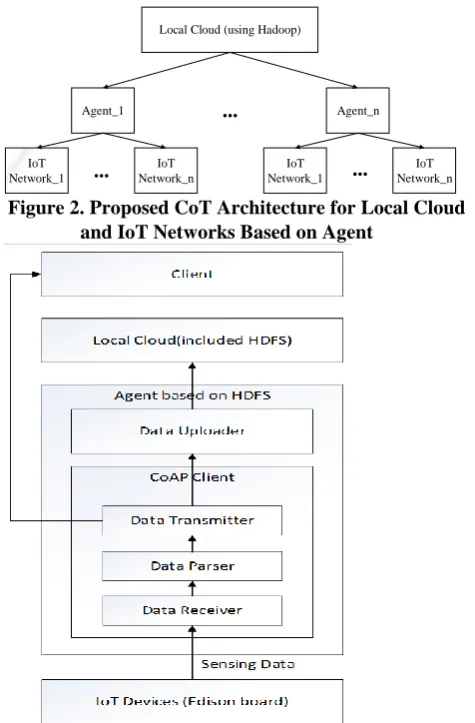
Nowadays several developers are working to integrate IoT and cloud. The figure illustrates the CoT design of local Cloud (Hadoop) and IoT Networks based on agent. As depicted in the following figure local clouds have the
each IoT device can connect several sensors. IoT device receives data from sensors and pass these data to the agentandthe agent has the responsibility to upload data to the cloud.
Agent_1 Agent_n
IoT Network_1
IoT Network_n
IoT Network_1
IoT Network_n
... ...
Local Cloud (using Hadoop)
...
Figure 2. Proposed CoT Architecture for Local Cloud and IoT Networks Based on Agent
Figure 3. Interwork of Local Cloud and IoT Devices Based on Agent in CoT
Figure 3 illustrates the architecture of interworking for local cloud and IoT devices. The temperate sensor is connected to the IoT device. CoAP server in IoT device receives data from the temperature sensor and sends to CoAP client in agent based on HDFS on request of CoAP client. The CoAP receiver receives data and send to the parser. Next, the data parser passes the data to the transmitter, and then data transmitter pass the data to uploader and client. The data uploader has the capability to receive the data, create data files and do uploading of the file to HDFS. Client do the operation of control processing of start-stop and results are illustrated to users. A HDFS agent has been developed in the proposed work comprised of two parts, data uploader and CoAP client. Data uploader has the capability to get the sensing data from CoAP client, converting the data to files and carried out the uploading of these files to HDFS.
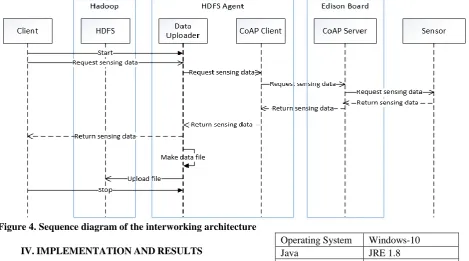
The sequence Diagram of CoT architecture is represented in figure 4. The architecture in figure 4 is for local cloud (include HDFS) and IoT networks. The client sends the sensing data request to data uploader. The CoAP client receives that request from data uploader and sends that request message to CoAP
[image:2.595.100.246.521.650.2]International Journal of Innovative Technology and Exploring Engineering (IJITEE) ISSN: 2278-3075,Volume-8 Issue-3C, January 2019
Then CoAP server generates a request to the sensor from data sensing. After sensing data, the CoAP server returns the data to CoAP client and data is moved from CoAP client to data uploader and from data uploader to client. After that, a data file (txt, csv) is created by data uploader, and data uploader upload the file in HDFS. Finally, stop request message isreceived to data uploader by the client and in the
[image:3.595.59.529.142.403.2]result, all process will stop. Edison board contain CoAP server which senses data from the sensor and send the sense data to CoAP client when it receives a request from CoAP client. HDFS agent resides inside the data uploader and canreceive the sense data make data files and upload the file to HDFS in Hadoop framework. The sensing result is shown to client and client control the start and stop the process.
Figure 4. Sequence diagram of the interworking architecture
IV.IMPLEMENTATIONANDRESULTS
The development environment for CoAP server in Edison board is illustrated in Table 1, we developed CoAP server in Windows 10 operating system, used the Edison board with Yocto 20160606, and used Intel System Studio IoT Edison 2016.4.012 as a development tool.
Table 1: Development environment of CoAP server
Tools Versions
Operating-System Windows-10
[image:3.595.68.504.601.737.2]Edison-board (Yocto) 20160606.0 Intel System Studio IoT Edison 2016.4.012 Table 2 shows the development environment for agent based on HDFS, we developed HDFS Agent in Windows 10 operating system, used Java 1.8, and used Spring Tool Suite 3.8.4 as a development tool.
Table 2: Development environment of agent based on HDFS
Tools Versions
Operating System Windows-10
Java JRE 1.8
Spring-Tool-Suite 3.8.4
Table 3 shows the development environment of the local Cloud (Hadoop). We configured Hadoop 2.7.3 in Windows 10 operating system; we also used Java 1.8 and Spring Tool Suite 3.8.4.
Table 3: Development environment of local Cloud (Hadoop)
Tools Versions
Operating-System Windows-10
Java JRE 1.8
Hadoop 2.7.3
Sprint-Tool-Suite 3.8.4
Figure 5 shows the IoT device with Edison board and temperature sensor.
Figure 6.CoAP server implementation result
Figure 6 illustrates the CoAP server. The coding of CoAP is carried out in C language on Edison board. When the client sends a request, The CoAP server responds to request and print the real-time temperature data.
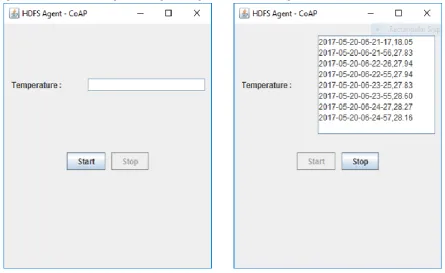
Figure 7. Client implementation result
The client implementation results are depicted in Figure 7. By clicking on “Start” button the data are getting from the CoAP server, and the file is created and uploaded to HDFS. By clicking on “Stop” will eventually stop the entire operations.
[image:4.595.51.538.501.666.2]Figure 8. Sensing files in local Cloud (HDFS)
International Journal of Innovative Technology and Exploring Engineering (IJITEE) ISSN: 2278-3075,Volume-8 Issue-3C, January 2019
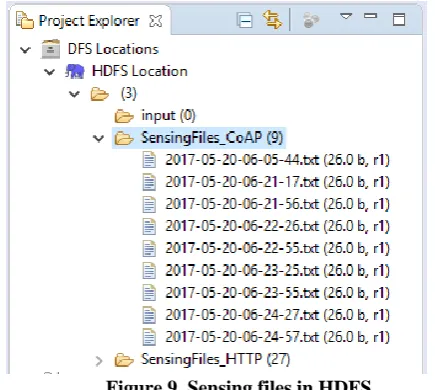
Figure 9. Sensing files in HDFS
The file name is represented by the time at which data is sensed from the sensor and the content in the file is a string separated by comma appended with time and sensed data. Temperature is 17.70ºC on 6:59:44, May 20, 2017,is represented in figure 10.
Figure 10. A sensing data file in HDFS
V.CONCLUSION
In this paper, we have presented the CoT architecture between local Cloud (Hadoop) and IoT networks using IETF CoAP protocol. And we developed an agent based on HDFS for the communication between IoT devices and local Cloud included HDFS successfully. Also, we can get sensing data from IoT devices and upload the sensing data files to HDFS. During the implementation of CoT Architecture for local Cloud and IoT networks architecture, we find it feasible and effective to use CoAP protocol for the communication between IoT devices and our developed HDFS Agent. We have planned to optimize our design by using deferent IoT devices in our future work.
ACKNOWLEDGMENT
This research was supported by Basic Science Research Program through the National Research Foundation of Korea(NRF) funded by the Ministry of Education (NRF-2017R1D1A1B06034648), and this research was supported by Basic Science Research Program through the National Research Foundation of Korea(NRF) funded by the Ministry of Education(2017R1D1A3B06035024). Any correspondence related to this paper should be addressed to DoHyeun Kim; [email protected].
REFERENCES
1. L. Atzori, A. Iera, and G. Morabito, “The Internet of Things: A survey,” Comput. Netw., vol. 54, no. 15, pp. 2787–2805, 2010.
2. D. Evans, “The internet of things how the next evolution of the internet is changing everything,” White Paper, Cisco, April 2011.
3. Jiang, Lihong, et al. "An IoT-oriented data storage framework in cloud computing platform." IEEE Transactions on Industrial Informatics 10.2 (2014): 1443-1451.
4. Derhamy, Hasan, et al. "A survey of commercial frameworks for the Internet of Things." Emerging Technologies & Factory Automation (ETFA), 2015 IEEE 20th Conference on. IEEE, 2015.
5. http://coap.technology/
6. Jun, Xu, and Liu Zhou. "Lithium battery remote monitoring system for vehicle mounted." Control And Decision Conference (CCDC), 2017 29th Chinese. IEEE, 2017.
7. Distefano, Salvatore, Giovanni Merlino, and Antonio Puliafito. "Enabling the cloud of things." Innovative Mobile and Internet Services in Ubiquitous Computing (IMIS), 2012 Sixth International Conference on. IEEE, 2012.
8. Petrolo, Riccardo, Valeria Loscri, and Nathalie Mitton. "Towards a smart city based on cloud of things." Proceedings of the 2014 ACM international workshop on Wireless and mobile technologies for smart cities. ACM, 2014.
9. Tei, Kenji, and LeventGurgen. "ClouT: Cloud of things for empowering the citizen clout in smart cities." Internet of Things (WF-IoT), 2014 IEEE World Forum on. IEEE, 2014.
10. Aazam, Mohammad, Pham Phuoc Hung, and Eui-Nam Huh. "Smart gateway based communication for cloud of things." Intelligent Sensors, Sensor Networks and Information Processing (ISSNIP), 2014 IEEE Ninth International Conference on. IEEE, 2014.
11. Petrolo, Riccardo, et al. "The design of the gateway for the cloud of things." Annals of Telecommunications 72.1-2 (2017): 31-40. 12. Bhattasali, Tapalina, RituparnaChaki, and NabenduChaki. "Secure and
trusted cloud of things." India Conference (INDICON), 2013 Annual IEEE. IEEE, 2013.
13. Tom White. Hadoop: The Definitive Guide. O’Reilly Media, Inc. 2009 14. Chuck Lam. Hadoop in Action. 2010-12-22