International Journal of Innovative Technology and Exploring Engineering (IJITEE) ISSN: 2278-3075, Volume-8 Issue-12, October, 2019
Abstract—A brief comprehensive research review of the various advances in the development of energy efficient distributed cooperative routing protocols for the WSNs, i.e., wireless sensor network in the current scenario is taken into consideration for the formulation of a research problem and is presented in a nut shell in this research article. The research problem is finalized with the clear objectives & outcomes.
Keywords : Cooperative Routing, Energy Efficiency, Packet Delivery Ratio, Throughput, Channel Quality Indicator, Wireless Sensor Networks (WSNs).
I. INTRODUCTION
In wireless Sensor Networks With the advantage of broadcast in wireless medium, the Cooperative communication has become more and more attractive recently [1]. Cooperative communication which allows several nodes cooperatively transmit signals to a destination together. In cooperative system, a gathering of hubs can send all together radio wire exhibit to get assorted variety gains. The cooperation can significantly improve the performance of wireless networks; cooperative routing can provide increased transmission range, improved vitality and data transmission proficiency, and progressively solid and longer enduring system availability. However, in large, complex, dynamic networks. Brought together control will probably be infeasible, and the overhead needed for the interchanges between the participating node hubs could be intemperate (excessive in nature). In order to address these issues, developing and analysing distributed cooperative strategies which work well without centralized control or full inter-node communications, and which are based as much as possible on locally obtained information.
II. ROUTING IN WIRELESS SENSOR NETWORK
The procedure of the network routing assumes an imperative job in the WSNs. It is amazingly hard to dole out the worldwide ids for countless sent sensor nodal hubs. In this manner, conventional conventions may not be relevant for WSN. Not at all like ordinary remote correspondence systems (MANET, cell organized n/w's, and so forth.), WSN has got some inalienable attributes. It is exceptionally powerful system and explicit to the application, and
Revised Manuscript Received on August 05, 2019.
Raghavendra Patil G.E, Research Scholar, VTU Research Centre, Nitte Meenakshi Institute of Technology, NMIT, Bangalore & Asst. Prof., CSE Dept., SDMIT,Shree Dharmasthala Manjunatheswara Institute of Technology, Dharmasthala Road, Near Siddhavana, Ujire, Karnataka 574240, South Canara, Karnataka, India
(Email : [email protected])
Dr. Thippeswamy M.N, 2Professor & Head, Computer Science &
Engg.,Nitte Meenakshi Institute of Technology, NMIT, Yelahanka, Bangalore 560064, Karnataka, India
furthermore it has constrained vitality, stockpiling, and handling ability. These qualities make it an exceptionally moving errand to build up a steering convention [2-4]. In the vast majority of the situations, numerous sources are required to send their information to a specific base station. The hubs close to the sink exhausted more vitality and consequently in the long beyond words. This causes dividing of the system; subsequently, the lifetime of the system gets the chance to diminish. The primary limitation of the sensor hub is vitality [5,6].
The sensors are battery-controlled registering gadgets. It's difficult to supplant the batteries in numerous applications. In this way, WSN requires a vitality proficient directing conventional procedures to develop some efficient routing energy algorithms. Because of thick arrangement of the sensor nodes, the sensor nodal hubs produce the repetitive information, and the base station may get different duplicates of similar information. Consequently, it pointlessly devours the vitality of the sensor hubs. WSN doesn't have any fixed framework and is exceptionally unique [7]. There are for the most part two reasons in charge of the dynamic framework. The primary explanation is the vitality; the sensor hubs have restricted vitality as batteries. On the off chance that the convention can't adjust the heap among the hubs, the sensor hub could bite the dust. It prompts the dynamic system structure. The subsequent explanation is the versatility; in numerous situations after the organization, sensor hubs are static however sink can move inside the system. It makes the system dynamic, and the convention that works for static sink may not be appropriate for versatile sink [8]. In numerous applications, sensor hubs are required to know their area data.
III. COOPERATIVE COMMUNICATION: AN OVERVIEW
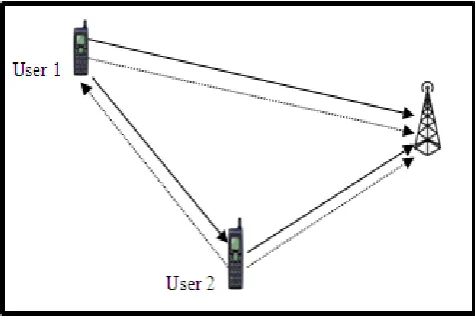
Fig.1 : Cooperative communication
Formulation of an Energy Efficient Routing
Problem in Cooperative Wireless Sensor
Networks
Agreeable correspondence ordinarily alludes to a framework where clients offer and facilitate their assets to improve the data transmission quality. It is a speculation of the hand-off correspondence, wherein various sources additionally fill in as transfers for one another [9]. For a primer clarification of the thoughts behind agreeable correspondence, we allude the peruser to see it in the Fig. 1.
This figure indicates two portable specialists speaking with a similar goal. Every portable has one recieving wire and can't independently produce spatial decent variety. Be that as it may, one versatile might be able to get the other, in which case it can advance some rendition of "caught" data alongside its very own information. Since the blurring ways from two mobiles are factually autonomous, this creates spatial assorted variety.
[image:2.595.59.297.427.587.2]In agreeable remote correspondence, we are worried about a remote system, of the phone or impromptu assortment, where the remote specialists, which we call clients, may expand their successful nature of administration (estimated at the physical layer by bit mistake rates, square blunder rates, or blackout likelihood) through participation. In an agreeable correspondence framework, every remote client is accepted to transmit information just as go about as a helpful specialist for another client (Fig. 2). In a transfer framework, sources initially transmit their information to the hand-off hubs (RNs). Every RN at that point procedures and advances its got information data to the goal hubs following some collaboration conventions. With the got sign from the RNs, the goals decipher the information from their comparing sources [10].
Fig. 2. In cooperative communication, each node is both a user and a relay
The co-operative WSNs are made dependent on the data of the system. The data of the system can be gotten by either: (1) utilizing an incorporated controller in a brought together mode known as Centralized Cooperative Routing, or (2) having every hub be in charge of acquiring system data without anyone else's input and settling on a steering choice in a disseminated mode Known as Distributed Cooperative Routing. In this manner, the principle contrast between the concentrated and dispersed agreeable directing calculations is where the data is acquired and course choice is made. Having a brought together controller may not be conceivable in some remote systems, for example, specially appointed systems [11]. In addition, the brought together
steering calculations are not versatile, especially in helpful directing where a total perspective on the system including every single agreeable connection and transfer hubs is required. In the accompanying three segments, we expand on agreeable steering calculations in the three scientific categorizations, optimality, goal, and centralization, and we talk about the key thoughts of helpful directing calculations in each gathering.
[image:2.595.317.568.505.653.2]A large portion of the current participation based steering calculations are executed by finding a briefest way course first. Since the helpful course depends on the most brief way one, these steering calculations don't completely misuse the benefits of agreeable correspondences at the physical layer. This is our fundamental inspiration to propose a participation based directing calculation that thinks about the impact of the helpful interchanges while developing the base power course. The base power steering issue with collaboration in remote systems. The ideal course is characterized as the course that requires the base transmitted power while ensuring certain Quality of Service (QoS). The QoS is described by the start to finish throughput. We infer a participation based connection cost equation, which speaks to the base transmitted power that is required to ensure the ideal QoS over a specific connection. In [23] The fundamental commitment of the proposed participation based steering calculation, to be specific the Minimum Power Cooperative Routing (MPCR) calculation, which can pick the base power course while ensuring the ideal QoS. It will be demonstrated that the MPCR calculation can accomplish power sparing of 57:36% contrasted with the regular briefest way steering calculations. Moreover, it can accomplish power sparing of 37:64% as for the Cooperation Along the Shortest Non-Cooperative Path (CASNCP) calculation, which finds the most limited way course first then it applies the helpful correspondence upon the developed course to decrease the transmitted power.
Fig. 3. Cooperative Transmission (CT) and Direct Transmission (DT) modes as building blocks for any
International Journal of Innovative Technology and Exploring Engineering (IJITEE) ISSN: 2278-3075, Volume-8 Issue-12, October, 2019
Fig. 4. An energy efficient routing concept
The ideal way could be a blend of agreeable transmissions and communicate transmissions. Along these lines, we think about two kinds of structure squares: direct transmission (DT) and helpful transmission (CT) building squares. In Fig. 1 the DT square is spoken to by the connection (I; j), where hub I is the sender and hub j is the recipient. What's more, the CT square is spoken to by the connections (x; y); (x; z), and (y; z), where hub x is the sender, hub y is a hand-off, and hub z is the recipient. The course can be considered as a course of any number of these two structure squares, and the all out intensity of the course is the summation of the transmitted powers along the course. Consequently, the minimization issue in can be settled by applying any circulated most limited way steering calculation, for example, the Bellman-Ford calculation.
IV. CENTRALIZED COOPERATIVE ROUTING
In a concentrated co-operative routing algos, a focal hub gathers data to check for potential agreeable connections and hand-off hubs. This data incorporates the topology and blurring data that settles on the helpful directing choice; for example in [12], the focal hub gathers the cost elements of agreeable connections and the channel attributes while the focal controller chooses the course dependent on the gathered data. In directing calculations where collaboration is applied along the non-agreeable way (Cooperation along Non-helpful Path, proposed in [13], [14], [15], [16], [17]) the focal controller gathers the data about the area of the hubs and the cost capacity of each connection and chooses the best non-helpful course.
Initially, hubs in the system counsel with the focal hub to settle on a non-helpful directing choice. Next, the controller allocates the transfer hubs. In [13], [14], [15], the last couple of forerunner hubs along the chose non-helpful way are allocated by the focal controller to fill in as the transfer hubs. In helpful steering calculations proposed in [16], [17], the controller analyzes the measure of intensity utilization that can be spared on the off chance that every hub goes about as the transfer hub and, at that point chooses the agreeable hand-off hub. In Cooperative-Based Path calculations, for example, [22], the focal controller (e.g., the goal (or sink) hub in a remote sensor arrange) has full Knowledge of the area of each hub in the system and utilizations this data to choose the agreeable based way.
V. DISTRIBUTED COOPERATIVE ROUTING
In the past area, concentrated helpful steering has been examined. Be that as it may, by and by, having a focal hub may not be conceivable in some remote system applications, (for example, impromptu systems) and courses should be developed in a dispersed way. In an appropriated helpful steering convention, every hub is educated about the system status, (for example, nearby topology status and cost elements of one-jump associated joins) from neighboring hubs. Every hub stores the data in its own nearby database and every hub is in charge of transfer hub choice and next hub choice. The calculations proposed in [12], [18], [19], [20] are completely conveyed. Conveyed helpful directing calculations are adaptable in light of the fact that they needn't bother with a total perspective on all connections and hubs in the system. In addition, dissimilar to unified steering calculations, they don't depend on a focal controller to choose hand-off hub or settle on the directing and asset distribution choices; along these lines, they are relevant to impromptu and remote sensor systems.
The principle challenge in the appropriated agreeable directing calculation usage is the data accessibility required for steering, transfer hub determination, and asset portion. Hubs manage this test by sending a refreshing message to the neighbors. For example, in [20], hubs use Route Request and Route Respond messages to educate the neighbors about the connection cost work, impedance level, and number of streams. Hubs likewise tune in to a pilot tone to follow the quantity of transfers comparing to the connections in their region. In the calculation proposed in [21], each hand-off hub intermittently communicates a Hello parcel to its source-goal pair to gauge the connection execution. In [19], the Hello parcels are occasionally communicated between neighbouring hubs to trade the lingering vitality and topology data.
VI. LITERATURE SURVEY
In the modern day technological world, automation plays a very important role in the human life ranging from domestic applications to the industrial applications. This automation makes use of various technological devices such as machines, computers & its accessories, etc… which could be used by the humans for various applications. Hence, networking plays a very important role. Each component can be treated as a wireless sensor network. A brief insight into the same was presented in the introductory chapter. In this chapter, a brief overview of the work done in the relevant field was conducted on the chosen research topic,
“An energy efficient distributed cooperative routing
protocol for wireless sensor networks” and the same was
presented in the form of an exhaustive literature survey [1] – [60], which was the content of our another research paper.
sources, studied @ length & breadth and a review paper was published by us to start with in the field of the control aspects related to the research work undertaken.
Like this, countless analysts had dealt with the remote system frameworks and truth be told, just the significant works have been introduced in this writing study. In larger part of the work done by the various specialists/creators exhibited in the past sections, there were parcel of impediments / loads / lacunas / dis-advantages / inadequacies. A large number of articles, papers, thesis, reports done by various authors, researchers, engineers, students, faculties were surfed upon studied in brief. Few of the drawbacks [1] – [60] of the works that were carried out by the previous analysts were considered in our examination work, contemplated in a nutshell and calculations were created so as to conquer a portion of the inadequacies of the current algos. The research work is verified through effective simulation results in the Matlab-Simulink environment or in the NS-2 simulator platform in order to substantiate the research problem undertaken in comparison with the work done by the earlier authors in the relevant field, in the sense to solve the desired objective (question) & arrive at the outcome (answer/solution) of the research work.
VII. RESEARCH PROBLEM STATEMENT
The cooperative routing techniques has been identified as an effective and useful method of reducing the negative effects of fading in Wireless Sensor Networks (WSN). The cooperative diversity techniques have been used in WSNs to save energy and reduce link errors to improve the overall network reliability and network lifetime. The route breakage occurs frequently due to network failure, node failure and channel impairments in WSNs. However, a few works have been considered to design cooperative routing protocols using cooperative diversity techniques in the literature to combat link breakage to reduce energy consumption as well to improve the network reliability for WSNs. In addition, cooperative diversity schemes have shown to be an effective energy saving method for WSNs in the energy efficient routing design. Therefore, I propose new distributed cooperative routing protocol for WSN that support the cooperative diversity and overhearing communication schemes to reduce energy consumption in the network. The research will also develop an analytical framework to quantify the impact of cooperative diversity and overhearing communications on the throughput, delay, reliability and energy consumption of WSNs.
VIII. OBJECTIVES OF THE RESEARCH PROBLEM STATEMENT
The main objectives of my research work are:
To investigate the performance of WSN
cooperative routing protocol
To design new energy efficient distributed cooperative routing protocol for WSN
To increase the life cycle of WSN
To enhance the power or energy efficiency of WSN To enhance the reliability of WSN
IX. OUTCOME& RESULTS
The final result or the outcome or the end-result of the research work was aimed @ developing some efficient routing protocols / algorithms which will work accurately etc… and to reduce the reducing the energy consumption w.r.t. the data transfer using the wireless sensor nodes. In short, to say, the outcome of the research is to show that when the designed algorithm is placed with this developed protocol, the new revised WSN will perform well and reaches the destination (output) in shorter lead times with less losses. The outcome of this research work has got wide application in the field of LAN, WAN, MAN. The outcome of the research work is to show that when the designed algorithm/s developed in the NS-2 is run, i.e., put in closed loop with the network system, the automatic tracking is done with minimum the requirement of minimum energy consumption in correlation with the work done by different scientists till date thinking about a large number of the downsides of the kindred specialists, thus enhancing and improving the performance of the existing algorithms with the end resulting in the following research outcome, “reaching the output sink value in minimum reasonable times with less energy & no packet switching losses”.
X. CONCLUSION AND FUTURE WORK
In this paper, an in-depth info is provided regarding the concept of developing routing algorithms in the area of wireless sensor networks with the definition of the problem after carrying out a literature review of a large number of
papers and defining the problem statement. The work done
in the literature has not considered using distributed cooperative communication to reduce energy consumption in WSNs. The various challenges which are still open for research in the field of Energy efficient cooperative
communication for WSNs. Thus, we propose in this
research work to develop a new distributed cooperative routing protocol, which implements cooperative diversity and overhearing communications to reduce path breakage to improve throughput and to reduce delay and energy consumption in WSNs. In addition, the works will focus on minimizing the use of control packets, and reducing transmission in the case of link failures to minimize energy consumption in the network. The research will also develop an analytical framework to quantify the impact of cooperative diversity and overhearing communications on the throughput, delay, reliability and energy consumption of WSNs.
REFERENCES
1. Perkins, E. Belding-Royer, and S. Das, “Ad hoc on-demand distance vector (aodv) routing,” United States, 2003.
2. Liang, x., Chen, M., Xiao, Y, and Balasingham, (2010). MRL-CC: a novel cooperative communication protocol for QoS provisioning in wireless sensor networks. International Journal of Sensor Networks, 8(2), 98-108.
3. Maria Sefuba, Tom Walingo, “Energy-efficient medium access control and routing protocol for multihop wireless sensor networks”.
International Journal of Innovative Technology and Exploring Engineering (IJITEE) ISSN: 2278-3075, Volume-8 Issue-12, October, 2019
4. Ibriq, J., Mahgoub, I.: „Cluster-based routing in wireless sensor networks: issues and challenges‟. SPECTS, 2004, pp. 759–766 5. Shan. 1.. Dong. L.. Liao. X., Shao. L.. Gao. Z .. and Gao. Y(2013).
Research on improved Leach Protocol of wireless sensor networks. PRZEGLD ELEKTROTECHNICZNY, ISSN, 0033-2097
6. AI-Rahayfeh, A. A., and Almiani, M. M. (2014). Parameterized Affect of Transmission-Range on Lost of Network Connectivity (LNC) of Wireless Sensor Networks.
7. Hussain, M and Mottalib. M. (2011). Energy-Efficient Hierarchical Routing Protocol for Homogeneous Wireless Sensor Network. I]CSNS International Journal of Computer Science and Network Security, 1 (I), 80-86.
8. Huang. X Zhai. H .. and Fang. Y (2008). Robust cooperative routing protocol in mobile wireless sensor networks. Wireless Communications, IEEE Transactions on, 7(12), 5278-5285.
9. Wang, J.; Kim, ].-U.; Shu, L.; Niu, Y; Lee, S. A distance-based energy aware routing algorithm for wireless sensor networks. Sensors 2010. 10. 94939511.
10. Wail Mardini; Yaser Khamayseh; Shorouq AL-Eide. Optimal Number of Relays in Cooperative Communication in Wireless Sensor Networks, Communications and Network Journal in Vol. 4, No. 2 Issue (May 2012). ISSN 1949-2421. USA.
11. Raghavendra Patil G E, Dr. Thippeswamy M N “The Energy Efficient Dynamic Source Routing Protocol For Manet” Proceedings of 2nd Inter National Conference on Networks Information and Communication, 2015 (ICNIC-2015), Sri Venkateshwara College of Engineering, Bangalore, India. May18th-20th 2015.
12. A.F. M. Shahen Shah, Md. Shariful Islam, “ A Survey on Cooperative Communication in Wireless Networks” I.J. Intelligent Systems and Applications, 2014, 07, 66-78 Published Online June 2014 in MECS (http://www.mecs-press.org/) DOI: 10.5815/ijisa.2014.07.09,
13. D. Zhang, G. Li, K. Zheng, X. Ming, and Z. H. Pan, “An Energy-Balanced Routing Method Based on Forward-Aware Factor for Wireless Sensor Networks,” IEEE Transactions on Industrial Informatics, Vol. 10, No. 1, Pages 766 – 773, February 2014. 14. J. I. Bangash, A. H. Abdullah, M. H. Anisi, and A. W. Khan, “A
Survey of Routing Protocols in Wireless Body Sensor Networks,” Sensors, Vol. 14, No. 1, Pages 1322 – 1357, January 2014.
15. T. Rault, A. Bouabdallah, and Y. Challal, “Energy Efficiency inWireless Sensor Networks: A Top-Down Survey,” Computer Networks, Vol. 67, No. 1, Pages 104 – 122, July 2014.
16. L. Xie, Y. Shi, Y. T. Hou, W. Lou, H. D. Sheral, and S. F. Midkiff, “Multi-Node Wireless Energy Charging in Sensor Networks,” IEEE/ACM Transactions on Networking, Vol. 23, No. 2, Pages 437 – 450, April 2015.
17. T. K. Jain, D. S. Saini, and S. V. Bhooshan, “Lifetime Optimization of a Multiple Sink Wireless Sensor Network through Energy Balancing,” Journal of Sensors, Vol. 2015, Pages 1 – 6, 2015. 18. M. Gholipour, A. T. Haghighat, and M. R. Meybodi, “Hop-by-Hop
Traffic-Aware Routing to Congestion Control in Wireless Sensor Networks,” EURASIP Journal on Wireless Communications and Networking, Vol. 2015, No. 15, Pages 1 – 13, January 2015. 19. M. Azharuddin and P. K. Jana, “A Distributed Algorithm for Energy
Efficient and Fault Tolerant Routing in Wireless Sensor Networks,” Wireless Networks, Vol. 21, No. 1, Pages 251 – 267, January 2015. 20. Quansheng Guan, F. Richard Yu, Shengming Jiang, Victor C. M.
Leung, Hamid Mehrvar, ―Topology Control in Mobile Ad hoc Networks With Cooperative Communications ―, IEEE Wireless Communications, Page(s): 74 – 79, April 2012.
21. Qian Li, Rose Qingyang Hu, Yi Qian, Geng Wu, ―Cooperative communications for wireless networks: techniques and applications in LTE-advanced systems ―, IEEE Wireless Communications, Volume: 19, Issue: 2, Page(s): 22 – 29, April 2012.
22. W.-H. Chen, A.-C. Pang, A.-C. Pang, and C.-T. F. Chiang, “Crosslayer cooperative routing for vehicular networks,” in Proc. IEEE International Computer Symposium (ICS), Dec. 2010, pp. 67– 72.
23. R. Madan, N. Mehta, A. Molisch, and J. Zhang, “Energy-efficient decentralized cooperative routing in wireless networks,” IEEE Trans. Autom. Control, vol. 54, no. 3, pp. 512–527, Mar. 2009.
24. A. Khandani, J. Abounadi, E. Modiano, and L. Zheng, “Cooperative routing in static wireless networks,” IEEE Trans. Commun., vol. 55, no. 11, pp. 2185–2192, Nov. 2007.
25. C. Pandana, W. Siriwongpairat, T. Himsoon, and K. Liu, “Distributed cooperative routing algorithms for maximizing network lifetime,” in Proc. IEEE Wireless Communications and Networking Conference, (WCNC), Apr. 2006, pp. 451–456.
26. F. Li, K. Wu, and A. Lippman, “Minimum energy cooperative path routing in all-wireless networks: Np-completeness and heuristic
algorithms,” EURASIP J. Wirel. Commun. Netw., vol. 10, no. 2, pp. 204– 212, June 2008
27. H. Xu, L. Huang, C. Qiao, Y. Zhang, and Q. Sun, “Bandwidth-power aware cooperative multipath routing for wireless multimedia sensor networks,” IEEE Trans. Wireless Commun., vol. 11, no. 4, pp. 1532– 1543, Apr. 2012.
28. S. Chen, M. Huang, Y. Li, Y. Zhu, and Y. Wang, “Energy-balanced cooperative routing in multihop wireless ad hoc networks,” in Proc. IEEE International Conference on Communications (ICC), June 2012, pp. 307–311.
29. A. Akhtar, M. Nakhai, and A. Aghvami, “Power aware cooperative routing in wireless mesh networks,” IEEE Commun. Lett., vol. 16, no. 5, pp. 670–673, May 2012.
30. C. Zhai, J. Liu, L. Zheng, H. Xu, and H. Chen, “Maximise lifetime of wireless sensor networks via a distributed cooperative routing algorithm,” Trans. Emerging Telecommun. Technol., vol. 23, no. 5, pp. 414–428, 2012.
31. S. Lakshmanan and R. Sivakumar, “Proteus: Multiflow diversity routing for wireless networks with cooperative transmissions,” IEEE Trans. Mobile Comput., vol. 12, no. 6, pp. 1146–1159, 2013. 32. Z. Sheng, Z. Ding, and K. Leung, “Distributed and power efficient
routing in wireless cooperative networks,” in Proc. IEEE International Conference on Communications (ICC), June 2009, pp. 1–5.
33. L. Shi and A. O. Fapojuwo, “Cross-layer optimization with cooperative communication for minimum power cost in packet error rate constrained wireless sensor networks,” Ad Hoc Networks, vol. 10, no. 7, pp. 1457 – 1468, 2012.
34. Ahmed s. Ibrahim, zhu hany, and k. J. Ray liu, “distributed energy-efficient cooperative routing in wireless networks. Ieee transactions on wireless communications, vol. 7, no. 10, october 2008
35. J. Shi, A. Calveras, Y. Cheng and K. Liu, “A Novel Power Efficient Location-Based Cooperative Routing with Transmission Power-Upper-Limit for Wireless Sensor Networks”, Sensors 2013, Vol. 13, doi:10.3390/s130506448, pp. 6448-6476.
36. X. Haung, H. Zhai and Y. Fang, “Robust Cooperative Routing Protocol in Mobile Wireless Sensor Networks”, IEEE Transaction on Wireless Communications, Vol.7, No.12, pp. 5278-5285, December 2008.
37. F. Akyildiz, W. Su, Y. S. Subramanian and E. Cerci, “A survey on Sensor Networks”, IEEE Communication Magazine, Vol.40, issue 8, pp.102-114, August 2002.
38. J. G. Proakis, Digital Communications, McGraw-Hill, 1995. 39. A. Sendonaris and E. Erkip, “User cooperation diversity Part II:
Implementation aspects and performance analysis," IEEE Trans. Commun., vol. 51, no. 11, pp. 1939-1948, November 2003.
40. J. N. Laneman, D. N. C Tse, and G. W. Wornell, “Cooperative diversity in wireless networks: Efficient protocols and outage behaviour," IEEE Trans. Inform. Theory, 2004.
41. L. Liu, Z. Wang and M. Zhou, “Energy-Efficient Cooperative Routing for Wireless Sensor Networks Using Space Time Block Code”, IEEE International Conference on Systems, Man and Cybernetics, pp.2837-2842, 7-10 Oct. 2007.
42. L. Liu, Z. Wang and M. Zhou, “Space-Time-Block-Code based Cooperative Routing for WSNs”, International Journal of Intelligent Control and Systems, Vol. 14, No. 3, 2009, pp.213-220.
43. H. Takagi, “Queuing Analysis: A foundation of Performance Evaluation, Vacation and Priority systems,” Vol. 1, North-Holland, Amsterdam, 1991.
44. L. Cheng, J. Cao, C. Chen, H. Chen, J. Ma and J.I. Siebert, “Cooperative Contention-based forwarding for Wireless Sensor Networks”, IWCMC ‟10, June 28-July 2, 2010, Caen, France. 45. H. Sivsankari, K. Shaila, K.R. Venugopal, S.S. Iyengar and L.M.
Panaik, “Energy Efficient Adaptive Cooperative Routing (EEACR) with Multiple Sinks in Wireless Sensor Networks”, 7th IEEE Conference on Industrial Electronics and Applications (ICIEA), 2012, pp. 676-681.
46. F. Bouabdallah, N. Bouabdallah and R. Boutaba, “Reliable and Energy Efficient Cooperative Detection in Wireless Sensor Networks”, Computer Communications Journal. Elsevier. Vol. 36(5), pp. 520-532, March 2013.
48. A.N. Beongku and D. T. Trung, "A cooperative routing in mobile ad-hoc wireless sensor networks with Rayleigh fading environments," International Symposium on Computer Communication Control and Automation (3CA), 2010, vol.1, doi: 10.1109/3CA.2010.5533848, pp.22-25, 5-7 May 2010.
49. L. Bin, W. Wang, Q. Yin, H. Li and H.Wang, "Energy-efficient cooperative geographic routing in wireless sensor networks," IEEE International Conference on Communications (ICC), pp.152-156, 10-15 June 2012.
50. R.R. Rout, S.K. Ghosh and S. Chakrabarti, "Co-operative routing for wireless sensor networks using network coding," Wireless Sensor Systems, IET , vol.2, no.2, pp.75-85, doi: 10.1049/iet-wss.2011.0069, June 2012.
51. A. Nieto, and J. Lopez, “Traffic Classifier for Heterogeneous and Cooperative Routing through Wireless Sensor Networks," 26th International Conference on Advanced Information Networking and Applications Workshops (WAINA), 2012, pp.607- 612, doi: 10.1109/WAINA.2012.202,26-29 March 2012.
52. Siyuan Chen, Yang Li , Minsu Huang , Ying Zhu , Yu, “Wang Energy-balanced cooperative routing in multihop wireless networks”, Published online: 2 November 2012 _ Springer Science Business Media New York 2012, Wireless Network 2013 19:1087–1099 DOI 10.1007/s11276-012-0520-6
53. Ahmed S. Ibrahim, Student Member, IEEE, Zhu Han, Member, IEEE, and K. J. Ray Liu, Fellow, IEEE “Distributed Energy-Efficient Cooperative Routing in Wireless Networks”, IEEE transactions on wireless communications, vol. 7, no. 10, October 2008
54. Lu Zhang, Student Member, IEEE, and Leonard J. Cimini, Jr., Fellow, IEEE “Efficient Power Allocation for Decentralized Distributed Space-Time Block Coding”, IEEE transactions on wireless communications, vol. 8, no. 3, march 2009
55. Mohamed Elhawary and Zygmunt J. Haas, Fellow, IEEE, “Energy-Efficient Protocol for Cooperative Networks”, IEEE/ACM transactions on networking, vol. 19, no. 2, aril 2011.
56. U.Sandhya, S.Vikram Phaneendra b “Optimization of Energy Usage in Cooperative Networks”, International Journal of Computer Trends and Technology (IJCTT) – volume 4 Issue 9– Sep 2013
57. A.F. M. Shahen Shah, Md. Shariful Islam, “ A Survey on Cooperative Communication in Wireless Networks” I.J. Intelligent Systems and Applications, 2014, 07, 66-78 Published Online June 2014 in MECS (http://www.mecs-press.org/) DOI: 10.5815/ijisa.2014.07.09,
58. Ritesh Madan, Member, IEEE, Neelesh B. Mehta, Senior Member, IEEE, Andreas F. Molisch, Fellow, IEEE, and Jin Zhang, Fellow, IEEE, “Energy-Efficient Decentralized Cooperative Routing in Wireless Networks”, IEEE transactions on automatic control, vol. 54, no. 3, march 2009.
59. Nikolaos A. Pantazis, Stefanos A. Nikolidakis and Dimitrios D. Vergados, Senior Member, IEEE Energy-Efficient Routing Protocols in Wireless Sensor Networks: A Survey, IEEE communications surveys & tutorials, vol. 15, no. 2, second quarter 2013.
60. Charles Pandana, W. Pam Siriwongpairat, Thanongsak Himsoon, and K. J. Ray Liu, “Distributed Cooperative Routing Algorithms for Maximizing Network Lifetime”, 1-4244-0270-0/06/ 2006 IEEE. 61. Nikos Dimokas, Dimitrios Katsaros, “Detecting Energy-Efficient
Central Nodes for Cooperative Caching in Wireless Sensor Networks”, 2013 IEEE 27th International Conference on Advanced Information Networking and Applications 1550-445X/13 2013 IEEE DOI 10.1109/AINA.2013.120
62. S. Manfredi, “Reliable and energy-efficient cooperative routing algorithm for wireless monitoring systems”, published in IET Wireless Sensor Systems, Received on 14th March 2011, doi: 10.1049/iet-wss.2011.0103.
63. Stefanos A. Nikolidakis, Dionisis Kandris, Dimitrios D. Vergados Christos Douligeris, “Energy Efficient Routing in Wireless Sensor Networks Through Balanced Clustering”, Algorithms 2013, 6, 29-42; doi:10.3390/a6010029
64. Lindsey, S.; Raghavendra, C. PEGASIS: Power-Efficient Gathering in Sensor Information Systems. In Proceedings of the IEEE Aerospace Conference, Los Angeles, MT, USA, 2002; pp. 1125– 1130.
65. Jung, S, Han, Y, Chung, T, “The Concentric Clustering Scheme for Efficient Energy Consumption in the PEGASIS”, In Proceedings of the 9th International Conference on Advanced Communication Technology, Gangwon-Do, Korea, 2007; pp. 260–265.
66. Manjeshwar, A, Agrawal, D. Teen: “A Routing Protocol for Enhanced Efficiency in Wireless Sensor Networks”, In Proceedings of the 15th International Parallel and Distributed Processing Symposium (IPDPS‟01) Workshops, San Francisco, CA, USA, 2001; pp. 2009–2015.
67. Yang, Y.; Wu, H.; Chen, H. SHORT: Shortest Hop Routing Tree for Wireless Sensor Networks. In Proceedings of the IEEE International Conference on Communications, Istanbul, Turkey, 2006; pp. 3450– 3454.
68. Lotf, J.; Bonab, M.; Khorsandi, S. A Novel Cluster-based Routing Protocol with Extending Lifetime for Wireless Sensor Networks. In Proceedings of the 5th International Conference on Wireless and Optical Communications Networks, Surabaya, India, 2008; pp. 1–5. 69. Allirani, A.; Suganthi, M. An Energy Efficient Cluster Formation
Protocol with Low Latency In Wireless Sensor Networks. World Acad. Sci., Eng. Tech. 2009, 51, 1–7.