0022-538X/11/$12.00 doi:10.1128/JVI.00813-11
Copyright © 2011, American Society for Microbiology. All Rights Reserved.
Major Histocompatibility Complex Class II Transactivator CIITA Is a
Viral Restriction Factor That Targets Human T-Cell Lymphotropic
Virus Type 1 Tax-1 Function and Inhibits Viral Replication
䌤
Giovanna Tosi,
1Greta Forlani,
1Vibeke Andresen,
2† Marco Turci,
3Umberto Bertazzoni,
3Genoveffa Franchini,
2Guido Poli,
4and Roberto S. Accolla
1*
Department of Experimental Medicine, University of Insubria, Varese, Italy1; Animal Models and Retroviral Vaccines Section,
National Cancer Institute, Bethesda, Maryland2; Department of Life and Reproduction Sciences, Section of Biology and
Genetics, University of Verona, Verona, Italy3; and AIDS Immunopathogenesis Unit, Division of Immunology,
Transplantation, and Infectious Diseases, San Raffaele Scientific Institute, Milan, Italy4
Received 21 April 2011/Accepted 27 July 2011
Human T-cell lymphotropic virus type 1 (HTLV-1) is the causative agent of an aggressive malignancy of CD4ⴙT lymphocytes. Since the viral transactivator Tax-1 is a major player in T-cell transformation, targeting Tax-1 protein is regarded as a possible strategy to arrest viral replication and to counteract neoplastic transformation. We demonstrate that CIITA, the master regulator of major histocompatibility complex class II gene transcription, inhibits HTLV-1 replication by blocking the transactivating function of Tax-1 both when exogenously transfected in 293T cells and when endogenously expressed by a subset of U937 promonocytic cells. Tax-1 and CIITA physically interactin vivovia the first 108 amino acids of Tax-1 and two CIITA adjacent regions (amino acids 1 to 252 and 253 to 410). Interestingly, only CIITA 1-252 mediated Tax-1 inhibition, in agreement with the fact that CIITA residues from positions 64 to 124 were required to block Tax-1 transac-tivation. CIITA inhibitory action on Tax-1 correlated with the nuclear localization of CIITA and was indepen-dent of the transcription factor NF-YB, previously involved in CIITA-mediated inhibition of Tax-2 of HTLV-2. Instead, CIITA severely impaired the physical and functional interaction of Tax-1 with the cellular coactivators p300/CBP-associated factor (PCAF), cyclic AMP-responsive element binding protein (CREB), and activating transcription factor 1 (ATF1), which are required for the optimal activation of HTLV-1 promoter. Accordingly, the overexpression of PCAF, CREB, and ATF1 restored Tax-1-dependent transactivation of the viral long-terminal-repeat promoter inhibited by CIITA. These findings strongly support our original observation that CIITA, beside increasing the antigen-presenting function for pathogen antigens, acts as an endogenous restriction factor against human retroviruses by blocking virus replication and spreading.
Human T-cell lymphotropic virus type 1 (HTLV-1), the first discovered human oncogenic retrovirus (40), infects approxi-mately 15 to 20 million people around the world and is en-demic in Japan, South America, Africa, and the Caribbean (34). HTLV-1-infected individuals are life-long virus carriers but, while the vast majority of them remain clinically asymp-tomatic, some (2 to 5%) develop an aggressive malignancy of T cells, designated adult T-cell leukemia/lymphoma (ATLL) (53). HTLV-1 infection is also associated with chronic inflam-matory diseases involving the nervous system (HTLV-1-asso-ciated myelopathy/tropical spastic paraparesis [HAM/TSP]), the eyes, the lungs, or the skeletal muscles (51). Likewise, HTLV-2, a closely related retrovirus, has been associated with HAM/TSP-like diseases, but its association with lymphoprolif-erative disorders has not been clearly proven (27, 33, 41).
Recently, two new members of the HTLV family have been identified, HTLV-3 and HTLV-4, but for them no
specific association with human diseases has been reported as yet (6, 52).
ATLL pathogenesis is not completely understood, but it clearly involves the viral protein Tax-1, which modulates the expression of cellular genes and deregulates cell signaling pro-cesses that are implicated in cellular proliferation, cell death, and cell cycle control (13, 19, 36). Because of these pleiotropic effects, Tax-1 has a central role in the transformation of T cells (17). Moreover, the lower pathogenicity of HTLV-2 virus com-pared to that of HTLV-1 has been hypothesized as dependent from reduced oncogenic potential of its transactivator, Tax-2, with respect to Tax-1 (see reference 11 and references therein).
In addition to its deregulatory action on the homeostasis of the host cell, Tax-1 has a crucial role in viral replication. It interacts with the cyclic AMP-responsive element binding pro-tein (CREB) and activating transcription factor 1 (ATF1), bound to enhancer elements located in the proviral long ter-minal repeat (LTR) (16, 32) and coordinates the assembly on the promoter of basal transcription factors, elongation tran-scription factors, and chromatin-modifying enzymes, including the histone acetyltransferases (HATs) p300, CREB-binding protein (CBP), and p300/CBP-associated factor (PCAF), to activate transcription of the viral genes (5, 20, 21, 28, 32). Interestingly, PCAF interacts directly with Tax-1 and,
differ-* Corresponding author. Mailing address: Department of Experi-mental Medicine, University of Insubria, Via O. Rossi 9, Varese 21100, Italy. Phone: 39-0332-217600. Fax: 39-0332-217608. E-mail: roberto [email protected].
† Present address: Institute of Medicine, Hematology section, Uni-versity of Bergen, N-5020 Bergen, Norway.
䌤Published ahead of print on 3 August 2011.
10719
on November 7, 2019 by guest
http://jvi.asm.org/
ently from CBP/p300, stimulates Tax-1 transactivation in a HAT-independent manner (15, 25).
TheAIR-1-encoded major histocompatibility complex class II (MHC-II) transactivator CIITA (1, 46) is a transcriptional factor that regulates the expression of MHC-II genes, whose products are cell surface molecules that play a pivotal role in the triggering of the adaptive immune response by presenting antigenic peptides to CD4⫹T cells. In the same way as Tax-1, CIITA integrates multiple events of the transcriptional process from chromatin remodeling to transcription initiation and elongation (12). To accomplish these functions, CIITA inter-acts with many of the cellular factors (i.e., HATs) engaged by Tax-1 in order to transactivate the viral promoter (30, 45). CIITA does not bind DNAper se, but it is recruited to the MHC-II promoter via multiple interactions with DNA-bound factors, including CREB, the regulatory factor X (RFX), and nuclear factor Y (NF-Y) complexes (10, 24, 35). Of note, the B subunit of the NF-Y complex has been shown to bind to Tax-1 (39). Similarly to Tax-1, CIITA forms dimers, and several post-translational modifications modulate its function (18, 31, 45, 48). In particular, the phosphorylation-dependent dimeriza-tion of CIITA has been associated with an increased accumu-lation of the protein in the nucleus and an higher activity on MHC-II promoters (48).
In the search for possible functional interaction between CIITA and HTLV transactivators, we have found that CIITA inhibits HTLV-2 Tax-2 transactivation and consequently HTLV-2 replication (7). Preliminary studies suggested that CIITA may inhibit Tax-2 function via interaction with the common binding factor NF-Y (49, 50). Thus, the idea has been put forward that CIITA may accomplish an unprecedented dual function against retroviruses. First, by regulating MHC-II expression and, thus, specific antigen presentation, CIITA con-trols the triggering of antigen-specific CD4⫹T helper cells, the key cells of adaptive immunity. Second, by blocking the func-tion of Tax-2, CIITA acts as a viral restricfunc-tion factor inhibiting viral replication. A number of viral restriction factors are known, such as APOBEC and certain TRIM family members (8, 37, 42, 47). These factors are, however, functionally unre-lated to molecules of the classical innate and adaptive immu-nity.
In order to investigate whether this hypothesis could be extended to human oncogenic retroviruses and, particularly, to the most pathogenic and oncogenic human retrovirus, HTLV-1, we analyzed here whether CIITA acts as a restriction factor for HTLV-1. We show that CIITA inhibits Tax-1-di-rected transactivation of the viral LTR, causing a strong im-pairment of HTLV-1 replication, and we define the minimal region of CIITA required for this inhibition. Furthermore, we show that Tax-1 interacts with CIITA and define their respec-tive interacting surfaces. We also demonstrate that overex-pressed NF-YB does not influence HTLV-1 replication, ruling out its involvement in CIITA-mediated inhibition of Tax-1. Moreover, we demonstrate that CIITA affects the functional interaction of the transcription factors CREB, ATF1, and PCAF with Tax-1. Finally, by localization studies aimed at better understanding how Tax-1 is inhibited by CIITA, we provide new information on the mechanisms regulating the nucleocytoplasmic transport of CIITA.
Taken together, our results definitely establish that CIITA,
in addition to increasing the antigen-presenting function for pathogen antigens, behaves as a viral restriction factor with an intrinsic defensive role against infection of human retroviruses.
MATERIALS AND METHODS
Plasmids.pcfCIITA1-124 and pcfCIITA748-1130 were generated from
pcf-CIITA1-1130 (49) by PCR with the primers F1(5⬘-GGGGGGAATTCGCCAC
CATGGACTACAAGGACGACGACGACAAGGCACGTTGCCTGGCTCC
ACGCCCTGCTGGG) and 124R (5⬘-GGGCTCGAGTTATGGTCCTATGTG
CTTGAA) and the primers F748 (5⬘-GGGGGGAATTCACAATGGACTACA
AGGACGACGACGACAAGGACAACTGGCTGGAGGGCGTG) and 1130R
(5⬘-CGATGCTCTAGATCATCTCAGGCTGATCCGTGA) and by ligation
into EcoRI/XhoI-cleaved and EcoRI/XbaI-cleaved pcDNA3.1⫹vectors,
respec-tively.
Expression vectors for all of the other flag-tagged deleted forms of CIITA, green fluorescent protein (GFP)-fCIITA1-1130, and myc-tagged CIITA were described elsewhere (48, 49). Plasmids expressing GFP-fCIITAs 1-124, 1-252,
253-1130, 26-200, 64-200, 253-410, and⌬253-410 were generated by excision of
the corresponding CIITA cDNA from the pcDNA3.1 vector and ligation in pEGFP-C2 vector (Clontech). The expression vectors for myc-NF-YB
(pcmNF-YB), p300 (pCMVp300), flag-PCAF (pcfPCAF), andRenilla(phRL-CMV)
were previously described (49). The expression vectors for CREB (pCREB-GFP) and ATF1 (pATF-1-(pCREB-GFP) tagged with GFP at the C-terminal ends were purchased from Origene (Rockville, MD) as transfection-ready DNA. pLTR1-Luc vector containing 595 bp of HTLV-1 LTR promoter linked to the firefly luciferase gene was generated from the pL1CAT vector (38) by PCR with
the primers S-5⬘-GACGACGCGTCAATGACCATGAGCCCCA and AS-5⬘-G
ACGCTCGAGGAAAACGAAACAAAGACGC and by ligation into MluI/ XhoI-digested pGL2 firefly luciferase reporter vector (Promega). pCMV-Tax1 was previously described (44). The open reading frames of Tax-1 1-353 and the truncated forms 1-145, 1-250, and 109-353 were amplified by PCR from pJFE Tax-1 (22) and cloned into pcDNA6.2/N GFP Topo (Invitrogen) in frame with the V5 tag at the C terminus. The GFP open reading frame was eliminated by XhoI digestion. All constructs made by PCR were verified by sequencing.
Cells and stable transfections.COS and human embryonic kidney 293T cells were grown in Dulbecco modified Eagle medium supplemented with 10% fetal
calf serum (FCS) and 5 mML-glutamine. Promonocytic U937 isogenic cell clones
10 and 34 were previously described (4, 14, 26). HLA-II-negative U937 clone 10
cells were transfected by electroporation with 5g of pcfCIITA1-1130 by using
a GenePulser II apparatus (Bio-Rad) at 300 V and 250F. Transfected U937
cl10-fCIITA cells were selected and cultivated in RPMI supplemented with 10%
FCS, 5 mML-glutamine, and 1 mg of Geneticin-sulfate (Sigma)/ml.
HLA-II-positive cells were purified by fluorescence-activated cell sorting with a BD FACS ARIA II cell sorter (Becton Dickinson).
Transient transfections, Luciferase assay, and Western blotting.COS and
293T cells were seeded in 35-mm-diameter plates and transfected with 0.15g of
reporter plasmid pLTR1-Luc, 12.5 ng of pTax-1, and increasing amounts of effector plasmid DNA, as indicated in the corresponding figure legends, using Lipofectamine (Invitrogen). All of the transfections were carried out in the
presence of 5 ng of phRL-CMV expressing the Renilla luciferase. Empty
pcDNA3 vector was used as a stuffer DNA to maintain constant the total amount of transfected DNA. Cell extracts were prepared 24 h posttransfection and assayed for luciferase activities by using a dual luciferase reporter assay system (Promega) according to the manufacturer’s instructions. Mean luciferase values,
normalized to theRenillavalues, of at least three independent experiments
performed in duplicate are expressed as percentages of Tax-1-dependent lucif-erase activity set to 100%. Error bars represent the standard deviation (SD).
Statistically significant values (Pⱕ0.05) were assessed with a one-tailed Student
ttest. Cell lysates were analyzed for the expression of recombinant proteins by
SDS-PAGE and Western blotting with the following antibodies: anti-Flag (M2; Sigma) to detect fCIITA proteins and fPCAF, anti-Myc (9E10; Santa Cruz Biotechnology) to detect myc-tagged NF-YB, anti-p300 (N15; Santa Cruz Bio-technology) to detect p300, and anti-turboGFP (Origene) to detect GFP-tagged
CREB and ATF1. Endogenous␣-tubulin was detected by using anti-␣tubulin
monoclonal antibody (T5168; Sigma). Horseradish peroxidase (HRP)-conju-gated anti-mouse immunoglobulin or anti-rabbit immunoglobulin secondary an-tibodies (Amersham) were used. Blots were developed by chemiluminescence assay (Immune-Star HRP substrate; Bio-Rad).
Subcellular localization of CIITA and CIITA deletion fragments.COS cells transfected with pEGFP-fCIITAs chimera plasmids were grown on microscope
slides. At 24 h posttransfection, the cells were rinsed with 1⫻phosphate-buffered
on November 7, 2019 by guest
http://jvi.asm.org/
saline (PBS), mounted on coverslips, and immediately observed with a
Nikon-Eclipse 80i fluorescence microscope (⫻40 original magnification). Where
indi-cated, the cells were incubated with 20 nM leptomycin B (LMB; Sigma) for the last 3.5 h of transfection. LMB-treated and methanol-treated (negative control) cells were fixed with methanol, mounted with mounting medium (Fluor Save Reagent; Calbiochem), visualized with a Leica TCS SP5 confocal microscope
(objective lenses, HCX PL APO;⫻63 original magnification; numerical
aper-ture, 1.25), and imported into LAS AF software. The GFP tag at the N terminus does not affect either the transcriptional activity and the subcellular distribution of CIITA with respect to untagged protein (49).
Subcellular CIITA and Tax-1 colocalization studies.Human 293T cells seeded on glass coverslips were transfected with the expression vector for either pEGFP-fCIITA, Tax-1V5, or both expression vectors by Lipofectamine (Invitrogen).
After 24 h, the cells were fixed with cold methanol, washed three times with 1⫻
PBS, and blocked for 1 h with 1⫻PBS containing 0.5% gelatin (Bio-Rad) and
0.5% bovine serum albumin (Sigma). The cells were stained overnight with monoclonal anti-V5 antibody (Invitrogen) at 4°C and then washed five times with
1⫻PBS. F(ab⬘)2goat anti-mouse IgG conjugated to Alexa Fluor 546
(Invitro-gen) was used as a secondary antibody. After five washes, the samples were mounted with Fluor Save reagent (Calbiochem) and analyzed with the Leica
TCS SP5 confocal microscope using a⫻63 objective lens with a 438-nm light
source wavelength to detect GFP-fCIITA (green) and a 543-nm light source wavelength to detect Tax-1V5 (red).
Immunoprecipitation.For protein binding studies, 293T cells were seeded in
100-mm-diameter plates and transfected with 2.5g of the expression vector of
each interacting protein. Empty pcDNA3 vector was used as a stuffer DNA. Coimmunoprecipitations were carried out as previously described (48). For my-cNF-YB and Tax-1V5 pulldown, we used the anti-myc A14 polyclonal antibody (Santa Cruz Biotechnology) and the anti-V5 (Invitrogen) monoclonal antibody, respectively, and protein A-Sepharose beads. To precipitate flag-tagged proteins, we used the anti-flag M2 agarose beads (Sigma). Precipitated proteins were resolved by SDS-PAGE and analyzed by Western blotting with specific antibod-ies. To detect untagged Tax-1, we used the supernatant of the anti-Tax-1 hybrid-oma (clone 168A51-2) from the NIH AIDS Research and Reference Reagent Program. We analyzed 8% of the precleared cell lysate for the expression of recombinant proteins by Western blotting with specific antibodies (input).
HTLV-1 virus expression in 293T cells and U937 cell clones.293T cells were seeded in 35-mm-diameter plates and transfected by using Lipofectamine with
0.15g of pLTR1-Luc, 5 ng of phRL-CMV, 1g of the proviral clone pACH
(29), and increasing amounts of plasmids expressing either fCIITA full-length
(amino acids 1 to 1130), fCIITA⌬253-410, or mNF-YB. At 24 h posttransfection,
the cell culture supernatants were assessed for the presence of viral p19 antigen by enzyme-linked immunosorbent assay (ELISA) with the HTLV p19 antigen ELISA kit (ZeptoMetrix). The concentration of p19 was determined by inter-polation from a standard curve. Cell pellets were lysed, and extracts were ana-lyzed for luciferase activity and the expression of recombinant proteins by West-ern blotting. The values of three independent experiments performed in
duplicate were calculated as the mean luciferase/Renillaratio⫾the SD and are
expressed as percentages relative to the luciferase activity produced by virus-derived Tax-1 set to 100%.
To evaluate HTLV-1 expression in U937 cell clones 34 and 10, cells were seeded in six-well plates and transfected by using FuGENE HD (Promega) with
0.15g of pLTR1-Luc, 5 ng of phRL-CMV, and 2g of the proviral clone
pACH. At 48 h posttransfection, the cell extracts were analyzed for luciferase activity, and cell culture supernatants were analyzed for the p19 antigen.
RESULTS
CIITA inhibits Tax-1-dependent activation of HTLV-1 LTR promoter in the nucleus.To examine whether CIITA inhibits the transcriptional activity of HTLV-1 Tax-1, we cotransfected COS cells with the HTLV-1 LTR luciferase reporter construct and the expression vector for Tax-1, alone or together with increasing amounts of a plasmid coding for CIITA full-length. At 24 h posttransfection, the cells were lysed, and cell lysates were assessed for Tax-1-dependent luciferase activity. We found that full-length CIITA does not significantly affect basal promoter activity (Fig. 1A, column 3 versus column 1). In contrast, CIITA repressed Tax-1 transactivation in a dose-dependent manner (Fig. 1A, columns 4 to 6 versus column 2).
Superimposable results were obtained in 293T human cells (see Fig. 3B).
In order to define the region of CIITA that mediates this inhibitory effect, N-terminal or C-terminal truncations of CIITA were also tested for their ability to inhibit Tax-1-depen-dent transactivation. The N-terminal 1-252 fragment inhibited Tax-1 transactivation, whereas the complementary C-terminal 253-1130 region exerted only a modest inhibition at the highest doses (Fig. 1A, columns 7 to 9 and columns 10 to 12 versus column 2). Western blot analyses revealed that the inability of CIITA253-1130 to interfere with Tax-1 function was not due to its lower expression levels compared to CIITA wild-type or the other CIITA truncated molecules (Fig. 1A, WB:a flag).
To further restrict the region involved in Tax-1 inhibition, we tested three additional N-terminal CIITA fragments (1-124, 26-200, and 64-200). All three molecules strongly inhibited Tax-1 activity (Fig. 1A, columns 13 to 21 versus column 2), indicating that the common region 64-124 of CIITA is mini-mally required to block the function of the viral transactivator (Fig. 1C, black box). Accordingly, a CIITA fragment spanning amino acids 253 to 410 did not inhibit Tax-1-directed LTR activation (Fig. 1A, columns 22 to 24 versus column 2). In contrast, CIITA ⌬253-410, carrying an in-frame deletion of residues from positions 253 to 410 and maintaining all of the functional domains of CIITA, except the domain mediating the phosphorylation-dependent dimerization of CIITA (48), inhibited Tax-1 activity (Fig. 1A, columns 25 to 27 versus col-umn 2).
Taken together, these results indicate that CIITA inhibits Tax-1-directed transactivation of HTLV-1 promoter indepen-dently of its dimerization and that 60 amino acids at the N terminus of the molecule are necessary to mediate this inhib-itory effect.
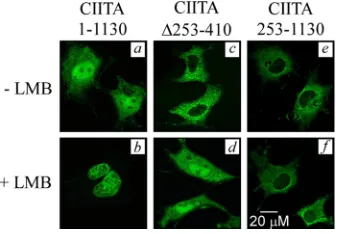
It is noteworthy that the CIITA wild type and all of the other Tax-1-inibiting fragments of CIITA show a predominant, if not exclusive, nuclear accumulation (Fig. 1Ba, b, d, e, and f), with the exception of CIITA⌬253-410, which is cytoplasmic (Fig. 1Bh). The noninhibiting fragments CIITA253-1130 and CIITA253-410 are, respectively, localized in the cytoplasm (Fig. 1Bc) or diffusely distributed in both the nucleus and the cytoplasm (Fig. 1Bg). This observation raised the possibility that CIITA might affect Tax-1 transactivation by acting at the cytoplasmic level as well. Alternatively, CIITA⌬253-410 could temporarily localize and interfere with Tax-1 in the nucleus. To verify the second possibility, we assessed whether the cytoplas-mic localization of CIITA⌬253-410 was due to a decreased nuclear import or to an increased nuclear export. To distin-guish between these two scenarios, we examined the effect of LMB, a specific inhibitor of CRM1/exportin-mediated nuclear export, on the localization of CIITA⌬253-410. If the deletion of the dimerization domain simply abrogates nuclear import, LMB should have no effect. Conversely, if the deletion affects nuclear export, LMB treatment would cause the accumulation of CIITA⌬253-410 in the nucleus. Indeed, CIITA⌬253-410 showed a strong but not complete nuclear localization follow-ing LMB treatment (Fig. 2d versus 2c). On the contrary, CIITA253-1130, which did not inhibit Tax-1, did not respond to LMB and remained cytoplasmic (Fig. 2f versus 2e). More-over, LMB treatment determined the complete accumulation of CIITA wild-type in the nucleus (Fig. 2b versus 2a),
on November 7, 2019 by guest
http://jvi.asm.org/
ing previous reports showing that CIITA is a shuttling protein exiting the nucleus via a CRM1-dependent mechanism (9, 31). We conclude that the deletion of the dimerization domain does not inhibit nuclear import of CIITA, but rather facilitates its nuclear export. Therefore, CIITA⌬253-410 transiently lo-calizes in the nucleus, and this may explain its capacity to impair the transcription function of Tax-1.
The cellular transcription factor NF-YB interacts with Tax-1 but does not alter the transcription function of the viral transactivator.We have previously shown that Tax-2-directed HTLV-2 LTR activation is suppressed by the overexpression of NF-YB, a subunit of the trimeric NF-Y complex, and we have hypothesized a possible involvement of NF-Y in
CIITA-medi-ated inhibition of Tax-2 (49). On the basis of these findings, we sought to determine whether NF-YB could exert a similar negative effect on Tax-1 activity. Because a physical interaction between Tax-1 and NF-YB was previously reported (39), and this interaction might interfere with Tax-1 transactivation, we first assessed whether the two factors interactin vivo. Expres-sion vectors for Tax-1 and myc epitope-tagged NF-YB (mNF-YB) were cotransfected in 293T cells. Cell lysates were immu-noprecipitated with anti-myc antibody and examined for the presence of the viral transactivator by anti-Tax-1 Western blot-ting. Tax-1 was indeed detected in the immunoprecipitates when coexpressed with mNF-YB but not when expressed with pcDNA3 (Fig. 3A, IP:a myc, WB:aTax-1, lane 1 versus lane 2).
FIG. 1. A stretch of 60 amino acids at the N terminus of CIITA blocks Tax-1 transcriptional function. (A) COS cells were cotransfected with fixed amounts of pLTR1-Luc (HTLV-1 LTR driving the expression of luciferase reporter gene), phRL-CMV (Renillaexpression vector), and pTax-1 vectors and with increasing amounts (0.2, 0.4, and 0.8g) of plasmid coding for either flag-tagged full-length CIITA1-1130 (lanes 4, 5, and 6, respectively) or each of the indicated deletion mutants, as specified at the bottom of panel A. Each CIITA construct was assessed at least in three independent gene-reporter assays performed in duplicate. The results of a representative experiment are shown. Mean luciferase activities, normalized toRenillaactivity (ordinate axis), are presented as percentages relative to activation by Tax-1 set to 100% (black column 2). Column 1 represents the activity of the pcDNA3 vector. Error bars represent the SD. The expression of endogenous␣-tubulin and of recombinant fCIITA proteins in cell extracts was evaluated by anti-␣tubulin (WB:a tub) and anti-flag (WB:a flag) Western blotting, respectively. (B) GFP-fCIITAs chimeras (1-1130, panel a; 1-252, panel b; 253-1130, panel c; 1-124, panel d; 26-200, panel e; 64-200, panel f; 253-410, panel g; and⌬253-410, panel h) were expressed in COS cells and visualized with a fluorescence microscope. Images of single cells representative of the entire population are shown. (C) Schematic representation of the results of the gene reporter assay illustrated in panel A. CIITA proteins used for the mapping are shown, along with their capacity to inhibit Tax-1 function (⫹). The endpoints of each CIITA form are indicated. At the top is a diagram of CIITA with its domains, labeled as follows: AD, activation domain; P/S/T, proline/serine/threonine-rich domain; GBD, GTP-binding domain; and LRR, leucine-rich repeats. The black box represents the minimal domain from positions 64 to 124 that is necessary to block the transcription function of Tax-1.
on November 7, 2019 by guest
http://jvi.asm.org/
To examine whether NF-YB interferes with Tax-1-depen-dent transcriptional activation of the HTLV-1 LTR promoter, 293T cells were cotransfected with increasing amounts of mNF-YB and fixed amounts of the reporter construct HTLV-1 LTR-luciferase and Tax-1 expression vector. Increasing amounts of CIITA plasmid were transfected as a positive con-trol of Tax-1 inhibition. Overexpression of NF-YB did not cause any decrease in Tax-1-dependent luciferase activity (Fig. 3B, columns 6 to 8 versus column 2). These findings confirm that NF-YB interacts with Tax-1in vivo, but this interaction does not affect Tax-1-dependent HTLV-1 LTR activation.
CIITA inhibits HTLV-1 replication by inhibiting Tax-1 func-tion. The observed inhibition of Tax-1 transactivation by CIITA, prompted us to investigate whether this suppressive effect correlates with the inhibition of HTLV-1 virus sion. In order to do this, we took advantage of a viral expres-sion system in human 293T cells that upon transfection with the HTLV-1 proviral clone pACH (29) become permissive to virus replication and sustain the production of viral particles that are released in the cell culture supernatant. 293T cells were transiently transfected with pACH vector alone or to-gether with the expression vectors for either CIITA wild type, CIITA⌬253-410, or NF-YB. To detect the activity of virus-derived Tax-1 transactivator, the pLTR1-Luc reporter plasmid was also cotransfected. As shown in Fig. 4A, the expression of CIITA wild-type and CIITA⌬253-410 caused up to 10- and 20-fold reduction of Tax-1 transactivation, respectively (white columns versus black column). In contrast, overexpression of NF-YB did not affect Tax-1-mediated activation of the viral LTR promoter (hatched columns versus black column). These findings confirm that full-length CIITA and CIITA⌬253–410, but not NF-YB, inhibit the transcriptional activity of virus-derived Tax-1.
To demonstrate that CIITA renders 293T cells refractory to HTLV-1 replication by targeting Tax-1, we measured by ELISA the viral p19 antigen in the supernatants of the same cell cultures analyzed for the luciferase activities. The amounts of p19 were dramatically reduced in the supernatants of cells expressing wild-type CIITA and below the detection limit of our assay in cells transfected with the highest dose of CIITA⌬253-410 (Fig. 4B, white columns versus black column). The expression of exogenous NF-YB, instead, did not affect
the production of p19, whose levels were comparable to those measured in the supernatant of cells expressing the virus alone (Fig. 4B, hatched columns versus black column).
In order to establish whether the replication of HTLV-1 is inhibited also in cells that express physiologic levels of CIITA, we cotransfected the pACH vector and the pLTR1-Luc re-porter plasmid in two previously described U937 promonocytic cell clones, one HLA-II positive and the other HLA-II nega-tive (4, 14, 26). Accordingly, we showed that HLA-II-posinega-tive cells (clone 34) express endogenous CIITA protein, whereas HLA-II-negative cells (clone 10) do not (data not shown). By measuring both the luciferase activity and the p19 production, we demonstrated that HTLV-1 expression was significantly inhibited in CIITA-positive U937 clone 34 cells with respect to CIITA-negative U937 clone 10 cells (Fig. 4C and D, column 4 versus column 2). To further confirm that this distinct behavior of the two cell clones was indeed due to their differential expression of CIITA, we established an U937 clone 10-fCIITA transfectant stably expressing exogenous CIITA. It is signifi-cant that, upon the expression of CIITA, U937 clone 10 cells became relatively refractory to HTLV-1 replication (Fig. 4C and D, column 6 versus column 2). Thus, we conclude that endogenously expressed CIITA, by targeting the transcrip-tional activator Tax-1, inhibits HTLV-1 virus expression.
[image:5.585.79.249.70.187.2]CIITA interacts with Tax-1 in vivo. To further detail the molecular mechanisms of CIITA-mediated inhibition of Tax-1 function, we assessed whether CIITA interacts with the viral
FIG. 3. The transcriptional activity of Tax-1 is not affected by its interaction with NF-YB. (A) 293T cells were transfected with pTax-1 expression vector, together with the expression vector for myc-tagged NF-YB (mNF-YB, lane 1) or pcDNA3 (lane 2). Anti-myc-precipitated cell lysates were separated by SDS-PAGE and analyzed by anti-Tax-1 Western blotting (IP:a myc, WB:a Tax-1). Eight percent of the pre-cleared cell lysate was analyzed for the expression of recombinant proteins by Western blotting with anti-Tax-1 (input, WB:a Tax-1) and anti-myc (input, WB:a myc) antibodies. (B) Increasing amounts (0.2, 0.4, and 0.8g) of the expression vectors for mNF-YB (lanes 6, 7, and 8) or flag-tagged CIITA (fCIITA) (lanes 3, 4, and 5) were cotrans-fected in 293T cells with fixed amounts of plasmids pLTR1-Luc, phRL-CMV, and pTax-1. Mean luciferase activities, normalized to theRenilla
[image:5.585.301.541.71.233.2]activity, are presented as percentages relative to activation by Tax-1 set to 100% (black column 2). Column 1 represents the activity of the pcDNA3 vector. Error bars represent the SD. The expression of en-dogenous␣-tubulin, used as an internal control of sample loading, and of recombinant fCIITA and mNF-YB proteins was evaluated by anti-␣ tubulin, anti-flag, and anti-myc Western blotting, respectively. FIG. 2. LMB treatment demonstrates localization of CIITA⌬
253-410 in the nucleus. The subcellular distribution of CIITA1-1130, CIITA⌬253-410, and CIITA253-1130, expressed as GFP fusion pro-teins in COS cells, was analyzed before (a, c, and e) and after (b, d, and f) LMB treatment with a confocal microscope, as described in Mate-rials and Methods.
on November 7, 2019 by guest
http://jvi.asm.org/
transactivator. To test this hypothesis, Tax-1 and flag-tagged CIITAs were coexpressed in 293T cells. Cell lysates were im-munoprecipitated with anti-flag antibody, and CIITA-bound proteins were assessed for the presence of Tax-1 by Western
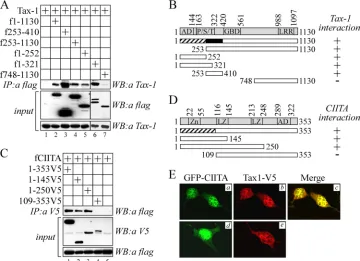
blotting. Tax-1 coprecipitated with CIITA (Fig. 5A, IP:a flag, WB:a Tax-1, lane 2). To map the region of CIITA mediating this interaction, we performed the pulldown experiments with two N-terminal fragments (1-252 and 1-321) and two C-termi-nal fragments (253-1130 and 748-1130) of CIITA, each one coexpressed in cells with Tax-1. The two N-terminal fragments and the C-terminal 253-1130 fragment of CIITA interacted with Tax-1 (Fig. 5A, IP:a flag, WB:a Tax-1, lanes 5 and 6 and lane 4, respectively). A very weak interaction, if any, was ob-served with CIITA748-1130 (Fig. 5A, IP:a flag, WB:a Tax-1, lane 7). We also detected an interaction between Tax-1 and CIITA253-410 (Fig. 5A, IP:a flag, WB:a Tax-1, lane 3), indi-cating that the C-terminal 253–1130 fragment of CIITA binds to Tax-1 at least through this stretch of amino acids. Tax-1 is not precipitated by the anti-flag antibody when expressed alone (Fig. 5A, IP:a flag, WB:a Tax-1, lane 1) in 293T cells. We conclude that CIITA binds specifically to Tax-1 via two non-overlapping regions from positions 1 to 252 and from positions 253 to 410 (Fig. 5B, hatched and black boxes, respectively).
To define the region of Tax-1 mediating the binding to CIITA, we cotransfected in 293T cells the expression vectors for CIITA and either one of two N-terminal or one C-terminal fragments of Tax-1. The capacity of these deletion mutants to interact with CIITA was then analyzed by pulldown experi-ments and compared to that of full-length Tax-1. As shown in Fig. 5C, CIITA interacted with Tax-1(1-145) and Tax-1(1-250) even better, on a stoichiometric basis (input, WB:a V5), than with Tax-1 full-length (IP:a V5, WB:a flag, lanes 2 and 3 versus lane 1). In contrast, the C-terminal 109-353 fragment of Tax-1 did not interact repeatedly with CIITA (IP:a V5, WB:a flag, lane 4), indicating that the overlapping 109-145 region is likely dispensable for the binding to CIITA. We therefore conclude that the first 108 amino acids of Tax-1 (Fig. 5D, hatched box) are necessary for the interaction with CIITA.
To further investigate CIITA–Tax-1 physical interaction at the subcellular level, we performed confocal microscopy anal-ysis in 293T cells cotransfected with the two transactivators. The results showed that CIITA and Tax-1 are both present in the nucleus and in the cytoplasm of 293T cells when singularly expressed (Fig. 5Ed and e, respectively). When coexpressed (Fig. 5Ea and b), they colocalize in both compartments (Fig. 5 Ec, merge image).
CIITA inhibits the functional and physical interaction be-tween Tax-1 and PCAF.Tax-1 and CIITA use common cellular coactivators to direct transcription from their target promot-ers, HTLV-1 LTR and MHC-II, respectively. In particular, they both physically and functionally interact with the HATs p300, CBP, and PCAF (20, 21, 25, 30, 45). Moreover, the squelching of the cofactors described above is the primary mechanism by which CIITA suppresses the transcription of cellular genes (43, 54).
In order to determine whether a similar mechanism is re-sponsible for CIITA-mediated suppression of Tax-1 transacti-vation, we verified whether the overexpression of PCAF or p300 could reverse the inhibitory action of CIITA. Increasing amounts of expression vectors for PCAF or p300 were cotrans-fected in COS cells with the HTLV-1 LTR-luciferase reporter construct and with a fixed inhibitory amount of CIITA plasmid. Overexpression of PCAF, but not p300, rescued in a dose-dependent manner the transcriptional activity of Tax-1
inhib-FIG. 4. CIITA inhibits HTLV-1 viral expression. (A) 293T cells were transfected with the vectors pLTR1-Luc and phRL-CMV and with the pACH plasmid containing the entire HTLV-1 genome. Where indicated, the cells were also transfected with increasing amounts (0.4 to 0.8 g) of plasmid coding for flag-tagged CIITA1-1130 or CIITA⌬253-410 (white columns) or myc-tagged NF-YB (hatched col-umns). At 24 h posttransfection, the supernatants were collected, and the cells were lysed to quantify the luciferase activity. Mean luciferase values, normalized toRenillavalues, of three independent experiments performed in duplicate are expressed in the ordinate as percentages of the luciferase activity produced by virus-derived Tax-1 set to 100% (black column). Error bars represent the SD. Recombinant proteins were detected by immunoblotting with anti-flag or anti-myc antibodies. (B) The concentration of viral p19 antigen (ordinate, pg/ml) in super-natants of the same cell cultures analyzed in panel A, was determined 24 h after transfection by ELISA. The black column represents the amount of p19 detected in the supernatant of 293T cells transfected with pACH vector alone (positive control). (C) CIITA-negative U937 clone 10, CIITA-positive U937 clone 34, and U937 clone 10 cells stably transfected with pcfCIITA expressing full-length CIITA were trans-fected with pLTR1-Luc and phRL-CMV vectors in the absence (black columns) or the presence (white columns) of pACH plasmid. At 48 h posttransfection, the supernatants were collected, and the cells were lysed for the quantitation of luciferase activity. Mean luciferase values, normalized to theRenillavalues, of three independent experiments performed in duplicate are shown (ordinate axis). Error bars represent the SD. (D) The concentration of viral p19 antigen (ordinate, pg/ml) in the supernatants of cell transfections analyzed in panel C was deter-mined 48 h after transfection by ELISA. Black columns represent the amount of p19 detected in the supernatant of U937 cells transfected with pLTR1-Luc and phRL-CMV vectors (negative control).
on November 7, 2019 by guest
http://jvi.asm.org/
[image:6.585.42.284.69.380.2]ited by CIITA (P⫽ 0.001) (Fig. 6A and B, respectively, col-umns 7 and 8 versus column 6). Using a CIITA mutant that does not inhibit Tax-1, PCAF increases Tax-1-dependent transactivation of viral LTR similarly to what we observed when increasing doses of PCAF were cotransfected with Tax-1 alone (data not shown). The discrepancy between the two HATs is particularly relevant in light of the fact that p300 had a stronger cooperative effect on Tax-1 transactivation com-pared to PCAF (Fig. 6B and A, respectively, columns 4 and 5 versus column 3); nevertheless, p300 did not significantly coun-teract the negative effect of CIITA on Tax-1 activity (P⫽0.07). We conclude that CIITA causes a reduced availability of PCAF for Tax-1-mediated activation of HTLV-1LTR.
A physical interaction between Tax-1 and PCAF has been previously reported (25). Therefore, we tested whether this binding was somehow affected by CIITA. 293T cells were cotransfected with plasmids expressing Tax-1 and flag-tagged
PCAF in the absence or in the presence of myc-tagged CIITA. Cell lysates were incubated with anti-flag agarose beads, and the precipitates were analyzed for the presence of Tax-1. As shown in Fig. 6C, Tax-1 was precipitated by PCAF, but the interaction was strongly reduced in the presence of CIITA (IP:a flag, WB:a Tax-1, lane 2 versus lane 1). Because PCAF is also known to bind to CIITA (45), we analyzed the same cell lysates for CIITA-PCAF interaction in the absence or in the presence of Tax-1. A slight, but reproducible increase of CIITA-PCAF interaction was observed in the presence of Tax-1 (IP:a flag, WB:a myc, lane 5 versus lane 2). Thus, we conclude that in cells expressing comparable amounts of exog-enous CIITA, PCAF, and Tax-1 proteins, PCAF preferentially associates with CIITA, and it is no longer available for Tax-1-mediated activation of the viral promoter.
[image:7.585.111.471.71.332.2]CIITA inhibits the functional interaction between Tax-1 and CREB/ATF1.As outlined above, LTR transactivation by Tax-1
FIG. 5. Mapping of Tax-1–CIITA interacting surfaces and colocalization studies. (A) 293T cells were transfected with pTax-1 plasmid alone (lane 1) or together with vectors expressing flag-tagged CIITA full-length 1-1130 or CIITA fragments 253-410, 253-1130, 1-252, 1-321, and 748-1130 (lanes 2 to 7). Cell lysates were incubated with anti-flag agarose beads and precipitated proteins were analyzed by anti-Tax-1 immunoblotting (IP:a flag, WB:a Tax-1). Eight percent of the precleared cell lysate was analyzed for the expression of recombinant proteins by Western blotting with anti-flag (input, WB:a flag) and anti-Tax-1 (input, WB:a Tax-1) antibodies. (B) Schematic representation of the results of thein vivobinding experiments shown in panel A. CIITA proteins used for the mapping are shown, along with their capacity to interact with Tax-1 (⫹). At the top is a diagram of CIITA with its domains, as specified in Fig. 1C. Hatched and black boxes represent the two regions of CIITA interacting with Tax-1. (C) The expression vector for flag-tagged CIITA (fCIITA) was transfected in 293T cells alone (lane 5) or together with plasmid expressing V5 epitope-tagged Tax-1 1-353, 1-145, 1-250, or 109-353, respectively (lanes 1 to 4). Cell lysates were immunoprecipitated with anti-V5 antibody and protein A-Sepharose beads. Tax-1-associated proteins were analyzed by anti-flag immunoblotting (IP:a V5, WB:a flag). Eight percent of the precleared cell lysates was analyzed for the expression of recombinant proteins by Western blotting with anti-V5 and anti-flag antibodies (input, WB:a V5 and WB:a flag, respectively). (D) Schematic representation of the results of thein vivobinding experiments shown in panel C. Tax-1 proteins used for the mapping are shown, along with their capacity to interact with CIITA (⫹). At the top is a diagram of Tax-1 with its domains, abbreviated as follows: Zn, zinc finger motif; LZ, leucine-zipper-like region; and AD, activation domain. The hatched box represents the 1-108 sequence that is necessary for the binding to CIITA. (E) CIITA and Tax-1 colocalize within the cell. Human 293T cells seeded on glass coverslips were transfected with the expression vector for GFP-fCIITA (d), Tax-1V5 (e) or both expression vectors (a, b, and c) by Lipofectamine. After 24 h, the cells were processed as described in Materials and Methods and analyzed by confocal microscopy using⫻63 objective lenses with a 438-nm light-source wavelength to detect GFP-fCIITA (green) and a 543-nm light-source wavelength to detect Tax-1V5 (red). A merge image is shown in panel c (yellow). Images of representative cells are shown.
on November 7, 2019 by guest
http://jvi.asm.org/
requires the assembly of a multiprotein complex containing CBP/p300/PCAF, as well as CREB/ATF1. Since the region in Tax-1 targeted by CIITA is also involved in binding the tran-scription factors CREB and ATF1, additional experiments were performed to determine whether CIITA affects this func-tional interaction. COS cells were cotransfected with plasmid expressing Tax-1 and increasing amounts of plasmids express-ing either CREB or ATF1, in the absence or in the presence of flag-tagged CIITA. As observed for PCAF, both CREB and ATF1 significantly enhanced the Tax-1 activity on the HTLV-1 LTR promoter in a dose-dependent manner (Fig. 7, lanes 4 and 5). Interestingly, the CIITA-mediated inhibition of Tax-1 activity (Fig. 7, lane 6) was strongly counteracted by overex-pression of both CREB (Fig. 7A, lanes 7 and 8) and ATF1 (Fig. 7B, lanes 7 and 8), thus indicating that the functional interaction between Tax-1 and CREB/ATF1 is also affected by CIITA.
DISCUSSION
[image:8.585.117.474.68.251.2]In this study, we demonstrated that CIITA, the master reg-ulator of MHC-II gene expression, inhibits HTLV-1 replica-tion by targeting the LTR-dependent transcripreplica-tional activating function of the viral transactivator Tax-1. This inhibitory effect was observed with exogenously expressed CIITA but, more importantly, also with endogenous CIITA expressed in HLA-II-positive promonocytic U937 cells. This result is particularly relevant because it indicates that physiologic amounts of CIITA might inhibit HTLV-1 expression in antigen-presenting cells of the promonocytic/monocytic cell lineage, which is
FIG. 6. The overexpression of PCAF, but not p300, counteracts CIITA-mediated inhibition of Tax-1 transactivation, and CIITA affects Tax-1–PCAF interaction. COS cells were cotransfected with fixed amounts of pLTR1-Luc, phRL-CMV, and pTax-1 and with increasing amounts (0.8 to 1.6g) of plasmid coding for flag-tagged PCAF (A) or p300 (B) in the absence (white columns 4 and 5) or the presence (hatched columns 7 and 8) of a fixed amount (0.4g) of pcfCIITA vector. Column 6 in panels A and B represents the percentage inhibition of Tax-1 activity by 0.4 g of pcfCIITA in the absence of overexpressed PCAF or p300. Mean luciferase activities, normalized to theRenillaactivity, are presented in the ordinate as percentages relative to activation by Tax-1 set to 100% (black column 3). Columns 1 and 2 represent the activity of pcDNA3 vector and of fPCAF (1.6g) or p300 (1.6g) in panels A and B, respectively, in the absence of Tax-1. Error bars represent the SD. Studentttest analysis was performed, andPⱕ0.05 was considered significant (*). Recombinant flag-CIITA (fCIITA), flag-PCAF (fPCAF), and p300 proteins were detected in cell extracts by Western blotting with anti-flag and anti-p300 antibodies. (C) 293T cells were transfected with Tax-1, myc-CIITA (mCIITA), and flag-PCAF (fPCAF) expression vectors in different combinations as indicated. Anti-flag agarose bead-precipitated proteins were analyzed for the presence of Tax-1 and CIITA by immunoblotting with anti-Tax-1 (IP:a flag, WB:a Tax-1) and anti-myc (IP:a flag, WB:a myc) antibodies, respectively. Eight percent of the precleared cell lysates was analyzed for the expression of recombinant proteins by immunoblotting with the indicated antibodies (input, WB:a Tax-1, WB:a myc; WB:a flag).
FIG. 7. Overexpression of CREB or ATF1 counteracts CIITA-me-diated inhibition of Tax-1 transactivation. COS cells were cotrans-fected with fixed amounts of pLTR1-Luc, phRL-CMV, and pTax-1 and with increasing amounts (0.1 and 0.2g) of plasmid coding for GFP-tagged CREB (A) or GFP-GFP-tagged ATF1 (B) in the absence (white columns 4 and 5) or the presence (hatched columns 7 and 8) of a fixed amount (0.4g) of pcfCIITA vector. Column 6 in panels A and B represents the percentage inhibition of Tax-1 activity by 0.4 g of pcfCIITA in the absence of overexpressed CREB or ATF1. Mean luciferase activities, normalized to theRenillaactivity, are presented in the ordinate as percentages relative to activation by Tax-1 set to 100% (black column 3). Columns 1 and 2 represent the activity of pcDNA3 vector and of CREB-GFP (0.2g) or GFP-ATF1 (0.2g) (A and B, respectively) in the absence of Tax-1. Error bars represent the SD. Recombinant flag-CIITA (fCIITA), GFP-CREB (CREB), and ATF1-GFP (ATF1) proteins were detected in cell extracts by Western blot-ting with anti-flag (for CIITA) and anti-tGFP (for CREB and ATF1) antibodies.
on November 7, 2019 by guest
http://jvi.asm.org/
[image:8.585.317.523.392.561.2]known to be a potential target of HTLV-1 infection (23). Interestingly, the CIITA-positive U937 clone 34 and the CIITA-negative U937 clone 10 used in the present study have been mainly characterized for their efficient or inefficient ca-pacity of supporting HIV-1 replication, as recently reviewed (26). U937 clone 34 belongs to the subset of so-called “minus” or “nonpermissive” cell clones for HIV-1 replication (4, 14). Thus, it is tempting to speculate that its transcriptional and epigenetic setup is geared toward resistance to retroviral in-fection or replication, unlike what observed in the counterpart of “plus/permissive” cell clones, such as the CIITA-negative U937 clone 10. The potential interplay between CIITA and other candidate restriction factors for HIV-1 and HTLV in this clonal model is under investigation. A functional mapping of CIITA showed that a short stretch of 60 amino acids from positions 64 to 124 is the minimal region required to inhibit Tax-1 function. Indeed, all CIITA fragments lacking this do-main do not affect Tax-1 transactivation, irrespective of their subcellular localization. Full-length CIITA and the N-terminal fragments inhibiting Tax-1 activity are predominantly localized in the nucleus, an observation compatible with CIITA inhibit-ing the latest steps of transcriptional activation of the viral promoter in the nucleus. A noticeable exception to this rule was found with CIITA⌬253-410, which has the internal dele-tion of amino acids from posidele-tions 253 to 410, a predominant cytoplasmic localization, and yet inhibits Tax-1 transactivation and HTLV-1 replication. This finding suggested two alterna-tive, but not exclusive, hypotheses: (i) CIITA⌬253-410 sup-presses Tax-1 transactivation by acting in the cytoplasm, for example, by trapping Tax-1 or a cellular factor crucial for Tax-1 transcription activity, and (ii) CIITA⌬253-410 transiently lo-calizes in the nucleus and there inhibits Tax-1 function. Rele-vant to the second possibility, it must be mentioned that CIITA shuttles between the nucleus and the cytoplasm, and many regions mediating nuclear import and export have been iden-tified within the protein, although their real contribution to CIITA subcellular localization is difficult to decipher (9, 31). In order to dissect out these two possibilities, we incubated cells expressing CIITA⌬253-410 with LMB, an inhibitor of CRM1/ exportin-mediated nuclear export, and observed that this de-letion mutant relocated to the nucleus. This result is consistent with previous studies defining CRM1-binding nuclear export regions in CIITA (31) and supports the possibility that the temporary expression of cytoplasmic CIITA in the nucleus is sufficient to inhibit Tax-1. Furthermore, since CIITA⌬253-410 has lost the intrinsic capacity of CIITA to form phosphoryla-tion-dependent homodimers (48) and, as shown here, stable nuclear retention, our results imply that dimerization regulates the retention of CIITA in the nucleus, possibly masking nu-clear export regions from the export machinery. It will be important to verify whether cytoplasmic CIITA mutants that contain the inhibitory region 64-124, but are insensitive to LMB, retain the capacity to inhibit Tax-1 transcription func-tion. Because we cannot exclude that parallel mechanisms op-erating in the cytoplasm might contribute to CIITA-mediated abrogation of Tax-1 transactivation, and on the basis of the results presented here showing that CIITA and Tax-1 interact
in vivo(see discussion below) and colocalize both in the nu-cleus and in the cytoplasm, future investigations will assess the
subcellular localization of Tax-1 in the presence of cytoplasmic mutants of CIITA.
In searching for the molecular mechanisms at the basis of CIITA-mediated inhibition of Tax-1 transactivation, we first focused on the transcription factor NF-YB, whose involvement in the inhibition of Tax-2 by CIITA was previously hypothe-sized (49). We confirm here that NF-YB interacts with Tax-1in vivo, but in contrast to the effect on Tax-2, NF-YB did not inhibit the transcription function of Tax-1 and the replication of HTLV-1 virus. These findings establish a crucial difference in the molecular mechanism by which the two retroviruses are affected by CIITA. The reasons of this different behavior, as well as the functional consequences of Tax-1–NF-YB interac-tion on the activities of the viral transactivator beyond its transcriptional activation of the LTR promoter, are currently under investigation.
We also focused on the possible interaction between CIITA and Tax-1. We found, for the first time, that CIITA, a tran-scriptional integrator exquisitely dedicated to the transcription activation of a very specific genetic system, the MHC-II gene complex, interactsin vivowith a human oncogenic retrovirus-specific gene product, the Tax-1 transactivator. We found that the region of Tax-1 required to bind CIITA spans the N-ter-minal amino acids 1 to 108. Two regions of CIITA mediate this interaction. The N-terminal region 1-252 mediates both the binding to Tax-1 and the functional inhibition of the viral transactivator, whereas the adjacent region 253-410 binds to Tax-1 without affecting its transactivation capacity. In the context of full-length CIITA, the two regions may form a single Tax-1-interacting surface, but only the presence of residues 64 to 124 associates this interaction with the inhibition of Tax-1. The fact that CIITA may interact with a factor via two distinct regions is not unprecedented, since it has been previously shown for CIITA-p300 interaction (43).
Tax-1 interacts with a multitude of cellular factors, including transcriptional activators and repressors, basal transcription factors, chromatin-modifying enzymes, and transcription elon-gation factors, to modulate the expression of viral and host genes. All of these proteins, forming the so-called Tax-1 inter-actome (5), are general factors involved in many activation and/or repression transcription pathways. Remarkably, many of the above Tax-1-interacting cellular coactivators, such as the HATs p300, CBP, and PCAF, are used also by CIITA to activate the transcription of MHC-II promoter (20, 21, 25, 30, 45).
Importantly, we show here that overexpression of PCAF, but not of p300, counteracts the inhibitory action of CIITA on Tax-1, restoring full activity of the viral transactivator. More-over, we demonstrate that CIITA decreases thein vivobinding of Tax-1 to PCAF. In addition, we show that two other impor-tant transcription factors, CREB and ATF1, required for the assembly of the functional complex necessary for Tax-1 acti-vation of HTLV-1 LTR promoter, counteract the inhibitory action of CIITA on Tax-1.
Thus, it is likely that CIITA may suppress Tax-1 transcrip-tional activity by inhibiting the physical and functranscrip-tional inter-action between the viral transactivator and crucial components of the multiprotein complex whose assembly is required for Tax-1 transactivating function. This could take place in two ways that are not mutually exclusive: CIITA may sequester
on November 7, 2019 by guest
http://jvi.asm.org/
Tax-1 that could no longer form and/or participate to the assembly of the multiprotein complex required for the HTLV-1 LTR transactivation, and/or CIITA may sequester crucial transcription factors that would no longer be available to interact with Tax-1.
Regarding PCAF, CIITA might inhibit its recruitment to the transcriptional complex on the viral LTR promoter simply by sequestering it. Alternatively, CIITA by interacting with Tax-1 may simply prevent the binding between PCAF and the viral transactivator. On the basis of the finding reported here that the N-terminal 1-108 Tax-1 region is required for the interac-tion with CIITA and on previous findings indicating the C-ter-minal part of Tax-1 as the region mediating the interaction with PCAF (25), it is likely that, if CIITA and PCAF compete for the binding to Tax-1, they do not compete for the binding to the same surface of the viral transactivator. Rather, the binding of CIITA to the N-terminal part of Tax-1 might alter the conformation of the viral transactivator, and this might affect the binding of PCAF to the C-terminal region of Tax-1. In addition to its relevance for the biology of HTLV-1 infec-tion, this observation underlines an additional difference be-tween HTLV-1 and HTLV-2, since PCAF does not seem to be involved in CIITA-mediated inhibition of Tax-2 function and HTLV-2 replication (49).
The N-terminal region of Tax-1 that binds CIITA engages also CREB and ATF1 (5). Although an interaction between CIITA and CREB has been described (10), no direct interac-tion between CIITA and ATF1 has been reported. Thus, the hypothesis of the sequestration by CIITA of Tax-1, which no longer would be available to interact with the above crucial transcription factors, should be considered the most likely pos-sibility for factors such as ATF1.
Future studies will assess whether CIITA-Tax-1 interaction can prevent other cellular transcription factors to bind to Tax-1 and whether Tax-1 bound to CIITA is still recruited to the viral LTR. Most importantly, future investigation will help to clarify whether the newly found function of CIITA on Tax-1 and viral replication can affect the oncogenic potential of the HTLV-1 retrovirus. Within this frame, it will be important to assess the involvement of CIITA in the Tax-1-mediated activation of the NF-B pathway, which is believed to be a critical step in the in-duction of T cell transformation by HTLV-1. Indeed, NF-B is constitutively activated in HTLV-1-infected cells expressing Tax-1 and in ATLL cells despite they often lack detectable Tax-1 expression (19, 36). This finding not only underscores the importance of NF-B in HTLV-1-mediated T-cell trans-formation but also implies that transition from Tax-1-depen-dent to Tax-1-indepenTax-1-depen-dent NF-B activation is occurring dur-ing the multistep process of leukemogenesis.
The results of this investigation, together with the previously reported inhibition of two other human retroviruses, HIV-1 and HTLV-2 (2, 3, 50), unambiguously demonstrate that CIITA has evolved as a general defense mechanism of the host against retroviruses not only because it activates the adaptive immune response against the infectious agents but also be-cause of its intrinsic capacity to act as an endogenous viral restriction factor. The different molecular mechanisms through which CIITA mediates its viral restriction function emphasize the functional adaptation and plasticity of this molecule to serve its manifold host-intrinsic protecting activities. Together
with its fundamental function on MHC-II expression, these findings make CIITA a unique example of molecule bridging directly adaptive and intrinsic immunity during evolution.
ACKNOWLEDGMENTS
We thank A. De Lerma Barbaro for the construction of the pLTR1-Luc vector.
This study was supported by the grants to R.S.A. (Fondazione Cariplo 2008-2230, Cellular and Molecular Basis of Human Retrovi-ral-Dependent Pathology; A.I.R.C IG 8862, New Strategies of Tumor Vaccination and Immunotherapy Based on Optimized Triggering of Anti-Tumor CD4⫹ T Cells; MIUR-PRIN project 2008-WXF7KK, New Strategies of Immunointervention against Tumors), University of Insubria grants FAR 2009 and FAR 2010 to G.T., and grant Miur PRIN 2007 and AIRC 2008 regional grant to U.B.
REFERENCES
1.Accolla, R. S., et al.1986. Air-1, a newly found locus on mouse chromosome
16 encoding atrans-acting activator factor for MHC class II gene expression.
J. Exp. Med.164:369–374.
2.Accolla, R. S., et al.2001. The MHC class II transactivator: prey and hunter
in infectious diseases. Trends Immunol.22:560–563.
3.Accolla, R. S., S. Mazza, A. De Lerma Barbaro, A. De Maria, and G. Tosi.
2002. The HLA class II transcriptional activator blocks the function of
HIV-1 Tat and inhibits viral replication. Eur. J. Immunol.32:2783–2791.
4.Alfano, M., C. Rizzi, G. Poli, and P. Biswas. 2007. HIV-1 infection of promonocytic U937 and U1 cell lines: clonal distribution of innate restriction
factors, p. 89–113.InG. Herbein (ed.), HIV and the macrophage.
Tran-sworld Research Network, Kerala, India.
5.Boxus, M., et al.2008. The HTLV-1 Tax interactome. Retrovirology5:76–99. 6.Calattini, S., et al.2005. Discovery of a new human T-cell lymphotropic virus
(HTLV-3) in central Africa. Retrovirology2:30–33.
7.Casoli, C., et al.2004. The MHC class II transcriptional activator (CIITA) inhibits HTLV-2 viral replication by blocking the function of the viral
trans-activator Tax-2. Blood103:995–1001.
8.Chiu, Y., and W. Greene.2008. The APOBEC3 cytidine deaminases: an innate defensive network opposing exogenous retroviruses and endogenous
retroelements. Annu. Rev. Immunol.26:317–353.
9.Cressman, D. E., W. J. O’Connor, S. F. Greer, X. S. Zhu, and J. P. Y. Ting.
2001. Mechanisms of nuclear import and export that control the subcellular
localization of class II transactivator. J. Immunol.167:3626–3634.
10.De Sandro, A. M., U. M. Nagarajan, and J. M. Boss.2000. Associations and interactions between bare lymphocyte syndrome factors. Mol. Cell. Biol.
20:6587–6599.
11.Feuer, G., and P. L. Green.2005. Comparative biology of human T-cell
lymphotropic virus type 1 (HTLV-1) and HTLV-2. Oncogene24:5996–6004.
12.Fontes, J. D., S. Kanazawa, N. Nekrep, and B. M. Peterlin.1999. The class II transactivator CIITA is a transcriptional integrator. Microbes Infect.
1:863–869.
13.Franchini, G.1995. Molecular mechanisms of human T-cell
leukemia/lym-photropic virus type I infection. Blood86:3619–3639.
14.Franzoso, G., et al.1994. A family of serine proteases expressed exclusively
in myelomonocytic cells specifically processes the nuclear factor-B subunit
p65 in vitro and may impair human immunodeficiency virus replication in
these cells. J. Exp. Med.180:1445–1456.
15.Georges, S. A., et al. 2003. Tax recruitment of CBP/p300, via the KIX domain, reveals a potent requirement for acetyltransferase activity that is
chromatin dependent and histone tail independent. Mol. Cell. Biol.23:3392–
3404.
16.Goren, I., O. J. Semmes, K. T. Jeang, and K. Moelling.1995. The amino terminus of Tax is required for interaction with the cyclic AMP response
element binding protein. J. Virol.69:5806–5811.
17.Grassmann, R. C., et al.1989. Transformation to continuous growth of primary human T lymphocytes by human T-cell leukemia virus type I X-re-gion genes transduced by a Herpesvirus saimiri vector. Proc. Natl. Acad. Sci.
U. S. A.86:3351–3355.
18.Greer, S. F., E. Zika, B. Conti, X. S. Zhu, and J. P. Y. Ting.2003. Enhance-ment of CIITA transcriptional function by ubiquitin. Nature Immunol.
4:1074–1082.
19.Hall, W. W., and M. Fujii.2005. Deregulation of cell-signaling pathways in
HTLV-1 infection. Oncogene24:5965–5975.
20.Harrod, R., et al.1998. An exposed KID-like domain in human T-cell lymphotropic virus type 1 Tax is responsible for the recruitment of
coacti-vators CBP/p300. Mol. Cell. Biol.18:5052–5061.
21.Harrod, R., et al.2000. p300 and p300/cAMP-responsive element-binding protein associated factor interact with human T-cell lymphotropic virus type 1 Tax in a multi-histone acetyltransferase/activator-enhancer complex.
J. Biol. Chem.16:11852–11857.
on November 7, 2019 by guest
http://jvi.asm.org/
22.Hemelaar, J., et al.2001. Human T-cell leukemia virus type 1 Tax protein binds to assembled nuclear proteasomes and enhances their proteolytic
activity. J. Virol.75:11106–11115.
23.Hoffman, P. M., et al.1992. Human T-cell leukemia virus type I infection of monocytes and microglial cells in primary human cultures. Proc. Natl. Acad.
Sci. U. S. A.89:1845–1849.
24.Jabrane-Ferrat, N., N. Nekrep, G. Tosi, L. Esserman, and B. M. Peterlin.
2003. MHC class II enhanceosome: how is the class II transactivator
re-cruited to DNA-bound activators? Int. Immunol.15:467–475.
25.Jiang, H., et al.1999. PCAF interacts with Tax and stimulates Tax transac-tivation in a histone acetyltransferase-independent manner. Mol. Cell. Biol.
19:8136–8145.
26.Kajaste-Rudnitski, A., et al.2011. TRIM22 inhibits HIV-1 transcription
independently of its E3-ubiquitin ligase activity, Tat, and NF-B responsive
LTR elements. J. Virol.85:5183–5196.
27.Kalyanaraman, V. S., et al.1982. A new subtype of human T-cell leukemia virus (HTLV-II) associated with a T-cell variant of hairy cell leukemia.
Science218:571–573.
28.Kashanchi, F., et al.1998. The coactivator CBP stimulates human T-cell
lymphotropic virus type I Tax transactivation in vitro. J. Biol. Chem.51:
34646–34652.
29.Kimata, J. T., F. H. Wong, J. J. Wang, and L. Ratner.1994. Construction and characterization of infectious human T-cell leukemia virus type 1 molecular
clones. Virology204:656–664.
30.Kretsovali, A., et al.1998. Involvement of CREB binding protein in expres-sion of major histocompatibility complex class II genes via interaction with
the class II transactivator. Mol. Cell. Biol.18:6777–6783.
31.Kretsovali, A., C. Spilianakis, A. Dimakopoulos, T. Makatounakis, and J. Papamatheakis.2001. Self-association of class II transactivator correlates
with its intracellular localization and transactivation. J. Biol. Chem.276:
32191–32197.
32.Kwok, R. P., et al.1996. Control of cAMP-regulated enhancers by the viral
transactivator Tax through CREB and the coactivator CBP. Nature380:642–
646.
33.Lehky, T. J., et al.1996. Human T-cell lymphotropic virus type II-associated
myelopathy: clinical and immunologic profiles. Ann. Neurol.40:714–723.
34.Mahieux, R., and A. Gessain.2003. HTLV-1 and associated adult T cell
leukemia/lymphoma. Rev. Clin. Exp. Hematol.7:336–361.
35.Masternak, K., et al.2000. CIITA is a transcriptional coactivator that is recruited to MHC class II promoters by multiple synergistic interactions with
an enhanceosome complex. Genes Dev.14:1156–1166.
36.Matsuoka, M., and K. T. Jeang.2007. Human T-cell leukaemia virus type 1
(HTLV-1) infectivity and cellular transformation. Nat. Rev. Cancer7:270–
280.
37.Ozato, K., D. Shin, T. Chang, and H. C. Morse, III.2008. TRIM family proteins and their emerging roles in innate immunity. Nat. Rev. Immunol.
8:849–860.
38.Paskalis, H., B. K. Felber, and G. N. Pavlakis.1986.cis-Acting sequences responsible for the transcriptional activation of human T-cell leukemia virus
type 1 constitute a conditional enhancer. Proc. Natl. Acad. Sci. U. S. A.
83:6558–6562.
39.Pise-Masison, C. A., J. Dittmer, K. E. Clemens, and J. N. Brady.1997. Physical and functional interaction between the human T-cell lymphotropic virus type I Tax1 protein and the CCAAT binding protein NF-Y. Mol. Cell.
Biol.17:1236–1243.
40.Poiesz, B. J., et al.1980. Detection and isolation of type C retrovirus particles from fresh and cultured lymphocytes of a patient with cutaneous T-cell
lymphoma. Proc. Natl. Acad. Sci. U. S. A.77:7415–7419.
41.Roucoux, D. F., and E. L. Murphy.2004. The epidemiology and disease
outcomes of human T-lymphotropic virus type II. AIDS Rev.6:144–154.
42.Sheehy, A., N. Gaddis, J. Choi, and M. Malim.2002. Isolation of a human gene that inhibits HIV-1 infection and is suppressed by the viral Vif protein.
Nature418:646–650.
43.Sisk, T. J., T. Gourley, S. Roys, and C.-H. Chang.2000. MHC class II transactivator inhibits IL-4 gene transcription by competing with NF-AT to
bind the coactivator CREB binding protein (CBP)/p300. J. Immunol.165:
2511–2517.
44.Smith, M. R., and W. C. Green.1990. Identification of HTLV-1 Tax trans-activator mutants exhibiting novel transcriptional phenotypes. Genes Dev.
4:1875–1885.
45.Spilianakis, C., J. Papamatheakis, and A. Kretsovali.2000. Acetylation by PCAF enhances CIITA nuclear accumulation and transactivation of major
histocompatibility complex class II genes. Mol. Cell. Biol.20:8489–8498.
46.Steimle, V., L. A. Otten, M. Zufferey, and B. Mach.1993. Complementation cloning of an MHC class II transactivator mutated in hereditary MHC class
II deficiency (or bare lymphocyte syndrome). Cell75:135–146.
47.Stremlau, M., et al.2004. The cytoplasmic body component TRIM5␣
re-stricts HIV-1 infection in Old World monkeys. Nature427:848–853.
48.Tosi, G., N. Jabrane-Ferrat, and B. M. Peterlin.2002. Phosphorylation of CIITA directs its oligomerization, accumulation, and increased activity on
MHC-II promoters. EMBO J.21:5467–5476.
49.Tosi, G., et al.2006. Inhibition of human T cell leukemia virus type 2 replication by the suppressive action of class II transactivator and nuclear
factor Y. Proc. Natl. Acad. Sci. U. S. A.103:12861–12866.
50.Tosi, G., L. Bozzo, and R. S. Accolla.2009. The dual function of the MHC
class II transactivator CIITA against HTLV retroviruses. Front. Biosci.14:
4149–4156.
51.Uchiyama, T.1997. Human T-cell leukemia virus type 1 (HTLV-1) and
human diseases. Annu. Rev. Immunol.15:15–37.
52.Wolfe, N. D., et al. 2005. Emergence of unique primate T-lymphotropic viruses among central African bushmeat hunters. Proc. Natl. Acad. Sci.
U. S. A.102:7994–7999.
53.Yoshida, M., I. Miyoshi, and Y. Hinuma.1982. Isolation and characterization of retrovirus from cell lines of human adult T-cell leukemia and its
implica-tion in the disease. Proc. Natl. Acad. Sci. U. S. A.79:2031–2035.
54.Zhu, X. S., and J. P. Y. Ting.2001. A 36-amino-acid region of CIITA is an effective inhibitor of CBP: novel mechanism of gamma interferon-mediated
suppression of collagen␣(2)(I) and other promoters. Mol. Cell. Biol.21:
7078–7088.