Applied General
User Research
OCTOBER 2017
OFQUAL/17/6217
This report has been commissioned by the Office of Qualifications and Examinations Regulation
Author:
CONTENTS
Page
EXECUTIVE SUMMARY ... I
1 RESEARCH OVERVIEW ... 1
2 TERMINOLOGY AND INTERPRETATION ... 12
3 APPLIED GENERALS AS A ROUTE INTO HIGHER EDUCATION ... 13
4 ASSESSING APPLIED GENERAL QUALIFICATIONS ... 25
5 SUPPORTING STUDENTS TO SUCCEED ... 32
6 CONCLUSIONS ... 37
APPENDIX 1: APPLIED GENERAL QUALIFICATION PERFORMANCE TABLES ... 40
Important information about this report
Applied General qualifications were introduced in 2014 and met the Department for
Education’s interim requirements for inclusion in performance tables. A new set of Applied General qualifications, meeting the Department for Education’s full requirements, became available for first teaching from September 2016. These qualifications contain at least 40% must-pass external assessment – a hurdle that is unique to the reformed qualifications. The timing of this research dictated that both types of Applied General qualification have been in scope. Specifically:
• At the time of the research, HEIs had not received any students that had completed the new Applied Generals (introduced in 2016). Therefore, the staff and students in the HEIs involved in the research were, by definition, only able to provide views on the
older or ‘interim’ set of qualifications.
• Some of the schools and colleges in the research sample were delivering the new Applied Generals, but others had decided to defer their introduction until 2017/18. Examples of a blended approach were also found, with schools and colleges delivering the new Applied Generals in some subjects but not in others. In the main, however,
the findings presented in the report are based upon the consultees’ views of the interim qualifications.
It is also possible that the feedback provided by some consultees may have included views on qualifications that pre-dated the introduction of Applied Generals as a category.
However, the researchers’ view is that this only happened by exception.
The researchers sought to converse with consultees specifically about Applied General qualifications. To assist this, briefing materials were issued to the participating institutions in advance and the researchers explained the focus of the study (i.e. Applied Generals) at the start of each consultation. Even so, while all of the consultees were familiar with the
term ‘Applied General qualifications’, they often spoke collectively about ‘BTECs’ and/or ‘vocational qualifications’ when giving their feedback. This was particularly true of teaching
staff in HEIs, although it also applied to their counterparts in schools and colleges.
EXECUTIVE SUMMARY
Research overview
1. This is the final report from an independent qualitative research study into how Applied General qualifications are viewed and used by key stakeholders.
2. Applied General qualifications are described by the Department for Education as “rigorous advanced (Level 3) qualifications that allow 16 to 19 year-old students to develop transferable knowledge and skills”1. Aimed at students who want to continue their education through applied learning, they allow entry to a range of Higher Education (HE) courses, either by meeting entry requirements in their own right or by being accepted alongside other qualifications at Level 3, such as A-levels.
3. BTEC and OCR Cambridge Technical Qualifications account for approximately three quarters of the Applied General qualifications included in the Department for Education’s
2018 16-19 Performance Tables, i.e. for courses taught from September 2016. Applied General qualifications in these Performance Tables must have at least 40% external assessment.
4. The number of young people in England entering HE with a BTEC is rising. BTECs are now taken by around a quarter of all English university entrants, while the combination of BTECs and A-levels is the fastest growing route into university. Each year since 2010, the acceptance rate for university applicants holding BTECs has increased.
5. This research study was commissioned by Ofqual to enable a better understanding of how Applied General qualifications are perceived. The specific objectives of the study were to:
• Improve Ofqual’s understanding of the key issues and concerns of those who use
Applied General qualifications.
• Identify the ways in which Applied General qualifications are, and/or are not, fit for purpose in preparing students to progress to HE.
• Identify the key features of Applied General qualifications that are particularly valued by users.
• Identify any specific areas where stakeholders believe that improvements could be made to the standards of current Applied General qualifications (based on their experience predominantly of qualifications that met the interim requirements). 6. The study has been based around a programme of primary research involving in-depth,
semi-structured consultations with more than 725 staff and learners at a combined total of 70 schools, Further Education (FE) colleges and Higher Education Institutions (HEIs). Key findings from the research are presented in the sub-sections that follow.
Preparing students for HE
7. Staff in schools, colleges and HEIs across the research sample reported that Applied
General qualifications are effective at developing students’ teamworking, organisation,
time management, practical, interpersonal and presentation skills, all of which they agreed can be beneficial to HE study.
8. Views were more mixed on how effectively Applied Generals develop students’
independent research, critical thinking and analysis skills. Students with, or studying for, Applied Generals tended to be quite positive about this, yet HEI staff regularly said that these skills are under-developed amongst new undergraduates that had entered HE with Applied Generals.
9. More broadly, most of the HEI staff in the sample said that students with Applied Generals are less well prepared for HE study than those entering through an A-level route (noting that, at the time of the research, HEIs had not received any students that had completed the new Applied Generals featuring the must-pass external assessment). Differences between the two cohorts are reportedly most evident in numeracy skills, academic writing, the theory underpinning various practical skills/activities and examination and revision skills.
10. However, there are significant differences by subject area. HEI staff delivering courses in creative arts, sport and ICT, together with some aspects of health and social care, were more positive about the preparedness for HE of Applied General students than those delivering more traditionally academic subjects and those with significant mathematical content.
11. Eight HEIs in the sample shared with the researchers the results of analysis they had undertaken comparing the retention and/or degree outcomes of Applied General/BTEC students with those of A-level students. Six of the eight HEIs had found that the Applied General/BTEC students were more likely to drop out and less likely to obtain first-class and upper-second class degrees (they also acknowledged that a range of other factors, including socio-economic background, can influence a student’s likelihood of dropping
out) . The other two HEIs found there to be no significant difference.
Assessing Applied General qualifications
13. The introduction of must-pass external assessments on Applied General qualifications (from September 2016) has been widely welcomed by the HEI and college staff in the research sample. In the main they believe that this change will lead to a strengthening of the reputation of the qualifications and will provide a truer reflection of students’
abilities. However, this view is less prevalent amongst those delivering creative arts, sports and ICT courses.
14. Staff in the schools and colleges in the sample understand the rationale for the changes but are concerned about the potential impacts on take-up and, more significantly, outcomes. There is a widely held expectation amongst these staff that the grade distribution for Applied General qualifications will change (namely that there will be fewer Distinctions) and that pass rates will fall.
Supporting learners to succeed
15. Staff in 12 HEIs provided examples of additional support which, whilst typically not targeted specifically at students with Applied Generals/vocational qualifications, tends to be accessed or needed by an above average proportion of those students. This support included peer assisted learning schemes, ‘preparation for exams’ sessions and ‘summer camps’ to help learners develop skills and knowledge in key areas prior to the start of their undergraduate programme.
Conclusions
16. Applied Generals are seen to fulfil an important role in providing pathways for students not suited to, or not inclined towards, more academic or more vocational programmes at Level 3. In creative arts, ICT and sports related subjects, they can be preferred by HEIs over A-levels. However, the common view is that Applied General students enter HE with a comparative disadvantage in terms of their skills in mathematics and academic learning.
17. Students are enthused by the ‘applied’ nature of Applied General qualifications. The
absence of significant examination components has also been a central part of their appeal. There is some concern amongst schools and colleges about how the assessment/examination related changes to Applied Generals may affect students who struggle to perform well under examination conditions.
18. HEI teaching staff delivering academic and mathematical subjects would tend to advocate a reduction in the UCAS points attached to Applied Generals. Whilst this research study identified some support for this within schools and colleges, it comes with the caveat that it should not impact upon the opportunities that students have to progress to HE.
1
RESEARCH OVERVIEW
Introduction
1.1 This is the final report from an independent qualitative research study into how Applied General qualifications are viewed and used by key stakeholders. Undertaken between February and July 2017, the study was commissioned by Ofqual – the Office of Qualifications and Examinations Regulation.
1.2 Ofqual is the independent statutory body responsible for the regulation of general and vocational qualifications in England. Ofqual was set up in April 2010 under the Apprenticeships, Skills, Children and Learning Act 2009 and is also covered by the Education Act 2011. Ofqual is responsible for ensuring that:
• Regulated qualifications reliably indicate the knowledge, skills and understanding that students have demonstrated.
• Assessments and exams show what a student has achieved. • People have confidence in qualifications.
• Students and teachers have information on the full range of qualifications available to them.
What are Applied General qualifications?
1.3 Applied General qualifications are described by the Department for Education as “rigorous advanced (Level 3) qualifications that allow 16 to 19 year-old students to develop transferable knowledge and skills”2. Aimed at students who want to continue their education through applied learning, they allow entry to a range of Higher Education (HE) courses, either by meeting entry requirements in their own right or by being accepted alongside other qualifications at Level 3, such as A-levels.
1.4 As a category of qualifications, Applied Generals are relatively new. They have existed formally since 2014, having been introduced as part of the government’s response to a 2013 consultation on vocational qualifications3. However, qualifications that met the
Department for Education’s full criteria for Applied Generals were introduced for first
teaching in September 2016.
1.5 Unlike Tech Level qualifications, which focus on hands-on practical training and are designed to lead to recognised occupations, Applied Generals focus on the broader study of a technical area and are not directly linked to a specific occupation.
1.6 Transferable skills such as teamworking and communication are included in the assessment of Applied Generals to help students prepare for employment, a higher or
2 2018 16-19 performance tables: qualifications in the Applied General category (Department for Education, 2016). 3
advanced apprenticeship, or further academic study. Applied Generals have been designed with the help of employers and professional bodies and all attract UCAS points.
1.7 Pearson and OCR have the highest proportion of qualifications which are recognised as Applied Generals. Together they account for:
• 80 of the 107 Applied Generals (75%) included in the Department for Education’s
2017 16-19 Performance Tables (i.e. for courses taught from September 2015)4. • 62 of the 86 Applied Generals (72%) included in the Department for Education’s
2018 16-19 Performance Tables (i.e. for courses taught from September 2016)5. 1.8 Other awarding organisations, including AQA, WJEC, NCFE and LIBF, also have
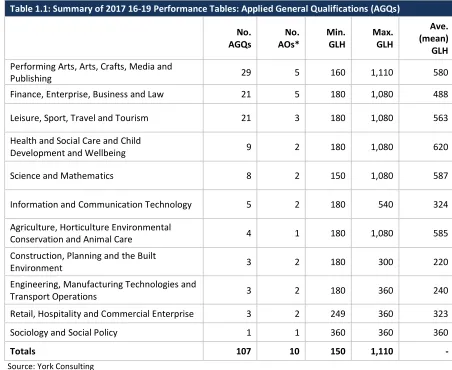
qualifications in the aforementioned Performance Tables. A summary of those tables, showing the number of Applied Generals and awarding organisations per subject area, together with the average Guided Learning Hours6 (GLH) per subject area, is provided in Table 1.1 (2017 Performance Tables) and Table 1.2 (2018 Performance Tables). The key messages from this data are that:
• The number of Applied Generals has reduced from 107 in the 2017 tables to 86 in the 2018 tables. Several of the subject areas have also been categorised or re-grouped.
• In the 2017 tables, over three quarters (76%) of the Applied Generals were accounted for by three subject areas: a) Performing Arts, Arts, Craft, Media and Publishing; b) Finance, Enterprise, Business and Law; and c) Leisure, Sport, Travel and Tourism.
• It is a different picture in the 2018 tables. Finance/Business and Performing Arts/Media remain the largest subject areas in terms of number of qualifications, but there are more Science and Mathematics qualifications (in 2018, this subject area also has the highest average GLH) and fewer Sport qualifications.
• In most subject areas, the GLH of Applied Generals are in multiples of 180 (one A-level is equivalent to 360 GLH). There are some exceptions to this: in the 2017 tables, for example, there is a WJEC Level 3 Certificate in Statistical Problem Solving Using Software with 150 GLH, while in the 2018 tables, the TLM Level 3 Diploma for Design, Engineering and Constructing a Sustainable Built Environment has 300 GLH. 1.9 A full list of qualifications included in the 2017 and 2018 Performance Tables is provided
at Appendix 1.
4https://www.gov.uk/government/publications/technical-and-vocational-qualifications-for-14-to-19-year-olds 5https://www.gov.uk/government/publications/2018-performance-tables-technical-and-vocational-qualifications
6 Guided Learning is an estimate of the number of supervised and assessment hours required for a learner to complete a
Table 1.1: Summary of 2017 16-19 Performance Tables: Applied General Qualifications (AGQs)
No.
AGQs AOs* No. Min. GLH Max. GLH
Ave. (mean) GLH
Performing Arts, Arts, Crafts, Media and
Publishing 29 5 160 1,110 580
Finance, Enterprise, Business and Law 21 5 180 1,080 488
Leisure, Sport, Travel and Tourism 21 3 180 1,080 563
Health and Social Care and Child
Development and Wellbeing 9 2 180 1,080 620
Science and Mathematics 8 2 150 1,080 587
Information and Communication Technology 5 2 180 540 324
Agriculture, Horticulture Environmental
Conservation and Animal Care 4 1 180 1,080 585
Construction, Planning and the Built
Environment 3 2 180 300 220
Engineering, Manufacturing Technologies and
Transport Operations 3 2 180 360 240
Retail, Hospitality and Commercial Enterprise 3 2 249 360 323
Sociology and Social Policy 1 1 360 360 360
Totals 107 10 150 1,110 -
Source: York Consulting *Awarding Organisations
Table 1.2: Summary of 2018 16-19 Performance Tables: Applied General Qualifications (AGQs)
No.
AGQs AOs* No. Min. GLH Max. GLH
Ave. (mean) GLH
Finance and Business 17 5 180 1,080 432
Performing Arts and Media 16 3 180 1,080 512
Science and Mathematics 14 4 180 1,080 520
Sport 12 4 180 1,080 618
Health and Social Care 10 2 180 1,080 501
ICT 8 2 180 1,080 443
Engineering 4 2 180 540 360
Construction, Planning and the Built
Environment 2 1 180 300 240
Sociology and Social Policy 2 1 180 360 270
Hospitality 1 1 360 360 360
Totals 86 10 180 1,080 -
1.10 Both lists are relevant to this study as qualifications from both were being delivered at the time that the research was undertaken. For example, in many of the schools and colleges that were visited, Year 13 students were undertaking qualifications from the 2017 lists, while Year 12 students in the same institution were undertaking qualifications from the 2018 lists.
Trends in participation and achievement
1.11 The number of young people in England entering HE with a BTEC (used here as a proxy for Applied Generals) is rising. BTECs are now taken by around a quarter of all English university entrants, while the combination of BTECs alongside A-levels is the fastest growing route to university.
1.12 Looking at this in more detail shows that:
• Between 2010/11 and 2012/13, there was a 300% increase in the number of university students holding a combination of BTEC and academic qualifications. Over the same period, the number of university students holding BTECs without academic qualifications increased by 183%7.
• Each year since 2010, the acceptance rate8 for university applicants holding BTECs has increased. In 2015, the acceptance rate for BTEC-only students was 82%, while for students with a combination of BTECs and A-levels it was 86%. This compares
with 88% for ‘A-level only’ students9.
• The number of 18 year-olds accepted into HE with a combination of A-Levels and BTECs increased by 10% between 2015 and 201610.
1.13 As the number of young people studying BTECs at Key Stage 5 has increased, there has been a notable shift in the subjects they are most likely to study. For example, research
presented in HEFCE’s ‘Young participation in higher education: A-levels and similar
qualifications’11 found that:
• Just over one third (35%) of the subjects studied by students achieving BTEC Extended Diplomas are in the Science, Technology, Engineering and Mathematics (STEM) family. However, within this group, the growth in Sports Science has outstripped all other subjects. The number of pupils achieving high grades12 in Sports Science tripled between 2005/06 and 2012/13.
• The second most popular STEM subject – Computer Sciences – more than doubled in uptake over the same period, but as a proportion of all the BTECs that were started, it fell from 9% to 8%.
7 Reforming BTECs: Applied General qualifications as a route to higher education (Higher Education Policy Institute, 2017). 8 Defined as the proportion of applicants who are offered a university place and who accept and meet the conditions of that
offer.
9 Reforming BTECs: Applied General qualifications as a route to higher education (Higher Education Policy Institute, 2017). 10 End of Cycle Report 2016: UCAS Analysis and Research (UCAS, 2016).
11 HEFCE, 2015.
1.14 Previous research has demonstrated the impact of BTEC students progressing to HE on widening participation. In 2012/13, 19% of students with a BTEC came from neighbourhoods with the lowest rate of university participation, compared with 12% of university entrants overall. In the same year, more than one third of students holding BTECs – 36% – came from less advantaged socio-economic groups and 42% came from a family where neither parent had gone to university13.
1.15 On average, BTEC students achieve fewer first-class and upper-second class degrees than traditional entry students. In 2012/13, 54% of students holding BTECs achieved a first or upper-second class degree, compared with 72% of traditional entry students14. Similar findings emerged from research by Cambridge Assessment15, which found that undergraduates who obtain 360 UCAS points via BTECs had a 5% probability of obtaining a first-class degree, compared with a 20% probability amongst A-level students with the same tariff score. BTEC students covered by the study had a 46% chance of obtaining an upper-second class degree, compared with an 80% probability for their A-level counterparts. The research also found that differences in degree outcomes remain even when demographic factors such as background and gender are taken into consideration, i.e. the changes in outcomes associated with vocational qualifications are statistically significant and of a higher magnitude than factors such as entry tariff and social class.
New specifications and other recent developments
1.16 Applied General qualifications that are in the 2018 Performance Tables (referred to in
this report as being the ‘new specifications’) must have at least 40% external
assessment and this must be passed to avoid a failed qualification outcome. This change was introduced by the Department for Education in response to concerns over
assessment quality and the development of a ‘resit culture’. External assessment has
also been advocated in numerous government or government-endorsed publications since 2011. For example:
• The Wolf Review in 2011 stated that external assessment is able to “safeguard against downward pressure on standards”.
• The Department for Education subsequently emphasised the connection between external assessment and the rigour and esteem of qualifications16.
• External assessment was highlighted as an important feature of the Post-16 Skills Plan, where it was described as essential for “comparability and reliability”17. 1.17 Formally, Applied Generals sit within an academic route, although many of the
consultees in this research described them as vocational. The government’s acceptance
13 Vocational Progression to Selecting Universities: Comparisons and Trends 2010-13 (Western Vocational Progression
Consortium, 2014).
14 Ibid
15 Research Matters: 21 (Cambridge Assessment, 2016).
16 Technical awards for 14 to 16 year-olds. 2017 and 2018 performance tables: technical guidance for awarding organisations
(Department for Education).
and implementation of the recommendations made in the Sainsbury Review of Technical and Professional Education means that students will be expected to choose between an academic route with progression to university, and a new technical route at the age of 16. All Applied Generals (and most BTECs) are categorised as being on the academic side of this distinction and are grouped as qualifications “designed explicitly to meet the needs of universities”18.
Objectives of this research
1.18 To date, published research on Applied General qualifications has been largely quantitative and has covered trends in participation and outcomes. This study has been designed to build on the existing evidence base by taking a qualitative approach to explore the perspectives of key stakeholders in further detail. Specifically, the study had the following objectives:
• To improve Ofqual’s understanding of the key issues and concerns of those who use Applied General qualifications.
• To identify the ways in which Applied General qualifications are, and/or are not, fit for purpose in preparing students to progress to Higher Education (HE).
• To identify the key features of Applied General qualifications that are particularly valued by users.
• To identify any specific areas where stakeholders believe that improvements could be made to the standards of current Applied General qualifications (based on their experience predominantly of qualifications that met the interim requirements). 1.19 Everyone that has taken part in the research is thanked sincerely for their input.
Methodology
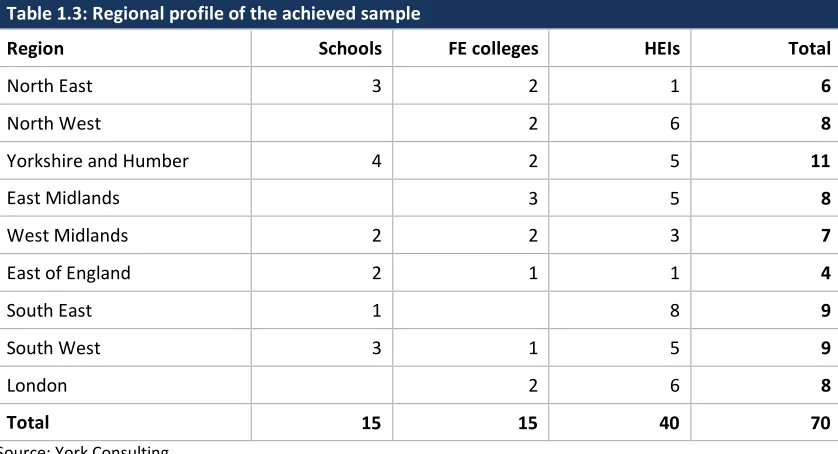
1.20 This was a qualitative research study undertaken by a team from York Consulting LLP. It was based around a programme of primary research involving in-depth, semi-structured one-to-one consultations and focus group sessions with staff and students at a combined total of 70 schools, Further Education (FE) colleges and HEIs19. As shown in Table 1.3, input was obtained from institutions in each English region (the intention at the outset of the work was to achieve national coverage rather than to hit specific regional quotas).
18 Report of the Independent Panel on Technical Education (Sainsbury, 2016).
19 Verbal consent was obtained at the start of each consultation and focus group. It was made clear to participants in the
Table 1.3: Regional profile of the achieved sample
Region Schools FE colleges HEIs Total
North East 3 2 1 6
North West 2 6 8
Yorkshire and Humber 4 2 5 11
East Midlands 3 5 8
West Midlands 2 2 3 7
East of England 2 1 1 4
South East 1 8 9
South West 3 1 5 9
London 2 6 8
Total 15 15 40 70
Source: York Consulting
1.21 The researchers spent part or all of one day at each institution. Whilst the composition of the visits varied, they typically involved consultations with:
• Teaching staff who deliver Applied General qualifications in a school or college, or HEI teaching staff who deliver to students that took an Applied General
qualification(s) before entering HE.
• Students that are undertaking one or more Applied General qualification in a school or college, or HEI students who undertook one or more Applied General before entering HE.
• Admissions staff (HEIs only).
1.22 Some visits also involved consultations with senior staff at the institution, e.g. department heads, curriculum leads and head teachers. The final decisions over who
was consulted were taken by the researchers’ nominated point of contact in each
institution. Typically this was a member of the senior management team.
Table 1.4: Consultee profile
Consultee Type Schools FE colleges HEIs Total
Teachers, tutors, lecturers 40 55 129 224
Students 92 156 104 352
Admissions staff 0 1 122 123
Head teachers/principals 4 3 1 8
Other senior staff 6 9 6 21
Total 142 224 362 728
Source: York Consulting
1.24 Feedback has been gathered on all 10 of the subject areas20 covered by the latest Applied General qualification Performance Tables, plus a selection of those covered by previous iterations of the Performance Tables. In total, 57 different Applied General qualifications have been represented in the research via the staff and student consultations (these are listed at Appendix 2). However, it is also important to note that:
• Feedback has been gathered on two ‘types’ of Applied Generals: those that met the Department for Education’s interim requirements (available for first teaching from September 2014) and those that met the full requirements (first taught from September 2016).
• Because some consultees’ feedback referred to Applied Generals, BTECs or
vocational qualifications collectively, it is very likely to have encompassed other qualifications in addition to those listed in Appendix 2.
Sampling
211.25 Alongside institution type and geographic coverage, five other criteria influenced the composition of the achieved sample:
• Number of students with an Applied General qualification (HEIs and schools): with one exception (a small university in the South East of England), the researchers approached HEIs and schools that, based on data published by UCAS for the 2015/16 academic year, had at least 50 students that were undertaking, or who had completed, an Applied General qualification (for HEIs, data availability dictated that BTECs were used as a proxy for Applied Generals). Amongst the HEIs and schools that took part in the research, the number of students with at least one Applied General/BTEC ranged from 15 (the aforementioned small university22) to 2,400.
20 Performing Arts and Media; Finance and Business; Health and Social Care; Construction, Planning and the Built
Environment; Engineering; Information and Communications Technology; Sport; Hospitality; Science and Mathematics; Sociology and Social Policy.
• A-level performance (schools): the sample of participating schools includes a broad range of average points scores per A-level entry, from 20.3 (a school in the West Midlands) to 32.6 (a school in the South East). Based on Department for Education data from 2015-16, 8 of the 15 schools in the sample had average points scores per A-level entry that were above the national average, 2 were below the national average and 5 were close to the national average (within +/-0.5 points of the national average of 27.16).
• Size of institution (FE colleges): at the time of selecting the sample, the researchers did not have access to participation data for Applied General qualifications at individual college level. In the absence of that data, and with the need to progress the research in order to hit key milestones, the largest FE colleges (based on number of students) in each English region were invited to participate. By
approaching the largest colleges, it was hoped – and indeed proved to be the case in practice – that each would have a sufficient number of Applied General
qualification students to make focus groups and consultations viable.
• UCAS tariff tier (HEIs)23: the original intention was to obtain input from at least 6
HEIs whose average UCAS tariff points per students exceed 360 (‘high-tier’), at least 6 whose average tariff points are between 273 and 359 (‘middle-tier’) and at least 6
[image:17.596.115.358.469.562.2]whose average tariff points are below 273 (‘low-tier’). In practice, and as shown in Table 1.5, the achieved sample has an under-representation of low-tier institutions. This is primarily because there are relatively few low-tier universities in England. Based on UCAS data from 2016, 6 have average UCAS tariff points below 273. All 6 were invited to take part in the study, but at the time of writing only one had done so.
Table 1.5: HEI sample by UCAS tariff point tier
Tier No. HEIs in the achieved sample
High-tier 13
Middle-tier 26
Low-tier 1
Total 40
Source: York Consulting
23 Note that a new UCAS tariff was introduced for HE courses starting from September 2017. It differs from the old tariff
(which is what this report refers to) in that it is based on a simple mathematical model and provides a broad metric of a
qualification’s size and grading structure. HE providers are autonomous and make their own decisions regarding the suitability of qualifications for their courses. Regulated information, such as a qualification specification or information
contained within the UK qualification register, is used by UCAS to confirm a qualification’s size and grading structure. A qualification is then allocated size and grade band points which are multiplied to form the overall tariff score. The new tariff is accompanied by Qualification Information Profiles, designed by universities and colleges, to provide the important
contextual information regarding a qualification’s purpose and assessment structure, which need to be considered in
• Willingness to participate (all institutions): participation in the research was
entirely voluntary for each institution. No incentives were offered for taking part.
Research and sampling limitations
1.26 The timescales for the research, combined with the number of institutions in the research sample, meant that a prompt start was needed with engagement and recruitment. From a sampling perspective, the main drawback of this was the absence of Applied General participation data for FE colleges24, hence the ‘largest college’ approach described approach.
1.27 Other limitations included the following:
• Granularity of HEI data: it was hoped at the outset of the work that the HEI sample would be informed by data on the number of students per HEI with one or more Applied General and, ideally, the specific type/title of Applied General they had obtained. However, discussions with the Higher Education Statistics Agency (HESA)
revealed that there isn’t currently an Applied General ‘flag’ in the data they hold on
students’ pre-HE qualifications. Similarly, the current categorisation of qualification types in the HESA data does not enable the accurate identification of either the number or specific types of Applied Generals held at an institution or by individual students. As a result, data on the number of students per HEI with one or more BTECs, which is available publicly, was used as a proxy for sampling purposes. • Student attendance: in colleges and HEIs, it was often the case that fewer students
attended a focus group for the research than had originally signed up. It was difficult for the institutions to prevent this, although the consequence was that in some institutions, fewer subject areas were represented than had been
anticipated.
• Recognition of Applied Generals: as explained in Chapter 2, it was common for those taking part in the research to refer collectively to ‘BTECs’ and ‘vocational qualifications’ when answering questions about Applied Generals. Whilst the
researchers sought to clarify any potential confusion (for example by referencing the Performance Tables to confirm with consultees which qualifications were being discussed), it is possible that some of the participants were referring to Tech Levels in their answers as well as, or instead of, Applied Generals.
• Representation: considerable efforts were made to obtain input from a varied sample of providers, both geographically and in terms of key characteristics such as average A-level grades and average UCAS tariff points. Whilst this was achieved, and whilst the study has generated a large body of qualitative evidence, it cannot be assumed that the findings contained within this report reflect the views of staff and students at institutions that were not in the research sample. In particular, it has only been possible to obtain input from one low-tier HEI.
• Comparator information: the research scope did not include consultations with students in HEIs that had exclusively undertaken A-levels at Key Stage 5. This
includes students who are being taught the new reformed A levels25, the first results of which will be announced in August 2017. As such, it has not been possible to compare the views of Applied General students with A-level students on how well they felt prepared for HE.
Quotations and examples used in this report
1.28 This report includes direct quotations from the qualitative consultations as well as institution-levels examples of practice. The quotations are in blue shaded boxes and the examples of practice are in grey shaded boxes.
1.29 In keeping with the research protocols agreed with each of the participating institutions, all quotations and examples of practice have been anonymised.
25 The new AS and A levels includes a focus on mainly exam assessment at the end of the course; decoupling of AS and A
2
TERMINOLOGY AND INTERPRETATION
2.1 The school and college staff consulted during this research were all familiar with the term ‘Applied General qualifications’ and all could identify the qualifications from the
2017 and 2018 Performance Tables they were delivering. In conversation, however, they typically used ‘BTECs’ and/or ‘vocational qualifications’ as collective terms when talking about Applied Generals.
2.2 This could be for several reasons. The relative newness of Applied Generals is one. The fact that BTECs account for a large share of Applied Generals is another. And significantly, the only Applied Generals that some of the schools and colleges in the sample deliver are BTECs. Whatever the reasons, it was rare for ‘Applied Generals’, as a
specific term or category of qualifications, to be regularly used by the consultees in conversation.
2.3 At the HEIs in the sample, and specifically amongst teaching staff, the term ‘Applied
General qualifications’ is less well understood and knowledge of how they differ from
other non-A-level qualifications at Level 3 is mixed. Like their counterparts in schools and colleges, teaching staff in the HEIs consistently referred to ‘BTECs’ and ‘vocational qualifications’ when discussing Applied Generals. It was very rare for any of them to differentiate their views (either unprompted or when prompted by the researchers) between Applied Generals and Tech Level qualifications.
2.4 The HEI admissions staff consulted for the study were more familiar with the term
‘Applied General qualifications’, the purpose of those qualifications and how they differ
3
APPLIED GENERALS AS A ROUTE INTO HIGHER EDUCATION
A note on the findings in this chapter
3.1 This chapter presents key findings from the research on how effectively Applied Generals prepare students for HE. In this context, HE is defined as an undergraduate degree programme.
3.2 The research has also explored how well Applied Generals prepare students for further study at Level 4, e.g. a Higher National Certificate, or equivalent. The findings from this specific line of enquiry are presented in the final sub-section of this chapter (‘Preparing students for learning at Level 4’).
Preparing students for HE: the headline messages
3.3 Across the research sample, there is no unanimous answer to the question, “how well do Applied Generals prepare students for HE?”. The number and variety of subject areas in scope, the array of institutions and institution types, and the heterogeneity of the students all contribute to make it a multi-faceted picture.
3.4 Nonetheless, some clear headline messages have emerged. These are summarised under the following two sub-headings, after which differences in views by stakeholder type and subject area are considered.
Applied Generals are seen to instil a range of skills that are valuable in HE study
3.5 Staff in schools, colleges and HEIs across the research sample agreed that Applied Generals are often effective at developing students’:
• Teamworking skills.
• Organisational and time management skills.
• Practical skills, e.g. laboratory work and other hands-on activity.
• Interpersonal skills, especially where the students have undertaken work experience or a work placement during their Applied General.
• Proficiency at giving presentations and speaking in front of groups of people. 3.6 Staff agree that each of the above can be very beneficial to HE study. There is also a
clear majority view across the research sample that Applied Generals perform well in terms of equipping students with a useful base level of subject/industry specific knowledge.
“Students who come to us with a BTEC in Health and Social Care tend to have a better understanding and familiarity with workplace language and terminology.”
3.7 Views are more mixed on how effectively Applied Generals develop students’ research
and analysis skills. Students themselves, and especially those in schools and colleges, tend to be quite positive about this. During the focus groups, they regularly spoke of how their research and analysis skills have developed and improved through the assignment-based nature of Applied General qualifications. Students in Year 12 that are studying for Applied Generals under the new specifications regularly gave feedback to this effect.
“I’ve had to do a lot of independent research [on a BTEC National Extended Certificate in IT]….a lot of planning and evaluation.”
Student at an FE college
3.8 Whilst only able to comment on the legacy qualifications that met the Department for
Education’s interim criteria, teaching staff in HEIs acknowledge that whilst Applied Generals may well have helped to develop those skills, in their view the students entering HE with one or more Applied General tend to be less adept at independent research, critical thinking and the interpretation and analysis of data than students that have come through an ‘A-level only’ route. They also reported a noticeable difference, in terms of how advanced these skills are, between students that have entered HE having only undertaken Applied Generals at Key Stage 5 and those that have done so via a combination of an Applied General(s) and an A-level(s).
“We find that students that have done BTECs without any A-levels often need to be nudged towards working independently and solution-finding. Many of them don’t seem to be used to it, presumably because of the nature of the qualifications they have undertaken before coming here.”
Head of Science and Engineering at an HEI
In most subject areas (although not all), HEI staff report that students with Applied Generals are less well prepared for HE study than those entering through an A-level route
3.9 Whilst recognising the importance of Applied Generals in the post-Raising the Participation Age landscape, and whilst acknowledging the range of skills they help to develop, the majority of HEI staff in the research sample expressed reservations about the preparedness for HE of Applied General students.
3.10 There are some notable exceptions to this which are considered under ‘Differences in view by subject area’, below. But in the main, HEI teaching staff were of the view that:
• Students with Applied Generals are not as well prepared for HE as their A-level counterparts.
3.11 When asked for their view on why this is the case, the HEI staff usually cited one or more of the following three reasons:
• Numeracy and academic writing skills: an insufficient level of skill in these areas (versus the demands of an HE programme) was the most frequently raised reason and was mentioned by at least one member of teaching staff in three quarters of the 40 HEIs in the research sample. These staff frequently reported that students with Applied Generals, and especially those without Distinction grades, are more likely than ‘A-level only’ students to require additional support on courses that either have a high numeracy/academic writing content or where strong skills in those areas are required (although that is not to say that students that have
entered HE through more traditional routes do not also require support) Many also mentioned that Applied General students are less likely to be able to reference appropriately (e.g. using Harvard referencing) or to understand the importance of referencing to develop an argument.
“All of the undergraduates in the department do a maths test at the start of the year. When we look at the results, we consistently find that students with BTECs are in the bottom third.”
Head of Engineering and Manufacturing at an HEI
• Underpinning theory: HEI staff regularly praised the practical skills of first year undergraduate students with Applied General qualifications and remarked that they are often stronger in this regard than their A-level counterparts. However, with similar regularity, they stated that students with Applied Generals are less likely to have a sound grasp of the theories or principles that underpin those practical skills and activities. This was mentioned most frequently by HEI staff delivering programmes in subjects related to engineering, science and health and social care, some of whom suggested that it may have been caused, in part at least, by the modules the students had chosen during their Applied General.
“We’d prefer students to understand the theory first and then develop their practical skills. With some of the BTEC students, it feels like it’s the other way around.”
Chemistry tutor at an HEI
Differences in views by stakeholder type
3.12 In the main:
• Staff in the schools and FE colleges covered by the research are more positive about the effectiveness of Applied Generals in preparing students for HE than staff in HEIs.
• Within HEIs, admissions staff are typically more positive than teaching staff.
• Feedback from students in HEIs on this topic is very mixed.
3.13 Each of the above is considered in more detail below.
Staff in schools and FE colleges
3.14 The majority of staff in the majority of schools and colleges that took part in the research said that, in their opinion, undertaking an Applied General(s) would stand students in good stead for HE. The specific skills that they identified are those listed in paragraph 3.5 and include teamworking and time management skills.
“The qualifications [BTEC Level 3 Extended Certificate in Health & Social Care and BTEC Level 3 National Foundation Diploma in Health & Social Care] provide a good breadth of knowledge and suit the modular approach they follow at uni. They’ve also had experience of meeting deadlines which they’ll have to do at uni.”
School teacher delivering Health and Social Care
3.15 However, during the consultations it was not always clear that staff were making a distinction between how effectively Applied Generals offer a route into HE and how well the content and structure of the qualifications actually prepare students for HE. Potentially, and certainly in the view of many HEI staff, this is an important distinction.
3.16 It should also be noted that the majority of school and college staff expressed a personal view on this topic, but were also candid in saying that their view was not necessarily evidence-based. Whilst some could provide information on the number and proportion of Applied General students from their institution that had applied to an HEI, and the number whose applications had been successful, they had very little insight on how the students had actually fared once in a HE setting.
Staff in HEIs
3.17 Admissions staff in low-tier and middle-tier institutions, and especially those where admissions functions are centralised, were, on average, more positive than their counterparts in high-tier institutions about the suitability of Applied Generals in preparing students for HE. That said:
• The low-tier and middle-tier institutions are more reliant on Applied General
high-tier institutions, which may influence their views on preparedness. Across the low-tier and middle-tier institutions in the sample, a combined average of 26% of first year undergraduate students in 2016 had one or more BTEC26, compared with an average across the high-tier institutions of 8%.
• The feedback from admissions staff also suggests that low-tier and middle-tier institutions are more likely than high-tier institutions to base shortlisting and
recruitment decisions on a student’s UCAS points (and in some cases their Personal Statement27) rather than on the specific qualifications they have undertaken28. High-tier institutions appear, on average, to give greater consideration to the specific qualifications, and the modules that have been chosen within those qualifications.
• At the time of the research, staff in less than a third of the HEIs were aware of any data comparing the retention rates and degree outcomes of Applied General students in their institutions with those of A-level students. In other words, at an individual institution level, it was relatively rare for staff’s opinions on the
preparedness for HE of different student cohorts to have been tested against outcomes data.
“We analyse retention and outcomes by whether or not students are from the local area, and in terms of widening participation, but not by the qualifications they obtained before coming here. However, we will be doing that in the future.”
Member of admissions team at an HEI
3.18 Teaching staff in HEIs were generally less positive than admissions staff, although the spectrum of views was very wide and ranged from those who evidently believe that Applied Generals provide a solid foundation for successful HE study, through to those with an equally strong view that they do not and that the UCAS points attached to the qualifications are too high. The subject areas in which they teach appear to be linked to their views and are considered below under ‘Differences in views by subject area’.
3.19 Teaching staff in some HEIs also claim that they observe a correlation between the preparedness for HE of new undergraduate students and the institution at which they undertook their Level 3 qualifications. Anecdotal examples were provided of how students who completed their Level 3 qualifications at one local provider will, on average, find it harder to make the transition to HE study than similar students with equivalent grades from a different local provider.
26 Used here as a proxy for Applied Generals in the absence of more granular data.
27 The part of the UCAS application where prospective students provide, in free text, information about themselves and why
they want to study a chosen degree.
28 Assuming that the student is applying for a course which has subject related relevance to the qualification(s) they have
Students
3.20 Students in HEIs were asked to reflect upon how well they thought their Applied General qualification(s) had prepared them for HE. Whilst some common findings emerged and are listed below, the student feedback was very varied and does not lend itself to the drawing of conclusions.
3.21 For some students, it was evidently difficult in the focus group sessions to separate the specific effects or suitability of an Applied General qualification(s) from other factors that might influence how they view their own preparedness for HE. These other factors include other qualifications (non-Applied Generals) they have undertaken, the advice and guidance they received before entering HE, and the extent to which they were, or were not, enjoying their HE course and felt motivated by it at the time of the research. This may be reflected by the fact that when the students were asked to rank how well their Applied General(s) had prepared them for HE, their average response on a five-point scale (where 5 is high) was 3.
3.22 Nonetheless, a number of headline messages did emerge on this topic from the student consultations. These are:
• Approximately three fifths of the HE students in the sample agreed that the academic/intellectual challenge of HE had proved greater than they had expected.
They often remarked that the ‘jump’ from an Applied General to a higher level programme had been substantial.
• The most common cause of that challenge, especially for science-based courses, had been the mathematical demands of their degree programmes compared with their proficiency in mathematics on entry to HE. For arts-based courses, students often reported that literature reviews and academic writing/referencing had initially proven difficult.
• Students tended not to cite the content of their Applied General as a reason why they found the mathematical components of their HE course difficult. Instead they regularly said that they were “just not very good at maths”.
• By contrast, they were more likely to say that their Applied General had not prepared them as well as they would have liked for the essay writing and other writing-based requirements of their course. None said they were “just not very good at writing”.
• The fact that they had been working to deadlines throughout their Applied General was regularly said to have been helpful in their transition to HE.
“The 3-week turnaround per module that we had on the BTEC provided me with a really good foundation for the first year of my degree, where I had regular deadlines in different subjects.”
• Only seven of the students consulted during the research had pursued an HE programme in a subject area different to that of their Applied General. Whilst it is difficult to draw conclusions from such a small cohort, these students seemed to have found the transition to HE study more academically/intellectually challenging than students whose HE programme was in the same subject area as their Applied General(s).
3.23 Students in schools and colleges undertaking an Applied General provided less feedback on preparedness for HE, mainly because they had not progressed on to an HE course at the time of the research. Approximately 75% of those that were consulted intended to do so and most were upbeat about the skills and knowledge that they were developing through their Applied General(s).
3.24 For Year 13 students in schools and colleges, and those in Year 12 whose institutions were not delivering the new specifications for Applied Generals, the only common area of concern was examinations. The students consistently recognised that their HE courses would have examinations, and understood that their performance in examinations would be central to their HE outcomes. However, unless they were studying for an A-level(s) alongside their Applied General(s), they also recognised that they risked becoming ‘out of practice’ in terms of examination preparation and
performance. Very few of the students identified this as a major concern, but some recognised it as an area where they may need additional support once in HE.
“There are no exams in my BTEC [Pearson BTEC Level 3 Diploma in Performing Arts]….this could hinder me when I’m at university.”
Year 13 college student
Differences in views by subject area
3.25 Views from HEI teaching staff on the effectiveness of Applied Generals as a means of preparing students for HE typically vary by subject area. Using the subject area classifications from the 2018 Performance Tables as a structure, Table 3.1 summarises these views. Note that this is a generalisation as views from staff in the same subject areas but different institutions do not always align.
Table 3.1: Summary views from HEI staff on how well Applied Generals prepare students for HE
Subject area (from 2018 Performance Tables) Majority view from HEI teaching staff Main reasons behind the majority view
Performing Arts and Media HEI teaching staff often prefer students to have an Applied General (or a vocational qualification). Applied Generals were consistently said to prepare students for HE in this subject area very well.
The content and delivery/learning style of the Applied Generals are well aligned with higher level courses in this subject area.
Sport Students with Applied Generals are often better suited to HE courses in sport-related subjects than A-level students. Applied Generals give students the skills/knowledge to transfer and apply their knowledge to ‘real world’ situations.
ICT HEI staff expressed consistently positive views towards Applied Generals as
effective preparation for HE study in computing and game design courses.
The applied/practical nature of the Applied Generals prepares students well for undergraduate study in this subject area.
Health and Social Care HEI staff views vary by specific HE course, although there are common concerns about the preparedness of Applied General students for certain mathematical elements (e.g. drug calculations).
Mathematical elements are central to the successful completion of several Health and Social Care courses in HE.
Finance and Business HEI staff views vary by specific HE course, although common concerns exist around mathematics, academic writing and preparation for/performance at examinations.
Numeracy and academic writing skills are important to student success in this subject area.
Hospitality
Students are generally well prepared for the practical elements of the HE courses but are less well prepared for the theoretical and/or science elements of hospitality (e.g. food technology).
Successful HE in this subject area typically requires a broad range of academic and applied skills.
Science and Mathematics Students with Applied Generals tend to be less well prepared for HE and are more likely to struggle with the demands of the course than A-level students. Substantial mathematics component of the HE courses.
Engineering Students with Applied Generals tend to be less well prepared for HE and are
more likely to struggle with the demands of the course than A-level students. Substantial mathematics component of the HE courses.
Sociology and Social Policy
Applied General students studying Criminology (the part of this subject area covered by the research) tend to have a reasonable level of familiarity with the key topics but issues can arise as they progress through their course.
Applied General students often lack an awareness of the additional depth and academic critique that needs to be applied when studying criminology at a higher level.
Construction, Planning and the Built
Environment Not covered through the HEI consultations in the research. -
Comparing Applied Generals with other routes into HE
3.27 The equivalence and comparability of Applied General qualifications and A-levels was a much-discussed topic during the research and one which divides opinion.
3.28 As with the majority of topics covered by this report, it is an over-simplification to suggest that all of the views expressed can be neatly categorised, or that all of the views expressed by a certain stakeholder group are consistent. Neither is true, although here, as elsewhere in the report, there are some clear headline messages which represent the majority points of view from the research sample. These are:
• School and college staff were generally supportive of Applied Generals (although views are mixed on the new specifications – see Chapter 4) and the pathways of progression that they offer. Most do not think that ‘Applied General’ means ‘easy’,
but rather that it indicates a less academic, but equally valid, alternative to A-levels that can be motivational for students who may not have excelled at Key Stage 4.
“A-level students think their course is harder. At the end of the course they don’t know what grade they're going to get whereas Applied General students have a pretty good idea of what grades they're going to get.”
School teacher delivering Applied General qualifications in Business (and referring to interim Applied Generals)
“Applied General students are different types of students to A-level students. The debate exists because of the UCAS points, but really I don’t think we should be comparing the two.”
School teacher delivering Applied General qualifications in Health and Social Care
• In tariff terms, admissions staff in low-tier and middle-tier HEIs tend to regard Applied General qualifications as being equivalent to A-levels. However, there is less confidence amongst these staff that that an Extended Diploma should be considered equivalent to three A-levels than there is about the equivalence of smaller Applied Generals. Opinions are more mixed, and generally less positive, amongst admissions staff in high-tier institutions.
“Applied Generals are not comparable with A*, A and B grades at A-level and they’re certainly not comparable to the reformed A-levels.”
Engineering tutor at an HEI
“This is not meant as a slight on the [Applied General] students themselves, but I’m sure that the ones I teach wouldn’t have got an A at A-level, yet they’ve got the same number of [UCAS] points.”
Business studies tutor at an HEI
“The tariff points for BTECs are completely out of proportion. BTEC students can come in with 1080 points, a triple D*, but it's not comparable to A-level. The academic underpinning and transferable skills are a long way apart.”
Head of Animation at an HEI
• Students demonstrated considerable pride in the Applied Generals they had undertaken or were undertaking. The students taking part in the research recognise the parity of esteem issues that exist (on social media, for example, it is easy to find
examples of ‘BTEC’ being used as slang for ‘second best’). The vast majority also acknowledge that a purely A-level route, even if they had been inclined to pursue one, would have been very challenging for them. In fact, those students that had undertaken an A-level alongside their Applied General(s) often remarked how much more knowledge it had been necessary to acquire for the A-level. Nonetheless, the students were largely unanimous in saying that the Applied General(s) had been the right qualifications for them, regardless of the UCAS points attached to those qualifications.
Are the qualitative findings reflected in the statistics?
3.29 Research focused on BTECs (used here as a proxy for Applied Generals) shows that whilst the gap is narrowing, pupils studying them have, on average, performed less well at Key Stage 4 than pupils who go on to study A-levels29. BTEC students are also more likely to come from disadvantaged backgrounds (in 2015, 66% of them were eligible for Free School Meals) and be male – each of which, on average, is associated with lower attainment at school. As reported earlier, research has also shown that drop-out rates in HE remain significantly higher amongst BTEC students than A-level students.
29 Passports to Progress: How do vocational qualifications help young people in building their careers? (Social Market
At an HEI in the East of England, the number of students applying with Applied Generals (without any other Level 3 qualifications) has risen from 14% in 2011 to 23% in 2016.
Analysis undertaken by the HEI shows that the proportion of students not progressing to the second year of their course, either through dropping out or by failing their first year exams, is highest amongst students that only have Applied Generals. Students with a combination of Applied Generals and A-levels, even if they achieved low grades in their A-level(s), are more likely to progress to the second year.
3.30 Eight HEIs in the sample shared with the researchers the results of analysis they had undertaken comparing the degree outcomes of Applied General/BTEC students with those of A-level students. Six of the eight had found that the Applied General/BTEC were less likely to obtaine first-class and upper-second class degrees. The other two HEIs found there to be no significant difference.
3.31 These findings raise the question of how HEIs are supporting students with Applied Generals and other non-A-level qualifications. Chapter 5 considers this and provides a series of examples uncovered during the research.
Preparing students for learning at Level 4
3.32 In addition to questions on preparedness for HE, tutors at the FE colleges in the sample were asked how well they thought Applied General qualifications prepare students for successful study at Level 4 (Higher National Certificates and equivalent). Their responses were more consistent, and less subject specific, than they were when discussing preparedness for undergraduate study. In summary:
• The tutors reported that Applied Generals provide students with a broadly appropriate set of skills and knowledge for progression to a Level 4 qualification in the same, or a related, subject area.
• Whilst some students were said to have found the mathematical and/or scientific elements of Level 4 study challenging, this has not occurred as regularly or as severely as when they have progressed directly from an Applied General to an undergraduate degree programme.
• Some students are also said to have found the increased requirement for independent research and study skills at Level 4 to have been a challenge, but this too has been less significant than on undergraduate degree programmes.
3.34 The second is that students will often progress from an Applied General to a Level 4 qualification at the same institution. They may also have the same tutors on both courses. As such, they tend to be more familiar with the learning environment, with the delivery styles and with the expectations of teaching staff than in an institution that is new to them.
3.35 Consultations were undertaken with 28 students, in 4 different institutions, that had progressed from an Applied General to a Level 4 qualification (in all cases a Higher National Certificate in a STEM30 subject). Their feedback echoed that of the tutors in that they had found the transition to Level 4 to be manageable and did not feel they were struggling with the higher level of difficulty. Half of the students said that they were having to work harder on the mathematics elements of their Higher National Certificate than they had expected (they were doing this through a combination of additional self-directed study and contact time with their tutors) but did not expect this to jeopardise the successful completion of their qualification.
4
ASSESSING APPLIED GENERAL QUALIFICATIONS
Why do students choose Applied Generals?
4.1 Before exploring views on the assessment of Applied General qualifications, it is appropriate to consider why the students in the research sample chose to undertake them. This is because assessment is clearly a factor in the decision-making process for many of the students.
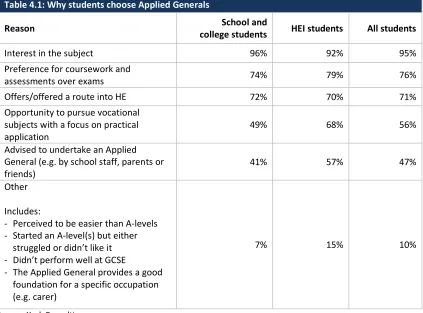
4.2 Aside from ‘interest in the subject’, the most common reason given by the students for choosing an Applied General was that they favoured qualifications without significant examination components:
• 74% of the school and college students that took part in the research, and 79% of the HEI students, identified the absence of examinations as being one of the main reasons why they chose an Applied General.
• 31% of the school and college students, and 34% of the HEI students, said that it was the most important reason.
“I much prefer coursework over exams. I find it much less stressful.” University undergraduate
“Exams are mostly about memorising facts and hoping they come up in the exam. BTECs make you apply the knowledge in the form of coursework. This in my opinion gives you a much better understanding of the subject.”
FE college student
“I prefer coursework over exams as I find it difficult to revise for long periods of time.” School student (Year 13)
“I have always wanted to go to university and this course can lead me there without doing exams.”
FE college student
HEIs. This may indicate that there is less scope for the current school and college cohort (where they are studying for new Applied Generals with external assessments) to focus on practical application than there had been in the past. However, this was not explicitly explored through the research.
Table 4.1: Why students choose Applied Generals
Reason college students School and HEI students All students
Interest in the subject 96% 92% 95%
Preference for coursework and
assessments over exams 74% 79% 76%
Offers/offered a route into HE 72% 70% 71%
Opportunity to pursue vocational subjects with a focus on practical application
49% 68% 56%
Advised to undertake an Applied General (e.g. by school staff, parents or
friends) 41% 57% 47%
Other
Includes:
- Perceived to be easier than A-levels - Started an A-level(s) but either
struggled or didn’t like it
- Didn’t perform well at GCSE
- The Applied General provides a good foundation for a specific occupation (e.g. carer)
7% 15% 10%
Source: York Consulting
Views on recent increases in attainment
4.4 There is widespread awareness across the research sample of the grade increases that have occurred on BTECs in recent years (between 2005/06 and 2012/13, the proportion of students who achieved top grades31 in BTEC qualifications equivalent in size to three A-levels, rose from 17% to 38%32).
4.5 Although BTECs are not the only qualifications in which grade