Data Structures
and
NAVIGATING THE DISK
For information on using the Acrobat toolbar and other Acrobat commands, consult the Help document within Acrobat. See especially the section “Navigating Pages.” Material displayed in green enables jumps to other locations in the book, to transparency masters, and to run sample demonstration programs. These come in three varieties:
➥
The green menu boxes in the left margin of each page perform jumps to fre-quently used parts of the book:➥
Green material in the text itself will jump to the place indicated. After taking such a jump, you may return by selecting the//icon (go back) in the Acrobat toolbar.➥
The transparency-projector icon ( ) brings up a transparency master on the current topic. Return by selecting the//icon (go back) in the Acrobat toolbar.➥
The Windows ( ) icon in the left margin select and run a demonstrationpro-gram, which will operate only on the Windows platform.
This CD contains a foldertextprogthat contains the source code for all programs and program segments appearing in the book. These files cannot be compiled directly, but they can be copied and used for writing other programs.
HINTS FOR PAGE NAVIGATION
➥
Each chapter (or other major section) of the book is in a separatepdffile, so you may start Acrobat directly on a desired chapter.➥
To find a particular section in the current chapter, hit the Home key, or select |/in the Acrobat toolbar or in the green menu bar, which will jump to the first page of the chapter where there is a table of contents for the chapter.➥
After jumping to a new location in the book, you can easily return to yourprevious location by selecting//(go back) in the Acrobat toolbar.
➥
To find a particular topic, select the index icon ( ) in the left margin.➥
To find a particular word in the current chapter, use the binoculars icon in theAcrobat toolbar.
➥
The PgDown and Enter (or Return) keys advance onescreenful, whereas.,↓, →, and advance onepage. Of these, only will move from the last page of one chapter to the first page of the next chapter.Data Structures
and
Program Design
in C++
Robert L. Kruse
Alexander J. Ryba
CD-ROM prepared by
Paul A. Mailhot
Prentice Hall
Library of Congress Cataloging–in–Publication Data
KRUSE, ROBERTL.
Data structures and program design in C++ / Robert L. Kruse, Alexander J. Ryba.
p. cm.
Includes bibliographical references and index. ISBN 0–13–087697–6
1. C++ (Computer program language) 2. Data Structures (Computer Science) I. Ryba, Alexander J. II. Title.
QA76.73.C153K79 1998 98–35979
005.13’3—dc21 CIP
Publisher: Alan Apt
Editor in Chief: Marcia Horton
Acquisitions Editor: Laura Steele
Production Editor: Rose Kernan
Managing Editor: Eileen Clark
Art Director: Heather Scott
Assistant to Art Director: John Christiana
Copy Editor: Patricia Daly
Cover Designer: Heather Scott
Manufacturing Buyer: Pat Brown
Assistant Vice President of Production and Manufacturing:David W. Riccardi
Editorial Assistant: Kate Kaibni
Interior Design: Robert L. Kruse
Page Layout: Ginnie Masterson (PreTEX, Inc.) Art Production: Blake MacLean (PreTEX, Inc.)
Cover art: Orange, 1923, by Wassily Kandinsky (1866-1944), Lithograph in Colors. Source: Christie’s Images
© 2000 by Prentice-Hall, Inc.
Simon & Schuster/A Viacom Company Upper Saddle River, New Jersey 07458
The typesetting for this book was done with PreTEX, a preprocessor and macro package for the TEX typesetting system and the POSTSCRIPTpage-description language. PreTEX is a trademark of PreTEX, Inc.; TEX is a trademark of the American
Mathematical Society; POSTSCRIPTis a registered trademarks of Adobe Systems, Inc.
The authors and publisher of this book have used their best efforts in preparing this book. These efforts include the re-search, development, and testing of the theory and programs in the book to determine their effectiveness. The authors and publisher make no warranty of any kind, expressed or implied, with regard to these programs or the documenta-tion contained in this book. The authors and publisher shall not be liable in any event for incidental or consequential damages in connection with, or arising out of, the furnishing, performance, or use of these programs.
All rights reserved. No part of this book may be reproduced, in any form or by any means, without permission in writ-ing from the publisher.
Printed in the United States of America
10 9 8 7 6 5 4 3 2 1
ISBN 0-13-087697-6
Prentice-Hall International (U.K.) Limited,London
Prentice-Hall of Australia Pty. Limited,Sydney
Prentice-Hall Canada Inc.,Toronto
Prentice-Hall Hispanoamericana, S.A.,Mexico
Prentice-Hall of India Private Limited,New Delhi
Prentice-Hall of Japan, Inc.,Tokyo
Simon & Schuster Asia Pte. Ltd.,Singapore
Contents
Preface
ix
Synopsis xii
Course Structure xiv
Supplementary Materials xv
Book Production xvi
Acknowledgments xvi
1
Programming
Principles
1
1.1 Introduction 2 1.2 The Game of Life 4
1.2.1 Rules for the Game of Life 4
1.2.2 Examples 5
1.2.3 The Solution: Classes, Objects,
and Methods 7
1.2.4 Life: The Main Program 8
1.3 Programming Style 10
1.3.1 Names 10
1.3.2 Documentation and Format 13
1.3.3 Refinement and Modularity 15
1.4 Coding, Testing,
and Further Refinement 20
1.4.1 Stubs 20
1.4.2 Definition of the Class Life 22
1.4.3 Counting Neighbors 23
1.4.4 Updating the Grid 24
1.4.5 Input and Output 25
1.4.6 Drivers 27
1.4.7 Program Tracing 28
1.4.8 Principles of Program Testing 29
1.5 Program Maintenance 34
1.5.1 Program Evaluation 34
1.5.2 Review of the Life Program 35
1.5.3 Program Revision
and Redevelopment 38
1.6 Conclusions and Preview 39
1.6.1 Software Engineering 39
1.6.2 Problem Analysis 40
1.6.3 Requirements Specification 41
1.6.4 Coding 41
Pointers and Pitfalls 45 Review Questions 46
References for Further Study 47
C++ 47
Programming Principles 47
The Game of Life 47
Software Engineering 48
2
Introduction
to Stacks
49
2.1 Stack Specifications 50
2.1.1 Lists and Arrays 50
2.1.2 Stacks 50
2.1.3 First Example: Reversing a List 51
2.1.4 Information Hiding 54
2.1.5 The Standard Template Library 55
vi
Contents2.2 Implementation of Stacks 57 2.2.1 Specification of Methods
for Stacks 57
2.2.2 The Class Specification 60
2.2.3 Pushing, Popping,
and Other Methods 61
2.2.4 Encapsulation 63
2.3 Application: A Desk Calculator 66 2.4 Application: Bracket Matching 69 2.5 Abstract Data Types
and Their Implementations 71
2.5.1 Introduction 71
2.5.2 General Definitions 73
2.5.3 Refinement of Data Specification 74
Pointers and Pitfalls 76 Review Questions 76
References for Further Study 77
3
Queues
78
3.1 Definitions 79
3.1.1 Queue Operations 79
3.1.2 Extended Queue Operations 81
3.2 Implementations of Queues 84 3.3 Circular Implementation
of Queues in C++ 89
3.4 Demonstration and Testing 93
3.5 Application of Queues: Simulation 96
3.5.1 Introduction 96
3.5.2 Simulation of an Airport 96
3.5.3 Random Numbers 99
3.5.4 The Runway Class Specification 99
3.5.5 The Plane Class Specification 100
3.5.6 Functions and Methods
of the Simulation 101
3.5.7 Sample Results 107
Pointers and Pitfalls 110 Review Questions 110
References for Further Study 111
4
Linked Stacks
and Queues
112
4.1 Pointers and Linked Structures 113
4.1.1 Introduction and Survey 113
4.1.2 Pointers and Dynamic Memory
in C++ 116
4.1.3 The Basics of Linked Structures 122
4.2 Linked Stacks 127
4.3 Linked Stacks with Safeguards 131
4.3.1 The Destructor 131
4.3.2 Overloading the
Assignment Operator 132
4.3.3 The Copy Constructor 135
4.3.4 The Modified
Linked-Stack Specification 136
4.4 Linked Queues 137
4.4.1 Basic Declarations 137
4.4.2 Extended Linked Queues 139
4.5 Application: Polynomial Arithmetic 141
4.5.1 Purpose of the Project 141
4.5.2 The Main Program 141
4.5.3 The Polynomial Data Structure 144
4.5.4 Reading and Writing
Polynomials 147
4.5.5 Addition of Polynomials 148
4.5.6 Completing the Project 150
4.6 Abstract Data Types
and Their Implementations 152 Pointers and Pitfalls 154
Review Questions 155
5
Recursion
157
5.1 Introduction to Recursion 158
5.1.1 Stack Frames for Subprograms 158
5.1.2 Tree of Subprogram Calls 159
5.1.3 Factorials:
A Recursive Definition 160
5.1.4 Divide and Conquer:
The Towers of Hanoi 163
5.2 Principles of Recursion 170
5.2.1 Designing Recursive Algorithms 170
5.2.2 How Recursion Works 171
5.2.3 Tail Recursion 174
5.2.4 When Not to Use Recursion 176
5.3 Backtracking: Postponing the Work 183
5.3.1 Solving the Eight-Queens Puzzle 183
5.3.2 Example: Four Queens 184
5.3.3 Backtracking 185
5.3.4 Overall Outline 186
5.3.5 Refinement: The First Data Structure
and Its Methods 188
5.3.6 Review and Refinement 191
5.3.7 Analysis of Backtracking 194
5.4 Tree-Structured Programs: Look-Ahead in Games 198
5.4.1 Game Trees 198
5.4.2 The Minimax Method 199
5.4.3 Algorithm Development 201
5.4.4 Refinement 203
5.4.5 Tic-Tac-Toe 204
Pointers and Pitfalls 209 Review Questions 210
References for Further Study 211
6
Lists and
Strings
212
6.1 List Definition 213
6.1.1 Method Specifications 214
6.2 Implementation of Lists 217
6.2.1 Class Templates 218
6.2.2 Contiguous Implementation 219
6.2.3 Simply Linked Implementation 221
6.2.4 Variation: Keeping the Current
Position 225
6.2.5 Doubly Linked Lists 227
6.2.6 Comparison of Implementations 230
6.3 Strings 233
6.3.1 Strings in C++ 233
6.3.2 Implementation of Strings 234
6.3.3 Further String Operations 238
6.4 Application: A Text Editor 242
6.4.1 Specifications 242
6.4.2 Implementation 243
6.5 Linked Lists in Arrays 251 6.6 Application:
Generating Permutations 260 Pointers and Pitfalls 265
Review Questions 266
References for Further Study 267
7
Searching
268
7.1 Searching:
Introduction and Notation 269 7.2 Sequential Search 271
7.3 Binary Search 278
7.3.1 Ordered Lists 278
7.3.2 Algorithm Development 280
7.3.3 The Forgetful Version 281
7.3.4 Recognizing Equality 284
7.4 Comparison Trees 286
7.4.1 Analysis forn=10 287
7.4.2 Generalization 290
7.4.3 Comparison of Methods 294
7.4.4 A General Relationship 296
7.5 Lower Bounds 297 7.6 Asymptotics 302
7.6.1 Introduction 302
7.6.2 Orders of Magnitude 304
7.6.3 The Big-O
and Related Notations 310
7.6.4 Keeping the Dominant Term 311
Pointers and Pitfalls 314 Review Questions 315
References for Further Study 316
8
Sorting
317
8.1 Introduction and Notation 318
8.1.1 Sortable Lists 319
8.2 Insertion Sort 320
8.2.1 Ordered Insertion 320
8.2.2 Sorting by Insertion 321
8.2.3 Linked Version 323
8.2.4 Analysis 325
8.3 Selection Sort 329
8.3.1 The Algorithm 329
8.3.2 Contiguous Implementation 330
8.3.3 Analysis 331
8.3.4 Comparisons 332
viii
Contents8.6 Divide-and-Conquer Sorting 339
8.6.1 The Main Ideas 339
8.6.2 An Example 340
8.7 Mergesort for Linked Lists 344
8.7.1 The Functions 345
8.7.2 Analysis of Mergesort 348
8.8 Quicksort for Contiguous Lists 352
8.8.1 The Main Function 352
8.8.2 Partitioning the List 353
8.8.3 Analysis of Quicksort 356
8.8.4 Average-Case Analysis of
Quicksort 358
8.8.5 Comparison with Mergesort 360
8.9 Heaps and Heapsort 363
8.9.1 Two-Way Trees as Lists 363
8.9.2 Development of Heapsort 365
8.9.3 Analysis of Heapsort 368
8.9.4 Priority Queues 369
8.10 Review: Comparison of Methods 372 Pointers and Pitfalls 375
Review Questions 376
References for Further Study 377
9
Tables and Information
Retrieval
379
9.1 Introduction:
Breaking the lg n Barrier 380 9.2 Rectangular Tables 381 9.3 Tables of Various Shapes 383
9.3.1 Triangular Tables 383
9.3.2 Jagged Tables 385
9.3.3 Inverted Tables 386
9.4 Tables: A New Abstract Data Type 388 9.5 Application: Radix Sort 391
9.5.1 The Idea 392
9.5.2 Implementation 393
9.5.3 Analysis 396
9.6 Hashing 397
9.6.1 Sparse Tables 397
9.6.2 Choosing a Hash Function 399
9.6.3 Collision Resolution with Open
Addressing 401
9.6.4 Collision Resolution by Chaining 406
9.7 Analysis of Hashing 411
9.8 Conclusions:
Comparison of Methods 417 9.9 Application:
The Life Game Revisited 418
9.9.1 Choice of Algorithm 418
9.9.2 Specification of Data Structures 419
9.9.3 The Life Class 421
9.9.4 The Life Functions 421
Pointers and Pitfalls 426 Review Questions 427
References for Further Study 428
10
Binary Trees
429
10.1 Binary Trees 430
10.1.1 Definitions 430
10.1.2 Traversal of Binary Trees 432
10.1.3 Linked Implementation
of Binary Trees 437
10.2 Binary Search Trees 444 10.2.1 Ordered Lists
and Implementations 446
10.2.2 Tree Search 447
10.2.3 Insertion into a Binary Search
Tree 451
10.2.4 Treesort 453
10.2.5 Removal from a Binary Search
Tree 455
10.3 Building a Binary Search Tree 463
10.3.1 Getting Started 464
10.3.2 Declarations
and the Main Function 465
10.3.3 Inserting a Node 466
10.3.4 Finishing the Task 467
10.3.5 Evaluation 469
10.3.6 Random Search Trees
and Optimality 470
10.4 Height Balance: AVL Trees 473
10.4.1 Definition 473
10.4.2 Insertion of a Node 477
10.4.3 Removal of a Node 484
10.4.4 The Height of an AVL Tree 485
10.5 Splay Trees:
A Self-Adjusting Data Structure 490
10.5.1 Introduction 490
10.5.2 Splaying Steps 491
10.5.4 Amortized Algorithm Analysis:
Introduction 505
10.5.5 Amortized Analysis
of Splaying 509
Pointers and Pitfalls 515 Review Questions 516
References for Further Study 518
11
Multiway
Trees
520
11.1 Orchards, Trees, and Binary Trees 521 11.1.1 On the Classification of
Species 521
11.1.2 Ordered Trees 522
11.1.3 Forests and Orchards 524
11.1.4 The Formal Correspondence 526
11.1.5 Rotations 527
11.1.6 Summary 527
11.2 Lexicographic Search Trees: Tries 530
11.2.1 Tries 530
11.2.2 Searching for a Key 530
11.2.3 C++ Algorithm 531
11.2.4 Searching a Trie 532
11.2.5 Insertion into a Trie 533
11.2.6 Deletion from a Trie 533
11.2.7 Assessment of Tries 534
11.3 External Searching: B-Trees 535
11.3.1 Access Time 535
11.3.2 Multiway Search Trees 535
11.3.3 Balanced Multiway Trees 536
11.3.4 Insertion into a B-Tree 537
11.3.5 C++ Algorithms:
Searching and Insertion 539
11.3.6 Deletion from a B-Tree 547
11.4 Red-Black Trees 556
11.4.1 Introduction 556
11.4.2 Definition and Analysis 557
11.4.3 Red-Black Tree Specification 559
11.4.4 Insertion 560
11.4.5 Insertion Method
Implementation 561
11.4.6 Removal of a Node 565
Pointers and Pitfalls 566 Review Questions 567
References for Further Study 568
12
Graphs
569
12.1 Mathematical Background 570
12.1.1 Definitions and Examples 570
12.1.2 Undirected Graphs 571
12.1.3 Directed Graphs 571
12.2 Computer Representation 572
12.2.1 The Set Representation 572
12.2.2 Adjacency Lists 574
12.2.3 Information Fields 575
12.3 Graph Traversal 575
12.3.1 Methods 575
12.3.2 Depth-First Algorithm 577
12.3.3 Breadth-First Algorithm 578
12.4 Topological Sorting 579
12.4.1 The Problem 579
12.4.2 Depth-First Algorithm 580
12.4.3 Breadth-First Algorithm 581
12.5 A Greedy Algorithm: Shortest Paths 583
12.5.1 The Problem 583
12.5.2 Method 584
12.5.3 Example 585
12.5.4 Implementation 586
12.6 Minimal Spanning Trees 587
12.6.1 The Problem 587
12.6.2 Method 589
12.6.3 Implementation 590
12.6.4 Verification
of Prim’s Algorithm 593
12.7 Graphs as Data Structures 594 Pointers and Pitfalls 596
Review Questions 597
References for Further Study 597
13
Case Study:
The Polish
Notation
598
13.1 The Problem 599
13.1.1 The Quadratic Formula 599
13.2 The Idea 601
13.2.1 Expression Trees 601
x
Contents13.3 Evaluation of Polish Expressions 604 13.3.1 Evaluation of an Expression
in Prefix Form 605
13.3.2 C++ Conventions 606
13.3.3 C++ Function
for Prefix Evaluation 607
13.3.4 Evaluation
of Postfix Expressions 608
13.3.5 Proof of the Program:
Counting Stack Entries 609
13.3.6 Recursive Evaluation
of Postfix Expressions 612
13.4 Translation from Infix Form to Polish Form 617 13.5 An Interactive
Expression Evaluator 623
13.5.1 Overall Structure 623
13.5.2 Representation of the Data:
Class Specifications 625
13.5.3 Tokens 629
13.5.4 The Lexicon 631
13.5.5 Expressions: Token Lists 634
13.5.6 Auxiliary
Evaluation Functions 639
13.5.7 Graphing the Expression:
The Class Plot 640
13.5.8 A Graphics-Enhanced
Plot Class 643
References for Further Study 645
A
Mathematical
Methods
647
A.1 Sums of Powers of Integers 647 A.2 Logarithms 650
A.2.1 Definition of Logarithms 651
A.2.2 Simple Properties 651
A.2.3 Choice of Base 652
A.2.4 Natural Logarithms 652
A.2.5 Notation 653
A.2.6 Change of Base 654
A.2.7 Logarithmic Graphs 654
A.2.8 Harmonic Numbers 656
A.3 Permutations, Combinations, Factorials 657
A.3.1 Permutations 657
A.3.2 Combinations 657
A.3.3 Factorials 658
A.4 Fibonacci Numbers 659
A.5 Catalan Numbers 661
A.5.1 The Main Result 661
A.5.2 The Proof by One-to-One
Correspondences 662
A.5.3 History 664
A.5.4 Numerical Results 665
References for Further Study 665
B
Random
Numbers
667
B.1 Introduction 667 B.2 Strategy 668
B.3 Program Development 669 References for Further Study 673
C
Packages and
Utility Functions
674
C.1 Packages and C++ Translation Units 674 C.2 Packages in the Text 676
C.3 The Utility Package 678 C.4 Timing Methods 679
D
Programming Precepts,
Pointers, and Pitfalls
681
D.1 Choice of Data Structuresand Algorithms 681
D.1.1 Stacks 681
D.1.2 Lists 681
D.1.3 Searching Methods 682
D.1.4 Sorting Methods 682
D.1.5 Tables 682
D.1.6 Binary Trees 683
D.1.7 General Trees 684
D.1.8 Graphs 684
D.2 Recursion 685
D.3 Design of Data Structures 686 D.4 Algorithm Design and Analysis 687 D.5 Programming 688
D.6 Programming with Pointer Objects 689 D.7 Debugging and Testing 690
D.8 Maintenance 690
Preface
T
HE APPRENTICE CARPENTERmay want only a hammer and a saw, but a masterbuilder employs many precision tools. Computer programming likewise requires sophisticated tools to cope with the complexity of real applications, and only practice with these tools will build skill in their use. This book treats structured problem solving, object-oriented programming, data abstraction, and the comparative analysis of algorithms as fundamental tools of program design. Several case studies of substantial size are worked out in detail, to show how all the tools are used together to build complete programs.
Many of the algorithms and data structures we study possess an intrinsic el-egance, a simplicity that cloaks the range and power of their applicability. Before long the student discovers that vast improvements can be made over the naïve methods usually used in introductory courses. Yet this elegance of method is tem-pered with uncertainty. The student soon finds that it can be far from obvious which of several approaches will prove best in particular applications. Hence comes an early opportunity to introduce truly difficult problems of both intrinsic interest and practical importance and to exhibit the applicability of mathematical methods to algorithm verification and analysis.
Many students find difficulty in translating abstract ideas into practice. This book, therefore, takes special care in the formulation of ideas into algorithms and in the refinement of algorithms into concrete programs that can be applied to practical problems. The process of data specification and abstraction, similarly, comes before the selection of data structures and their implementations.
xii
Prefacefunctions and complete programs of substantial length. The exercises and pro-gramming projects, moreover, constitute an indispensable part of the book. Many of these are immediate applications of the topic under study, often requesting that programs be written and run, so that algorithms may be tested and compared. Some are larger projects, and a few are suitable for use by a small group of students working together.
Our programs are written in the popular object-oriented language C++. We take the view that many object-oriented techniques provide natural implemen-tations for basic principles of data-structure design. In this way, C++ allows us to construct safe, efficient, and simple implementations of data-structures. We recognize that C++ is sufficiently complex that students will need to use the ex-perience of a data structures courses to develop and refine their understanding of the language. We strive to support this development by carefully introducing and explaining various object-oriented features of C++ as we progress through the book. Thus, we beginChapter 1assuming that the reader is comfortable with the elementary parts of C++ (essentially, with the C subset), and gradually we add in such object-oriented elements of C++ as classes, methods, constructors, inheri-tance, dynamic memory management, destructors, copy constructors, overloaded functions and operations, templates, virtual functions, and the STL. Of course, our primary focus is on the data structures themselves, and therefore students with relatively little familiarity with C++ will need to supplement this text with a C++ programming text.
SYNOPSIS
By working through the first large project (CONWAY’s game of Life), Chapter 1
Programming
Principles expounds principles of object-oriented program design, top-down refinement, re-view, and testing, principles that the student will see demonstrated and is expected to follow throughout the sequel. At the same time, this project provides an oppor-tunity for the student to review the syntax of elementary features of C++, the programming language used throughout the book.
Chapter 2introduces the first data structure we study, the stack. The chapter Introduction to Stacks
applies stacks to the development of programs for reversing input, for modelling a desk calculator, and for checking the nesting of brackets. We begin by utilizing the STL stack implementation, and later develop and use our own stack imple-mentation. A major goal ofChapter 2 is to bring the student to appreciate the ideas behind information hiding, encapsulation and data abstraction and to apply methods of top-down design to data as well as to algorithms. The chapter closes with an introduction to abstract data types.
Queues are the central topic ofChapter 3. The chapter expounds several dif-Queues
ferent implementations of the abstract data type and develops a large application program showing the relative advantages of different implementations. In this chapter we introduce the important object-oriented technique of inheritance.
Chapter 4presents linked implementations of stacks and queues. The chapter Linked Stacks and
destructors, copy constructors, and overloaded assignment operators, all of which are needed in the safe C++ implementation of linked structures.
Chapter 5continues to elucidate stacks by studying their relationship to prob-Recursion
lem solving and programming with recursion. These ideas are reinforced by ex-ploring several substantial applications of recursion, including backtracking and tree-structured programs. This chapter can, if desired, be studied earlier in a course than its placement in the book, at any time after the completion ofChapter 2.
More general lists with their linked and contiguous implementations provide Lists and Strings
the theme for Chapter 6. The chapter also includes an encapsulated string im-plementation, an introduction to C++ templates, and an introduction to algorithm analysis in a very informal way.
Chapter 7,Chapter 8, andChapter 9present algorithms for searching, sorting, Searching
and table access (including hashing), respectively. These chapters illustrate the interplay between algorithms and the associated abstract data types, data struc-Sorting
tures, and implementations. The text introduces the “big-O” and related notations for elementary algorithm analysis and highlights the crucial choices to be made regarding best use of space, time, and programming effort. These choices require Tables and
Information Retrieval that we find analytical methods to assess algorithms, and producing such analyses is a battle for which combinatorial mathematics must provide the arsenal. At an elementary level we can expect students neither to be well armed nor to possess the mathematical maturity needed to hone their skills to perfection. Our goal, there-fore, is to help students recognize the importance of such skills in anticipation of later chances to study mathematics.
Binary trees are surely among the most elegant and useful of data structures. Their study, which occupiesChapter 10, ties together concepts from lists, searching, Binary Trees
and sorting. As recursively defined data structures, binary trees afford an excellent opportunity for the student to become comfortable with recursion applied both to data structures and algorithms. The chapter begins with elementary topics and progresses as far as such advanced topics as splay trees and amortized algorithm analysis.
Chapter 11continues the study of more sophisticated data structures, including Multiway Trees
tries, B-trees, and red-black trees.
Chapter 12 introduces graphs as more general structures useful for problem Graphs
solving, and introduces some of the classical algorithms for shortest paths and minimal spanning trees in graphs.
The case study in Chapter 13 examines the Polish notation in considerable detail, exploring the interplay of recursion, trees, and stacks as vehicles for problem Case Study:
The Polish Notation solving and algorithm development. Some of the questions addressed can serve as an informal introduction to compiler design. As usual, the algorithms are fully developed within a functioning C++ program. This program accepts as input an expression in ordinary (infix) form, translates the expression into postfix form, and evaluates the expression for specified values of the variable(s). Chapter 13may be studied anytime after the completion ofSection 10.1.
The appendices discuss several topics that are not properly part of the book’s subject but that are often missing from the student’s preparation.
Appendix Apresents several topics from discrete mathematics. Its final two Mathematical
xiv
Prefaceneeded for any vital purpose in the text, but are included to encourage combina-torial interest in the more mathematically inclined.
Appendix Bdiscusses pseudorandom numbers, generators, and applications, Random Numbers
a topic that many students find interesting, but which often does not fit anywhere in the curriculum.
Appendix Ccatalogues the various utility and data-structure packages that are Packages and
Utility Functions developed and used many times throughout this book. Appendix Cdiscusses dec-laration and definition files, translation units, the utility package used throughout the book, and a package for calculating CPU times.
Appendix D, finally, collects all the Programming Precepts and all the Pointers Programming
Precepts, Pointers,
and Pitfalls and Pitfalls scattered through the book and organizes them by subject for conve-nience of reference.
COURSE STRUCTURE
The prerequisite for this book is a first course in programming, with experience prerequisite
using the elementary features of C++. However, since we are careful to introduce sophisticated C++ techniques only gradually, we believe that, used in conjunction with a supplementary C++ textbook and extra instruction and emphasis on C++ language issues, this text provides a data structures course in C++ that remains suitable even for students whose programming background is in another language such as C, Pascal, or Java.
A good knowledge of high school mathematics will suffice for almost all the algorithm analyses, but further (perhaps concurrent) preparation in discrete math-ematics will prove valuable. Appendix Areviews all required mathematics.
This book is intended for courses such as the ACM Course CS2 (Program Design content
and Implementation), ACM Course CS7 (Data Structures and Algorithm Analysis), or a course combining these. Thorough coverage is given to most of the ACM/IEEE knowledge units1 on data structures and algorithms. These include:
AL1 Basic data structures, such as arrays, tables, stacks, queues, trees, and graphs;
AL2 Abstract data types;
AL3 Recursion and recursive algorithms;
AL4 Complexity analysis using the big Oh notation;
AL6 Sorting and searching; and
AL8 Practical problem-solving strategies, with large case studies.
The three most advanced knowledge units, AL5 (complexity classes, NP-complete problems), AL7 (computability and undecidability), and AL9 (parallel and dis-tributed algorithms) are not treated in this book.
1 SeeComputing Curricula 1991: Report of the ACM/IEEE-CS Joint Curriculum Task Force, ACM
Most chapters of this book are structured so that the core topics are presented first, followed by examples, applications, and larger case studies. Hence, if time allows only a brief study of a topic, it is possible, with no loss of continuity, to move rapidly from chapter to chapter covering only the core topics. When time permits, however, both students and instructor will enjoy the occasional excursion into the supplementary topics and worked-out projects.
A two-term course can cover nearly the entire book, thereby attaining a satis-two-term course
fying integration of many topics from the areas of problem solving, data structures, program development, and algorithm analysis. Students need time and practice to understand general methods. By combining the studies of data abstraction, data structures, and algorithms with their implementations in projects of realistic size, an integrated course can build a solid foundation on which, later, more theoretical courses can be built. Even if it is not covered in its entirety, this book will provide enough depth to enable interested students to continue using it as a reference in later work. It is important in any case to assign major programming projects and to allow adequate time for their completion.
SUPPLEMENTARY MATERIALS
A CD-ROM version of this book is anticipated that, in addition to the entire contents of the book, will include:
➥
All packages, programs, and other C++ code segments from the text, in a form ready to incorporate as needed into other programs;➥
Executable versions (for DOS or Windows) of several demonstration programs and nearly all programming projects from the text;➥
Brief outlines or summaries of each section of the text, suitable for use as a study guide.These materials will also be available from the publisher’s internet site. To reach these files withftp, log in as useranonymousto the siteftp.prenhall.comand change to the directory
pub/esm/computer_science.s-041/kruse/cpp
Instructors teaching from this book may obtain, at no charge, an instructor’s version on CD-ROM which, in addition to all the foregoing materials, includes:
➥
Brief teaching notes on each chapter;➥
Full solutions to nearly all exercises in the textbook;xvi
PrefaceBOOK PRODUCTION
This book and its supplements were written and produced with software called PreTEX, a preprocessor and macro package for the TEX typesetting system.2PreTEX,
by exploiting context dependency, automatically supplies much of the typesetting markup required by TEX. PreTEX also supplies several tools that greatly simplify some aspects of an author’s work. These tools include a powerful cross-reference system, simplified typesetting of mathematics and computer-program listings, and automatic generation of the index and table of contents, while allowing the pro-cessing of the book in conveniently small files at every stage. Solutions, placed with exercises and projects, are automatically removed from the text and placed in a separate document.
For a book such as this, PreTEX’s treatment of computer programs is its most important feature. Computer programs are not included with the main body of the text; instead, they are placed in separate, secondary files, along with any desired explanatory text, and with any desired typesetting markup in place. By placing tags at appropriate places in the secondary files, PreTEX can extract arbitrary parts of a secondary file, in any desired order, for typesetting with the text. Another utility removes all the tags, text, and markup, producing as its output a program ready to be compiled. The same input file thus automatically produces both type-set program listings and compiled program code. In this way, the reader gains increased confidence in the accuracy of the computer program listings appearing in the text. In fact, with just two exceptions, all of the programs developed in this book have been compiled and succesfully tested under the g++ and Borland C++ compilers (versions 2.7.2.1 and 5.0, respectively). The two exceptions are the first program inChapter 2(which requires a compiler with a full ANSI C++ standard library) and the last program ofChapter 13(which requires a compiler with certain Borland graphics routines).
ACKNOWLEDGMENTS
Over the years, the Pascal and C antecedents of this book have benefitted greatly from the contributions of many people: family, friends, colleagues, and students, some of whom are noted in the previous books. Many other people, while studying these books or their translations into various languages, have kindly forwarded their comments and suggestions, all of which have helped to make this a better book.
We are happy to acknowledge the suggestions of the following reviewers, who have helped in many ways to improve the presentation in this book: KEITH
VANDER LINDEN (Calvin College), JENS GREGOR(University of Tennessee), VICTOR
BERRY(Boston University), JEFFERYLEON(University of Illinois at Chicago), SUSAN
2 TEX was developed by DONALDE. KNUTH, who has also made many important research
HUTT(University of Missouri–Columbia), FREDHARRIS(University of Nevada), ZHI
-LIZHANG(University of Minnesota), and ANDREWSUNG(New Mexico Institute of
Technology).
ALEXRYBAespecially acknowledges the helpful suggestions and encouraging
advice he has received over the years from WIMRUITENBURG and JOHN SIMMSof
Marquette University, as well as comments from former students RICKVOGELand
JUNWANG.
It is a special pleasure for ROBERTKRUSEto acknowledge the continuing advice
and help of PAULMAILHOTof PreTEX, Inc., who was from the first an outstanding
student, then worked as a dependable research assistant, and who has now become a valued colleague making substantial contributions in software development for book production, in project management, in problem solving for the publisher, the printer, and the authors, and in providing advice and encouragement in all aspects of this work. The CD-ROM versions of this book, with all their hypertext features (such as extensive cross-reference links and execution of demonstration programs from the text), are entirely his accomplishment.
Without the continuing enthusiastic support, faithful encouragement, and pa-tience of the editorial staff of Prentice Hall, especially ALANAPT, Publisher, LAURA
STEELE, Acquisitions Editor, and MARCIAHORTON, Editor in Chief, this project would
never have been started and certainly could never have been brought to comple-tion. Their help, as well as that of the production staff named on the copyright page, has been invaluable.
ROBERTL. KRUSE
Programming
Principles
1
T
HIS CHAPTERsummarizes important principles of good programming,
es-pecially as applied to large projects, and introduces methods such as
object-oriented design and top-down design for discovering effective algorithms.
In the process we raise questions in program design and data-storage
methods that we shall address in later chapters, and we also review some of
the elementary features of the language C++ by using them to write programs.
1.1 Introduction 2
1.2 The Game of Life 4
1.2.1 Rules for the Game of Life 4
1.2.2 Examples 5
1.2.3 The Solution: Classes, Objects, and Methods 7
1.2.4 Life: The Main Program 8
1.3 Programming Style 10
1.3.1 Names 10
1.3.2 Documentation and Format 13
1.3.3 Refinement and Modularity 15
1.4 Coding, Testing, and Further Refinement 20
1.4.1 Stubs 20
1.4.2 Definition of the Class Life 22
1.4.3 Counting Neighbors 23
1.4.4 Updating the Grid 24
1.4.5 Input and Output 25
1.4.6 Drivers 27
1.4.7 Program Tracing 28
1.4.8 Principles of Program Testing 29
1.5 Program Maintenance 34
1.5.1 Program Evaluation 34
1.5.2 Review of the Life Program 35
1.5.3 Program Revision and Redevelopment 38
1.6 Conclusions and Preview 39
1.6.1 Software Engineering 39
1.6.2 Problem Analysis 40
1.6.3 Requirements Specification 41
1.6.4 Coding 41
Pointers and Pitfalls 45 Review Questions 46
References for Further Study 47
C++ 47
Programming Principles 47
The Game of Life 47
Software Engineering 48
The greatest difficulties of writing large computer programs are not in deciding what the goals of the program should be, nor even in finding methods that can be used to reach these goals. The president of a business might say, “Let’s get a computer to keep track of all our inventory information, accounting records, and
2
personnel files, and let it tell us when inventories need to be reordered and budget lines are overspent, and let it handle the payroll.” With enough time and effort, a staff of systems analysts and programmers might be able to determine how various staff members are now doing these tasks and write programs to do the work in the same way.
This approach, however, is almost certain to be a disastrous failure. While interviewing employees, the systems analysts will find some tasks that can be put on the computer easily and will proceed to do so. Then, as they move other work problems of large
programs to the computer, they will find that it depends on the first tasks. The output from these, unfortunately, will not be quite in the proper form. Hence they need more programming to convert the data from the form given for one task to the form needed for another. The programming project begins to resemble a patchwork quilt. Some of the pieces are stronger, some weaker. Some of the pieces are carefully sewn onto the adjacent ones, some are barely tacked together. If the programmers are lucky, their creation may hold together well enough to do most of the routine work most of the time. But if any change must be made, it will have unpredictable consequences throughout the system. Later, a new request will come along, or an unexpected problem, perhaps even an emergency, and the programmers’ efforts will prove as effective as using a patchwork quilt as a safety net for people jumping from a tall building.
The main purpose of this book is to describe programming methods and tools that will prove effective for projects of realistic size, programs much larger than those ordinarily used to illustrate features of elementary programming. Since a piecemeal approach to large problems is doomed to fail, we must first of all adopt a consistent, unified, and logical approach, and we must also be careful to observe important principles of program design, principles that are sometimes ignored in writing small programs, but whose neglect will prove disastrous for large projects. The first major hurdle in attacking a large problem is deciding exactly what the problem is. It is necessary to translate vague goals, contradictory requests, problem specification
and perhaps unstated desires into a precisely formulated project that can be pro-grammed. And the methods or divisions of work that people have previously used are not necessarily the best for use in a machine. Hence our approach must be to determine overall goals, but precise ones, and then slowly divide the work into smaller problems until they become of manageable size.
The maxim that many programmers observe, “First make your program work, program design
then make it pretty,” may be effective for small programs, but not for large ones. Each part of a large program must be well organized, clearly written, and thor-oughly understood, or else its structure will have been forgotten, and it can no longer be tied to the other parts of the project at some much later time, perhaps by another programmer. Hence we do not separate style from other parts of program design, but from the beginning we must be careful to form good habits.
Section 1.1 • Introduction
3
Even with very large projects, difficulties usually arise not from the inability to find a solution but, rather, from the fact that there can be so many different methods and algorithms that might work that it can be hard to decide which is best, which may lead to programming difficulties, or which may be hopelessly inefficient. The greatest room for variability in algorithm design is generally in the way in which choice of
data structures the data of the program are stored:
➥
How they are arranged in relation to each other.➥
Which data are kept in memory.➥
Which are calculated when needed.➥
Which are kept in files, and how the files are arranged.A second goal of this book, therefore, is to present several elegant, yet fundamen-tally simple ideas for the organization and manipulation of data. Lists, stacks, and queues are the first three such organizations that we study. Later, we shall develop several powerful algorithms for important tasks within data processing, such as sorting and searching.
When there are several different ways to organize data and devise algorithms, it becomes important to develop criteria to recommend a choice. Hence we devote attention to analyzing the behavior of algorithms under various conditions. analysis of algorithms
The difficulty of debugging a program increases much faster than its size. That is, if one program is twice the size of another, then it will likely not take twice as long to debug, but perhaps four times as long. Many very large programs (such testing and
verification as operating systems) are put into use still containing errors that the programmers have despaired of finding, because the difficulties seem insurmountable. Some-times projects that have consumed years of effort must be discarded because it is impossible to discover why they will not work. If we do not wish such a fate for our own projects, then we must use methods that will
➥
Reduce the number of errors, making it easier to spot those that remain. program correctness➥
Enable us to verify in advance that our algorithms are correct.➥
Provide us with ways to test our programs so that we can be reasonably con-fident that they will not misbehave.Development of such methods is another of our goals, but one that cannot yet be fully within our grasp.
Even after a program is completed, fully debugged, and put into service, a great deal of work may be required to maintain the usefulness of the program. In maintenance
time there will be new demands on the program, its operating environment will change, new requests must be accommodated. For this reason, it is essential that a large project be written to make it as easy to understand and modify as possible.
The programming language C++ is a particularly convenient choice to express C++
➥
C++ allows data abstraction: This means that programmers can create new types to represent whatever collections of data are convenient for their appli-cations.➥
C++ supportsobject-oriented design, in which the programmer-defined types play a central role in the implementation of algorithms.➥
Importantly, as well as allowing for object-oriented approaches, C++ allows for the use of thetop-down approach, which is familiar to C programmers.➥
C++ facilitates code reuse, and the construction of general purpose libraries.The language includes an extensive, efficient, and convenient standard library.
➥
C++ improves on several of the inconvenient and dangerous aspects of C.➥
C++ maintains the efficiency that is the hallmark of the C language.It is the combination of flexibility, generality and efficiency that has made C++ one of the most popular choices for programmers at the present time.
We shall discover that the general principles that underlie the design of all data structures are naturally implemented by the data abstraction and the object-oriented features of C++. Therefore, we shall carefully explain how these aspects of C++ are used and briefly summarize their syntax (grammar) wherever they first arise in our book. In this way, we shall illustrate and describe many of the features of C++ that do not belong to its small overlap with C. For the precise details of C++ syntax, consult a textbook on C++ programming—we recommend several such books in the references at the end of this chapter.
1.2 THE GAME OF LIFE
If we may take the liberty to abuse an old proverb,
One concrete problem is worth a thousand unapplied abstractions.
Throughout this chapter we shall concentrate on one case study that, while not large by realistic standards, illustrates both the principles of program design and the pitfalls that we should learn to avoid. Sometimes the example motivates general principles; sometimes the general discussion comes first; always it is with the view of discovering general principles that will prove their value in a range of practical applications. In later chapters we shall employ similar methods for larger projects.
3
The example we shall use is the game calledLife, which was introduced by the British mathematician J. H. CONWAYin 1970.
1.2.1 Rules for the Game of Life
Life is really a simulation, not a game with players. It takes place on an unbounded rectangular grid in which each cell can either be occupied by an organism or not. Occupied cells are calledalive; unoccupied cells are calleddead. Which cells are definitions
Section 1.2 • The Game of Life
5
1. The neighbors of a given cell are the eight cells that touch it vertically, horizon-transition rules
tally, or diagonally.
2. If a cell is alive but either has no neighboring cells alive or only one alive, then in the next generation the cell dies of loneliness.
3. If a cell is alive and has four or more neighboring cells also alive, then in the next generation the cell dies of overcrowding.
4. A living cell with either two or three living neighbors remains alive in the next generation.
5. If a cell is dead, then in the next generation it will become alive if it has exactly three neighboring cells, no more or fewer, that are already alive. All other dead cells remain dead in the next generation.
6. All births and deaths take place at exactly the same time, so that dying cells can help to give birth to another, but cannot prevent the death of others by reducing overcrowding; nor can cells being born either preserve or kill cells living in the previous generation.
A particular arrangement of living and dead cells in a grid is called aconfiguration. configuration
The preceding rules explain how one configuration changes to another at each generation.
1.2.2 Examples
As a first example, consider the configuration
The counts of living neighbors for the cells are as follows:
4
0 0 0 0 0 0
0 1 2 2 1 0
0 1 1 1 1 0
0 1 2 2 1 0
By rule 2 both the living cells will die in the coming generation, and rule 5 shows moribund example
that no cells will become alive, so the configuration dies out. On the other hand, the configuration
0 0 0 0 0 0
0 1 2 2 1 0
0 2 3 3 2 0
0 2 3 3 2 0
0 0 0 0 0 0
0 1 2 2 1 0
has the neighbor counts as shown. Each of the living cells has a neighbor count of stability
three, and hence remains alive, but the dead cells all have neighbor counts of two or less, and hence none of them becomes alive.
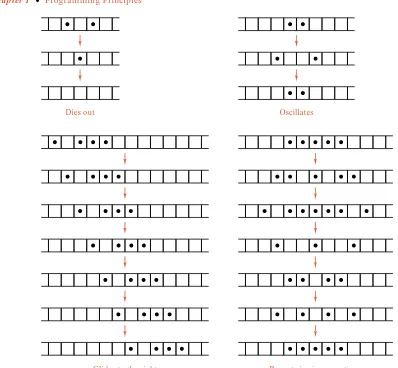
The two configurations
0 0 0 0 0
1 2 3 2 1
1 1 2 1 1
1 2 3 2 1
0 0 0 0 0
0 1 1 1 0
0 2 1 2 0
0 3 2 3 0
0 2 1 2 0
0 1 1 1 0
and
continue to alternate from generation to generation, as indicated by the neighbor alternation
counts shown.
It is a surprising fact that, from very simple initial configurations, quite compli-cated progressions of Life configurations can develop, lasting many generations, and it is usually not obvious what changes will happen as generations progress. Some very small initial configurations will grow into large configurations; others variety
will slowly die out; many will reach a state where they do not change, or where they go through a repeating pattern every few generations.
Not long after its invention, MARTINGARDNERdiscussed the Life game in his
popularity
column inScientific American, and, from that time on, it has fascinated many people, so that for several years there was even a quarterly newsletter devoted to related topics. It makes an ideal display for home microcomputers.
Section 1.2 • The Game of Life
7
1.2.3 The Solution: Classes, Objects, and Methods
In outline, a program to run the Life game takes the form:
Set up aLife configurationas an initial arrangement of living and dead cells. algorithm
Print theLife configuration.
While the user wants to see further generations:
Update theconfigurationby applying the rules of the Life game. Print the currentconfiguration.
The important thing for us to study in this algorithm is theLife configuration. In
class
C++, we use aclassto collect data and the methods used to access or change the data. Such a collection of data and methods is called anobjectbelonging to the object
given class. For the Life game, we shall call the classLife, so thatconfiguration
becomes aLifeobject. We shall then use three methods for this object: initialize( )
will set up the initial configuration of living and dead cells;print( )will print out
5
the current configuration; and update( )will make all the changes that occur in moving from one generation to the next.
Every C++ class, in fact, consists ofmembersthat represent either variables or C++ classes
functions. The members that represent variables are called thedata members; these are used to store data values. The members that represent functions belonging to a class are called themethodsormember functions. The methods of a class are methods
normally used to access or alter the data members.
Clients, that is, user programs with access to a particular class, can declare and clients
manipulate objects of that class. Thus, in the Life game, we shall declare a Life
object by:
Life configuration;
We can now apply methods to work withconfiguration, using the C++ operator . (the member selection operator). For example, we can print out the data in member selection
operator configurationby writing:
configuration.print( );
It is important to realize that, while writing a client program, we can use a C++ class so long as we know the specificationsof each of its methods, that is, specifications
statements of precisely what each method does. We do not need to know how
6
the data are actually stored or how the methods are actually programmed. For example, to use a Lifeobject, we do not need to know exactly how the object is stored, or how the methods of the classLifeare doing their work. This is our first information hiding
example of an important programming strategy known asinformation hiding. When the time comes to implement the class Life, we shall find that more goes on behind the scenes: We shall need to decide how to store the data, and we shall need variables and functions to manipulate this data. All these variables private and public
In this book, we shall always distinguish between methods and functions as follows, even though their actual syntax (programming grammar) is the same:
Convention
Methods of a class are public. Functions in a class are private.
1.2.4 Life: The Main Program
The preceding outline of an algorithm for the game of Life translates into the fol-lowing C++ program.
7
#include"utility.h"
#include"life.h"
intmain( ) // Program to play Conway’s game of Life.
/*Pre: The user supplies an initial configuration of living cells.
Post: The program prints a sequence of pictures showing the changes in the configuration of living cells according to the rules for the game of Life. Uses:The class Life and its methods initialize( ), print( ), and update( ).
The functions instructions( ), user_says_yes( ).*/ {
Life configuration;
instructions( );
configuration.initialize( );
configuration.print( );
cout<< "Continue viewing new generations?" <<endl; while(user_says_yes( )){
configuration.update( );
configuration.print( );
cout<< "Continue viewing new generations?" <<endl;
} }
The program begins by including files that allow it to use the class Lifeand the utility package
standard C++ input and output libraries. The utility functionuser_says_yes( ) is declared inutility.h, which we shall discuss presently. For our Life program, the only other information that we need about the fileutility.his that it begins with the instructions
#include<iostream>
using namespacestd;
Section 1.2 • The Game of Life
9
The documentation for our Life program begins with itsspecifications; that is, precise statements of the conditions required to hold when the program begins and program specifications
the conditions that will hold after it finishes. These are called, respectively, the pre-conditionsandpostconditionsfor the program. Including precise preconditions and postconditions for each function not only explains clearly the purpose of the function but helps us avoid errors in the interface between functions. Including specifications is so helpful that we single it out as our first programming precept:
Programming Precept
Include precise preconditions and postconditions with every program, function, and method that you write.
functions A third part of the specifications for our program is a list of the classes and functions that it uses. A similar list should be included with every program, function, or method.
action of the program The action of our main program is entirely straightforward. First, we read in the initial situation to establish the first configuration of occupied cells. Then we commence a loop that makes one pass for each generation. Within this loop we simply update the Life configuration, print theconfiguration, and ask the user whether we should continue. Note that theLifemethods,initialize,update, and
printare simply called with the member selection operator.
In the Life program we still must write code to implement:
➥
TheclassLife.➥
The methodinitialize( )to initialize aLifeconfiguration.➥
The methodprint( )to output aLifeconfiguration.➥
The methodupdate( )to change aLifeobject so that it stores the configuration at the next generation.➥
The functionuser_says_yes( )to ask the user whether or not to go on to the next generation.➥
The functioninstructions( )to print instructions for using the program.The implementation of the class Life is contained in the two files life.h and life.c. There are a number of good reasons for us to use a pair of files for the implementation of any class or data structure: According to the principle of infor-mation hiding, we should separate the definition of a class from the coding of its methods. The user of the class only needs to look at the specification part and its list of methods. In our example, the filelife.hwill give the specification of the classLife.
Each compilation unit ought to be able to include any particular.hfile (for example to use the associated data structure), but unless we omit function and variable definitions from the .h file, this will not be legal. In our project, the second filelife.cmust therefore contain the implementations of the methods of theclassLifeand the functioninstructions( ).1
Another code file,utility.c, contains the definition of the function
user_says_yes( ).
We shall, in fact, soon develop several more functions, declarations, definitions, and other instructions that will be useful in various applications. We shall put all utility package
of these together as apackage. This package can be incorporated into any program with the directive:
#include"utility.h"
whenever it is needed.
Just as we divided theLifeclass implementation between two files, we should divide the utility package between the filesutility.handutility.cto allow for its use in the various translation units of a large program. In particular, we should place function and variable definitions into the fileutility.c, and we place other sorts of utility instructions, such as the inclusion of standard C++ library files, into utility.h. As we develop programs in future chapters, we shall add to the utility package. Appendix Clists all the code for the whole utility package.
Exercises 1.2
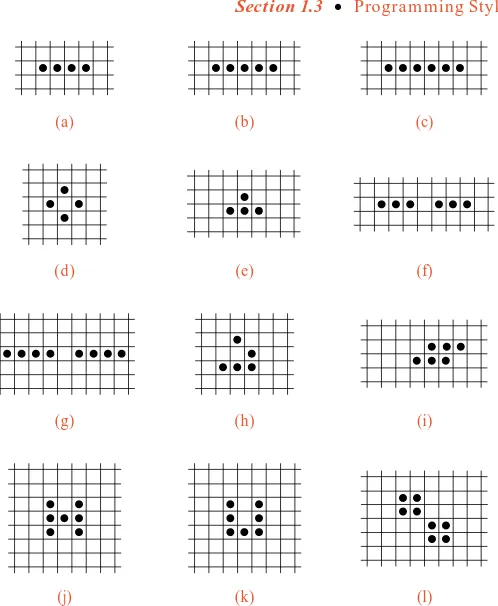
Determine by hand calculation what will happen to each of the configurations shown inFigure 1.1over the course of five generations. [Suggestion: Set up the Life configuration on a checkerboard. Use one color of checkers for living cells in the current generation and a second color to mark those that will be born or die in the next generation.]1.3 PROGRAMMING STYLE
Before we turn to implementing classes and functions for the Life game, let us pause to consider several principles that we should be careful to employ in programming.
1.3.1 Names
In the story of creation (Genesis 2 : 19), the LORDbrought all the animals to ADAM
to see what names he would give them. According to an old Jewish tradition, it was only when ADAMhad named an animal that it sprang to life. This story brings
1 On some compilers the file suffix.chas to be replaced by an alternative such as.C,.cpp,.cxx,
Section 1.3 • Programming Style
11
(a)
(d)
(g)
(j)
(b)
(e)
(h)
(k)
(c)
(i)
[image:28.612.225.474.100.403.2](l) (f)
Figure 1.1. Simple Life configurations
an important moral to computer programming: Even if data and algorithms exist
8
before, it is only when they are given meaningful names that their places in the program can be properly recognized and appreciated, that they first acquire a life of their own.
purpose of careful
naming what each class and variable represents and to know exactly what each functionFor a program to work properly it is of the utmost importance to know exactly does. Documentation explaining the classes, variables, and functions should there-fore always be included. The names of classes, variables, and functions should be chosen with care so as to identify their meanings clearly and succinctly. Finding good names is not always an easy task, but is important enough to be singled out as our second programming precept:
9
Programming Precept
Always name your classes, variables and functions with the greatest care, and explain them thoroughly.
names. Constants used in different places should be given names, and so should different data types, so that the compiler can catch errors that might otherwise be difficult to spot.
We shall see that types and classes play a fundamental role in C++ programs, and it is particularly important that they should stand out to a reader of our pro-grams. We shall therefore adopt a capitalization convention, which we have already used in the Life program: We use an initial capital letter in the identifier of any class or programmer defined type. In contrast, we shall use only lowercase letters for the identifiers of functions, variables, and constants.
The careful choice of names can go a long way in clarifying a program and in helping to avoid misprints and common errors. Some guidelines are
1. Give special care to the choice of names for classes, functions, constants, and guidelines
all global variables used in different parts of the program. These names should be meaningful and should suggest clearly the purpose of the class, function, variable, and the like.
2. Keep the names simple for variables used only briefly and locally. Mathemati-cians usually use a single letter to stand for a variable, and sometimes, when writing mathematical programs, it may be permissible to use a single-letter name for a mathematical variable. However, even for the variable controlling aforloop, it is often possible to find a short but meaningful word that better describes the use of the variable.
3. Use common prefixes or suffixes to associate names of the same general cate-gory. The files used in a program, for example, might be called
input_file transaction_file total_file out_file reject_file
4. Avoid deliberate misspellings and meaningless suffixes to obtain different names. Of all the names
index indx ndex indexx index2 index3
only one (the first) should normally be used. When you are tempted to intro-duce multiple names of this sort, take it as a sign that you should think harder and devise names that better describe the intended use.
5. Avoid choosing cute names whose meaning has little or nothing to do with the problem. The statements
do{
study( );
}while(TV.in_hock( )); if(!sleepy) play( ); elsenap( );
Section 1.3 • Programming Style
13
6. Avoid choosing names that are close to each other in spelling or otherwise easy to confuse.
7. Be careful in the use of the letter “l” (small ell), “O” (capital oh), and “0” (zero). Within words or numbers these usually can be recognized from the context and cause no problem, but “l” and “O” should never be used alone as names. Consider the examples
l = 1; x = 1; x = l; x = O; O = 0
1.3.2 Documentation and Format
Most students initially regard documentation as a chore that must be endured after a program is finished, to ensure that the marker and instructor can read it, so that no credit will be lost for obscurity. The author of a small program indeed can keep all the details in mind, and so needs documentation only to explain the program to someone else. With large programs (and with small ones after some the purpose of
documentation months have elapsed), it becomes impossible to remember how every detail relates to every other, and therefore to write large programs, it is essential that appropriate documentation be prepared along with each small part of the program. A good habit is to prepare documentation as the program is being written, and an even better one, as we shall see later, is to prepare part of the documentation before starting to write the program.
Not all documentation is appropriate. Almost as common as programs with little documentation or only cryptic comments are programs with verbose docu-mentation that adds little to understanding the program. Hence our third pro-gramming precept:
10
Programming Precept
Keep your documentation concise but descriptive.
The style of documentation, as with all writing styles, is highly personal, and many different styles can prove effective. There are, nonetheless, some commonly accepted guidelines that should be respected:
1. Place a prologue at the beginning of each function including guidelines
(a) Identification (programmer’s name, date, version number).2
(b) Statement of the purpose of the function and algorithm used. (c) The changes the function makes and what data it uses. (d) Reference to further documentation external to the program.
2. When each variable, constant, or class is declared, explain what it is and how it is used. Better still, make this information evident from the name.
2 To save space, programs printed in this book do not include identification lines or some other