Next-to-leading order QCD analysis of deeply virtual Compton scattering amplitudes
Andreas Freund*Institut fu¨r Theoretische Physik, University of Regensburg, Universita¨tstrasse 31, 93053 Regensburg, Germany
Martin McDermott†
Division of Theoretical Physics, Department of Mathematical Sciences, University of Liverpool, Liverpool, L69 3BX, United Kingdom
共Received 3 July 2001; published 11 March 2002兲
We present a next-to-leading order共NLO兲QCD analysis of unpolarized and polarized deeply virtual Comp-ton scattering 共DVCS兲 amplitudes, for two different input scenarios, in the MS scheme. We illustrate and discuss the size of the NLO effects and the behavior of the amplitudes in skewedness,, and photon virtuality, Q2. In the unpolarized case, at fixed Q2, we find a remarkable effective power-law behavior in, akin to Regge factorization, over several orders of magnitude in. We also quantify the ratio of real to imaginary parts of the DVCS amplitudes and their sensitivity to changes of the factorization scale.
DOI: 10.1103/PhysRevD.65.074008 PACS number共s兲: 12.38.Bx, 13.85.Fb, 13.85.Ni
I. INTRODUCTION
Deeply virtual Compton scattering 共DVCS兲 关1–9兴, ␥*(q)⫹p( P)→␥(q
⬘
)⫹p( P⬘
), is the most promising pro-cess for acpro-cessing generalized parton distributions 共GPDs兲 关1–3,10–12兴which carry new information about the dynami-cal degrees of freedom inside a nucleon. GPDs are an exten-sion of the well-known parton distribution functions共PDFs兲 appearing in inclusive processes and are defined as the Fou-rier transform of nonlocal light-cone operators sandwiched between nucleon states of different momenta, commensurate with a finite momentum transfer in the t channel. These dis-tributions are true two-particle correlation functions and con-tain, in addition to the usual PDF-type information residing in the Dokshitzer-Gribov-Lipatov-Altarelli-Parisi 共DGLAP兲 关13兴 region, supplementary information about the distribu-tion amplitudes of virtual mesonlike states in the nucleon in the Efremov-Radyushkin-Brodsky-Lepage 共ERBL兲 关14兴 re-gion.We recently presented a full numerical solution of the associated renormalization group equations at next-to-leading order共NLO兲accuracy, for unpolarized and polarized distributions, using realistic input models关15兴, as well as a complete NLO QCD analysis of DVCS observables关16兴. To achieve this we calculated the real and imaginary parts of unpolarized and polarized DVCS amplitudes, TDVCSV/A , at NLO which are related to the triple differential cross section on the lepton level 关which also includes the Bethe-Heitler 共BH兲process兴via
d(3)共e⫾p→e⫾␥p兲
dxb jdQ2d兩t兩
⫽
冕
0 2
d d
(4)
dxb jdQ2d兩t兩d
⫽␣e.m.
3 x
b jy2
8Q4
冉
1⫹4 M2xb j2 Q2
冊
⫺1/2
⫻
冕
0 2
d兩T⫾兩2, 共1兲
where
兩T⫾兩2⫽兩T
DVCS兩2⫾共TDVCS* TBH⫹TDVCSTBH* 兲⫹兩TBH兩2,
and M is the proton mass. The dependent variables Q2⫽
⫺q2, xb j⫽Q2/2P•q, t and are minus the photon
virtual-ity, Bjorken x, the momentum transfer to the proton squared and the relative angle between the lepton and proton scatter-ing planes关17兴, respectively. Variable y⫽Q2/xb jS, where S
is the total lepton-proton center of mass energy. For the DVCS process in the proton rest frame, y is the fraction of the energy of the incoming lepton carried by the photon.
The real and imaginary parts of the polarized and unpo-larized DVCS amplitudes are interesting in their own right, since each can be independently accessed experimentally via various asymmetries which exploit the dependence of the interference term 关8,18兴. Thus the predictions that we give here for the real and imaginary parts of the amplitudes at NLO, their behavior in the skewedness,⫽xb j, and Q2, as
well as the relationship between real and imaginary parts, which all depend on the GPDs, can be directly tested by experiment. A NLO analysis of the DVCS amplitudes for large was carried out in 关19兴 and, at the limited points where a comparison is possible, we agree with their results. This paper is structured as follows. In Sec. II we define the input model for the GPDs and briefly review their NLO evolution. We state the necessary factorized convolution in-tegrals and explain their exact technical implementation, via subtractions. In Sec. III we give detailed NLO results for the real and imaginary parts of the unpolarized 共Sec. III A兲and polarized共Sec. III B兲DVCS amplitudes, comparing them to LO results using the same input GPDs and commenting on their sensitivity to the input GPDs and the factorization scale,2. We also give the Q2 anddependence of the ratio of real to imaginary parts and quantize the importance of the ERBL region to the real part. We close our discussion in Sec. IV with a statement on the general structure of NLO and next-to-next-to-leading order共NNLO兲corrections and briefly conclude in Sec. V. For convenience, in Appendix A we re-state the NLO coefficient functions 关19兴 and give analytic results for their integrals共in Appendix B兲, which are required to implement the subtractions in Sec. III.
II. FACTORIZATION THEOREM AND DEFINITIONS
There are many representations for GPDs in the literature 关1–3,10–12,20兴. We chose to work in a particular represen-tation identical to the nondiagonal represenrepresen-tation defined in 关20兴which is a natural one when comparing to experiments. We use
FS(a),V/A共X,,2,t兲
⫽
冋
Ha,V/A共
v,,2,t兲⫿Ha,V/A共⫺v,,2,t兲
共1⫺/2兲
册
,Fg,V/A共X,,2,t兲
⫽
冋
Hg.V/A共
v,,2,t兲⫾Hg,V/A共⫺v,,2,t兲
共1⫺/2兲
册
, 共2兲wherev⫽(X⫺/2)/(1⫺/2), S(a) and g refer to the quark singlet for flavor a and the gluon, respectively, V and A stand for unpolarized 共vector兲 and polarized 共axial-vector兲 cases, taking the upper and lower signs, respectively. This represen-tation is different from the usual one共see for example 关10兴兲 which is defined symmetrically with respect to the incoming and outgoing nucleon plus momentum共defined on the inter-val v苸关⫺1,1兴 and symmetric about v⫽0). The GPDs in Eq. 共2兲 have plus momentum fractions 共on the interval X 苸关0,1兴) with respect to the incoming nucleon momentum,
P, in analogy to the PDFs of inclusive reactions, with the
ERBL region in the interval X苸关0,兴and the DGLAP region in the interval X苸关,1兴. The transformation between the symmetric and non-diagonal representation is given in 关20兴. Furthermore, within the non-diagonal representation ⫽xb j
⫽⫺q2/2 P•q and the symmetry of the GPDs, which was
previously manifest about v⫽0, is now manifest about the point X⫽/2.
We build input distributions,FS(a),g(X,,Q02), at the in-put scale, Q0, with the correct symmetries and properties, from conventional PDFs in the DGLAP region, for both the unpolarized and polarized cases, by employing the factorized model due to Radyushkin 关21兴, which is based on double distributions. The H functions 共symmetric GPDs兲 required for Eq.共2兲are related to the latter via the following reduction formula 共factoring out the overall t dependence兲:
H共v,兲⫽
冕
⫺11
dx
⬘
冕
⫺1⫹兩x⬘兩
1⫺兩x⬘兩
d y
⬘
␦冉
x⬘
⫹ y⬘
2⫺⫺v
冊
F共x⬘
, y⬘
兲. 共3兲The double distributions, Fi,V/A, are a product of a profile function,i, and a conventional PDF, fi,V/A 关i⫽q(a),g兴:
Fq(a)共x
⬘
, y⬘
兲⫽q共x⬘
,y⬘
兲fq(a)共x⬘
兲⫽3
4
共1⫺兩x
⬘
兩兲2⫺y⬘
2共1⫺兩x
⬘
兩兲3 fq(a)共x
⬘
兲,Fg共x
⬘
,y⬘
兲⫽g共x⬘
,y⬘
兲fg共x⬘
兲⫽1516关共1⫺兩x
⬘
兩兲2⫺y
⬘
2兴2共1⫺兩x
⬘
兩兲5 fg共x
⬘
兲, 共4兲where
fg共x兲⫽xg共x,Q0兲⌰共x兲⫹兩x兩g共兩x兩,Q0兲⌰共⫺x兲,
fq(a)共x兲⫽qa共x,Q0兲⌰共x兲⫺共¯qa兲共兩x兩,Q0兲⌰共⫺x兲. 共5兲
The profile functions are chosen to guarantee the correct symmetry properties in the ERBL region which are pre-served under evolution, as we explicitly illustrated in 关15兴. Their normalization is specified by demanding that the con-ventional distributions are reproduced in the forward limit at the input scale: Fi(X,→0,Q0)→fi(X,Q0).
In addition to the contributions from the double distribu-tions the unpolarized singlet GPDs also contain a so-called ‘‘D term’’关22,23兴, which is only non-zero in the ERBL re-gion, and ensures the correct polynomiality in 关23兴 of the moments in X of the GPDs. There is an equivalent term in the unpolarized gluon distribution but apart from its symme-try nothing is known about this function, thus we chose to set it to zero.
Within the above class of input model, we specify two particular input models for the GPDs by using two sets of inclusive unpolarized 关polarized兴PDFs 关for use in Eqs.共2兲– 共4兲兴, i.e., Glu¨ck-Reya-Vogt 1998 set共GRV98兲 关 Glu¨ck-Reya-Stratmann-Vogelsang 2000 set 共GRSV00兲兴 关24兴 with ⌳QCD
(4,NLO)⫽
246 MeV and Martin-Roberts-Stirling set A
⬘
共MRSA⬘
兲 关Gehrmann-Stirling set A 共GSA兲兴 关25兴 with ⌳QCD(4,NLO)⫽231 MeV at the common input scale Q 0 2
⫽4 GeV2 and⌳QCD(4,LO)⫽174 MeV for both sets. Using two different choices allows us to investigate the sensitivity of the amplitudes to the choice of input. The GPDs are then evolved in LO and NLO using our newly developed evolu-tion code 关15兴. Note that there are two sets of evolution equations which have to be solved simultaneously, one for the ERBL region 关14兴and one for the DGLAP关13兴 region, with the ERBL one being dependent on the evolution in the DGLAP region, whereas the evolution in the DGLAP region is independent from the evolution in the ERBL region 共for more details on the NLO skewed evolution and NLO coeffi-cient functions see关15,26兴兲.
The factorization theorem 关6,7兴 proves that the DVCS amplitude takes the following factorized form 共in the non-diagonal representation兲up to terms suppressed byO(1/Q):
TDVCS
S,V/A共,Q2,2,t兲⫽
兺
a
ea2
冉
2⫺
冊
冋
冕
0 1dX TS(a),V/A
⫻
冉
2X ⫺1,Q2
2
冊
FS(a),V/A共X,,2,t兲
⫿
冕
1
dX TS(a),V/A
冉
1⫺2X ,Q2
2
冊
TDVCS
g,V/A共,Q2,2,t兲⫽1
Nf
冉
2⫺
冊
2
冋
冕
01
dX Tg,V/A
⫻
冉
2X ⫺1,
Q2
2
冊
Fg,V/A共X,,2,t兲
⫾
冕
1
dX Tg,V/A
冉
1⫺2X ,Q2
2
冊
⫻Fg,V/A共X,,2,t兲
册
. 共6兲In the following we will initially set the factorization scale, 2, equal to the photon virtuality, Q2, and will later investigate its variation. Henceforth, we will suppress the factorized t dependence since all of our predictions will be made for t⫽0. The LO and NLO coefficient functions,
Ti,V/A, are taken from Eqs. 共14兲–共17兲 of 关19兴and are sum-marized in Appendix A. They can have both real and imagi-nary parts, depending on the region of integration, which in turn generates real and imaginary parts of the DVCS ampli-tudes. For the integrals over the range X苸关0,1兴, the coeffi-cient functions contain singularities associated with the point
X⫽, which are regulated using a ‘‘⫹i⑀’’ prescription. For
our numerical integration, we choose to regulate these inte-grals using the Cauchy principal value prescription共denoted
P.V.) as follows: P.V.
冕
0 1
dX T
冉
2X ⫺1
冊
F共X,,Q2兲⫽
冕
0
dX T
冉
2X ⫺1
冊
„F共X,,Q2兲⫺F共,,Q2兲…⫹
冕
1
dX T
冉
2X ⫺1
冊
„F共X,,Q2兲⫺F共,,Q2兲…⫹F共,,Q2兲
冕
0 1
dX T
冉
2X ⫺1
冊
. 共7兲Each term in Eq. 共7兲 is now either separately finite or only contains an integrable logarithmic singularity. This algorithm closely resembles the implementation of the⫹ regularization in the evolution of PDFs and GPDs. Note that the first inte-gral in Eq.共7兲 共in the ERBL region兲is strictly real; however, the second and third terms contain both real and imaginary parts共which are generated in the DGLAP region兲. This defi-nition leads to the following formulas for the real and imagi-nary parts of the DVCS amplitudes:
ReTDVCSS,V/A共,Q2兲⫽
兺
a
ea2
冉
2⫺
冊
冋
冕
0 dX TS共a兲,V/A共z兲„FS共a兲,V/A共X,兲⫺FS共a兲,V/A共,兲…
⫹
冕
1
dX关ReTS共a兲,V/A共z兲„FS共a兲,V/A共X,兲⫺FS共a兲,V/A共,兲…⫿TS共a兲,V/A共⫺z兲FS共a兲,V/A共X,兲兴
⫹FS共a兲,V/A共,兲Re
冕
01
dX TS共a兲,V/A共z兲
册
,ImTDVCSS,V/A共,Q2兲⫽
兺
a
ea2
冉
2⫺
冊
冋
冕
1dX关ImTS共a兲,V/A共z兲„FS共a兲,V/A共X,兲⫺FS共a兲,V/A共,兲…兴
⫹FS共a兲,V/A共,兲Im
冕
01
dXTS共a兲,V/A共z兲
册
, 共8兲ReTDVCS g,V/A共
,Q2兲⫽1
Nf
冉
2⫺
冊
2
冋
冕
0 dX Tg,V/A共z兲„Fg,V/A共X,兲⫺Fg,V/A共,兲…⫹
冕
1
dX关ReTg,V/A共z兲„Fg,V/A共X,兲
⫺Fg,V/A共,兲…⫾Tg,V/A共⫺z兲Fg,V/A共X,兲兴⫹Fg,V/A共,兲Re
冕
0 1
dX Tg,V/A共z兲
册
,ImTDVCSg,V/A共,Q2兲⫽1
Nf
冉
2⫺
冊
2
冋
冕
1dX关ImTg,V/A共z兲„Fg,V/A共X,兲⫺Fg,V/A共,兲…兴⫹Fg,V/A共,兲Im
冕
0 1
dX Tg,V/A共z兲
册
, 共9兲where z⫽2X/⫺1 and for convenience we have suppressed the scale and explicit quark flavor dependence of the GPDs on the right hand sides. The real and imaginary parts of the
solution to the renormalization group equation 共RGE兲 for ␣s, in LO and NLO as appropriate, in our calculation to be
consistent throughout our analysis.
III. NLO AND LO DVCS AMPLITUDES
In Secs. III A and III B we present results for the real and imaginary parts of the NLO DVCS amplitudes for the unpo-larized and pounpo-larized cases, comparing them to LO results 共using the same input GPDs兲throughout. This allows us to quantify the effect of moving from LO to NLO. We first plot the absolute values, then the ratio of real to imaginary parts 共in Q2 for fixedand infor fixed Q2). Finally, we discuss the influence of the ERBL region on the real part of the amplitudes and the factorization scale dependence.
A. The unpolarized DVCS amplitudes
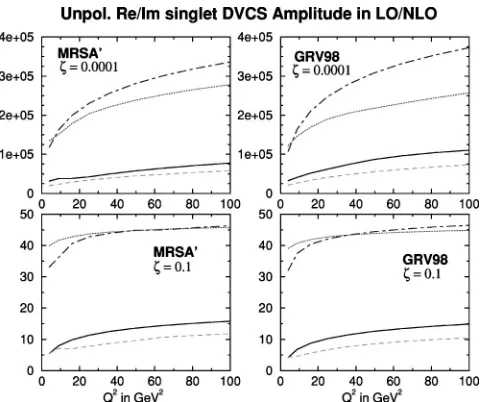
In Fig. 1 we plot the real and imaginary parts of the un-polarized quark singlet amplitude 关cf. Eq. 共8兲兴 at LO and NLO. We observe that MRSA’ and GRV98 give broadly similar results.
The NLO corrections are generally fairly large and tend to decrease the value of the real part and increase the value of the imaginary part of the quark singlet amplitude共bearing in mind that the NLO imaginary amplitude is lower at the input scale, due to the inclusion of the NLO coefficient function兲. The relative correction, R, in moving from LO to NLO关i.e.
R⫽共NLO-LO兲/LO兲兴 can be inferred from Fig. 1. R is typi-cally⫺20% to⫺40% for the real part for both values of. For the imaginary part at⫽0.1 the corrections are moderate (兩R兩⬍20%), whereas at small, R can be as large as⫹50% for GRV98 at large Q2. The amplitudes drop dramatically in going from small to large reflecting the strong decrease in the GPDs. They generally increase with increasing Q2, albeit moderately, reflecting the expected ln(Q2) behavior. In fact,
an approximate scaling is observed at LO and NLO, but only sets in at large Q2 for smallin the imaginary part at NLO. In Fig. 1 and subsequent figures a comparison of the LO and NLO curves at the input scale Q2⫽4 GeV2 reveals the effect of including NLO coefficient functions alone. Of course at higher Q2 NLO effects are included in both the coefficient functions and in the evolution of the GPDs. For the numerical size of the NLO corrections in the evolution of the GPDs alone see关15兴.
In Fig. 2 we show the real and imaginary parts of the unpolarized gluon amplitude 关cf. Eq. 共9兲兴 which starts at NLO. We note firstly that the gluon contribution is of the same order of magnitude as the quark singlet one, although it is suppressed by␣s/2, and secondly that both the real and
imaginary parts are large and negative. This explains the strong variation of the azimuthal angle asymmetry共AAA兲, in moving from LO to NLO, observed in关16兴 共for the case of a dominant Bethe-Heitler contribution兲 which is directly pro-portional to the real part of a combination of DVCS ampli-tudes. Otherwise, the gluon mirrors the NLO quark singlet amplitudes in its behavior in Q2 and for large and small.
Of course for the physical amplitude at NLO one must add the quark singlet and gluon contributions together. For the real part at small⫽10⫺4 this leads to a relative change in moving from LO to NLO of 40% (MRSA
⬘
) and 80% 共GRV98兲 at the input scale to 75% (MRSA⬘
) and 80% 共GRV98兲 at Q2⫽100 GeV2. For large ⫽0.1 the relative change in the real part at both scales is about 60%. For the imaginary part at small ⫽10⫺4 the relative changes for MRSA⬘
are 35% 共at the input兲 and 15% 共at Q2 [image:4.612.55.296.483.684.2]⫽100 GeV2). For GRV98 one finds 50% 共input scale兲and 2% 共evolved scale兲changes. For the imaginary part at large ⫽0.1, for both MRSA
⬘
and GRV98, one finds about 30% 共input scale兲and 10%共evolved scale兲changes. Note that the NLO changes in the physical amplitude decrease as Q2 in-creases in line with the expectation of perturbative QCD that the NLO corrections should die out as Q2→⬁. [image:4.612.317.558.506.694.2]FIG. 1. The Q2 dependence of the real and imaginary parts of the quark singlet DVCS amplitude. The solid共dashed兲curve is the real part in LO共NLO兲and the dotted共dashed-dotted兲 curve is the imaginary part in LO共NLO兲.
In Fig. 3 we show the ratio of the real to imaginary parts for both the quark singlet and the gluon amplitudes as a function of Q2. We note that for smallthe ratios can be as
large as 45% 共a similar value was found for the closely re-lated process of high energy J/ photoproduction in 关28兴兲. The quark ratios are slightly different for the two inputs. The greatest contrast is seen at small: the NLO case is basically flat in Q2 which differs markedly from LO which rises with
Q2. Both cases are similar at large . The gluon ratio is remarkably similar for the two input sets, at both small and large, for the whole Q2 range considered.
We now turn to the dependence for fixed Q2 which is shown in Fig. 4 for the quark singlet and Fig. 5 for the gluon. The most striking feature for the quark singlet case is that the amplitudes exhibit an effective power-like behavior inover basically the whole range (苸关0.0001,0.2兴), as illustrated by the straight lines in Fig. 4. A simple two parameter fit of the type a00 works remarkably well up to about ⫽0.1. The
best fit is obtained with a four parameter fit, of the type
c11(1⫹c22), which can reproduce most of the curves on
the few percent level, with0 and1 within 5%⫺20% of
each other, and2small. The simple two parameter fit works
best for the imaginary part of the amplitudes where we ob-tain a value for0 between⫺1.1 and⫺1.25 with a moder-ate growth in Q2 as expected from measurements of the slope of F2 and the DESY e p collider HERA diffractive
processes. For the real part of the amplitude the simple fit starts to decrease in quality around ⫽0.05 共depending on the input兲.
Similar power-like behaviors have been observed in many small-x processes at HERA, including diffractive DIS in which the xPdependence of diffractive structure functions is known to factorize for small xP. This behavior, known as Regge factorization, is predicted for high energy processes within Regge theory given the postulate of a universally
ex-changed Regge pole, known as the Pomeron. Since the rela-tionship between the phenomenological Regge theory and perturbative QCD remains unresolved, we find the observa-tion of this single power in our numerical perturbative QCD calculation remarkable and very interesting.
Note that we do not claim to have derived this powerlike behavior from first principles. The analytic forms for the coefficients functions共see Appendix A兲would seem to favor a more complicated sum of logarithms in , particularly FIG. 3. The ratio of real to imaginary parts of the unpolarized
quark singlet and gluon DVCS amplitudes, as a function of Q2. The solid 共dotted兲curve is for the quark singlet in LO共NLO兲 and the dashed curve is for the gluon in NLO.
FIG. 4. The real and imaginary parts of the unpolarized quark singlet DVCS amplitude, as a function of . The solid 共dashed兲 curve is the real part in LO共NLO兲and the dotted共dashed-dotted兲 curve is the imaginary part in LO 共NLO兲. A remarkably simple behavior is observed in which is close to a single power over a wide range. Because Q2is fixed, this behavior in translates di-rectly into a single power in energy.
when the interplay with the effective behavior in of the GPDs, at a given Q2, is taken into account. Hence, the fact that a single power apparently works for such a large range in for DVCS is somewhat surprising. Naively one may expect that a sum of two or more powers would be required to give a reasonable fit. Perhaps this indicates that DVCS always proceeds through partonic configurations which lie in the same universality class, i.e. are self-similar. The reason why these self-similar configurations seem to be of impor-tance beyond the ‘‘diffractive region’’ can be understood if one examines the behavior of the integrand in the convolu-tion integrals in Eqs.共8兲,共9兲. One observes that a large con-tribution to the integral and ultimately to the imaginary part of the amplitude itself stems from the region in X very close to, even for larger values of , leading to the self-similar behavior. This is not too surprising given the steep rise of the GPD in the DGLAP region towardsand that the coefficient functions are singular at, where even the implementation of the principal value in Sec. II leaves an integrable singularity. This situation is somewhat altered for the real part of the amplitude where the ERBL region plays a very important part, as we will see. There, although the coefficient function is singular, the symmetry of the GPD in the ERBL region makes the value of the integral somewhat less dependent on the region near , i.e. less singular, especially for large . Although the value of the real part also depends on an inte-gral over the DGLAP region which contributes more to the powerlike behavior, this dependence progressively decreases as grows.
The physical picture which is emerging is the following: the region near corresponds to large light-cone distances for the operators which translates into two parton configura-tions, either a qq¯ pair in the ERBL region or a quark leaving and then returning to the proton in the DGLAP region, where one of the partons, either the q¯ or the returning q, carries virtually zero momentum fraction, X⫺, in either the⫹ or
⫺ direction on the light cone and the other carries approxi-mately, i.e. very asymmetric configurations seem to have a disproportionate weighting in the amplitude. The coefficient functions, with their singularity structure at , weight these configurations much more heavily in the amplitude than other, more symmetric, configurations.
Although asymmetric configurations become rare as one approaches the valence region of large , because they should be mainly found in the sea, they are still enhanced by the singularity structure of the coefficient functions. This then leads us to the conclusion that, although the sea is small at large , DVCS still proceeds largely through sea configu-rations in the valence region, thus its relative scarcity com-pared to DIS in the valence region. Physically, at large X ⬇, one has to strike an unusual fluctuation in the proton to emit a real photon, while still leaving the proton intact.
For the gluon contribution, shown in Fig. 5, we find the same behavior as in the case of the quark singlet. Note that we took the modulus of both the real and imaginary parts, since they are actually negative, in order to produce a log-log plot. Performing the same type of fits as in the quark case, one obtains similar numbers for 0 between ⫺1.14 and
⫺1.28 in the two parameter fit and again very similar ones in the four parameter fit (5%⫺25% variation in the powers兲. The quality of the two parameter fit starts to decrease rapidly for a ⬃0.05. Nevertheless, the explanation given in the quark singlet case is still applicable in the case of the gluon. In Fig. 6 we show the ratio of real to imaginary parts in for fixed Q2. Again we note the remarkable similarity be-tween the gluon curves for both inputs, both in shape as well as absolute values. A very mild growth is seen for the quark singlet ratio in, whereas the gluon varies quite strongly in .
Using Fig. 6 we can make a simple test to check whether we have computed the real part of the amplitude at small properly by employing a dispersion relation for the unpolar-ized amplitudes at small 共for more details see关28兴兲:
Re TDVCS
Im TDVCS
⫽tan
冉
2共兩兩⫺1兲
冊
. 共10兲For the fitted values of we obtain a ratio which is in very good agreement with the values in Fig. 6 up to about⫽5
⫻10⫺3 for both the quark singlet and the gluon. This con-firms the self-consistency of our calculation.
importance of the ERBL region drops to 50% at the input scale and 130% at Q2⫽100 GeV2 (80% and 30%, respec-tively, in LO兲; however, the subtraction term now starts to dominate the value of the amplitude. This observation is in line with our previous argument of the importance of very asymmetric parton configurations. Remember that the sub-traction term is directly proportional to the GPD at . Also note that going from LO to NLO seems to change the rela-tive importance of the ERBL region, especially its Q2 behav-ior.
Turning now to the gluon we make a slightly different observation. Firstly, at small the relative contribution var-ies from 40%⫺60% in going from the input scale to Q2
⫽100 GeV2. Again there is a large cancellation between the previously mentioned terms, but the change in Q2is not very dramatic. Increasing one finds an increase of the relative importance to 60%⫺80% in going from the input scale to our large Q2 value. Again the subtraction term becomes more and more dominant, relatively speaking, and thus our interpretation from the quark case carries over to the gluon case.
To close our analysis of the unpolarized case, we discuss the scale dependence of the DVCS amplitudes. We varied the factorization scale, 2, from Q2, used above, to Q2/2 and 2Q2 for both sets and found the following variations, where the two sets agree fairly well with one another. At small , we found a small variation at the input scale of 3⫺5% which increases to about 15%⫺30% at large Q2 共we used
Q2⫽100 GeV2, for the large scale, throughout兲for both the real and imaginary part of the quark singlet. For the gluon we find a variation of about 15% for the real and imaginary part at the input scale which reduces to about 10% for the real part and to about 2% for the imaginary part. At large, we find similar variations as the authors of 关19兴, i.e. around 5% for both the real and imaginary parts of the quark singlet and around 10% for the gluon, for both the input scale and at large Q2. In summary one can say that the scale dependence is not troublesome and that the uncertainties due to the cho-sen GPD are still much larger than those due to the factor-ization scale.
B. The polarized case
For the polarized case we proceed exactly as we did for the unpolarized case starting in Fig. 7 with the absolute val-ues of the real and imaginary parts of the polarized quark singlet amplitudes as functions of Q2. Again the relative im-pact of the NLO corrections to the quark singlet can be in-ferred from this figure. One immediately notices for small the very large NLO corrections for the GS共A兲input (兩R兩can be as large as 70%), whereas for the GRSV00 input共 ‘‘stan-dard scenario,’’ i.e. unbroken sea兲 the corrections are more moderate (兩R兩⬍20%). The very large corrections can be eas-ily explained since in 关15兴it was shown that the GPD evo-lution drastically alters the shape of the GS共A兲 distribution, in fact inverting its shape, whereas the shape of GRSV00 was almost unchanged and the absolute value changed only moderately. The difference in shape at small was due to radically different assumptions about the polarized sea
distri-bution. At large , where the shape of the two input sets is similar we find that the shape of the amplitudes in Q2is also
very similar, whereas their absolute values differ.
The real and imaginary parts of the polarized gluon am-plitude are plotted in Fig. 8. Note that the real and imaginary parts of the amplitude are positive for small , exactly the opposite to the unpolarized case. For large , the real parts are positive, again in contrast to the unpolarized case. The imaginary part at largestarts positive but becomes negative under evolution. This behavior is due to the particular shape of the polarized gluon GPD at small and large 共see关15兴兲. FIG. 7. Real and imaginary parts of the polarized quark singlet DVCS amplitude, as a function of Q2, for fixed . The solid
共dashed兲curve is the real part in LO共NLO兲and the dotted共 dashed-dotted兲curve is the imaginary part in LO共NLO兲.
In Fig. 9 we show the ratio of real to imaginary parts as a function of Q2, for fixed . At large , we again observe flattening at large Q2: the GRSV00 result is flatter than the GS共A兲 case, especially at NLO, where we still observe strong variations in Q2. For large Q2, the gluon ratio is very similar for both sets and fairly flat in Q2. We did not plot the gluon ratio at largesince it has a very large value near the point where the imaginary part changes sign and thus would have completely swamped the quark result which we find more interesting here. Note that our LO ratio for the GS共A兲 model is in agreement with the values obtained in关18兴.
In Fig. 10 we plot the behavior at fixed Q2 and find a single power-like behavior only for very small共up to about 3⫻10⫺3), seen explicitly on the log-log plot for GS共A兲. Per-forming the same type of fits as in the unpolarized case, i.e. simple two and four parameter fits, reveals a 0 between
⫺0.4 to⫺0.55, and a similar story for the four parameter fit. However, the second power, a2, is now substantially larger than in the unpolarized case, in order to be able to describe the large behavior. The four parameter fit is able to de-scribe the behavior of the amplitudes on the few percent level. Thus the simple single-power Regge-type effective be-havior observed in the unpolarized case is only valid at small in the polarized case. This is because the polarized sea dies out even more quickly with increasingthan the unpolarized one: therefore the highly asymmetric configurations neces-sary to produce a universal behavior in become very rare. At large they are almost completely gone.
Turning to the gluon in Fig. 11 we illustrate that the be-havior inat an evolved scale, Q2⫽9 GeV2, is very similar
in shape and size for the two input sets, despite the fact that they start off very different at the input scale, Q2
⫽4 GeV2. The evolution forces the distributions to be quite similar very quickly.
For the GS共A兲 input, at small, the relative changes in going from LO to NLO in the physical polarized amplitude, i.e. the sum of polarized quark singlet and polarized gluon, are found to be about 15% for both the real and imaginary parts at the input scale and about 8% for the imaginary part and 40% for the real part at Q2⫽100 GeV2. At large
⫽0.1, the changes in the real part vary from about 90% at the input scale to 25% at Q2⫽100 GeV2 and those in the imaginary part vary from about 25% 共at the input scale兲to 15% at the evolved scale. For GRSV00 we also find a de-crease in the variation which at small drops from 60% at FIG. 9. The ratio of real to imaginary parts of the polarized
quark singlet and gluon DVCS amplitudes, as a function of Q2, at fixed . The solid 共dotted兲 curves show the ratio for the quark singlet in LO共NLO兲and the dashed curves show the ratio for the gluon in NLO.
FIG. 10. Polarized real and imaginary parts of the quark singlet DVCS amplitude, as a function of , for fixed Q2. The solid
共dashed兲curve is the real part in LO共NLO兲and the dotted共 dashed-dotted兲curve is the imaginary part in LO共NLO兲.
the input scale to 25% at Q2⫽100 GeV2 for the imaginary part, and from 35% to 5% for the real part. At large there is a decrease from about 25%, at the input for both real and imaginary parts, to about 2% and 15% for the real and imaginary parts, respectively, at the evolved scale. As in the unpolarized case the NLO corrections to the physical ampli-tude decrease as Q2 increases except in the case of the real part at small for GS共A兲which is in line with the dramatic NLO evolution effects in the ERBL region.
The relative change induced by NLO corrections of the quark singlet can be inferred directly from Fig. 10.
The dependence of the ratio of real to imaginary parts, plotted in Fig. 12, is rather different than the unpolarized case, with a strong fluctuation in the gluon due to a sign change of one of the amplitudes around the spike共we sample at a finite number of points in ). The real part is typically much larger then the imaginary part, in contrast to the unpo-larized case.
Concerning the issue of the importance of the ERBL re-gion, we find a similar picture to the unpolarized case, al-though the relative percentage contribution is smaller by about a factor of two for both quarks and gluons. The influ-ence of the subtraction term on the value of the real part of the amplitude is considerably less than in the unpolarized case, thus the ERBL region is weighted more heavily in the final value of the amplitude. This is in line with our obser-vation of the deviations of the amplitudes from a single power in, for relatively small values of, compared to the unpolarized case 共for which the ERBL region was of less importance as compared to the subtraction term兲.
Finally, we comment briefly on the factorization scale de-pendence of the polarized amplitudes. We proceed in an identical manner to the unpolarized case in varying 2. For small, we find a similar variation as in the unpolarized case
for the quark singlet and larger variations of 35–40 % at the input scale and 1 –30 % at large Q2⫽100 GeV2, respec-tively, for the gluon. At large, we find variations in the real part of the quark singlet around 100% at the input and at large Q2. The imaginary part only varies between 5% at the input scale to 20% at the evolved scale. Both real and imagi-nary parts of the gluon amplitude at large are very well behaved and vary only between 5 –20 % at both the input scale and at large Q2. It is encouraging that the variations due to factorization scale changes can be safely neglected since the polarized distributions are even less well known than the unpolarized ones.
IV. GENERAL COMMENTS ON NLO AND NNLO CORRECTIONS
In this section we make some general comments about the structure of NLO corrections and expected NNLO correc-tions. In关15兴we pointed out that the relative shape change in the NLO evolution of GPDs, compared with LO, is due to a new class of integrable divergences, ln(1⫺X/)n/(1⫺X/)i,
n,i⫽0,1,2, appearing in the region around. The same type of integrable divergence also appears in the NLO coefficient functions, but is absent at LO, although one has an integrable singularity of the 1/(1⫺X/) type. This fact alone helps to explain why one finds, in certain regions, large changes in going from LO to NLO in the amplitudes.
For DVCS observables the appearance of the gluon at NLO also changes things dramatically since the gluon con-tribution turns out to be of the same order as the quarks, at least at small due to an extra factor of 1/ in Eq. 共6兲. So, not only is a new quantity introduced, but one of the same order of magnitude as our LO quantities. Furthermore, with the unpolarized real part of the gluon amplitude being
nega-tive and of comparable size at smallas the NLO correction to the real part of the quark amplitudes共which is also nega-tive兲, observables sensitive to the real part, such as the azi-muthal angle asymmetry are expected to change dramatically in NLO 共see 关16兴兲. Conversely, the effect should not be as dramatic for observables sensitive to the imaginary part, de-spite the fact that the NLO gluon correction is big and
nega-tive, since the correction to the quark singlet at NLO is big
and positive so the corrections will cancel to a certain extent 共see 关16兴兲.
What would one expect in NNLO? From experience ob-tained in calculating forward coefficient functions, and some evolution kernels atO(␣s2), one would expect to see only the same type of integrable divergences reappearing, maybe with different powers in logarithms and rational functions, but not a new class of divergences which could radically alter the behavior of the amplitudes. Also, in contrast to moving from LO to NLO which gives the first gluon contributions, no new parton species appears at NNLO. This leads us to speculate that the NNLO order corrections should be mild.
V. CONCLUSIONS
We have presented a detailed analysis of the quark singlet and gluon contributions to the polarized and unpolarized FIG. 12. The ratio of real to imaginary parts of the polarized
DVCS amplitudes at NLO, using NLO-evolved generalized partons distributions 共GPDs兲 built from sensible input mod-els. We have compared throughout with the LO results using the same input GPDs, and have therefore quantized the effect of the NLO corrections.
These results are directly relevant to measurable quanti-ties in e p→e p␥ processes at the HERA and HERMES ex-periments, and hence may be used to constrain the GPDs at NLO.
The most striking feature of our results is that for a given
Q2 the unpolarized amplitudes exhibit an effective single-power behavior in the skewedness parameter, , over a very large range, apparently indicating a universal behavior.
ACKNOWLEDGMENTS
A.F. was supported by the DFG under contract No. FR 1524/1-1. M.M. was supported by PPARC. We are happy to acknowledge discussions with D. Mueller and M. Diehl.
APPENDIX A: LO AND NLO COEFFICIENT FUNCTIONS
The coefficient functions in Eq.共6兲are expanded in pow-ers of␣s. Up to terms ofO(␣s2), they read
Tq,V/A共z兲⫽Tq,LO共z兲⫹␣s共
2兲
2 T
q,NLO,V/A共z,Q2/2兲,
Tg,V/A共z兲⫽Tg,LO共z兲⫹␣s共
2兲
2 T
g,NLO,V/A共z,Q2/2兲,
共A1兲
with z⫽2X/⫺1.
The LO and NLO coefficient functions were taken from 关19兴and are given by
Tq,LO共z兲⫽ 1
1⫺z, Tg,LO共z兲⫽0,
Tq,NLO,V共z兲⫽Tq,NLO,A共z兲⫺ CF
1⫹zln
1⫺z
2 ,
Tq,NLO,A共z兲⫽ CF
2共1⫺z兲
冋
冉
2 ln1⫺z
2 ⫹3
冊
⫻
冉
lnQ2
2⫹
1 2ln
1⫺z
2 ⫺
3 4
冊
⫺27 4
⫺11⫺⫹zzln1⫺z 2
册
,Tg,NLO,V共z兲⫽⫺Tg,NLO,A共z兲
⫹N2F
冋
1⫺1z冉
lnQ2
2⫹ln
1⫺z
2 ⫺2
冊
⫹ ln1⫺z2 1⫹z
册
,Tg,NLO,A共z兲⫽NF
2
冋冉
1 1⫺z2⫹ln1⫺z 2 共1⫹z兲2
冊
⫻
冉
lnQ2
2⫹ln
1⫺z
2 ⫺2
冊
⫺ln21⫺z 2 2共1⫹z兲2
册
,共A2兲
where the LO quark coefficient is normalized in such a way that, in the forward limit, after properly restoring the depen-dence on both skewedness parameters, one recovers the LO DIS coefficient ␦(1⫺x) and the NLO gluon coefficient is
normalized such that one recovers 12Cg DIS
.
In the interval 关0,兴, the above coefficients are strictly real. However, in the interval关,1兴, they split into a real and imaginary parts, which can be easily deduced from Eq.共A2兲.
APPENDIX B: LO AND NLO SUBTRACTION FUNCTIONS
In this section we present the subtraction functions needed in our implementation of the Cauchy principal value pre-scription of Eq. 共7兲, i.e. the integrals
Iq,V/A共兲⫽
冕
0 1
dX Tq,V/A
冉
2X ⫺1
冊
,Ig,V/A共兲⫽
冕
0 1
dX Tg,V/A
冉
2X ⫺1
冊
. 共B1兲There are four different integrals to be done, which are regu-lated by adding⫹i⑀ to X共this implies analytically continu-ing the logarithmic terms in the lower half plane to pick up
⫺i). This generates real and imaginary parts for the sub-traction functions, Iq,g, given below, for the unpolarized 共V兲
and polarized 共A兲 cases. One has to be careful to take the appropriate sheet of the Riemann surface for the logarithms in order to obtain the correct imaginary parts, i.e. to use the
⫹i⑀ prescription consistently. In order to ensure the correct-ness of the results below, we cross checked them both with
MATHEMATICA andMAPLE:
Iq,LO共兲⫽⫺
2
冋
ln冉
1⫺Iq,NLO,A共,Q2,2兲⫽CF 4
冉
2
6 ⫺Li2
冉
1⫺ 1 冊
⫹ln冉
1⫺
冊冋
2⫹9⫹ln⫺ 1 3ln2
冉
1⫺
冊册
⫹lnQ2
2
冋
2⫺3 ln
冉
1⫺
冊
⫺ln2
冉
1⫺
冊册
⫺i再
23 ⫹9⫹ln⫺ln
2
冉
1⫺
冊
⫺lnQ2
2
冋
2 ln冉
1⫺
冊
⫹3册
冎冊
, 共B3兲Iq,NLO,V共,Q2,2兲⫽CF
4
冉
22 ⫺3Li2
冉
1⫺ 1 冊
⫹ln冉
1⫺
冊冋
2⫹9⫹3 ln⫺ 1 3ln2
冉
1⫺
冊册
⫹lnQ2
2
冋
2⫺3 ln
冉
1⫺
冊
⫺ln2
冉
1⫺
冊册
⫺i再
23 ⫹9⫹3 ln⫺ln
2
冉
1⫺
冊
⫺lnQ2
2
冋
2 ln冉
1⫺
冊
⫹3册
冎冊
, 共B4兲Ig,NLO,A共,Q2,2兲⫽NF 4
再
1⫹2
4 ⫹ln
冉
1⫺
冊冋
1⫺ 1 4ln冉
1⫺
冊册
⫺1 2ln
Q2
2
冋
1⫹ln冉
1⫺
冊册
⫺i
2
冋
2⫺ln冉
1⫺
冊
⫺lnQ2
2
册冎
, 共B5兲Ig,NLO,V共,Q2,2兲⫽NF 4
冉
⫺1⫹2
3
冉
1⫺ 34
冊
⫹Li2冉
1⫺ 1
冊
⫺lnln冉
1⫺
冊
⫹共2⫺兲ln冉
1⫺
冊冋
1⫺ 1 4ln冉
1⫺
冊册
⫹12lnQ
2
2
冋
1⫺共2⫺兲ln冉
1⫺
冊册
⫺i
2
再
共2⫺兲冋
2⫺lnQ2
2⫺ln
冉
1⫺
冊
册
⫺2 ln冎冊
. 共B6兲关1兴D. Mu¨ller et al., Fortschr. Phys. 42, 101共1994兲.
关2兴A.V. Radyushkin, Phys. Rev. D 56, 5524共1997兲.
关3兴X. Ji, Phys. Rev. D 55, 7114 共1997兲; J. Phys. G 24, 1181
共1998兲.
关4兴M. Diehl et al., Phys. Lett. B 411, 193共1997兲.
关5兴M. Vanderhaeghen, P.A.M. Guichon, and M. Guidal, Phys. Rev. D 60, 094017共1999兲.
关6兴J.C. Collins and A. Freund, Phys. Rev. D 59, 074009共1999兲.
关7兴X. Ji. and J. Osborne, Phys. Rev. D 58, 094018共1998兲.
关8兴L. Frankfurt, A. Freund, and M. Strikman, Phys. Rev. D 58, 114001共1998兲; 59, 119901共E兲 共1999兲; Phys. Lett. B 460, 417
共1999兲; A. Freund and M. Strikman, Phys. Rev. D 60, 071501
共1999兲.
关9兴HERMES Collaboration, A. Airapetian et al., Phys. Rev. Lett. 87, 182001 共2001兲; ZEUS Collaboration, P.R. Saull, hep-ex/0003030; H1 and ZEUS Collaborations, L. Favart, hep-ex/0106067; Jefferson Laboratory, J. P. Chen, http:// www.jlab.org/⬃sabatie/dvcs/index.html.
关10兴A.V. Belitsky et al., Phys. Lett. B 437, 160共1998兲; A.V. Bel-itsky, A. Freund, and D. Mu¨ller, Nucl. Phys. B574, 347共2000兲.
关11兴V.Yu. Petrov et al., Phys. Rev. D 57, 4325共1998兲.
关12兴L. Frankfurt et al., Phys. Lett. B 418, 345共1998兲; 429, 414共E兲
共1998兲; A. Freund and V. Guzey, ibid. 462, 178共1999兲.
关13兴V.N. Gribov and L.N. Lipatov, Sov. Phys. J. 15, 438 共1972兲; 15, 675 共1972兲; Yu.L. Dokshitzer, Sov. Phys. JETP 46, 641
共1977兲; G. Altarelli and G. Parisi, Nucl. Phys. B126, 298
共1977兲.
关14兴A.V. Efremov and A.V. Radyushkin, Theor. Math. Phys. 42, 97
共1980兲; Phys. Lett. 94B, 245 共1980兲; S.J. Brodsky and G.P. Lepage, ibid. 87B, 359共1979兲; Phys. Rev. D 22, 2157共1980兲.
关15兴A. Freund and M. McDermott, Phys. Rev. D 65, 056012
共2002兲.
关16兴A. Freund and M. McDermott, hep-ph/0106124.
关17兴A.V. Belitsky et al., Phys. Lett. B 510, 117共2001兲.
关18兴A.V. Belitsky et al., Nucl. Phys. B593, 289共2001兲.
关19兴A.V. Belitsky et al., Phys. Lett. B 474, 163共2000兲.
关20兴K. Golec-Biernat and A.D. Martin, Phys. Rev. D 59, 014029
共1999兲.
关21兴A.V. Radyushkin, Phys. Rev. D 59, 014030共1999兲.
关22兴N. Kivel, M.V. Polyakov, and M. Vanderhaeghen, Phys. Rev. D 63, 114014共2001兲.
关23兴M.V. Polyakov and C. Weiss, Phys. Rev. D 60, 114017共1999兲.
关24兴M. Glu¨ck, E. Reya, and A. Vogt, Eur. Phys. J. C 5, 461共1998兲; M. Glu¨ck et al., Phys. Rev. D 63, 094005共2001兲. We evolve from the low input scales up to Q0⫽2 GeV, using conven-tional共forward兲DGLAP evolution.
关26兴J. Blumlein, B. Geyer, and D. Robaschik, Phys. Lett. B 406, 161共1997兲; I.I. Balitsky and A.V. Radyushkin, ibid. 413, 114
共1997兲; L. Mankiewicz et al., ibid. 425, 186共1998兲; A.V. Be-litsky and D. Mueller, ibid. 417, 129共1998兲; Nucl. Phys. B537, 397共1999兲.
关27兴A. Freund and M. McDermott, ‘‘A detailed next-to-leading or-der QCD analysis of deeply virtual Compton scattering observ-ables,’’ hep-ph/0111472.