565 | P a g e
COMPRESSION BEHAVIOR OF CIRCULAR AND
RECTANGULAR RC COLUMNS RETROFITTED BY GFRP
LAMINATES: AN EXPERIMENTAL STUDY
Imaad Majid
*
1,
R.Navaneethan
2,
Dr. V. Rajesh Kumar
31
M.Tech Structural Engineering,School of Civil Engineering, Lovely Professional University, (India)
2
Assistant Professor, School of Civil Engineering, Lovely Professional University, (India)
3
Dean, Professor, School of Civil Engineering, Lovely Professional University, (India)
ABSTRACT
The study aims at evaluating the effect of retrofitting by GFRP on circular and rectangular columns. Both control
and retrofitted columns of circular and rectangular shapes were tested on CTM and UTM to determine the
compressive strength after 7 and 28 days. From the experimental data, it is observed that there is increase in
compressive strength in the retrofitted specimens, both in circular and rectangular columns. For retrofitted circular
columns, there is 20.36% increase in compressive strength. Also, there is an increase of 19.23% of compressive
strength in rectangular retrofitted columns. Strictly from the experimental study, it is observed that retrofitting by
GFRP is most efficient in circular columns
. Retrofitting by GFRP can be employed in case when the
structures are subjected to severe load combinations.
Keywords
-
Circular and Rectangular Columns, Compressive strength, GFRP,RetrofittingI.
INTRODUCTION
There are a number of reasons that lead to retrofitting of RC structures, which are: seismic activity, higher load demand, higher strength demand, constructional errors, deterioration caused by environmental factors, change in use of the structures, etc. Due to the formation of cracks, there is decrease in strength of a structure. So to regain its
strength, a structure needs to be retrofitted1. So to sum up, retrofitting is modification of existing structures to make
them more resistant towards the external loadings. Some of the retrofitting methods that has been applied in the past are steel plate bonding, jacketing, external post tensioning, addition of new structural elements, use of different
types of FRP’s, etc and these methods were successful2
566 | P a g e
easy for implementation and have high tensile strength and also are corrosion resistance3. Due to these reasons, FRP
composites are preferred solutions for strengthening of various reinforced concrete structural elements and are now extensively being used all over the world. Physical properties and mechanical properties of FRPs are governed by its
basic properties and the structure at micro level4. In FRP’s, the main load bearing component are the fibers. FRP
products that are used in retrofitting of structures can be in the form of strips, sheets and laminates5. In our
experimental study, FRP provides strength and stiffness to the structural component on which it will be wrapped6
.
II.MATERIALS AND METHODOLOGY
For the casting of columns, various construction materials are used like cement, fine aggregates and coarse aggregates and water. GFRP laminates are used for the purpose of retrofitting.
Cement: Portland pozzolana cement (PPC) was used for the casting of the columns. The cement has been checked for various properties and they are accurate taking IS:4031-1968 into consideration.
Coarse aggregates: Size of the aggregates which will be used in the making of concrete are 10mm and 20mm. This material has to satisfy IS:383-1970. Locally available aggregates and some basalt stone chips was used in this study. Fine aggregates: Locally available riverbed sand was used and it should be confirming some zone which depends
upon the sieve analysis of the sand6.
Glass fibers: These fibers are generally made up of silicon. Their main characteristic is high strength. After retrofitting, glass fibers enhance various properties of the structure. Table 1 gives the properties of glass.
Table 1: Properties of glass
Thickness 0.32 mm
Weight 935 g/m2
Tensile strength 2290 MPa
Tensile modulus 74632 MPa
Ultimate elongation 0.025
Epoxy: Epoxy is used as a resin and it will act as a binder for the purpose of wrapping of GFRP. Tensile strength and flexural modulus of epoxy is 37 MPa and 3680 MPa respectively, with elongation of 1.2%.
Steel: HYSD bars of 8mm were used for main reinforcement and stirrups of 6mm were used for both circular and rectangular columns with a minimum cover of 10mm for main reinforcement.
567 | P a g e
Table 2: Mix Proportion
Cement (kg) Fine aggregate (kg) Coarse aggregate (kg) Water (kg/m3)
387.5 608.79 1181.50 186
1 1.570 3.049 0.48
Therefore; ratio of concrete= 1:1.570:3.049
III. EXPERIMRNTAL SETUP
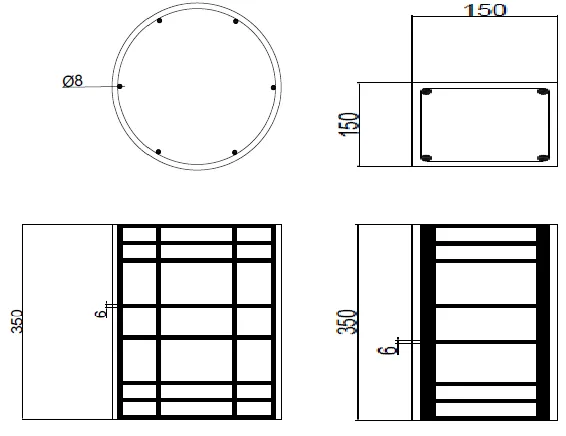
Total number of 24 columns were casted and were cured in a curing tank. Among these samples, 12 columns were rectangular and rest were circular. The diameter of circular column was 150mm and its height was 350mm. Cross-section of rectangular columns was 150mm×150mm and their height was 350mm. The columns were tested after 7 days and 28 days. All these samples were tested under compression testing machine CTM and UTM. After application of load, cracks were developed in the sample and load at failure was determined. The rate of loading was kept constant at 0.01mm/sec. To regain the strength in the columns, epoxy resin was coated on the surface for the purpose of bonding and then GFRP was wrapped around the specimen. Again the retrofitted specimens were tested under the same rate of loading and their strength was determined. The details of rectangular and circular specimens are given below in FIG I-V.
568 | P a g e
FIG III: Circular Column FIG IV: Rectangular column FIG V: Retrofitted column
IV. RESULTS AND DISCUSSION
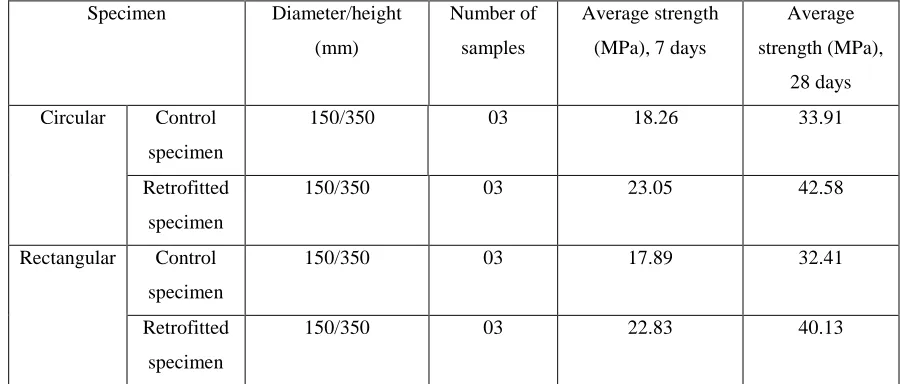
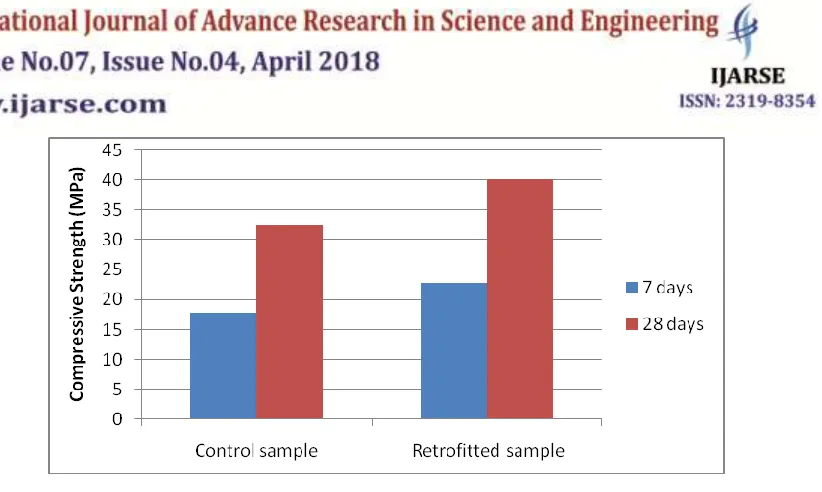
The testing of specimens has been performed after 7 days and 28 days for both control and retrofitted columns. From the experimental findings, it is clear that there is increase in load carrying capacity in retrofitted specimens. There is increase of 20.36% of compressive strength in circular retrofitted specimens after 28 days. Also there is increase of 19.23% of compressive strength in retrofitted rectangular specimens as given in Table 3.
Table 3: Compressive Strength after 7 and 28 days of different specimens.
Specimen Diameter/height
(mm)
Number of samples
Average strength (MPa), 7 days
Average strength (MPa),
28 days
Circular Control
specimen
150/350 03 18.26 33.91
Retrofitted specimen
150/350 03 23.05 42.58
Rectangular Control
specimen
150/350 03 17.89 32.41
Retrofitted specimen
150/350 03 22.83 40.13
569 | P a g e
FIG VI: variation of compressive strength of Rectangular specimens after 7 and 28 days
FIG VII: Variation of compressive strength of circular specimens after 7 and 28 days
V. CONCLUSIONS
570 | P a g e
REFERENCES
1. Antonio De Luca, Fabio Nardone,(2015) “Structural Evaluation of Full scale FRP-Confined
Reinforced Concrete Columns.” International Journal of Concrete Journals and materials Volume 6, No.4 PP
269-76
2. Elzinga T, Tromans, P.S. (2009). “Experimental evaluation of FRP strengthening of large size reinforced
concrete columns.” Centerfor Infrastructure Engineering Studies (CIES), Rep. No. 06-63.
3. Gottardi G and Butterfield, (2008). “Review of design guidelines for FRP confinement of reinforced concrete
columns of non-circular cross sections.” J. Compos. Construction, Vol. 32, No. 2, pp.111- 118.
4. KanOzcana, BarisBinici, (2008) “Seismic strengthening of rectangular reinforced concrete columns using fibre
reinforced polymers.” J StructEng 2007;123(10):1357–64.
5. Lostas P, Antonopoulos C, (2003) “Experimental Investigation of FRP-Strengthened RC Beam-Column Joints.” Structural Journal. 1990 Jan 1, 87(1), pp. 3-11.
6. Tsonos AG, Priestley MJN, (2007) “Seismic retrofit of RC columns with continuous carbon fibre jackets.” J