i
I hereby declare that I have read through this report entitle “Surface Tracking and Erosion Performance Insulation Material Under Different Frequency Behaviour” and found that it has comply the partial fulfilment for awarding the degree of Bachelor of Electrical Engineering (Industrial Power)
Signature :
Supervisor’s Name : DR. AMINUDIN BIN AMAN
ii
SURFACE TRACKING AND EROSION PERFORMANCE INSULATION MATERIAL UNDER DIFFERENT FREQUENCY BEHAVIOUR
MUHD FAIRUS NIZAM BIN MUHAMAD
A reported submitted in fulfilment of the requirement for the degree of Bachelor of Electrical Engineering (Industrial Power)
Faculty of Electrical Engineering
UNIVERSITI TEKNIKAL MALAYSIA MELAKA
iii
I declare that this report entitle “Surface Tracking and Erosion Performance Insulation Material under Different Frequency Behaviour” is the result of my own search except as cited in the references. This report has not been accepted for any degree and is not concurrently submitted in candidate of any other degree.
Signature :
Name : MUHD FAIRUS NIZAM BIN MUHAMAD
iv
To my beloved family especially my father and mother Mr Muhamad Bin Yaacob and Norhawati Binti Haji Harun. Also to my siblings for their supports and also goes
to everyone that directly or indirectly in this project.
v
ACLNOWLEDGEMENT
First of all I would like to express my gratitude and thanks to our God, Allah S.W.T for HIS guidance to make me finish the report.
I would like to show my highest gratitude to my supervisor Dr. Aminudin Bin Aman for his guidance, patient, assistance and support in the making this report. His encouragement to this project was so encouraging for me. I learnt a lot about this project and all this experienced and knowledge can’t be done without his guidance. I also want to thank to the technical staff of the Research Laboratory of High Voltage Engineering, En Mohd Wahyudi bin Md Hussain for his assistance and opinions while performing the work at the lab.
vi
ABSTRACT
vii
ABSTRAK
viii
TABLE OF CONTENTS
CHAPTER TITLE PAGE
ACKNOWLEDGEMENT v
ABSTRACT vi
TABLE OF CONTENTS viii
LIST OF TABLES xi
LIST OF FIGURES xii
LIST OF SYMBOLS xiii
1 INTRODUCTION 1
1.1 Research Background 1
1.2 Project Motivation 2
1.3 Problem Statement 2
1.4 Objectives 3
1.5 Scope of Works 3
2 LITERATURE REVIEW 4
2.1 Introduction 4
ix
2.3 Polymeric Insulation 6
2.4 Polypropylene 7
2.5 Factors Affected In Polymeric Insulation 7
2.6 Ageing 8
2.7 Surface Tracking and Erosion 8 2.8 Surface Tracking and Erosion Performance 9 Test
2.9 Inclined Plane Test 10
2.10 Standard Test Method in IPT 11 2.11 Polymeric Surface Tracking and Erosion on 12 Frequency Behaviour
2.12 Conclusion 13
2.13 Summary 14
3 METHODOLOGY 15
3.1 Introduction 15
3.2 Overall Flowchart of Methodology 16
3.3 PP Specimen 17
3.4 Preparation of Contaminant 19
3.5 Peristaltic Pump 22
3.6 Function Generator 23
x
3.7.1 Method 1: Application of Constant Tracking 27 Voltage
3.8 IPT Start Procedure 27
3.9 Physical Measurement 28
4 RESULT 29
4.1 Introduction 29
4.2 Data Observation 29
4.3 Overall Discussion 33
5 CONCLUSION 34
5.1 Conclusion 34
5.2 Recommendations 35
REFERENCES 36
xi
LIST OF TABLES
TABLE TITLE PAGE
2.1 Important Properties and Minimum Requirement of Polymeric 9 Insulation
2.2 Standard test parameter 12
3.1 Test Parameter 25
4.1 Result of five specimens 31
xii
LIST OF FIGURES
FIGURE TITLE PAGE
2.1 Inclined Plane Test Setup Based on BS EN60587 10 2.2 Summarization of Literature Review 14
3.1 Overall Flowchart of Methodology 16
3.2 Standard size of specimen 17
3.3 Test specimen with holes for fixing electrodes 18
3.4 Specimen to be drill 18
3.5 Distilled water 19
3.6 Ammonium Chloride (NH4CL) 20
3.7 Triton X-100 20
3.8 The conductivity of contaminant 21
3.9 Peristaltic Pump 22
3.10 IPT Setup 24
3.11 Power amplifier, Function Generator and Digital Multimeter 24
3.12 Schematic. Test assembly 26
3.13 Contaminant drop from top 26
xiii
xiv
LIST OF SYMBOLS
SYMBOL TITLE
HV High Voltage
HDPE High Density Polyethylene
PP Polypropylene
IPT Inclined Plane Test
BS British Standard
AC Alternating Current
DC Direct Current
Hz Heartz
KV Kilovolts
PVC Polyvinyl Chloride
mm Milimeter
ρ Density
TFD Time Frequency Domain
CHAPTER 1
INTRODUCTION
1.1 Research Background
As to prevent the current flow to undesired paths, the insulation play an important role to keep the high voltage (HV) applications running well. Although the type of insulation had been used since 1900’s, it is still under study and improvement. It involves the development of designing the insulator, material of insulation, development of practical monitoring and measurement [1]. Material for the insulation on outdoor and indoor is still under study and recent development of an insulation that are used ceramic and non-ceramic type. Material can be classified into 3 type of measuring ageing from diagnostic properties which are mechanical properties, chemical properties and electrical properties.
2
1.2 Project Motivation
This project has been motivated by the several previous studies and experimental. On the previous research, this test has been conducted under non material test. To complete the project, this polymer insulation has been test on surface and erosion tracking using different frequency behaviour.
Because of its advantages, the polymeric material seems become the imperative material proportionate from porcelain and glass fibre. Thus, this polymeric material now replacing the porcelain and glass usage in the transmission line and distribution industry.
1.3 Problem Statement
3
1.4 Objectives
In this study, the main objective to be achieved is:
1. To conduct different frequency and standard tracking and erosion test for polymeric insulation material.
2. To observe and compare the physical result of different frequency and standard test on surface tracking and erosion performance of polymeric material.
1.5 Scope of Works
The scope of work will be focused on:
1. International standard on tracking and erosion test according to BS EN60587-1 is complied.
2. The range of frequency to be tested are between 50 Hz to 1 kHz.
3. Material to be studied is polypropylene (PP)
CHAPTER 2
LITERATURE REVIEW
2.1 Introduction
5
2.2 Insulation Materials
Electrical insulator must be utilized as a part of electrical framework to avert undesirable stream of current to the earth from its supporting focuses. It is the most important material in the high voltage industry. The separator assumes an imperative part in electrical system. Insulator is a high resistive way through which for all intents and purposes to ensure the current disable to flow through it and also along these lines make it almost difficult to direct an electric current affected by an electric field. There are 3 sorts of insulating material which comprise of gas, fluid and solid or composites. This insulator appears differently in relation to different materials, semiconductors and conduits, which transmit electric current all the more effortlessly. The property that distinguishes of this insulator is its resistivity.
Based on the study for this project, a large amount of organic and inorganic materials had been used. Thus, high voltage insulation material can be classified into 3 groups which is organic materials, inorganic materials and synthetics polymers. There are numerous good insulating material can be used for protective coating on electrical wire and cables such as glass, rubber, PVC, asbestos and paper [3][4]. Therefore, the electrical insulation is stressed by several factors that is:
i. Dielectric
ii. Thermal
iii. Mechanical
iv. Chemical
v. Radiations
6
2.3 Polymeric Insulation
Polymeric insulation is a hydrophobic type of insulation which means it is water repellent. Compared to ceramic material that is hydrophilic. But the limitations of the polymeric material is life performance. There are several ways to decide their life performance. Previous studies shows that, surface tracking and erosion on polymeric insulator can be displayed by utilizing leakage current [5]. Surface tracking and erosion had been test by using inclined plane test (IPT) method according to BS EN60587-2007 is directed on polymeric insulation.
Polymeric composite insulations were introduced in service for outdoor distribution and transmission for more than four decades. In high voltage insulation, there are three classes of polymeric material which are epoxy resins, hydrocarbon elastomers and silicone elastomers [6]. Polymeric material can be divided into two groups consists of thermoplastic and thermosetting. For this study, thermoplastic is selected for its low melting temperatures property. Thermoplastic consists of Polypropylene (PP) and High Density Polyethylene (HDPE).
Many research had been done on this polymeric insulation to improve its lifespan and performances. This is because of its physical and economic especially. Due to the advantages of the polymeric insulation compared to the ceramic insulation, it has replaced the use of ceramic insulation in the high voltage industry. Some of the advantages are [7]:
i. Low surface energy
ii. Better contamination performance
iii. Light in weight
iv. Easy to handle
v. Easy transportation and installation
7
2.4 Polypropylene
There were two type of this thermoplastic polymers which is polyethylene (PE) and polypropylene (PP). Both of this properties had different in term characteristics of resistivity on temperature, moisture and chemical. Polypropylene (PP) has a good resistance to organic solvents, degreasing agents and electrolytic attack. Compare to polyethylene (PE), PP has lower impact strength. Despite the fact that polypropylene not good at receiving an impact, the reaction on temperature and tensile strength is better than PE. In addition, Polypropylene (PP) is one of flexible polymers and does not retain water. It is more hydrophobic which is unequipped for dissolving in water. The advantages of the polypropylene as below [8] [9]:
i. Lightweight
ii. High tensile strength, high heat resistance and impact resistance iii. Non-toxic and non-staining
iv. Good dielectric properties
v. Resist chemical and stress cracking
vi. Easily fabricated
2.5 Factors Affected In Polymeric Insulation
8
2.6 Ageing
The major problems that lead to failure of an insulator is ageing. Ageing which can cause either surface tracking or erosion. Both of this defect can affected the life performance of the polymeric insulator. Ageing is a factor when the life performance of the insulator is reduce or failure due to any changes in the chemical, mechanical and electrical properties of the polymeric materials [10]. It consists in the degradation with time of one or several properties. Ageing is one of the factors that affect life performances of insulation material and will meet failure when the polymer encounter several type of stress which are electrical, environment, mechanical, heat, and weather pollution [11]. Surface tracking and erosion are the method to test the life performance of the polymeric insulation.
2.7 Surface Tracking and Erosion
9
2.8 Surface Tracking and Erosion Performance Test
[image:23.596.82.540.533.705.2]The best ways to investigate about the ageing of polymeric insulation is by examined the insulation material that is polypropylene under the actual area situation. Unfortunately, the time taken for the effects of this aging will take a long period of time. Therefore, surface tracking and erosion test consenting to BS EN 60587-2007 are led, at that point leakage current recurrence parts is utilized as an analytic apparatus for their surface condition checking and degradation seriousness. Basically, there are also other test can be conducted to test this surface tracking and erosion that is tracking wheel dust, fog test and salt fog test. All of the test are based on standard and each test have their own objective and purpose on getting the results [13]. For this study, IPT was chosen because of its advantages and it fulfil the requirement needed. The advantage of performing this test are because it is economical and all the material is provided. Furthermore, the results found within a short term period. Unfortunately, by using this procedure will make the researcher experienced in difficulty to determining the initial tracking voltage. Based on the study, a test to carry out performance of insulating material has been made. Table 2.1 has shown the important properties of material and minimum requirement of polymeric insulation.
Table 2.1: Important properties and minimum requirement of polymeric insulation [14]
Property Minimum Requirement Test Standard
Resistance to tracking and erosion 1A3,5b IEC 60587*
Tear strength >6N/mm ISO 34-1*
Volume resistivity >10MΩ IEC 60093*
Breakdown field strength 10kV/mm IEC 60243-1*
Water diffusion test Voltage test -12kV-1min or
tan δ<0.2
IEC 62217* IEC 60250*
10
2.9 Inclined Plane Test (IPT)
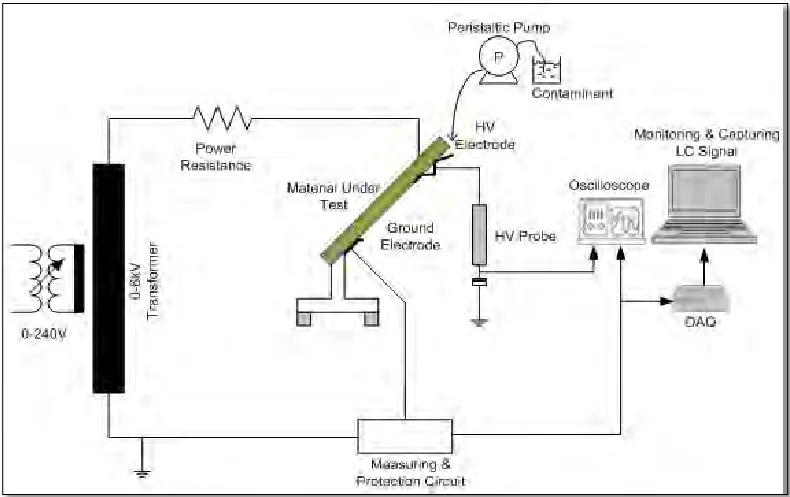
[image:24.596.105.500.466.715.2]The inclined plane test on surface tracking and erosion is one of popular testing procedure to evaluating the surface tracking and erosion on polymeric insulation material. Based on standard BS EN60587:2007, the sample of polymeric insulator must be in rectangular shape with the size of 120 x 50 x 6 mm. The sample are place at 45 degrees angle according to the standard stated. Conductive solution (ρ = 3.95Ω.m) is dripping on a filter paper and streaming down the specimen towards the ground electrode where dry band arcing for the most parts happens [15]. Base on previous study, this test is conducted in the lab where the variable transformer has been used where on the other hand, the secondary voltage can be adjusted according to standard values (0-6kV) with a rated current not less than 0.1 A for each specimen. Then, the transformer will be through to the fixed resistor and connected to upper electrode that been tide with the specimen. The lower electrode is connected to ground. The peristaltic pump acts as a medium to flow the contaminant flow rate at the upper electrode. Figure 2.1 has shown the IPT test experimental setup.
![Table 2.1: Important properties and minimum requirement of polymeric insulation [14]](https://thumb-us.123doks.com/thumbv2/123dok_us/136554.13698/23.596.82.540.533.705/table-important-properties-minimum-requirement-polymeric-insulation.webp)