DESIGN AND DEVELOPMENT OF HOME BASED SOLID WASTE INCINERATOR
MUHAMMAD IZAMUDIN BIN JOHARI
DESIGN AND DEVELOPMENT OF HOME BASED SOLID WASTE INCINERATOR
MUHAMMAD IZAMUDIN BIN JOHARI
This report is submitted
in fulfillment of the requirement for the degree of Bachelor of Mechanical Engineering (Design and Innovation)
Faculty of Mechanical Engineering
UNIVERSITI TEKNIKAL MALAYSIA MELAKA
i
DECLARATION
I declare that this project report entitled “Design And Development of Home Based Solid Waste Incinerator” is the result of my own work except as cited in the references
ii
APPROVAL
I hereby declare that I have read this project report and in my opinion this report is sufficient in terms of scope and quality for the award of the degree of Bachelor of Mechanical Engineering (Design & Innovation).
iii
Dedication to:
My beloved Family Johari bin Yamin Zainon bte Hj Abd Samad Muhammad Izuddin bin Johari
Nurizuana binti Johari Nurul Izyani binti Johari
My lovely:
Fatin Irfah binti Iskandar My Classmate & friend My Family Theater TOPART
iv
ACKNOWLEDGEMENT
Thanks to Allah S.W.T for giving me the opportunity to complete this final year project. This research paper I made possible through the help and support from everyone ,including my parents, lecturers, family, and my friends and in essence, all sentient beings. Especially, please allow me to dedicate my acknowledgement of gratitude towards the following significant advisor and contributors.
First and foremost, I would like to express my sincere gratitude to my supervisor, Dr.Mohd Nizam Bin Sudin for his support and encourgement. He has always been enthusiastic in solving, reflecting, responding and advising my problems. Also, I appreciate for the countless time he had spent having discussion with me regarding my final year project, offered invaluable detailed advice on grammar and offering numerous suggestion to improve my work.
Secondly, I would like to acknowledge and give appreciation to my friends, Adam bin Azha, Aminurashid and Rozaidi Rozman for giving suggestions, sharing knowledge and provide guidance throughout the project, mostly on modelling and analyzing using ANSYS and CATIA V5 Software. Their knowledge has helped me a lot on completing this project.
Special thanks go to my parents and families for their good-natured forbearance with the process and for their pride in this accomplishment. My gratitude is for their understandings of my busy life and pack schedules.
v
ABSTRACT
vi
ABSTRAK
TABLE OF CONTENT
CHAPTER TOPIC PAGE
TITLE PAGE i
DECLARATION ii
SUPERVISOR DECLARATION iii
DEDICATION iv
ACKNOWLEDGEMENT v
ABSTRACT vi
ABSTRAK vii
TABLE OF CONTENTS viii
LIST OF FIGURES x
LIST OF TABLE xi
LIST OF SYMBOLS xii
CHAPTER 1 INTRODUCTION
1.1 Background 1
1.2 Problem Statement 3
1.3 Objectives 3
1.4 Scope 3
CHAPTER 2 LITERATURE REVIEW
2.1 Introduction 4
2.2 Type Of Waste 5
2.2.2 Construction and Demolition waste 6
2.2.3 Hazardous waste 6
2.2.4 Industrial Waste 2.2.5 Solid Waste 2.3 Solid Waste Management
2.3.1 Waste Reduction and Reuse 2.3.2 Recycling
6 7 8 8 9
2.3.3 Landfills Disposal 10
2.3.4 Thermal treatment 11
2.4 Incinerator 12
2.4.1 History 13
2.4.2 Type of incinerator 14
2.4.2.1 Large Scale Incinerator 14
2.4.2.2 Small Scale Incinerator 21
2.4.3 Advantage of Incinerator 22
2.4.4 Disadvantage of incinerator 23
2.5 Residue of Solid Waste Incinerator 24
2.5.1 Bottom Ash 25
2.5.2 Grate Sifting 25
2.5.3 Boiler and Economizer Ash 25
2.5.4 Fly ash 26
CHAPTER 3 METHODOLOGY
3.1 Introduction 27
3.2 Flow Chart Of Methodology 3.3 Literature Research
3.4. Existing Product
3.5 Quality Function Deployment
27 30 30 31 3.4 Conceptual Design
3.5 Concept Design Selection
3.5.1 Concept Scoring 3.6 Detail Design
3.6.1 CATIA V5 3.7 Material Selection
3.7.1 CES Selector 2013
34 36 36 37 37
3.8 Simulation Analysis 38
3.8.1 ANSYS Software 38
CHAPTER 4 CONCEPTUAL DESIGN
4.1 Product Design Specification
4.2 Quality Function Deployment (QFD) 4.2.1 House of Quality (HOQ) 4.3 Conceptual Design
4.3.1 Concept generation 4.4 Morphological Chart 4.5 Concept Design Selection
4.5.1 Concept 1 4.5.2 Concept 2 4.5.2 Concept 3 4.5.2 Concept 4 4.5.2 Concept 5 4.6 Selection Design
4.6.1 Concept scoring
42 44 44 48 48 49 50 51 52 53 54 55 56
CHAPTER 5 DETAIL DESIGN
5.1 Introduction 61
5.2 Detail Engineering Drawing 5.2.1 Assembly View
5.2.2 Exploded View and Isometric View 5.3 Part Description
5.4 Material Selection
5.4.1 Material Comparison
CHAPTER 6
CHAPTER 7
ANALYSIS, DISCUSSION AND PROTOTYPE
DEVELOPMENT
6.1 Introduction
6.2 Home Based Solid Waste Incinerator Experiment 6.3 Simulation Analysis
6.3.1 CFD Simulation Result for Temperature Distribution 6.4 Model Product Development process
CONCLUSION AND RECOMMENDATION
7.1 Conclusion 7.2 Recommendation REFERENCE
APPENDIX
73 73 78 79 86
90 92
LIST OF FIGURE
FIGURE TITLE PAGE
2.1 Colour coded recycling bins for waste separation at the source of production.
10
2.2 Main feature of a modern landfill disposal 11
2.3(a) Counter current rotary kiln 15
2.3(b) Ash of the counter current rotary kiln 15
2.4(a) Co-current rotary kiln 15
2.4(b) Ash of the Co-current rotary kiln 15
2.5 2.6 2.7 2.8 3.1 3.2 3.3 3.4 3.5 3.6 4.1
5.1(a) & 5.1(b) 5.2 5.3 5.4 5.5
Grate incinerator for domestic waste burning The scheme of a fluidised-bed incinerator Vulcan incinerator
Low-cost medical waste incinerator
Flow chart for home based solid waste incinerator Small scale incinerator medical waste
Example material selection using CES Selector 2013 Example of ANSYS analysis
Mesh model design of the home based solid waste incinerator
Flowchart ANSYS process
Product Design Specification for home based solid waste incinerator
Assembly view for home based solid waste incinerator Exploded view for home based solid waste incinerator Isometric view for home based solid waste incinerator Maximum service temperature vs Fracture toughness Maximum service temperature vs thermal conductivity
5.6 6.1 6.2 6.3 6.4 6.5 6.6 6.7 6.9 6.10 6.11 6.12 6.13 6.14 6.15 6.16 6.17 6.18 6.19
Melting point vs Price Apparatus of experiment
The solid waste was set up at top of the burning pit at 0 minutes
Condition and reading temperature of solid waste in 2 minutes
Condition and reading temperature of solid waste in 4 minutes
Condition and reading temperature of solid waste in 6 minutes
Condition and reading temperature of solid waste in 8 minutes
Condition and reading temperature of solid waste in 10 minutes
Result of simulation at 0 minutes Result of simulation at 1.1 minutes Result of simulation at 2.2 minutes Result of simulation at 3.3minutes Result of simulation at 4.4 minutes Result of simulation at 5.5 minutes Result of simulation at 6.6 minutes Result of simulation at 7.7 minutes Result of simulation at 8.8 minutes Result of simulation at 10 minutes
The temperature distribution graph of Temperature (°C) v's Time (m)
1
CHAPTER 1
INTRODUCTION
1.1BACKGROUND
Waste is a unwanted or unusable material as a result of waste disposal activities, whether in residential or housing, industry and trade in certain areas. There are various types of waste that can be categorized according to its origin as domestic waste, industrial waste, commercial waste, construction waste, residual institution agricultural, waste water treatment, and so on.
2
contaminants to the air, soil, surface and ground-water, such as chrome from tanneries and oil from car garages” (Frijns and Van Vliet, 1999).
Moreover, technological progress is limited in order to deal with dangers, products, requirements, and environments. This result in many countries waste management is uncontrolled and disorganized. The World Health Organization (WHO) advocates for the relative risk approach to waste treatment- ie, the weight of health risks from environmental exposure to the risks posed by the deliberate infection of infectious waste is not managed well (especially sharp). Same with another country India, 23 metro cities in India generates about 30,000 tonnes of such municipal wastes per day while about 50,000 tonnes are generated daily from the Class I cities. This makes it very difficult to control the informal collection, segregation and recycling of MSW & improper waste handling because scarcity of land for landfill.
Besides, to solve the problem of disposing of waste, there are various actions that have made governments and non-governmental organizations such as conducting campaigns to tackle the problem of waste disposal in every place, especially in residential areas. In addition, the public was introduced with the Reduce, Reuse, and Recycle. These methods of waste reduction, waste reuse and recycling are the preferred options when managing waste. There are many environmental benefits that can be derived from the use of these methods. They prevent or reduce greenhouse gas emissions, reduce the release of pollutants, conserve resources, save energy and reduce the demand for waste treatment technology and landfill space.
3
1.2 PROBLEM STATEMENT
Solid waste disposal is increasing in our country nowadays. This is because areas such cities that continue grow exposed to uncontrolled waste disposal. Also, these things happen because of rising of human population, housing and factories. As a result of the uncontrolled disposal of waste, is environmental pollution such as air pollution, ground pollution and water pollution, as well as crops destroyed.
1.3 OBJECTIVE
To research, design, analysis and develop a simple incinerator that can be constructed at low cost to encourage clean burning and complete combustion for solid wastes at a house to reduce the waste that cannot be recycled, reused, or disposed of in a landfill.
1.4 SCOPE OF PROJECT
The scopes of this project are:
1. The incinerator is only designed and constructs to remove a solid waste by using a fire to burn the waste disposed. Further acts of the heat generated by incineration can be used to generate electric power will not be done in this research.
4
CHAPTER 2
LITERATURE REVIEW
2.1 INTRODUCTION
Nowadays, regardless people in urban, rural, residential or factory area are having a same problem which is limited access for collection services, not enough landfill place and processing facilities. As a result, their behaviors of disposing waste in ineffective manners such as dumping and burning causes a variety of environmental impacts such as global warming, land pollution and more. In addition, the people dwelling in these areas are often unaware of the health risks when they throw trash everywhere. This is because with the uncontrolled disposal of waste, it can cause smells unpleasant and makes the place dirty. Other than that, animals that are dirty such as rats, worms, and flies also like to come to places that are dirty and it will make the surrounding place not clean and uncomfortable.
5
As a conclusion to solve this problem, various methods have been carried out by government and non-government organizations. Among them is by making a Recycle Campaign from home to home, establish a waste recovery and many others. In this way it does help in reducing the uncontrolled discharge of waste. However, for future periods of research and investigations should be made to solve this problem with larger scale and ensure its effectiveness so that this problem can be solved in a short time and easily.
2.2 TYPE OF WASTE
In our country, garbage or waste is a problem that is increasingly growing day and become a burden to mankind and the environment. This is true because as a result of economic development and the development of the rapid increase in population in the country. Every day, large quantities of waste are produced throughout the world. In order to treat this waste, it must be classified so that it can be directed toward the appropriate treatment facility. Often, waste is discarded will be brought to the landfill and this is also a problem for the management, namely the lack of landfill areas. As we know, there are various types of waste disposed of in landfill areas. They come from various places such as factories, hospitals, farms, shops and many more. Among the types of waste that there is:
2.2.1 Institutional waste
6
2.2.2 Construction and Demolition waste
The composition of this waste depends on the type of building materials, but usually covers the ground, stone, brick, concrete materials, wood and ceramics, packaging materials, etc. Moreover, it is also a building material waste and rubble due to the operation of the construction, reconstruction, repair and demolition of houses, commercial buildings, and other structures. In addition plaster and wallboard, roofing materials, metal hands on type and nonferrous, glass (Windows and doors); and others are also a construction waste.
2.2.3 Hazardous waste
Hazardous waste is waste that contains a variety of toxic elements such as organic materials or dangerous (solvents and hydrocarbons), acid or gas that may have an impact on human health or the environment. In addition, this waste also has one or more of the following characteristics: explosive, flammable, irritant, easily spread, poisonous, toxic, and mutagenic or erode carcinogenic. Normally, 2/3 of hazardous waste comes from industry and the construction sector. More exactly, production and industrial waste treatment resulted in the highest percentage of hazardous waste, followed by construction (produced using tar contaminated soil and stone), service industry and Chemical Industry. According to Eurostat, the volume of hazardous waste produced stood at 94.5 million tons in the European Union in 2010, or less than 4% of all waste produced.
2.2.4 Industrial Waste
7
remaining oil that had used to place that not suitable to disposal. As a result, environment pollution happens and it will bring harm to human beings.
2.2.5 Solid Waste
Solid waste is the unwanted or useless solid materials generated from human activities such as domestic, commercial, agricultural, waste water treatment and so on. The domestic waste comes from household activities, including food preparation, cleaning, fuel burning, old clothes and furniture, obsolete utensils and equipment, packaging, newsprint, and garden wastes. In lower-income countries, domestic waste is dominated by food waste and ash. On the other hand, for commercial waste, it comes from place like shops, offices, restaurants, hotels, and similar commercial establishments; typically consisting of packaging materials, office supplies, and food waste and bearing a close resemblance to domestic waste. In lower-income countries, food markets may contribute a large proportion of the commercial waste. Commercial waste may include hazardous components such as contaminated packaging materials. The solid waste must properly handle and treated, if not it will give a negative impact on the hygienic conditions in urban areas and pollute the air and surface and ground water, as well as the soil and crops. Also, with rising urbanization and change in lifestyle and food habits, the amount of solid waste has been increasing rapidly and its composition changing. This can give an impact of decreasing a disposal landfill.
8
2.3 SOLID WASTE MANAGEMENT
In our country nowadays, solid waste management is decreasing among human. This can cause adverse effects on the environment, human health and economic development and public life in urban areas or rural areas. Therefore, several methods and activities in managing waste by municipalities, including the monitoring, collection, transport, processing, recycling and disposal.
Methods of waste reduction, reuse and recycling of waste are a suitable method for managing and controlling waste disposal. There are many environmental benefits that can be obtained from the use of this method. This is because with the use of these methods, it can reduce or prevent the occurrence of environmental pollution, such as greenhouse gas emissions, reduce pollutant emissions, and conserve resources. In addition, it also saves energy and reduces the demand for waste treatment and reducing the dumping of solid waste at landfills.
2.3.1 Waste Reduction and Reuse
Waste reduction method to give benefits to humans because it can reduce the use of packaging and promoting the use of goods that can be reused for example, encouraging customers to bring their own bags for use as packaging in buying goods in stores. This can reduce the use of plastic. Another benefit from the use of this method is that it can encourage people to select the used goods such as cloth towels and plastic and glass containers that can be reused. In addition, unwanted goods can also be donated or shared in others than get rid of it. Therefore, all methods of waste prevention require public participation mentioned. Waste prevention will also succeed and have a significant impact on MSW reduction when consumers change both their consumption habits as well as their manner of disposing of what they purchase. (Thomas R. Mounteer, Oct 1992)
9
2.3.2 Recycling
Recycling is one of the methods for the Elimination of the goods does not apply from waste flows to be used as raw materials in making and producing new products. According to (T. E. & N. R. Council, 1989), Recycling efforts are on the rise in the United States. The use of recycled glass, known as "cullet" in the glass manufacturing industry, increased from 24,000 tons a year in 1970 to more than one million tons in 1987. Therefore, this method of recycling occurs in three phases, first the rest of the collected recyclables and distance, recyclables which will be used to produce raw materials.
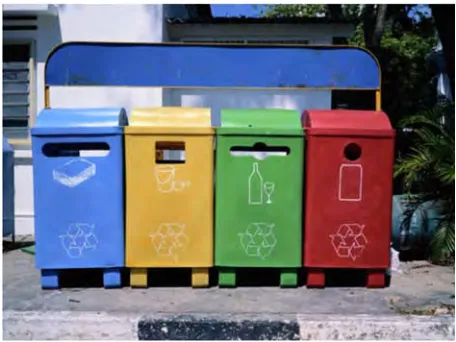
This is because raw materials produced from recycled treatment are used in the production of new products. Furthermore, for recyclables process, it can be done at a place around us which are not within households, offices, store and more. For example, collections of old items and an item that still can be use can be sent to the recycling centres. In addition, at each residential and shops there should be Colour coded recycling bins for waste separation at the source of production. This is because, with this recycling bin product, people can dispose of waste according to the resources that have in the front of recycling bin such as paper, glass, plastic and many others.
10
Figure 2.1 (Colour coded recycling bins for waste separation at the source of production)
2.3.3 Landfills Disposal
Historically, landfilling has been the most common disposal method in the United
States, with an estimated eighty percent about 130 million tons of the MSW disposed in approximately 10,000 landfills in 1986.( OTA Report, July 1987). Landfills have been created in order to reduce or eliminate waste that may pose a risk and a danger to public health and environmental quality. This landfill is usually placed in areas where the characteristics of the soil act as a natural buffer between the environment and the landfill. For example the area may be comprised of clay soil which is fairly impermeable due to its tightly packed particles, or the area may be characterized by a low water table and an absence of surface water bodies thus preventing the threat of water contamination. As we know, the placement of landfills should be suitable and strategic. This is because, in the bottom and sides of the landfill must be filled with a layer of clay or plastic to store liquid waste, known as leachate, escape into the ground. On the other hand, Landfill is divided into several individual cells and only a few cell sites are filled with garbage at any time. This can reduce exposure to wind and rain. In addition, the daily waste must be compacted to decrease the volume, and then the cover is used to reduce the smell and keep out pests.
[image:24.612.198.426.66.237.2]