
0022-538X/90/062967-09$02.00/0
Copyright ©1990, American Society forMicrobiology
Characterization of Poliovirus Clones Containing
Lethal and
Nonlethal Mutations in the Genome-Linked
Protein
VPg
QUENTINREUER,1* RICHARDJ. KUHN,2 AND ECKARD WIMMER'
DepartmentofMicrobiology, Schoolof Medicine, State UniversityofNew YorkatStony Brook, StonyBrook, New York 11794-8621,1andDivision of Biology, CaliforniaInstitute of Technology, Pasadena, California 911252
Received 27 October1989/Accepted 22 March 1990
Viral RNA synthesis wasassayed in HeLa cells transfected withnonviable poliovirus RNA mutated in the
genome-linked protein VPg-coding region. The transfecting RNA was transcribed in vitro from full-length
poliovirustype 1(Mahoney) cDNA containingaVPgmutagenesis cartridge. Hybridization experimentsusing
ribonucleotideprobes specific for the3' end of positive- andnegative-sense poliovirusRNA indicated that all mutantRNAs encoding alinking tyrosine in position3or4ofVPgwerereplicatedeventhoughnoviruswas
produced. VPg, butnoVPg precursor,wasfound tobe linkedtothe 5' end ofthe newlysynthesizedRNA. Encapsidated mutant RNAs were not found in transfected-cell lysates. After extended maintenance of transfected HeLa cells, aviablerevertantofoneof the nonviable RNAswasrecovered; therevertantlostthe lethal lesion in VPg by restoring the wild-type amino acid, but it retained all other nucleotide changes introduced during construction ofthe mutagenesiscartridge. Mutant RNA encoding phenylalanineor serine
rather than tyrosine, thelinking amino acid in VPg,wasnotreplicatedintransfectedcells.Achimericmutant
containing the VPg-coding region ofcoxsackievirus within the poliovirus genome was viable but displayed
impairedmultiplication. Apoliovirus-coxsackievirus chimera lackingalinking tyrosine in VPgwasnonviable and replication-negative. The results indicate thata linkage-competent VPg isnecessaryfor poliovirus RNA
synthesis to occur but that a step in poliovirus replication other than initiation of RNA synthesis can be
interrupted bylethalmutationsin VPg.
Poliovirus consists ofamessenger-sense, single-stranded
RNA genome approximately 7,440 nucleotides in length
packaged in 60 copies each ofthecapsid proteins VP1, VP2, VP3,andVP4(14, 32). Poliovirus genomic RNA and mRNA
areidenticalinsequence:theycontaina5'-noncoding region of 742 bases followed by a 6,627-nucleotide open reading
frame,a72-base 3'untranslated region, anda3' polyadeny-latetract(14, 30, 45).Both RNAspecies differ, however, in the structures of their 5' termini. Whereas viral mRNA terminates in pU, the genomic RNA carries an additional
group,thegenome-linked viral protein VPg,atthe5'end(7,
19, 23-25, 27, 28, 44). It has been observed that all newly synthesized viralRNAsareVPglinked(VPg-pU...) (23)but that plus strands destined to become mRNA are unlinked from the5'-terminalVPgtoyield pU...,aprocessthoughtto becatalyzed by acellularenzyme(2, 6).
VPgisabasic,22-amino-acidoligopeptidethatislinkedto RNA by a phosphodiester bond between the 5'-terminal uridine residue of the RNA and the 04-hydroxyl group of tyrosine,thethird residue ofVPg (1, 31). VPgisnotrequired forinfectivity;the RNA is the onlycomponent ofthe virus
necessary to initiatea productive infection ofa susceptible
hostcell(44).
VPgisacomponentofthepoliovirus polyprotein (13)and is released from it by two cleavages at glutamine-glycine aminoacidpairs (22) (Fig. 1).It isnotknownatwhatstages inthereplicative cyclethesecleavages occur. The cleavage
at theC-terminal glutamineofVPg isvery rapidandleads, togetherwithupstreamproteolytic processing, tothe
emer-gence of 3AB (3B is VPg; see reference 32), apolypeptide
thoughttobeamembrane-associatedprecursorofVPg(34). The mechanism by which VPg, or a VPg precursor, is linked to RNA has not been identified. Linkage of the
*Correspondingauthor.
protein topositive- and negative-senseRNAsmayoccurby different mechanisms, since the negative-sensestrands con-tain poly(U) at their 5' termini, whereas the 5' termini of positive-sense strandsare heteropolymeric.
Despite intensive biochemicalandgenetic analyses, polio-virus genomereplication remains a poorly understood pro-cess (17, 36). Replication ofpoliovirus template RNA in a cell-free system, a means ofsimplifying theanalysis of the role individual proteins and cofactors may play in various stages ofRNAreplication, hasnotbeen achieved. In vitro systemsarecomplicatedbecausegenomereplicationoccurs on membranes (9, 21, 26, 37-39). Intracellular poliovirus RNAreplicationfollowsthepathwaycharacteristic of other lytic, single-stranded RNA viruses with messenger-sense
genomes.However,poliovirusandtheother members ofthe
familyPicornaviridae employa strategy ofgeneexpression
common to only a few plus-strand RNA virus families.
Translationof thepoliovirusgenomeyieldsasingle polypep-tide that iscleavedbyviralproteinasestoprovidestructural and nonstructural polypeptides (10, 22, 41). Among the virus-specific nonstructural proteinsis theprimer-dependent RNA polymerase, 3DPo1, that is probably involved in the synthesisofnegative-sense andpositive-sense copiesofthe genomicRNA(8, 17, 36).Individualstepsof RNAsynthesis, particularly initiation, are obscure; however, a
protein-nucleotidyl moiety containing VPg or a VPg precursor is likely to be generated. Whether this is achieved through uridylylation of polypeptides (37-39) or by cleavage ofa
polynucleotide chain (8) remains to be seen (discussed in references 17 and36).RegionsofVPg, includingthenucleic
acid-linkingsite,arehighlyconservedamongpicornaviruses (3) and thusappearto be understrong selective pressure.
In a membranous replication complex, endogenous VPg can be uridylylated in vitro to VPg-pUpU, which can be extendedtolongerRNAmolecules, anobservationthatwas 2967
on November 10, 2019 by guest
http://jvi.asm.org/
polio Type 1 (Mahoney) A G H Q GA
- 5 10 15
Y T G L P N K K P N V P T I
3Cpro
_3C~ 20
R T A K V Q G P G F
-- - - R - -- -
-- - - T Y - - - R - - - -y
--- - - R - - -
Q-- - - R - - - E - - -
-- - - R - - - K - - -
-- - - K A - - -
-- - R
-G H R S T
pT7-VPg(Y3F)
pT7-VPg (Y3S)
pT7-VPg43
pT7-VPg42
- - - F - - - R - - - -- - - S - - - R - - - -- - - V - - Q - - K - - - L - Q - - - -- - - N - - M - - Q - - K - - - L - Q - - -
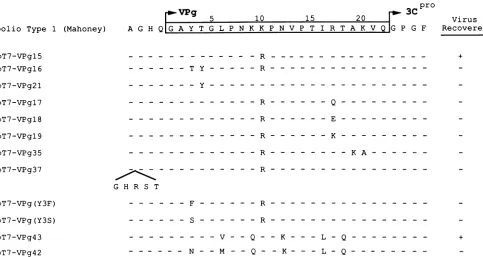
-FIG. 1. Schematic representation of poliovirustype1(Mahoney)andmutantVPgs.The amino acidsequenceof thewild-type VPgisgiven by the one-letter amino acid code within the boxed region. Mutantsarelisted belowthewild-typesequence,with their amino acidchanges replacing the dashed lines. Construct pT7-VPg37 encodesa5-residueinsertion,asindicated. Some of themutantscontainargininerather than
lysineatposition 10 of VPg;this conservative substitutionwasthe result of construction of the mutagenesiscartridge. Whetherinfectious
virus wasrecovered fromtransfected HeLa cells is showntothe right.
interpreted as suggesting that the uridylylated protein may
serve as a primer for RNA-dependent RNA synthesis (23,
37). Priming of genome synthesis with a nucleotidyl
poly-peptide isnot without precedent. Forexample, nucleotidy-lated proteins of adenovirus and the DNA bacteriophages +29 and PRD1serve as aprimers inDNAsynthesis (12,44),
during which they become linked to the genomic DNAs. Surprisingly, the PRD1 terminal protein sharessomeamino acidhomology with poliovirus VPg (11, 12).
WhetherVPgserves as asignal for encapsidation of virion RNAinto procapsidsorisinvolvedinthematuration cleav-age of VPO to VP4 and VP2 (22) remains to be seen. Whatever the role of VPg in poliovirus replication, the construction of mutants by site-directed mutagenesis seemed a plausible strategywith whichto attack the prob-lem.Accordingly, several poliovirus VPgmutantshave been generated by Kuhn et al. (15, 16) by using cartridge muta-genesis.Herewereportfurthercharacterization oftheseand newly constructed mutants. Although these studies do not allowusasyet toassignafunction toVPg,ourdatasuggest thatVPgmayplayarole in RNA synthesisandalso inastep ofreplication that follows RNAsynthesis.
MATERIALS AND METHODS
Cellsand viruses. Transfections, virus propagations, and
assays of viral RNA synthesis and VPg-RNA linkage were
performed with R19 HeLa cell monolayers maintained in Dulbecco modified Eagle medium supplemented with 5% fetalbovineserum. Poliovirustype 1(Mahoney strain)stock used in the experiments was a plaque-purified isolate ob-tainedby transfection of COS-1 cells withpT7XL RNA (42) orpEV104DNA(35). Purificationof virions andpreparation
ofviral RNA forsequencingwere done asdescribed
previ-ously(29).
Construction of plasmids and transfection of cells. The construction ofmutantcDNAsby using the VPg mutagene-sis cartridge has been described previously (15, 16). Com-plementary oligonucleotides encoding mutations were
in-serted intothe VPg mutagenesis cartridge contained in the plasmid pNT15. Putativemutantswerescreenedbydideoxy sequencing of plasmid DNA (5, 33). BglI (nucleotide 5318)-to-BglII (nucleotide 5601) fragments from mutant clones
were used to replace the corresponding fragment in the transcription plasmid pT7-VPgl5, which contains a
full-length cloneoftype1 poliovirusundercontrol of thephage T7 promoter. The sequence ofmutants was confirmed by
dideoxy sequencing of RNA transcribed from full-length clones (33). Transcription of RNA by T7RNA polymerase andtransfection of cellsusingDEAE-dextran weredoneas
previously described (16, 42), except that cells were
sup-ported in Dulbecco modified Eagle medium containing 5% rather than 10% fetal bovine serum. Mutant RNAs were considered nonviable if no plaque-forming virus was de-tected by 48 h posttransfection. One-step growth curve
experiments with viable mutants were done as previously described(15).
Synthesis ofradiolabeled polynucleotide probes. Radioac-tively labeled probes specific for positive- and
negative-sense poliovirus RNA wereprepared by transcriptionfrom
restrictionendonuclease-digested plasmids containing polio-viruscDNAdownstreamfromaT7promoter.Transcription mixtures contained 1 mCi of[t-32P]ATP (specific activity, 650 Ci/mmol; ICN Radiochemicals, Irvine, Calif.) per ml.
Digestion of 10,ug ofpT7PV1-2withPvuII and subsequent transcription produceda 386-base polyribonucleotide com-pT7-VPgl5
pT7-VPgl6 pT7-VPg21
pT7-VPgl7
pT7-VPgl8
pT7-VPgl9
pT7-VPg35
pT7-VPg37
Virus Recovered
+
rom VPg 1-
--R
on November 10, 2019 by guest
http://jvi.asm.org/
[image:2.612.62.545.77.334.2]plementary to the 3' end of positive-sense poliovirus RNA.
KpnI
digestion of 10,ug
of pT7XL, a plasmid derived from pT7PV1-5 that contains a full-length poliovirus cDNA, al-lowed transcription of a 70-base polyribonucleotide comple-mentary to the 3' end of negative-sense poliovirus RNA. Labeled probes were purified by passage through 2 ml of Sephadex G-50 (particle size, 20 to 80,um)
columns.RNA blotting and hybridization. HeLa cell monolayers in 35-mm dishes were transfected with 200 ng of RNA or were mock transfected. As a positive control, some monolayers were transfected with RNA transcribed from plasmid pT7XL or pT7-VPglS. RNA transcribed from pT7-VPglS
encodes arginine rather than lysine at position 10 of VPg, but the multiplication of virus derived from VPg15 RNA is similar to that of wild-type virus, as indicated by one-step growth experiments. RNA lacking a complete RNA poly-merase-encoding region was transcribed from PvuII-digested pT7PV1-5 and served as an additional negative control. At various times posttransfection, the growth me-dium was aspirated and the monolayers were rinsed twice with cold phosphate-buffered saline. Cells were lysed in 200
,ul
of lysis buffer (10 mM Tris hydrochloride [pH 7.5], 100 mM NaCl, 1 mM EDTA, 0.2% [vol/vol] Nonidet P-40). The lysates were clarified by centrifugation at 5,000 x g for 5min, and the RNA was denatured by the addition of 120,ul
20x SSC (lx SSC is 0.15 M NaCl, 0.015 M sodium citrate [pH 7.0]) (20) and 80
[LI
of 37% (wt/vol) formaldehyde followed by incubation at60°C
for 15min. RNA was spotted on Zeta-Probe nylon membranes (Bio-Rad Laboratories, Richmond, Calif.) with a Micro-Sample filtration manifold (Schleicher & Schuell, Inc., Keene, N.H.) (40). Prehybrid-ization of membranes was done in 6 x SSPE (lx SSPE is 0.18 M NaCl, 10 mM sodium phosphate [pH 7.7], 1 mM EDTA) (20),lOx Denhardt reagent(lx Denhardt reagent is0.02% Ficoll, 0.02% polyvinylpyrrolidone, 0.02% bovine serum albumin) (20), 0.75% sodium dodecyl sulfate (SDS), and 50
,ug
of herring sperm DNA per ml for 2 h at42°C.The prehybridization solution was then replaced with hybridiza-tion soluhybridiza-tion(6x SSPE, 0.75% SDS, 50% [vol/vol] formam-ide, 50,ug
of herring sperm DNA per ml) containing S x 107 cpm of radiolabeled probe. Hybridization was done at59°Cfor 16 h. After two15-min washes in 6x SSPE-0.3% SDS at room temperature and two 15-min washes in lx SSPE-0.75% SDS at
37°C,
the degree of hybridization was mea-sured by exposure of the membranes to XAR-2 film (East-man Kodak Co., Rochester, N.Y.).Labeling of VPg-pUp. HeLa cell monolayers in 10-cm dishes were transfected with 2,ug of RNA or were mock transfected and incubated at
37°C.
Nine hours posttransfec-tion, the medium was aspirated and replaced with medium containing 2.5,ug
of dactinomycin per ml. Fifteen minutes later,32Pi
was added to a concentration of 2mCi/ml. At 20 h posttransfection, the medium was aspirated, the monolayers were rinsed once with cold phosphate-buffered saline, and the cells were lifted from the plates with trypsin. Cells were washed once with cold phosphate-buffered saline and lysed in 200,ul of lysis buffer. Clarified lysates were extracted once with phenol, ethanol precipitated, and treated with 0.5 mg of RNase A per ml and 0.2 mg of RNase T1 per ml for 30 min at37°C.
Immunoprecipitations were done with antiserum specific for VPg or 3A as previously described (39). How-ever, protein A-Sepharose was used in place of Staphylo-coccus aureus cells. A VPg marker was prepared by labeling a 100-ml suspension culture (4.5 x 10⁵ cells per ml) with 5,uCi
of['4C]lysineper ml 45min after infection with PV1. At 6 h postinfection, the14C-labeled cells were harvested, andpoliovirions were gradient purified as previously described (29). The virions weredenatured and treated with RNaseA andRNase T1 as describedabove, and 14C-labeledVPg-pUp
was immunoprecipitated with VPg-specific antiserum.
Im-munoprecipitatedmaterial was denatured for 5 minat
65°C
in loading buffer and electrophoresed in 13.5% bisacryla-mide-cross-linkedpolyacrylamide gels (18). Gelswerefixed in 12% (vol/vol) acetic acid-40% (vol/vol)methanol,
dried,
and exposed toKodak X-Omat AR film.
Fractionation of viral RNA and poliovirions. R19 HeLa cells in 6-cm dishes were transfected with 2 ,ug of RNA transcribed from pT7-VPgl6, -17, -21, and -35. Cells were labeled with
32Pi
at a concentration of 125,uCi/ml
as de-scribed above. Clarified lysateswere layered onto 30-ml 15 to 30% sucrose gradients containing a toplayer
of 1% deoxycholate, 1% Brij 58, and 10% sucrose inreticulocyte
standard buffer plus
Mg2+
(25). Thegradients werecentri-fuged in an SW28 rotor at 53,000 x g for 16.7 h when migration of RNA was assayed and at89,000 x gfor2.5 h whenmigration ofpoliovirions wasassayed. Gradientswere fractionated, and trichloroacetic
acid-precipitable
counts weremeasured. CsClgradient-purifiedpoliovirions,
phenol-chloroform-extracted virion RNA, and HeLa cell rRNA wereused as markers in the sucrosegradients.
RESULTS
Accumulation of poliovirus RNAsin transfected HeLa cells. To determine the effect of mutations in
VPg
on RNA replication, HeLa cells were transfected withfull-length
transcripts, and at various times after transfection total intracellular RNAs were recovered, denatured with formal-dehyde, and immobilized on membranes. The immobilized RNAs were separately identified by
hybridization
with32p_
labeled polyribonucleotide probes as described in Materials and Methods. The probes were
specific
forthe detection of negative- and positive-sense RNA and allowedanalysis
of the kinetics ofsynthesis of the twospecies
of viral RNA.Dot blot autoradiograms are shown in
Fig.
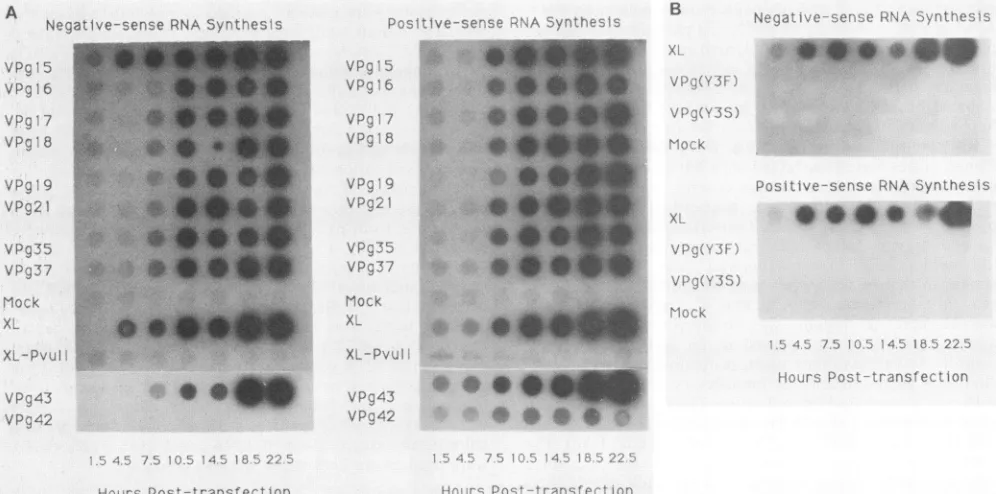
2A. RNAs ofmock-transfected cells yielded
barely
detectable dots. As another negative control, RNAs of cells transfected with transcripts fromPvuII-digestedpT7XL,
in which aportion
of
3DPo1
and all of the 3'-nontranslatedregion
aredeleted,
yielded dots ofan intensity similar to that of the dots of
mock-transfected cells, an observation
confirming
that the remaining genetic elements were unable to directsynthesis
of viral RNA and that the amount of
transfecting
RNAby
itself was too low to yield a
signal
under the conditions applied. On the otherhand,allmutantRNAs,
exceptVPg42,
can direct viral RNA
replication.
VPglS
is avariantwithout phenotype, which wasexpected
since the KlORchange
yields a VPg that occurs in type 2 and type 3
polioviruses
(15, 16), whereas none ofthe mutant RNAs except
VPg43
yielded viable virus in HeLa cells. It wasapparent from the hybridization signal intensities that in transfections with nonviable mutants there was a
lag
period
before RNA replication commenced, and overall less RNA wassynthe-sized incomparison with PV1
(Mahoney)
orVPgl5.
Ofparticular interest to us were mutations of
tyrosine
3,
the amino acid that links VPg to the viral genome.
Among
these wasVPgl6, which carriesan inversion of amino acids 3 and 4 (TY instead YT).
Apparently,
this mutation allows RNA replication, albeit at animpaired
level(Fig.
2A).
Absence ofa tyrosine
residue,
as in mutantVPg42,
abol-ished RNA synthesis (Fig.2A).
SinceVPg42
had additionalamino acid replacements, we constructed mutants inwhich
on November 10, 2019 by guest
http://jvi.asm.org/
A
Negative-sense RNASyntnes s
VPg 5
V P 16
VPg 16
VPg 7 VPc 8
VPg 9 VPa21
VPr 5 7
XL..
XL-PV'UIT
VPr43
Vpn4zd2
1..
..,s
.~~~~~.arL.-VPo
VP I.
VPy
P'^K 1YP-Se'' S ;{ A 5.RvKr e.,i
6 . M
7 :?
8
:'
'. '
:
VPg 9
VPo2
VPq7
Mock :.
XL- P.vu
XL-Pvul.
B
SF
x
"4'.
Neg3a'Li . e re PA [It.1he(E Is '1;. F 0*4
Positive-sense RNASynt.hesis
*
*,,
* *'
ZSi.5 X 4.5 e, 22
l
r- Po r'4.3nsf eionVPro42 * *
--'7` j k..; r.
-- >!F 'rc Post---transffec.:tionr) }i .rri P t r:.r-r;-, 'ien.
FIG. 2. Quantitativecomparison of viralRNAsynthesisin transfected HeLacells.(AandB)Dotblothybridizationof intracellular RNA harvested atvarioustimes posttransfection. RNAsamplesweredenatured, spottedonnylonmembranes, andprobedwithequallevels of 32P-labeledpolyribonucleotides specific forthe 3' end ofnegative-andpositive-sensepoliovirusRNA.Theinitial numberof cells inlysates of allsampleswas106.
[image:4.612.57.555.78.325.2]onlythe third residueofVPgwaschangedtophenylalanine [VPg(Y3F)] or serine [VPg(Y3S)]. Neither VPg(Y3S)- nor
VPg(Y3F)-transfected cells displayed viral RNA synthesis (Fig. 2B), an observation proving the pivotal role of the amino acidin position3 ofVPg.
IstheviralRNAlinkedtoVPg? To determine whether viral RNAs synthesizedin transfected HeLa cellswerelinkedat their 5' terminitoVPg,itwasnecessarytoprepare poliovi-rus RNA labeled to high specific activity with 32p. After phenol-chloroform extraction to remove proteins not
cova-lently bound to the RNA(including intracellular free VPg-pUpU; seebelow), the labeled materialwasdigestedwitha
mixtureof RNasesT1 and A,twoenzymesthatdegradethe
RNAtomono- and oligonucleotideswith 3' phosphates. If
VPg was linked to newly synthesized RNA in transfected cells, it could be identified as [32P]VPg-pUp after RNase treatment (since the 5' end of VPg-linked RNA is VPg-pUpU...) through immunoprecipitation andpolyacrylamide gel electrophoresis. Immunoprecipitations were carried out with antiseraspecific for VPgor3A (39).
Immunoprecipita-tionwithantiserum specific for 3A didnotyieldadetectable
labeled product(Fig. 3A). RNAs linkedto aVPgprecursor were notlost during phenol extraction of cell lysates(e.g., 3AB-RNA entering thephenol phase),asunextracted mate-rialexamined inparallel with extracted samples also failedto
yield 32P-labeled material recognized by anti-3A (data not shown). All the nonviable VPg mutants yielded material immunoprecipitated by anti-VPg that migrated to the same
position as [14C]-lysine-labeled markerVPg-pUp (Fig. 3B). The immunoprecipitated VPg-pUp isnotderived from free VPg-pUpUinthe transfected cells, as extraction with
phe-nol-chloroform removed all VPg-pUpU from the lysates, a
phenomenon described previously by Ambros and Baltimore (1, 2). Accordingly, immunoprecipitations with anti-VPg
seraafterphenol-chloroform extraction but before nuclease
digestion did notyield VPg-pUpU in ourexperiments (data not shown).
Assays for encapsidation of RNA. We next analyzed the nature of the viral RNAs in transfected cells and whether
virus particles could be detected in gradients. For this purpose, cellular lysates of HeLa and COS-1 cells trans-fected with nonviablemutantRNAswereharvested at20 h
posttransfection and analyzed on CsCl gradients. None of the mutants yielded virions or empty capsids (data not shown). Total RNAs of32P-labeled cells transfected with
VPg16, -17, -21, and -35 were fractionated on 15 to 30%
sucrose gradients. Peaks of radioactivity corresponding to free viral RNAwereobserved(Fig.4AandB). However,no virions were detected in cells transfected with the replica-tion-positive, nonviable RNAs(Fig. 4C).
HeLa cells transfected with replication-positive,
virus-negative RNA werelabeled with
[35S]methionine
from 8to 20 hposttransfectioninanattempttoanalyzetheproteolytic processing of virus-specific proteins translated from the nonviable RNAs. Whereas poliovirus proteins could be detected by immunoprecipitation from extracts of cells transfected withwild-type poliovirusRNA,noviralproteinswere observed when nonviable mutant RNAs were used
(data not shown). This observation suggests that viral pro-tein synthesis may be severely impaired in mutant RNA-transfected cells.
Fourtosixdays after transfection withVPg16andVPg18 transcripts,asmallpercentageof COS-1 cells in transfected monolayers begantodisplay cytopathic effectcharacteristic
of cells transfected withwild-typeRNA,althoughno
plaque-forming particlescould be recovered(datanotshown). The reasonfor thecytopathogenic effect isnotknown.
Recovery of a viable revertant. HeLa and COS-1 cells transfected with the nonviable VPg mutant RNAs were maintained for extended intervals to encourageproduction
.i
:,;,'. Am
-, WW'..
on November 10, 2019 by guest
http://jvi.asm.org/
A B a,t -::,
- -- - -- - N
7--~~~~It
e
_4p
_ _ _
9-2A
3AB
3.A
[image:5.612.83.542.78.459.2]VP.,
FIG. 3. Immunoprecipitation of poliovirus-specific proteins byVPg- and3A-specificantiserum. Lysateswereprepared fromtransfected
cellslabeled with 32p;. The lysateswerephenol extractedand treatedwithRNase A and RNase T1. Immunoprecipitations weredonewith
antiserum specific for 3A (A) or VPg (B), and immunoprecipitated material was electrophoresed in a 13.5% SDS-polyacrylamide gel.
['4C]lysine-labeled VPg and [35S]methionine-labeled poliovirus-infected HeLa cellextractareusedasmarkers.Thepositions of 2A, 3AB, 3A,
andVPgareindicatedtotheright.
of viablerevertants.Wehaverecovered infectious virus72 h posttransfection from HeLa cells transfected with VPg17 RNA(Fig. 5). VPg17wasgenerated by introducingaG-to-A
substitution in the position 17 codon of the VPg-coding region, a mutation resulting in an arginine-to-glutamine substitution. The RNA sequence of the viable revertant retained thenucleotide changes usedtointroducerestriction sites intothemutagenesis cartridge but possessed the wild-type codon at position 17 and thus has the genotype of VPg15. Indeed, the plaque size of therevertantwas similar
tothatof VPg15 and XL virus (datanotshown).
Substitution ofcoxsackievirusVPgforpoliovirusVPg. The replacement of poliovirusVPgwith that of coxsackieBvirus yielded VPg43,aviablechimericvirus.TheVPg of this virus contained amino acids of CBV1, CBV3, and CBV4, a fortuitousresult ofconstructionof themutagenesis cartridge (possibly due to mixtures in the oligonucleotides used) and/ormolecular cloning. Specifically, the valineresidue at
position 6 corresponds to the VPg of coxsackievirus B3, while thelysineresidueatposition 12is found in theVPg of coxsackieviruses Bi and B4.Cellstransfected withchimeric
transcripts displayed cytopathic effect at40h posttransfec-tion and were completely lysed by 60 h posttransfection.
VPg43 hada small-plaque phenotype (data not shown) and replicatedlessefficientlythan PV1 inone-stepgrowthcurve
experiments (Fig. 6). Production ofVPg43 viruswas 100to 1,000 times lower than that of PV1 during the replication cycle. As mentioned above, VPg42, a mutant with amino acid replacements similar to those of VPg43 but with an
asparagine in position 3,was nonviable. DISCUSSION
A poliovirus cDNA containing a mutagenesis cartridge
spanning the VPg-encoding region permitted rapid genera-tion ofsite-specificmutationsbyinsertion ofcomplementary oligonucleotides atunique restriction sites. Previous muta-tionalanalysesofVPgfunction have identified amino acids in the protein that can be replaced without loss of virus production by transfected cells. However, generation ofa
large number of nonviable mutants demonstrated that cer-tain amino acids must be conserved if viability is to be
CC
-S
m
on November 10, 2019 by guest
http://jvi.asm.org/
A.
50
E
X 25
0
0
C.
500
-E
CL 250-0
B.
FRACTIONS
maintained. Nonviable VPg mutants, none of which
dis-playedatemperature-sensitive phenotype, wereused in this
studytoidentify the step(s)inpoliovirus replication thatare
impaired orhalted by changes ofthese amino acids.
To assay viral RNA synthesis in cells transfected with
RNAs encoding mutations in VPg, intracellular RNA was
harvestedatvarious timesposttransfectionand probedwith poliovirus-specific polyribonucleotides. All nonviableRNAs that encoded tyrosine in position 3 or 4 of VPg were
replicated in transfected HeLa cells. With most mutants,
selectiveinhibition against positive-ornegative-sense RNA
synthesis was not apparent, although we repeatedly
ob-servedalag phase before RNA synthesis in cellstransfected with nonviable, RNA-positive mutants, and this lag
ap-peared to be more pronounced for negative-sense RNA. Some of the mutants overcame the initial delay and
ap-proached the level of RNA synthesis displayed by cells transfected withwild-type transcripts. VPg16, in which the
E
0
0 10 20 30
FRACTIONS
FIG. 4. Fractionation of poliovirus RNA through 15 to 30% sucroseinreticulocyte standardbufferplus Mg2".Thebottomsof thegradientsare at theleft. (A)Sedimentationof32P-labeledHeLa cell RNA andpoliovirus virionRNAfor 16.7 hat53,000 xginan SW28 rotor. (B) HeLa cells were transfected with nonviable, replication-positive VPg mutant RNA. 32P-labeled RNA was har-vestedfromdactinomycintreated cells at 18 hposttransfectionand layeredonthegradients. Centrifugationwasasdescribedforpanel A.(C) Cellswereinfectedwithpoliovirusortransfectedwithmutant
RNA. At7.5 hpostinfectionor20hposttransfection, lysateswere harvested from the 32P-labeled, dactinomycin-treated cells and sedimentedthroughthegradientsfor 2.5 hat89,000x ginanSW28 rotor.
tyrosinewasmovedfromposition3 to4, displayedmarked inhibition of bothpositive-andnegative-sense RNA
synthe-sis. This may reflectimpaired uridylylation ofVPg dueto a change in the position of the linking amino acid and/or defective priming of viral RNA synthesis. Overall, the
poliovirus RNA replication system displayed aremarkable degree of tolerance for variation inVPgsequence,aslongas atyrosine wasavailable forlinkageof the proteinto RNA. The high rate of RNA synthesis shown by the mutants cannotbe explained byreversion of the RNA sequences to the wild type,asassaysof cell mediumcollectedduringthe
hybridization experiments did not detect plaque-forming
virus (datanotshown). However, in separateexperiments,a viable revertant has beenrecovered from HeLa cells trans-fected with VPg17 RNA after long-term incubation ofthe
plates. The revertantRNAretained the nucleotidechanges
resulting from formation of unique restriction sites in the VPgmutagenesis cartridge and encoded VPg molecules with theprimarystructureofVPg15. We arecurrently searching
for revertants of other nonviablemutants. The low rate of reversion exhibited by the nonviable, replication-positive
mutantshas yettobeexplained.Thusfar,all attemptstofind second-siterevertants havefailed.
Labelingexperimentsrevealed that VPgwaslinkedtothe 5' ends of the replication-positive, nonviable RNAs. The
presumed precursor of VPg, 3AB, wasnotfound at the 5' endof thenonviableRNAssynthesized intransfected cells. If 3AB is involved in replication at all, cleavage of this
polypeptide may occurconcomitantwith, orbefore, uridy-lylationof VPg.
Mutations that prevent VPg uridylylation (and thus
on November 10, 2019 by guest
http://jvi.asm.org/
[image:6.612.319.549.79.287.2]VPg
mutagenesis cartridge
Stu
I
Ava
II
-
3C Pro
Ava I
TTGC GGTCACC+ AACG4CCAGTGG
GGAGCATACACTGGTTTACCAAACAA AGGCC CGTGCCCACCATT G GCAAAGGTACAI CCTCGTATGTGACCAAATGGTTTGTT TCCGG TGCACGGGTGGTAA CCTG CGTTTCCATGTI
GCCCCGGCTTCG CCGGGCCCAAGC
= 5450
AG HQ GAY
TG
L P N KR P NV PT I R T AK VQ
G
PG
FVPgl7
rVPg
--3C
proW
GCUGGUCACCACGGAGCAUACACUGGUUUACCAAACAAGAGGCCUAACGUGCCCACCAUU@
ACCGC,AAAGGUACAAGGCCCCGGGTTrCGA
G
HQ
G A
Y TG
L P N K R P N V P T IQ
T A K VQ
G
PG
FViable
revertantof
VPg17
*VPg 3C
pro
UUGCUGGUCACCA4GGAGCAUACACUGGUUUACCAAACAAGAGGCCUAACGUGCCCACCAUUCGGACCGCAAAGGUACAAkGCCCCGGGTrrCG
A G
VI
Q G
A Y T G L P N K R P N V P T I R T A K V QG
PG
FFIG. 5. Structure of the VPg mutagenesis cartridge and the nucleotide sequence of nonviable VPg17 RNA and the viableVPg17-specific revertant. Nucleotide sequences showncorrespondto nucleotides 5357 through 5450 of the poliovirus type 1 (Mahoney) genome.Nucleotide substitutionsresulting fromintroductionof restriction sites into the mutagenesis cartridge are denoted by asterisks above the nucleotides. The G-to-Anucleotidesubstitution used to generateVPg17 is boxed in the VPg17 sequence. The amino acid sequence of the corresponding region ofthe PV1polyprotein is givenbelow each nucleotide sequence in the one-letter amino acid code.
age of VPg to RNA) abolish
synthesis
of viral RNA in transfected cells, and this was found to be true for the three amino acid replacements Y3F, Y3S, and Y3N. Mutant VPg(Y3S) was particularly interesting to us because serine is11
-10
-E
Q-0) 0
9.
8-
7.-
6-
5-3 4 5 6
[image:7.612.58.557.79.344.2]Hours Post-infection
FIG. 6. One-step growthcurve ofpoliovirus type 1 (Mahoney)
and theVPg43mutantvirus. HeLa cellmonolayerswereinfectedat
amultiplicity of infection of 25 and incubatedat 37°C. At various timespostinfection,cellswereharvestedand virusproductionwas
measuredby plaqueassay.Dataareplottedasthe virus titer(logl0
PFUpermilliliter) versushourspostinfection.
thelinking amino acid in VPg of cowpea mosaic virus RNA (46) and also in the terminalproteinof adenovirus DNA (4). However, thepoliovirus replication system does not appear toallow substitution oftyrosine with serine. VPg(T3F)was undoubtedly nonviable and RNA replication defective be-cause of the absence of a phenolic hydroxyl group with whichaphosphodiester could be formed with the 5'-terminal
uridylicacid. An essential role for tyrosine is likely for all
picornavirusVPgs, since in all cases the tyrosine in position 3 is conserved (3). Together with the analyses of the 5' termini of viral RNA isolated aftertransfection, these results supportthehypothesisthatauridylylation-competentVPgis essential in poliovirusRNAsynthesis.
A function of VPg other than involvement in RNA syn-thesis may be defective in the mutants that were RNA
replication positive but nonviable. Genomic masking exper-imentsareunder waytoexamine thepossibleroleof VPg in the encapsidation of viral RNA (43). The hypothesis to be tested is whether VPg can serve as a specific signal for
packaging ofRNA into capsids. We must entertain, how-ever, a more trivial explanation, which is that defective virus-specific protein synthesis in mutant-transfected cells may result in levels ofcapsid proteins inadequate for pro-duction of virions. Indeed, [35S]methionine-labeled viral
proteinscouldnotbedetected inimmunoprecipitatesof cells transfected with the RNA replication-positive, nonviable mutants.
Mutants VPg37 and VPg35 are the mostdifficult to
com-prehend.VPg37 containsaninsertion in
polypeptide
3A,and its VPg is identical to thatofVPg15, whichreplicates
with wild-type kinetics. Since transfection with VPg37produced VPg15-like, VPg-linkedRNA,whywasthisRNA notencap-o
VPg
BstE
11
- VPg43
* WT
on November 10, 2019 by guest
http://jvi.asm.org/
[image:7.612.59.299.467.671.2]sidated? The insertion in 3A may resultindefective interac-tion of 3AB with the membranous replicainterac-tion complex;the perturbation of 3AB function could be responsible for an impairment in encapsidation. In VPg35, the cleavage site AXXQ*G at the C terminus of VPg was changed to KXXQ*G, which is considered the least favorable of all cleavage sequences (22). This mutantproduced VPg-linked RNA;however, as VPg35 produced nocleavagebetween3B and 3CD in vitro (16), processing may take place at an impaired level in vivo.
Replacement ofpoliovirus VPg with that of coxsackievi-rus yielded a viable chimeric virus that did not replicate as efficiently aswild-type poliovirus. This is probably not due to a host cell restriction of virus multiplication, as multipli-cation of coxsackievirus strains is supported byR19 HeLa cells. Rather, the defect in multiplication maybe due to an impairment of interaction between PV1 proteins and the heterologous VPg.
ACKNOWLEDGMENTS
Wethank Sung K. Jang andJonathan Bradley for helpful sugges-tions anddiscussions, Aniko Paul and Christopher Hellen for critical reading of the manuscript, and Peter Kissel for synthesis of oligo-nucleotides.
This work wassupported in part by Public Health Service grants AI-15122 and CA-28146 to E.W. from the National Institutes of Health. Q.R. is supported by training grant5T32CA-09176 from the National InstitutesofHealth.
LITERATURE CITED
1. Ambros, V.,and D. Baltimore. 1978. Protein is linked to the 5' end ofpoliovirus RNA by a phosphodiester linkage to tyrosine. J. Biol.Chem. 253:5263-5266.
2. Ambros, V., and D.Baltimore. 1980. Purification and properties of aHeLa cell enzyme able to remove the 5'-terminal protein from polio virus RNA. J. Biol. Chem. 255:6739-6744.
3. Bradley, J., M. G. Murray, R. J. Kuhn, H. Tada, X.-F. Yang, C. Mirzayan, and E. Wimmer. 1989. Use of mutagenesis cartridges in molecular genetic analyses of poliovirus: mutations in the genome-linked protein VPg and in neutralization antigenic siteI, p. 3-25. In B. L. Semler and E. Ehrenfeld (ed.), Molecular aspects ofpicornavirus infection and detection. American So-ciety forMicrobiology, Washington, D.C.
4. Challberg, M. D., and T. J. Kelly. 1982. Eukaryotic DNA replication: viral and plasmid model systems. Annu. Rev. Biochem. 51:901-934.
5. Chen, E., and P. H.Seeburg. 1985. Supercoil sequencing: a fast and simple method for sequencing plasmid DNA. DNA 4: 165-170.
6. Dorner, A. J., P. G.Rothberg, and E. Wimmer. 1981. The fate of VPg during in vitro translation of poliovirus RNA. FEBS Lett. 132:219-223.
7. Flanegan, J. B., R. F. Pettersson, V. Ambros, M. J. Hewlett, and D. Baltimore. 1977. Covalent linkage of a protein to a defined nucleotide sequence at the 5'-terminus of virion and replicative intermediate RNAs of poliovirus. Proc. NatI. Acad. Sci. USA 74:961-965.
8. Flanegan, J. B., D. C. Young, G. J. Tobin, M. M. Stokes, C. D. Murphy, and S. M. Obertst. 1987. Mechanism of RNA replica-tion by the poliovirus RNA polymerase, HeLa cell host factor, and VPg, p. 273-284. In M. A. Brinton and R. R. Rueckert (ed.), Positive strand viruses. Alan R. Liss, New York.
9. Girard, M., D. Baltimore, and J. E. Darnell. 1967. The poliovi-rus replicationcomplex: site for synthesis of poliovirus RNA. J. Mol. Biol. 24:59-74.
10. Hanecak, R., B. L. Semler, C. W. Anderson, and E. Wimmer. 1982. Proteolytic processing of poliovirus polypeptides: anti-bodies to polypeptide P3-7C inhibit cleavage at glutamine-glycine pairs. Proc. Natl. Acad. Sci. USA79:3973-3977. 11. Hsieh, J. C., and J. Ito. 1988. Possibleevolutionary relationship
betweenpoliovirus RNA-linkedprotein VPgand PRD1 DNA-terminal protein. Nucleic AcidsRes. 16:4180.
12. Hsieh, J. C., G. Jung, M. C. Leavitt, and J. Ito. 1987.Primary structureof the DNA terminal protein ofbacteriophage PRD1. Nucleic AcidsRes. 15:8999-9009.
13. Kitamura, N., C. J. Adler, P. G. Rothberg, J.Martinko, S. G. Nathenson, and E. Wimmer.1980. Thegenome-linked protein of picornaviruses. VII. Genetic mapping of poliovirus VPg by proteinand RNAsequencestudies. Cell21:295-302.
14. Kitamura, N., B. L. Semler,P. G. Rothberg, G. R. Larsen, C.J. Adler, A. J. Dorner, E. A. Emini, R.Hanecak, J. J.Lee, S. van der Werf, C. W. Anderson, and E. Wimmer. 1981. Primary structure, gene organization and polypeptide expression of poliovirus RNA. Nature (London)291:547-553.
15. Kuhn, R. J., H. Tada, M. F. Ypma-Wong, J. J. Dunn, B. L. Semler, and E. Wimmer.1988. Construction of a "mutagenesis cartridge" forpoliovirus genome-linked viral protein: isolation and characterization of viable and nonviable mutants. Proc. Natl. Acad. Sci. USA 85:519-523.
16. Kuhn, R. J., H. Tada, M. F.Ypma-Wong,B. L.Semler, and E. Wimmer. 1988. Mutational analysis of the genome-linked pro-tein VPgof poliovirus. J. Virol. 62:4207-4215.
17. Kuhn, R. J., and E. Wimmer. 1987.Thereplication of picorna-viruses, p. 17-51. In D. J.Rowlands et al. (ed.), The molecular biologyof positive strand RNA viruses. Academic Press, Inc., New York.
18. Laemmli, U. K.,and M. Favre. 1973. Maturation of the head of bacteriophage T4. I. DNA packaging events. J. Mol. Biol. 80:575-599.
19. Lee, Y. F., A. Nomoto, B. M. Detjen, and E. Wimmer. 1977.The genome-linked protein of picornaviruses. I. A protein cova-lentlylinked to poliovirus genome RNA. Proc. Natl.Acad. Sci. USA 74:59-63.
20. Maniatis, T., E. F. Fritsch, and J. Sambrook. 1982. Molecular cloning: alaboratory manual. Cold Spring HarborLaboratory, ColdSpring Harbor, N.Y.
21. Mosser, A. G., L. Caliguiri, A. S. Scheid, andI. Tamm. 1972. Chemical andenzymatic characterization ofcytoplasmic
mem-branes in poliovirus infected cells. Virology 47:30-38. 22. Nicklin, M. J. H., H. Toyoda, M. G. Murray, and E. Wimmer.
1986. Proteolytic processing in the replication of polio and relatedviruses. Bio/Technology 4:33-42.
23. Nomoto, A., B. Detjen, R. Pozzatti, and E. Wimmer. 1977. The location of the polio genome protein in viral RNA and its implications for RNAsynthesis. Nature(London) 268:208-213. 24. Nomoto, A., N. Kitamura, F. Golini,and E. Wimmer. 1977. The 5'-terminal structures ofpoliovirion RNA andpoliovirus mRNA differonlyin thegenome-linked protein VPg. Proc. Natl. Acad. Sci. USA 74:5345-5349.
25. Nomoto, A., Y. F. Lee, and E. Wimmer. 1976. The 5' end of poliovirus mRNA is notcapped withm7G(5')ppp(5')Np. Proc. Natl. Acad. Sci. USA73:375-380.
26. Penman, S., Y. Becker, and J. E. Darnell. 1964. Acytoplasmic structure involved in the synthesis andassembly ofpoliovirus components. J. Mol. Biol. 8:541-555.
27. Pettersson, R. F., V. Ambros, and D. Baltimore. 1978. Identifi-cation of aproteinlinked to nascentpoliovirusRNAandtothe polyuridylic acid ofnegative-strand RNA. J. Virol. 27:357-365. 28. Pettersson, R. F., J. B. Flanegan, J. K. Rose, and D. Baltimore. 1977. 5'-Terminalnucleotide sequence of poliovirus polyriboso-mal RNA and virion RNA are identical. Nature (London) 268:270-272.
29. Pincus, S. E., D. C. Diamond, E. A. Emini, and E. Wimmer. 1986. Guanidine-selected mutants of poliovirus: mapping of pointmutations to polypeptide 2C. J. Virol. 57:638-646. 30. Racaniello, V. R., and D. Baltimore. 1981. Molecularcloningof
poliovirus cDNA anddetermination of the complete nucleotide sequence of the viral genome. Proc. Natl. Acad. Sci. USA 78:4887-4891.
31. Rothberg, P. G., T. J. R. Harris, A. Nomoto, and E. Wimmer. 1978. 04-(5'-uridylyl) tyrosineis the bond between the genome-linked protein and the RNA ofpoliovirus. Proc. Natl. Acad. Sci. USA75:4868-4872.
on November 10, 2019 by guest
http://jvi.asm.org/
32. Rueckert, R. R. 1990. Picornaviruses and their replication, p. 507-548. In B. M. Fields etal. (ed.), Virology, 2nd ed. Raven Press, NewYork.
33. Sanger, F., S. Nicklen, and A. R.Coulson. 1977. DNA sequenc-ing with chain-terminatsequenc-ing inhibitors. Proc. Natl. Acad. Sci. USA74:5463-5467.
34. Semler, B. L., C. W. Anderson, R. Hanecak, L. F. Dorner, and E. Wimmer. 1982. A membrane-associated precursor to polio-virus VPg identified by immunoprecipitation with antibodies directedagainst a synthetic heptapeptide. Cell 28:405-412. 35. Semler, B. L., A. J. Dorner, and E. Wimmer. 1984. Production
of infectious poliovirus from cloned cDNA is dramatically increasedby SV40transcription andreplicationsignals. Nucleic AcidsRes. 12:5123-5141.
36. Semler, B. L., R. J. Kuhn, and E. Wimmer. 1987.Replication of the poliovirus genome, p. 23-48. In E. Domingo et al. (ed.), RNAgenetics. CRCPress, Inc., BocaRaton, Fla.
37. Takeda, N., R. J. Kuhn, C. F. Yang, T. Takegami, and E. Wimmer.1986.Initiationofpoliovirusplus-strandRNA synthe-sis in a membrane complex of infected HeLacells. J. Virol. 60:43-53.
38. Takegami, T., R. J. Kuhn, C. W. Anderson, and E. Wimmer. 1983.Membrane-dependent uridylylationof thegenome-linked protein VPg of poliovirus. Proc. Natl. Acad. Sci. USA 80: 7447-7451.
39. Takegami, T., B. L.Semler, C. W.Anderson, and E. Wimmer.
1983. Membranefractions active in poliovirus RNA replication contain VPgprecursorpolypeptides. Virology128:33-47. 40. Thomas, P. S.1980.Hybridization of denatured RNA and small
DNAfragmentstransferredtonitrocellulose. Proc. Natl. Acad. Sci. USA 77:5201-5205.
41. Toyoda, H., M. J. H.Nicklin, M. G. Murray, C. W. Anderson, J. J. Dunn, F. W. Studier, and E. Wimmer. 1986. A second virus-encoded proteinase involved in proteolytic processing of polioviruspolyprotein. Cell 45:761-770.
42. van derWerf,S. J., J. Bradley,E.Wimmer, F. W.Studier, and J. J. Dunn. 1986. Synthesis of infectious poliovirus RNA by purified T7 RNA polymerase. Proc. Natl. Acad. Sci. USA 83:2330-2334.
43. Wecker, E., and G. Lederhilger. 1964. Genomic masking pro-ducedby double-infectionofHeLacells withheterotypic polio-viruses. Proc. Natl.Acad. Sci. USA52:705-709.
44. Wimmer, E. 1982. Genome-linked proteins of viruses. Cell 28:199-201.
45. Yogo, Y., and E. Wimmer. 1972. Polyadenylic acid atthe 3' terminus of poliovirus RNA. Proc. Natl. Acad. Sci. USA 69:1877-1882.
46. Zabel, P., M. Moerman, G. Lomonossoff, M. Shanks, andK.
Beyreuther. 1984. Cowpea mosaic virus VPg: sequencing of radiochemically modifiedproteinallowsmappingof the geneon
B RNA. EMBO J. 3:1629-1634.
![FIG. 3.cellsandantiserum['4C]lysine-labeled Immunoprecipitation of poliovirus-specific proteins by VPg- and 3A-specific antiserum](https://thumb-us.123doks.com/thumbv2/123dok_us/1320892.85751/5.612.83.542.78.459/cellsandantiserum-labeled-immunoprecipitation-poliovirus-specific-proteins-specific-antiserum.webp)


