Market focused learning and entrepreneurial orientation: Improving
performance measurement in a travel agency context
Renzo Cordina, University of Dundee (Corresponding author), Dundee, UK (email: [email protected])
Babak Taheri Heriot-Watt University, Edinburgh, UK (email: [email protected])
Umit Bititci, Heriot-Watt University, Edinburgh, UK (email: [email protected])
Martin Gannon: University of Strathclyde, Glasgow, UK (email: [email protected])
Introduction
Essential to successful organisations, performance measurement involves “setting goals, developing a set of performance measures, collecting, analysing, reporting, interpreting, reviewing and acting on performance data” (Smith & Bititci, 2016, p. 3). Within tourism research, studies exploring performance measurement typically focus on quantitative accounting-based performance indicators, contextualised specifically within the hotel industry (Sainaghi et al., 2017). However, the intangibility of many tourism services and the increasing importance of longer-term financial measures may render a reliance on traditional accounting based measurement systems unsuitable (Phillips & Louvieris, 2005).
Therefore, more comprehensive performance management systems, which include both financial and non-financial performance measures, have received considerable attention throughout contemporary business research (Homburg et al., 2012). Homburg et al., (2012) refer to such systems as being comprehensive performance measurement systems (CMPMS). Here, they contend that central to these systems is the degree of comprehensiveness, which consists of the three components: breadth (i.e., financial, historical and contemporary information); strategy fit (strategic targets of the organisation); and the yield of information related to cause-and-effect relationships (i.e., the value chain).
CMPMS provide necessary direction and structure which positively affects market-focused learning (H1). The capability to learn from the market, and to share the product of this learning with employees, provides an organisation with the foundation from which to compete (O'Cass & Weerawardena, 2010; Vorhies & Morgan, 2005). Market-focused learning stems from a proclivity to proactively explore and refine new and existing market segments, keep abreast of competitor actions and advancements, and maintaining an understanding of sector-wide innovation and technological advancements (Hooley et al., 2001). If the information gleaned from market-focused learning is collected in a robust fashion and subsequently analysed, shared internally and used appropriately, it can serve as a source of competitive advantage. Given this, we hypothesise that market-focused learning positively impacts upon the overall performance of the organisation (H3).
Further, in compliance with strong market-focused learning and the desire to understand sector-wide advancements and innovations, many organisations internally foster a degree of entrepreneurial orientation in order to facilitate long-lasting success (Zellweger & Sieger, 2012). Entrepreneurial orientation consists of five dimensions: autonomy, innovativeness, proactivity, risk-taking, and competitive aggressiveness (Lumpkin & Dess, 2001). When considering innovativeness, organisations are considered as having an entrepreneurial orientation when there is explicit managerial openness to and acceptance of new, unorthodox, or revolutionary approaches or technologies in order to improve the firm’s core activities. With regards to risk-taking, entrepreneurially oriented firms are typically less concerned with maintaining the status-quo, have higher rates of project approval, and pursue riskier projects where returns are less certain but could potentially be higher (Martin & Javalgi, 2016). Further, entrepreneurial orientation is underpinned by proactivity. Here, as with CMPMS, there is an emphasis on long-term orientation and prolonged success, strategic advancements, and the impact of being first to market with a given experience, brand, product, or service (Zellweger & Sieger, 2012; Martin & Javalgi, 2016). Resultantly, we hypothesise that CMPMS positively affects entrepreneurial orientation (H2).
place within the market, but is again likely to directly impact upon the financial performance of the organisation (Morgan et al., 2009). This dimension of overall firm performance considers the organisation’s growth relative to competitors, whether revenues have increased, the extent and rate of customer acquisition, and the extent to which sales to existing customers have increased. The final indicator of firm overall performance centres on customer satisfaction. Here, customer retention, sustained positive customer feedback, and the realisation of a defined value proposition for customers are emphasised (Homburg et al., 2005).
Given the parallels between innovativeness, proactivity, competitive understanding, satisfaction, and growth, we hypothesise that firms with strong entrepreneurial orientation generally experience better overall performance (H4). Finally, as the overall performance of an organisation is drawn from many financial and non-financial considerations, and with many of these parameters measured explicitly within CMPMS, organisations where the comprehensive nature of CMPMS is embraced may perform better. As such, this study posits that CMPMS positively affects overall firm performance (H5). Figure 1, represents a holistic graphical demonstration of the hypotheses.
Market-Focused Learning
Entrepreneurial Orientation
Overall Performance CMPMS
H1
H2
H3
[image:3.595.77.525.399.561.2]H4 H5
Figure 1. Conceptual framework.
Method and Results
2012; Martin & Javalgi, 2016; Vorhies & Morgan, 2005). Judgmental sampling was used in this study. This sampling approach has been established as an effective way of collecting data where the main purpose is theoretical advancement rather than generalisation, and is used frequently in tourism and hospitality studies (Wells et al., 2016; Karatepe et al., 2010). The mean replacement approach was employed to overcome 87 missing values across the dataset. Mean replacement “replaces the missing values for a variable with the mean value of that variable calculated from all valid responses” (Hair et al., 2010, p. 53). This approach has the advantage of not altering the sample size and the sample mean of variables (Hair et al., 2010). The conceptual framework and hypothesis was assessed using PLS-SEM, as it is suitable for testing complex models with comparatively small sample sizes, reflective, formative and higher-order modes (Hair et al., 2017). In this study, as per previous research (Homburg et al., 2012; Martin & Javalgi, 2016), CMPMS, firm overall performance and entrepreneurial orientation were conceptualized as higher-order measures composed of first-order factors.
The convergent validity of reflective constructs was assessed using composite reliability (CR) factor loadings and average variance extracted (AVE). The discriminant validity was tested in two ways. First, following Fornell and Larcker (1981), we found that the square root of the AVE of all constructs were larger than all other cross correlations. The correlations among all constructs were below the threshold (0.70). Second, heterotrait–monotrait (HTMT) ratio of correlations approach was used (Henseler et al., 2015), with all valignificantly different from 1; establishing discriminant validity.
Exploratory factor analysis (EFA) was used to confirm that each higher-order construct (CMPMS, entrepreneurial orientation and firm overall performance) was reflectively represented by their underlying constructs. The findings show that all item loadings exceed the minimum threshold (0.50) under the respective dimensions (Hair et al., 2010). Following Becker et al. (2012), the repeated measures approach was used to estimate the PLS-SEM hierarchical component models (HCMs). We find that CMPMS, entrepreneurial orientation and firm overall performance are higher-order constructs represented reflectively by their underlying first-order dimensions.
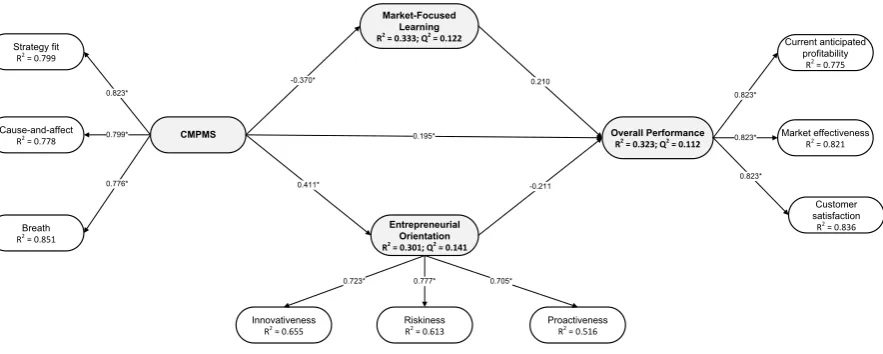
Standardized Root Mean Square Residual (SRMR) fit index were calculated. Following the PLS-SEM blindfolding procedure, Q2 using cross-validated redundancy procedure, shows that all Q2 values were greater than 0 (Figure 2). To measure the f2, Cohen‘s effect sizes recommendation was used. The results show that the f2 values for the significant paths exceeded the recommended value (0.02). Following Wells et al. (2016), the GoF index was calculated. GoF was 0.44 which shows good model fit. The SRMR value for the model was 0.062, which is less than the recommended value of 0.08 (Henseler et al., 2014). As exhibited
in Figure 2, CMPMS negatively and significantly influenced marketfocused learning (β =
-0.391, p < 0.01). CMPMS positively affected entrepreneurial orientation (β = 0.465, p < 0.01);
Market-focused learning positively affected firm overall performance (β = 0.117, p < 0.01) and
CMPMS positively affected firm overall performance (β = 0.198, p < 0.01). However,
entrepreneurial orientation negatively affected firm overall performance (β = -0.221, p < 0.01).
The model explained 35.3% of market-focused learning, 31.6% of entrepreneurial orientation and 31.2% of firm overall performance.
Market-Focused Learning
R2 = 0.333; Q2 = 0.122
Entrepreneurial Orientation
R2 = 0.301; Q2 = 0.141
Overall Performance
R2 = 0.323; Q2 = 0.112 CMPMS -0.370* 0.411* 0.210 -0.211 0.195* Strategy fit
R2 = 0.799
Cause-and-affect
R2 = 0.778
Breath
R2 = 0.851
0.823*
0.799*
0.776*
Innovativeness
R2 = 0.655 RiskinessR2 = 0.613 ProactivenessR2 = 0.516
0.723* 0.777* 0.705*
Current anticipated profitability
R2 = 0.775
Market effectiveness
R2 = 0.821
Customer satisfaction
R2 = 0.836 0.823*
0.823*
[image:5.595.79.521.381.558.2]0.823*
Figure 2. Results of structural model.
As shown above, the findings suggest that CMPMS negatively and significantly influences market-focused learning, contradicting H1. However, supporting H2, CMPMS was found to positively affect entrepreneurial orientation. Similarly, H3 and H5 were supported by the findings, which suggest that market-focused learning and CMPMS positively affect firm overall performance. Nonetheless, H4 was not supported by the findings, with entrepreneurial orientation found to negatively affect overall firm performance in this study.
Although performance measurement literature emerged in the 1960s, research regarding tourism performance measurement is in its infancy. This study examined an integrated conceptual model of CMPMS, market-focused learning and entrepreneurial orientation and firm performance. H1 predicted that the CMPMS has a negative impact on market-focused learning. The strategy fit, breath and cause-and-effect approaches allow agency to increase their learning in negative way. This is in contrast with previous studies. Hypotheses 2 and 5 proposed a direct positive relationship among CMPMS, entrepreneurial orientation and firm performance. Agency owners with high levels of CMPMS have confidence in their ability to attain high levels of performance and leadership (Martin & Javalgi, 2016; Homburg et al., 2005). H3 proposed a direct positive relationship between a market-focused leaning and firm overall performance. This was supported empirically demonstrating how leaning from market influence agency current anticipated profitability, market effectiveness and customer satisfaction (O'Cass & Weerawardena, 2010). H4 predicated the entrepreneurial orientation to have a direct relationship with overall performance. The results indicated a negative relationship between these two constructs. It seems the agency should revisit their innovativeness, riskiness and proactiveness leadership strategies in order to achieve positive overall firm performance. Taken together, these results provide new knowledge advancing our understanding of the mechanism by which CMPMS, market-focused learning and entrepreneurial orientation affect performance in the travel agency context. We also confirm that CMPMS, entrepreneurial orientation and overall firm performance are higher-order constructs with their underlying factors.
Becker, J.M., Klein, K., & Wetzels, M. (2012). Hierarchical Latent Variable Models in PLS-SEM: Guidelines for Using Reflective-Formative Type Models. Long Range
Planning, 45, 359-394.
Fornell, C., & Larcker, D.F. (1981). Evaluating structural equation models with unobservable variables and measurement error. Journal of Marketing Research, 18(1), 39-50. Hair, J.F.J., Black, W.C., Babin, B.J., & Anderson, R.E. (2010). Multivariate Data Analysis:
A Global Perspective (7th ed.). USA: Pearson.
Hair, J.F.J., Hult, G.T.M., Ringle, C.M., & Sarstedt, M. (2017). A primer on Partial Least
Squares Structural Equation Modeling (PLS-SEM) (2nd ed.). Los Angeles, CA: Sage.
Henseler, J., Dijkstra, T.K., Sarstedt, M., Ringle, C.M., Diamantopoulos, A., Straub, D.W., . . . Calantone, R. (2014). Common beliefs and reality about PLS comments on Rönkkö and Evermann (2013). Organizational Research Methods, 17(2), 182-209.
Homburg, C., Artz, M., & Wieseke, J. (2012). Marketing performance measurement systems: does comprehensiveness really improve performance? Journal of Marketing, 76(3), 56-77.
Homburg, C., Koschate, N., & Hoyer, W. D. (2005). Do satisfied customers really pay more? A study of the relationship between customer satisfaction and willingness to pay.
Journal of Marketing, 69(2), 84-96.
Hooley, G., Greenley, G., Fahy, J., & Cadogan, J. (2001). Market-focused resources, competitive positioning and firm performance. Journal of marketing Management, 17(5-6), 503-520.
Karatepe, O. M., Keshavarz, S., & Nejati, S. (2010). Do Core Self-Evaluations Mediate the Effect of Coworker Support on Work Engagement? A Study of Hotel Employees in Iran. Journal of Hospitality and Tourism Management, 17, 62-71.
Lumpkin, G. T., & Dess, G. G. (2001). Linking two dimensions of entrepreneurial orientation to firm performance: The moderating role of environment and industry life cycle. Journal of business venturing, 16(5), 429-451.
Martin, S.L., & Javalgi, R.G. (2016). Entrepreneurial orientation, marketing capabilities and performance: The Moderating role of Competitive Intensity on Latin American International New Ventures. Journal of Business Research, 69, 2040–2051. Morgan, N. A., Vorhies, D. W., & Mason, C. H. (2009). Market orientation, marketing
capabilities, and firm performance. Strategic Management Journal, 30(8), 909-920. O'Cass, A., & Weerawardena, J. (2010). The effects of perceived industry competitive
intensity and marketing-related capabilities: Drivers of superior brand performance. Industrial Marketing Management, 39(4), 571-581.
Sainaghi, R., Phillips, P., & Zavarrone, E. (2017). Performance measurement in tourism firms: A content analytical meta-approach. Tourism Management, 59, 36-56. Smith, M., & Bititci, U. S. (2016). Interplay between performance measurement and
management, employee engagement and performance. International Journal of Operations and Production Management, 1-24.
Vorhies, D.W., & Morgan, N.A. (2005). Benchmarking Marketing Capabilities for Sustainable Competitive Advantage. Journal of Marketing, 69(January), 80-94. Wells, V. K., Taheri, B., Gregory-Smith, D., & Manika, D. (2016). The role of generativity
and attitudes on employees home and workplace water and energy saving behaviours.
Tourism Management, 56, 63-74.