City, University of London Institutional Repository
Citation
:
Hampton, J. A. (2003). Abstraction and context in concept representation. Philosophical Transactions of the Royal Society B, 358(1435), pp. 1251-1259. doi: 10.1098/rstb.2003.1314This is the unspecified version of the paper.
This version of the publication may differ from the final published
version.
Permanent repository link:
http://openaccess.city.ac.uk/1007/Link to published version
:
http://dx.doi.org/10.1098/rstb.2003.1314Copyright and reuse:
City Research Online aims to make research
outputs of City, University of London available to a wider audience.
Copyright and Moral Rights remain with the author(s) and/or copyright
holders. URLs from City Research Online may be freely distributed and
linked to.
City Research Online: http://openaccess.city.ac.uk/ [email protected]
ABSTRACTION AND CONTEXT IN CONCEPT REPRESENTATION
James A. Hampton
City University, London
Based on a paper originally presented to ACI Cognitique Atelier "Abstraction"
Paris, January 11, 2001
INTRODUCTION
Information is represented in the mind at widely different levels of abstraction.
Consider how you might store information about a particular scene in a film, about
the layout of the Paris Metro system or about Newton’s first law of motion. If you are
a movie fan, then your memory for the moment at the end of Casablanca, where Humphrey Bogart and Claude Rains are left on the airport runway, will be full of
detail; the graininess of the film, the expressions of faces and voices are likely to be
stored and recalled, even if the memories are inaccurate or distorted. Your
knowledge of the Paris Metro will be a broader set of information – including some
basic geography of Paris, notions of how distance can be translated into travel time,
and specific details of invidual lines or metro-stations that you have passed through.
When it comes to understanding of Newton’s laws of motion, we have a type of
knowledge that may involve an ability to verbally express a formula (“a body in motion will continue to move in a straight line with constant velocity unless acted upon by some force”), together with an ability to use the law to make predictions and to understand the operation of a wide variety of physical systems, from cars braking
to satellites orbiting the planet.
These three kinds of stored information represent different levels of
abstraction in memory. We even have different ways of describing the information in
our language – using terms such as memory, knowledge and understanding to refer
to information varying from the specific to the abstract. When we think we have
“explained” or “understood” something, we often mean that some specific event or
situation is to be seen as an instantiation of some more abstract principle or notion.
One of the key notions underlying the concept of abstraction itself, is the
notion of context independence. Whereas the scene in Casablanca can only be
understood in the context of that particular film, the laws of motion can be applied in
some more detail, and to discuss its relation to context-dependence in knowledge
representation. I will do this by discussing three general approaches to modelling
conceptual knowledge from the domain of cognitive psychology, which themselves
can be mapped onto a dimension of increasing levels of abstraction.
1. ABSTRACTION
The notion of abstraction is itself very abstract, and the term “abstract”
probably has many senses. For example we distinguish concrete from abstract
nouns in terms of whether they refer to physical objects or non-physical notions.
Abstract concepts such as “loyalty” or “dimension” may refer to physical situations
but they are unrelated to any direct sensory experience. Abstract art, on the other
hand, is painting or sculpture that does not purport to represent the world in a
recognisable form, but in which the sensory qualities of the paint or object are
primary – a Rothko painting is “just” patches of colour, a Brancusi sculpture just
smooth shiny curves. So we must be careful not to assume that there is just one
notion of abstraction.
Let us begin with a simple example of abstraction, and then build up to more
abstract levels. At its most basic, the process of abstraction may be considered as a
form of generalisation across time and place. Suppose that we set up a classical
discrimination learning experiment in which a pigeon receives a food reward in the
presence of one class of stimuli, and does not in the presence of a different class.
For example, food may be available if a red key is pecked, but will be withdrawn if a
yellow key is pecked. If we train the pigeon with red and yellow keys, we can then
test its acquired “knowledge” through a generalisation test. How likely is the pigeon
to peck keys of different shades of colour ranging between red and yellow? Typically
the level of responding will show a generalisation gradient – the pigeon will peck
colours that have never been encountered before, to the extent that they are close or
This form of learning employs abstraction because an experience is identified
through linking it to some generic representation of similar experiences in the past
(Millikan, 1984). Our memories act to recognise the object or situation as a familiar
one, and we respond accordingly. The abstraction involves storing three types of
information:
information about which dimensions of the situation are relevant (for example the
colour rather than the shape or size of a key)
information about which values on which dimensions reliably predict how we
should act (for example the red and yellow values on the colour dimension)
information about the range of variability of the predictive values (so if a range of
reds is rewarded, a more “abstract” representation of the stimulus class is created
than if just a single value is rewarded, and there will be greater generalisation of
responding).
Crucially, abstraction also involves not storing anything else, or at least
separating out this action-relevant information from the rest. So the representation
will be more abstract the greater the degree to which only the important or relevant
information is stored, and all else is discarded. Abstraction thus provides for rapid
and easy processing of information – we are not distracted by irrelevant variation
along other dimensions. On the other hand, the down side of abstraction is that we
fail to notice or record details which may turn out to be relevant should the task or
situation change.
All abstraction therefore involves selectively discarding some of the
information presented. So, for example, we may form an abstract representation of
the concept TRIANGLE through selecting out the common elements (closed plane
figure with just three straight sides and three corners) and ignoring details of the
angles or sizes of individual triangles that we may have encountered or could
Along with this selection of relevant dimensions comes the construction of a
type representation – a representation not of an invidual or particular object, but of a class of possible objects. Individual objects may be encoded in memory with more or
less attention to detail, and so give rise to memories that are more concrete or more
abstract. Remembering that the bank robbers escaped in some kind of car will be a
more abstract recollection than remembering that they drove off in a rusty red station
wagon with a broken tail-light. However the formation of a type is a different form of
abstraction. Individual objects are tokens or instances of particular categories of
thing. To represent that category as a type is to make an assumption that there is
something that such tokens share in common. We then set up a type representation
which is more than just a collection of remembered exemplars.
The process of abstraction of a type involves us in making an ontological
commitment that the collection of individuals we have encountered constitutes some
form of coherent class. To illustrate this, let us consider a medical example. A
physician may start encountering a number of patients with similar symptoms –
headaches, night sweats and loss of appetite. Initially she may class them together
purely on the basis of these symptoms. Such a category is convenient, since it can
be given a name, and can be used as the basis for organising case records. At this
point, the physician may then decide to adopt a hypothesis that these cases have
some common cause – there is perhaps some infectious agent, or some toxicity in
the environment that is producing the cluster of similar cases. To form such a
hypothesis is to create an abstract type representation for the category. Although
behaviourists often speak of discrimination learning as a form of “concept learning”,
one could argue that it is only with the construction of types that true concept
formation occurs.
The final, and most abstract stage in the development of abstract
representations of the world is to construct a type hierarchy. Our conceptual
world into domains of people, biological kinds, artifact kinds, individuals, qualities,
events and so forth. In each domain there is a form of template that dictates what
relevant kinds of information should be stored. For people we may store there age,
their behaviour, or their beliefs. For a car, age and behaviour are relevant but beliefs
are not. In order to understand what questions it is relevant to ask about some new
class, and what questions would just make no sense, we must abstract a framework
in which there are types of types. One common assumption, used to good effect in
object-oriented programming languages is that concept types are organized in a
hierarchy (Keil, 1979).1
2. THE ORIGINS OF ABSTRACTION
Empiricist and rationalist traditions in philosophy agree that the mind can form
both specific and abstract representations. We are at the same time capable of
appreciating the rich flavour of a particular sauce, and speculating about the status of
ethical laws in human society. The argument between the traditions is about the
origins of these representations and whether abstract structures are a necessary
precursor to empirical learning.
This argument is also endemic in psychological theories of cognition. On the
one hand it has been argued that all knowledge must be grounded in some form of
sensory experience, and that theories of learning are therefore crucial to
understanding how knowledge comes about. On the other hand one can argue that
without some form of abstract structure to give meaning to experience, learning
would be random and impossible. Piaget (1967) was one of those who understood
this problem most clearly. In his theory of development, the child begins with
rudimentary structures – schemas – that allow action to be tied to sensory input (for
example the sight of a face leads to tracking of the eyes). These schemas then
1
develop and change by adapting themselves to the structure of experience, thus
allowing richer meaning to be given to new inputs.
Psychological models of concept representation differ in the emphasis that
they place on bottom-up learning processes as opposed to top-down interpretative
processes. In the next section I turn to consideration of two broad classes of model
that can be differentiated on this basis.
3. MODELS OF CONCEPTS
The two classes of model I will consider both use similarity as the basis for
forming categories. Exemplar models do so in terms of stored individuals, whereas
Prototype models do so by abstracting a single representation of the class.
3.1 EXEMPLAR MODELS
Exemplar models of concept representation are located at the “specific” end
of the abstraction dimension. There are two main lines of research employing these
models. The first line is research into “non-analytic" cognition developed by Lee
Brooks and Bruce Whittlesea, and the second line involves constructing models of
category learning based on representing exemplars in similarity spaces.
3.1.1 Non-analytic cognition
Brooks (1978) proposed the radical thesis that much human behaviour that
we assume to reflect conceptual or analytic thinking is in fact based on more specific
memory-like processes. For example, we commonly find typical members of
categories (for example cars as vehicles) easier to process than atypical members
(such as hot-air balloons as vehicles). Rosch (1975) proposed that this is because of
the similarity of different category members to some stored prototype for the category
(see also Hampton, 1979). However it is equally possible that each time we
processing typical category members reflects the relative frequency with which they
are encountered, rather than anything that would require there to be a generic
abstract representation of the category prototype. Research on this question
(Barsalou, 1985; Hampton, 1997a) has shown that speed of categorization is
influenced by both frequency of items in the world and their similarity to a prototype.
Hampton (1997) found that when the task of categorizing words was made very quick
and easy, by having only unrelated false items as fillers, then frequency was the
primary predictor of categorization speed. However when the task required more
cognitive effort to discriminate members from related non-members, similarity to
prototype was more influential.
The non-analytic cognition tradition has provided many experiments
demonstrating the strong effects of prior processing episodes on subsequent use of
abstract knowledge. For example even when the task is to classify stimuli on the
basis of a simple rule, performance is affected by prior exposure to the stimuli (Allen
& Brooks, 1991). For a review of many of these demonstrations, see (Shanks,
1995).
Brooks, Norman, & Allen (1991) conducted a study of doctors diagnosis of
common skin diseases. The participants in the study first worked their way through
named slides of skin disorders of various categories, and rated how typical they were
of their disease category. Later they were given a new set of slides to categorize
according to the diagnostic categories. Brooks et al. found that the preferred
diagnosis was consistently influenced by the similarity of a novel case to the recently
viewed cases of that category. Even though the experts had been trained in the
application of abstract rules for classification, they were unable to avoid using
similarity to recently experienced exemplars to help them categorize. Brooks
concludes that perhaps much of the behaviour that we assume is based on abstract
This approach is the most clearly anti-abstractionist. It makes no
assumptions about representation, other than that a stimulus may evoke the memory
of an earlier one together with its processing history. All that is required for a model
of concept representation is some way in which a novel stimulus or experience can
evoke the right kind of earlier episode – a principle of “reminding”. Such a system
must presumably be mediated by a representational medium of some form.
Remindings are typically triggered by salient perceptual features of a stimulus rather
than abstract or functional features (Ross, Perkins, & Tenpenny, 1990), so it must be
assumed that there has been some selective storage of information. However the
force of the demonstrations is that this selection is probably automatic and driven by
basic perceptual attention processes, and is not easily modified by the imposition of
strategies for the performance of the task.
One clever way to determine how much abstraction is involved in a task is to
use an implicit learning paradigm. Barsalou & Ross (1986) presented participants
with lists of words to read. At a later stage they were asked to estimate the
frequency with which particular classes of word had appeared. Frequencies for
categories based on simple perceptual features (e.g., red objects) were not
estimated better than chance – participants were unable to say reliably whether there
had been one, two, three or four red objects in the list. However frequencies for
common superordinate categories such as Birds, Fruits or Vehicles were well
estimated. A plausible interpretation of this result is that there is some automatic
encoding of a word’s superordinate category when it is read and understood. If so,
then this would be evidence for a degree of automatic abstraction occuring during the
processing of the word’s meaning.
3.1.2 Generalised Context Model
Perhaps the best known and most influential exemplar model for concept
Nosofsky (Nosofsky, 1988). The GCM is a model of classification learning and has
largely been tested through studies in which participants have to learn to classify a
set of simple visual shapes into two categories. Measures are taken of the rate of
learning of individual stimuli, and a test is made of generalisation of the learning to a
transfer set of stimuli that were not seen in training.
The model assumes a very simple system for representing a category,
involving a minimum of abstraction. Individual exemplars are stored together with
their category labels, and the subsequent classification of a new stimulus is based on
the overall similarity of the stimulus to the stored exemplars of each category in
memory.
In more detail, the GCM assumes that each exemplar is analyzed along a set
of dimensions (experimental tests of the model typically use visual stimuli that can be
fully defined by their position on just two independent dimensions such as size and
orientation). By plotting a space with the dimensions as axes, it is then possible to
store an exemplar and its category by placing the label of that category at the point in
the space corresponding to the exemplar’s dimensional coordinates. Once the
space has become populated with exemplars, the categorization of a novel stimulus
can be made by comparing the sum of similarities to members of category A with the
sum of similarities to members of category B. The probability of categorizing the
stimulus as an A is predicted directly through a formula comparing these two
summed similarities.
Formally the model uses a number of mathematical devices, details of which
can be found in Nosofsky (1988) or Lamberts (1997). In order to fit the data from any
experiment, it is also necessary to use the data to estimate a number of parameters
for the model. These include the relative importance of each dimension, the rate at
which similarity to a stored exemplar drops off as a function of distance in the space,
choosing the more likely category) or follows probability matching (responding with a
probability that matches the likelihood of the category being correct).
The GCM has had considerable success in giving precise quantitative fits to
data from a range of different experimental paradigms, including recognition
accuracy for individual exemplars, and speed of categorization (Lamberts, 1995).
More recently the generality of the model has been challenged by J. David Smith,
who has demonstrated a range of situations in which performance indicates that
people may abstract a prototype rather than store individual exemplars (Smith &
Minda, 1998). Broadly speaking, where a category has a large number of exemplars,
and the differentiation between categories is relatively easy (large distances between
categories relative to variance within), then there tends to be more evidence for the
formation of a category based around a prototype (a single point in the stimulus
space) rather than exemplars.
Exemplar models employ a degree of abstraction because only the
information about position in the similarity space is encoded for any stimulus, all
other information is lost. Where there are additional dimensions of variation that are
not relevant to the classification, it can be shown that attention shifts away from these
dimensions and they lose any influence in determining performance (Goldstone,
1994). A model that successfully captures the learning of dimensional weights
during classification learning is the ALCOVE model developed by John Krushke
(Kruschke, 1992). Goldstone has demonstrated that this form of learning can affect
visual discrimination abilities – people retune their perceptual processing of the
stimuli to attend to the dimensions that are more relevant.
To what extent is it possible to abstract out from a perceptual array just those
dimensions that are relevant to a discrimination? An answer to this question can be
found in the work of (Garner, 1978)) who developed the distinction between
separable and integral dimensions. If a pair of dimensions are separable (such as
on the other will not interfere with processing. Furthermore similarity between stimuli
will be the inverse of an additive function of distance on each dimension. Where a
pair of dimensions are integral (such as hue and saturation in colour) then variability
in one dimension will always interfere with judgments on the other, and similarity
between stimuli is best captured using a Euclidean function (similarity is inversely
related to the square root of the sum of the squared distance on each dimension)
3.1.3 Exemplars and natural categories
There have been relatively few attempts to generalise the GCM beyond the
realm of tightly controlled laboratory experiments using simple visual stimuli. A
notable exception is the work of Gert Storms and his colleagues. For example,
(Storms, De Boeck, & Ruts, 2000) compared two models of category internal
structure. For a prototype model (see next section) they predicted that typical
category members would be those with the most features in common with the
category prototype (Hampton, 1979). For an exemplar model they predicted that
typical category members would be those that shared most features with the top few
most frequently generated members. Their results showed that for a range of
measures of category structure (speed of categorization, rated typicality, and so
forth), the exemplar measure was as good as or in some cases better than the
prototype measure. Optimum fit was obtained when combining similarity to about ten
exemplars.
Another demonstration of exemplar effects was a study by (Storms, De
Boeck, & Ruts, 2001) in which they examined how people classify edible plant
objects into fruits and vegetables (or their equivalent in Flemish). They obtained a
range of exotic produce that was unknown to their participants and obtained ratings
of similarity to familiar fruits and vegetables, and judgments of which category they
belonged to. They found that similarity to known exemplars was a better predictor of
3.2) PROTOTYPE MODELS
Prototype models stand in the "middle ground" between non-analytic
exemplar storage and highly abstract "theory-like" conceptual representations. A
variety of representational assumptions can be adopted. For example one can
assume that stimuli are represented in a multi-dimensional similarity space (Rips,
Shoben, & Smith, 1973) of the kind also used by exemplar models. Or one can
assume a more powerful schema-based representational format (e.g., Hampton,
1987; Hampton, 1995a; Smith & Osherson, 1984).
3.2.1 Spatial prototype models
The key difference between prototype and exemplar models of classification
learning is that prototype models involve abstraction over exemplars to represent the
central tendency and the variability within the category. Rather than represent each
exemplar as a point in the similarity space, the prototype model would represent the
centre of each category cluster and define the category as a region in the space
centred on that point. Individual exemplars are therefore merged into a single
generic representation.
There are two effects of using a prototype representation. First, the likelihood
of selecting a category will decrease in a smooth monotonic fashion as distance from
the centre of the category increases. There will be no local maxima in the regions
close to individual exemplars as occur in the exemplar model. Second, information
about higher order covariance of features across exemplars is lost. The bivariate
distribution of exemplars across two dimensions of the space may show a
correlation, but the prototype just represents the centre of the cluster and not its
3.2.2 Exemplars versus prototypes
Prototype models do better at explaining learning when the stimuli are more
complex, when there are more of them, and when the category structure is well
differentiated (Smith & Minda, 1998).
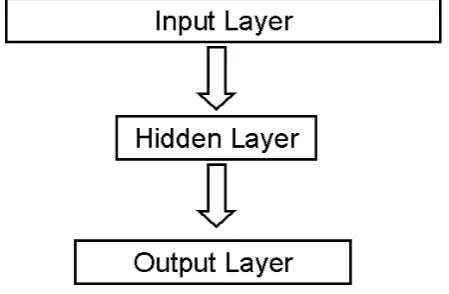
INSERT FIGURE 1 ABOUT HERE
A clear way to show how the difference between the models can be
understood as one of degree of abstraction is by implementing the models within the
same structure of a neural net (see Figure 1). Barsalou (1990) argued persuasively
that exemplar and prototype representations differ only in the degree to which
individual exemplar information is retained (exemplar model) or discarded (prototype
model). If one considers the simple feed-forward neural network in Figure 1, the
input layer encodes the particular set of features of different exemplars, the network
carries this pattern through on the basis of the weights of each connection into a
hidden layer, and then into an output layer where the different nodes each
correspond to a different category. It is easy to show that, in such a model, the
degree to which it behaves like an exemplar or like a prototype model is simply a
function of how narrow the hidden layer is made to be. If the hidden layer has very
few nodes, then the model necessarily has to throw away individual information
about particular exemplars. There are not enough hidden layer nodes for each
possible pattern of input to generate a distinctive pattern in the hidden layer, and so
abstraction is forced on the representation. On the other hand, if there are enough
hidden layer nodes, each exemplar can be mapped onto a particular pattern in the
hidden layer, and the category response then mapped onto that.
This feature of neural networks is well understood, and when training nets to
classify it is necessary to adjust the size of the hidden layer accordingly. Too many
nodes leads to rapid learning on the training set but very poor generalisation to a
with some exceptional items never properly learned, but generalisation to the transfer
set will be better. The hidden layer acts in statistical terms to reduce the
dimensionality of the variance in the stimulus array, in a way that will be maximally
useful for predicting the correct categorization.
3.2.3 The effects of increasing expertise
As learning continues, so more exemplar information is likely to become
stored. Smith and Minda (1998) found that prototype models were a better fit early in
learning, whereas exemplar models were better later on. It is easiest to get a
general idea of two broad classes first, but getting to a more accurate level of
performance requires the learning of individuals. This notion that exemplar
representations come with increasing expertise has some support from studies of
expertise in decision making. In complex domains where knowledge and its
application are uncertain, experts have been shown to have a greater store of
relevant experience than well-trained novices, and to rely to a greater extent on
stored exemplars (using a process known as “case-based reasoning”) in coming to
decisions. Rosch, Mervis, Gray, Johnson, and Boyes-Braem (1976) also argued
that the perception of a class as having high commonality – associated with their
notion of a "basic level class" – can change with expertise in the same manner. The
novice student of art history may see paintings by Vermeer as a single recognizable
category, based on a prototype of the typical qualities of light and subject matter. To
the expert, all the known individual paintings by the master are represented as
familiar individual exemplars, so that the prototype representation no longer serves
much purpose.
3.2.4 Schema-based prototypes
Prototype models were originally developed for classification learning of
common everyday concepts like Chair or Fruit (Hampton, 1979; Rosch, 1975). Of
course the variety of Fruits require that the dimensionality of a similarity space would
be very large, and in fact there is good evidence that the assumptions required for
mapping similarities into multi-dimensional space are often violated by more complex
natural concepts (Tversky, 1977). It is therefore best to abandon the assumption of a
similarity space as the medium for representation. In its place concepts such as
these are commonly represented using Minsky’s idea of a frame with slots (=
features or dimensions) and fillers (= values or ranges) (Minsky, 1975).
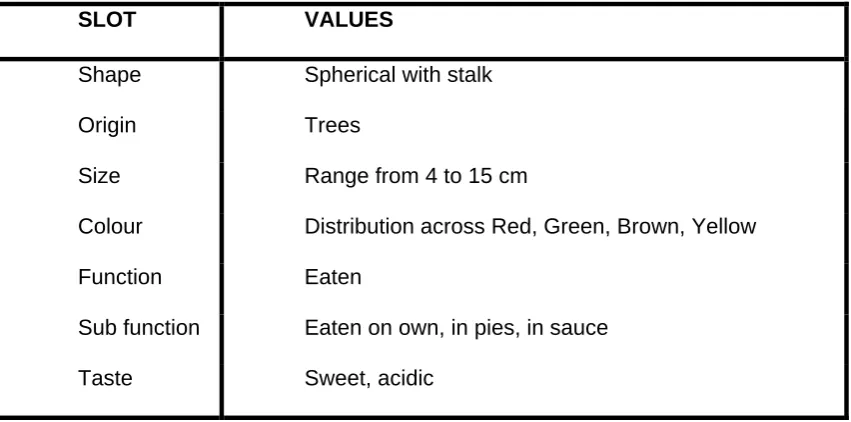
INSERT FIGURE 2 ABOUT HERE
For example, Figure 2 shows part of a possible frame representation for the
concept of APPLE. Slots represent variables that will differentiate different concepts
within a particular domain. So for fruits and vegetables, they would represent shape,
colour, taste, origin and so forth. For vehicles they might represent form of
locomotion (wheels or wings), shape, use (passengers or freight), and location (air,
land or sea). The particular set of slots for a domain will reflect the level of
abstraction described above as an ontological framework. Thus depending on the
location of a concept within the ontological hierarchy it may be expected to use a
particular range of slots (although the frame representation is likely to be very flexible
and expandable – see Barsalou & Hale (1993).
These schema representations are prototype models in that a single
representation is used to store the central tendency and range of variation in the
category across relevant dimensions, but no exemplar information is stored. They
also have the important characteristic of prototype models that although the most
typical exemplars will be clearly described, the schema itself will not determine
precisely the boundaries of the category. This vagueness in the placing of category
boundaries differentiates schematic prototypes from more precise rule-based or
Barsalou and Hale (1993) also describe how more powerful representations
can be constructed around frame-based schemas by introducing constraints and
meta-conceptual principles defined across the slots in the frame. Abstract
knowledge – of the kind sometimes referred to as “naïve theories” – can be
incorporated into the representation in this way. For example, within the domain of
biological kinds there are constraints that operate between size, habitat, shape and
means of locomotion. Small creatures may have wings and fly in the air. Creatures
of any size may swim through the water by moving a tail. There is good evidence
that we are aware of, and represent many of these higher order relations between
different features within a representation (Murphy & Medin, 1985), although it is
unclear to what extent we may be able to articulate such abstract knowledge in an
explicit form.
Schematic prototypes therefore typically involve:
a frame with slots and values
constraints operating between dimensions that reflect the broader principles of
world knowledge
categorization rules that weight different dimensions in relation to their "centrality"
in the structure (as determined by the constraints).
The models tend to be imprecise about how a stimulus might be encoded,
and about how categorization is decided. Rips (1989) has suggested that we
categorize something by finding the conceptual schema that provides the "best
explanation" of the observable features of the object. There is also evidence (Ahn,
1998) that, given a schema in which some features are represented as the cause of
others, people will give greater weight to the causally active features and less to their
effects when categorizing. However much needs to be done to discover how
widespread such effects may be in the categories that we use in everyday reasoning.
indiscriminate in the way that they attribute weight to different kinds of information
when deciding how to categorize an object.
4) CONTEXTUAL EFFECTS IN CONCEPT REPRESENTATION
Having described two basic classes of model on the basis of different levels
of abstraction, I now turn to the question of context-dependence. Contextual effects
in conceptual tasks are prima facie evidence for the lack of abstraction. We have already discussed demonstrations by Brooks of the effects of the context of recent
experience on performing categorization tasks. But there are other forms of context
manipulation that can have equally strong effects.
Exemplar and simple non-schematic prototype models are similarly affected
by specific context effects. In particular the order in which exemplars are presented
early on in learning, and the separability of the relevant dimensions may have effects
on how quickly the category is learned. However there are much more interesting
context effects to be found with schema-based concept representations. I will argue
that such effects frequently occur through a process of instantiation, which can be
thought of as the filling out of abstract representations with more specific features to
help the concept to fit into the current context.
4.1 Context-dependent properties
One powerful effect of context is the addition of new dimensions to a
representation. Barsalou (1982) used the example of a basketball. Participants had
to verify two kinds of sentence. Some were constructed using highly associated
properties as predicates – for example, “a basketball is round”. Others were
constructed using weakly associated properties that were still nonetheless true, such
as “a basketball floats”. Without any prior context, the former were more rapidly
threw the basketball into the pool”, the two sentences became equally fast to
understand.
One way to interpret this result is to suppose that in the context of
understanding the prior sentence about a swimming pool, the attribute "floats" is
added to the representation of basketballs. A particular individual basketball is
represented in working memory, and its roundness is part of that representation
regardless of the prior context. Its ability to float is added to the representation in
order to provide coherence to the story line, and permit a successful simulation in
working memory of the situation described. Barsalou (1999) has since greatly
developed the notion of mental simulation in regard to concepts and argues that our
basic conceptual knowledge consists of a set of abilities to mentally simulate objects
in situations.
The context of placing a word in a sentence may also lead to the negating of
common attributes. Consider the sentence
"The family watched hungrily as the cook took the bird out of the oven"
Clearly attributes of birds such as flying, having feathers and singing in trees
will be absent from the working memory representation of the word in this context,
although it is not known whether they are initially present and then deleted, or
whether it is possible for the modified representation to be constructed directly.
4.2 Instantiation as the reverse of abstraction
It is possible to argue that most context effects involve the instantiation of an
abstract concept by reference to plausibility in the context. For example, Roth and
Shoben (1983) presented sentences such as
"the trucker sipped the beverage" and "the bird crossed the farmyard". They showed that in such circumstances there was considerable priming of
words that were plausible instantiations of the abstract category term (for example
basic level of concepts. The basic level in any conceptual hierarchy picks out the
concept terms that are most general but still easily imagined in terms of a visual
image. For example, the following are basic terms: car, chair, penguin or banana.
Basic level terms are the first nouns that children typically learn, and they have been
shown to have a wide range of processing advantages over more superordinate
terms such as vehicle, furniture or fruit.2 Instantiation in context appears to involve
the retrieval of a basic level concept that will plausibly replace the superordinate. We
can easily imagine a cup of coffee in the trucker’s hand, but not so easily an
unspecified beverage. Interestingly, it is probably rare that instantiation would go
more specific than the basic level – we do not appear to fill in what colour the chicken
was or whether the coffee was white or black when understanding the sentences.
A second example of context effects involving instantiation is some research
by Barsalou (1987). He had the original idea of asking students to adopt different
points of view when making judgments about the typicality of different members of a
category. For example, they might have been asked to judge a list of vehicles for
how typical they were from the point of view of a suburban housewife as opposed to
the point of view of a farmer. In this case, the students were able to agree on a
consistent notion of how typical the objects would seem to the target group, and the
ranking of typicalities changed radically according to point of view. Indeed, when
asked to make judgments from the point of view of a university professor, they were
in fairly good agreement with the actual views of professors measured independently
(although the professors were apparently less good at matching the views of
students).
How to explain these effects? A shift in typicality gradients might indicate that
a different prototype has been formed, but it is unclear how the students would be
able to know what kind of prototype a farmer or housewife might have. A more
2
probable account is to suppose that the students were relying on exemplar
representations, using their knowledge of the likelihood of finding trucks, tractors,
estate cars or sports cars in the enviroment of a farm or suburb.
A third example of instantiation processes comes from my own studies of
Conceptual Combination using conjunctively defined conceptual categories
(Hampton, 1987; 1988; 1995). If people are asked to list attributes of birds, and
separately to list attributes of pets, they will come up with a list of about 30 different
common properties. In Hampton (1987) I investigated (among other conjunctions)
which of these properties would then be considered true of the conjunction “birds
which are pets”. A striking result was that people generated attributes for the
conjunction which had not been considered to be true of either class considered
alone. Birds do not live in cages and nor do pets, but clearly pet birds do. People
also claimed that pet birds can talk, although other subjects had judged it impossible
for pets to talk. Once again, once the two superordinate categories were placed in
context, particular basic level concepts were instantiated – in this case concepts such
as PARROT. The “emergent features” of conceptual conjunctions were mostly of this
kind – properties that were true of high probability instantiations of the conceptual
conjunction.
An even stronger effect was found when negated conjunctions were studied
(Hampton, 1997b). For example, the concept "dwellings which are not buildings" was instantiated (implicitly) as tents and caravans, and properties generated for the
conjunction reflected the common features of these objects.
Sometimes it seems impossible to perform some conceptual tasks without
instantiating abstract categories into more basic level ones. An example is the
"Impossible object task" (Hampton, 1997c). In this task, people are asked to imagine
an object that does not exist, such as
They are encouraged to list properties of the object, to consider ways in which
it differs from standard furniture or standard fruit, and to draw a picture to illustrate it if
they wish.
The task is difficult, and only about half the participants typically find a
reasonable resolution of the problem. Where successful, solutions appear to involve
the following four elements:
a) a search for instantiations of furniture and of fruit
b) alignment of schemas
c) identification of conflicting elements
d) invention of modifications to reduce the conflict
For example they may choose to instantiate furniture as a chair, and then
search for some fruit that could be fashioned into a chair. They may then look for
something strong and large with a flat surface which could be sat upon, and come up
with a pumpkin. At this point stage (b) involves finding links between the parts and
functions of one concept and those of the other. At various points in this process, the
same slot needs to be filled with values that are incompatible. For example, chairs
need to be long lasting, whereas pumpkins will start to rot. The final stage then
involves a creative process of modifying one or other concept to ensure the
resolution of the conflict – for example people may declare that the chair will need
replacing regularly but could be turned into a nice soup, or alternatively they may
declare that genetic modification of the pumpkin has led to a fruit that remains hard
and unripe for many years without problem.
Most striking about these results, is that people never create a new kind of
furniture, or a new kind of fruit. There is almost always an instantiation of a familiar
type, although it may not always be typical (depending on the particular constraints
5) CONCLUSIONS
In this paper I have argued that abstraction within conceptual representations
involves three levels
the selective storage of relevant information, and discarding of irrelevant
the development of type rather than token representations
the development of higher order constraints within an ontological hierarchy
Psychological models of concepts are distinguishable by the level of
abstraction that they incorporate, and in particular exemplar models operate at a
much lower level of abstraction than prototype models. There is considerable
evidence that people operate at a very specific level of information processing, even
when faced with relatively abstract tasks. Furthermore, a range of context effects are
best understood by supposing that when presented with broad superordinate terms,
References
Ahn,W.K. (1998). Why are different features central for natural kinds and
artifacts? The role of causal status in determining feature centrality. Cognition, 69,
135-178.
Allen,S.W., & Brooks,L.R. (1991). Specializing the operation of an explicit rule.
Journal of Experimental Psychology: General, 120, 3-19.
Barsalou,L.W. (1982). Context-independent and context-dependent information in
concepts. Memory and Cognition, 10, 82-93.
Barsalou,L.W. (1985). Ideals, Central Tendency, and Frequency of Instantiation
as Determinants of Graded Structure in Categories. Journal of Experimental
Psychology: Learning, Memory, and Cognition, 11, 629-654.
Barsalou,L.W. (1987). The instability of graded structure: implications for the
nature of concepts. In U. Neisser (Ed.), Concepts and conceptual development:
Ecological and intellectual factors in categorization. (pp. 101-140). Cambridge:
Cambridge University Press.
Barsalou,L.W. (1990). On the indistinguishability of exemplar memory and
abstraction in category representation. In T. Skrull & R. S. Wyer (Eds.), Advances in
social cognition, Volume III: Content and process specificity in the effects of prior
experiences. (pp. 61-88). Hillsdale, NJ: Lawrence Erlbaum Associates.
Barsalou,L.W. (1999). Perceptual symbol systems. Behavioral and Brain
Sciences, 22, 577-609.
Barsalou,L.W., & Hale,C.R. (1993). Components of conceptual representation:
from feature lists to recursive frames. In I. van Mechelen, J. A. Hampton, R. S.
Michalski, & P. Theuns (Eds.), Categories and Concepts: Theoretical Views and
Inductive Data Analysis. (pp. 97-144). London: Academic Press.
Barsalou,L.W., & Ross,B.H. (1986). The roles of automatic and strategic
processing in sensitivity to superordinate and property frequency. Journal of
Brooks,L.R. (1978). Nonanalytic concept formation and memory for instances. In
E. R. Rosch & B. B. Lloyd (Eds.), Cognition and Categorization. (pp. 170-211).
Hillsdale, NJ: Lawrence Erlbaum Associates.
Brooks,L.R., Norman,G.R., & Allen,S.W. (1991). Role of specific similarity in a
medical diagnosis task. Journal of Experimental Psychology: General, 120,
278-287.
Garner,W.R. (1978). Aspects of a Stimulus: Features, Dimensions, and
Configurations. In E. Rosch & B. B. Lloyd (Eds.), Cognition and Categorization. (pp.
99-139). Hillsdale, N.J.: Erlbaum.
Goldstone,R.L. (1994). The role of similarity in categorization: Providing a
groundwork. Cognition, 52, 125-157.
Hampton,J.A. (1979). Polymorphous Concepts in Semantic Memory. Journal of
Verbal Learning and Verbal Behavior, 18, 441-461.
Hampton,J.A. (1987). Inheritance of attributes in natural concept conjunctions.
Memory and Cognition, 15, 55-71.
Hampton,J.A. (1995b). Similarity-based categorization: the development of
prototype theory. Psychological Belgica, 35, 103-125.
Hampton,J.A. (1995a). Testing Prototype Theory of Concepts. Journal of
Memory and Language, 34, 686-708.
Hampton,J.A. (1997a). Associative and Similarity-based Processes in
Categorization Decisions. Memory & Cognition, 25
Hampton,J.A. (1997b). Conceptual combination: conjunction and negation of
natural concepts. Memory & Cognition, 25, 888-909.
Hampton,J.A. (1997c). Emergent attributes in conceptual combinations. In T. B.
Ward, S. M. Smith, & J. Viad (Eds.), Creative Thought: An Investigation of
Conceptual Structures and Processes. (pp. 83-110). Washington DC: American
Keil,F.C. (1979). Semantic and conceptual development: An ontological
perspective. Cambridge: Harvard University Press.
Kruschke,J.K. (1992). ALCOVE: An exemplar-based connectionist model of
category learning. Psychological Review, 99, 22-44.
Lamberts,K. (1995). Categorization under time pressure. Journal of Experimental
Psychology: General, 124, 161-180.
Lamberts,K. (1997). Process Models of Categorization. In K. Lamberts & D.
Shanks (Eds.), Knowledge, Concepts, and Categories. (pp. 371-403). Hove:
Psychology Press.
Malt,B.C. (1990). Features and beliefs in the mental representation of categories.
Journal of Memory and Language, 29, 289-315.
Millikan,R. (1984). Language Thought and Other Biological Categories.
Cambridge MA: MIT Press.
Minsky,M. (1975). A framework for representing knowledge
New York. In P. H. Winston (Ed.), The psychology of computer vision. (pp. 211-277).
McGraw-Hill.
Murphy,G.L., & Medin,D.L. (1985). The role of theories in conceptual coherence.
Psychological Review, 92, 289-316.
Nosofsky,R.M. (1988). Exemplar-based accounts of relations between
classification, recognition, and typicality. Journal of Experimental Psychology:
Learning, Memory and Cognition, 14, 700-708.
Piaget,J. (1967). Piaget's theory. In J. Mussen (Ed.), Carmichael's manual of
child psychology. New York: Basic Books.
Posner,M.I., & Keele,S.W. (1968). On the genesis of abstract ideas. Journal of
Experimental Psychology, 77, 353-363.
Rips,L.J. (1989). Similarity, typicality and categorization. In S. Vosniadou & A.
Ortony (Eds.), Similarity and Analogical Reasoning. (pp. 21-59). Cambridge:
Rips,L.J., Shoben,E.J., & Smith,E.E. (1973). Semantic distance and the
verification of semantic relations. Journal of Verbal Learning and Verbal Behavior,
12, 1-20.
Rosch,E. (1975). Cognitive representations of semantic categories. Journal of
Experimental Psychology: General, 104 , 192-232.
Rosch,E., Mervis,C.B., Gray,W.D., Johnson,D.M., & Boyes-Braem,P. (1976).
Basic objects in natural categories. Cognitive Psychology, 8, 382-439.
Ross,B.H., Perkins,S.J., & Tenpenny,P.L. (1990). Reminding-based category
learning. Cognitive Psychology, 22, 460-492.
Roth,E.M., & Shoben,E.J. (1983). The effect of context on the structure of
categories. Cognitive Psychology, 15, 346-378.
Shanks,D.R. (1995). Representation of categories and concepts in memory. In M.
A. Conway (Ed.), Cognitive Models of Memory. Hove: Psychology Press.
Smith,E.E., & Osherson,D.N. (1984). Conceptual combination with prototype
concepts. Cognitive Science, 8, 337-361.
Smith,J.D., & Minda,J.P. (1998). Prototypes in the mist: The early epochs of
category learning. Journal of Experiment Psychology: Learning, Memory, and
Cognition, 24, 1411-1436.
Storms,G., De Boeck,P., & Ruts,W. (2000). Prototype and exemplar based
information in natural language categories. Journal of Memory and Language, 42,
51-73.
Storms,G., De Boeck,P., & Ruts,W. (2001). Categorization of unknown stimuli in
well-known natural concepts: A case study. Psychonomic Bulletin and Review, 8,
377-384.
Figure 1
A simple feed-forward network for learning to categorize on the basis of input
features. The more nodes allowed within the hidden layer, the more the network is
able to learn the characteristics of individual exemplars. The more the number of
hidden layer nodes is restricted, the more the network forms generalisations of the
Figure 2: A (partial) frame representation for the concept APPLE
SLOT VALUES
Shape Spherical with stalk
Origin Trees
Size Range from 4 to 15 cm
Colour Distribution across Red, Green, Brown, Yellow
Function Eaten
Sub function Eaten on own, in pies, in sauce