City, University of London Institutional Repository
Citation
:
Motshegwa, T. (2009). Distributed Termination Detection For Multiagent Protocols. (Unpublished Doctoral thesis, City, University of London)This is the accepted version of the paper.
This version of the publication may differ from the final published
version.
Permanent repository link:
http://openaccess.city.ac.uk/19754/Link to published version
:
Copyright and reuse:
City Research Online aims to make research
outputs of City, University of London available to a wider audience.
Copyright and Moral Rights remain with the author(s) and/or copyright
holders. URLs from City Research Online may be freely distributed and
linked to.
C
ITYU
NIVERSITY LondonDistributed Termination Detection
For Multiagent Protocols
A dissertation submitted in partial satisfaction of the requirements for the degree Doctor of Philosophy in Computer Science
by
Tshiamo Motshegwa
To my mother . . .
who—among so many other things—
taught me the virtues of humility and sacrifice
To my father . . .
who—among so many other things—
taught me the virtue of discipline
To my late grandparents . . .
who—for all things—
T
ABLE OFC
ONTENTS1 Introduction. . . 1
1.1 Hypothesis . . . 3
1.2 The Problem . . . 4
1.3 Assumptions . . . 6
1.4 Contribution and Originality . . . 9
1.5 Exploitation . . . 10
1.6 Thesis Roadmap . . . 12
1.7 Summary . . . 13
2 State of the art in Termination detection in distributed Systems . . . 15
2.1 Introduction and Background . . . 15
2.1.1 Overview and terminology . . . 17
2.2 Classical Algorithms and Taxonomy . . . 19
2.2.1 Tracing Algorithms . . . 20
2.2.2 Wave-Based Solutions . . . 21
2.2.3 Other approaches to termination detection . . . 22
2.3 A general computing model and termination detection . . . 25
2.4 A contemporary taxonomy for distributed termination detection algo-rithms . . . 29
2.5 Summary . . . 34
3.1 Introduction: On Agents and Multiagent Systems . . . 37
3.2 Multiagent systems and Distributed systems . . . 39
3.3 Summary . . . 43
4 From computer protocols to agent interaction protocols . . . 44
4.1 Introduction . . . 44
4.2 On computer protocols . . . 45
4.3 Specifying Protocols . . . 46
4.3.1 A formal model of protocol systems . . . 46
4.3.2 Formal Languages for protocol specification . . . 52
4.4 Interaction protocols in Multi-Agent systems . . . 54
4.4.1 Protocol engineering in multiagent systems . . . 55
4.4.2 Discussion . . . 62
4.5 Summary . . . 64
5 Termination Detection for Protocols . . . 66
5.1 Introduction . . . 66
5.2 Overview . . . 68
5.3 Definitions . . . 69
5.4 Termination detection model . . . 83
5.4.1 A model for agent conversations . . . 83
5.5 Distributed protocol for termination detection . . . 96
5.5.1 Evaluation of the distributed termination detection protocol . . 105
5.6 Summary and Contributions . . . 110
6 Prototype implementation, experimental design and data analysis . . . 114
6.1 Introduction . . . 114
6.2 Overview . . . 114
6.3 Experimental setup . . . 115
6.4 Prototype implementation . . . 119
6.5 Scheduled experiments . . . 120
6.6 Data collection . . . 124
6.7 Data analysis . . . 127
6.8 Summary and contributions . . . 129
7 Partial Protocol Results . . . 131
7.1 Introduction . . . 131
7.2 Results: Exploratory Data Analysis . . . 133
7.3 Confidence intervals, standard errors and the Bootstrap . . . 144
7.3.1 Bootstrap results . . . 145
7.4 Summary . . . 156
8 Full Protocol Results . . . 157
8.1 Introduction . . . 157
8.2 Results: Exploratory Data Analysis . . . 158
8.2.1 Bootstrap results . . . 165
9 Comparisons . . . 175
9.1 Introduction . . . 175
9.2 Hypothesis testing . . . 178
9.3 Scalability Results . . . 182
9.4 Summary . . . 186
10 Distribution . . . 187
10.1 Introduction . . . 187
10.2 Experimental Results and Analysis . . . 190
10.2.1 A note on the presentation of results . . . 190
10.2.2 Results for network latency . . . 191
10.3 Results for detection delays in the distributed setting . . . 196
10.3.1 Results for scenario 1 . . . 196
10.3.2 Results for scenario 2 . . . 204
10.3.3 Scenario 3 . . . 208
10.3.4 Scenario 4 . . . 214
10.3.5 Scenario 5 . . . 218
10.4 Summary . . . 229
11 Conclusion . . . 230
11.1 Discussion of other issues . . . 230
11.2 Summary . . . 232
11.3 Contributions . . . 233
11.5 Directions for future work . . . 236
11.6 Related Work . . . 236
References . . . 239
A Termination Detection for protocols . . . 261
A.1 Illustration for the diffusing conversations algorithm . . . 261
A.2 Other possible implementations of a global c-matrix . . . 263
A.3 Algorithms . . . 266
A.4 Discussion and complexity analysis . . . 268
B Prototype Implementation . . . 273
B.1 Java Agent Development Framework . . . 273
B.2 Implementation . . . 275
C Experimental design and data analysis . . . 280
C.1 Data collection setup . . . 280
C.2 Data collection during experimental cycles . . . 282
C.3 Hardware used in experiments . . . 285
D Tutorial on resampling statistical methods . . . 287
D.1 The Bootstrap . . . 287
D.2 Bootstrap confidence intervals . . . 293
D.3 The Jackknife . . . 298
D.4 Computational statistical tools support for resampling techniques . . . 302
D.5 Experiences with jacknife-after-bootstrap . . . 303
E Statistical tests . . . 308
E.1 Goodness of fit tests . . . 308
E.2 Hypothesis Tests . . . 317
E.3 Repeatability of experiments . . . 318
F All summary statistics . . . 321
F.1 Partial Protocol data sets . . . 321
F.2 Full Protocol datasets . . . 324
G Partial Protocol experimental runs results . . . 330
G.1 Resampling, Bootstrap confidence intervals . . . 336
H Network latency and Synchronisation . . . 339
H.1 Clock synchronisation algorithms . . . 340
H.2 Network latency experiments . . . 342
I Distributed Termination detection . . . 346
I.1 Tracing Algorithms . . . 346
I.2 Some Selected Algorithms, some optimisations and robustness con-siderations . . . 348
I.3 Static and dynamic termination algorithms . . . 350
L
IST OFA
LGORITHMS1 Shortest Termination paths algorithm . . . 80
2 Reachability algorithm . . . 81
3 Termination paths update Algorithm . . . 82
4 Diffusing conversations algorithm . . . 93
5 Algorithm for predicateactiveP rotocol . . . 94
6 Global termination on controllers{Cn | n ∈N} . . . 100
7 Local termination on controller Cn for agent i, handles query(Cn, i) messages fromC0, returnsCni 7→F from this controller . . . 101
A
CKNOWLEDGMENTSFirst of all I would like to thank my supervisor Dr Eduardo Alonso for showing great patience when the drafts were taking longer than they ought to have been. I would also like to thank him for providing continuous support during the course of the PhD and making available the opportunities and provisions for me to do some undergraduate module teaching to support my studies.
I would like to thank Prof. M. Schroeder for origionally helping me secure a City Uni-versity PhD studentship on completion of my undergraduate studies at City uniUni-versity, for arranging that I spend time at British Telecom Labs during the first year of the PhD and for the involvement in the AgentCities project.
I would also like to sincerely thank the examiners for all they have done at all the stages of the examination process, clearly at a great sacrifice of time on their part. I would like to acknowledge Prof. Michael P. Wellman at Michigan university for responding to my query about his 1999 paper titled "Distributed Quiescence Detection
in Multiagent Negotiation". I discovered the paper when I was in British Telecom ,
BTexact Laboratories in Mattlesham Ipswich on an extended visiting research student fellowship away from City University and still searching for a PhD topic.
In the paper he tabled the possibility of using Dijkstra-Scholten algorithm for quies-cence detection in a multiagent protocol. The interaction with Prof Wellman prompted me to pursue the research topic I have chosen as on enquiring about any follow up to this work, mentioned there was none but that the area was well studied in distributed systems with early work in the 1980’s but not so much within agents and that there is big scope for research.
of the PhD. I would like to thank Dr Simon Thompson at BT Labs for the 6 months I spent at the labs and the interactions we had. I would also like to thank Dr Christos Kloukinas, Dr Tillman Weyde, Prof. Bernie Cohen, Dr Kostas Statis and other current and past academic members of the City university Computing Department. I would also like to thank Dr Michael Rovatsos at the School of Informatics at University of Edinburgh.
I would also like to acknowledge other staff and PhD students over the years at the de-partment of computing at City university, and other colleagues namely Dr Rodrigo Agerri, Dr Jacek Gomuluch, Dr Penny Noy, Dr Panos Dafas, Mr Alexander Ko-zlenkov, Mr George Lekeas, Mr George Katapodis, Mr Gilberto Cysneiros Filho, Mr Rafael Borges, Mr Chris Child, Mr Marcus Andrews, Dr Cornelius Ncube, Mr Pe-ter Kristoffersson-Izmajlow, Dr Teddy Ngosi, Dr Tak-Shing Chan, Dr Eddy Parkinson and others for providing a lively research environment. I would also like to particularly thank Mark Firman and Edna Morris for all they have done in supporting me and other research students by unravelling and elucidating the processes within the department and the university. I would also like to thank the librarian Mrs Sheila Munton for al-ways locating those hard to get documents. I would also like to thank Chris Marshall for making available more hardware when I needed it the most.
Finally I would like to also thank my dear family for all they have done from as long as I can remember. I would like to thank my parents for the sacrifices they have made for us. I would like to thank my dear sister, Ms Agnes Ntwaagae, my brothers, Dr Kefentse Motshegwa, Mr Pantanowitz Motshegwa and Mr Moduku Motshegwa for providing the context in which I grew up.
could not study medicine instead. On one of his quotes, he says;
Even the intrepid wayward of dragon slayers do return home, for the next
A
BSTRACT OF THED
ISSERTATIONDistributed Termination Detection
For Multiagent Protocols
by
Tshiamo Motshegwa
Doctor of Philosophy in Computer Science City University, London, October 2009
The research conducted in this thesis is on distributed termination detection in multia-gent systems.
Agents engage in complex interactions by executing behaviour specifications in the form of protocols. This work presents and experiments with a framework for making termination in a multiagent system explicit. As a side effect, the mechanism can be exploited to aid management of agent interactions, by providing visibility of the inter-action process and can be extended to drive multiagent system management tasks such as timely garbage collection.
Results from previous attempts to deploy agents systems when scaling up, e.g. Agentc-ities, have shown and exposed a big gap between theory and practice especially in the reliability and availability of deployed systems. In particular more work needs to be done in the area of supporting agent infrastructures as much as in theoretical agent foundations.
ver-ification of agent communication languages. But overall verver-ification is difficult and often requires knowledge of internal states of agents at compile time, and as yet has not been satisfactorily solved to be deployed in real systems. The second, the runtime approach is adopted in here.
The research is not about protocol engineering but assumes correct protocols, and protocol specifications to be finite state machine graphs. Given these correct verified protocols, the thesis proposes a number of definitions culminating in identification of minimal information in the form of sub-protocols that agents being autonomous, can make available for the termination detection. An off line procedure for deriving these sub-protocols is then presented.
The thesis then considers a termination detection model, and within this model, pro-poses an conversation model encompassing protocol executions, with hierarchical con-versations modelled as diffusing computation trees and defines a number of predicates to derive termination in centralised and distributed environments. Algorithms that im-plement these predicates are sketched and some complexity analysis is performed. The thesis then considers a prototype implementation evaluated over some defined detec-tion delays metric.
CHAPTER 1
Introduction
Like mathematicians, computer scientists use formal languages to denote
ideas. Like engineers, they design things, assembling components into systems
and evaluating tradeoffs among alternatives. Like scientists, they observe the
behavior of complex systems, form hypotheses, and test predictions,
— Allen B. Downey.
Aspiring computer scientist aspire to do these things.
The research in this thesis is in the area of multiagent systems (MAS). Multiagent systems are related to distributed systems in that they are inherently distributed and distributed systems offer a platform for developing multiagent systems.
Differences are often cited to exist between the agent and object models and related communication models assumed in the two areas. Agents are deemed autonomous (in theory), are considered higher level entities which use a rich communication language and execute interaction protocols to engage in potentially complex goal oriented inter-actions in dynamic and uncertain environments. By contrast objects are by and large passive, with no real control over execution of their methods, for example. But as ob-served in [239], it appears the debate on agents and objects (processes) has moved on to converge to a consensus that agents and objects to occupy different realms and can co-exist.
of resources, MAS in addition, emphasise distribution of objectives, distribution of problem solving1 (e.g. by the divide and conquer metaphor), coordination of actions
and flexible interaction in open environments.
Given these assumptions, there are important issues addressed in the distributed system research and the corresponding results that can be adopted in developing multiagent systems but taking into account issues pertinent to the agent model of computation. This thesis proposes to look at one particular area, distributed termination detection. We consider this in a multiagent system, identifying agent interaction protocols as the mechanism that enable coordination and flexible interaction between agents and using this as a starting point of our model.
Termination is an example of a stable global state of a distributed system. Components of a distributed system have only local views of a computation and lack a global per-spective. So ascertaining that a distributed computation has terminated is not straight forward since it requires a global view.
The termination detection problem is related to the more general problem of detection of global predicates, a fundamental problem in debugging and monitoring.
It has also been shown [227], that the semantics of the garbage collection problem are contained in the semantics of the termination detection problem, in that, with ap-propriate transformations garbage collection schemes can be derived from termination detection schemes.
So termination detection has useful applications as the terminated status is among stable states (consider as another example global communication deadlock) that should be known for system administration. In summary consider the following applications of termination detection;
1
1. Distributed workpool, i.e. dynamic mapping of tasks onto processes for load balancing in which any task may potentially be performed by any process, and if the work is generated dynamically and a decentralized mapping is used, then a termination detection algorithm would be required so that all processes can actually detect the completion of the entire program and stop looking for more work.
2. Deadlock detection, a stable state where there are wait-for cycles ,i.e. when two or more processes permanently block each other by each process having a lock on a resource which the other process are trying to lock.
3. Crash recovery, recovering and rolling back from abnormal termination.
4. Garbage collection, because termination detection is related to garbage collec-tion, it is possible with appropriate transformations to derive garbage collection schemes from termination detection schemes as [227] has shown.
We wish to explore research done in distributed systems in the area of termination detection to provide a basis for development of a class of mechanisms to make termi-nation explicit in multiagent systems, (possibly at a tradeoff with some autonomy of agents, not an unrealistic assumption for practical systems). This mechanism can be exploited in the future for work on automatic garbage collection of multiagent systems in automated environments.
1.1
Hypothesis
mechanisms will allow for timely detection of termination in multiagent interactions.
1.2
The Problem
One of the underlying assumptions in the development of societies of interacting au-tonomous agents is that we can fully specify correct and predictable interaction pro-tocols and mechanisms apriori. Given that this has been achieved, collaborating or self-interested agents can then engage in complex interactions such as negotiation to achieve their goals. Equipped with these capabilities and imbued with specific pri-vate strategies and resources, agents can be let loose in open environments to perform complex transactions on behalf of their owners. But given the nature of the interaction space (potentially large, open and unpredictable environments) and inherent uncer-tainty in open systems, it is extremely difficult to specify and predict fully apriori such interactions and their likely consequences without building overly complex monolithic agents.
Also experiments and experiences with an attempt to do deploy agents for services on a global network called AgentCities [66] are recounted in [242] and [67] lists concrete challenges for AgentCities service environment as follows, quote;
– i – Automation, i.e. management of autonomy:- Understanding how to effectively automate systems in an open environment, how to control and manage de-ployed automated systems. This must draw on work from mathematical control theory to distributed systems and agent technology,
– iii – Coordination:- Putting in place frameworks that enable automatic creation, maintenance, execution and monitoring of contracts and agreements between automated systems to fulfil their business objectives,
– iv – Knowledge acquisition (interfaces between worlds):- Putting in place frame-works that enable automatic creation, maintenance, execution and monitoring of contracts and agreements between automated systems to fulfil their business objectives.
We claim and position our research to make a contribution to the first point above, observing that multiagent systems are distributed and are implemented on distributed systems infrastructures, and noting (as has been elsewhere [247]), that research efforts in agent infrastructure support should necessarily draw upon experiences and coordi-nate with the general distributed systems research.
We observe that, while autonomy is a key feature in agent based systems, some level of control for the highlighted purposes should be acceptable when building non-trivial agent-based applications, such as the ones envisaged in global agent based service pro-vision networks as exemplified by past initiatives such as AgentCities [66]. This is not an unreasonable assumption given that, while autonomous, agents in real applications participate in societies governed by some enforced rules of participation.
process for example.
Furthermore, consider the flexibility of interactions in multiagent systems, in particular consider a multiagent society with provisions for dynamism in protocols, i.e. in such environments;
– i – There could be support for dynamic execution of coordination protocols as proposed by [31], i.e. where the role an agent intends to hold within a protocol can be played without the need of prior knowledge.
– ii – There could be an infrastructure for dynamic protocol specification as dis-cussed in [14], an infrastructure that accommodates revision of protocol spec-ifications during execution in situations where there is such a strong require-ment. This approach can be contrasted with the traditional one where specifi-cation of protocols has largely been considered as a design-time activity.
– iii – There could be infrastructure support for runtime protocol discovery in general.
Given these points, we propose that there is a plausible case for considering further how issues like termination detection can be addressed within multiagent systems en-vironments.
1.3
Assumptions
So regarding our research assumptions, we;
– i – We accept the computing perspective of agents as detailed above, and do not for example consider mentalistic notions in agents.
– ii – Furthermore, assume that an agent’s behaviours are specified through public protocols for example available through public a library. We assume public protocols so that an external entity, e.g a resource manager, can know about terminating states and protocol paths.
– iii – Assume that all messages are observable in principle so that in general an ob-server can decide if a terminating state has been reached.
– iv – Assume a total ordering of messages, e.g. through a global clock. This is es-sential because temporal ordering of messages are used to identify current state of protocols. This global clock can be realised through clock synchronisation in a distributed system for example.
– v – And without loss of generality assume further that protocols are in the form of finite state machines, edge-labelled directed graphs and assume existence of transformations of other behaviour specifications to finite state machines (FSMs) for use with our mechanism. The basis for this assumption is discussed in Chapter 4.4, page 54, but as a prelude to that, we assume FSMs because;
• Most of the models used in protocols specification are mainly extensions of finite state machines, i.e. FSMs underpin the current study of proto-cols.
• FSMs are grounded in sound theoretical foundations and are well under-stood.
• FSMs are accompanied by a variety of techniques and tools for formal analysis and design.
• FSMs have an intuitive graphical representation and graph theoretic ap-proaches can be used with the resulting protocol structures
– vi – Regarding properties of agents, particularly the notion that agents can be per-sistent, we assume non-persistent agents, agents with a known lifecycle. In the case of persistent agents, assume existence of copies of these agents whose resources can be recouped once they have played their part in interactions. We assume that an agent or such a copy of an agent is terminated if all protocol executions in its set of interactions have reached terminal states. Regarding the notion of autonomy, we assume agents to be autonomous and this feature allows them to offer runtime information about their public protocol execu-tions but are constrained by some society rules, e.g. obligation to register and provide this information.
Research Methodology Regarding the research methodology [129] observes that is no one standard way of conducting research in an evolving discipline like computer science and goes on to discuss models of argument, namely proof by demonstration, empiricism, mathematical proof and hermeneutics.
1.4
Contribution and Originality
We propose a concrete and generic method for termination detection for multiagent systems discussed and evaluated in Chapters 5 to 10.
With this method, we propose to have made a number of contributions; On a
theo-retical level, we have considered the distributed termination detection research from
distributed systems and considered it in the agent model and used this a basis for de-veloping a class of agent control mechanisms.
1. To this end, in Chapter 5, we present definitions related to protocols, and define minimal protocol information agents can make available and propose a termina-tion detectermina-tion model.
2. We present an agent conversation model, and define some predicates and present algorithms for their implementation.
3. Combining all these we present a distributed protocol for termination detection and consider distribution possibilities.
On a practical level, we have offered a structured and systematic, methodical experi-mental framework, i.e.
1. In Chapter 6 we offer a prototype implementation for flat conversations and use it to evaluate the proposed mechanism and various configurations. The experi-mental prototype uses and tests a widely used agent development framework.
3. Equally experimental work and results here can also set a benchmark for future work for comparison.
Aspects of these contributions have been previously published in [174] and are subject of papers in progress resulting from research discussed in this thesis.
1.5
Exploitation
In addition to the applications given on page 2, consider the following example sce-narios for how termination detection maybe be exploited in agent applications.
Automated Auction-based marketplaces Consider an automated agent-based mar-ket place hosting an auction with numerous agents. Typically participants maintain varying valuations of goods and bid to those upper bounds according to adopted pri-vate strategies. Inevitably most participants will drop off early from the game. Typi-cally in real applications, these entities would stay on longer than need be consuming system resources. In most applications this is not a concern. But where scalability and resource consumption is an issue, a deliberative mechanism for identifying and timely garbage collecting defunct agents is a necessity.
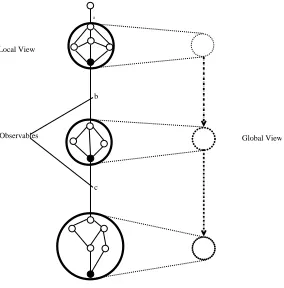
Observables Local View
Global View a
c
[image:27.612.254.396.32.176.2]b
Figure 1.1: Mapping local view to global view for a process
Business Processes Consider a business process, with internal processes, transitions and stages. The outside observer, for example a manager, does not need to know the details of the internal processes, but would need to keep track of deliverables. This can be achieved by reporting or by maintaining a list of checkpoints or observables, actions marking stage transitions. The external entity would then keep track of particular terminal states marking end of a stage and transitions from them leading to the next phase in the process.
A cluster of local states and transitions separated by designated terminal states and checkpoints or observables can be viewed as an aggregate that can map to a state in the partial global view, and this view maybe what is required by an external entity to infer progress in the underlying process. Figure 1.1 illustrates this process.
1.6
Thesis Roadmap
Part I presents background work, the material there is not my work apart from the analysis where given, the updated taxonomy and the survey of the related areas from the given references. In Part I ;
1. Chapter 2 provides a theoretical back drop presenting background research in termination detection, detailing models, algorithms and their taxonomy.
2. Chapter 3 Briefly discusses multiagent systems, their agent model of computa-tion, distributed systems and the process or object model.
In Part II, Chapter 5 presents
1. Definitions related to protocols, and defines minimal protocol information agents can make available.
2. A termination detection model, comprising a conversation model, a set of pred-icates and algorithms for their implementation.
3. A distributed protocol for termination detection and distribution possibilities.
Part III presents experimental details and results, with
1. Chapter 6 detailing experimental setup, prototype implementation, experimen-tal design, and detailing data collection and analysis,
2. Chapters 7 , 8 , 9, 10 presenting experimental results and data analysis,
4. Appendices A to I providing supplementary background material, illustrations, further analysis or repeated data analysis , data summaries for the experimental part of the work. These appendices can be consulted when referenced in the thesis for illustrations if necessary.
1.7
Summary
The research documented in this thesis is about termination detection in multiagent systems. The problem is encountered and widely researched in distributed systems. There are benefits of applications that can be accrued in considering this problem in multiagent systems, but this requires consideration of properties of agents such as flexible interaction and coordination through interaction protocols, autonomy, possi-ble runtime protocol discovery, protocol specification revision and dynamic execution of coordination protocol with flexible roles. Therefore this highlights the need to re-consider research with respect to agents, observing that agents being autonomous, they can make available additional information about protocols they are executing.
This research proposes contributions at two levels, at a theoretical level, a considera-tion of the terminaconsidera-tion detecconsidera-tion problem in the agent model, and at a practical level implementing and experimentally evaluating a mechanism for termination detection in a multiagent environment.
PART I
CHAPTER 2
State of the art in Termination detection in distributed
Systems
The problem we wish to discuss in this thesis was originally formulated in the area of distributed systems. This chapter serves to provide a self contained survey of the history and state of the art in the area of distributed termination detection. The purpose of this being to provide a context and the theoretical underpinnings for the proposed research work in this area within multiagent systems.
The chapter is structured as follows; A general introduction to the field is first given, illustrating briefly application areas, terminology, models, and then the problem for-mulation. A taxonomy and example classical algorithms are then discussed next. Then finally a selection of recent algorithms is presented to reflect current activity in the field.
2.1
Introduction and Background
Distributed termination detection (from hereon referred to as DTD) is a fundamental problem in distributed computing. It is a classical problem of distributed control, and it is considered to be of practical, algorithmical, theoretical and methodical importance [227].
The termination detection problem is related to the more general problem of detection of global predicates, a fundamental problem in debugging and monitoring [16].
In general, a distributed system can be viewed as a set of autonomous processes which cooperate with each other to compute a task. To coordinate computation and exchange data, processes may communicate with each other by message-passing. Termination detection refers to the necessity of determining whether the system has entered a silent status where all processes are idle and no computation is possible to take place in the future [233].
The level of difficulty to detect such a status depends on the nature of the distributed system, but is usually non-trivial due to the variation of processor speeds and the un-predictable delays of the message delivery and the absence of global clocks. The distributed termination problem was first identified by [78], and has since inspired a lot of research interest as reflected in various literature, (e.g. [77, 231].
Application of Distributed Termination Detection DTD has many applications: It serves an important role in the diffusion computation [78, 233] and the distributed
workpool models which are commonly used in distributed and parallel computational
models [7]. The work pool or the task pool model is characterized by a dynamic mapping of tasks onto processes for load balancing in which any task may potentially be performed by any process. There is no desired preassignment of tasks onto pro-cesses [7]. The mapping may be centralized or decentralized. [139] observes that, in a workpool, if the work is generated dynamically and a decentralized mapping is used, then a termination detection algorithm would then be required so that all processes can actually detect the completion of the entire program (i.e., exhaustion of all potential tasks) and stop looking for more work.
Furthermore, the terminated status of a distributed system is among the stable states (such as global communication deadlock, token loss) that should be known for system administration [233]. It has also been shown that termination detection schemes can be applied to solve other distributed computing problems such as deadlock detection, checkpointing [64], and crash recovery among others.
2.1.1 Overview and terminology
A distributed algorithm terminates when it reaches a terminal state, a configuration in which no further event is applicable.
Techniques have been developed to make termination explicit by distributively detect-ing that the program has reached a terminal configuration. These are the techniques we set out to explore in this section.
A very informal problem statement can be formulated as follows; Given a network of
nodes; each message sent is received after some period of time later. After having received a message, a passive node becomes active; the receipt of a message is the only mechanism that triggers for a passive node its transition to activity. For each node, the transition from the active to the passive state may occur spontaneously. The state in which all nodes are passive and no messages are on their way is stable: the distributed computation is said to have terminated. The purpose of the algorithm is to enable one of the nodes, say node 0, to detect that this stable state has been reached.
Definition of termination detection Consider this informal definition by [161],
A distributed computation is considered globally terminated if every
pro-cess is locally terminated and no messages are in transit. Locally
termi-nated can be understood to be a state in which the process has finished its
computation and will not restart unless it receives a message.
Consider a formalisation given by [233], summarised here, quote;
A distributed system consists of a set of processesS ={P1, P2...., Pn}which
cooper-ate with each other to complete a job. Processes can communiccooper-ate with each other by message-passing. Logically, from eachPi to eachPj there is a communication
chan-nelCi,j. A process may switch between two states: active and idle. A process when
performing some computation is said to be in the active state. An active process is free to send/recieve messages and may become idle spontaneously. On idle state, a process does not perform any computation, but can passively receive messages, on which event it becomes active immediately and starts computations. For distinction , computation carried out and messages transmitted by the system are called basic computation and basic messages respectively.
The distributed system is said to be terminated iff (i) Pi is idle and (ii)Ci,j is empty
unpre-dictable and any hidden message will wake up the system later). When terminated , no distributed process can become active and perform any further computation. Extra messages, called control messages are sent , or extra information associated with basic messages to detect such a state. This is the distributed termination detection problem [233].
So the following definition follows;
Definition 1. Termination detection
LetPi(t)denote the state (active or idle) of processPi at time t andCi,j(t)denote the
number of messages of messages in transit in the channel at an instanttfrom process Pito processPj. A distributed computation is said to be terminated at time instantt0
iff:(∀Pi(t0) =idle)∧(∀Ci,j(t0) = 0).
2.2
Classical Algorithms and Taxonomy
In early research in the areas, (1980’s) the termination detection algorithms were iden-tified roughly fall into two categories, namely;
• Tracing algorithms (computation tree based). Algorithms of this type follow the
computation flow by tracing active nodes along the message chains that activated them, and call termination when all traced activity has ceased.
• Probe algorithms (wave based) A probe is a distributed activity that visits all
processes in the network (can be implemented by a token circulating on a ring or by an echo mechanism.
col-lectors [130].
The next section considers in more detail, the two classes of algorithms given in the taxonomy above and gives example algorithms.
2.2.1 Tracing Algorithms
A tracing algorithm relies on the knowledge of the set of initially active nodes, be-cause all activity of the computation originates from these nodes by message chains. Solutions of this type are based on maintaining dynamically a directed graph, called a computation graph (spanning tree), of which the nodes include all active processes and all basic messages in transit [226].
Termination is detected when the computation graph becomes empty. One requirement is that the network be bi-directed , i.e. messages can be sent in two directions via each channel. The Dijkstra-Scholten algorithm [78] describes a solution for centralized ba-sic computations, in which the computation graph is a tree with the initiator as the root (the only node initially active). The Shavit-Franchez Algorithm [206] generalises this solution to decentralised basic computations and uses a forest, in which each initiator of the basic computation is the root of a tree.
To illustrate in detail this class of algorithms, we consider the details of the Dijkstra-Scholten Algorithm below.
The Dijkstra-Scholten Algorithm The algorithm of Dijkstra and Scholten detects the termination of a centralised basic computation ( called a diffusing computation [78]). The initiator of the algorithm (called the environment) also plays an important role in the detection algorithm.
– i – Every node1maintains a counterc. Sending a message increasescby one; the receipt of a message decreasescby one. The sum of all counters thus equals the number of messages pending in the network. Whennode0initiates a detection probe, it sends a token with a value0tonodeN−1. Everynodeikeeps the token
until it becomes passive; it then forwards the token tonodei−1 increasing the token value byc.
– ii – Every node and also the token has a colour (initially all white). When a node receives a message, the node turns black. When a node forwards the token, the node turns white. If a black machine forwards the token, the token turns black; otherwise the token keeps its colour.
– iii – Whennode0 receives the token again, it can conclude termination, if
• node0is passive and white,
• the token is white, and
• the sum of the token value andcis 0.
Otherwise,node0may start a new probe.
A formalisation of this algorithm in given in ([226]), and is given in Appendix I, page 346.
2.2.2 Wave-Based Solutions
Applications of the algorithms discussed above require that communication channels are bidirectional; for each basic message sent from p to q a signal must be sent from q to
p. The average message complexity equals the worst case complexity; each execution
1
requires one signal message per basic message, and in the case of the Shavit-Francez algorithm, exactly one wave execution [226].
Wave based algorithms are based on the repeated execution of a wave algorithm; at the end of each wave, either termination is detected, or a new wave is started. Termination is detected if a local condition turns out to be satisfied in each process [226].
Dijkstra-Feijen-Van Gasteren [77] is an example of a wave based algorithm. It detects termination of a basic computation using synchronous message passing.
But the synchronous message passing assumed in that algorithm is a serious limitation on its general application, hence several generalisation of it to computations with asyn-chronous message have since been proposed , e.g. Safra’s algorithm which introduces message counting, counting messages sent and received in order to establish that no messages are under way [160] has similarly introduced an algorithm based on vector counting but which maintains a separate count for each destination.
It is worth noting that an alternative to maintaining message counts is to use acknowl-edgements. [177] has proposed a variation of the Dijkstra-Feijen-Van Gasteren al-gorithm to use acknowledgements, though the resulting alal-gorithm does not offer an improvement on the Shavit-Franchez algorithm.
2.2.3 Other approaches to termination detection
An alternative view of termination detection algorithms research is to consider a num-ber of approaches in the existing literature for developing algorithms for the termina-tion detectermina-tion problem and identify a wider range of categories. These are discussed extensively in [4] and summarised here.
that termination of a distributed computation is a stable property.
It follows therefore that if a consistent snapshot of a distributed computation is taken after the distributed computation has terminated, the snapshot will capture the termination of a computation. Algorithms using this approach often assume that there is a logical bidirectional communication channel between every pair of processes. Communication channels are assumed to be reliable but non-FIFO and message delay is assumed arbitrary but finite.[46] and [116] discuss using distributed snapshots for termination detection.
2. Using weight throwing . In this approach there is a controlling process. A com-munication channel exists between each process and the controlling process. All processes start off in the idle state and are assigned a weight of zero, whilst the controller process is assigned weight of one. The computation starts with the controlling process sending a basic message to one of the processes. That pro-cess becomes active and the computation starts. Weights are bounded between zero and one , i.e. weightW (0< W <1). When a process sends a message it sends a part of its weight in the message. On receiving a message a process adds the weight received in the message to its weight. Thus the sum of weights on all the processes and on the message in transit is always one. On becoming passive a process sends its weight to the controlling agent in a control message. The con-troller add this to its weight. If its weight becomes one, the concon-troller concludes termination. [161] and [117] discuss algorithms based on weight throwing.
3. Using spanning tree. AssumingN processesPi,0 ≤ i ≤ N, the processes are
for termination detection. This process communicates with other processes to determine their states. Messages used are called signals. All leaf nodes report to their parents if they are terminated. A parent node will similarly report to its parent when it has completed processing and all of its immediate children have terminated and so on. The root concludes that termination has occurred, if it has terminated and all of its immediate children have also terminated.
4. Message optimal. Algorithms using this approach attempt to optimise and re-duce inefficiencies in message complexity when concluding termination, for ex-ample in spanning tree based algorithms. [143] discusses such a message op-timal algorithm, using a network represented by G = (V, E), where V is the set of nodes andE ⊆ V ×V is the set of edges or communication links. The communication links are bidirectional and exhibit FIFO property.The algorithm assumes the existence of a leader and a spanning tree in a network
devel-oped a number of algorithms based on the atomic model.
6. Fault tolerant methods assumes processes may fail, particularly fail in a fail-stop manner. Algorithms here detect termination in this environment. For example based on the weight throwing scheme a scheme called flow detecting scheme is developed by [48] to derive a fault tolerant termination detection algorithm.
Some selected with some optimisations and robustness considerations are presented in Appendix I, page 348.
In addition to the above there are also attempts to develop a general computing model for termination detection. An example of such work is discussed in detail in [37]. The next section provides a brief summary of concepts discussed and introduced there.
2.3
A general computing model and termination detection
[37] introduces a general distributed computation model, termination definitions, some terminology and predicates relating to termination detection and finally algorithms for the given termination definitions.
So far the assumption has been that the reception of a single message is enough to activate a passive process. In the general model introduced by [37], a passive process does not necessarily become active on the receipt of a message, instead a condition of
activation of a passive process is more general and a passive process requires a set of
messages to become active. This requirement is defined over a setDSi of processes
from which a passive processPi is expecting messages. The setDSi associated with
a passive processPi is called a dependent set ofPi. A passive process becomes active
The Communication model: A distributed application program (whose execution is traditionally called the underlying computation) is composed of a finite set P of processes Pi, i = 1, .., n, interconnected by unidirectional transmission channels; the
channel Cij links the sender Pi to the receiver Pj. Processes communicate only by
exchanging messages through channels; there is neither common memory nor a global
clock, [37].
Communication is asynchronous in the following sense:
1. A sender sends a message to a channel (which then has responsibility for its delivery) and then the sender immediately continues its own execution;
2. Channels do not necessarily obey the FIFO (first in first out) rule, but they are reliable (no loss, no corruption, no duplication, no spurious messages);
3. Channel transfers (carries) a message to its destination process, the receiver puts it in its local buffer: the message has then arrived. The arrived message can then be consumed provided that its receiver has been activated, i.e. when the request of receiver has been fulfilled;
4. The transfer delay (time elapsed between sending and arrival of a message) is finite but unpredictable.
The process model: in addition to the discussed process model, there is a further requirement expressed by an activation condition (see below) defined over the set DSi
of processes from which a passive process Pi is expecting messages [37]. The set DSi
associated with a passive process Piis called dependent set of Pi. A passive process can
A passive process that has terminated its computation is said to be individually
termi-nated, its dependent set is empty and therefore it can never be activated [37].
Request models: Formulation of activation conditions strictly depends on the re-quest model considered.
1. AND model:- In this model a passive process Pi can be activated when a
mes-sage from every process Pjbelonging to DSihas arrived. It models receive
state-ment that is atomic on several messages [37].
2. OR model:- In the OR model, a passive process Pi can be activated when a
message from any process Pj belonging to DSi has arrived. It models classical
non-deterministic receive constructs [37].
3. Other more complex models such as OR-AND, Basic k out of n and Disjunctive
k out of n models are presented in [37].
In order to abstract the activation condition of a passive process Pi, a predicate fulfilledA
can be considered, where A is a subset of P, the set of all processes. Predicate fulfilledA
is true if and only if messages arrived (not yet consumed) from all processes belonging to the set A are sufficient to activate process Pj. The following monotonicity property
is valid: if X⊆Y and fulfilledX is true, then fulfilledYis also true [37].
Termination definitions: The following notations are introduced to formally define terminations of distributed computations. The notation used here is introduced in [37].
1. passivei: true iff Piis passive;
2. empty (j, i) : true iff all messages sent by Pjto Pihave arrived at Pi; the messages
3. arri (j) : true iff a message from Pj to Pi has arrived and has not yet been
con-sumed by Pi;
4. arri = { processes Pj such that arri (j) };
5. nei = {processes Pj such that¬empty (j, i) }.
Dynamic termination: The set P of processes is said to be dynamically terminated at some time if and only if the predicate Dterm is true at this moment, where:
Dterm≡ ∀Pi∈P: passivei ∧ ¬fulfilledi ( arri ∪nei ) [37].
This notion of termination means that no more activity is possible from processes, though messages of the underlying computation can still be in transit (represented by possibly non empty sets nei in the predicate ). This definition is interesting for early
detection of termination as it allows to conclude a computation is terminated even if some of its messages have not yet arrived [37]. It can be shown that once true, the predicate Dterm remains true, thus dynamic termination is a stable property [37].
Static Termination The setP of processes is said to be statically terminated at some time if and only if the following predicate is true at this moment:
Sterm≡ ∀Pi ∈P: passivei∧(nei =∅)∧ ¬fulfilledi( arri) [37].
For this predicate to be true, channels must be empty and processes cannot be acti-vated. Thus this definition is based on the state of both channels and processes. When compared to Dterm, the predicate Sterm correspond to "late" detection as, additionally, channels must be empty.
Given this model, static and dynamic termination detection can be discussed, this dis-cussion is given in Appendix I, page 350 with some illustrations.
2.4
A contemporary taxonomy for distributed termination
detec-tion algorithms
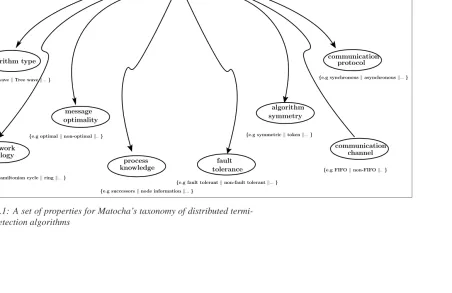
[159] provides a more complete and detailed taxonomy for distributed termination detection algorithms, partitioning the algorithms according to the following eight clas-sification categories;
1. The algorithm type . This considers the general action of the algorithm. For example most common method for constructing DTD algorithms is to consider creation of a wave algorithm.
2. The required network topology. Many DTD algorithms assume a particular net-work topology for the nodes to allow correct and efficient definition of the algo-rithm. Hamiltonian cycles, trees,spanning trees, rings etc. are often assumed.
3. The algorithm symmetry. If each process executes an identical algorithm, and no process is distinguished from others for any purpose, then the DTD algorithm is considered symmetric.
4. The required process knowledge. Some DTD algorithms can assume that the process have knowledge of the system initially. An assumption can be made for example about the static size of the network. It can be observed that given that this knowledge is required at compile time, this makes the particular algorithm less general and restricts the network from changing.
processes [109]. CSP is an asynchronous protocol and the resulting protocol were elegant, e.g. [92].
6. The communication channel behavior. The communication channel can be con-sidered to be first-in first-out (FIFO) or non-FIFO. Algorithms assuming FIFO are easier to construct e.g. [168]. FIFO channel can be achieved for example with a network protocol, which can guarantee that eventually messages reach an application in FIFO order. On the other hand a non-FIFO protocol is more general as it can work with both type of channels, e.g. [78, 160].
7. The message optimality. It can be shown that there is a worst case lower bound on the number of control messages used by a DTD algorithm, e.g. [45]. This bound means that for each message sent in the basic computation, there is a con-stant number of control messages to determine when termination has occurred.
8. Fault tolerance. This is a non-functional requirement that the algorithm is robust to failures of the network and individual nodes, important in distributed systems.
This taxonomy, 2 and its elements are depicted in Figure 2.1. We have also extended
and updated this taxonomy to reflect and incorporate algorithms that have since been subsequently developed.
algorithm type
DTD Algorithms
communication protocol
symmetry algorithm
topology network
message optimality
process knowledge
communication channel
tolerance fault
{e.g synchronouskasynchronousk...}
{e.g FIFOknon-FIFOk..} {e.g symmetricktokenk...}
{e.g fault tolerantknon-fault tolerantk...} {e.g successorsknode informationk...}
{e.g treekhamiltonian cyclekringk...}
{e.g optimalknon-optimalk..} {e.g cyclic wavekTree wavek...}
3
[image:47.612.160.743.155.448.2]Algorithm Cyclic
wave Tree
wave
General
wave
Non-repetitive
wave
Parental
re-sponsibility
Credit
re-covery
Other
(Francez,1980) X
(Dijkstra & Scholten,1980)
(Francez et. al, 1981) X
(Misra & Chandy, 1982) X
(Chandy &Misra, 1985) X
(Szymaski et. al, 1985) X
(Mattern 1987) X
(Muller, 1987) X
(Huang, 1988) X
(Mattern, 1989) X
(Vankatesan, 1989) X
(Lai et al.,1992) X
(Wang and Mayo, 2004) X
Table 2.1: DTD algorithms and their associated type, adapted from [159]
3
Appendix I from page 356 presents recent research activity and the updated taxonomy in the rest of the tables from tables ( Table I.1 through to I.7) for the other categories of the taxonomy.
A note on evaluating the performance of DTD algorithms Regarding performance analysis and measurement of DTD algorithms, a set of metrics can be considered. Three metrics are often deemed adequate [169], namely;
1. Detection latency. This measures the time elapsed between when the underlying computation terminates and when the termination algorithm actually announces termination. When computing this latency some algorithms e.g. [169] assume that message delay is at most one unit, similar assumptions are made in [144] and [48] when analysing detection latency of their algorithms. In addition message processing time is often deemed negligible.
2. Message complexity. This refers to the number of control messages exchanged by the termination detection algorithm in order to detect termination. Some algorithms as discussed above claim to be message optimal.
3. Message-size complexity. This means the size of control data as payload on the message by the termination detection algorithm.
2.5
Summary
DTD has been observed to be related to other distributed computing problems such as global snapshot detection and distributed garbage collection. Indeed there is an important link between termination detection and garbage collection as first described by [227].
Many distributed algorithms have since been proposed to solve the problem after it was first conceived of by Dijkstra and Scholten when discussing diffusing computations.
This chapter has provided a detailed survey of the classical distributed termination de-tection problem as formulated for the communicating process model and the numerous solutions that have been since put forward. First the survey considered the classical algorithms and a taxonomy that partitioned the algorithms into wave and probe type algorithms.
section 2.4 introduced a contemporary taxonomy, due to Matocha, that gave eight crite-ria for assessing DTD algorithms. In tables I.1 through to I.7 in Appendix I we updated Matocha’s 1998 taxonomy of distributed algorithms with recent algorithm proposals. It can be observed there that recent algorithms are by and large asynchronous and mostly do not make assumptions about message arrivals and are claimed to be mes-sage optimal. Most of the recent research activity has been in mobile systems and wireless networks.
protocol discovery and potentially protocol specification revision , the use of seman-tically rich interaction protocols and most importantly the high levels of autonomy assumed which can manifest in agents being capable of providing additional informa-tion about their protocol execuinforma-tion at runtime which may aid terminainforma-tion detecinforma-tion process
CHAPTER 3
Distributed Systems vs Multiagent Systems
3.1
Introduction: On Agents and Multiagent Systems
Multiagent systems [220] research is multi-disciplinary and diverse. The theoretical foundations of the field can be seen in diverse areas spanning computer science, ar-tificial intelligence, logic, philosophy and linguistics, game theory, economics and sociology.
On a practical and implementation level, work on multiagent systems and agent ori-ented software engineering can be viewed as an evolution of software engineering and multiagent systems are built on and are an evolution of distributed systems with emphasis on coordination and flexible interaction and open systems. Coordination in multiagent systems is primarily cast into a communication problem and effected through interaction protocols.
Below is a incomplete list of some key issues of research in multiagent systems and some are expanded on in the next paragraphs.
–i– Agent communication languages [141] and interaction protocols [120].
–ii– Organisations [93, 27] electronic institutions and markets [75, 87].
–iii– Multiagent coordination [126, 80, 50, 25].
–v– Negotiation [22].
–vi– Agent foundations, theories, social semantics, commitments [252], social order [53], roles [132] and autonomy [179], norms [54, 151].
–vii– Agent oriented software engineering [239, 253] multiagent systems engineering methodologies [36].
–viii– Agent technologies , languages and platforms [30].
–ix– Applications [127].
Agenthood Agents and Agent-orient programming are discussed in [209, 249], where agents and multiagent systems are proposed as candidate tools for managing the plexity that is inherent in software systems. In evaluating agent based solutions, com-mon pitfalls to be considered in agent oriented development are highlighted in [248]. Multiagent systems research has not evolved in isolation but is closely related to other areas such distributed artificial intelligence [29, 175].
Agents should ideally exhibit desirable characteristics such as autonomy but there are some reservations [240] as to whether this is adequately captured and translated to real systems in the current state of the art, leading to research in efforts in computational autonomy [179]. Related to this is research on agent roles [73].
Agent interactions Agents exist in societies called multiagent systems [247, 210] and engage in collaborative (cooperative) or competitive interaction in achieving their joint or individual goals. Agents can be given strategies and protocols to engage in ne-gotiations [22] to achieve their goal. These nene-gotiations can possibly involve multiple issues, sometimes under time constraints [88]. Agents also can participate in auctions [133, 12] in electronic marketplaces. In some agents theories, agents can engage in di-alectic interactions such as argumentation [201] to resolve conflicts in there knowledge [224] or belief revision [154] for example.
Agent theories There are numerous parallel strands of research in agent theories [249]. In some theories agents can be ascribed high level mentalistic notions of beliefs, desires and intentions [196], and have social semantics like commitments defined. In practice there are various ways of implementing agents, e.g. logic based agents, and it has been the case that agents can be realised with the object paradigm (though with limitations [42]), and there are some views of agents as active objects [99].
3.2
Multiagent systems and Distributed systems
The research areas of multiagent systems and distributed systems overlap. Multiagent systems are inherently distributed systems, and distributed systems are platforms for supporting multiagent systems.
The following represent the widely accepted notions about agents (multiagent systems) and distributed systems;
stronger notion is added that of beliefs, desired, intentions for example. Agents vary in their abilities; e.g. they can be static or mobile, or may or may not be intelligent. Each agent may have its own task and/or role. Agents and multiagent systems are used as a metaphor to model complex distributed processes.
2. A distributed system is considered to be a collection of independent systems that appear to the users of a system as a single system, i.e. transparency is often a key element. Processes and/or data can (or cannot) move from host to host, share information, etc.
There are a number of areas relevant to both distributed systems and multiagent sys-tems that can be discussed to draw parallels.
Table 3.1 gives examples and compares and contrast various aspects of distributed
systems and multiagent systems, showing what is known and well understood in both areas.
Feature Distributed System Multiagent system
mobility mainly no yes
Reliability mostly yes mostly no
Availability mostly yes mostly yes
Communication simple complex
Protocols syntax-based (e.g HTTP) semantic-based (e.g.FIPA ) Automatic Garbage Collection yes manual
Termination Detection yes not well studied
Table 3.1: Comparing and contrasting various features of multiagent and distributed systems. Showing
The current state of the debate on agents is summarised in [239], and states that the debate seems to converge to the consensus below, quote;
that it allows for a qualitatively different perspective of complex systems and their development and,
–ii– there is room for both the agent concept and the object concept because they are concerned with different levels of computational abstraction.
In our research we concur with this view and seek to consider some pragmatic and practical concerns that emerge as we make a progression from developing distributed systems based on relatively simple passive objects to building infrastructures for agents. In particular we propose the argument below to motivate and highlight why some tra-ditional problems in distributed systems like the termination detection problem may need further consideration within agent computational model assumed in multiagent systems. We consider autonomy, flexibility of interactions and dynamism is multiagent environment as relevant properties, i.e.
– i – Because agents are autonomous, regarding termination detection, agents may offer additional information about the execution of their protocols to facilitate the termination detection process for example.
– ii – Regarding flexibility and dynamism, consider the flexibility of interactions in multiagent systems, in particular consider a multiagent society with provisions for dynamism in protocols, i.e. in such environments;
• There could be support for dynamic execution of coordination protocols as proposed by [31], i.e. where the role an agent intends to hold within a protocol can be played without the need of prior knowledge.
requirement. This approach can be contrasted with the traditional one where specification of protocols has largely been considered as a design-time activity.
• There could be infrastructure support for runtime protocol discovery in general.
3.3
Summary
This chapter has given a brief overview and account of the areas of multiagent systems and distributed systems by considering the underlying models of agents and objects. The current consensus is to view the notion of agents and objects not as competing but occupying different spheres and represent different levels of abstraction and therefore can coexist. With this background, we propose that there is necessity to consider some aspects of distributed systems research in light of the multiagent requirements and the agent model.
The reason for this is that while a multiagent system is a distributed system, there is emphasis on coordination, flexible interaction and higher degree of autonomy of entities and dynamism in environments. We propose to consider one aspect, namely a mechanism that detects termination of agents, by considering interaction protocols that are used by agents to flexibly coordinate. We can exploit this research to build on an agent management infrastructure that can culminate in the future with a realisa-tion of an automatic timely mechanisms for high level tasks like society wide garbage collection.
CHAPTER 4
From computer protocols to agent interaction protocols
This chapter discusses interaction protocols as used in multiagent systems. First it provides a background by considering evolution of protocols, how protocols are spec-ified and implemented using current methodologies . This thesis is not about protocol engineering or formal methods used therein for the development and verification of protocols. The purpose of the chapter is to solely provide some context and a back-drop for the discussion of the use of protocols in this thesis and also to give a basis for the choice we made on the use of finite state machines in representing protocols. To that end the chapter can be skipped without consequence to the subsequent chapters apart from noting the assumptions we make about the model of protocols we adopt as first highlighted in Chapter 1 in page 7.
4.1
Introduction
A distributed systems centric view considers protocols as sets of rules that govern the interaction of concurrent processes in distributed systems. Protocol design is therefore closely related and often discussed in the context various established fields, such as operating systems, computer networks, data transmission, and data communications [111].
specification, validation verification of protocols, software engineering challenges that also face other systems . For example, assuming a protocol designer is capable of capturing and understanding the full set of requirements, then in conceptualising and designing a protocol that meets its requirements, a language that has precise, unam-biguous semantics is needed in order to capture the protocol. Such a language is re-ferred to as a formal language [115].
For this, a large body of work exists in the formal languages area. The first task in engineering a protocol is then that of choosing an appropriate language to describe the protocol.
This chapter begins by giving a general overview of protocols, then introduces some formal models and examples of formal languages for the specification of protocols. The chapter then proceeds to discuss the state of the art in protocol engineering in multiagent systems where it is shown that by and large, the current work builds on the work done in the wider area of computer protocols. The chapter concludes by dis-cussing what is regarded as current challenges in engineering protocols for multiagent systems.
![Figure 4.2: Petri net example: A simplified model of a communication protocol,adapted from [176]](https://thumb-us.123doks.com/thumbv2/123dok_us/1623086.115414/67.612.127.514.35.261/figure-petri-example-simplied-model-communication-protocol-adapted.webp)
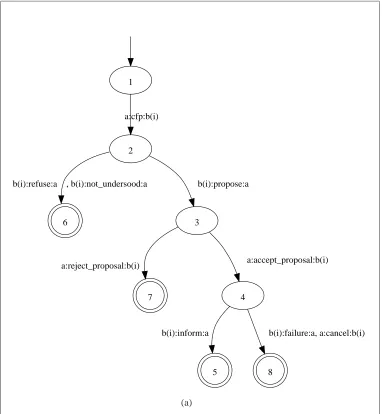
![Figure 4.4: FIPA contract-net protocol adapted from [1].](https://thumb-us.123doks.com/thumbv2/123dok_us/1623086.115414/76.612.165.567.106.518/figure-fipa-contract-net-protocol-adapted-from.webp)
![Figure 5.1: Contract Net protocol [215]. Showing roles in the protocol and withindexing is used to identify protocol participants.](https://thumb-us.123doks.com/thumbv2/123dok_us/1623086.115414/86.612.155.493.43.358/contract-protocol-showing-protocol-withindexing-identify-protocol-participants.webp)