Abstract — This paper presents the study of a novel all-optical method for processing all-optical CDMA signals towards improving suppression of multi access interference. The main focus is on incoherent OCDMA systems using multiwavelength 2D-WH/TS codes generated using FBG based encoders and decoders. The MAI suppression capabilities based on its ability to eliminate selective wavelength pulse processing have been shown. A novel transmitter architecture that achieves up to 3dB power saving was also presented. As a result of hardware savings, processing cost will be significantly reduced and power budget improvement resulted in improved performance.
Keywords — Fiber Bragg Grating, Optical CDMA, all-Optical Signal Processing.
I. INTRODUCTION
PTICAL code division multiple access (OCDMA) has a unique soft blocking property that enables the trade off between performance and number of simultaneous users [1]. This explains why it has been suggested as a possible alternative to both time division multiple access (TDM) and wavelength division multiple access(WDM). Another advantage of OCDMA is the elimination of centralized control and management associated with TDM and WDM thereby reducing latency. Depending on their implementation, OCDMA can be categorised as coherent and incoherent [2]. Coherent OCDMA involves manipulation of the phase characteristics of an optical signal to poduce the codes which can be bipolar. On the other hand, incoherent Optical CDMA involves the intensity modulation of the optical spectrum of the signal. All the spectral components are passively sent as a single optical beam to all receivers. The incoherent two-dimensional wavelength hopping time spreading OCDMA (2D-WH/TS) code is one of several families of codes that have been proposed for OCDMA. Becasue it combines both wavelength and time to form a single code, it can potentially support a larger number of codes than the one dimentional codes [3]. The main problem faced in practical implementations of OCDMA is multi access interference (MAI) [4]. As the number of simultaneous
This work was supported in part by the GRPe grant, the Scottish Overseas Research Award studentship and the University of Strathclyde postgraduate research students award.
Tolulope B. Osadola, Siti K. Idris, and Ivan Glesk are with The Center for Intelligent and Dynamic Communications, Electronic and Electrical Engineering Department, University of Strathclyde Glasgow. G1 1XW, UK. (Phone: +447403034903; e-mail: [email protected], [email protected], ivan.glesk@ strath.ac.uk.
users increases in OCDMA system, bit error performance degrades. In incoherent OCDMA systems which use intensity modulation and direct detection (IM/DD), every user is assigned a unipolar address code for identification. Because of this, overlapping between chips is inevitable. Bit errors occur when the peak of disturbance pulse exceeds the threshold of receiver. Several methods have been proposed to either eliminate or significantly supress MAI in 2D-WH/TS OCDMA. Some of these methods include the use of optical thresholding [5], and also a parallel interference calcellation receiver [6].
In this paper, we demonstrate a novel simple all optical signal processing method for reducing MAI in incoherent 2D-WH/TS OCDMA. In section II, we provide background information about 2D-WHTS OCDMA, section III presents a novel transmitter architecture that enables power savings and cost savings, section IV descibes the process of incoherent OCDMA detection in detail including how MAI is originated. The proposed method of MAI suppression is discussed in section V while section VI concludes the paper.
II. 2D-WH/TSOCDMAENCODING
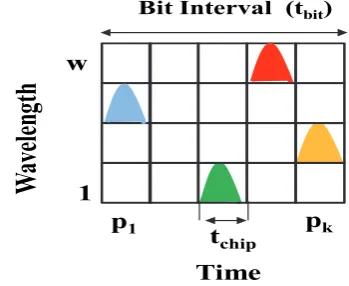
Fig. 1 shows a typical wavelength hopping time spreading OCDMA code generated using a 2D algebraic approach.
Fig. 1. A concept of 2D-Wavelength-Hopping Time-Spreading (2D-WH/TS) OCDMA code, where pi is
number of used time chips and w is number of used wavelengths (a code weight).
As shown in Fig. 1, the code sequences are represented as (p1 p2 … pk) binary (0, 1) matrices of length p1 p2 … pk,
weight w, and k being a set of prime numbers {p1 p2 … w
1
p1 pk
Bit Interval (tbit)
tchip
Wa
ve
len
gt
h
Time
Improving Multi Access
Interference Suppression in Optical CDMA by
using all-Optical Signal Processing
Tolulope B. Osadola, Student Member IEEE, Siti K. Idris, and Ivan Glesk, SeniorMember, IEEE
[image:1.595.332.507.533.676.2]pk}. Note that w is also the number of rows, relating to the
number of available wavelengths, and p1 p2 … pk is the
number of columns, relating to the length of the matrices. Each matrix consists of one pulse (i.e., binary one) per row and each pulse in a matrix is assigned with a distinct carrier wavelength, the code has zero autocorrelation side lobes (λa = 0) and a cross-correlation function of at most one (λc = 1). Therefore, any 2D-WH/TS code matrix can be described as a set of ordered pairs, where an ordered pair (w, pk) records the vertical and horizontal position of a
binary one from the bottom-leftmost corner of a matrix, w represents the wavelength and t shows the (time or chip) position of a binary one in the matrix. The wavelength hopping time spreading code can thus be denoted as a class of (w × p, 0, 1) where w is the number of wavelengths and p is the number of chips.
In incoherent OCDMA, each user transmits using uniquely assigned codes. At the transmitter, an On/Off keying (OOK) method is used to modulate the optical channel which is a unipolar OCDMA code sequence generated by the encoder. The code sequence is unique to each user. In the same way, several other users’ data are encoded differently using separately assigned codes. All the separately encoded data are subsequently combined and launched into a single optical fiber for onward transmission.
Various methods have been demonstrated for the generation of OCDMA codes [5] – [8]. The most common source of optical pulses used to generate multiwavelength OCDMA codes is the supercontinuum generation. This method is particularly useful because of its ability to generate picosecond pulses having a very broad spectrum [7].
Fig. 2 shows OCDMA code generation from a supercontinuum using arrayed waveguide gratings (AWG) based OCDMA encoding [8].
Fig. 2. 2D-Wavelength Hopping Time Spreading OCDMA code generation using arrayed waveguide gratings (AWG). The code matrix is generated by first passing the input multiwavelength pulse (supercontinuum) through the AWG. Each output port of the AWG produces separate wavelength pulses which then undergo the appropriate delays it needs in order to form the code sequence. The optical attenuator is added for power control between these pulses. All the individually separated pulses are then
[image:2.595.320.515.141.209.2]combined together to form the OCDMA code. Another method that can be used to generate OCDMA codes is the use of thin film filters (TFF) [9], [10]. As shown in Fig. 3, the thin film filter performs the same functions as the AWG, in addition, delay and attenuation is needed in order to obtain the required OCDMA code.
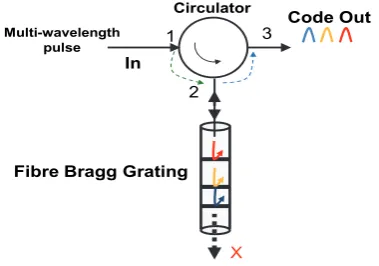
[image:2.595.334.524.364.497.2]Fig. 3. 2D-Wavelength Hopping Time Spreading OCDMA code generation using thin-film filters. The fiber Bragg grating (FBG) has also been developed for OCDMA encoding and decoding [11], [12]. The advantage of fiber Bragg grating en/decoders is the integrated function of wavelength separation and pulse delay. Also, the fiber Bragg grating can be easily miniaturized to save space. Fig. 4 shows the process of generating incoherent 2D-WH/TS OCDMA code using fiber Bragg gratings.
Fig. 4. 2D-Wavelength Hopping Time Spreading OCDMA code generation using integrated fiber Bragg
gratings.
In the next section we will discuss more about 2D WH/TS OCDMA traffic generation using fiber Bragg grating encoders.
III. NOVEL POWER SAVING ARCHITECTURE FOR FBG BASED OCDMA CODE GENERATION
In this section, we present a novel architecture that will enable both cost and energy savings in the process of generating incoherent FBG based 2D WH/TS optical CDMA codes. Fiber Bragg grating (FBG) based optical reflectors have been widely used for the purpose of encoding and decoding optical code division multiple access (OCDMA) data. Both coherent OCDMA and incoherent OCDMA codes can be generated using carefully designed fiber Bragg gratings.
In our previous experiments involving FBG based OCDMA codes; the multi wavelength source signal is usually distributed equally to all users as shown in the transmitter architecture illustrated in Fig. 5 below [13].
In
Code Out Multi-wavelength
pulse
Thin-film
Filter N x 1 D
D
D
Multi-wavelength
pulse 1
2
Fibre Bragg Grating
Circulator
In
3 Code Out
[image:2.595.58.288.502.649.2]Fig. 5. Architecture of a multiuser OCDMA signal generation. The input multiwavelength pulse is splitted N
times and distributed to each of the FBG based OCDMA transmitters representing up to N simultaneous users.
Mod-Modulator.
Here, we conducted an experiment to determine the ratio of input multi wavelength pulse to the resulting encoded optical signal. In the experiment, an optical supercontinuum (multi wavelength pulse) with peak power reduced to 0dBm was passed into an FBG based OCDMA encoder via the input port of an optical circulator (port 1 in Fig. 4) and the output power of the encoded signal was measured (at port 3 of the circulator).
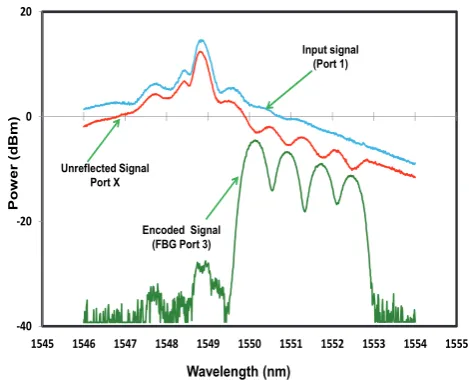
Also, the power of the unreflected supercontinuum passing through the FBG was measured. Fig. 6 shows the spectrum of the input optical supercontinuum, the resulting encoded optical signal and unreflected optical supercontinuum that was transmitted through port X (see Fig. 4) of the FBG encoder is also shown.
From the experiment, it was observed that for the 0dBm input optical supercontinuum, the average power of the encoded optical signal output (at port 3) is -14.6dBm and the average power of the optical supercontinuum that passed through the FBG encoder without being reflected is -3dBm. This implies that only about 20% of the optical power that enters into the FBG based optical en/decoder is reflected and actually forms part of the encoded signal, while up to 80% of the input optical supercontinuum is not used in the encoding process.
When we consider a specific application where 17 simultaneous users are required, it is not possible to obtain off-the-shelf splitters that will split 17 times, hence going by the “power of 2” splitting rule, a 1×32 optical splitter will be required to distribute the optical supercontinuum to only 17 OCDMA transmitters. If the power of the multi wavelength pulse is 0dB, then the average power for each OCDMA encoded user signal exceeds 29.6dBm considering the 15db loss associated with the 32 times splitting and the 14.6dB loss in the gratings.
Also, knowing that majority of the input optical supercontinuum into each encoder is not being utilized; this method of optical power distribution might therefore
Fig. 6. Optical spectrum of (a) multi wavelength signal input from port 1 (b) unreflected signal coming out of port
X of the encoder and (c) OCDMA encoded signal output from port 3 of the FBG based OCDMA encoder. not be the most energy-efficient. It is therefore necessary to find new architectures that will enable us to make use of the unutilized optical source signal.
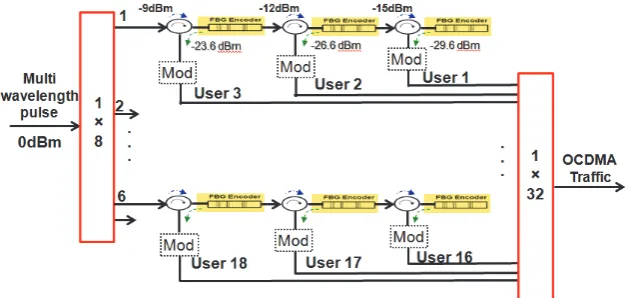
As an alternative to the transmitter architecture in Fig. 5, let us cascade several OCDMA encoders as illustrated in the new architecture shown in Fig. 7. In this novel architecture, each OCDMA encoder is supplied with unutilized multi wavelength optical source signal by the encoder preceding it. The major difference between the transmitter architecture in Fig. 5 and that of Fig. 6 is that a cheaper 1×8 optical splitter can now be used to replace the more expensive 1×32 optical splitter while up to three separate FBG based OCDMA encoders can be cascaded to reuse the unreflected optical supercontinuum from the preceding FBG based encoder thereby achieving 24 users.
The power budget analysis of the new cascaded architecture shows that it is possible to improve the output power of some of the cascaded users by ~6dB. Also, none of the users have output powers less than 29.6dBm even though the architecture has been changed. Using the architecture in Fig. 7 instead of the traditional method as depicted in Fig. 5, we have been able to practically achieve power savings of up to 3dB for a 4- user OCDMA system.
One major drawback associated with the integrated function of the fiber Bragg grating code generator is that if the pulse powers of the generated code are not equal, (which can happen as a result of imperfections in the manufacturing process or other intrinsic material properties of the fiber) it is not easy to selectively attenuate or equalize the powers as can be done if the code was generated using AWG or TFF based code generators.
IV. ORIGIN OF MULTI-ACCESS INTERFERENCE IN A 2D-WH/TSOCDMASYSTEM
As already known, incoherent OCDMA signals use intensity modulation to convert electrical data to optical data that can be transmitted through the optical fiber.
...
OCDMA
Traffic
Mod
N x 1 1
x
N Mod
Multi wavelength
Pulse
Mod
User 2
User N User 1
‐40
‐20 0 20
1545 1546 1547 1548 1549 1550 1551 1552 1553 1554 1555
Encoded Signal (FBG Port 3) Unreflected Signal
Port X
Input signal (Port 1)
Pow
e
r (
d
B
m
)
[image:3.595.60.288.59.245.2]Fig. 7. Modified architecture of the multiuser FBG based OCDMA signal generation. The encoders have been cascaded to enable the reuse of unreflected multiwavelength optical. The input optical splitter has also been replaced with a
cheaper alternative. Mod-Modulator. In the same way, the detection process at the receiver
employs direct detection of the optical signal by converting the optical signal to electrical form using the photodiode. However this conversion only takes place after the encoded signal has been decoded optically.
[image:4.595.57.284.484.643.2]Fig. 8 illustrates the decoding process of an OCDMA signal. The process involves passing the encoded signal which contains information from multiple users through a reciprocal operation of the encoding process. This is done in a manner that will ensure that only the pulses corresponding to one single user (desired user) out of the multiple users are completely overlapped. This overlapping produces an autocorrelation signal. Because of the presence of other transmitting users, the decoder output signal also consists of cross correlations formed by pulses from other users codes, this forms the multi access interference (MAI).
Fig. 8. Illustration of the decoding process of OCDMA encoded data showing the desired user signal (autocorrelation) and MAI (cross correlations). The resultant decoded optical signal (autocorrelation + cross correlations) is then converted to an electrical pulse by a photodiode and sent to the threshold detector. The threshold detector makes the decision whether an autocorrelation signal actually represents a transmitted digital bit “1” or a zero was transmitted.
The threshold detection is achieved by setting a decision
threshold for the autocorrelation signal power above which the detector decides a “1” was transmitted and below which the signal is decided to be “0”. For optimum performance, the threshold is usually set equal to the code weight w. To improve performance, OCDMA receivers can also employ hard limiting, and time gating, [14], [15].
For a receiver with the hard limiter, if the input light intensity at a time instant is greater than or equal to a fixed decision threshold, th, the intensity of the output is clipped to a fixed level. If the light intensity falls below the threshold, the hard limiter will clip its output to zero. Thus in the event that the threshold of the detector is set equal to the code weight w (usually done for better performance), any autocorrelation signal whose height falls below the code weight is automatically clipped to zero.
Also, the use of time gating [15] can be employed in OCDMA systems in order to minimize the effect of multiple access interference (MAI). Usually located immediately after the decoder, an OCDMA receiver’s time gate (gating window) is tuned to match the time width of the decoded autocorrelation signal. This ensures that only the desired autocorrelation signal is passed onto the detector and cross correlation signal is rejected; thereby reducing errors due to MAI. However, in order to achieve effective time gating, especially in systems in which the codes are generated using picosecond pulses, effective and accurate synchronization is required. Most importantly, it is preferable for the synchronization clock to be recovered directly from the data signal. An all optical method for clock recovery from 2D-WH/TS OCDMA traffic has been reported in [16]. Another major requirement for all optical time gating of picosecond based OCDMA signal is that the process must be significantly fast.
In OCDMA systems with coding schemes based on multi-wavelength pulses, in order to achieve the best performance of the OCDMA system, the theory prescribes [11] that these individual wavelengths pulses within the generated OCDMA code should have equal power levels. Fulfilling this requirement is essential towards achieving the desired power relationship between auto and cross-correlation signals in the presence of MAI. This is so because during the signal detection the OCDMA receiver/decoder produces besides the autocorrelation peak
Decoder
2D - WH/TS Coded Traffic
Decoder re-aligns pulses in time
MAI
carrying data also undesired cross correlations as the result of seeing and incorrectly decoding transmitted codes from simultaneous network users.
It is obvious that depending on relative positions among individual wavelengths pulses within these individual WH/TS codes, there will be always a non-zero probability that some of these wavelength pulses during decoding process will “accidentally” overlap in such a manner which will result in cross-correlations (MAI) of similar or even taller heights than is the desired correlation peak itself [12]. This will then cause a significant data corruption resulting in undesirable degradation of bit error rate (BER).
The influence of MAI in a multiuser OCDMA system can be very severe especially in incoherent OCDMA implementations that use a simple ON/Off method of data modulation. MAI can cause a significant reduction in the total number of simultaneous users that will be able to transmit conveniently without significant deterioration in performance and this in turn impacts upon the system scalability.
However, once a signal is encoded and an OCDMA code had been generated by the FBG encoder, the individual wavelengths of the WH/TS OCDMA code cannot be any more easily individually accessed for a selective processing. In current approaches these individual wavelengths will have to be first accessed by de-multiplexing the multi-wavelength OCDMA code then individually attenuated for the proper power equalization and then multiplexed back in a similar manner to code generation using AWG and thin film filters while maintaining the original time spreading.
All the above adds additional hardware complexity and also increases the overall system cost. Therefore it is important to find alternative methods by which encoded multi-wavelength OCDMA signals are processed all optically and in a manner that will lead to an improvement in the performance of the system without introducing a distortion to the sequence of the already encoded information.
V. NOVEL MAISUPPRESSION SCHEME
We have recently demonstrated an in-situ method by which we can control the powers of individual wavelength pulses inside FBG encoded OCDMA codes without the need for demultiplexing and selective attenuation [16]. The method is based on the principle of polarization induced power diffusion which occurs when a single mode signal is passed through a multimode fiber section. The process is schematically illustrated in Fig. 9.
We then studied the effect of the in-situ wavelength power equalization technique on multi access interference suppression. The study was carried out on a transmission link which we built for high speed data transmission experiments. As shown in Fig. 9, a module containing a generic polarization controller from Fiber Control followed by a short (60cm) piece of multi mode fiber was placed before the FBG-based decoder belonging to the desired user in an OCDMA system. At this point the signal was already affected by its propagation in the 17km long
Fig. 9. Illustrating technique used to optically process in-situ an FGB based 2D-WH/TS code. The optical spectrum of the input un-equalized code and the resulting
output equalized code is shown.
[image:5.595.314.535.56.202.2]single mode fiber link outside the laboratory. As already noted in [16] the equalisation of the wavelength powers is carried out without converting the signal from optical to electrical. Therefore the all-optical signal processing was achieved without the need to for optical-electrical–optical conversion.
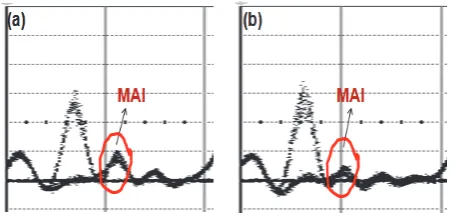
Fig. 10 shows an autocorrelation signal of a desired user in the presence of multi access interference as seen on a bandwidth limited oscilloscope for case (a) when the multiuser OCDMA signal was transmitted and received without wavelength equalization and case (b) when wavelength pulse power equalization was performed on the encoded signal just before decoding. It can be observed that the extinction ratio between the autocorrelation and the cross correlation in case (b) see Fig. 10(b) was much larger compared to the extinction ratio in case (a) see Fig. 10(a). This shows that when the wavelength power within the code becomes equalized, the magnitude of optical power in the resulting cross correlations (MAI) is much reduced.
Therefore this confirms that the wavelength pulse power equalization achieved using the in situ method provides an effective way to suppress multi access interference in fibre Bragg grating encoded 2D-WH/TS OCDMA codes. From the experiment using the multiuser testbed, we achieved a 1.5dB power budget improvement as a result of the improved MAI suppression.
Fig. 10. (a) OCDMA signal autocorrelation after decoding a single user OCDMA data from a multiuser traffic without wavelength power equalization and (b) the same
decoded signal after power equalization was performed before decoding.
OCDMA Traffic
(MMF)
PLC
λ4 λ2λ1λ3
1546.13nm 1551.72nm 1557.23nm
Po
wer
(a
.u
.) λ4 λ2λ1λ3
1546.13nm 1551.72nm 1557.23nm
Po
wer
(a
.u
.)
[image:5.595.312.540.599.708.2]VI. CONCLUSION
We have demonstrated a method for suppressing multi access interference in the OCDMA system using 2D-WH/TS OCDMA codes generated using fibre Bragg grating encoders. It utilises all optical signal processing without the need for optical-electrical-optical conversion.
The method described here will provide significant cost savings as there will be no need to first de-multiplex wavelength pulses within a code before the pulse powers can be individually controlled. It should also be noted that the method enables the simultaneous processing of wavelength pulses for all users in the OCDMA system. The method also resulted in a 1.5dB power budget improvement.
A novel transmitter architecture that achieves up to 3dB power saving was also presented. The novel architecture which involves cascading of FBG based 2D-WH/TS OCDMA encoders, ensures effective utilization of the optical source.
REFERENCES
[1] J. Berthold, “Evolution of WDM in transport networks," Optical Fibre Communication Conference and Exhibit, OFC '98, Technical
Digest, pp. 133, 22-27, Feb. 1998.
[2] I. Glesk, P. R. Prucnal, and I. Andonovic, "Incoherent ultrafast OCDMA receiver design with 2ps all-optical time gate to suppress multiple-access interference, “IEEE Journal of Selected Topics in
Quantum Electronics, vol.14, no.3, pp. 861-867, May-June 2008
[3] L. Tancevski and I. Andonovic, “Wavelength hopping time spreading code-division multiple-access systems,” Elect. Lett. vol. 30, pp. 1388-1390, 1994.
[4] C. Goursaud, A. Julien-Vergonjanne, C. Aupetit-Berthelemot, J.P. Cances, J.M. Dumas, , "MAI Impact Suppression with Parallel Interference Cancellation in DS-OCDMA Systems using Prime Codes,” Acoustics, Speech and Signal Processing, 2006. ICASSP
2006 Proceedings. 2006 IEEE International Conference on , vol.4,
no., pp.IV, 14-19 May 2006.
[5] C.-S. Bres, I. Glesk, P.R. Prucnal, "Experimental demonstration of a 2D incoherent transparent OCDMA path router," LEOS Summer
Topical Meetings, 2005 Digest of the , vol., no., pp. 205- 206, 25-27 July 2005.
[6] N. Elfadel, E. Idriss, A. Mohammed, A.A. Aziz, N.M. Saad, "Multi-user Detection for the Optical CDMA: One Stage Optical Parallel Interference Cancellation," Signal Processing, Communications and Networking, 2007. ICSCN '07. International Conference on , vol., no., pp.290-293, 22-24 Feb. 2007
[7] I. Glesk, V. Baby, C.S. Bres, P.R. Prucnal, W.C. Kwong, "Design and demonstration of a novel incoherent optical CDMA system," Military Communications Conference, 2005. MILCOM
2005. IEEE, vol., no., pp.3155-3161 Vol. 5, 17-20 Oct. 2005
[8] C.S.U. Wang; N. Wada, K.-I. Kitayama, “Multi-user asynchronous coherent OCDMA system," Optical Fiber Communication and the National Fiber Optic Engineers Conference, 2007. OFC/NFOEC
2007. Conference on , vol., no., pp.1-3, 25-29 March 2007
[9] G. Cincotti, N. Wada, and K. Kitayama, “Characterization of a full encoder/decoder in the AWG configuration for code-based photonic routers. Part I: modelling and design,” IEEE/OSA J. Lightwave
Technol., vol. 24, no. 1, pp. 103-112, Jan. 2006
[10] N. Minato, H. Tamai, H. Iwamura, S. Kutsuzawa, S. Kobayashi, K. Sasaki, and A. Nishiki, “Demonstration of 10Gbit/s-Based Time-Spreading and Wavelength-Hopping Optical-Code-Division-Multiplexing Using Fiber-Bragg-Grating En/Decoder”, IEICE Trans. Comm., vol. E88-B, no.10, pp. 3848-3854, Oct. 2005. [11] G.–C. Yang and W. C. Kwong, Prime codes with applications to
cdma optical and wireless networks, Boston: Artech House, 2002.
[12] C. Michie, R. Atkinson, I. Andonovic, I. Glesk, P. R. Prucnal; K. Sasaki, and G. Gupta, "Interferometric Noise Characterisation of a 2-D Time spreading Wavelength Hopping OCDMA Networks using FBG Encoding/Decoding," ICTON '07, vol. 1, pp. 114-117, 1-5 July 2007.
[13] T. B. Osadola.; S.K. Idris, I. Glesk,; K Sasaki, G.C Gupta, , " In situ Method for Power Re-Equalization of Wavelength Pulses Inside of OCDMA Codes," IEEE Journal of Quantum Electronics, vol.47, no.8, pp.1053-1058, Aug. 20.
[14] I. Glesk, V. Baby, C.-S. Brès, Y.-K. Huang, and P. R. Prucnal, “Performance Enhancement of Optical CDMA Systems Using Ultrafast All-Optical Sampling,” In proceedingsIEEE-LEOS 2005
Avionics Fiber-Optics Conference, Minneapolis, MN, 20-22 Sept.
2005, paper ThA1, pp. 58-59.
[15] V. Baby, C.-S. Bres, I. Glesk, L. Xu, P.R. Prucnal, "Wavelength aware receiver for enhanced 2D OCDMA system performance," Electronics Letters , vol.40, no.6, pp. 385- 387, 18 March 2004.