NARROW-BAND INTERFERENCE SUPPRESSION IN CDMA SPREAD-SPECTRUM COMMUNICATION SYSTEMS USING PRE-PROCESSING BASED TECHNIQUES IN TRANSFORM-DOMAIN P. Azmi and N. Tavakkoli
Electrical Engineering Department Tarbiat Modares University Iran
Abstract—In this paper, we present two pre-processing based techniques in unitary transform-domain for narrow-band interference rejection in CDMA communication systems. In our techniques, by using Karhaunen-Loeve Transform (KLT) and Discrete Fourier Transform (DFT), at the transmitter, eigenvectors occupied by NBI are determined; then the energy ofthe transmitted signal is set to zero into the direction ofthose determined vectors. Hence, any information is not deleted by NBI through channel. As a result after applying these transforms, a major part of the processing would be shifted to the transmitter, and thus complexity ofreceiver is reduced. Our simulation results show that the proposed methods improve the performance of the CDMA communication systems in the presence ofnarrow-band interference.
1. INTRODUCTION
Direct-Sequence Code-Division Multiple-Access system (DS-CDMA) is considered as a proper method in cellular communication systems. Furthermore, DS-CDMA for these communication systems is capable to share the bandwidth with Narrow-band communication systems without undue degradation ofeither system’s performance [1].
The performance of a DS-CDMA communication system against narrow-band interference can be improved by using the interference suppression techniques [2–8]. Among the techniques which have been proposed in recent years there is a general method oftransform-domain processing. In recent years, several authors have proposed the use of different transforms such as discrete Fourier Transform (DFT) and Karhaunen Loeve Transform (KLT) in the receiver [8] for narrow-band interference suppression.
A group ofmethods which are recently suggested for mitigating multi-user and intersymbol interference is based on pre-processing techniques [9–12]. In this paper, we use the pre-processing technique in unitary transform-domain in transmitter in order to narrow-band interference suppression in CDMA communication systems. In other hand, it is shown that by using the suitable processing in transmitter, the capability ofmitigation ofboth types ofinterference (i.e., NBI and MAI) in CDMA systems are enhanced. As a result after applying this method, receiver complexity is reduced; because the major part of the processing which is needed to the suppression ofthe narrow-band interference would be shifted from receiver to transmitter.
The general structure ofproposed methods in this paper is shown in Fig. 1, where the data to be transmitted is given by the vector a, while the channel input is denoted as x. H and FRX denotes the channel matrix, and additional receiver processing, respectively. The goal is making FRX as simple as possible and transferring complexity from receiver to transmitter. In the contrast to the detection methods, now the channel state information (CSI) is required at the transmitter side. This is naturally the case in symmetric time-division-duplex systems, where each receiver in turn also acts as transmitter [9–12].
a x
n
RX F
y x
Figure 1. Diagram ofa communication system with preprocessing in transmitter.
show that because ofnot sending the energy in the area where the NBI presents, any information is not deleted by NBI through channel. Following this introduction, Section 2 describes the system model. In Section 3, the proposed narrow-band interference suppression methods are introduced. In Section 4, the receiver structure is presented. Simulation results for performance evaluation and comparison ofproposed methods is given in Section 5, and the finally we present the conclusions in Section 6.
2. SYSTEM MODEL
Consider a synchronous multi-user system with K users sharing the channel, the received base-band signal in an additive white Gaussian noise channel can be modeled as:
r(t) =x(t) +n(t) 0≤t≤Tb (1)
wheren(t) represents additive white Gaussian noise oftwo sided power spectral density (p. s. d) σ2, Tb is the bit duration and x(t) is the transmitted signal specified by
x(t) = K
k=1
AkSk(t)bk=ST(t)Ab (2)
where S(t) = [S1(t), . . . , SK(t)] is the vector ofsignature waveforms. A = diag (Ai) is the diagonal matrix ofamplitudes and b =
[b1, b2, . . . , bK] represents the vector ofthe data bits ofK users, such
that bk ∈ {−1,1}, k = {1,2, . . . , K}. It is assumed that signature
waveforms have unit energy. It is easy to check that the likelihood function depends on the observation only through the outputs of the bank ofmatched-filters matched to the signature waveforms [1],
yk=
Tb
0
rk(t)Sk(t)dt k= 1,2, . . . , K (3)
By combining match-filter outputs fromK receiving sites into a single vector, y= [y1, . . . , yk], we get
where R is a positive semi definite cross correlation matrix with elements Rij defined as:
Rij =
Tb
0
Si(t)Sj(t)dt (5)
And n is a zero-mean Gaussian noise vector, defined as [1]
n = [n1, . . . , nk] (6)
nk =
T
0
n(t)Sk(t)dt (7)
3. PREPROCESSING IN TRANSMITTER TO MITIGATE NBI
In this paper, we propose two pre-processing based methods in unitary transform-domain for narrow-band interference rejection in direct-sequence code-division multiple access (DS-CDMA) systems. On the other hand, in order to mitigate multi-user interference, the decorrelating precoder is applied, that is defined by linear transformation matrix T=R−1 [10].
3.1. The First Proposed Method
3.2. The Second Proposed Method
In the second method, by using the Karhaunen-Loeve transform [8], the energy of the narrow-band interference is packed on to fewest number ofbasis vectors and similar to the first method, deletion of information by interference through channel is prevented with making zero energy oftransmitted signal in spectrum band where NBI exists. Information signal is processed by the optimum transform (KLT) at the transmitter. The optimum transform (KLT) requires the knowledge of the statistical autocorrelation matrix ofthe narrow-band interference signal, which can be estimated in symmetric time-division-duplex systems. Therefore, the KLT can be found by estimation of the autocorrelation matrix eigenvectors ofthe narrow-band interference [8]. In this method, similar to the first method, in order to determine eigenvectors occupied by the narrow-band interference, we calculate the mean ofreceived signal through return channel into the direction ofeigenvectors at the transmitter, the components oftransformed signal whose amplitudes are greater than 5 times oftheir mean are considered as interfered vectors. Then, the energy of transmitted signal is set to zero into the direction ofthose vectors at the transmitter. The advantage ofthis method, similar to the first method, is its simultaneously resistibility against several narrow-band interference signals.
On the other hand, because ofthe area where occupied by the narrow-band interference is estimated properly in this method [8], it is expected that its performance has been much better than that of the first method.
4. RECEIVER STRUCTURE
The receiver structure is depicted in a Fig. 2. First, the received signal is processed by Discrete Fourier Transform DFT, and then a clipping operation is performed on the transformed signal in order to reject the narrow-band interference in frequency-domain. Finally, the Inverse Discrete Fourier Transform IDFT reproduces the interference-free signal. In principle, transforming the received signal enables straightforward identification of the narrow-band interference and then
y x
its removal by clipping operation. The clipping operation is performed in spectrum bands whose amplitudes ofDiscrete Fourier Transform (DFT) are greater than 5 times oftheir mean. Note that the clipping operation in the receiver, does not affect on the transmitted signal, because the pre-processing operation is applied in the transmitter.
In the following section, we evaluate the performance of the proposed rejection methods in the presence ofthe narrow-band interference by simulations.
5. SIMULATION RESULTS
In our simulation, a digital DS-CDMA network with 3 users is considered, and GOLD sequences oflength L = 7 are used for spreading as follows,
S1 = [0 1 1 0 1 0 0] (8) S2 = [0 1 0 1 0 0 1] (9) S3 = [1 0 1 1 1 0 1] (10) For performance analysis of a narrow-band interference suppres-sion system a model for the narrow-band interference signal must be selected. In the literatures, in particular, narrow-band interference sig-nals are mostly modeled as either a deterministic sinusoidal signal or an Auto Regressive (AR) signal [2–8]. An AR signal well capture the narrow-band characteristic ofthe interference signal, because a sinu-soidal signal can be modeled by an AR (2) process. Furthermore, a narrow-band digital communication signal may be approximated by an AR process ofsufficiently large order. In this section, for the per-formance evaluation, we consider a CDMA system in the presence of an AR narrow-band interference and white Gaussian noise. The AR interference was obtained by passing white noise through a second-order infinite impulse response filter with two poles in 0.9999 and it is modeled by the following regressive equation,
I(n) = 2(0.9999)I(n−1)−(0.9999)2I(n−2) +ν(n) (11)
where{ν(n)} is a white Gaussian process, and
E{ν(n)ν(n+m)}=cδ(n) (12)
Figure 3. The shifted power spectrum of the AR narrow-band interference with two poles in 0.99999.
In order to mitigate multi-user interference a precoding technique which has been introduced in [5] and named “decorrelating precoder” is applied.
-30 -28 -26 -24 -22 -20 10-5
10-4 10-3 10-2
SIR (dB)
Bit
E
rr
o
r
R
a
te
(B
E
R
)
Without Pre-Processing DFT-Based Pre-Processing KLT-Based Pre-Processing
Figure 4. Bit error rate versus SIR in the presence ofAR interference.
-30 -28 -26 -24 -22 -20
10-7 10-6 10-5 10-4 10-3 10-2
SIR (dB)
Bit
E
rr
o
r
R
a
te
(B
E
R
)
Without Pre-processing DFT-based Pre-Processing KLT-based Pre-Processing
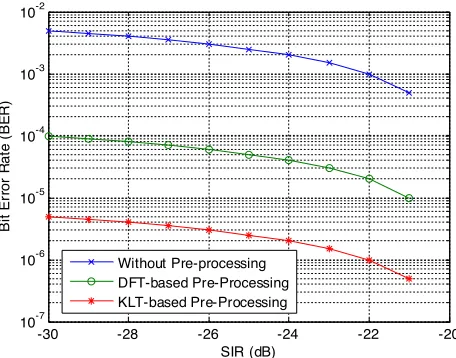
Figure 5. Bit error rate versus SIR in the presence ofsingle-tone sinusoidal interference.
6. CONCLUSIONS
In this paper, it has been shown that the pre-processing based technique which had been previously applied to multi-user and intersymbol interference suppression can be also applied to narrow-band interference rejection in CDMA communication systems. Hence, we have proposed two methods using pre-processing based technique in transform-domain for narrow-band interference suppression, in which the energy ofthe transmitted signal is set to zero in the area where the NBI presents. It is observed that the proposed methods improve the performance of the CDMA communication systems in the presence of NBI. By means of pre-processing, receiver complexity is shifted from receiver to transmitter. In this paper, it has been shown that the complexity ofthe DFT-based method is lower than the KLT-based method, but the system performance by using the KLT is improved more than that ofby using the DFT. This is because the spectrum band where the narrow-band interference exists is determined better by using the KLT in the transmitter.
REFERENCES
1. Zigangirov, K. S., Theory of Code Division Multiple Access Communication, IEEE Press, 2004.
2. Milstein, L. B. and R. A. Iltis, “Signal processing for interference rejection in spread spectrum communications,” IEEE ASSP Magazine, 18–31, April 1986.
3. Ricci, M. and G. Tulino, “Narrow-band interference suppression in multiuser CDMA systems,”IEEE Trans. on Com., Vol. 46, No. 6, 1163–1175, Sep. 1998.
4. Jones, W. W. and K. R. Jones, “Narrow-band interference suppression using filter bank synthesis/analysis techniques,”Proc. MILCOM 92, 898–902, Oct. 1992.
5. Akansu, A. N., M. V. Tazebay, M. J. Medley, and P. K. Das, “Wavelet and subband transforms: Fundamentals and communi-cation applicommuni-cations,” IEEE Com. Mag., 104–115, Dec. 1997. 6. Tazebay, M. V. and A. N. Akansu, “A performance analysis
ofinterference excision techniques in direct-sequence spread-spectrum communication,” IEEE Trans. Signal Proc., Vol. 46, No. 9, 2530–2535, Sept. 1998.
interpolator,” IEEE Trans. on Vehicular Tech., Vol. 52, No. 1, 374–379, March 2003.
8. Azmi, P., “Narrow-band interference suppression CDMA spread-spectrum communication systems based on sub-optimum unitary transforms,” IEICE Trans. Communication, Vol. E85-B, No. 1, 239–246, January 2002.
9. Windpassinger, C., “Detection and precoding for multiple input multiple output channel,” M.Sc. Thesis, Erlangen, 2004.
10. Brandt-Pearce, M. and A. Dharap, “Transmitter-based multiuser interference rejection for the down-link of a wireless CDMA system in a multipath environment,” IEEE Journal of Selected Area on Com., Vol. 18, No. 3, 407–417, March 2000.
11. Wang, Z., S. Zhou, and G. B. Giannakis, “Joint coding–precoding with low-complexity turbo-decoding,” IEEE Trans. on Wireless Communication, Vol. 3, 832–842, May 2004.