FPGA Implementation of a High Speed
Matrix Multiplier for Use in Signal and Image
Processing Applications
Harinee.K
1, Dr.S.Ramamoorthy
*2Assistant Professor, Dept. of ECE, Jerusalem College of Engineering, Chennai, Tamil Nadu, India 1
Assistant Professor, Dept. of ECE, Bharath University, Chennai, Tamil Nadu, India2
* Corresponding Author
ABSTRACT: The evolution of computer and internet has brought demand for powerful and high speed data processing, but in such complex environment fewer methods can provide perfect solution. Parallel Computing is a solution to handle above address issue. This will provide solution for the address issue of demand for high speed data processing. An effective implementation of the matrix multiplication using systolic architecture on reconfigurable systems (RS) like field programmable gate arrays (FPGA) is demonstrated. The systolic architecture increases the computing speed by combining the concept of parallel processing and pipelining into a single concept. The RTL code is written for matrix multiplication with systolic architecture and matrix multiplication without systolic architecture in Verilog HDL, compiled then finally the designs are compared to each other to evaluate the performance of the architecture. The Matrix Multiplication with systolic architecture will enhance the speed of matrix multiplication by twice of conventional method. Replacing PE (Processing element) by an efficient MAC in terms of speed, reduced
complexity and also power
.
KEYWORDS: Systolic Array Architecture, Processing Element, MAC Unit, Reconfigurable System, Matrix Multiplication.
I. INTRODUCTION
Earlier, the major concerns of the VLSI engineers were area, performance, Speed, cost and reliability. In computer architecture, a systolic architecture is a pipelined network arrangement of Processing Elements (PEs) called cells. It is a specialized form of parallel computing, where cells compute the data which is coming as input and store them independently. A systolic architecture is an array composed of matrix-like rows of cells. Here, the Processing Elements is similar to central processing units (CPUs) (except for the usual lack of a program counter, instruction register, control unit etc. since operation is transport-triggered, i.e., sensitive to arrival of a data object across it).Each cell shares the information with its neighbors immediately after processing. The systolic array is often rectangular where data flows across the array between neighbor Data Processing Units (DPUs), often with different data flowing in different directions. Systolic architecture is arrays of DPUs which are connected to a small number of nearest neighbor DPUs in a mesh-like topology. DPUs perform a sequence of operations on data that flows between them. In this research, DPU performs the Multiplication and Accumulation (MAC) and the systolic array concept is used for multiply the matrices to enhance its computation speed [1]. There will be demand for powerful and high speed data processing in the evolution of computer and internet. Only fewer methods can provide perfect solution in such complex environment. The issue is handled by parallel computing. Among different fields, we concentrate image and signal processing applications in which high speed matrix multiplication plays a role. We need a high-performance, special-purpose
computer system to meet specific application. I/O and computation imbalance is a notable problem. The concept of
are performed on matrix elements. Partial results are accumulated in a register array. Once the pipeline is completely filled, results are available and they are fed to output registers in row wise manner [2].
A run-time reconfigurable multiply-accumulate (MAC) architecture can be easily reconfigured to trade bitwidth for array size (thus maximizing the utilization of available hardware); process signed-magnitude, unsigned or 2‟s complement data; make use of part of its structure or adapt its structure based on the specified throughput requirements and the anticipated computational load [4]. The proposed architecture consists of a reconfigurable multiplier, a reconfigurable adder, an accumulation unit, and two units for data representation conversion and incoming and outgoing data stream transfer [14]. Reconfiguration can be done dynamically by using only a few control bits and the main component modules can operate independently from each other. We need a high-performance, special-purpose computer system to meet specific application. I/O and computation imbalance is a notable problem. The concept of Systolic architecture can map high-level computation into hardware structures. Systolic system works like an automobile assembly line [5]. Systolic system is easy to implement because of its regularity and easy to reconfigure. Systolic architecture can result in cost-effective, high-performance special-purpose systems for a wide range of problems.
II.LITERATUREREVIEW
a) Basic principle of systolic architecture
Systolic system consists of a set interconnected cells, each capable of performing some simple operation. Systolic approach can speed up a compute-bound computation in a relatively simple and inexpensive manner [12]. A systolic array in particular, is illustrated below. (We achieve higher computation throughput without increasing memory bandwidth).
memory
PE
memory
PE PE PE PE PE
Instead of :
100 ns
We have :
100 ns 30 MOPS
possible 5 million operations per second at most
The systolic array PE
Figure1. Basic principle of systolic architecture
b) Systolic Array Architecture for Matrix Multiplication
Figure2. Systolic Architecture for Matrix Multiplication
c) Parallel Matrix Multiplication Algorithms
The Singular Value Decomposition has been applied in a two dimensional adaptive FIR filtering technique. However, a two-dimensional adaptive algorithm based on a Singular Value Decomposition (SVD) method will be presented using systolic arrays that is applied in the area of image processing [11].The procedure may be implemented as a systolic array algorithm. The actual algorithm is to be combined out of partial linear algebra solutions presented above. Note that the array to perform singular value decomposition is almost identical to Eigen decomposition array. The simulation results show that the Wiener filtering principle can successfully be implemented in image restoration. Methods well known from the linear algebra theory that may be applied instead of classical methods based on Fourier transformation [10]. The effectiveness of the procedure may be improved using special updating techniques.
d) Reconfigurable MAC Unit
The proposed architecture consists of a reconfigurable multiplier, a reconfigurable adder, an accumulation unit, and two units for data representation conversion and incoming and outgoing data stream transfer [15]. Reconfiguration can be done dynamically by using only a few control bits and the main component modules can operate independently from
each other. The architecture is composed mainly of three parts: a reconfigurable multiplication unit, a reconfigurable
addition unit and an accumulation unit. The first two components are properly combined into a reconfigurable MAC unit, but they can function totally independent from each other. This ability is dependent on two configuration bits. The processor that will be presented here can operate 2 64-bit items, or 8 32-bit items, or 32 16-bit items, or 128 8-bit items, or 512 4-bit items, with items in unsigned, or signed, or 2‟s complement representation[13].In particular, the first two units include two similar logic modules, which manipulate the incoming operands, for multiplication and addition and the outgoing stream, i.e. the final result, and perform the data transfers from/to the bus. The ASU also includes a third
module for internal data conversion [14]. Reconfiguration can be done dynamically using a few control bits. There are
III.PROPOSEDARCHITECTURE
The Parallel Matrix Multiplication [7] has many different identifications, but all with the similar implementation. That is, they immediately multiplex a pair of matrix elements in special. Parallel Matrix Multiplication on Systolic Array (PMMSA) uses this approach. In [5], PMMSA is characterized by processing data input in pipeline and comprised of regularly arrayed PE. Where neighbor PEs are connected with each other by shortest line and therefore mass data has no need to be stored before processing. Decrease of distance between the PEs in an array greatly reduces the internal communication delay and improves the utility of processing units [17]. It also removes time consumption for controlling the establishment of data stream. In, this research, the PE is replaced with Multiplication and Accumulation (MAC) to enhance the speed and reduce the complexity of Systolic Architecture. The algorithm for the matrix multiplication of order N×N is shown bellow.
1. For I = 1 to N Start of for loop 1
2. For J = 1 to N Start of for loop 2
3. For K = 1 to N Start of for loop 3
4. C[I,J] = C[I,J] + A[J,K]
×
B[K,J]Computation of Matrix Multiplication and it will be
Implemented by using systolic array
5. End End of for loop1
6. End End of for loop2
7. End End of for loop3
The above algorithm can be implemented in two methods 1. Conventional method (without Pipeline and Parallel Processing)
2. Systolic Architecture (Pipeline and Parallel
Processing)
In this paper, we aim to compute the equation (1) with a two dimensional systolic array.
C
m×n= A
m×k× B
m×k---
(1)
Where A, B and C are the matrices with order m×k,k×n and m×n respectively. Each PE of systolic array computes the
multiplication of elements and accumulates to the corresponding element and then elements will be passed to neighbor PE in the systolic array [18]. First elements
ɑ
i,j in row i of matrix A are injected first into PE as pipeline with thesequence of
ɑ
i,k and the input time to the element ofɑ
i+1,j is one time unit later thanɑ
i,j. Similarly, elementsb
i,j incolumn j of matrix B are injected first into PE as pipeline with the sequence of
b
k,j and the input time to the element ofthe sequence of
b
k,j+1 is one time unit later thanb
k,j. The architecture of PE in this approach is shown in figure 3 whichperforms the Multiplication and Accumulation on data
IV. RESULTS & DISCUSSION
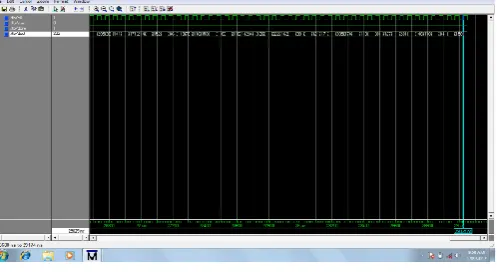
The implementation of Matrix Multiplication is done in both methods i.e. Conventional without pipeline and Conventional with pipeline, as described above, on FPGA. The RTL code is written in VHDL, verification of logic and simulation is done by ModelSim XE 6.4b [19]. The simulation results have given that, the conventional with pipeline implementation requires less number of clock cycles then Conventional method without pipeline and is shown in Figure given below. The simulation results in Figure given below.
Figure 4, Simulation output for Conventional method without pipeline (Two even matrixes (2x2))
Figure 5, Simulation output for Conventional method without pipeline (Two uneven matrixes (4x3) and (3x5))
Figure 7, Simulation output for Conventional method with pipeline (Two even matrixs (8x8))
Exposes the parallel processing and pipelining by the conventional with and without pipeline and also the input and output matrices, next step will be trying to write RTL code in VHDL for systolic array and respectively where the matrix elements are of 4 bit each. After simulation, the design is passed for synthesis onto the platform XILINX ISE 9.2i to convert RTL logic into gate level netlist and also the schematic diagram is captured.
V. CONCLUSION
The implementation of Matrix Multiplication is done in both methods i.e. Conventional and Systolic Architecture, The Systolic Array Architecture is designed for Matrix Multiplication and it is targeted to the Field Programmable Gate Array device. The parallel processing and pipelining is introduced into the systolic architecture to enhance the speed and reduce the complexity of the Matrix Multiplier for image and signal applications. To replacing the processing element of systolic architecture by efficient MAC (Multiplication and Accumulation) unit .The design is simulated, synthesized, and implemented on FPGA device.
REFERENCES
1. Mahendra Vucha, Arvind Rajawat, „Design and FPGA Implementation of Systolic Array Architecture for Matrix Multiplication‟,( July 2011) International Journal of Computer Applications (0975 – 8887), Volume 26– No.3,
2. Anbuselvi S., Rebecca J., "A comparative study on the biodegradation of coir waste by three different species of Marine cyanobacteria", Journal of Applied Sciences Research, ISSN : 1815-932x, 5(12) (2009) pp.2369-2374.
3. H. T. Kung “Why systolic architectures?,”( 1982.) IEEE Computer, vol. 15, pp. 37.
4. I. N. Tselepis, M. P. Bekakos, I. Ž. Milovanović and E. I. Milovanović, ( 2007) „FPGA Implementation of Optimal Planar Systolic Arrays for Orthogonal Matrix Multiplication‟
5. Bharatwaj R.S., Vijaya K., Rajaram P., "A descriptive study of knowledge, attitude and practice with regard to voluntary blood donation among medical undergraduate students in Pondicherry, India", Journal of Clinical and Diagnostic Research, ISSN : 0973 - 709X, 6(S4) (2012) pp.602-604.
6. Syed M. Qasim, Ahmed A. Telba and Abdulhameed Y. AlMazroo,(2010) „FPGA Design and Implementation of Matrix Multiplier Architectures for Image and Signal Processing Applications‟ VOL.10 No.2
7. Raj M.S., Saravanan T., Srinivasan V., "A modified direct torque control of induction motor using space vector modulation technique", Middle - East Journal of Scientific Research, ISSN : 1990-9233, 20(11) (2014) pp.1572-1574
8. Sung Burn Pan, Seung Soo Chae and Rae-Hong Park,(1996.) „VLSI Architecture for Block Matching Algorithms using Systolic Array‟, IEEE Transactions on Circuits and Systems for Video Technology, Vol. 6, No. 1,
9. Kuan-i Lee,( 2007) „Algorith and VLSI architecture design for H.264/AVC Inter Frame Coding‟, A PhD Thesis at National Cheng Kung University, Tainan, Taiwan.
10. Rajasulochana P., Krishnamoorthy P., Dhamotharan R., "An Investigation on the evaluation of heavy metals in Kappaphycus alvarezii", Journal of Chemical and Pharmaceutical Research, ISSN : 0975 – 7384, 4(6) (2012) pp. 3224-3228.
13. Jasmine M.I.F., Yezdani A.A., Tajir F., Venu R.M., "Analysis of stress in bone and microimplants during en-masse retraction of maxillary and mandibular anterior teeth with different insertion angulations: A 3-dimensional finite element analysis study", American Journal of Orthodontics and Dentofacial Orthopedics, ISSN : 0889-5406, 141(1) (2012) pp. 71-80.
14. Chien-Min Ou, Chian-Feng Le and Wen-Jyi Hwang,( 2005) „An Efficient VLSI Architecture for H.264 Variable Block Size Motion Estimation‟, IEEE Transactions on Consumer Electronics, Vol. 51, No. 4.
15. Feifei Dong, Sihan Zhang and Cheng Chen,( 2009) „Improved Design and Analyse of Parallel Matrix Multiplication on Systolic Array Matrix‟, IEEE,
16. Ziad Al-Qadi and and Musbah Aqe(2009), „performance Analysis of Parallel Matrix Multiplication Algorithms Used in Image Processing‟, World Applied Sciences Journal 6 (1): 45-52,.
17. Mohammad Mahdi Azadfar, „Implementation of A Optimized Systolic Array Architecture for FSBMA using FPGA for Real-time Applications‟, (2008) IJCSNS International Journal of Computer Science and Network Security, VOL.8 No.3.
18. Chao Cheng, Member, IEEE, and Keshab K. Parhi, (2005) „A Novel Systolic Array Structure for DCT‟, Fellow, IEEE VOL. 52, NO. 7, 19. Tatas, G. Koutroumpezis, D. Soudris And A. Thanailakis,(2009) „Architecture Design Of A Coarse-grain Reconfigurable
Multiply-accumulate Unit For Data Intensive Applications‟.
20. B Karthik, S Rajeswari, Design and Analysis of a Transceiver on a Chip for Novel IR-UWB Pulses, Middle-East Journal of Scientific Research 19 (6), PP 817-820, 2014.
21. Shriram, Revati; Sundhararajan, M; Daimiwal, Nivedita; , Application of High & Low Brightness LEDs to Human Tissue to Capture Photoplethysmogram at a Finger TipRed, V-620,PP 700.
22. Muralibabu, K; Sundhararajan, M; , PAPR performance improvement in OFDM system using DCT based on adjacent symbol groupingTrans Tech Publ, Applied Mechanics and Materials, V-550,PP 204-209, 2014.
23. sivaperumal, s; sundhararajan, m; , advance feature extraction of mri brain image and detection using local segmentation method with watershed.