
Hide The Modulus:
A Secure Non-Interactive Fully Verifiable
Delegation Scheme for Modular Exponentiations via CRT
Osmanbey Uzunkol1, Jothi Rangasamy2, Lakshmi Kuppusamy2
1 FernUniversit¨at in Hagen, Faculty of Mathematics and Computer Science, Germany
2
Society for Electronic Transactions and Security (SETS), Chennai, India
{jothiram,lakshdev}@setsindia.net
Abstract. Security protocols using public-key cryptography often requires large number of costly modular exponentiations (MEs). With the proliferation of resource-constrained (mobile) devices and advancements in cloud computing, delegation of suchexpensive com-putations to powerful server providers has gained lots of attention. In this paper, we ad-dress the problem of verifiably secure delegation ofMEs using two servers, where at most one of which is assumed to be malicious (the OMTUP-model). We first show verifiabil-ity issues of two recent schemes: We show that a scheme from IndoCrypt 2016 does not offer full verifiability, and that a scheme fornsimultaneousMEs from AsiaCCS 2016 is verifiable only with a probability 0.5909 instead of the author’s claim with a probabil-ity 0.9955 forn = 10. Then, we propose the firstnon-interactive fully verifiable secure delegation scheme byhiding the modulus via Chinese Remainder Theorem (CRT). Our scheme improves also the computational efficiency of the previous schemes considerably. Hence, we provide alightweight delegation enabling weak clients to securely and verifiably delegateMEs without any expensive local computation (neither online nor offline). The proposed scheme is highly useful for devices having (a) only ultra-lightweight memory, and (b) limited computational power (e.g. sensor nodes, RFID tags).
Keywords: Verifiable and secure delegation; modular exponentiations; cloud security; applied cryptography; lightweight cryptography
1
Introduction
Recent advances in mobile computing, internet of things (IoT), and cloud computing makes delegating heavy computational tasks from computationally weak units, devices, or components to a powerful third party servers (also programs and applications) feasible and viable. This enables weak mobile clients with limited memory and computational capabilities (e.g. sensor nodes, smart cards and RFID tags) to be able to utilize several applications of these technolo-gies, which otherwise is difficult and often impossible because of underlying resource-intensive operations and consumption of considerable amount of energy.
severe consequences especially if the delegatedMEs are the core parts of authentication or sig-nature schemes.
Related Work. After the introduction of wallets with observers by Chaum and Pedersen [8], Hohenberger and Lysyanskaya [12] provided the first secure delegation scheme for group exponentiations (GEs) with a verifiability probability 1/2 using two servers, where at most one of them is assumed to be malicious (the OMTUP-model). They also gave the first formal simulation-based security notions for the delegation of GEs in the presence of malicious pow-erful servers. In ESORICS 2012, Chenet al.[9] improved both the verifiability probability (to 2/3) and the computational overhead of [12]. A secure delegation scheme for two simultaneous
GEs with a verifiability probability 1/2 is also introduced in [9].
In ESORICS 2014, for the first time Wanget al.[20] proposes a delegation scheme forGEs us-ing asingle untrusted server with a verifiability probability 1/2. This scheme involves anonline
group exponentiation of asmall exponent by the delegator; the choice of such a small exponent is subsequently shown to be insecure by Chevalier et al.[10] in ESORICS 2016. Furthermore, it is also shown in [10] essentially that a secure non-interactive (i.e. single-round) delegation with a single untrusted server requires at least an online computation of a GEeven without any verifiability if the moduluspis known to the server. Kiraz and Uzunkol [13] introduce the first two-round secure delegation scheme for GEs using a single untrusted server having an
adjustable verifiability probability requiring however a huge number of queries to the server. They also provide a delegation scheme fornsimultaneous GEs with an adjustable verifiability probability. Cavalloet al.[6] propose subsequently another delegation scheme with a verifiability probability 1/2 again by using a single untrusted server under the assumption that pairs of the form (u, ux) are granted at the precomputation for variable base elementsu. However, realizing this assumption is difficult (mostly impossible) for resource-constrained devices. In AsiaCCS 2016, Renet al.[18] proposed the first fully verifiable (with a verifiability probability 1) secure delegation scheme forGEs in the OMTUP-model at the expense of anadditional round of com-munication. They also provide a two-round secure delegation scheme forn∈Z>1 simultaneous
GEs which is claimed to have a verifiability probability 1− 1 2n(n+1).
Kuppusamy and Rangasamy use in INDOCRYPT 2016 [14] for the first time the special ring structureofZpwith the aim of eliminating the second round of communication and providing full verifiability simultaneously. They propose anon-interactive efficient secure delegation scheme forMEs using Chinese Remainder Theorem (CRT) in the OMTUP-model which is claimed to satisfy full-verifiability under the intractability of the factorization problem. This approach is also used very recently by Zhou et al. [21] together with disguising the modulus pitself, also assuming the intractability of the factorization problem. They proposed an efficient delegation scheme with an adjustable verifiability probability using a single untrusted server. However, the scheme in [21] does not achieve the desired security properties.
Our Contribution.This paper has the following major goals:
1. We analyze two delegation schemes recently proposed at INDOCRYPT 2016 [14] and at AsiaCCS 2016 [18]:
(a) We show that the scheme in [14] is unfortunately totally unverifiable, i.e. a malicious server can always cheat the delegator without being noticed, instead of the author’s claim of satisfying the full verifiability.
(b) We show that the scheme fornsimultaneous MEs in [18] does not achieve the claimed verifiability guarantees; instead of having the verifiability probability 1− 1
2n(n+1), it only has the verifiability probability at most 1− n−1
2. We propose the firstnon-interactive fully verifiable secure delegation schemeHidePforMEs in the OMTUP-model by disguising the prime number pvia CRT. HidePis not only com-putationally much more efficient than the previous schemes but requires also no interactive round, whence substantially reduces the communication overhead. In particular, hiding p enables the delegator to achieve both non-interactivity and full verifiability at the same time efficiently.
Note that the delegator of MEshides the prime moduluspfrom the servers, andnot from a party intended to be communicated (i.e. a weak device (delegator) does not hide pwith whom it wants to run a cryptographic protocol). In other words, it solely hidespfrom the third-party servers to which the computation of MEs is delegated.
3. We applyHidePto speed-up blinded Nyberg-Rueppel signature scheme [17].
We refer the readers to Appendix which provide a delegated preprocessing technique Rand. It eliminates the large memory requirement and reduces substantially the computational cost of the precomputation step. The overall delegation mechanism (i.e. HideP together with Rand) offers acomplete solution for delegating the expensiveMEs with full verifiability and security, whence distinguish our mechanism as a highly usable secure delegation primitive for resource-constrained devices.
2
Preliminaries & Security Model
In this section, we first revisit the definitions and the basic notations related to the delegation of MEs. We then give a formal security model by adapting the previous security models of Hohenberger and Lysyanskaya [12] and Cavalloet al.[6]. Lastly, an overview for the requirements of the delegation of aME3 is given.
2.1 Preliminaries
We denote byZm the quotient ringZ/mZfor a natural numberm∈Nwithm >1. Similarly, Z∗mdenotes the multiplicative group of Zm.
Letσbe a global security parameter given in a unary representation (e.g. 1σ). Let furtherpand qbe prime numbers withq|(p−1) of lengthsσ1andσ2, respectively. The valuesσ1andσ2are calculated at the setup of a cryptographic protocol on the input ofσ. LetG=< g >denote the multiplicative subgroup ofZ∗p of orderqwith a fixed generatorg∈G.
The process of running a probabilistic algorithmA, which acceptsx1, x2, . . .as inputs, and pro-duces an outputy, is denoted byy←A(x1, x2, . . .).Let (zA, zB,tr)←(A(x1, x2, . . .), B(y1, y2, . . .)) denote the process of running an interactive protocol between an algorithmAand an algorithm B, where Aacceptsx1, x2, . . ., andB accepts y1, y2, . . . as inputs (possibly together with some
random coins) to produce the final outputzA andzB, respectively. We use the expressiontrto represent the sequence of messages exchanged byAandBduring protocol execution. By abuse of notation, the expressiony←xalso denotes assigning the value of xto a variabley.
Delegation Mechanism & Protocol Definition.We assume that a delegation mechanism consists of two types of parties called as the client (or delegator) C (trusted but resource-constrained part) andservers U (potentiallyuntrusted but powerful part), whereU can consist of one or more parties. Hence, the scenario raises if C is willing to delegate (or outsource) the computation of certain functions toU. For a givenσ,letF:Dom(F)→CoDom(F) be a function, where F’s domain is denoted by Dom(F) andF’s co-domain is denoted by CoDom(F). desc(F) denotes the description ofF. We have two cases fordesc(F):
3
1. desc(F) is known to bothC andU, or
2. desc(F) is known toC, and another descriptiondesc(F0) is given toU such that the function
Fcan only be obtained fromF0 if atrapdoor informationτ is given. By abuse of notation, we sometimes writeτ(F) =F0.
From now on, we concentrate on the second case since we propose a delegation scheme in this scenario. A client-server protocol for the delegated computation ofFis defined as a multiparty communication protocol betweenC andU and denoted by (C(1σ,desc(F), x, τ),U(1σ,desc(F0))), where the inputx and the trapdoor τ are known only by C. A delegated computation of the valuey=F(x), denoted by
(yC, yS,tr)←(C(1σ,desc(F), x, τ),U(1σ,desc(F0))),
which is an execution of the above client-server protocol using independently chosen random bits for C and U. At the end of this execution, C learns yC = y, U learns yU; and tr is the sequence of messages exchanged byAandB.Note that the execution may happen sequentially or concurrently. In the case of the delegation of MEs, the aim is to always have yU =∅.
Factorization Problem We prove some security properties of the proposed scheme later by using the intractability of the factorization problem4: Given a composite integern, wherenis a product of two distinct primes pand q, the factorization problem asks to compute por q. The formal definition is as follows:
Definition 1. (Factorization Problem) Letσbe a security parameter given in unary represen-tation. Let furtherA be a probabilistic polynomial-time algorithm. Let further the primespand
q,p6=q, are obtained by running a modulus generation algorithmPrimeGen on the input of σ
withn=pq. RunAwith the inputn. The adversary Awins the experiment if it outputs either
porq. We define the advantage ofAas
AdvFactA (σ) =Prob[x=p or x=q: (n, p, q)←PrimeGen(1σ), x← A(n)].
2.2 Security Model
Hohenberger and Lysyanskaya provided first formal simulation-based security notions for secure and verifiable delegation of cryptographic computations in the presence of malicious powerful servers [12]. Different security assumptions for delegation ofMEs can be summarized according to [12] as follows:
– One-Untrusted Program (OUP): There exists a single malicious programU performing the delegated MEs.
– One-Malicious version of a Two-Untrusted Program (OMTUP): There exist two untrusted programsU1andU2performing the delegatedMEs but only one of them behaves maliciously.
– Two-Untrusted Program (TUP): There exist two untrusted programsU1andU2performing the delegated MEs and both of them may simultaneously behave maliciously, but they do not maliciously collude.
Cavallo et al. [6] gave a formal definition for delegation schemes byrelaxing the security def-initions first given in [12]. Although the simulation-based security defdef-initions [12] intuitively include (whatever can be efficiently computed about secret values with the protocol’s view can
4
also be efficiently computed without this view [10]) the most direct way of guaranteeing the desired secrecy and verifiability, its formalization is unfortunately highly complex and subtle. Therefore, simpler indistinguishability-based security definitions have been recently used both in [6] and in [10], which, in particular, include the fact that an untrusted server is unable to distinguish which inputs the other parties use.
In this section, we adapt the security definitions of [6] for our security requirements to the OMTUP-model of [12], i.e. the adversary is modeled by a pair of algorithmsA= (E,U0), where E denotes the adversarial environment and U0 = (U0
1,U20) is a malicious adversarial software in place ofU = (U1,U2), where exactly one of (U0
1,U20) is assumed to be malicious. In the OMTUP-model we have the fundamental assumption that after interacting withC, any communication betweenE andU0
1 or betweenE andU20 pass solely through the delegatorC [12].
Completeness. If the parties (C,U1andU2) executing the scheme follow the scheme specifica-tions, thenC0s output obtained at the end of the execution would be equal to the output obtained by evaluating the functionFonC. The following is the formal definition for completeness:
Definition 2. For the security parameter σ, let (C,U1,U2) be a client-server protocol for the delegated computation of a function F. We say that(C,U1,U2)satisfies completenessif for any
xin the domain ofF, it holds that
Prob[(yC, yS,tr)←(C(1σ,desc(F), x),Ui(1σ,desc(F0)) :yC =F(x)] = 1.
Verifiability. Verifiability means informally that ifC follows the protocol, then the malicious adversary A = (E,U0
i), i = 1 or i = 2, cannot convince C to obtain some output y0 different from the actual output y at the end of the protocol. The model let further the adversary chooseC0s trapdoored inputτ(F(x)) and take part in exponential/polynomial number of protocol executions before it attempts to convinceC with incorrect output values (corresponding to the environmental adversaryE).
Definition 3. Let(C,U1,U2)be a client-server protocol for the delegated computation of a func-tionFandU0 = (U0
1,U20)be a malicious adversarial software in place ofU = (U1,U2). We say that (C,U1,U2) satisfies (tv, v)−verifiability against a malicious adversary if for any A = (E,Ui0),
eitheri= 1or i= 2, running in time tv, it holds that
Prob[out←VerExpF0,A(1σ) :out= 1]≤v,
for smallv,where experiment VerExpis defined as follows:
1. i= 1.
2. (a, τ(F(x1)),aux)← A(1σ,desc(F0))
3. Whilea6=attack do
(yi,(a, τ(F(xi+1)),aux),tri)←(C(τ(F(xi))),A(aux)) i←i+ 1
4. τ(F(x))← A(aux)
5. (y0,aux,tri)←(C(τ(F(x))),A(aux))
6. return:1 if y0 6=⊥andy0 6=F(x)
7. return:0 if y0 =⊥or y0=F(x).
Ifv is negligibly small for any algorithmArunning in timetv, then(C,U1,U2)is said to satisfy
Security. Security means informally that ifCfollows the protocol, then the malicious adversaryA= (E,U0
i),i= 1 ori= 2, cannot obtain any information aboutC0s inputx.The model let further the adversary choose C0s trapdoored input τ(F(x)) and take part in exponential/polynomial number of protocol executions before it attempts to obtain useful information aboutC0s input (corresponding to the environmental adversaryE).
Definition 4. Let(C,U1,U2)be a client-server protocol for the delegated computation of a func-tionF andU0 = (U0
1,U20) be a malicious adversarial software in place ofU = (U1,U2). We say
that (C,U1,U2) satisfies(ts, s)−security against a malicious adversary if for any A= (E,Ui0),
eitheri= 1or i= 2, running in time ts, it holds that
Prob[out←SecExpF0,A(1σ) :out= 1]≤s,
for negligibly small s for any algorithm A running in time ts, where experiment SecExp is
defined as follows:
1. (a, τ(F(x1)),aux)← A(1σ,desc(F0))
2. Whilea6=attack do
(yi,(a, τ(F(xi+1)),aux),·)←(C(τ(F(xi))),A(aux)) i←i+ 1
3. (τ(F(x0)), τ(F(x1)),aux)← A(aux)
4. b←0,1
5. (y0, b0,tr)←(C(τ(F(xb))),A(aux))
6. return:1 if b=b0
7. return:0 if b6=b0.
Remark 1. We emphasize that the above security definition corresponds to the OMTUP-model of [12]. As in [12], the adversary Acorresponds to both E andU0, and can only interact each other overC after they once begin interacting with C. The behavior of both parts (E andU0) is modeled as a single adversary Aby letting the adversaryAsubmit its own inputs to C and see/take part in multiple executions of (C,U1,U2).
Efficiency Metrics. (C,U1,U2) has efficiency parameters (tF, tmC, tC, tU1, tU2, cc, mc)
whereFcan be computed usingtF(σ) atomic operations, requirestmC(σ) atomic storage forC, C computestC(σ) atomic operations, Ui can be run using tUi(σ) atomic operations, C and Ui
exchange a total of at mostmcmessages of total length at mostccfori= 1,2. 5
2.3 Steps of a Delegation Scheme
Letpandqbe distinct prime numbers. We now give four main steps of a delegation ofua modp under the OMTUP-model, whereu∈G,a∈Zq∗ andGis a subgroup of Z∗p of orderq.
1. Precomputation: Invocation of the subroutineRand:A preprocessing subroutineRand
is required to randomizeuandaand to generate the trapdoor informationτ, see Appendix for the details.
2. Randomizing a ∈Z∗q and u∈G.The base uand the exponenta are both randomized byCby performing only modular multiplications (MMs) inZ∗q andGwith the values from
Randusing the trapdoor information τ.
3. Delegation to servers.The randomized elements are queried to the serversU1 andU2by usingτ. Fori= 1,2,Ui(τ(α), τ(h)) denotes the delegation ofhαmodpwithα∈Z∗q, h∈G using the trapdoor information τ in order to disguise the parameters p, q, whence the concrete description ofG.
4. Verification of the delegated computation.Upon receiving the outputs of U1 andU2, the validity of the delegated computation is verified by comparing the received data with some elements fromRand. If the verification fails, an error message ⊥is returned.
5. Derandomizing outputs and computingua modp.If the verification is successful, then uamodpis computed byC by performing onlyMMs.
3
Verifiability Issues in Two Recent Delegation Schemes
In this section, we show two verifiability issues for recently proposed delegation schemes appeared in INDOCRYPT 2016 [14] and AsiaCCS 2016 [18]. We recall the original schemes briefly before the attacks to give a self-contained paper and make the attacks easily understandable for readers.
3.1 An Attack on the Verifiability of Kuppusamy and Rangasamy’s Scheme from INDOCRYPT 2016
Using CRT, Kuppusamy and Rangasamy proposed a highly efficient secure delegation scheme forMEs in subgroups ofZ∗p [14].
The scheme in [14] takes as inputs the base u∈Gand the exponent a∈Z∗q, and outputs the valueuamodp, where
G=< g1>is a subgroup ofZ∗p of prime orderq.
Initialization:Setn =pr1r2 for distinct primesr1 6=p andr2 6=pand subgroupsG1,G2 of Z∗r1 and Z
∗
r2 of distinct prime ordersq16=q andq26=q, respectively. By using a preprocessing
technique described in Appendix, the value (θ, gθ1) ∈ Z∗p ×G is computed; and x ∈ Zn is constructed by CRT with
x≡u·g1θmodp, x≡hmodr1, andx≡g2modr2.
Masking the valuea.Cinvokes a preprocessing technique to obtain the pairs (α, gα2)∈Z∗r2×G2
and (β, gβ2)∈Z∗r2×G2. Then,C computes
1. a1≡a−αmodq, 2. a2≡a−βmodq.
Queries toU1.Cinvokes a preprocessing technique once more to obtain the pair (t, gt
1)∈Z∗p×G, and sends the following query toU1 in random order:
1. U1(a1, x, n)←−D11≡xa1modn,
2. U1(β, x, n)←−D12≡xβmodn, 3. U1(−aθ/t, gt
1, p)←−D13≡g −aθ 1 modp.
Queries toU2.Similarly, Csends the following query toU2 in random order: 1. U2(a2, x, n)←−D21≡xa2modn,
2. U2(−aθ/t, gt
Verification.C verifies
– g2β≡? D12modr2,
– D11·g2α≡? D12·D21modr2,
– D13≡? D22modp.
Recovering.If the verification step passes successfully, thenC computes
ua≡D12·D13·D21modp. (1) If the verification step fails, thenC outputs⊥.
We now show that the scheme is unfortunately totally unverifiable.
Attack: Assume first that the server U1 is malicious and U2 is honest. Since the prime p is public,U1 can computer1r2=n/p, and return the bogus values
Y11:≡D11+r1r2modn, andY12:≡D12+r1r2modn. (2) Now, U1 can successfully distinguishD11 and D12 from D13 with probability 1 since the first component ofD13is an element ofGwhereas the first components ofD11andD12are elements ofZn. Afterwards, by the choices of the distinct primes p, r1 andr2, and the propertiesY12 ≡ D12modr2 andY11≡D11modr2, U1 can pass the verification step with Y11 and Y12 instead of usingD11 andD12, respectively. This leads to the bogus final output
Y12·D21·D13
instead of the actual outputua=D12·D13·D22given in Congruence (1).
Similarly, a maliciousU2can successfully distinguishD21fromD22with probability 1 since the first component ofD22is an element of Gwhereas the first component ofD21 is an element of Zn. Then,U2can act as the untrusted server by computing
Y21≡D21+r1r2modr2. (3) Afterwards, by the choices of the distinct primesp, r1andr2and the propertyY21≡D21modr2, U2 can pass the verification step with the bogus valueY21. This results in the output
D12·Y21·D13
instead ofua =D12·D13·D21given in Congruence (1). Hence, the scheme in [14] is unfortunately totally unverifiable and the claim regarding full verifiability [14, Thm. 2, pp. 90] does not hold.
3.2 An Attack on the Verifiability of Ren et al.’s Simultaneous Delegation Scheme from AsiaCCS 2016
Ren et al. proposed the first fully verifiable two-round secure delegation scheme for GEs to-gether with a delegation scheme ofnsimultaneousMEs [18].
The delegation scheme for n simultaneous MEs in [18] takes as inputs the base elements u1,· · ·, un ∈ G and the exponents a1,· · · , an ∈ Z∗q, and outputs u
a1
1 · · ·uann modp, where p is a prime number,G=< g >is a subgroup ofZ∗p of prime orderq.
By using a preprocessing technique described in Appendix, the values (α, v=gα), (β, µ=gβ), (t1, gt1), (t2, gt2)∈
Z∗q×G
Masking. C splits
ua1
1 · · ·u an
n ≡(vw1)
a1· · ·(vw
n)an modp ≡gα(a1+···an)wa1
1 · · ·w an
n modp ≡gβgγwa1
1 · · ·w an
n modp withwi=ui/vandγ= ((P
n
i=1ai)α−β) for 1≤i≤n.
First Queries Cchooses a randomi∈ {1,2,· · ·, n}sends the following queries toU1in random order:
1. U1(b/t1, wigt1)←−D111≡w b/t1
i g
b modp, 2. U1(b/t1,(Qn
j=1,i6=jwj)gt1)←−D112≡(Qj=1,i6=j) nw
j)b/t1gb modp, Similarly,C sends the following queries toU2 in random order:
1. U2(c/t1, wigt1)←−D211≡w c/t1
i gcmodp, 2. U2(c/t1,(Q
n
j=1,i6=jwj)gt1)←−D212≡(Qj=1,i6=j) nw
j)c/t1gbmodp. Upon receivingD11iand D21i fromU1 andU2,i= 1,2,C computes
Wb:=w b/t1
i ≡D111g−b, ( n Y
j=1,i6=j
wj)b/t1 ≡D112g−b,
Wc:=w c/t1
i ≡D211g −c, (
n Y
j=1,i6=j
wj)c/t1≡D212g−c.
Second Queries Csends the following queries to U1 in random order: 1. U1(γ/t2, gt2)←−D12≡gγ modp,
2. U1(aj−c/t1, wj)←−D13j≡w aj−c/t1
j modpfor 1≤j≤n,i6=j, 3. U1(ait1/c, w
c/t1
i )←−D13i≡wiai modp.
Similarly,C sends the following queries toU2 in random order: 1. U2(γ/t2, gt2)←−D22≡gγ modp,
2. U2(aj−b/t1, wj)←−D23j≡w aj−b/t1
j modpfor 1≤j≤n, i6=j, 3. U2(ait1/b, w
b/t1
i )←−D23i≡wiai modp.
Verification of the Output-Correctness of{U1,U2}. Upon receiving the queriesD12,D13i andD13j from U1, andD22,D23i andD23j fromU2for 1≤j≤n,Cverifies
1. D12≡? D22modp, 2. D13i
?
≡D23imodp, 3. T :≡Wc·Qnj=1D13j
?
Recovering. If every congruence in the verification step holds, thenC believes that the values have been computed correctly. It outputs
ua1
1 · · ·u an
n ≡g β
·D12·T modp. (4)
If the verification step fails, thenC outputs⊥.
We now show that the author’s claim [18, Thm. 4.2, pp. 298] does not hold.
Attack: Assume without loss of generality that the server U2 is malicious and U1 is honest. Then,U2 chooses a randomθ∈Gand sends the bogus value
T212≡D212·θ
instead ofD212after correctly distinguishingD212fromD211with probability at least 1/2. Then, C computes
Θ:=θ( n Y
j=1,i6=j
wj)c/t1 ≡T212g−c.
In order to pass the verification step withΘ·T instead ofT,U2requires to find an outputT23j with T23j 6∈ {D22, D23i}, i.e. T23j ≡D23jmodn for some i 6=j, and sends θ·T23j instead of T23j. Now, since there aren(n+ 1)/2 pairs from the set
D:={D22, D231,· · · , D23n}
we totally haven(n−1) possibilities for T23j corresponding to a single component of such a pair. If (Θ1, Θ2) is a pair from the set D. Then,
1. there exists 2 values for T23j which can be detected byC corresponding to the single pair with (Θ1, Θ2)≡(D22, D23i) modp,
2. there exists n−1 values ofT23j which can be detected byC corresponding to the pairs of the form (Θ1, Θ2) withT1=Θ1≡D22andΘ26≡D23i,
3. there exists n−1 values ofT23j which can be detected byC corresponding to the pairs of the form (Θ1, Θ2) withT23j =Θ1≡D23i andΘ26≡D12.
Therefore, there exist
n(n+ 1)−2−(n−1)−(n−1) =n(n+ 1)−2n=n(n−1)
possible values forT23j with T23j 6∈ {D22, D23i}. Combining with the probability of correctly guessing the position ofD232, the server U2 can cheat C with a probability at least 2nn((n−n+1)1) =
n−1
2(n+1). Hence, the scheme is verifiable with a probability at most 1− n−1
2(n+1) instead of the author’s claim that the scheme would be verifiable with a probability 1− 1
2n(n+1). Thereby it also leads to a bogus outputθua1
1 · · ·uann.
For example withn= 10 and n= 100, the scheme is verifiable only with probabilities at most 13/22≈0.5909 and 103/202≈0.5099 instead of the claims with probabilities 219/220≈0.9955 and 20199/20200 ≈0.9999, respectively. Clearly, the verification probability becomes 1/2 if n tends to infinity.
4
HideP
: A Secure Fully Verifiable One-Round Delegation Scheme
for Modular Exponentiations
g∈G. Our scheme HidePuses another primer6=pof lengthσ1(e.g. pandrare of about the same size) such thatG1 is a subgroup of prime orderq1of lengthσ2(e.g.qandq1are of about the same size). We setn:=p·randm:=q1·q. Note thatHidePuses the prime numberpas a trapdoor information, i.e.pmust bekept secret to bothU1andU2.
Throughout the sectionUi(α, h) denotes thatUi takes (α, h)∈Z∗m×Z∗nas inputs, and outputs hαmodnfori= 1,2, as described in Section (2).
4.1 HideP: A Secure Fully Verifiable One-Round Delegation Scheme
Our aim is to delegateuamodpwitha∈
Z∗q andu∈G.
We now describe our schemeHideP. Public and private parameters ofHidePare given as follows:
Public parameter:n,
Private parameters: Prime numbersp, r, q, andq1, description of the subgroupGof Z∗p of orderq,u∈G,a∈Z∗q..
6
Additionally, thestatic values
Qr:≡r·(r−1modp) modn, Qp:≡p·(p−1modr) modn, (5) Qq1 :≡q1·(q
−1
1 modq) modm, Qq :≡q·(q−1modq1) modm, (6) and
R:≡g·Qr+g1·Qpmodn (7) are calculated at the initialization ofHideP.
Precomputation. Using the existing preprocessing technique or a delegated versionRand as described in Appendix,C first outputs
(Gt≡gtQrmodn, Gγt ≡gγtQrmodn, Hγt≡gγt1 Qpmodn), (Ht1 ≡g
t1
1 Qpmodn, Ht2 ≡g
t2
1Qpmodn, gt1modr), and
(γ−1modm, T1≡t1Qqmodm, T2≡t2Qq modm) for random elementst1, t2, t∈Zm∗ witht=t1+t2.
Masking. The base uis randomized byC with
x1≡u·Gt+Ht1 modn, (8)
x2≡uGt+Ht2modn, (9)
Note that by CRT we have
x1≡x2≡ugtmodp, y≡gγt modp, and
x1≡gt1
1 modr, x2≡g t2
1 modr, y≡g γt 1 modr.
Then, the exponentais first written as the sum of two randomly chosen elementsa1, a2∈Z∗m witha=a1+a2. Then, the following randomizations are also computed by C
α1≡a1·Qq1+T1modm, (11)
α2≡a2·Qq1+T2modm, (12)
α3≡ −a·γ−1modm. (13)
Query to U1. C sends the following queries in random order toU1:
1. U1(α1, x1)←−X1≡xα1
1 modn, 2. U1(α3, y)←−Y1≡yα3 modn.
Query to U2. Similarly, C sends the following queries in random order toU2: 1. U2(α2, x2)←−X2≡xα22modn,
2. U2(α3, y)←−Y2≡yα3 modn.
Verifying the Correctness of the Outputs of {U1,U2}. Upon receiving the queries X1
andY1from U1, andX2 andY2from U2, respectively,C verifies
(X1modr)·(X2modr)≡? g1t (14)
and
Y1 ?
≡Y2modn. (15)
Recovering ua. If Congruences (14) and (15) hold simultaneously, thenC believes that the valuesX1, X2,Y1 andY2 have been computed correctly. It outputs
ua≡(X1modp)·(X2modp)·(Y1modp). (16) If the verification step fails, thenC outputs⊥.
5
Security and Efficiency Analysis
5.1 Security Analysis
Theorem 1. Let F0 be given by the exponentiation modulo n = pr, where the trapdoor in-formation τ is given by the primes p and r, p 6= r. Let further (C,U1,U2) be a one-client, two-server, one-round delegation protocol implementation of HideP. Let the adversary be given asA= (U0,E)in the OMTUP-model (i.e.U0= (U0
1,U20)and at most one of Ui0 is malicious with i= 1 ori= 2). Then, in the OMTUP-model, the protocol(C,U1,U2)satisfies
1. completeness forHideP,
2. security for the exponenta and the exponentiation ua against any (computationally
unre-stricted) malicious adversary A, i.e. s = 0, and security for the base u with ts=poly(σ)
ands=AdvFactA0 (σ),
3. full verifiability for any malicious adversaryA, wheretv=poly(σ)andv=AdvFactA (σ), and
verifiability for any computationally unrestricted malicious adversary A with v = 1/2 +,
where is negligibly small inσ,
4. efficiency with parameters where(tF,tmC,tC,tU1,tU2,cc,mc), where
– F can be computed by performingtF=1 exponentiation modulo p
– C0smemory requirement ist
mC consists of1 output of theRandscheme,
– C can be run by expending tC atomic operations consisting of7 modular multiplications
and5modular reductions (2multiplications modulop,1multiplication modulor,3 multi-plications modulom,1multiplication modulon,2reductions modulor, and3reductions modulop),
– Ui, i= 1,2 computestUi = 2 exponentiations modulon for eachi= 1,2,
– C andUi exchange a total of at most mc= 4 messages of total lengthccconsisting of 2
elements modulomand2 elements modulonfori= 1,2.
Proof.We first note that the efficiency results can easily be verified by inspecting the description ofHidePfor the efficiency parameters given above. Throughout the rest of the proof we assume without loss of generality thatU1is a malicious server, i.e. adversary is given asA= (U1,E).
Completeness. We first prove the completeness of the verification step. Since the same basey and the exponent α3 are delegated to both U1 and U2, the congruence Y1 ≡Y2 ≡ yα3 holds
by the OMTUP assumption. Furthermore, by the choice ofT1 ≡t1Qq,T2≡t2Qq, we have the congruences
a1Qq1+T1≡t1modq1, a2Qq1+T2≡t2modq1.
Then, together with the equalityt=t1+t2the following congruence holds:
(X1modr)·(X2modr)≡(xα11 modr)·(x α2
2 modr) ≡gt1
1 ·g t2
1 modr ≡gt1+t2
1 modr ≡g1tmodr.
the equalitya=a1+a2 and Lagrange’s theorem (X1·X2modp)·(Y1modr)≡(xα1
1 ·x α2
2 modp)·(y
α3 modp)
≡(ugt)a1·(ugt)a2·g−atγγ−1 modp
≡(ugt)a1+a2·g−atmodp
≡(ugt)a·g−atmodp ≡ua·gat·g−atmodp ≡ua·gat−atmodp ≡uamodp.
Security. We argue thatHidePsatisfies security under the OMTUP-model due to the following observations:
1. On a single execution of (C,U1,U2) the input (α, x) in the query sent byC to the adversary A= (U1,E) does not leak any information aboutu,aandua. The reason is that
– uis randomized by multiplying withgtwhich is random. Hence, the adversaryAcannot obtain any useful information aboutueven if the factors p, rofnare known,
– ais randomized by a1 and a2 and aγ. Hence A cannot obtain any useful information aboutaby obtaininga1 throughx1 andaγmodpeven if it knows the factors p, rand q, q1 ofnandm, respectively.
– To obtain useful information aboutua,Arequires to knowx2which is random and not known by the OMTUP assumption.
2. Even if the adversary Asees multiple executions of (C,U1,U2) wherein the inputs ofC are adversarially chosen,Acannot obtain any useful information about the exponentachosen by C, and the desired exponentiationuain a new execution since logical divisions ofa=a1+a2 at each execution involve freshly generated random elements. This implies that s= 0 for the exponentaand the outputuamodp. Assume thatAcan break the secrecy of the base u with a non-negligible probability. In particular, it can obtain useful information about both elements u·GT and ugt with a non-negligible probability, where GT ≡gtmodpfor some t. Then,Acan obtain gcd((uGT−ugt), n). This gives the factorspandrofnwith a non-negligible probability asu·GT ≡ugtmodpholds. This implies thatts=poly(σ) ands is at mostAdvFactA (σ), i.e. (C,U1,U2) is a secure implementation ofHidePif the factorization problem is intractable .
In particular, these arguments show that (C,U1,U2) provides unconditional security for the exponentaand the outputuaagainst any (computationally unrestricted) adversary and security for the baseuagainst any polynomially bounded adversary.
Verifiability. SinceY1andY2 both have the same base and exponent elements,U1cannot cheat the delegatorC by manipulatingY1 by the OMTUP assumption. This means thatU1 can only pass the verification step by manipulating the outputX1. Hence, the resultp = 1/2 +(where is negligibly small in the security parameter σ) holds for any adversary U1 sinceU1 needs to know the correct position of x1 which has at most 1/2. We now show that if there exists an adversaryAthat breaks the verifiability property with a non-negligible probability, thenAcan be used to effectively solve the factorization problem. Assume now thatU1as a malicious server passes the verification step with a bogus outputZ1(instead ofX1=xα11) with a non-negligible probability. Then, the following congruence must hold for any arbitrary outputX2of the honest serverU2
with a non-negligible probability. This implies thatU1can decide whether the congruenceZ1≡ X1modr holds with a non-negligible probability. We note that Z1 6≡ 0 modr as otherwise Congruence 17 cannot hold withgt16≡0 modr. This implies that Z1−X1 ≡0 modr and that Z1 6≡ 0 modr. From the inequality Z1−X1 < n (when the representatives are considered as integers), it follows thatU1 can compute gcd(Z1−X1, n) =rwith a non-negligible probability. Hence, U1 can obtain information about both the factors p and r of n with a non-negligible probability. This implies thattv=poly(σ) andv is at mostAdvFactA (σ). ut
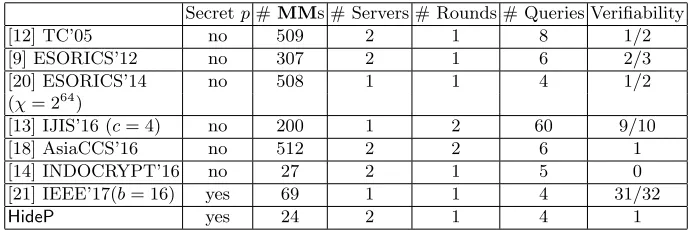
Secretp#MMs # Servers # Rounds # Queries Verifiability
[12] TC’05 no 509 2 1 8 1/2
[9] ESORICS’12 no 307 2 1 6 2/3
[20] ESORICS’14 no 508 1 1 4 1/2
(χ= 264)
[13] IJIS’16 (c= 4) no 200 1 2 60 9/10
[18] AsiaCCS’16 no 512 2 2 6 1
[14] INDOCRYPT’16 no 27 2 1 5 0
[21] IEEE’17(b= 16) yes 69 1 1 4 31/32
HideP yes 24 2 1 4 1
Table 1.Comparison of Computational and Communication Costs forC.
5.2 Comparison
We now compareHideP with the previous delegation schemes forMEs. We denote by MMa modular multiplication, MI a modular inversion, and MR a modular reduction. Throughout the comparison we make the following assumptions:
– we regard 1MMmodulonas ≈4 MMs modulop,
– 1MMmodulopand 1MMmodulorcost approximately the same amount of computation,
– 1 MIis at worst 100 times slower than 1 MM(see [13]),
– we regard 1 MR costs approximately 1 MM(e.g. by means of Barret’s or Mongomery’s modular reduction techniques).
We give the delegator’s computational workload in Table 1 by considering the approximate number of MMs modulop. In particular, Table 1 compares computational cost and communi-cation overhead ofHidePwith the previous schemes. It shows thatHidePhas not only the best computational cost but requires also only a single round with 4 queries (instead of 2 rounds and 6 queries when compared with the only scheme in the literature satisfying full verifiability [18]).
6
Application: Verifiably Delegated Blind Signatures
Fig. 1.CPU time:HidePvs. Computation
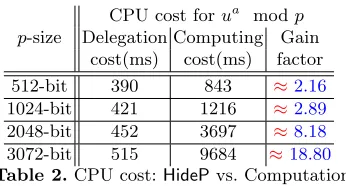
CPU cost forua modp
p-size Delegation Computing Gain cost(ms) cost(ms) factor 512-bit 390 843 ≈2.16
1024-bit 421 1216 ≈2.89
2048-bit 452 3697 ≈8.18
3072-bit 515 9684 ≈18.80
Table 2.CPU cost:HidePvs. Computation
Experiments were conducted on a laptop with an Intel Core i5 2.6 GHz processor and 4 GB RAM. Results presented were taken out of 1000 iterations. The comparison is between the CPU time for
HideP’s 24MMs and local computation of aME
protocols, both the signer and the verifier have to computeMEs using private and public keys, respectively. As an example, delegation of MMs in blinded Nyberg-Rueppel signature scheme [17,2] using HideP is depicted in Fig. 2. It is also evidenced from Fig. 1 that the time taken by HideP is much smaller than that of directly computing ua modp, and this gain in CPU time increases rapidly with the size of the modulus. Hence,HideP becomes more attractive for resource-constrained scenario such as mobile environment when we go for higher security levels.
7
Conclusion
Cloud Servers
Signer(gx
) Verifier
r=mgaRb(p)
m0=rb−1
(q)
c=m0x+k(q) σ=cb+a(q)
R=gk←HideP(.)
1
ga&Rb←HideP(.)
3
R
2
m0
4
c
5
Fig. 2.Delegating Blinded Nyberg-Rueppel Signature
scheme without any requirement of online or offline computation of MEs by the delegator (or its impossibility) under the TUP/OUP assumptions could be highly interesting.
Acknowledgement
We thank the anonymous reviewers for their helpful comments on the previous version of the paper which led to improvements in the presentation of the paper.
References
1. Agnew, G.B., Mullin, R.C., Onyszchuk, I.M., Vanstone, S.A.: An implementation for a fast public-key cryptosystem. Journal of Cryptology 3(2), 63–79 (Jan 1991)
2. Asghar, N.: A survey on blind digital signatures. Technical Report (2011)
3. Beunardeau, M., Connolly, A., Ferradi, H., G´eraud, R., Naccache, D., Vergnaud, D.: Reusing nonces in schnorr signatures. In: Foley, S.N., Gollmann, D., Snekkenes, E. (eds.) Proc. – ESORICS 2017, Part I. pp. 224–241. Springer International Publishing (2017)
4. Boyko, V., Peinado, M., Venkatesan, R.: Speeding up discrete log and factoring based schemes via precomputations. In: Nyberg, K. (ed.) Advances in Cryptology – Proc. EUROCRYPT ’98. LNCS, vol. 1403, pp. 221–235. Springer (1998)
5. Brickell, E.F., Gordon, D.M., McCurley, K.S., Wilson, D.B.: Fast exponentiation with precompu-tation. In: Rueppel, R.A. (ed.) Proc. EUROCRYPT’ 92. pp. 200–207. Springer Berlin Heidelberg, Berlin, Heidelberg (1993)
6. Cavallo, B., Di Crescenzo, G., Kahrobaei, D., Shpilrain, V.: Efficient and secure delegation of group exponentiation to a single server. In: Mangard, S., Schaumont, P. (eds.) Proc. RFIDsec 2015. pp. 156–173. Springer International Publishing, Cham (2015)
7. Chaum, D.: Blind signatures for untraceable payments. In: Chaum, D., Rivest, R.L., Sherman, A.T. (eds.) Advances in Cryptology: Proceedings of Crypto 82. pp. 199–203. Springer US, Boston, MA (1983)
8. Chaum, D., Pedersen, T.P.: Wallet databases with observers. In: Brickell, E.F. (ed.) Proc. CRYPTO’ 92. pp. 89–105. Springer Berlin Heidelberg, Berlin, Heidelberg (1993)
9. Chen, X., Li, J., Ma, J., Tang, Q., Lou, W.: New algorithms for secure outsourcing of modular exponentiations. In: Foresti, S., Yung, M., Martinelli, F. (eds.) Proc. ESORICS 2012. LNCS, vol. 7459, pp. 541–556. Springer (2012)
11. Galbraith, S.D.: Mathematics of Public Key Cryptography. Cambridge University Press, New York, NY, USA, 1st edn. (2012)
12. Hohenberger, S., Lysyanskaya, A.: How to securely outsource cryptographic computations. In: Proc. TCC 2005. LNCS, vol. 3378, pp. 264–282. Springer (2005)
13. Kiraz, M.S., Uzunkol, O.: Efficient and verifiable algorithms for secure outsourcing of cryptographic computations. International Journal of Information Security 15(5), 519–537 (Oct 2016)
14. Kuppusamy, L., Rangasamy, J.: Crt-based outsourcing algorithms for modular exponentiations. In: Proc. INDOCRYPT 2016. pp. 81–98. LNCS, Springer (2016)
15. M’Ra¨ıhi, D., Naccache, D.: Batch exponentiation: A fast dlp-based signature generation strategy. In: Proceedings of the 3rd ACM Conference on Computer and Communications Security. pp. 58–61. CCS ’96, ACM, New York, NY, USA (1996)
16. Nguyen, P., Shparlinski, I., Stern, J.: Distribution of modular sums and the security of the server aided exponentiation. In: Proc. Workshop on Cryptography and Computational Number Theory (CCNT’99). pp. 257–268. Birkh¨auser (2001)
17. Nyberg, K., Rueppel, R.A.: Message recovery for signature schemes based on the discrete logarithm problem. In: De Santis, A. (ed.) Proc. EUROCRYPT’94. pp. 182–193. Springer Berlin Heidelberg (1995)
18. Ren, Y., Ding, N., Zhang, X., Lu, H., Gu, D.: Verifiable outsourcing algorithms for modular expo-nentiations with improved checkability. In: AsiaCCS 2016. pp. 293–303. ACM, New York, NY, USA (2016)
19. Schroeppel, R., Orman, H., O’Malley, S., Spatscheck, O.: Fast key exchange with elliptic curve systems. In: Coppersmith, D. (ed.) Proc. CRYPTO’ 95. pp. 43–56. Springer Berlin Heidelberg, Berlin, Heidelberg (1995)
20. Wang, Y., Wu, Q., Wong, D.S., Qin, B., Chow, S.S.M., Liu, Z., Tan, X.: Securely outsourcing exponentiations with single untrusted program for cloud storage. In: Kuty lowski, M., Vaidya, J. (eds.) Proc. ESORICS 2014. pp. 326–343. LNCS, Springer International Publishing, Cham (2014) 21. Zhou, K., Afifi, M.H., Ren, J.: Expsos: Secure and verifiable outsourcing of exponentiation operations
for mobile cloud computing. IEEE Transactions on Information Forensics and Security 12(11), 2518– 2531 (Nov 2017)
Appendix: The Precomputation Step of
HideP
We now propose a fully verifiable delegated precomputation step Rand in the OMTUP-model in order to improve the overall efficiency ofHideP. In other words,Randcan be used in place of the other preprocessing techniques [5,4,20] to reduce the computational cost of the delegatorC. The reason is that one can remove the requirement of offline computation ofMEs by delegating the preprocessing subroutine ofHideP.
We first briefly revisit the existing preprocessing techniques for the delegation of GEs. Then, we introduce our delegated preprocessing technique Rand. The security and efficiency analysis is given subsequently. Lastly, we give a comparative analysis ofRand with the previous prepro-cessing techniques to show its efficiency.
Rand: Precomputation via a Power Generator
Some pseudorandom pairs (k, gk)∈
Zp×Gare required to randomize the base-elementu, the exponenta, or preferably both, byCbefore delegating theMEs to untrusted servers. Depending on the available memory capacity of C and the existence of anonline trusted server, there are mainly three different approaches:
2. Performing the computation for specially chosen values ofk(either offline byCitself or by an online trusted third party server by e.g. choosingkwith low Hamming weight [1], choosing it as a random Frobenius expansion of low Hamming weight [11] or a random element within some addition chains [19]),
3. Performing a large amount of precomputation by storing a fixed number of offline elements (xi, gxi) which could be computed at the initialization of the system byC or stored toCby a trusted server (static table). This computation of the pairs (k, gk)∈
Zp×G performing
MMs from a random subset of the static table yields to outputs (dynamic table) whose distribution is statistically close to the uniform distribution for carefully chosen parameters [5,4,20].
We refer to [3] for a detailed discussion about the security of the above preprocessing techniques, optimal choices for a given amount of memory, and an efficient technique for halving the storage cost by using pseudo-random functions (PRF).
The Rand Scheme
Our aim is to give another way of generating fresh pseudorandom pairs of the form (k, gk)∈ Zp×G; we alsodelegateits computation byRandto untrusted servers which could be performed totally independent of the other steps of HideP. Assume thatg1 is a fixed generator ofG1. C has astatic tuple
(smodm, h, h1)∈Z∗m×G×G1 (18) generated at the initialization stageonly once. This could be done at the initialization either
1. by the delegator Citself, or
2. by a trusted server (e.g. an HSM or any secure hardware component), such thatsis a random chosen element with
h:≡gsmodp, h1:≡g1smodr. (19) Additionally, thestatic values
Qr:≡r·(r−1modp) modn, Qp:≡p·(p−1modr) modn, (20) Qq1 :≡q1·(q
−1
1 modq) modm, Qq :≡q·(q−1modq1) modm, (21) and
R:≡g·Qr+g1·Qpmodn (22) are also computed and storedonly once at the initialization as defined in Section (4).
Remark 2. Note that a similar initialization is also required in the existing preprocessing tech-niques in order to store the static table [3]. Nevertheless, delegation of the preprocessing subrou-tine viaRandimproves the efficiency of the overall delegation mechanism considerably, especially when compared with the other preprocessing techniques since generation of blinding pairs (dy-namic table from a static one) requires each time the computation of a large number of MMs by the delegator sideC whereas Equations (18), (19), (20), (21), (22) are computed onlyonce
Randtakes no input except the global parameters including the above static values.Rand gen-erates random values t, γ ∈ Z∗m such that t = t1 +t2 for a randomly chosen t1 ∈ Z∗m, and outputs
(Gt≡gtQrmodn, Gγt ≡gγtQrmodn, Hγt≡g γt
1 Qpmodn), (Ht1 ≡g
t1
1 Qpmodn, Ht2 ≡g
t2
1Qpmodn, gt1modr), and
(γ−1modm, T1≡t1Qqmodm, T2≡t2Qq modm). Firstly,C computes
α1≡t1−smodm, (23) α2≡t2−smodm, (24) and
β ≡t·γ−smodm. (25)
Queries toU1. C sends the following queries toU1 in random order:
1. U1(α1, R)←−T11≡Rα1 modn,
2. U1(α2, R)←−T12≡Rα2 modn,
3. U1(β, R)←−T13≡Rβ modn.
Queries toU2. Similarly,C sends the following queries toU2 in random order:
1. U2(α1, R)←−T21≡Rα1 modn, 2. U2(α2, R)←−T22≡Rα2 modn,
3. U2(β, R)←−T23≡Rβ modn.
Verification of the Output-Correctness of{U1,U2}. Upon receiving the queriesT1i from U1, andT2i fromU2 fori= 1,2,3,C verifies
T1i ?
≡T2imodn, 1≤i≤3. (26)
Recovering. If Congruences (26) holds, thenC believes thatT1i andT2i have been computed correctly fori= 1,2,3. It outputs
(Gt≡((T11modp)·h)·((T12modp)·h)·Qrmodn), (27) (Ht1 ≡((T11modr)·h1)·Qrmodn), (28)
(Ht2 ≡((T12modr)·h1)·Qrmodn), (29)
gt1≡((T11modr)h1)·((T12modr)h1)
, (30)
Remark 3. We refer to the comparison subsection which gives additional arguments explaining why Rand is more beneficial with respect to the others precomputation techniques. We also emphasize here however that delegation via Rand can also be done once for many MEs, and it is totally independent of the online phase since a single independent interaction of C with the servers via the delegation using Rand is much more efficient than utilizing the existing precomputation techniques several times at each delegation.
Security and Efficiency Analysis
We now give the security analysis ofRandand give a comparison with the previous preprocessing techniques.
Theorem 2. LetF0 be given by the exponentiation modulon=pr, where the trapdoor informa-tionτ is given by the primes pandr,p6=r. Let further (C,U1,U2)be a one-client, two-server, one-round delegation protocol implementation ofRand. Let the adversary be given asA= (U0,E)
in the OMTUP-model (i.e.U0= (U0
1,U20)and at most one ofUi0is malicious withi= 1ori= 2).
Then, in the OMTUP-model, the protocol(C,U1,U2) satisfies 1. completeness forRand,
2. security of the outputs forRandagainst any (computationally unrestricted) malicious adver-sary A, i.e.s= 0
3. full verifiability forRandagainst any (computationally unrestricted) malicious adversaryA, i.e.v = 0
4. efficiency with parameters where(tF,tmC,tC,tU1,tU2,cc,mc), where
– F can be computed by performing tF atomic operations consisting of 3 exponentiations modulon,1 inversion modulo m, and2multiplications modulom,
– C0s memory requirement is t
mC = 8 group elements (3 elements modulo m, 1 element
modulop,1element modulor,3 elements modulon),
– C runs by computing tC atomic operations consisting of 16 modular multiplications, 6
modular reduction, and1 modular inversion (3 multiplications modulo p, 4 multiplica-tions modulo r, 6 multiplications modulo n, 3 multiplications modulo m, 3 reduction modulop,3reduction modulo r, and1 inversion modulo m),
– Ui, i= 1,2computestUi atomic operations consisting of 3exponentiations modulo nfor eachi= 1,2,
– C andUi exchange a total of at mostmc= 4messages of total length ccwhich consists
of3 elements modulom and1element modulon fori= 1,2.
Proof.Similar to the proof of Theorem 1, the efficiency results can be verified easily by inspect-ing the scheme description for the efficiency parameters (tF,tmC,tC,tU1,tU2,cc,mc).
Completeness. Since we delegate the computation of the same exponent and the same bases to both U1 and U2, the verification steps hold trivially. Additionally, the outputs γ−1,T1 and T2 are solely computed byC, whence they are complete. Moreover, it is obvious from CRT and the choice ofR that
Then, the congruences:
Gt≡(T11·hmodp)Qrmodn ≡(Rα·hmodp)Qrmodn ≡(gt−s·gsmodp)Qrmodn ≡(gt−s+smodp)Qrmodn ≡(gtmodp)Qrmodn ≡gtQrmodn,
and
Gγt≡(T12·hmodp)Qrmodn ≡(Rβ·hmodp)Qrmodn ≡(gγt−s·gsmodp)Qrmodn ≡(gγt−s+smodp)Qrmodn ≡(gγt modp)Qrmodn ≡gγtQrmodn.
hold. Results forHt1,Ht2,Hγt, andg
t follow similarly.
Secrecy. On a single execution of (C,U1,U2), the elementsα1, α2, β, R in the queries sent by C to both U1 and U2 do not leak any useful information about t1, t2, γ and the outputs to the adversaryA= (U0
1,U20,E) in the OMTUP-model since they are randomized by a secret random elements. Even ifAsees multiple executions of (C,U1,U2), it cannot find any useful information about the exponentt1, t2, γ chosen byCin a new execution unless it obtains useful information abouts since freshly chosen random elements are used by C at each execution. We note that there exists no input ofC except public parameters, thence nothing can be adversarially chosen byAin advance. An adversaryAcan obtain for example the differences of the inputs`(0) and `(1) in two executions as `(0)−s−(`(1)−s) = `(0)−`(1) for any ` ∈ {t
1, t2, γt}. This value however is a random value due to the randomness of `(0) and `(1) which leaks no information aboutsand the outputs as well.
To see this more precisely, we present the following argument that if there exists an adversary Athat breaks the secrecy of the scheme in the OMTUP-model, thenAcan also be used to solve the factorization problem effectively:
Assume that an adversaryAbreaks the secrecy of the scheme and obtains information aboutg andg1with a non-negligible probability. Then, by the scheme description the equivalenceR≡g1 modr holds. Now, Acan use this knowledge to compute gcd(R−g1, n), which, in particular, gives the factorspandq ofnwith a non-negligible probability.
On the other hand, if A is given a factorization oracle, then it can obtain g and g1 with a non-negligible probability asR≡g modpandR≡g1 modrhold. In this case, the adversary can obtain`−s both modulopand modulor, which are however random for the adversaryA even if the difference `(0)−`(1) modulopand modulo r is known because of the randomness of `(0) and `(1) both modulo pand modulo r. Thus, even if the adversary is computationally unbounded (i.e. capable of factorizingnand find the bases g andg1), the outputs ofRandare unconditionally secure.
Full Verifiability. Since one of the servers is honest by the OMTUP assumption, the result trivially follows since only equivalence tests from the outputs of Ui, i = 1,2, are required to
Comparison for Delegated Rand
LetQ:= logqdenote the size of the groupG. By the scheme description ofRand, the delegator C requires ≈ 14 logQ−bits of memory (for storing the static values (s, h, h1), Qp, Qr, Qq, Qq1
andR). Furthermore,Randrequires by Theorem (2)
– 3 MMs modulo p,
– 4 MMs modulo r,
– 6 MMs modulo n,
– 3 MMs modulo m,
– 3 MR’s modulop,
– 3 MR’s modulor, and
– 1 MI’s modulom.
Now, we estimate the overall computational cost of Rand as in Subsection (5.2), i.e. we make the following assumptions:
– we regard 1MMmodulonas ≈4 MMs modulop,
– 1MMmodulopand 1MMmodulorcost approximately the same amount of computation,
– 1 MIis at worst 100 times slower than 1 MM(see [13]),
– we regard 1MRcosts approximately 1MM.
Hence, the overall computational cost of the delegatorC can be estimated to be at most ≈3 + 4 + 4·6 + 4·3 + 3 + 3 + 100·4·1 = 449
MMs modulop, ifp, r, q, q1are about the same size. Table 3 compares memory and
computa-Scheme Storage #MMs Security Square & Multiply 0 1.5Q Always BPV [4] `Q k−1 σ√Q <2−κ
E-BPV [16] `Q 2k+h−3 σq(h−Q1)` <2
−κ
Beunardeauet al.[3] 2h
1·v1·Q hQ
1(1 +
1
v1)−3 Always
Rand 14Q 449 Always
Table 3.Comparison of the Preprocessing Techniques with delegatedRand, see [3].

![Table 3. Comparison of the Preprocessing Techniques with delegated Rand, see [3].](https://thumb-us.123doks.com/thumbv2/123dok_us/7978702.1323197/23.612.176.439.412.490/table-comparison-preprocessing-techniques-delegated-rand.webp)
