Sadegh Sadeghi1, Nasour Bagheri2
1
Kharazmi University, Tehran, Iran,[email protected]
2
Electrical Engineering Department, Shahid Rajaee Teacher Training University, [email protected]
Abstract. SFN is a lightweight block cipher designed to be compact in hardware environment and also efficient in software platforms. Compared to the conventional block ciphers that are either Feistel or Substitution-Permutation (SP) network based, SFN has a different encryption method which uses both SP network structure and Feistel network structure to encrypt. SFN supports key lengths of 96 bits and its block length is 64 bits. In this paper, we propose an attack on full SFN by using the related key distinguisher. With this attack, we are able to recover the keys with a time complexity of 260.58encryptions. The data and memory complexity of the attacks are negligible. In addition, in the single key mode, we present a meet in the middle attack against the full rounds block cipher for which the time complexity is 280SFN calculations
and the memory complexity is 287 bytes. The date complexity of this attack is only a single known plaintext and its corresponding ciphertext.
Keywords:Lightweight block cipher, SFN, Related key differential cryptanalysis, Meet in the middle attack.
1 Introduction
Encryption systems have been known to exist for more than a millennium; most of the earlier systems can be considered as block ciphers. Block ciphers gained popularity after Data Encryption Standard was published in 1977. Block ciphers play a significant role in the security of communications as cryptography algorithms. Hence, security analysis of block ciphers is of particular importance. To this end, in this paper, we apply related key attack to analyze the lightweight block cipher SFN [5].
The notion of related key attack functions based on the idea that the attacker has a prior awareness that (or chooses) there exists a relation between a number of keys and thus she can access the encryption functions under such related keys. The purpose of the attacker could be to recover the exact values of the keys. The earliest attacks of this kind were developed independently by Biham [2] and Knudsen [4], and the concept of a related key attack was delineated by [2]. An arbitrary bijective function R (or even a group of such functions) that is specified (or identified) beforehand by the adversary [1] can constitute the relation between the keys. The simplest form of this attack can be when such a relation is just a XOR having a constant: K2 = K1⊕C, in which the constant C is chosen by the adversary. This type of relation enables the adversary to track down the propagation of XOR differences that are caused by the key differenceC through the key schedule of the cipher. Nevertheless, in more complex forms of this attack, other (possibly non-linear) relations between the keys are made possible, e.g. [2, 3] are examples for this case.
paper, we analyse the security of SFN block cipher against the related key cryptanalysis and meet in the middle attack. Our attacks compromise the security of this block cipher both in related key mode and single key mode of operation. All attacks works on full rounds of the block cipher.
1.1 Outline.
This article is organised as follows. in Section 2 we present some notations and also a brief description of SFN. The description of the related key differential attack is given in Section 3 and Section 4 explains meet in the middle attack. Finally, the conclusion and closing remarks are presented in Section 5.
2 Preliminaries
In this section, we give some notations and a brief description of SFN block cipher which will be used in the following parts.
2.1 Notations
Throughout this paper, we use the following notations:
• || : is the concatenation of two binary strings.
• ∆X : represents a non-zero difference ofX.
• ∆Pi : represents the input difference of the (i+ 1)-th round encryption (i= 0,· · ·31).
• ∆RKi : represents the difference of the (i+ 1)-th round keys (i= 0,· · ·31).
• ∆CK : represents the difference of the control signal keys and ∆CKi represents the difference of thei-th bit (i= 0,· · ·31) ofCK.
• CKi : represents the i-th bit (i= 0,· · ·31) of CK.
• RKin
F , RKFout : represent the input and the output states of the Feistel key expansion structure of the round 32, respectively.
• RKSin,RKSout : represent the input and the output states of the SP key expansion struc-ture of the round 32, respectively.
• PF,PS : represent the input states of the Feistel structure and SP structure of encryption in round 32, respectively.
• 0 : represents a sequence of 64 bits as 0.
2.2 Brief description of SFN
operation, and the SFN includes 32 rounds. In case of a detailed signal key, that is, when the bit of the control signal is 0, SFN chooses SP network structure to perform encryption or decryption, while Feistel network structure conducts KeyExpansion. However, if the bit of the signal is 1, SFN selects Feistel network structure to carry out encryption or decryption and the SP network structure pursues KeyExpansion [5] (see Figure 2).
When SFN round function uses the SP network structure for encryption or decryption, its round function is composed of such operations as: AddRoundKey, S1-box layer,
Mix-Columns, MixRows, and S1-box layer. When the SP network structure carries out
KeyEx-pansion, its round function is composed of such operations as: AddConstants,S2-box layer,
MixColumns, MixRows, and S2-box layer. Simultaneously, When SFN round function uses
the Feistel network structure for encryption or decryption, its round function is composed of such operations as:AddRoundKey,S2-box layer,P layer,MixXors, and S2-box layer. When
the Feistel network structure carries out KeyExpansion, its round function is composed of such operations as: AddConstants, S1-box layer, P layer, MixXors, and S1-box layer. The mechanism of the round function is given in Figure 2. For more details of SFN structure we
Signal =1 No 64-bit 64-bit
Yes
Pre and post 32-bit swapping
AddConstnt box layer 2 S MixColumn MixRows box layer 2 S A d d R o u n d K ey b o x la ye r 2 S P la yer M ix xo r la ye r b o x la ye r 2 S i=32? No Pre 32-bit 32-bit 32-bit 64-bit A d d C o n st n t b o x la ye r 1 S P la yer M ix xo r la ye r b o x la ye r 1 S
32-bit 32-bit Pre and post 32-bit swapping
AddRoundKey box layer 1 S MixColumn MixRows box layer 1 S 64-bit i=32? No Yes Yes
Pre and post 32-bit swapping
AddRoundKey
Ciphertext Plaintext/Primary Key
Fig. 1.Encryption procedure of SFN cipher [5].
refer the readers to [5].
3 Related Key Cryptanalysis
data. Modern symmetric-key ciphers are specifically developed to be secure against such attacks. In case an algorithm can be found that is able to distinguish the output of a cipher from a random sequence more efficiently and faster than a brute force search, then that algorithm possibly can be used to break of the cipher and recover the secret key. In the next section, we will discuss the security of SFN against the related key differential cryptanalysis.
3.1 Attack Procedure
The SFN’s designers claim that the cipher is secure against the related key attacks. However, in this section, we show that by encrypting different plaintexts under related keys, the secret key of SFN can be extracted with a time complexity of 260.58 encryptions.
In SFN cipher, the 96-bit main key is divided into the 64-bit round key as RK0 ∈ {0,1}64 and 32-bit control key as CK ∈ {0,1}32. The RK0 conducts AddRoundKey and
KeyExpansion, and theCK=CK0||CK1|| · · · ||CK30||CK31 is considered to be the control signal, and each bit of the control signal carries out one and only one round operation. Consider the two secret related-key inputs to beK0 = (RK0||CK) and K0 = (RK0||CK),
where ∆CK = CK0 ⊕CK0 = 0,· · ·0,1
and hence ∆K0 = K0 ⊕K0 = 0||0,· · ·0,1
. Using this information:
- The adversary chooses a random base plaintext P0 and requests the corresponding ci-phertextC for (P0, K0).
- The adversary chooses a plaintext P0 = P0 and requests the corresponding ciphertext C for (P0, K0).
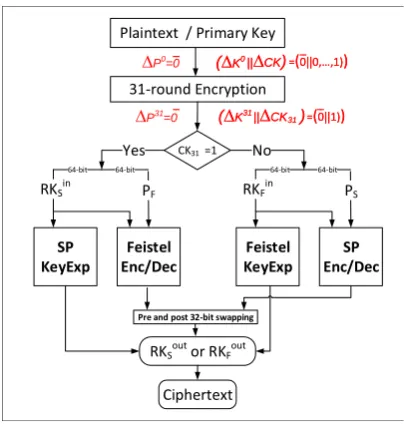
It is trivial to see from the definition of the SFN cipher that the output differentials after 31-round encryption are∆P31= 0 and ∆K31= (∆RK31||∆CK31) = (0||1) with a probability
of 1, which is a distinguisher for 31 rounds of SFN. Since ∆CK31 = 1, refer to Fig. 2, the
adversary would not be able to determine the difference of ciphertexts (differential output). However, give the distinguisher for 31 rounds of SFN, we are able to do key recovery on the 32th round of the cipher. The procedure of the key recovery of this round is given in Algorithem 1.
Complexity. According to Algorithm 1, there are 264choices ofRKF32. So, for each choice, the attacker has the cost of 3-round encryption (one round in step 1, one round in step 2, and one round in step 4(a)) to determine the round key candidate. Also, we exhaustively search the 32 bits ofCK that are not involved in the attack to find the correct key. Therefore, the total time complexity of the attack is (264×3)321 + 232'260.58 32-round SFN encryptions.
4 Meet in the middle attack
Following the SFN’s description, given the 96-bit main keyK =RKkCK, the fractionRK ∈ {0,1}64is used to generate the round keys andCK∈ {0,1}32is used as the control signal to
Algorithm 1:A Key Recovery Attack on SFN For each choice ofRKFout (264 choices)do
1. Decrypt one round Feistel KeyExpansion to calculate the value ofRKFin. Since
∆RK31= 0, the value of RKSin can be derived. So, encrypt one round SP KeyExpansion from the knowledge ofRKSin to calculate the value ofRKSout. 2. Calculate one round encryption for (C, RKFout) and (C, RKSout) to determine the
value of PS and PF. 3. If PS⊕PF = 0 then
go to step 5. end If
4. If PS⊕PF 6= 0 then
(a). Calculate one round encryption for (C, RKout
F ) and (C, RKSout) to determine the value of PS and PF.
(b). If PS⊕PF = 0then go to step 5.
end If
(c). If PS⊕PF 6= 0then
abort and start with a new choice ofRKout F . end If
end If
5. ReturnRKFout as the correct round key. end For
or the SPN. Notice that each bit of the control signal is used in one and only one round of SFN, this block cipher will be an appropriate candidate for meet in the middle attack.
Given that the key-expansion’s round function is a permutation, givenRKi and CKi it would be easy to determine RKi−1. Hence, given a plaintext P and related cipher text C, the adversary guessesRK0 and CK0∼15 to determine the internal state after round 15, i.e. P15, and related subkey, i.eRK15, by encryption for 16 rounds. on the other hand, given the ciphertextC, the adversary guessesRK32andCK31∼16, decryptionCfor 16 rounds using the
Plaintext / Primary Key
31-round Encryption
0 =
0
P
∆ ((∆∆KK00||||∆∆CKCK))==((00||||00,…,,…,1)1)))
0 =
31
P
∆ ((∆∆KK3131||||∆∆CKCK3131))==((00||||1)1)))
Feistel KeyExp
SP Enc/Dec 64-bit
in F
RK PS
64-bit
1 =
31
CK No
SP KeyExp
Feistel Enc/Dec 64-bit
in S
RK PF
64-bit
Yes
out F
or RK
out S
RK
Ciphertext Pre and post 32-bit swapping
ــ
ــ ــ
ــ
Fig. 2.A Distinguisher on full SFN.
time complexity of the provided attack would be 280 calls to SFN. The memory complexity of the attack is dominated by the size ofT which is at most 280 words, 287 bytes.
5 Conclusion
This paper investigates the security level on SFN against the related key attack and meet in the middle attack. The encryption of SFN involves a SP network structure and a Feistel network structure. The SFN fixes 64-bit block with 96-bit key. We have proposed an efficient attack against SFN, taking advantage of the related key distinguisher. With this attack we have shown that SFN provides at most 260.58 encryptions security. In addition, in the single
key mode, we presented a meet in the middle attack for which the time complexity was 280 and the memory complexity was 287 bytes. The attack complexity should be compared with the complexity of exhaustive key search which is 296.
References
1. M. Bellare and T. Kohno. A theoretical treatment of related-key attacks: Rka-prps, rka-prfs, and appli-cations. In International Conference on the Theory and Applications of Cryptographic Techniques, pages 491–506. Springer, 2003.
2. E. Biham. New types of cryptanalytic attacks using related keys. Journal of Cryptology, 7(4):229–246, 1994.
3. A. Biryukov and D. Khovratovich. Related-key cryptanalysis of the full AES-192 and AES-256. In International Conference on the Theory and Application of Cryptology and Information Security, pages 1–18. Springer, 2009.
![Fig. 1. Encryption procedure of SFN cipher [5].](https://thumb-us.123doks.com/thumbv2/123dok_us/7979379.1323368/3.595.97.500.327.564/fig-encryption-procedure-of-sfn-cipher.webp)