One-loop Feynman integrals with Carlson hypergeometric
functions
Khiem HongPhan1,∗
1VNUHCM-University of Science, 227 Nguyen Van Cu, Dist. 5, Ho Chi Minh City, Vietnam.
Abstract. In this paper, we present analytic results for scalar one-loop two-, three-, four-point Feynman integrals with complex internal masses. The calcu-lations are considered in general space-time dimensionDfor two- and three-point functions andD = 4 for four-point functions. The analytic results are expressed in terms of the Carlson hypergeometric functions (R-functions) and valid for both real and complex internal masses.
1 Introduction
In order to confront particle physics theory with high-precision of experimental data at future colliders, theoretical predictions including high-order corrections are required. In general framework for computing high-order corrections, detailed calculations for one-loop multi-leg and higher-loop are necessary for building blocks. When we compute scattering processes which Feynman diagrams involve internal unstable particles that can be on-shell, we have to resume Feynman propagators with a complex mass term in the denominator. In other words, one has to perform the perturbative renormalization in the Complex-Mass Scheme [1]. Therefore, the calculations for Feynman loop integrals with complex internal masses are of great interest. Furthermore, within the general framework for computing two-loop or higher-loop corrections scalar one-higher-loop integrals in general space-time dimension play a crucial role for several reasons. Higher-terms in theε-expansion from one-loop integrals are necessary for building blocks. In additional, one-loop integrals at higher space-time dimensionD>4 may be taken into account in the framework.
There have been available many calculations for scalar one-loop integrals inD=4−2ε
dimensions atε0-expansion [2–11]. Scalar one-loop integrals in general dimensionDhave performed in [12–16]. However, not all of these calculations cover general dimensionDwith a generalε-expansion at general scale and complex internal masses. In this paper, based on the method in [5–8], we present analytic results for scalar one-loop two-, three-, four-point Feynman integrals with complex internal masses. The calculations are considered in general space-time dimension D for two- and three-point functions and D = 4 for four-point functions. The analytic results are expressed in terms of the Carlson hypergeometric functions.
The layout of the paper is as follows: In section 2, we present in detail the method for evaluating scalar one-loop functions. In this section, analytic results for one-loop two-, three-and four-point functions are presented. Conclusions three-and outlooks are devoted in section 3. Several useful formulas used in this calculation can be found in the appendix.
∗
2 The calculations
Based on the method introduced in Refs. [5–7], we present the calculations for scalar one-loop functions with complex internal masses. Scalar one-one-loopN-point functions are defined
JN =
Z
dDl 1
P1P2· · · PN. (1)
Where inverse Feynman propagators are given
Pk = (l+qk)2−m2k+iρ, with k=1,2,· · ·,N. (2)
The Feynman prescription isiρ. We use momentaqk=Pkj=1pj,pjare external momenta and they are inward as shown in Fig. 1. The internal masses in the Complex-Mass scheme are taken the form of
m2k=m20k−im0kΓk, for Γk>0. (3)
The Γk are decay widths of unstable particles. The momenta qk may take the following configuration
q1=q1(q10,q11,0,· · ·,0, − →
0D−J), (4)
q2=q2(q20,q21,0,· · ·,0, − →
0D−J), (5)
q3=q3(q10,q31,q32,0,· · ·,0, − →
0D−J), (6)
· · ·=· · · ,
qN−1=qN−1(q(N−1)0,q(N−1)1,· · ·,q(N−1)(J−1), − →
0D−J) (7)
which haveJnon-zero components. Here,q10 =0 forq21 <0 andq11 =0 forq21 >0. As a result, scalar product of external and internal momenta are obtained
q2k = q2k0−qk21− · · · −q2k(J−1), (8)
l2 = l20−l12− · · · −l2J−1−l 2
⊥, (9)
l·qk = l0·qk0−l1·qk1· · · −lJ−1·qk(J−1). (10)
In parallel space which is the linear span of the external momenta and its orthogonal space (POS) [5, 6], scalar one-loopN-point functions are taken the form of:
JN =
2πD−2J
Γ(D−J2 ) ∞
Z
−∞
dl0dl1· · ·dlJ−1 ∞
Z
0
dl⊥
lD−J−1 ⊥
P1P2· · · PN. (11)
The propagators now become
Pk = (l0+qk0)2−(l1+qk1)2− · · · −(lJ−1+qk(J−1))2−l2⊥−m 2
k+iρ, (12)
fork = 1,2,· · ·,N. The calculations can be summarized as follows. We first make the partition for the integrand ofJNas
1
P1P2· · · PN = N
X
k=1
1
Pk N
Q
l=1 k,l
(Pl− Pk)
pN−1 pN
p1
p2 p3
p4 m2
1 m2
2 m2
3
m2
N
m2
N−1
Figure 1.Generic Feynman diagrams at one-loop
withNexternal lines. All external momenta are inward and follow momentum conservation
qN=PN
j=1pj=0.
with
Pl− Pk = (l0+ql0)2−(l0+qk0)2+(l1+ql1)2−(l1+qk1)2
+· · ·+(lJ−1+ql(J−1))2−(lJ−1+qk(J−1))2+m2k−m 2
l (14)
= alkl0+blkl1+· · ·+clklJ−1+d˜lk. (15)
Where we have introduced the following kinematic variables
alk = 2(ql0−qk0), blk=−2(ql1−qk1), · · ·, (16)
clk = −2(ql(J−1)−qk(J−1)), d˜lk=q2l −q2k+m2k−m2l. (17)
Making a shift
l0→l0+qk0, l1→l1+qk1,· · ·, lJ−1 →lJ−1+qk(J−1), (18)
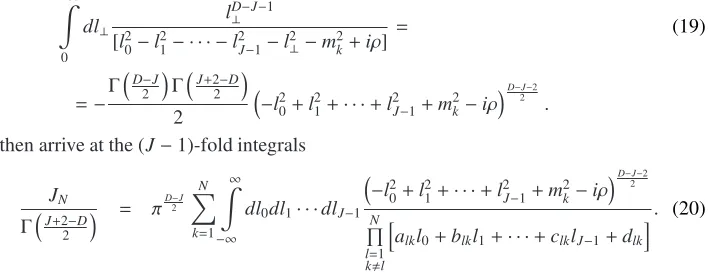
we convert allPkin (13) toPN. As a matter of this fact, thel⊥-integral then yields a simple form which can be taken easily as follows:
∞
Z
0
dl⊥
lD−J−1 ⊥ [l2
0−l 2
1− · · · −l 2 J−1−l
2
⊥−m2k+iρ]
= (19)
=−Γ
D−J
2
ΓJ+22−D
2
−l20+l21+· · ·+l2J−1+m2k−iρ
D−J−2 2
.
We then arrive at the (J−1)-fold integrals
JN
ΓJ+2−D 2
= π
D−J 2
N
X
k=1 ∞
Z
−∞
dl0dl1· · ·dlJ−1
−l2 0+l
2
1+· · ·+l 2 J−1+m
2 k−iρ
D−2J−2
N
Q
l=1 k,l
h
alkl0+blkl1+· · ·+clklJ−1+dlk
i
. (20)
In this formulaalk,blk,· · ·,clk ∈Randdlk=(ql−qk)2−(ml2−m2k)∈ Cwhich is obtained from ˜dlkafter applying the shift (18). The integrals in (20) can be carried out with the help of residue theorem. For that purpose, one first linearizes thel0for example, .i.el′1=l1+l0. The result reads
JN
ΓJ+2−D 2
= π
D−J 2
N
X
k=1 ∞
Z
−∞
dl0dl1· · ·dlJ−1
−2l0l1+l2
1+· · ·+l 2 J−1+m
2 k−iρ
D−2J−2
N
Q
l=1 k,l
h
ABlkl0+blkl1+· · ·+clklJ−1+dlk
i
(21)
⊗ · · · ⊗
⊗
l1>0
⊗ ⊗ ⊗ · · · ⊗
⊗
l1<0
⊗ ⊗
Figure 2.We close the contour integration forl0that the poles in (22) locate outside the contour.
withABlk=alk−blk. The singularity poles of the integrand in (21) are obtained:
l0 =
l2
1+· · ·+l 2 J−1+m
2 k−iρ 2l1
, Im(l0)=−
m0kΓk+ρ 2l1
, (22)
and
l(0l) = −blkl1+· · ·+clklJ−1+dlk
ABlk
, Im[l(0l)]=Im − dlk
ABlk
!
. (23)
The polel0in (22) locates upper (lower) inl0-complex plane ifl1 <0 (l1 >0) respectively. We plan to close the contour integration forl0thatl0-poles in (22) locate outside the contour, seen Fig. 2 for more detail. As a result, the poles in (23) are only taken into account to the residue contributions forl0-integration. The resulting reads
JN
ΓJ+22−D
= π
D−J 2
N
X
k=1 N
X
l=1 k,l
flk+
∞
Z
0
dl1+flk− 0 Z −∞ dl1 · · · ∞ Z −∞
dlJ−1[1−δ(ABlk)] (24)
×
"
1−2 blk
ABlk
!
l2
1+· · ·+l 2 J−1−2
clk
ABlk
l1lJ−1−2
dlk
ABlk
l1+m2k−iρ
#D−2J−2
N
Q
m=1 m,k m,l
h
˜
Amlkl1+· · ·+C˜mlklJ−1+F˜mlk
i
.
Where theδ-function is defined as
δ(x)=
0, if x,0;
1, if x=0. (25)
New kinematic variables ˜Amlk,· · ·,C˜mlk ∈Rand ˜Fmlk ∈Care obtained from residue contri-butions of the poles in (23). The functions flk±indicate the location of the poles in (23) in the
l0complex plane:
flk+=
0, if Im − dlk
ABlk
!
<0;
1, if Im − dlk
ABlk
!
=0;
2, if Im − dlk
ABlk
!
>0.
and flk−=
0, if Im − dlk
ABlk
!
>0;
1, if Im − dlk
ABlk
!
=0;
2, if Im − dlk
ABlk
!
<0.
q2 q2
m21 m22
b b Figure 3.Bubble diagrams.
We continue to linearizel1 in numerator of the integrand of (24) by applying a Euler shift
l1 →l1+βlkl2.βlkcan be chosen in such a way of the disappearance ofl21-term. The residue theorem is applied against forl1-integration. At the final stage, the resulting integrals can be expressed in terms ofR-functions [18] which is defined as
∞
Z
r
(x−r)α−1 k
Y
i=1
(zi+wix)−bidx
=B(β−α, α)Rα−β b1,· · ·,bk,r+
z1
w1
,· · ·,r+ zk
wk
! k
Y
i=1
w−bi
i , (27)
withβ =Pk
i=1bi. In next subsections, we present analytic results for scalar one-loop two-, three- and four-point functions. Detailed calculations for these functions have published in Ref. [17].
2.1 One-loop two-point functions
In POS,J2takes the form of [5, 6]
J2= 2πD2−1
ΓD−21
∞
Z
−∞
dl0 ∞
Z
0
dl⊥
lD−2 ⊥ [(l0+q10)2−l2⊥−m21+iρ][l
2 0−l
2
⊥−m22+iρ]
. (28)
Hereq = q(q10, − →
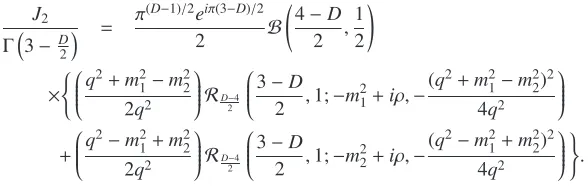
0D−1) for q2 > 0. Ifq2 < 0, we refer [17] for detailed evaluations. The results in [17] have shown that the below formulas forJ2are valid for both above cases. The R-function representation for two-point integrals is as follows [17]:
J2
Γ3−D
2
=
π(D−1)/2eiπ(3−D)/2
2 B
4−D
2 , 1 2
!
(29)
×
(
q2
+m2
1−m 2 2 2q2
RD−4 2
3−D
2 ,1;−m 2 1+iρ,−
(q2
+m2
1−m 2 2)
2
4q2
+
q2−m2 1+m
2 2 2q2
RD−4 2
3−D
2 ,1;−m 2 2+iρ,−
(q2−m2 1+m
2 2)
2
4q2
)
.
p2 2
p21 p23
m2 3
m21 m22
b b
b
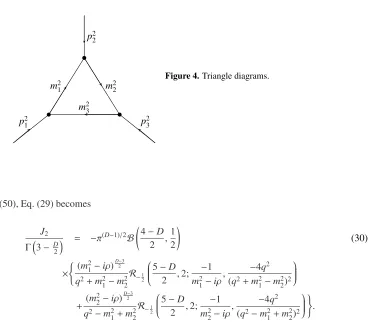
Figure 4.Triangle diagrams.
(50), Eq. (29) becomes
J2
Γ3−D
2
= −π
(D−1)/2B 4−D 2 ,
1 2
!
(30)
×
((m2
1−iρ) D−3
2
q2+m2 1−m
2 2
R−1 2
5−D
2 ,2; −1
m21−iρ,
−4q2
(q2+m2 1−m
2 2)
2
+(m
2 2−iρ)
D−3 2
q2−m2 1+m
2 2
R−1 2
5−D
2 ,2; −1
m2 2−iρ
, −4q
2
(q2−m2 1+m
2 2)
2
)
.
It can be seen that the right hand sides of Eqs. (29,30) are symmetric under the interchange ofm21 ↔ m22. From Eqs. (29,30) we can take the limits of m12 = m22 → 0 and q2 → 0 respectively, seen Ref. [17] for more detail.
2.2 One-loop three-point functions
The momenta q1,q2 take the following configuration q1 = q1(q10,q11, − →
0D−2), q2 =
q2(q20,q21, − →
0D−2). Here q10 = 0 forq21 < 0 andq11 = 0 forq21 > 0. The results for J3 in this paper cover both the above cases. The integralJ3in POS takes the form of [5, 6]
J3 =
πD−22
ΓD−22
∞
Z
−∞
dl0 ∞
Z
−∞
dl1 ∞
Z
−∞
l⊥D−3dl⊥
1
[(l0+q10)2−(l1+q11)2−l2⊥−m21+iρ]
× 1
[(l0+q20)2−(l1+q21)2−l2⊥−m22+iρ][l 2 0−l
2 1−l
2
⊥−m23+iρ]
. (31)
follows [17]
J3
Γ2−D
2
= −π
D
2iB(4−D,1) 3
X
k=1 3
X
l=1 k,l
[1−δ(ABlk)]
Amlk
(αlk−iρ) D−4
2
×
(
S+lk flk+RD−4 4−D 2 ,
4−D
2 ,1;+Z (1) lk ,+Z
(2) lk,+Fmlk
!
(32)
+S−lk flk−RD−4 4−D 2 ,
4−D
2 ,1;−Z (1) lk ,−Z
(2) lk ,−Fmlk
!)
,
form, l. When all internal masses are real, f+ lk = f
−
lk = 1 andS ±
lk =1, Eq. (32) confirms the results of, for instance,J3in the Eq. (11) of [6]. We can derive other represents forJ3by applying several transformations forR-functions, as shown in appendix. For example, with the help of (50), one obtains
J3
Γ2−D
2
= −π
D
2iB(4−D,1) 3
X
k=1 3
X
l=1 k,l
[1−δ(ABlk)]
Cmlk
(m2k)(D−4)/2 (33)
×
flk+R−1
6−D 2 ,
6−D 2 ,2;+
1
Z(1)lk ,+
1
Z(2)lk ,+
1
Fmlk
−flk−R−1
6−D 2 ,
6−D 2 ,2;−
1
Zlk(1),
− 1
Zlk(2),
− 1
Fmlk
,
form,l. The kinematic variables appear in subsection are listed:
alk = 2(ql0−qk0), blk = −2(ql1−qk1),
ABlk = alk−blk, clk = (qk−ql)2+m2k−m2l,
Amlk = −ABkmblk+ABlkbkm, Cmlk = −ABkmclk+ABlkckm,
Fmlk = Cmlk/Amlk, Zlk(1,2) = aclk lk+blk
±
q clk
alk+blk
2
−m2k−iρ
αlk .
The factorS±
lkis given
S±lk = Exphπiθ(−αlk)θ[∓Im(Zlk(1))]θ[∓Im(Z(2)lk)] (D−4)i
×Exph−πiθ(αlk)θ[±Im(Z(1)
lk )]θ[±Im(Z (2)
lk )] (D−4)
i
. (34)
We turn our attention into the analytic results for scalar one-loop four-point functions in next subsection.
2.3 One-loop four-point functions
At present, the calculations for four-point functions are performed in D = 4. We set configuration of external momenta as follows q1 = (q10,q11,0,0), q2 = (q20,q21,0,0),
q3 = (q30,q31,q32,0). Where q10 = 0 forq21 < 0 andq11 = 0 forq21 > 0. Our result presented in this paper cover all the above cases. In POS,J4takes the form of
J4=2 ∞
Z
−∞
dl0dl1dl2 ∞
Z
0
dl⊥ 1
P1P2P3P4, (35)
withPk =(l+qk)2−m2
p2
p1
p3
p4 l,m4
l+q2,m2
l+q1,m1 l+q3,m3
b
b
b
b
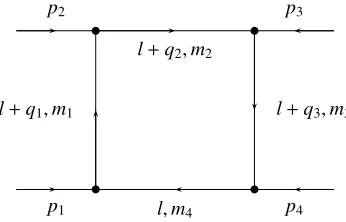
Figure 5.Box diagrams.
written as one-fold integrals [17] as follows
J4
iπ2 = 4
X
k=1 4
X
l=1 k,l
4
X
m=1 m,l m,k
1−δ(AClk)1−δ(Bmlk)
AClk(BmlkAnlk−BnlkAmlk)
× (36)
×
∞
Z
0
dz G(z)
"
(flk+g+mlk+flk−g+mlk) ln Fnmlk
βmlk
!
−flk+g+mlkln z+Fnmlk
βmlk
!
−f+ lkg
− mlkln −
z+Fnmlk
βmlk
!
−(f−
lkg+mlk+flk+g+mlk) ln
S(σmlk,z)
Pmlkz+Qmlk
!
+flk+g+mlkln S(σmlk=0,z)
Pmlkz+Qmlk
!
+flk+g−mlkln −S(σmlk=0,z)
Pmlkz+Qmlk
! #
+
0
Z
−∞
dz G(z)
"
−flk+g−mlkln −Fnmlk
βmlk
!
+(flk−g−mlk+flk−g+mlk) ln z+Fnmlk
βmlk
!
−flk−g−mlkln Fnmlk
βmlk
!
−(flk−g+mlk+ flk−g−mlk) ln S(σmlk=0,z)
Pmlkz+Qmlk
!
+flk−g−mlkln S(σmlk,z)
Pmlkz+Qmlk
!
+flk+g−mlkln − S(σmlk,z)
Pmlkz+Qmlk
! # )
Where the related kinematic variables are given:
alk = 2(ql0−qk0), blk = −2(ql1−qk1),
clk = −2(ql2−qk2), dlk = (ql−qk)2−(m2l −m 2 k),
AClk = alk+clk, αlk = blk/AClk,
Amlk = amk−AClkalk ACmk, Bmlk = bmk−AClkblk ACmk,
Cmlk = dmk−ACdlk
lkACmk, Dmlk =
−4(ql−qk)2/AC2lk,
Fnmlk = CAnlkBmlk−BnlkCmlk nlkBmlk−BnlkAmlk
±iρ′, β(1,2) mlk =
Amlk Bmlk−αlk
±
s
Amlk Bmlk−αlk
2 −Dmlk
Dmlk ,
Qmlk = −2
C
mlk Bmlk
−2 dlk AClk
βmlk, Pmlk = −2
A
mlk Bmlk
−αlk−βmlkDmlk
,
withσmlk =0,−11/βmlk. TheS(σmlk,z) andG(z) are obtained:
S(σmlk,z) = Smlk(σ)z2+(Emlk+Qmlkσmlk)z−m2k+iρ, (37)
G−1(z) = Zmlkz2+Kmlkz−βmlk(m2k−iρ)−FnmlkQmlk, (38)
withZmlk =Dmlkβmlk−PmlkandKmlk =Emlkβmlk−Qmlk−PmlkFnmlk. The functionsflk±(and
g±
mlk) are defined as in (26) with replacingclk/ABlkbydlk/AClk(andCmlk/Bmlk) respectively. TheJ4in (36) is decomposed into two basic integrals as follows:
I1 = ∞
Z
0
1 (z+T1)(z+T2)
dz=R−1(1,1;T1,T2), (39)
I2 = ∞
Z
0
ln(1+z/T3) (z+T1)(z+T2)
dz= (40)
= lim
ω→0 1
ω
∞
Z
0
1 (z+T1)(z+T2)
dz− ∞
Z
0
(1+z/T3)−ω (z+T1)(z+T2)
dz
(41)
= lim
ω→0 1
ω
(
R−1(1,1;T1,T2)−
B(1+ω,1)
T3−ω R−1−ω(1,1, ω;T1,T2,T3)
)
. (42)
The ε-expansions for allR-functions appear in this paper have devoted in Ref. [17]. The numerical checks for all analytic formulas in this paper and applications of this work to compute Feynman diagrams in real scattering processes have shown in [17].
3 Conclusions
We have presented the analytic results for scalar one-loop two-, three-, four-point Feynman integrals with complex internal masses. The analytic results in this paper are valid for both real and complex internal masses. The calculations have carried out in general space-time dimension for two- and three-point functions. At present work, the four-point functions have performed inD =4. The analytic formulas have expressed in terms of theR-functions. In future work, we will extend this work to tensor one-loop integrals (to be published).
Acknowledgment: This work is funded by Vietnam’s National Foundation for Science and Technology Development (NAFOSTED) under the grant number 103.01-2016.33. The au-thor is grateful to the organizers of ISMD 2018 for the invitation and for financial support.
Appendix: Useful relations for
R
-functions
Useful relations forR-functions are also listed in this appendix. The formulas shown here are collected from Ref. [18]. We denote thatb,zandeiarek-tuple
b = (b1,b2,· · ·,bk), (43)
z = (z1,z2,· · ·,zk), (44)
The relations are presented as follows
Rt(b,z) =
k
X
i=1
bi
βRt(b+ei,z), (46)
Rt+1(b,z) =
k
X
i=1
bi
β ziRt(b+ei,z), (47)
βRt(b,z) = (β+t)Rt(b+ei,z)−tziRt−1(b+ei,z), (48)
∂ziRt(b,z) =
bi
βtRt−1(b+ei,z), (49)
Rt(b,z) =
k
Y
i=1
z−bi
i R−β−t(b+ei,z −1
), Euler’s transformation (50)
Rt(b, λz) = λtR
t(b,z) scaling law. (51)
References
[1] A. Denner, S. Dittmaier, M. Roth and L. H. Wieders, Nucl. Phys. B724(2005) 247.
[2] G. ’t Hooft and M. J. G. Veltman, Nucl. Phys. B153(1979) 365.
[3] D. T. Nhung and L. D. Ninh, Comput. Phys. Commun.180(2009) 2258.
[4] A. Denner and S. Dittmaier, Nucl. Phys. B844(2011) 199.
[5] D. Kreimer, Z. Phys. C54(1992) 667.
[6] D. Kreimer, Int. J. Mod. Phys. A8(1993) 1797.
[7] J. Franzkowski,Dissertation, Mainz 1997.
[8] K. H. Phan, PTEP2017(2017) no.6, 063B06.
[9] G. Cullen, J. P. Guillet, G. Heinrich, T. Kleinschmidt, E. Pilon, T. Reiter and M. Rodgers, Comput. Phys. Commun.182(2011) 2276
[10] Z. Bern, L. J. Dixon and D. A. Kosower, Phys. Lett. B302(1993) 299.
[11] G. Ossola, C. G. Papadopoulos and R. Pittau, JHEP0803(2008) 042.
[12] E. E. Boos and A. I. Davydychev, Theor. Math. Phys.89(1991) 1052 [Teor. Mat. Fiz.
89(1991) 56].
[13] A. I. Davydychev, J. Math. Phys.33(1992) 358.
[14] A. I. Davydychev and R. Delbourgo, J. Math. Phys.39(1998) 4299
[15] J. Fleischer, F. Jegerlehner and O. V. Tarasov, Nucl. Phys. B672(2003) 303
[16] J. Blümlein, K. H. Phan and T. Riemann, Acta Phys. Polon. B48(2017) 2313.
[17] Khiem Hong Phan and Thinh Nguyen Hoang Pham, arXiv:1710.11358 [hep-ph].