Robust Authenticated-Encryption
AEZ and the Problem that it Solves
Viet Tung Hoang1,2 Ted Krovetz3 Phillip Rogaway4
1 Dept. of Computer Science, University of Maryland, College Park, USA
2 Dept. of Computer Science, Georgetown University, USA
3 Dept. of Computer Science, California State University, Sacramento, USA
4 Dept. of Computer Science, University of California, Davis, USA
March 31, 2017
Abstract. With a scheme forrobustauthenticated-encryption a user can select an arbitrary valueλ≥0 and then encrypt a plaintext of any length into a ciphertext that’sλcharacters longer. The scheme must provide all the privacy and authenticity possible for the requestedλ. We formalize and investigate this idea, and construct a well-optimized solution, AEZ, from the AES round function. Our scheme encrypts strings at almost the same rate as OCB-AES or CTR-AES (on Haswell, AEZ has a peak speed of about 0.7 cpb). To accomplish this we employ an approach we callprove-then-prune: prove security and then instantiate with ascaled-downprimitive (e.g., reducing rounds for blockcipher calls).
Table of Contents
1 Introduction . . . 1
2 Prior AE Definitions . . . 4
3 RAE Security . . . 6
4 Verified Redundancy Enhances Authenticity . . . 8
5 Robust AE from an Arbitrary-Input-Length TBC . . . 9
6 Wide-Block Enciphering: AEZ-core . . . 10
7 Definition of AEZ . . . 12
8 Security of AEZ[E] and AEZ[Ee ] . . . 16
9 Estimated Security of AEZ Itself . . . 17
10 Software Performance . . . 18
Acknowledgments . . . 19
References . . . 19
A More on Related Work . . . 22
B Deferred Proofs . . . 23
B.1 Proof of Theorem 1 . . . 23
B.2 Proof of Theorem 2 . . . 24
B.3 Proof of Theorem 3 . . . 25
B.4 Proof of Theorem 4 . . . 25
B.5 Proof of Theorem 5 . . . 30
B.6 Proof of Theorem 6 . . . 31
C Tweaking a Wide-Block Blockcipher . . . 31
1 Introduction
We expose the low cost and high benefit of building authenticated-encryption (AE) schemes that achieve the unprecedentedly strong goal we call robust AE (henceforth RAE). We explain why RAE is desirable, define its syntax and security, and explore its guarantees. Then we construct an RAE scheme, AEZ, from AES4 and AES10 (four- and ten-round AES). AEZ’s efficiency—nearly that of AES-based OCB [32] or CTR mode—flies in the face of a community’s collective work [4, 11–13, 22–25, 35, 38–40, 52–54, 60] in which wide-block enciphering schemes—a special case of RAE—were always far more expensive than conventional blockciphers. Achieving this efficiency has entailed using a design paradigm, the prove-then-prune approach, with implications beyond AE.
Ciphertext expansion. One can motivate RAE from a syntactic point of view. Recall that in a
nonce-based AE scheme, a plaintextM is mapped to a ciphertext C=EKN,A(M) under the control of a key K, nonceN, and associated data (AD)A. Typically the ciphertext expansion (orstretch) λ=|C| − |M|is a constant or user-selectable parameter. For conventional AE, the stretch mustn’t be too small, as customary definitions would break: a trivial adversary can get large advantage. This is because AE definitions “give up” when the first forgery occurs. The issue isn’tonly definitional: no prior AE scheme provides a desirable security guarantee when the ciphertext expansion is small. Still, we know that meaningful security is possible even for zero-stretch: a strong pseudorandom permutation buys significant security, even from an AE point of view [5]. What is more, it would seem to be useful to allow small stretch, as, for example, short tags can save significant energy in resource-constrained environments (as discussed, e.g., by Struik [58]).
RAE takes a liberal approach towards ciphertext expansion, accommodating whatever stretch a user requests. This leads to schemes that deliver more than conventional AE even when the stretch is not small. Indeed we could have motivated RAE without considering small-λ, describing a desire to achieve nonce-reuse misuse-resistance [51], to automatically exploit novelty or redundancy in plaintexts [5], or to accommodate the release of unverified plaintexts [1, 21]. But our ideas are most easily understood by asking what it means, and what it takes, to do well for any stretch.
Defining RAE. So consider an AE scheme that expands a plaintext M ∈ {0,1}∗ by a
user-selectable number of bits5 τ ≥ 0. We ask: what’s the best privacy and authenticity guarantee possible for some arbitrary, specifiedτ? Robust AE formalizes an answer.
Recall the definition of a pseudorandom-injection (PRI) [51]: for each nonce N and associated data A, for a fixed τ ≥0, the scheme’s encryption algorithm should resemble a uniformly chosen injective functionπN,A,τ from binary strings toτ-bit longer ones. Decryption of an invalid ciphertext
(one lacking a preimage under π) should return an indication of invalidity.
PRIs were introduced as an alternative characterization of nonce-reuse misuse-resistant AE (henceforth MRAE). But PRIs only approximate MRAE schemes with large stretch. We recast the PRI notion as prescriptive: the user selectsτ ≥0 and then the scheme must look like a PRI for the chosen value. This is our basic definition for RAE.
RAE can be thought of as a bridge connecting blockciphers and AE. Whenτ= 0 an RAE scheme is a kind of blockcipher—a tweakable blockcipher (TBC) [34] that operates on messages and tweaks of arbitrary length and is secure as strong pseudorandom permutation (PRP). The nonce and AD
comprise the tweak. Whenτ &128 an RAE scheme amounts to an MRAE scheme. An RAE scheme
encompasses both objects, and everything in between.
In defining RAE we are actually a bit more generous than what was sketched above, allowing an RAE’s decryption algorithm to return information about an invalid ciphertext beyond a single-valued indication of invalidity. The information just needs to be harmless. To formalize this the reference experiment uses a simulatorS to provide responses to invalid decryption queries. It must do this without benefit of the family of random injections.
Enciphering-based AE. We can achieve RAE with enciphering-based AE. The idea, rooted in
folklore, was formalized by Bellare and Rogaway [5] and, in a different form, by Shrimpton and Terashima [56]. In its modern incarnation, enciphering-based AE works like this:
Take the message you want to encrypt, augment it withτbits of redundancy, and then encipher the resulting string by applying an arbitrary-input-length tweakable blockcipher. Tweak this using the nonce, AD, and an encoding of τ. On decryption, check for the presence of the anticipated redundancy and reject a ciphertext if it is not there.
We will prove that this method achieves RAE. In fact, we’ll prove that this is so even if the decryption algorithm releases candidate plaintexts with incorrect redundancy.
AEZ. We construct a highly optimized RAE scheme, AEZ. We use the same name to refer to the
arbitrary-input-length tweakable blockcipher from which it’s built.6 With the increasing ubiquity of hardware AES support, we choose to base AEZ on the AES round function.
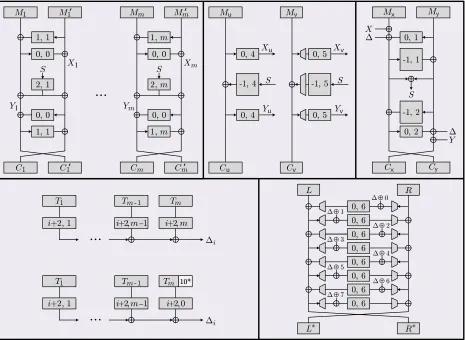
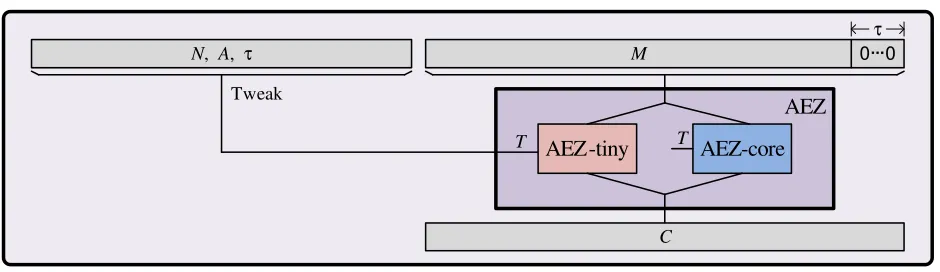
How AEZ works depends on the length of the input; see Fig. 1. To encipher a plaintext of fewer than 32 bytes we use AEZ-tiny, a balanced-Feistel scheme with a round function based on AES4, a four-round version of AES. The construction builds on FFX [6, 17]. The more interesting case, AEZ-core, is used to encipher strings of 32 bytes or more. It builds on EME [22, 24] and OTR [36]. Look ahead to the top-left panel of Fig. 7. There are two enciphering layers, with consecutive pairs of blocks processed together using a two-round Feistel network. The round function for this is again based on AES4. The mask injected as the middle layer is determined, for each pair of consecutive blocks, using another AES4 call.
Performance. AEZ-core is remarkably fast; as the description above implies, we need about five
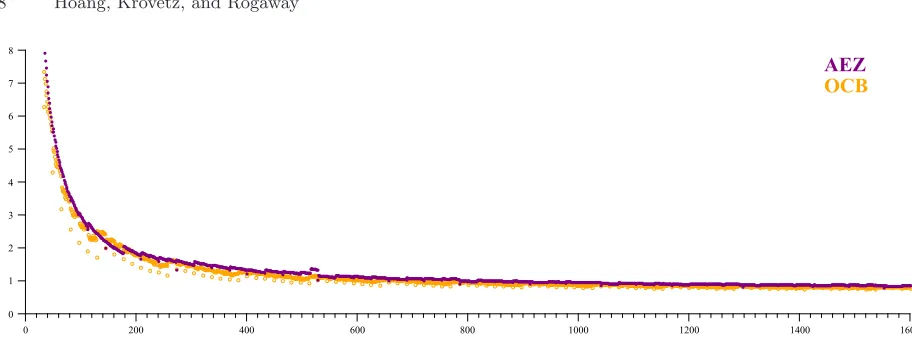
AES4 calls to encipher each consecutive pair of blocks, so ten AES rounds per block. Thus our performance approaches that of CTR-AES. An implementation of AEZ on Haswell using AES-NI has a peak speed of 0.72 cpb—about the same as OCB [32]. Look ahead to Fig. 8. Additionally, invalid strings can be rejected, and AD processed, in about 0.4 AES-equivalents per block, or 0.29 cpb peak (again on Haswell). Only the forward direction of AES is used, saving chip area in hardware realizations. The context size, about 128 bytes, is small, and key setup, about 1.2 AES-equivalents for a 128-bit key, is fast.
For a two-pass mode achieving MRAE, the cluster of performance characteristics described is unexpected. Part of the explanation as to how this is possible lies in the use of a design approach that benefits from both classical and provable-security design. Let us explain.
Prove-then-prune design. We designed AEZ using an approach we call prove-then-prune. It
works like this:
N, A, τ
C
0···0
M
τ
AEZ-core AEZ
AEZ-tiny
Tweak
T T
Fig. 1. High-level structure of AEZ. After appending to the message a block ofτ zero bits we encipher it using a tweak T comprising the nonce N, associated data A, and stretch τ. Enciphering depends on the length of the plaintext: usually we use AEZ-core, but strings shorter than 32 bytes are enciphered by AEZ-tiny. Both depend on the underlying keyK, which is not shown in the diagram above.
To achieve some complex cryptographic goal, design a scheme in the provable-security tradition, choosing an underlying primitive and demonstrably achieving the goal when it’s instantiated by an object achieving some standard assumption. Then, to improve speed, selectively instantiate some of the applications of the primitive using ascaled-down (e.g., reduced-round) construction. Use heuristic or cryptanalytic reasons to support the expectation that, despite scaling down, the scheme remains secure.
Specifically, AEZ is designed in terms of a tweakable blockcipher (TBC). If this TBC had been instantiated in the “usual” way, say using AES and the XE construction [34, 49], we would have a provably-sound design on message space {0,1}≥128. The cost would be about 2.5 times the cost of AES. But to speed things up, we instantiate most TBC calls with an AES4-based construction. Heuristics reasons to suggest that security nonetheless remains. Our design was specifically chosen so as to make a scaled-down instantiation plausible.
The thesis underlying prove-then-prune approach is that it can be instrumental for devising highly efficient schemes for complex aims. We believe thatif the instantiation is done judiciously, then the scaled-down scheme retains some assurance benefit. Still, it is important to emphasize the limitations of prove-then-prune. Naming an approach is not license to abuse it. The method is dangerous in the same sort of way that designing a confusion/diffusion primitive is: one has no guarantees for the object that will actually be used. Additionally, the set of people with provable-security competence is nearly disjoint from those with cryptanalytic competence. The authors think it essential that cryptanalysts study AEZ. This is all the more true because pruning was aggressive. In some way, prove-then-prune is implicit in prior work: schemes like ALRED [15] typify a trend in which reduced-round AES is used in contexts where full AES would demonstrably do the job.
RAE benefits. What do we hope to gain with RAE? Our definition and scheme are meant
or all of a putative plaintext that was supposed to be squelched because of an authenticity-check failure, this won’t compromise privacy or authenticity.
The authors believe that the properties enumerated would sometimes be worth a considerable computational price. Yet the overhead we pay is low: AEZ is almost as fast as OCB.
Discussion. AEZ’s name is meant to simultaneously suggest AE, AES, and EZ (easy), the last
in the sense of ease of correct use. But the simplicity is for the user; we would not claim that the AEZ algorithm is simple.
Since McOE and COPA [2, 20], some recent AE schemes have been advertised as nonce-reuse misuse-resistant despite being online.7 But online schemes are never misuse-resistant in the sense originally defined [51].8 They never support automatic exploitation of novelty or verified redun-dancy [5] and are always vulnerable to a simple message-recovery attack [47]. We disagree with the presumption that two-pass AE schemes are routinely problematic; in fact, our work suggests that, on capable platforms, there isn’t even a performance penalty. Finally, short messages routinely dominate networking applications, and we know of no application setting where it’s important to limit latency to just a few bytes, the implicit expectation for proposed online schemes.
This paper upends some well-entrenched assumptions. Before, AE-quality was always measured with respect to an aspirational goal; now we’re suggesting to employ an achievable one. Before, substantial ciphertext expansion was seen as necessary for any good AE; now we’re allowing an arbitrary, user-supplied input. Before, AE schemes and blockciphers were considered fundamentally different species of primitives; now we’re saying that, once the definitions are strengthened, they’re pretty much the same thing. Before, one could either give a provable-security design or one that follows a more heuristic tradition; now we’re doing the one and yet still finding need for the other. AEZ is one of 57 CAESAR submissions [7]. It’s distinguished by being the notionally strongest submission. We expect it to help clarify the potential cost and benefit of two-pass AE.
2 Prior AE Definitions
Fix an alphabet Σ. Typically Σ is {0,1} or {0,1}8, but other values, like Σ = {0,1, . . . ,9}, are fine. Forx∈Σ∗ let |x|denote its length. We write εfor the empty string andxևX for uniformly sampling from a distribution X. IfX is a finite set, it has the uniform distribution.
Syntax. We formalize a nonce-based AE scheme as a triple Π = (K,E,D). The key space K
is a set of strings with an associated distribution. The encryption algorithm E is deterministic and maps a four-tuple (K, N, A, M) ∈ (Σ∗)4 to a value C=EKN,A(M) that is either a string in Σ∗ or the distinguished symbol ⊥. Later we will allow AD to be a vector of strings, A ∈ (Σ∗)∗. The distinction is insignificant insofar as we can always encode a vector of strings as a string. We require the existence of sets N, A and M (the nonce space, AD space, and message space) such thatEKN,A(M)6=⊥iff (K, N, A, M)∈ K × N × A × M. The decryption algorithmDis deterministic and takes a four-tuple (K, N, A, C) to a value DKN,A(C)∈Σ∗∪ {⊥}. The length of a string-valued C = EKN,A(M) is not allowed to depend on anything beyond |N|, |A| and |M|. In fact, usually λ= |C| − |M| is a constant, in which case we call the scheme λ-expanding and refer to λas the
initialize IdealΠ KևK
oracleEnc(N, A, M)
C′← EK(N, A, M) CևΣ|C′|
returnC
oracleDec(N, A, C)
return⊥
initialize RealΠ KևK
oracleEnc(N, A, M) returnEK(N, A, M)
oracleDec(N, A, C)
returnDK(N, A, C)
initialize PRIΠ
for(N, A)∈ N × AdoπN,AևInj(λ)
oracleEnc(N, A, M) returnπN,A(M)
oracleDec(N, A, C)
if∃M ∈ Ms.t.πN,A(M) =Cthen returnM
return⊥
initialize REALΠ KևK
oracleEnc(N, A, λ, M)
returnEK(N, A, λ, M)
oracleDec(N, A, λ, C) returnDK(N, A, λ, C)
initialize RAEΠ andRAEΠ,S
for(N, A, λ)∈Σ∗×Σ∗×NdoπN,A,λևInj(λ)
θ←ε
oracleEnc(N, A, λ, M)
returnπN,A,λ(M)
oracleDec(N, A, λ, C)
if∃M ∈ Ms.t.πN,A,λ(M) =C then returnM
M ← ⊥ ←−forRAEΠ
(M, θ)←S(N, A, λ, C, θ) ←−forRAEΠ,S
returnM
Fig. 2. Games for defining security.The top three games are the usual ones for defining the AE and MRAE notions. The bottom two games are used to define RAE.
ciphertext expansion or stretch. We require that if C =EKN,A(M) is a string then DKN,A(C) = M. Algorithm Drejects ciphertext C ifDN,AK (C) =⊥and accepts it otherwise.
AE and MRAE security. Both conventional-AE and MRAE security can be defined using a
compact, all-in-one formulation [51]. LetΠ = (K,E,D) be an AE-scheme. Consider an adversaryA
with access to an encryption oracleEncand a decryption oracleDec. We define the MRAE security ofAasAdvmrae
Π (A) = Pr[ARealΠ ⇒1]−Pr[AIdealΠ ⇒1], the difference in the probability thatA
outputs 1 when run in theReal andIdealgames of Fig. 2. Both begin by selectingKևK. Game
Real answers encryption queries (N, A, M) with EKN,A(M) and decryption queries (N, A, C) with
DN,AK (C). Game Ideal answers Dec(N, A, C) queries with ⊥ and Enc(N, A, M) queries with |C|
uniformly chosen characters, where C ← EKN,A(M). For games Real and Ideal, adversaries may not repeat an Enc or Dec query, ask an Enc query (N, A, M) 6∈ N × A × M, ask a Dec query (N, A, C)6∈ N ×A×Σ∗, or ask aDec query (N, A, C) after anEnc query of (N, A, M) returnedC.
The above definition captures MRAE security because repeated nonces were allowed and were properly serviced. For the conventional AE notion,AdvaeΠ(A), modify Real and Ideal by having
anEnc(N, A, M) query following an earlierEnc(N, A′, M′) query return⊥. This has the same effect as prohibiting repeated N-values to the Enc oracle.
PRI security. We define security in the sense of a pseudorandom-injection (PRI) [51]. Fix a
Besides defining PRI security, Rogaway and Shrimpton showed that, for large ciphertext expan-sion λ, the notion essentially coincides with MRAE security [51]. Below we clarify the role of the ciphertext expansion by giving a sharper extended version of their result. To state our bound, define themisuse count as follows. Initially, set r = 0. Then, for each encryption queryEnc(N, A, M), if there was a prior query (N, A, M′) such that |M′| =|M|, increment r by 1. The final value of r is the misuse count. Below we show that good PRI security implies good MRAE security as long asq is small compared to|Σ|λ andr is small compared to|Σ|(λ+mmin)/2 (with all variables defined
below). The proof is in Appendix B.1.
Theorem 1. |AdvpriΠ (A)−Advmrae
Π (A)| ≤ 2q/|Σ|λ+ (r2 +r)/|Σ|λ+mmin+1 for any λ-expanding
AE scheme Π and adversary A, where r is the misuse count of A’s queries, q is the number of
queries it asks, andmmin is the length of the shortest string in the message space.
In short, the PRI definition captures best-possible security of a λ-expanding AE scheme, while the MRAE formulation captures an unreachable ideal. The gap between the realizable and the ideal is formalized by Theorem 1. It is small if the ciphertext expansion is large, and it is large if the ciphertext expansion is small. The latter is so because any actual encryption algorithm must map distinct (N, A, M) and (N, A, M′) to distinct ciphertexts, whence real encryptioncan’t return uniformly random characters. Similarly, for any infinite message space,some unqueried ciphertexts
must be valid, whence a decryption oracle thatalways returns an indication of invalidity is hoping for too much. Building on the PRI notion, we will now look towards an even more precise way to capture best-possible AE security.
3 RAE Security
Syntax. The principle difference between a PRI and an RAE scheme is that, for the latter, the
ciphertext expansion λis no longer a property of a scheme: it’s an arbitrary input from the user. All values λ ∈ N should be allowed.9 Corresponding to this change, we’ll write EN,A,λ
K (M) and DN,A,λK (C). The difference may look small, but its consequences are not.
Fix an alphabetΣ. Our formal definition again has an RAE scheme being a tripleΠ= (K,E,D), but with the signature ofEandDupdated. The encryption algorithmEis deterministic and maps a five-tuple (K, N, A, λ, M)∈(Σ∗)3×N×Σ∗to a stringC=EN,A,λ
K (M) of length|M|+λ. For maximal
utility when realized, we are not permitting a return value of ⊥: an RAE scheme must be able to encrypt anyM using anyN,A, andλ. The decryption algorithmDis deterministic and takes a five-tuple (K, N, A, λ, C) to a value DKN,A,λ(C)∈Σ∗∪ {⊥}. We require that DN,A,λ
K (E N,A,λ
K (M)) =M
for all K, N, A, λ, M. If there’s no M such thatC =EKN,A,λ(M) thenDN,A,λK (C) =⊥. Later in this section we will relax this requirement as a way to model the possibility of decryption algorithms that reveal information beyond an indication of invalidity.
RAE security. Let Π = (K,E,D) be an RAE scheme over alphabet Σ. Its security is defined
using the gamesREALΠ and RAEΠ at the bottom of Fig. 2. (For the moment, ignoreRAEΠ,S.)
The adversary Ahas two oracles, an encryption oracleEnc and a decryption oracleDec. For game REAL, these are realized by the actual encryption and decryption algorithms, which now take in the argument λ. For game RAEΠ we behave according to the family of random injections
9It might be OK to set some reasonable upperboundλ≤λ
πN,A,λ chosen at the beginning of the game, responding to each encryption query (N, A, λ, M)
withC =πN,A,λ(M) and responding to each decryption query (N, A, λ, C) withπN,A,λ−1 (C), if that
inverse exists, and ⊥ if it does not. We let AdvraeΠ (A) = Pr[AREALΠ ⇒
1]−Pr[ARAEΠ ⇒
1]. There are no restrictions on the kinds of queries the adversary may make.
To gain some appreciation for the RAE definition, consider an adversary that asks to encrypt a message M using a single byte of stretch. Such a scheme would not be considered secure in the MRAE setting, as forging with probability 1/256 is easy. But under the RAE viewpoint, that isn’t a defect per se, as the user who requests one-byte expansion would expect 1/256 of all ciphertexts to have some preimage. If a user should try to decrypt such a ciphertextC using the sameK, N, A butλ= 0, a plaintext will emerge, never an indication of invalidity, but that plaintext should be unrelated to the originally encrypted one.
Decryption-call leakage. An AE scheme will fail to approximate the RAEΠ abstraction if
its decryption algorithm, when presented an invalid ciphertext, routinely returns anything beyond an indication of invalidity. We now explain how to relax this expectation so that it’s OK to return additional material as long as it is known to be useless.
We said earlier that, for an RAE schemeΠ = (K,E,D) and anyN, A, λ, C, if there’s noM such that C=EKN,A,λ(M) then we expectDN,A,λK (C) to return⊥. Let us relax this requirement so that
DN,A,λK (C) may instead return a string, as long as its length is not|C|−λ. Any such string is trivially recognized as invalid, so, in effect, we are having D return both ⊥and an arbitrary piece of side informationY. We are not suggesting that the “real” decryption algorithm should return anything other than ⊥ when presented an invalid ciphertext; instead, we are effectively overloading D by folding into it a “leakage function” that captures which a decryption algorithm’s realization may leak about a presented ciphertext.
Using this generalized syntax, we define a gameRAEΠ,S parameterized by a probabilistic
algo-rithmS, thesimulator. Again see Fig. 2. SimulatorSis called upon to produce imitation ciphertexts when there’s no preimage underπN,A,λ. To accomplish this taskS is provided nothing beyond the
current oracle query and any saved stateθ it wants to maintain. An RAE scheme is judged secure if there’s a simulatorS—preferably an efficient one—such that (E,D) is indistinguishable from the pair of oracles defined in RAEΠ,S. We refine the RAE advantage by asserting thatAdvraeΠ,S(A) =
Pr[AREALΠ ⇒1]−Pr[ARAEΠ,S ⇒ 1]. The “basic” RAE definition corresponds to the case where simulatorS ignores its input and returns (⊥, ε).
The RAE definition effectively captures that, while it may be “nice” for decryption to reveal nothing but ⊥ on presentation of an invalid ciphertext, there are plenty of other things we could return without damaging privacy or authenticity. In fact, it really doesn’t matterwhat is returned just so long as it’s recognizably invalid and doesn’t depend on the key.
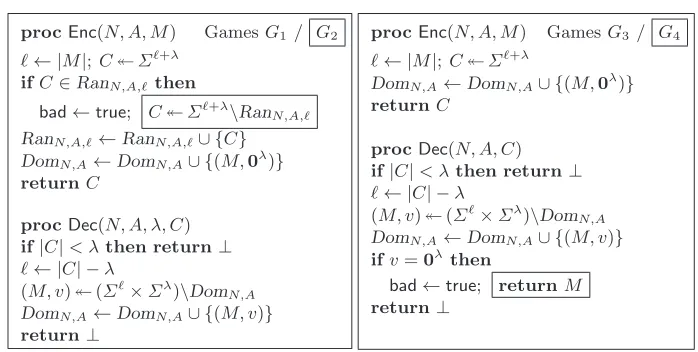
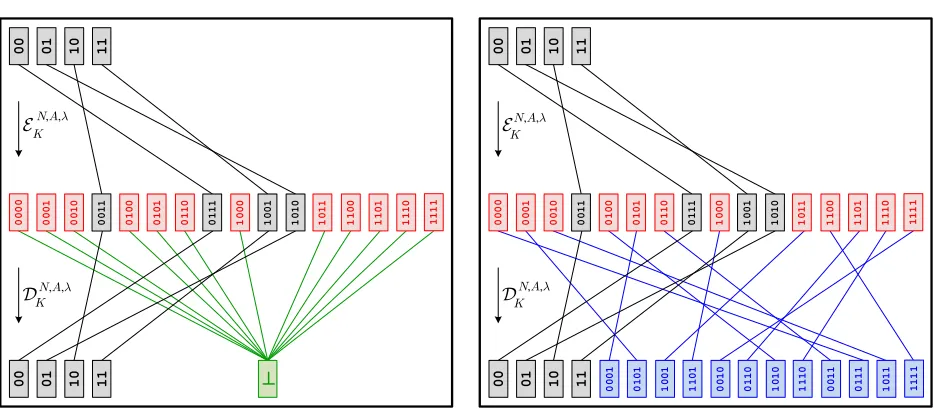
Illustration. Fig. 3 illustrates two possibilities for how an RAE scheme might encrypt 2-bit
D
EN,A,λ
K E D 0 0 0 0 0 0 0 1 0 0 1 0 0 0 1 1 0 1 0 0 0 1 0 1 0 1 1 0 0 1 1 1 1 0 0 0 1 0 0 1 1 0 1 0 1 0 1 1 1 1 0 0 1 1 0 1 1 1 1 0 1 1 1 1 0 0 0 0 0 0 0 1 0 0 1 0 0 0 1 1 0 1 0 0 0 1 0 1 0 1 1 0 0 1 1 1 1 0 0 0 1 0 0 1 1 0 1 0 1 0 1 1 1 1 0 0 1 1 0 1 1 1 1 0 1 1 1 1 ⊥ 0 0 0 1 1 0 1 1 0 0 0 1 1 0 1 1 0 0 0 1 0 1 0 1 1 0 0 1 1 1 0 1 0 0 1 0 0 1 1 0 1 0 1 0 1 1 1 0 0 0 1 1 0 1 1 1 1 0 1 1 1 1 1 1 0 0 0 1 1 0 1 1 0 0 0 1 1 0 1 1
N,A,λ
K
N,A,λ
K
N,A,λ
K
Fig. 3. Illustrating RAE.Two ways an RAE scheme might encrypt and decrypt a 2-bit string with 2-bit stretch.
Discussion. The reader may have noticed that there is no distinction in the RAE security definition
between the nonce N and associated data (AD) A. For this reason, either could be dropped—say the nonce—leaving us a signatureEKA,λ(M) andDA,λK (C). There’s an especially good argument for doing this when the AD A is vector-valued: the user is already free to use one of its components as a nonce. Still, for greater uniformity in treatment across AE notions, and to encourage users to provide a nonce, we have retained both N and A.
We gave our definition of RAE into two stages only for pedagogical purposes: this paper offers only one definition for RAE. The simulatorS may be trivial or not; that is the only distinction.
Andreeva et. al [1] recently provided several security definitions also meant to capture the requirement that a decryption algorithm releases only harmless information when presented an invalid ciphertext and a repeated nonce. Our own work is radically different from theirs insofar as we provide a single definition, RAE, that rolls into it this, among many, considerations.
4 Verified Redundancy Enhances Authenticity
If a plaintext contains redundancy, one naively expects that verifying its presence upon decryption should enhance the authenticity guarantee provided. For the case of enciphering-based encryption, which provides no authenticity guarantee on its own, this has been formally supported [5, 51]. But even in this case the existing results are with respect to conventional notions of AE, and such notions are too blunt to capture what one expects from verified redundancy. This is because the notions “give up” as soon as a single ciphertext forgery is made.
Let Π = (K,E,D) be RAE scheme and let v: Σ∗ → {0,1} be a function for indicating the “valid” strings: it determines Mv ⊆ Σ∗ by Mv = {M ∈ Σ∗: v(M) = 1}. Let Πv = (K,E,D˜)
be the AE scheme built from Π that declares messages invalid if v says so: ˜DN,A,λK (C) = M if
|M|=|C| −λandv(M) = 1, or if|M| 6=|C| −λ, where M =DN,A,λK (C), while ˜DKN,A,λ(C) =0kM otherwise, with 0 a canonical point in Σ. Let dv = maxℓ∈N
(|Mv∩Σℓ|)/|Σ|ℓ be the density
Suppose, for example, that Σ={0,1} and dv = 1/256: there’s a byte worth of redundancy in
the message space. We’d like to be able to make statements about the authenticity ofΠv such as: the
chance that an adversary can forge 10 successive, distinct ciphertexts is negligibly more than 2−80. Conventional AE definitions don’t let one say such a thing; they stop at the boundq/|Σ|λ whereq
is the number of queries and λ is the ciphertext expansion (assumed here to be a constant). One would like to obtain a much sharper bound viadv and λ—in our example, the forgery probability
should be about aboutq(dv/|Σ|λ)10. This way, even if, say,λ= 0 anddv = 1/2, we arestill able to
make strong statements about the security of Πv. Intuitively, for an RAE scheme Π, the scheme
Πv should have about (λmin+ log(1/dv)) log(|Σ|) bits of authenticity, where λmin is the minimum ciphertext expansion of any query—even after multiple successful forgeries and even in the presence of decryption leakage, future forgeries still remain just as hard.
To capture the intuition above, in Theorem 2 we show thatΠvitself is RAE-secure. The proof is
in Appendix B.2. Consequently, in gameRAE, for any query (N, A, λ, C) with|C|=ℓ+λtoDec, the chance that this query is a successful forgery is about |Mv∩Σℓ|/|Σ|ℓ+λ ≤ dv/|Σ|λ, despite
any decryption leakage and past successful forgeries.
Theorem 2. LetΠand Πv be defined as above. There is an explicitly given reductionRwith the
following property. For any simulatorS and any adversaryA, there is a simulatorS′ such that the
adversary B = R(A) satisfies Advrae
Π,S(B) = AdvraeΠv,S′(A). Adversary B makes the same queries asAand has essentially the same running time.
Note that for good RAE security, we want the simulator S to be efficient. This is important for privacy, but when the concern is authenticity, it’s less of an issue: a computationally-unbounded simulator may give the adversary some information that it can’t compute itself, but as long as the adversary can’t forge, whatever the adversary learns from the simulator is irrelevant for authenticity. Still, in the proof of Theorem 2, for each query (N, A, λ, C), the simulatorS′either runsSor samples from Σℓ∩ M
v, whereℓ=|C| −λ. For functionsv that arise from real-world usage, sampling from
Σℓ∩ Mv is likely to be simple and efficient, whenceS′ will be about as fast as S itself.
5 Robust AE from an Arbitrary-Input-Length TBC
We now show how to make an AE scheme that achieves RAE security. We begin with some basic definitions. LetM ⊆Σ∗ andT be sets. Ablockcipher Ee: K × T × M → Mis a mapping such that e
ET
K(·) = Ee(K, T,·) is a length-preserving permutation on M for any K, T. Thus |EeTK(X)| = |X|
and there’s a unique De: K × T × {0,1}∗ → M ∪ {⊥} such thatEeT
K(M) =C impliesDeTK(C) =M
and DeT
K(C) = ⊥ when there’s no M such that EeKT(M) = C. We call T the tweak space of eE.
When |T | = 1 we make the tweak implicit, writing E:K × M → M, now with inverse D. We define Perm(M) as the set of all length-preserving permutations onM, and Perm(T,M) the set of all mappings eπ:T × M → M whereπ(T,e ·)∈Perm(M) for allT ∈ T. We usually useencipher
instead ofencrypt when speaking of applying a blockcipher, and similarly fordecipher anddecrypt. An arbitrary-input-length blockcipher is a blockcipher with message space M = Σ∗. To be maximally useful, we will want a rich tweak space as well. These are versatile objects. A bit less general, awide-block blockcipher has message spaceΣ≥nfor some fixedn. Again one prefers a rich
tweak space. A conventional blockcipher has message space{0,1}n for some fixed n.
The strong, tweakable, PRP advantage of an adversary Aattacking a blockcipher Ee is defined asAdv±eprpg
E (A) = Pr[KևK : A
e
EK(·,·),eDK(·,·)
writeAdv±prpE (A) = Pr[KևK: A
EK(·),DK(·)
⇒1]−Pr[πևPerm(M) : Aπ(·), π−1(·)⇒1] if there’s
no tweak. If we prohibit the adversaryAfrom querying the second oracle we drop the word “strong”
and write Advgprpe
E (
A) and Advprp
E (A) respectively.
Encode-then-encipher. FixΣ. LetEe: K×T ×Σ∗ →Σ∗be an arbitrary-input-length tweakable blockcipher with tweak spaceT =Σ∗×Σ∗×N. LetDe be its inverse. Let Encode : Σ∗×N→Σ∗ be an injective function satisfying|Encode(M, λ)|=|M|+λ. We write the second argument to Encode as a subscript, Encodeλ(M)∈Σ|M|+λ. An example encoding function is Encodeλ(M) =Mk0λ.
For any encoding function Encode there’s a corresponding Decode : Σ∗×N→Σ∗∪ {⊥} such that Decodeλ(X) = M if there’s an M satisfying Encodeλ(M) = X, while Decodeλ(X) = ⊥ if
there’s no suchM. We expect Encode and Decode to be trivially computable, as in the example. From Ee: K × T ×Σ∗ → Σ∗ and Encode we define the encode-then-encipher construction as the RAE scheme EtE[Encode,Ee] = (K,E,D) where
EKN,A,λ(M) =eE(N,A,λ)
K (Encodeλ(M)), DN,A,λK (C) =M ifDe(N,A,λ)
K (C) =X andM satisfies Encodeλ(M) =X, DN,A,λK (C) =X ifDe(N,A,λ)
K (C) =X and noM satisfies Encodeλ(M) =X.
We stress that decryption does not simply return ⊥ when called on an invalid (N, A, λ, C), as is conventionally done; instead, we define decryption to “leak” the entire improperly encoded stringX. Nonetheless, Theorem 3 shows that EtE[Encode,eE] is RAE-secure when Ee is secure as a strong, tweakable PRP. Its proof appears in Appendix B.3.
Theorem 3 (EtE is RAE-secure). Let Encode and Ee: K × T ×Σ∗→Σ∗ be defined as above. Then there’s an explicitly given reductionRand an efficient simulatorSwith the following property.
For any adversary A, the adversary B = R(A) satisfies Advrae
EtE[Encode,eE],S(A) ≤ Adv ±gprp
e
E (
B). It
makes at most q queries whose total length is at most that ofA’s queries plus qλmax, where q is
the number of A’s queries and λmax is the largest stretch among them. The running time of B is
about that of A, plus the time associated to computations of Encode and Decode.
6 Wide-Block Enciphering: AEZ-core
Let n ≥ 1 be an integer and let {0,1}≥2n = {x ∈ {0,1}∗: |x| ≥ 2n}. Define the block length of a string x as⌈|x|/n⌉. We show how to build a strong PRP on {0,1}≥2n from a TBC on {0,1}n. We’ll use about 2.5 TBC calls pern-bit block. Later we’ll instantiate the TBC using mostly AES4, employing the prove-then-prune paradigm to selectively scale-down. This will reduce the amor-tized cost to about one AES call per block. Also see Appendix C for how to tweak a wide-block blockcipher.
We begin by recalling the definition of a pseudorandom function (PRF) f: K × M → {0,1}n.
For an adversary A attacking f, its PRF advantage is Advprf
f (A) = Pr[KևK: AfK(·) ⇒ 1]−
Pr[ρևFunc(M, n) : Aρ(·)⇒1] where Func(M, n) is the set of all functions from Mto{0,1}n.
AEZ-core. LetT ={a,u,uu,v,vv,x,xx,y,yy}∪({a,aa}×N) be the tweak space. Suppose we have a PRFf: K ×(T × {0,1}n)→ {0,1}n. One can instantiate this with a TBCEeon{0,1}nby setting fK(K,(T, X)) =EeKT(X). Consider the wide-block blockcipher AEZ-core[f] defined and illustrated
M1 M1
C1 C1
fa fa,1
X1
S fx
Mm Mm
Cm Cm
fa fa,m
Xm
Y1 Ym
S S
’ ’
’ ’
fa fa
fxx
fyy
fy
X
Y S
fvv fv
fv
...
Xv
Yv
Mx My
Cx Cy
Mu
Cu
S fuu
fu
fu
Mv
Cv Yu Xu
faa,1 faa,m
fa,1 fa,m
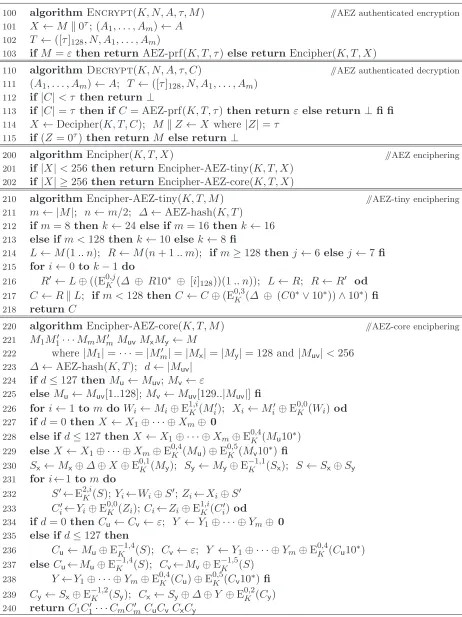
10 algorithmAEZ-core(K, M) //AEZ-core
11 M1M1′ · · ·MmMm′ Muv MxMy←M
12 where |M1|=· · ·=|Mm′ |=|Mx|=|My|=nand |Muv|<2n 13 d← |Muv|; if d < nthen Mu←Muv;Mv←ε
14 elseMu←Muv[1..n]; Mv←Muv[n+ 1..|Muv|]fi
15 fori←1 tom doWi←Mi⊕fa,i(Mi′); Xi ←Mi′⊕fa(Wi)od 16 ifd= 0 then X←X1⊕ · · · ⊕Xm⊕ 0
17 else if d < nthen X←X1⊕ · · · ⊕Xm⊕fu(Mu10∗) 18 elseX ←X1⊕ · · · ⊕Xm⊕fu(Mu)⊕fv(Mv10∗) fi
19 Sx←Mx⊕X⊕fx(My); Sy←My⊕fxx(Sx); S ←Sx⊕Sy 20 fori←1to mdo
21 S′←faa,i(S);Yi←Wi⊕S′;Zi←Xi⊕S′ 22 Ci′←Yi⊕fa(Zi); Ci←Zi⊕fa,i(Ci′) od
23 ifd= 0 then Cu←Cv←ε; Y ←Y1⊕ · · · ⊕Ym⊕ 0
24 else if d < nthen Cu←Mu⊕fuu(S); Cv ←ε;Y ←Y1⊕ · · · ⊕Ym⊕fu(Cu10∗) 25 elseCu←Mu⊕fu(S); Cv←Mv⊕fvv(S)
26 Y ←Y1⊕ · · · ⊕Ym⊕fu(Cu)⊕fv(Cv10∗)fi 27 Cy←Sx⊕fyy(Sy); Cx ←Sy⊕Y ⊕fy(Cy) 28 return C1C1′ · · ·CmCm′ CuCv CxCy
Fig. 4. The AEZ-core[f]construction.The method builds a strong-PRP on{0,1}≥2nfrom ann-bit-output PRFf
that operates on its subscript and argument. Its keyKis implicit. The PRF can be realized by a TBC.
uses the forward direction of the underlying TBC. AEZ-core[f] operates on M = {0,1}≥2n and
itself takes in no tweak. Theorem 4 shows that it’s a strong PRP. The proof is in Appendix B.4.
Theorem 4. Let n ≥ 1 be an integer and let T and f be as above. There’s an explicitly given reduction R with the following property. For any adversary A, adversary B = R(A) satisfies Adv±prpAEZ-core[f](A) ≤ Advprf
f (B) + 2σ2/2n where σ is the total block length of A’s queries.
Ad-versaryB uses the same running time asA, and makes at most 2.5σ queries.
Discussion. AEZ-core and its inverse are almost the same: the only change needed is to take
an RAE scheme—an involution is certainly RAE-insecure—this is about as symmetric a design as one could hope for. A high degree of symmetry can help maximize efficiency of both hardware and software. Symmetry is the reason for the wire-crossing just before each CiCi′.
Among the efficiency characteristics of AEZ-core is that one can selectively decrypt a chosen block about 2.5 times more quickly than decrypting everything. When AEZ-core is turned into an RAE scheme by the EtE construction, this observation is put to good use in achieving fast rejection of ciphertexts whose final 0τ bits is plaintext is not correct. That it is undamaging to release this timing information is guaranteed by results already show—in particular, that it is ok to release the
entire speculative plaintext.
AEZ-core confines “specialized” processing to the final 2–4 blocks. This helps with efficiency and simplicity compared to having specialized processing at the beginning or at the beginning and end. In particular, the 0τ authenticator used to make an RAE scheme will be put at theend of the message (adding a variable number of zero-bits at beginning could destroy word alignment) and, as long as τ ≤2n, it will be found in the final two blocks.
Numerous alternatives to AEZ-core were considered before arriving at our design. Correct al-ternatives we know are slower or more complex, while most simplifications are wrong. For example, consider trying to cheapen the design by using ci ·faa,1(S) instead of faa,i(S) where each ci is a
public constant and the product is in GF(2n). This fails for any choice ofci. See Appendix D.
One variant of AEZ-core thatdoes work is to eliminate the “left-hand” xor coming out offaa,i.
(One then has to defineXias the output offainstead of that output xor’ed withM1′, and changeYi
similarly.) We have kept this xor because it’s needed for symmetry.
7 Definition of AEZ
So far we have described two key elements of AEZ: the EtE construction and the AEZ-core[f] wide-block blockcipher. Now we give AEZ’s complete description. First a bit of notation.
Notation. The bit length of a string X is written |X|. For the bitwise xor of unequal-length
strings, drop the necessary number of rightmost bits from the longer (10⊕0100 = 11). For X a string, letX0∗ =X0p withp the smallest number such that 128 divides|X|+p. By X∗ we denote the set of all strings over the alphabet X, including ε. By (X∗)∗ we denote the set of all vectors overX∗, including the empty vector.
If|X|=nand 1≤i≤j≤nthenX(i) is theith bit ofX (indexing from the left starting at 1), msb(X) = X(1), and X(i..j) = X(i)· · ·X(j). Let [n]t be the t-bit string representing nmod 2t
and let [n] be shorthand for [n]8; for example [0]16 = ([0]8)16 = 0128 and [1]16 = (00000001)16. A block is 128 bits. Let 0 = 0128. If X =a
1 · · ·a128 is a block (ai ∈ {0,1}) then we define X≪1 =
a2 · · · a1280. For n∈Nand X ∈ {0,1}128 definen·X by asserting that 0·X =0 and 1·X=X and 2·X= (X≪1)⊕[135·msb(X)]128 and 2n·X = 2·(n·X) and (2n+ 1)·X = (2n·X)⊕X. For K, X ∈ {0,1}128 we writeaesenc(X, K) for a single round of AES:SubBytes,ShiftRows,
MixColumns, then anAddRoundKey with K. ForK = (K0, K1, K2, K3, K4) a list of five blocks, let AES4K(X) = AES4(K, X) beaesenc(aesenc(aesenc(aesenc(X⊕K0, K1), K2), K3), K4). ForK a list of 11 blocks, K = (K0, K1, . . . , K10), define AES10K(X) = AES10(K, X) like we defined
AES4 but with ten rounds ofaesenc. We do not omit the final-roundMixColumns.
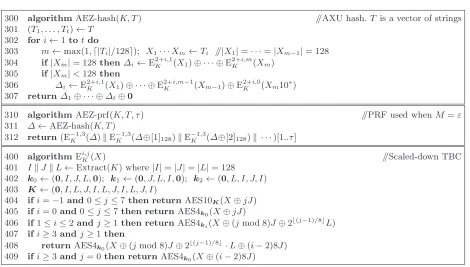
AEZ definition. See Figs. 5 and 6 for the definition of AEZ, and Fig. 7 for an illustration. Most
100 algorithmEncrypt(K, N, A, τ, M) //AEZ authenticated encryption 101 X←M k0τ; (A1, . . . , Am)←A
102 T ←([τ]128, N, A1, . . . , Am)
103 ifM =εthen returnAEZ-prf(K, T, τ) else returnEncipher(K, T, X)
110 algorithmDecrypt(K, N, A, τ, C) //AEZ authenticated decryption 111 (A1, . . . , Am)←A; T ←([τ]128, N, A1, . . . , Am)
112 if|C|< τ then return⊥
113 if|C|=τ then ifC = AEZ-prf(K, T, τ) then returnεelse return⊥fi fi 114 X←Decipher(K, T, C); M kZ←X where|Z|=τ
115 if(Z = 0τ) then returnM else return⊥
200 algorithmEncipher(K, T, X) //AEZ enciphering
201 if|X|<256then returnEncipher-AEZ-tiny(K, T, X)
202 if|X| ≥256then returnEncipher-AEZ-core(K, T, X)
210 algorithmEncipher-AEZ-tiny(K, T, M) //AEZ-tiny enciphering 211 m← |M|; n←m/2; ∆←AEZ-hash(K, T)
212 ifm= 8 then k←24 else if m= 16thenk←16
213 else if m <128thenk←10 elsek←8 fi
214 L←M(1.. n); R←M(n+ 1.. m); if m≥128thenj ←6 elsej ←7fi 215 fori←0 tok−1 do
216 R′ ←L⊕((E0K,j(∆ ⊕ R10∗ ⊕ [i]128))(1.. n)); L←R; R←R′ od
217 C←RkL; ifm <128thenC←C⊕(EK0,3(∆ ⊕ (C0∗∨10∗))∧10∗) fi 218 return C
220 algorithmEncipher-AEZ-core(K, T, M) //AEZ-core enciphering 221 M1M1′· · ·MmMm′ MuvMxMy←M
222 where|M1|=· · ·=|Mm′ |=|Mx|=|My|= 128 and|Muv|<256 223 ∆←AEZ-hash(K, T); d← |Muv|
224 ifd≤127thenMu←Muv;Mv←ε
225 elseMu←Muv[1..128];Mv←Muv[129..|Muv|]fi
226 fori←1 tom doWi←Mi⊕E1K,i(Mi′); Xi ←Mi′⊕E0K,0(Wi) od 227 ifd= 0then X←X1⊕ · · · ⊕Xm⊕ 0
228 else if d≤127thenX ←X1⊕ · · · ⊕Xm⊕E0K,4(Mu10∗)
229 elseX ←X1⊕ · · · ⊕Xm⊕E0K,4(Mu)⊕E
0,5
K (Mv10∗) fi 230 Sx←Mx⊕∆⊕X⊕E
0,1
K (My); Sy←My⊕E
−1,1
K (Sx); S ←Sx⊕Sy 231 fori←1 tom do
232 S′←E2K,i(S); Yi←Wi⊕S′;Zi←Xi⊕S′
233 Ci′←Yi⊕E0K,0(Zi);Ci←Zi⊕E1K,i(Ci′) od
234 ifd= 0then Cu←Cv←ε; Y ←Y1⊕ · · · ⊕Ym⊕ 0 235 else if d≤127then
236 Cu←Mu⊕E
−1,4
K (S); Cv←ε; Y ←Y1⊕ · · · ⊕Ym⊕E
0,4
K (Cu10∗) 237 elseCu←Mu⊕E
−1,4
K (S); Cv←Mv⊕E
−1,5
K (S) 238 Y ←Y1⊕ · · · ⊕Ym⊕E0K,4(Cu)⊕E
0,5
K (Cv10∗) fi 239 Cy←Sx⊕E
−1,2
K (Sy); Cx←Sy⊕∆⊕Y ⊕E
0,2
K (Cy) 240 return C1C1′ · · ·CmCm′ CuCvCxCy
300 algorithmAEZ-hash(K, T) //AXU hash.T is a vector of strings 301 (T1, . . . , Tt)←T
302 fori←1totdo
303 m←max(1,⌈|Ti|/128⌉); X1· · ·Xm←Ti //|X1|=· · ·=|Xm−1|= 128 304 if|Xm|= 128then∆i←EK2+i,1(X1)⊕ · · · ⊕E2+Ki,m(Xm)
305 if|Xm|<128then
306 ∆i←E2+Ki,1(X1)⊕ · · · ⊕EK2+i,m−1(Xm−1)⊕E2+Ki,0(Xm10
∗)
307 return∆1⊕ · · · ⊕∆t⊕0
310 algorithmAEZ-prf(K, T, τ) //PRF used whenM =ε
311 ∆←AEZ-hash(K, T)
312 return(E−K1,3(∆)kE−K1,3(∆⊕[1]128)kE−K1,3(∆⊕[2]128)k · · ·)[1..τ]
400 algorithmEi,jK(X) //Scaled-down TBC
401 IkJkL←Extract(K) where|I|=|J|=|L|= 128 402 k0←(0, I, J, L,0); k1←(0, J, L, I,0); k2←(0, L, I, J, I) 403 K←(0, I, L, J, I, L, J, I, L, J, I)
404 ifi=−1and0≤j≤7then returnAES10K(X⊕jJ)
405 ifi= 0and0≤j≤7then returnAES4k0(X⊕jJ)
406 if1≤i≤2andj≥1then returnAES4ki(X⊕(jmod 8)J⊕2
⌊(j−1)/8⌋L) 407 ifi≥3andj≥1then
408 returnAES4k0(X⊕(jmod 8)J⊕2
⌊(j−1)/8⌋·L⊕(i−2)8J) 409 ifi≥3andj= 0then returnAES4k0(X⊕(i−2)8J)
Fig. 6. AEZ’s hash, PRF, and TBC.The last is the locus of prove-then-prune scaling-down. The keyKis turned into 384 bits by a key-derivation function Extract.
AEZ operates on arbitrary byte strings. Not only is the plaintext M ∈ Byte∗ arbitrary, but
so too the key Key ∈Byte∗ and nonceN ∈Byte∗. The AD is even more general: an
arbitrary-length vector of byte strings, A∈(Byte∗)∗. The requested ciphertext expansion ofλ∈Nbytes is measured in τ = 8λbits.
At line 217, Encipher-AEZ-tiny may xor a bit into the ciphertext just before the algorithm’s conclusion. This is done to avoid a simple random-permutation distinguishing attacks, for very short strings, based on the fact that Feistel networks only generate even permutations [30]. A similar trick, conditionally swapping two fixed points, has been used before [45]. Our approach has the benefit that the natural implementation is constant-time.
We define Decipher(K, T, Y) as the uniqueX such that Encipher(K, T, X) =Y. Logically, this is all we need say for the specification to be well-defined. Still, the additional pseudocode is easy to describe. AEZ-tiny deciphering is identical to AEZ-tiny enciphering except we must count back-wards instead of forback-wards, and must do the even-cycles correction (line 217) at the beginning instead of the end. Specifically, Decipher-AEZ-tiny(K, T, M) is identical to Encipher-AEZ-tiny(K, T, M) except that line 215 is changed to count fromk−1 down to 0, while line 217 has each C replaced by M before moving the line up to just after line 213. And AEZ-core deciphering is identical to AEZ-core enciphering except that we must take the xy-tweaks in reverse order. Specifically, Decipher-AEZ-core(K, T, M) is identical to Encipher-AEZ-core(K, T, M) except we swap tweaks (0,1) and (0,2), and we swap tweaks (−1,1) and (−1,2). These appear at lines 230 and 239.
Mv
C v
M1 M1
C1 C1
X
1
S
Mx M
y
Cx C
y -1, 1
Mm Mm
Cm Cm
Xm Y 1 S S ’ ’ ’ ’
Tm - 1
T1 Tm T1 L R L R X S -1, 5 0, 5 0, 5 0, 0 0, 0
2, 1 2, m
0, 0 0, 0
0, 1
1, 1 1, m
1, m
1, 1 0, 2
i+2, 1 i+2, m−1
Y
∆i
-1, 2 ∆
∆
∆⊕ 1 0, 6 0, 6 0, 6 0, 6 0, 6 0, 6 0, 6 0, 6 ∆⊕ 0
∆⊕ 3
∆⊕ 2
∆⊕ 6 ∆⊕ 5
∆⊕ 7
Xv
Yv Ym
* *
∆⊕ 4
...
10*...
...
Cu -1, 4 0, 4 0, 4 S Xu Yu Mu ∆i TmTm - 1
i+2, 1 i+2, m−1
i+2, m
i+2, 0
Fig. 7. Illustrating AEZ enciphering.Rectangles with pairs of numbers are TBCs, the pair being the tweak (the key, alwaysK, is not shown).Top row:enciphering a messageMof (32 or more bytes) with AEZ-core. The diagram shows processing a string that is (exclude the middle panel) or isn’t (include the middle panel) a multiple of 16 bytes. Bottom left:AEZ-hash is an xor-universal hash built from AES4. It computes ∆= L∆i from a vector-valued tweakT comprisingA,N, andτ. Itsi-th componentT1· · ·Tmis hashed as shown.Bottom right:AEZ-tiny, when operating on a stringM =LkRof 16–31 bytes. More rounds are used ifM has 1–15 bytes.
insecure as a PRP: it is easily broken by the “Square” attack [14]. Use of an AES4-based TBC
despite this fact is where the scaling-down has been done in AEZ.
The key K ∈ Byte∗ is mapped to three 16-byte subkeys (I, J, L) using the key-derivation
function (KDF) named Extract that is called at line 401. The definition of Extract is omitted from the figures and regarded as orthogonal to the rest of AEZ. See the AEZ spec [26] for the current Extract : Byte∗ → Byte48. In our view, it is an unresolved matter what the security
properties (and even what signature) of a good KDF should be. Work has gone off in very different directions [33, 46, 61], and the area is currently the subject of a Password Hashing Competition (PHC) running concurrently with CAESAR.
the message. In this way we limit the frequency of doublings yet avoid number-of-trailing-zeros calculations.
We impose a limit that AEZ be used for at most 248 bytes of data (about 280 TB); by that time, the user should rekey. This usage limit stems from the existence of birthday attacks on AEZ, as well as the use of AES4 to create a universal hash function.
Cost accounting. Let us summarize the computational cost of AEZ in “AES-equivalents,”
where 1 AES-equivalent is 10 AES rounds. Assume a message of m blocks, the last of which may be fragmentary. To encipher or decipher m ≥ 2 blocks takes at most m + 2.4 AES-equivalents (latency 3.6). This assumes K, N, τ, and A have already been processed. To encrypt or decrypt m ≥ 2 blocks: at most m+ 3.8 AES-equivalents (latency 3.6). This assumes that K, A, and τ have already been processed and that |N| ≤ 128 and τ = 128. To reject an invalid ciphertext of m ≥2 blocks: at most 0.4m+ 2.4 AES-equivalents (latency 2.8). Same assumptions. To setup an m block key: 1.2m AES-equivalents (latency 0.4). This assumes that needed constants have been precomputed. To setup a string-values AD: 0.4m (latency 0.4). To encipher or decipher messages of 1–15 bytes is somewhat slower: 10, 6.8, and 4.4 AES-equivalents for 1, 2, and 3 bytes.
Parameterized counterparts. For a TBC-parameterized generalization of AEZ, let AEZ[E]e
be identical to AEZ except for using the TBC Ee: K × Taez× {0,1}128 → {0,1}128 in place of E (assume the correct tweak-space Taez). The key space of Ee is then taken as the key space for the constructed RAE scheme. Note that AEZ = AEZ[E] with E the algorithm defined by lines 400–409. Taking the above a step further, given a conventional blockcipher E: K × {0,1}128→ {0,1}128 we can define AEZ[E] as AEZ[E] wheree EeKi,j(X) = EK(X ⊕(i+ 1)I ⊕jJ) for I = EK(0) and
J =EK(1). The scheme AEZ[AES] can be regarded as a natural “scaled up” version of AEZ. We
emphasize that AEZ isnot AEZ[AES], which is about 2.5 times as slow.
Schemes AEZ[E] and AEZ[E] are close to AEZ, but enjoy conventional provable-security guar-e antees, as we now describe.
8 Security of AEZ[Ee] and AEZ[E]
We show that ifEeis secure as a tweakable PRP then AEZ[E] is RAE-secure. In fact, the statemente holds even if the decryption algorithm is modified so as to leak the entire improperly encoded string obtained by deciphering an invalid ciphertext. So, for the remainder of this section, assume the modification of AEZ in which the else clause of line 115 returns the deciphered message X rather than ⊥. This change only makes our results stronger, explicitly modeling the possibility of a decryption implementation leaking some or all ofX. Theactual decryption algorithm returns⊥. Our provable-security results for AEZ need to assume that the adversary avoids enciphering or deciphering extremely short strings—at least those under 16 bytes, say, for which AEZ-tiny, a Feistel-based construction, will not enjoy a desirable bound. While provably-secure options are now available for enciphering very short strings, they still do not have competitive efficiency.
As the alphabet for AEZ is Σ = Byte, in this this section we write |x| for the byte length
of x. For an encryption query (N, A, λ, M), define the number of blocks processed as ⌈|N|/16⌉+ P
i⌈|Ai|/16⌉+⌈(|M|+λ)/16⌉. This query is small if M 6= ε and 16 ≤ |M|+λ < 32, and tiny
if M 6=ε and |M|+λ < 16. Likewise, for a decryption query (N, A, λ, C), the number of blocks processed is ⌈|N|/16⌉+Pi⌈|Ai|⌉+⌈(|C|)/16⌉. The query is small if 16≤ |C|<32 and |C| 6=λ,
Theorem 5. LetEe: K × Taez× {0,1}128 → {0,1}128 be a TBC andΠ = AEZ[E]. Then there aree efficient, explicitly given algorithmsRandS with the following property. LetAbe an adversary for
attackingΠ. Assume it never asks any small or tiny query. ThenB=R(A) satisfiesAdvrae Π,S(A)≤
3.5s2/2128+Advgprpe
E (B), wheresis the total number of processed blocks, plus 2 blocks per message.
AdversaryB makes at most 2.5s queries and has about the same running time asA.
An alternative approach to justifying the security of AEZ is to speak of the security of AEZ[E], the cousin of AEZ defined from a conventional blockcipher E using the XE construction to make the needed TBC. Its security can be captured by the following result. The proof is in Appendix B.6.
Theorem 6. LetE: K × {0,1}128 → {0,1}128 be a blockcipher andΠ= AEZ[E]. Then there are efficient, explicitly given algorithmsRandS with the following property. LetAbe an adversary for
attacking Π. Assume it never asks a small or tiny query. Then B =R(A) satisfies Advrae Π,S(A) ≤
13s2/2128+Advprp
E (B), wheresis the total number of processed blocks, plus 2 blocks per message.
AdversaryB makes at most 2.5s queries and has about the same running time asA.
If one wants to accommodate small queries then we still have a provable, albeit much inferior result. Let Feistel[r, n] denote an idealr-round Feistel network on{0,1}2n. The best known provable
bound for Feistel networks [43, Theorem 7] states that if an adversary makesq≤ 1282nn queries then
Adv±prpFeistel[6,n](A) ≤ 8q
2n + q
2
22n+1. Translating this to our setting, one is bound to make at most
q ≤ 128·64264 = 251 small queries, and the security advantage is q/261+ 4s2/2128. These restrictions seem to be more of the artifacts of the analysis in [43, Theorem 7] than reflecting the actual security of Feistel networks: assuming that the round functions of Feistel[6, n] are instantiated from full AES, the fastest known attack, forn≥64, is still the exhaustive key search on AES.
9 Estimated Security of AEZ Itself
Consider enciphering a message M, |M| ≥ 256, by AEZ[AES] (which, recall, is not AEZ, but a scaled-up version using an AES-based TBC). The design would seem excessive: each block Mi
would be subjected to 30 rounds of AES (ten shared with a neighboring block), not counting the additional AES rounds to produce the highly unpredictable,M-dependent valueS, a value derived from which gets injected into the process while 20 rounds yet remain. It is in light of such apparent overkill that AEZ selectively prunes some of the AES calls that AEZ[AES] would perform. In particular, we prune invocations where we aim to achieve computational xor-universal hashing. We leave enough AES rounds so that each block Mi is effectively processed with 12 AES rounds,
eight of these subsequent to injection of the highly-unpredictableS and four of them shared with a neighboring block. The key steps in calculatingS are not pruned, nor are the TBCs used to mask
u- and v-blocks.
To estimate the security of AEZ it seems appropriate to replace thes2/2128term of Theorem 5 by s2/2113, resulting in the bound 4s2/2113+t/2128, because of the higher maximal expected differential probability of AES4 [31] compared to an ideal hash or cipher, where t is the time (including the description size) in which the adversary runs.
Fig. 8. AEZ vs. OCB performance. Thex-axis is message length, in bytes, and the y-axis is cycles per byte (cpb). The graph is best viewed in color: solid purple circles are for AEZ; unfilled yellow circles are for OCB3 [32]. Performance of the two is close, both having peak speeds around 0.7 cpb and being similar on most shorter messages as well. The execution vehicle is an Intel Haswell processor using AES-NI.
attack known, due to Patarin [41], that distinguishes them from a family of independent, truly random even permutations requires at least 2(k−4)n plaintext/ciphertext pairs. From our choice of
the number of rounds, this attack needs at least 272 plaintext/ciphertext pairs, and thus doesn’t violate our up-to-the-birthday-bound security goal.
AEZ was specifically designed so that scaling-down most of its AES calls would seem safe. This is design-specific; one cannot indiscriminately scale a scheme’s primitives. A previous design, where AEZ-core followed the NR approach [39, 40], could not be as effectively scaled-down.
10 Software Performance
The development of AEZ has generally presumed an instruction set architecture (ISA) with round-level support for AES, such as Intel’s AES-NI or ARM’s version 8 ISA. On these systems the AES unit can be kept busy processing several AES4 computations in parallel while idle processing units handle load, store, and xor overhead. On Intel’s Haswell architecture, for example, unrelated AES rounds can issue every cycle and take seven cycles to retire, so seven parallel AES4 calculations can complete in 34 CPU cycles, while idle superscalar processing units can handle other computations. This observation has led us to design AEZ to conveniently process eight blocks at a time.
AEZ overhead beyond AES rounds has been minimized. As an example of this, our AES4 key schedule omits the final round key, allowing aesenc’s included xor operation to be used for other
purposes. Such optimizations lead to AEZ peak speeds, on Haswell, of around 0.72 cpb—not far from the theoretical maximum for the number of rounds executed of 0.63 cpb.
Fig. 8 compares the performance of AEZ and OCB on messages of all byte lengths up to 1600 bytes. The two are not only similar for long messages but for short strings too. Only when messages are shorter than 16 bytes, where AEZ-tiny increases the number of AES4 calls used, does OCB become significantly faster.
OCB’s optimized reference code runs at 84 cpb. For comparison, GCM, CCM and CTR run at 124, 134 and 67 cpb, respectively. The figures use the OpenSSL libraries.
One might expect the two-pass nature of AEZ to be a performance burden because data must be dragged into cache from memory twice. We have found that modern processors, like Intel’s Haswell, have such efficient hardware prefetching that bringing data into cache twice, in a sequential streaming fashion, is not expensive at all. It requires no explicit prefetching. Encrypting 1MB on Haswell is as efficient as encrypting 32KB despite 1MB exceeding the 256KB level-2 cache. Two passes may have a more significant cost on systems with poor prefetching facilities, although this might be mitigated by software prefetching.
Another benefit of AEZ’s two passes is that the second pass is not needed to discover that a ciphertext is inauthentic, leading to message rejection costing as little as 0.28 cpb on Haswell. On long messages, approximately 2/5 of AES4 calls are performed during the first pass, which aligns perfectly with the peak times we’ve observed for encryption and fast-rejection.
All Haswell timings reported in this paper were gathered on a 2.9 GHz Intel Core i5-4570S CPU using its time-stamp counter to gather elapsed CPU cycles over encryption calls. Our imple-mentation is written in C using “intrinsic” functions to access CPU-specific functionality. It was compiled using GCC 4.9 with options-march=native -O3. Our optimized implementation will be made publicly available and freely licensed.
Acknowledgments
Many thanks to Tom Shrimpton, who provided important interaction on RAE definitions and their implications. Liden Mu and Chris Patton proofread our specification document and did imple-mentations that helped verify our own. We received good comments and corrections from Danilo Gligoroski, Tom Ristenpart, Yusi (James) Zhang, and Damian Viz´ar. Thanks to Dustin Boswell for an April 2013 email on the importance of making AE easier to use, Stefan Lucks for a Jan 2012 discussion on the problem unverified plaintexts, and Ren´e Struik for an August 2013 DIAC presen-tation on the utility of minimizing ciphertext expansion. Thanks to Terence Spies for catalyzing the idea of unifying AE and blockciphers both in definition and schemes.
Part of this work was done when Tung was a postdoc at UC San Diego and Phil was visiting ETH Z¨urich. Many thanks to Mihir Bellare for that postdoc, and many thanks to Ueli Maurer for hosting that sabbatical.
Hoang was supported by NSF grants 0904380, CCF-0915675, 1116800 and CNS-1228890; Krovetz was supported by NSF grant CNS-1314592; and Rogaway was supported by NSF grants CNS-1228828 and CNS-1314885. Many thanks to the NSF for their continuing support.
References
1. E. Andreeva, A. Bogdanov, A. Luykx, B. Mennink, N. Mouha, and K. Yasuda. How to securely release unverified plaintext in authenticated encryption. Cryptology ePrint report 2014/144. Feb 25, 2014.
2. E. Andreeva, A. Bogdanov, A. Luykx, B. Mennink, E. Tischhauser, and K. Yasuda. Parallelizable and authen-ticated online ciphers.ASIACRYPT 2013. LNCS 8269, Springer, pp. 424–443, 2013.
3. M. Bellare, A. Boldyreva, L. Knudsen, and C. Namprempre. Online ciphers and the Hash-CBC construction. CRYPTO 2001. LNCS 2139, pp. 292–309, 2001. Also Cryptology ePrint Archive 2007/197.
5. M. Bellare and P. Rogaway. Encode-then-encipher encryption: how to exploit nonces or redundancy in plaintexts for efficient cryptography.ASIACRYPT 2000. LNCS 1976, Springer, pp. 317–330, 2000.
6. M. Bellare, P. Rogaway, and T. Spies. The FFX mode of operation for format-preserving encryption. Draft 1.1. Submission to NIST. Feb 20, 2010.
7. D. Bernstein. Cryptographic competitions: CAESAR call for submissions, final (2014.01.27). Available at http://competitions.cr.yp.to/caesar-call.html.
8. J. Black and M. Cochran. MAC reforgeability. LNCS 5665, Springer, FSE 2009, pp. 345–362, 2009.
9. J. Black and P. Rogaway. Ciphers with arbitrary finite domains.CT-RSA 2002. LNCS 2271, Springer, pp. 114– 130, 2002.
10. A. Boldyreva, J. Degabriele, K. Paterson, and M. Stam. On symmetric encryption with distinguishable decryption failures. Cryptology ePrint Report 2013/433, 2013.
11. D. Chakraborty and M. Nandi. An improved security bound for HCTR. FSE 2008. LNCS 5086, Springer, pp. 289–302, 2008.
12. D. Chakraborty and P. Sarkar. HCH: A new tweakable enciphering scheme using the hash-encrypt-hash approach. IEEE Transactions on Information Theory, 54(4), pp. 1683–1699, 2008.
13. D. Chakraborty and P. Sarkar. A new mode of encryption providing a tweakable strong pseudorandom permu-tation.FSE 2006. LNCS 4047, Springer, pp. 293–309, 2006.
14. J. Daemen and V. Rijmen.The Design of Rijndael: AES — The Advanced Encryption Standard. Springer-Verlag, 2002.
15. J. Daemen and V. Rijmen. A new MAC construction ALRED and a specific instance ALPHA-MAC. Fast Software Encryption. LNCS 3557, Springer, pp. 1–17, 2005.
16. J. Daemen and V. Rijmen. The Pelican MAC function. Cryptology ePrint report 2005/088. 2005.
17. M. Dworkin. Recommendation for block cipher modes of operation: methods for format-preserving encryption. NIST Special Publication 800-38G: Draft. July 2013.
18. N. Ferguson. Authentication weaknesses in GCM. Manuscript. May 20, 2005.
19. R. Fisher and F. Yates. Statistical tables for biological, agricultural and medical research. London: Oliver & Boyd, 1938.
20. E. Fleischmann, C. Forler, S. Lucks, and J. Wenzel. McOE: A family of almost foolproof on-line authenticated encryption schemes.FSE 2012. LNCS 7549, Springer, pp. 196–215, 2011. Also Cryptology ePrint Report 211/644 (29 Nov 2011; revised 5 Dec 2013).
21. P. Fouque, A. Joux, G. Martinet, and F. Valette. Authenticated on-line encryption. SAC 2003. LNCS 3006, pp. 145–159, 2004.
22. S. Halevi. EME∗: extending EME to handle arbitrary-length messages with associated data.INDOCRYPT 2004. LNCS 3347, Springer, pp. 315–327, 2004.
23. S. Halevi. Invertible universal hashing and the TET encryption mode. Cryptology ePrint report 2007/014. 24. S. Halevi and P. Rogaway. A parallelizable enciphering mode.CT-RSA 2004. LNCS 2964, Springer, pp. 292–304,
2004.
25. S. Halevi and P. Rogaway. A tweakable enciphering mode.CRYPTO 2003. LNCS 2729, Springer, pp. 482–499, 2003.
26. V. T. Hoang, T. Krovetz, and P. Rogaway. AEZ v3: authenticated encryption by enciphering. CAESAR submis-sion. 2014.
27. J. Katz and M. Yung. Unforgeable encryption and chosen ciphertext secure modes of operation. FSE 2000, LNCS 1978, Springer, pp. 284–299, 2000.
28. V. T. Hoang, T. Krovetz, and P. Rogaway. Robust authenticated-encryption: AEZ and the problem that it solves. Cryptology ePrint report 2014/793. Jan 2015. Full version of this paper.
29. IEEE. 1619.2-2010 – IEEE standard for wide-block encryption for shared storage media. IEEE press, 2010. 30. B. Kaliski, R. Rivest, and A. Sherman. Is DES a pure cipher? (Results of more cycling experiments on DES).
CRYPTO 85. LNCS 218, Springer, pp. 212–226, 1986.
31. L. Keliher and J. Sui. Exact maximum expected differential and linear probability for two-round Advanced Encryption Standard.IET Information Security, 1(2), pp. 53–57, 2007.
32. T. Krovetz and P. Rogaway. The software performance of authenticated-encryption modes. FSE 2011. LNCS 6733, Springer, pp. 306–327, 2011.
33. H. Krawczyk. Cryptographic extraction and key derivation: the HKDF scheme. CRYPTO 2010. LNCS 6223, Springer, pp. 631–648, 2010.

![Fig. 4. The AEZ-core[f] construction. The method builds a strong-PRP on {0, 1}≥2n from an n-bit-output PRF fthat operates on its subscript and argument](https://thumb-us.123doks.com/thumbv2/123dok_us/7906357.1312735/13.612.76.540.89.546/construction-method-builds-strong-output-operates-subscript-argument.webp)