Cryptanalysis of GOST R Hash Function
Zongyue Wanga, Hongbo Yub,∗
, Xiaoyun Wangb
a
Key Laboratory of Cryptologic Technology and Information Security, Ministry of Education, Shandong University, Jinan 250100, China
b
Department of Computer Science and Technology, Tsinghua University, Beijing 100084, China
Abstract
GOST R is the hash function standard of Russia. This paper presents some cryptanalytic results on GOST R. Using the rebound attack technique, we achieve collision attacks on the reduced round compression function. Result on up to 9.5 rounds is proposed, the time complexity is 2176 and the memory requirement
is 2128 bytes. Based on the 9.5-round collision result, a limited birthday distinguisher is presented. More
over, a method to constructkcollisions on 512-bit version of GOST R is given which show the weakness of the structure used in GOST R. To the best of our knowledge, these are the first results on GOST R.
Keywords: Hash Function, GOST R, Rebound Attack, Multi-Collision
1. Introduction
Hash functions are taking important roles in cryptography and have been used in many applications, e.g., digital signatures, authentications and message integrity. Since the break of MD5 and SHA-1 [1, 2], cryptographers have been searching for secure and efficient hash functions. Developed from GOST, GOST R is the hash function standard of Russia [3]. Similar as the structure of Whirlpool [4], it also uses an AES-like block cipher in its compression function.
Rebound attack is a freedom degrees utilized technique which can be applied to find collisions in both permutation based and block cipher based hash constructions. This technique is first proposed by Mendel et al. to achieve collision attacks on reduced Whirlpool and Grøstl [5]. It aims to find a pair of values that follows a pre-determined truncated differential efficiently. The searching procedure is divided into two phase: the inbound phase and the outbound phase. In inbound phase the attacker makes full use of the available degrees of freedom and generates sufficiently many paired values that satisfy the truncated differential path of the inbound phase as starting points. The subsequent outbound phase tests these starting points in order to find paired values that satisfy the truncated differential path of the outbound phase.
Giving better results on Whirlpool, Lamberger et al. improved this technique in [6]. Available degrees of freedom of the key schedule are used to extended the inbound phase of the rebound attack by up to two rounds. The best result of [6] is near-collision attack on 9.5 rounds of the compression function with a complexity of 2176. And this result is further turned into the first distinguishing attack for the full 10
round compression function of Whirlpool. At the same time, Gilbert et al. bring in Super-Sbox technique to rebound attack in [7] where two rounds of AES-like permutations were viewed as a layer of Super-Sbox. Besides, the rebound technique can also be applied to analysis AES and AES-like block ciphers [8, 9] as well as ARX ciphers [10]. Recently, using techniques adapted from the rebound attack, Duc et al. constructed differential characteristics on Keccak in [11].
In contrary to finding collisions for hash functions, Joux proposed a method to construct multicollisions in [12]. He argued that for iterated hash functions, to find a multicollisions is not even harder than finding
✩supported by 973 Project (Grant 2013CB834205), NSF of China (No.61133013) and Tsinghua Initiative Scientific Research
Program (No.20111080970)
∗corresponding author
rebound_gost_r.tex
ordinary collisions. This method can be applied to generally analyze the security of the hash function structure.
1.0.1. Our Contributions
As the similarity between GOST R and Whirlpool, the rebound techniques used in [6] to analyze Whirlpool can also applied to GOST R. However, GOST R replace of the ShiftRows operation in AES-based designs with the matrix transposition. We show that this difference brings more weakness.
In this paper, we present the first analysis on GOST R. More precisely, by applying the rebound attack techniques similar as in [6], we give collision attacks on 4.5, 5.5, 7.5 and 9.5 rounds GOST R compression function respectively. Our collision attacks on GOST R compression function are summarized in Table1. Then we show that the result of 9.5 rounds can be further converted to a 10-round distinguisher. In addition, we give a method to construct multicollisions on full 512-bit version of GOST R. This result shows that the structure used in GOST R is not an ideal one.
Table 1: Summary of results for GOST R compression function. The complexity in brackets refer to modified attacks using a precomputed table taking 2128
time/memory to set up
rounds complexity time/memory type source
4.5 264/216 collision Sect.3.3
5.5 264/264 collision Sect.3.4
7.5 2128/216 collision Sect.3.5
9.5 2240/216(2176/2128) collision Sect.3.6
1.0.2. Outline of the Paper
The paper is organized as follows: In section 2, we briefly describe the GOST R hash function. Then we illustrate rebound attack in detail in section 3; a limited birthday distinguisher is given in section 4. In section 5, we present the method of constructing multicollisions. Finally, in section 6, we conclude this paper.
2. The GOST R hash function
GOST R is the Russian hash function standard [3]. It accepts message block size of 512 bits and produces a hash value of 512 or 256 bits. A l-bits message is first padded into a multiple of 512 bits. The bit ’1’ is appended to the end of the message, followed by 512−1−(lmod 512) zero bits. Let M =MtkMt−1 k · · · kM1 be a t-block message (after padding) which is represented in big endian form.
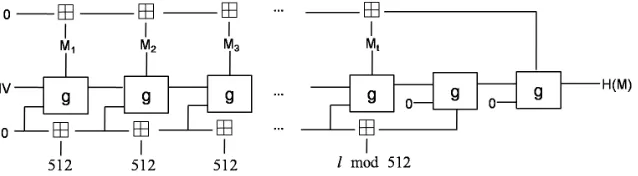
As illustrated in Fig.1, the computation ofH(M) can be described as follow:
Figure 1: The GOST R hash function
hj =gN(hj−1, Mj), N=N⊞512, Σ = Σ⊞Mj f or 0< j < t (2)
ht=gN(ht−1, Mt), N =N⊞(lmod 512), Σ = Σ⊞Mt (3)
ht+1=g0(ht, N) (4)
H(M) =g0(ht+1,Σ) (5)
whereIV is a predefined initial value and ’⊞’ means addition operation in the ringZ2512. gN(h, m) is the
compress function of GOST R which contains a 512 bits block cipher and is calculated as
gN(h, m) =E(L◦P◦S(h⊕N), m)⊕h⊕m (6)
The block cipher E used in GOST R is a variant of AES which update an 8×8 state1 of 64 bytes and
round key in 12 rounds. In one round, the state is updated by the round transformationri as follow:
ri≡X[ki+1]◦L◦P◦S
The round transformation is detailed as:
• the non-linear layerS applied an S-Box to each byte of the state independently.
• the byte permutationP transpose the state matrix.
• the linear transformationLis specified by the right multiplication with the 64×64 matrix A over the fieldGF(2) for each row of the state independently.
• the key additionX[ki+1] XOR the round keyki+1 to the state
The round keyki is update as
ki=L◦P◦S(ki−1⊕Ci−1) f or 1< i≤13
whereCi are constants in GOST R andk1 is initialized byk1=L◦P◦S(hj−1⊕N).
After the last round of the state update transformation, the output value of the block cipher E, the previous chaining valuehj−1and the messageMj are xored together as the output of the compress function.
We denote the resulting state of round transformationri byRi+1, and the intermediate states after S,
P and LbyRS
i,RPi andRLi, respectively. The initial stateR1=M1⊕k1.
3. Rebound Attack on GOST R Compression Function
The rebound attack is a hash function analyzing technique which was first proposed by Mendel et al. in [5] to attack round-reduced Grøstl and Whirlpool. The main idea of this technique is to construct a differential trail using the available degrees of freedom to fulfill the low probability part. Usually, it consists of an inbound phase with a match-in-the-middle part as well as a subsequent probabilistic outbound phase. With the help of rebound technique, we give collisions on 4.5 and 5.5 rounds of the GOST R compression function. Further more, by using the available degrees of freedom from the key schedule as in [6], we improve the results to collisions on 7.5 and 9.5 rounds.
1
3.1. The Original Rebound Attack
In rebound attack, the block cipher or permutation of a hash function used in the compression function is divided into three sub-parts. Let E be a block cipher, thenE =Ef w◦Ein◦Ebw. The rebound attack
works in two phases:
• Inbound phase: this phase start with several chosen input/output differences of Ein which are
propagated through linear layer forward and backward. Then one generate all possible actual value pairs that satisfy the difference by matching the differences though a single Sbox layer. These actual value pairs are the starting points for the outbound phase.
• Outbound phase: Compute the matches of inbound phase both forward and backward direction thoughEf w andEbw to obtain the desire collisions or near-collisions. Usually,Ef w and Ebw have a
low probability so that one has to repeat the inbound phase to obtain more starting points.
3.2. Preliminaries for the Rebound Attack
Before describing the rebound attack on GOST R, we briefly give some properties of its linear transfor-mationL and S-box in the compress function.
• Difference Propagation in L: Since Lis a linear transformation, a certain input difference ofL leads to a certain output difference. AsLacts on each row of the state independently, the output difference of a determined row is only affected by the input difference of that row. For only one active byte in a row, it always leads to eight active bytes propagating forward or backward through L, regardless the position of the active byte.
• Differential Properties of S: Givena, b∈ {0,1}8, the number of solutions to the equation
S(x)⊕S(x⊕a) =b (7)
can only be 0,2,4,6,8 and 256, which occur with frequency 38235, 22454, 4377, 444, 25 and 1, respec-tively. On average, for a random given differential (a, b), one expects to find one value as a solution. And a 256×256 input/output difference table can help us to find solutions with negligible computation.
3.3. Collision Attack on 4.5-Round GOST R Compression Function
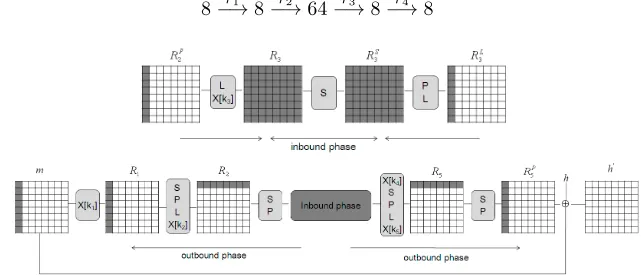
In this section, we will describe the application of rebound attack on the GOST R compression function reduced to 4.5 rounds. The core of the attack is a 4-round differential trail, which has the following sequence of active S-boxes:
8 r1
−→8 r2
−→64 r3
−→8 r4
−→8
Figure 2: A schematic view of the attack on 4.5 rounds of GOST R compression function. Black state bytes are active.
In the rebound attack, we first split the block cipher E into three sub-ciphers E = Ef w◦Ein◦Ebw.
3.3.1. Inbound Phase.
In the first step of the inbound phase, we start with 8-byte active differences at both RP
2 andR3L, and
propagate forward and backward to R3 and RS3 respectively (see Fig.2). As the difference propagation
property ofLdescribed in Sect.3.2, we get a fully active state at bothR3 andRS3.
In the second step of the inbound phase, we perform match-in-the-middle on theS layer ofr3 in order
to find a matching input/output difference. As indicated in Sect.3.2, we expect to find a solution on average for a given differential trail. Note that there are in total 2128different differential trails, we can get at most
2128 actual values for R3 and RS3. Ask3 can be any value, the maximum number of the starting points is
2128+512= 2640.
3.3.2. Outbound Phase.
In the outbound phase, we use the starting points produced in inbound phase and compute these values backward and forward. As shown in Fig.2, the differences atRP
2 and R3L lead differences only in the first
column ofR1 andR5P respectively.
One can easily construct a collision on the compression function of GOST R reduced to 4.5 rounds using the values generate in above step. As h′
= m⊕E(k, m)⊕h, for the same hand k, the same differences for m and E(k, m) always lead to a collision. For a pair of values generated in the outbound phase, the differences is equal formandE(k, m) with probability of 2−64. So we have to generate about 264starting
points to construct a collision. The time complexity is about 264. Since we only need to store a 256×256
input/output differences table for S-box, the memory requirement is only 216 bytes.
3.4. Collision Attack on 5.5-Round GOST R Compression Function
Using the Super-Sbox technique [7], we can improve the 4.5-round result by adding one round to the inbound phase. This turns out to an attack on 5.5-round GOST R compression function. The outbound phase of the attack is same as that of the 4.5-round attack and the new sequence of active S-boxes is:
8 r1
−→8 r2
−→64 r3
−→64 r4
−→8 r5
−→8
As shown in Fig.3, the values in every row ofRS4 is only affected by the corresponding column ofR3. In
Figure 3: Inbound phase of the attack on 5.5 rounds GOST R compression function.
other words, given a pair of values of a column inR3, ask4 is known to us, we could calculate the values of
the corresponding row inRS
4. So we can take the permutation of every column of R3 to the corresponding
row ofRS
4 as a Super-Sbox. For every Super-Sbox, randomly given a input and output difference, we suppose
to find an actual value on average.
In the following, we give the collision attack for 5.5 rounds in detail:
3.4.1. Inbound Phase.
The inbound phase of rebound attack for 5.5 rounds GOST R is described as follows:
1. Start with a 8-active-bytes difference at the first columnRP
2 and propagate forward toR3.
2. For every independent Super-Sbox, knowing its input difference, go though all the 264 pairs of input
value and compute the Super-Sbox forward. This provides 264 output differences values. For every
difference reached, store the appropriate pairs of input that led to it. This phase requires about 264
3. For every 8-byte differences ofRL
4, propagate backward toRS4. Check whether for all Super-Sbox, this
difference is presented in the storage above.
We can choose different differences at RP
2 to obtain more actual values that satisfy the differences. For a
input difference ofRP
2, we suppose to find about 264starting points.
3.4.2. Outbound Phase.
The outbound phase is the same as the 4.5-round attack where we need 264starting points. So the time complexity and memory requirement of finding a 5.5 rounds collision are both 264.
3.5. Collision Attack on 7.5-Round GOST R Compression Function
We can improve the 4.5-round results by adding 3 rounds to the inbound phase by using the degrees of freedom from the key schedule as in [6]. The basic idea is dividing the inbound phase into two subphases. These two subphases can be connected later by making full use of the degrees of freedom in key schedule. As a result, we obtain a collision attack on the compression function of GOST R reduced to 7.5 rounds.
For the improved inbound phase, we use the following sequence of active bytes:
8 r1
−→64 r2
−→8 r3
−→8 r4
−→64 r5
−→8
The inbound phase is again split into two subphases in order to find inputs following the differential trail (Fig.4). In the first subphase, we apply match-in-the-middle for rounds 1-2 and 4-5. And in the second subphase, we connect the active values of state betweenr2 andr4using the degrees of freedom by changing
the value of round key.
Figure 4: The inbound phase of collision attack on 7.5 Rounds GOST R compression function
3.5.1. Inbound Subphase 1.
In this subphase, we do match-in-the-middle for both rounds 1-2 and 4-5, which can be summarized as follows:
1. Rounds 1-2:
(a) Start with a 8-active-byte difference at the first column of R3and propagate it backward to RS2.
(b) For every differences with 8 active bytes at the first column ofRP
1, propagate them forward toR2.
As there are in total 264 different differences forRP
1, we could get 264 differences for R2. After
match-in-the-middle, these differences lead to about 264actual values. However, we could do the
match for each row independently and get 28 actual values for a row. So the time complexity of
generating 264actual values for which the differential trail holds is only 28round transformations.
2. Rounds 4-5: Do the same as in rounds 1-2.
Now, we get 264candidates forRS
2 as well asR5after the first subphase of the attack with a time complexity
3.5.2. Inbound subphase 2.
In the second subphase, we have to connect the differences of RS
2 and the differences ofR5 as well as
the actual values by using the degree of freedom in key schedule. This means we need to solve the following equation:
X[k5]LP SX[k4]LP SX[k3]LP(RS2) =S5 (8)
with
k4=LP S(k3⊕C3) (9)
k5=LP S(k4⊕C4) (10)
For the 264candidates forRS
2 and 264 candidates forR5, with the 512 degrees of freedom ofk3,k4and k5,
we expect to find 264solutions. Since LP(RS
2) =R2L and (X[k5])−1=X[k5], we can rewrite (8) as follows:
LP SX[k4]LP SX[k3](RL2) =X[k5]R5 (11)
As we can always change the order ofP andS and
P−1L−1X[k
5]R5=X[P
−1L−1(k 5)]P
−1L−1(R
5) (12)
X[P−1L−1(k
5)] =X[S(k4⊕C4)] (13)
we get the following equation:
SX[k4]LSP X[k3](RL2) =X[S(k4⊕C4)]P−1L−1(R5) (14)
TakeR∗
2 =P(RL2),k ∗
3 =P(k3),k∗4=S(k4⊕C4) andT =P−1L−1(S5), the equation above can be rewritten
as follows:
SX[k4]LSX[k3∗](R ∗
2) =X[k ∗
4](T) (15)
Solving the above equation is equivalent to connect the differences and values ofRS
2 andR5. We describe
the method used in solving the equation in the following.
Figure 5: Inbound subphase 2 of collision attack on 7.5 Rounds GOST R compression function
Since the difference ofRL
2 andRS4 is fixed due to inbound subphase 1, the difference ofR ∗
2 andT is also
fixed. And the 264 values for state RS
2 and R5 generated in subphase 1 directly lead to 264 values for R∗2
andT respectively. Now we can solve (15) for every row independently as illustrated in Fig.5, which can be summarized as follows:
1. Compute the 8-byte-difference and the 264 values of R∗
2 from R2S and compute the 8-byte-difference
and corresponding 264 values forT from R
5. We only need to compute and store a row of the values
forR∗
2 as well asT because we can do the solving row-by-row. The time and memory complexities of
this step are both 29instead of the 265.
2. For all 264 values of the first row ofR∗
3, repeat the following step:
(a) As the difference of R∗
3 is known, for the chosen value for the first row ofR ∗
3, forward compute
the values for the first row ofRL
3 and the difference for the first row ofR4.
(b) After doing match-in-the-middle for the difference of the first row of R4 and RS4, we expect to
find a solution of the first row ofR4. Since the first row of values ofR3L is known to us, we can
(c) Compute the first row ofk∗ 3, R
∗
2, RS4 andT. Since for the first row of both R ∗
2 andR4S we have
about 264values, we expect to find a match on both sides. In other words, we have now connected both the values and differences of the first row.
3. In this step, we connect the values of rows 2-8 for the matchedR∗
2 andT in the above step. For every
row independently, exhaustively search over all 264 key values ink∗
3 of corresponding row. Note that
we want to connect 64 bit values and test 264 key vales, we expect to always find a solution.
After all the steps, we have obtained 264matches connectingR∗
2 andT. In other words, we get 264starting
points for the outbound phase. The time complexity is about 2128 round transformation while the memory requirement is about 216 bytes. On average, we expect to find a starting point with time complexity of
264. Step 3 can be omitted by implying a lookup table of size 2128. With the help of the lookup table, we
expect to find a starting point with average complexity of 1. However, the time complexity of building the lookup table is 2128 and memory requirement is 2128 bytes. Note that there are 264 differences forR
3 and
264 differences for RS
4. For a fixed pair of differences of R3 and RS4, we expect to find 264 starting points.
Thus in total, we could generate at most 2192 starting points for outbound phase.
3.5.3. Outbound Phase.
The outbound phase of the 7.5-round attack is the same as that of 4.5 rounds. The collision attack on 7.5 rounds use the following sequence of active bytes:
8 r1
−→8 r2
−→64 r3
−→8 r4
−→8 r5
−→64 r6
−→8 r7
−→8
The time complexity of finding a collision for 7.5 rounds compression function of GOST R is about 264+64=
2128 and the memory requirement is 216 bytes.
3.6. Collision Attack on 9.5-Round GOST R Compression Function
Although we can get at most 2192starting points, the outbound phase of 7.5 rounds attack requires only
264 ones. We can extend the outbound phase by adding one round at the beginning and one round at the
end to construct a collision attack on 9.5 rounds. This collision attack use the following sequence of active bytes:
8 r1
−→1 r2
−→8 r3
−→64 r4
−→8 r5
−→8 r6
−→64 r7
−→8 r8
−→1 r9
−→8 In the following, we will describe the outbound phase of the 9.5 rounds collision in detail.
Figure 6: A schematic view of the attack on 9.5 rounds GOST R compression function.
3.6.1. Outbound Phase.
In contrast to the outbound phase for 7.5 rounds, we use truncated differentials here. After the inbound phase, the generated values lead the 8-byte-difference ofR3 andR8 as shown in Fig.6. For both direction,
we want to fulfill a 8→1 truncated differential trail. The probability of the truncated differential trail is 2−56. The 1-byte difference ofR
2 andR9 will always result in 8 active bytes for both R1 and R10. So the
probability of outbound phase is 2−112. Hence we have to generate 2112 times more starting points.
Since a collision on the compression function reduce to 9.5 rounds require the same differences inmand RP
10, we have to generate in total 2112+64= 2176starting points. As described in Sect.3.5, we expect to find
a staring points with time complexity of 264. So the time complexity of finding a 9.5 rounds collision is
about 264+176= 2240 and the memory requirement is 216 bytes. By using a lookup table with 2128 entries,
4. Limited-Birthday Distinguisher for 10 Rounds
In this section, we present a limited-birthday distinguisher for the compression function of GOST R reduced to 10 rounds.
Produced by Gilbert et.al. in [7], the limited-birthday distinguisher can be summarized as follow: for a random function which perform a b-bit permutation, mapping an input difference from a subspace of sizeI to an output difference from a subspace of sizeJ requires only max{p
2b/J,2b/(I·J)}calls to the function2.
By applyingLandX[k11] to previous result on 9.5 rounds, we extend the differential trail to 10 rounds.
Even thoughR11 is fully active in terms of truncated differentials, the differences in R11 still belong to a
subspace of dimension at most 64. Since the input differences of the compression function is in a subspace of size 264, the output differences belong to a subspace of 2128. For a random function, we need 2512−(64+128)=
2320computations to map this kind of input/output differences. But for the compression function reduced to
10 rounds, the time complexity is only 2176with a 216requirement of memory or 2128with a 2128requirement
of memory. The time complexity required for the compression function is much less than that for a random function. This property can be used to distinguish 10-round GOST R compression function from random function.
5. Multi-collision on GOST R Hash Function
Now, we consider the security of the structure of GOST R hash function. For this kind of structure, we give a method to construct ak-collision. The time complexity is much lower than constructing ak-collision for an ideal structure. In other words, we prove that this kind of structure is not an ideal one.
For an ideal hash function with n-bits output, the time complexity to find a pairwise collision is about 2n/2while 2n×(k−1)/kto find a k(multi)-collision. However, basing on the pairwise collisions, Joux proposed a
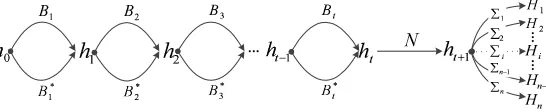
method to construct 2t-collisions with complexity of onlyt×2n/2for the iterated structure at Crypto’04 [12]. As shown in Fig.7, the attacker first generatetdifferent pairwise collisions{(B1, B1∗),(B2, B2∗), . . . ,(Bt, Bt∗)}.
Then, the attacker can directly output 2t-collision of the form (b
1, b2, . . . , bt) wherebiis one of the two blocks
Bi andBi∗.
−
Figure 7: Joux’s 2t
-collision construction. The 2t
messages are of the form (b1, b2, . . . , bt) wherebiis one of the two blocksBi
andB∗
i
Although the structure of GOST R is not an iterated one, we could also construct a k-collision for it. The method is described as follows:
1. As shown in Fig.8, generate 2tmessages which lead to a same value ath t:
(a) Let h0be equal to the initial valueIV of GOST R.
(b) For i from 1 totdo:
• Find Bi and Bi∗ such that gN(hi−1, Bi) = gN(hi−1, Bi∗) where Bi and Bi∗ are both of the
form 0256k {0,1}256. Since there are in total 2256this kind of messages, we suppose to find
a collision using generalized birthday paradox [13].
• Pad and output 2t messages of the form (b
1, . . . , bt) wherebi is in one of the two blocks Bi
andB∗ i.
2
2. From the 2tmessages generated in step 1, try to findk collisions in Σ and output thesek messages.
Note that all 2t messages have the same value ofN, thesek messages always lead to a k-collision of GOST R hash function.
! "
# %$ & ('
) − * + , + -. / 0 1 2 3 4 5 5 6 − 7 8 9 : ; < = > ? @ A B C D E F G H I J K L M N O P Q R S T U V − WX Y Z
Figure 8: A schematic view of construct k collisions of GOST R.
Since all message blocks in step 1 of the form 0256 k {0,1}256 and Σ = b1⊞b2⊞. . .⊞bt, there are at
most log2t+ 256 significant bits in Σ. Under an ideal model, step 2 needs 2(log2t+256)
×(k−1)/k messages to
construct k collisions of Σ which require the following inequality, wherek, t∈Z+:
t <2256 (16)
k≥3 (17)
2(logt2+256)×(k−1)/k ≤2t (18)
Solving the above inequality we get
176≤t≤2256
and
3≤k≤(logt2+256)/(log t
2+256−t) , 176≤t≤264
k≥3 , t≥265
In other words, for t-block messages where 176 ≤t ≤2256, we can find a k-collision of GOST R hash
function with only 2(log2t+256)×(k−1)/k computations. This time complexity is much less than that of finding
a k-collision for an ideal hash function structure.
6. Conclusion
In this paper, we presented some cryptanalytic results of GOST R. By applying rebound attack technique, we first explained our attack on 4.5 rounds of GOST R compression function. This result was further improved to 5.5 rounds by using super-Sbox technique. Then, degrees of freedom in key schedule were used to achieve attacks on 7.5 rounds and 9.5 rounds. More over, using the result of 9.5-round attack, we presented a 10-round distinguisher for the compression function of GOST R. At the end of this paper we presented a method to construct k collisions of GOST R hash function which show the weakness of the structure used in GOST R.
References
[1] X. Wang, H. Yu, How to Break MD5 and Other Hash Functions, in: Advances in Cryptology–EUROCRYPT 2005, Springer, 2005, pp. 19–35.
[2] X. Wang, Y. L. Yin, H. Yu, Finding Collisions in the Full SHA-1, in: Advances in Cryptology–CRYPTO 2005, Springer, 2005, pp. 17–36.
[3] V. Dolmatov, Gost R 34.11-94: Hash function algorithm.
[5] F. Mendel, C. Rechberger, M. Schl¨affer, S. S. Thomsen, The Rebound Attack: Cryptanalysis of Reduced Whirlpool and Grøstl, in: Fast Software Encryption, Springer, 2009, pp. 260–276.
[6] M. Lamberger, F. Mendel, C. Rechberger, V. Rijmen, M. Schl¨affer, Rebound Distinguishers: Results on the Full Whirlpool Compression Function, in: Advances in Cryptology–ASIACRYPT 2009, Springer, 2009, pp. 126–143.
[7] H. Gilbert, T. Peyrin, Super-sbox Cryptanalysis: Improved Attacks for AES-like Permutations, in: Fast Software Encryp-tion, Springer, 2010, pp. 365–383.
[8] O. Dunkelman, N. Keller, A. Shamir, Improved Single-Key Attacks on 8-Round AES-192 and AES-256, in: Advances in Cryptology-ASIACRYPT 2010, Springer, 2010, pp. 158–176.
[9] F. Mendel, T. Peyrin, C. Rechberger, M. Schl¨affer, Improved Cryptanalysis of the Reduced Grøstl Compression Function, Echo Permutation and AES Block Cipher, in: Selected Areas in Cryptography, Springer, 2009, pp. 16–35.
[10] D. Khovratovich, I. Nikoli´c, C. Rechberger, Rotational Rebound Attacks on Reduced Skein, in: Advances in Cryptology-ASIACRYPT 2010, Springer, 2010, pp. 1–19.
[11] A. Duc, J. Guo, T. Peyrin, L. Wei, Unaligned Rebound Attack: Application to Keccak, in: Fast Software Encryption, Springer, 2012, pp. 402–421.
[12] A. Joux, Multicollisions in Iterated Hash Functions: Application to Cascaded Constructions, in: Advances in Cryptology– CRYPTO 2004, Springer, 2004, pp. 306–316.