Copyright 0 1995 by the Cenetics Society of America
x
Recombination Activity in Phage
A Decays
as
a Function of Genetic Distance
Richard S .
Myers,'
Mary M. Stahl
and
FranklinW. Stahl
Institute of Molecular Biology, University of Oregon, Eugene, Oregon 97403-1229Manuscript received May 2, 1995 Accepted for publication July 26, 1995
ABSTRACT
In Escherichia coli,
x
is a recombination hotspot that stimulates RecBCDdependent exchange at and to one side of itself.x
activity is highest atx
and decreases with distance fromx.
The decrease inx
activity may be a simple property of the physical distance over whichx
can stimulate recombination. Alternatively, the decay inx
activity with distance may reflect the high likelihood that X-stimulated recombination occurs in a single X-proximal act, to the exclusion of additional X-stimulated exchanges more distal tox.
To test the models, we determined ifx
activity decreases as a function of physical distance ( i e . , DNA base pairs) or genetic distance (homologous DNA base pairs). Our results indicate thatx
activity decays as a function of genetic distance. In addition, we found that the sbcB gene product (exonuclease I, a 3' + 5' ssDNA exonuclease) modulates the distance over whichx
can act. In contrast,the redgene product (a 5' + 3' ssDNA exonuclease) does not alter the decay of
x
activity.S
PECIAL sites involved in generalized recombination have been identified in a variety of organisms (e.g., LISSOUBA and RIZET 1960; MURRAY 1963; ANGEL et al.1970; GUTZ 1971; LAM et al. 1974; FOCEL et al. 1978). These sites are associated with high rates of genetic exchange that diminish with distance from the site (hot- spot). In
Escherichia
colix
is such a hotspot for recombi- nation (reviewed in MYERS and STAHL 1994).x
hotspot activity depends on RecBCD enzyme, a potent dsDNA exonuclease (ex0 V) that degrades linear DNA from double-chain-break (DCB) sites up tox
(STAHL et al. 1990; DIXON and KOWALCZYKOWSKI 1993). Upon interacting with
x,
RecBCD enzyme activity is altered; exo V is inactivated, but the enzyme retains DNA helicase activity (DIXON and KOWALCZYKOWSKI 1993; DIXON et al. 1994). This property is shared by recDnull mutants; RecBC enzyme is exo V- but retains DNA helicase activity (CHAUDHURY and SMITH 1985; RINKEN et al. 1992; DIXON et al. 1994). By a number of criteria,
recD mutants behave as if RecBC enzyme were constitu-
tively activated for recombination (reviewed in MYERS and STAHL 1994). It has been proposed that the conver- sion of RecBCD enzyme from a destructive exonuclease
(ex0 V) (THALER et al. 1988) to a recombinagenic DNA helicase (RecBC) (ROSENBERG and HASTINGS 1991) is the function of
x
in homologous recombination. In support of this view,x
has been shown to transactivate RecBCD-mediated recombination (KOPPEN et al. 1995; MYERS et al. 1995). Once transactivated, recombination proceeds as if the cells were transiently RecD- (KOPPENet al. 1995; MYERS et al. 1995).
'Present address: Department of Biochemistry, Faculty of Natural
Corresponding author: F. W. Stahl, Institute of Molecular Biology, Sciences, University of the West Indies, St. Augustine, Trinidad.
University of Oregon, Eugene, OR 974031229.
E-mail: [email protected]
Genetics 141: 80.5-812 (November, 1995)
Since
x
is able to activate RecBCD recombination without directly participating in genetic exchange, why should DNA sequences close tox
experience higher exchange rates than sequences distant fromx?
What makesx
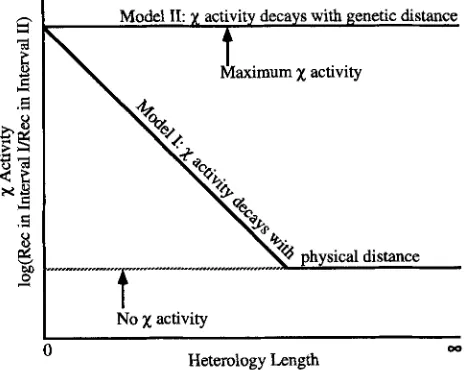
a recombination hotspot? Two general classes of models can account forx
hotspot behavior. Model I: The decrease inx
activity is simply a function of the physical distance (in DNA base pairs) fromx
as if the X-activated enzyme were subject to spontaneous dissoci- ation from its substrate or to deactivation by restoration of the RecD subunit. Model 11: The decrease inx
activ- ity with distance reflects the high likelihood thatx-
stimulated recombination occurs as a single act of ex- change close tox,
to the exclusion of additional x- stimulated exchanges distal tox.
The models are dia- grammed in Figure l.The two models make different predictions as to how DNA sequence heterology (which blocks RecA-medi- ated DNA pairing but not RecBGmediated DNA un- winding) will affect
x
recombination hotspot activity. Increasing the length of a heterologous DNA segment immediately to the left ofx
increases the distance over which RecBC must travel and unwind DNA before RecA can promote recombination with the subsequent ho- mologous DNA segment. We test the models by requir- ing X-activated RecBCD to act across heterologies of known and varied length, measuring X-stimulated ex- change in fixed intervals to the left (interval I) and to the right (interval 11) ofx,
respectively, and taking the ratio of the two exchange rates. If we view the process as it is diagrammed in Figure 2, Model I predicts the ratio interval I/interval I1 will decrease as the size of the DNA sequence heterology over whichx
must act increases, while Model I1 predicts that the ratio will not change when the size of the heterology is changed.MATERIALS AND METHODS
A
B
=
=
T
'
W
FIGURE 1.-Two scenarios are presented for the decay of
x
activity. RecBCD protein gains entry to a DNA duplex at a DCB. DNA is degraded from the point of entry to x , primarily on the chain ending 3' at the DCB (A). Recognition ofx
converts RecBCD from exo V to RecBC helicase (B). RecBC unwinds DNA beyondx
until it dissociates from the unwound duplex (C and D).
If RecBC dissociates from DNA with a rate that is independent of the number of DNA base pairs traveled, the decay ofx
activity may reflect the tendency of RecBC to disengage before catalyzing recombination. In this scenario,x
activity decreases as an exponential function of the number of DNA base pairs traversed by RecBC followingx
recogni- tion. Alternatively, RecBC may travel in a highly processive manner until it promotes a single act of recombination (E). In this alternative scenario,x
activity is maintained at full potential until DNA unwound by RecBC engages a homolo- gous DNA duplex (aided by RecA protein). Exchange is pro- posed to extinguishx
activity. We offer two possible mecha- nisms for the limitation of RecBC to one shot atrecombination. The first proposes that the tips of unwound DNA are required for recombination, and once used (that is, repaired) the resulting product is no longer recombina- tionally active to the left of
x
(as drawn). The second proposes that following a productive RecA-mediated pairing event, RecBC falls off, or is removed, from the unwound chromo- some (F) limiting the extent of unwinding beyond the paired region. The model is adapted from that of ROSENBERG andHASTINGS (1991).
FS2103 is recJ284:TnlO; FS2203 is sbcBIS; FS2505 is sbcB15 recJ284:TnIO; FS3688 is sbcBl5 recJ2001::TnlOdKn; FS3831 is recJ2001::TnlOdKn; FS3829 is sbcBI5 dnaBts22 malB::Tn9. Some crosses were conducted with unmodified phage in JASl3 (guK2 galT22 rpsL179 hsdR(r- m + ) I N ( m D m i i ) I) and FS2944 (as
JASl3 but dnuBts22 malB::Tnq. Particles that infect JAS13 or FS2944 become modified for EcoK and subsequently escape restriction when plated on restricting hosts.
X: All phage genotrpes (Figure 3 ) were constructed in this laboratory in standard or UV-stimulated lytic crosses. A genetic
No
x
activity0
Heterology Length 00
FIGURE 2.-Predictions of
x
activity decay models with re- spect to the activity ofx
when buried in DNA sequence heter- ologies. Heterology length indicates the size of the DNA se- quence heterology thatx
must act across to stimulate recombination in interval I. Interval I1 is a X-free control interval.x
activity = (number of interval I recombinants)/(number of interval I1 recombinants).
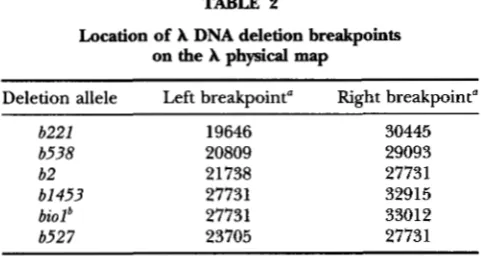
elements are defined in Table 1. The positions of deletion breakpoints in the A genome, taken from DANIELS et al.
(1983), are summarized in Table 2. Revertant frequencies of the Rsus5 and Asus32 alleles in our single-mutant stocks were low ( 5 3 X and 5 4 X respectively), so that revertant phage did not contribute significantly to the estimate of the recombinant titer.
A lytic crosses with free replication: Crosses were per- formed with seven infecting particles of each phage genotype (MOI = 7). Cells were grown at 34" with shaking in PC broth (Tryptone broth
+
0.2% maltose+
10 pg/ml B1+
5 mM MgS04) to 1 X 10s/ml, harvested by centrifugation and resus- pended in TM (10 mM Tris pH 7.4, 10 mM MgS04) to 1 X10⁸/ml as determined in a Petroff-Hausser counting chamber. Cells and phage were mixed in a total volume of 1 ml (volume
TABLE I
A genetic elements
Element Properties
~ Asus32
Ab2 A 6221 Ab527 Ab538 Ab1453 XA
x76
XbiO biol
int4 red3 gam21 0
GI 26 cI 85 7
&us5
Amber mutation in terminase gene A Chi mutation left of b region
b region deletion with no phenotype Deletion of b region and int
b region deletion with no phenotype Deletion of b region and int
Deletion of int, red and part of gam Chi mutation inseparable from b1453
Deletion of int, red and part of gam substituted by
E. coli DNA from the bio operon
Natural chi site within the E. coli bio operon Unconditional int mutation
Unconditional red mutation
Amber mutation in RecBCD inhibitor gene gam Unconditional mutation in repressor gene d
Temperature sensitive mutation in repressor
Amber mutation in lysozyme gene R
~-
Decay of
x
Activity 807TABLE
2Location of A DNA deletion breakpoints
on the A physical map
Deletion allele Left breakpoint“ Right breakpoint“
b221 19646 30445
b538 20809 29093
b2 21 738 27731
61 4 5 3 27731 32915
biolb 27731 33012
b52 7 23705 27731
‘
Deletion breakpoints (from DANIELS et al. 1983) refer to the DNA bp assignments of the left and right borders of the deletions on the A physical map.The biol allele deletes A DNA at the indicated breakpoints and replaces it with E. coli DNA spanning from uttB into the
bio operon. This insertion introduces a
x
site 3147 bp from the leftmost border of the deletion.difference made up with TM), and phage adsorption pro- ceeded at 37” with gentle aeration. After 10 min, 4 ml Cross broth (Tryptone broth
+
0.3% glucose+
10 ,ug/ml B1+ 2
mM MgS04+
75 ,uM CaC12+
4 ,uM FeC13) was added. In crosses with EcoK-modified phage, cells were harvested by low speed centrifugation, the supernatants were removed and tit- ered for unadsorbed phage, and the pellets were resuspended in 5 ml 37” Cross broth and diluted @fold in the same. In crosses with unmodified phage, unadsorbed phage were killed by restriction in the plating hosts. Phage adsorption exceeded 99.9%, and the two protocols gave essentially identical results. The cell suspensions were returned to the 37” water bath and vigorously aerated. After 75 min, 0.1 ml of egg white lysozyme(10 mg/ml) and 0.5 ml of fresh CHC13 were added, and the lysates were gently aerated for 15 min. Lysates were cleared of cell debris and residual CHC13 by centrifugation, trans- ferred to detergent-free glass serum tubes and stored at 4”. Lysates were titered on fresh BBL Trypticase agar plates within 72 hr of completing the crosses. A+ R+ recombinant titers were determined by plating on E. coli strain AC417 (Su-
recD1014). Total phage titers were determined by plating on strain FS1576 (Su’ recD1009). The recD alleles in AC417 and FS1576 permit A red gum to form large plaques without regard to the X genotype of the phage.
A lytic crosses without DNA replication: FS2944 and FS3829 were grown in PC broth at 26” to 1 X 10⁸/ml, har- vested by centrifugation, resuspended in TM, starved for 20 min at 26” and shifted to 42.5” for 10 min to inactivate dnaBfi22 protein. Next, 5 X lo’ cells and prewarmed phage were mixed in a total volume of 1 ml and incubated for 15 min with gentle aeration. The relative multiplicities in these crosses are indicated in the legends to Figures 5 and 6. After adsorption, 4 ml of 42.5” Cross broth was added, and the cultures were vigorously aerated. After 75 min, infected cells were harvested by centrifugation, and the supernatants were removed and titered for unadsorbed phage. Phage adsorption exceeded 90%. The cell pellets were resuspended in 4 ml Cross broth, 1 ml CHCls and 0.2 ml lysozyme (10 mg/ml) and shaken at 34” for 30 min to lyse the cells. Lysates were harvested and treated as above. To venfy that A was not repli- cating, ‘’C ”N-labeled phage were included in parallel mock crosses and spun in cesium formate density gradients (MYERS
et al. 1995). In each trial, a single density species of heavy phage was recovered, indicating that DNA replication was fully inhibited by the dnuB &22 allele at this temperature.
Determination of
x
activity: Dilutions of cross lysates were plated on AC417 to select for A+ R+ recombinants at 30 plaques per plate to minimize interplaque contamination.Individual plaques (separated by > 3 mm from neighboring plaques) were harvested with glass straws into 1 ml TM buffer containing a few drops of CHCls to kill AC417. The “pickates” were stored at room temperature until the CHC13 evaporated (-24 hr), at which time AC417 could no longer be detected. Portions of the pickates were spotted sequentially on AFT196 (Su’ recA56) and V227 [Su+ recC1001 (P2)] to determine the
gum allele present. The gum210 mutation creates a nonsense codon that is suppressed in Su+ strains. A red3 gum210 plates on AFT196 but not on V227 because inhibition of RecBCD enzyme by Gam permits A red3 to form packageable DNA concatemers in the absence of recombination but does not permit A red3 to overcome the inhibitory effect of the P2 old gene product. All of the other gam alleles used in this study eliminate the red and gum genes by deletion. A deleted for red
and gam plates on V227, but not on AFT196, because exo V
activity destroys linear A concatemers. This plating scheme allowed for unambiguous identification of the gum allele present in each pickate. Occasionally (< 5 %), a pickate plated on both hosts. These probably arose from interplaque contamination during picking and were discarded from the analysis.
The gum genotype of a pickate was used to determine the position of the crossover that created the A+ R+ recombinant. Crossovers that arose to the left of the deletion are said to be in the “X-stimulated” interval (interval I in Figures 3, 5 and 6). Crossovers that arose to the right of the deletion are said to be in the “control” interval (interval I1 in Figures 3, 5 and 6). In this paper, “ X activity” is defined as (number of interval I recombinants)/ (number of interval I1 recombinants).
The deletions create heterology borders that both define the genetic intervals examined and limit homology to the left of
x.
To makex
activities comparable between crosses, deletions were selected to minimize variation in the size of the homologous intervals; only the interstitial heterology was appreciably varied (Table 2).x
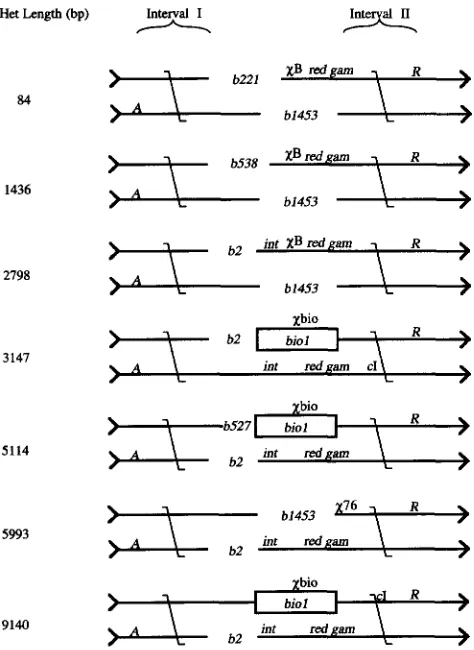
sites were embedded in the interstitial heterologies, i.e., across from deletions (Figures 3, 5 and 6). “Heterology length” refers to the distance fromx
to the leftmost border of the interstitial heterology defined by the opposing deletion.RESULTS
Experimental design: Relative recombination rates in two intervals were monitored.
x
stimulates recombi- nation primarily to one side of itself, “leftward” on the standard A map. To assess the effect of DNA sequence heterology onx
activity in each cross, the number of recombinants arising from exchange in a n interval to the left of X (interval I, the X-influenced interval) was compared to the number of recombinants arising from exchange in an interval to the right ofx
(interval 11,the X-free control interval). This x activity was plotted as a function of increasing length of the DNA sequence heterology across which
x
must act to stimulate ex- change in interval I.Het Length (bp)
84
1436
2798
3 147
5114
5993
Interval I
A
*
b221 xBi
>
>L
b1453>
*
>\
b1453A>
Xbio
>
7 x 1 R>
L
>
9140
b2 int red,qam
FIGURE 3.-Design of freely replicating A crosses. Het length indicates the size of the DNA sequence heterology that X must act across to stimulate recombination in interval I. Interval I1 is a X-free control interval. The site x76 is insepara- ble by recombination from the deletion b1453.
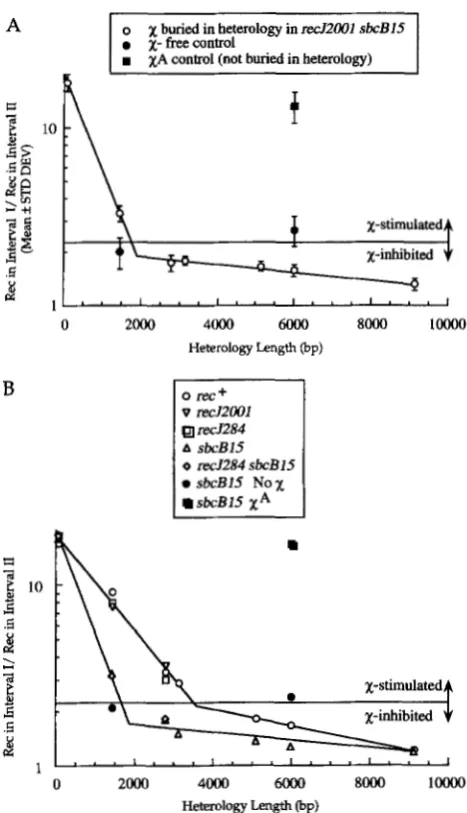
each 1.2 kb. This result is similar to previous reports on decay of
x
activity with distance (LAM et al. 1974;ENNIS et al. 1987; CHENG and SMITH 1989), but with a slightly steeper slope. In crosses with heterologies be- tween 5114 and 9140 bp,
x
activity decayed by a factor of 2.0 for each 6.9 kb. Howeverx
activity took on a different cast when the heterologies were >5114 bp; recombination in interval I appeared to be inhibited byx
to levels lower than in X-free control crosses. The inhibition ofx
activity by DNA sequence heterology could be due to either finite processivity of the X-stimu- lated enzyme (RecBC) or to the luring of unwound DNA into nonproductive exchanges with chromosomes of identical genotype.Heterology-induced decay of
x
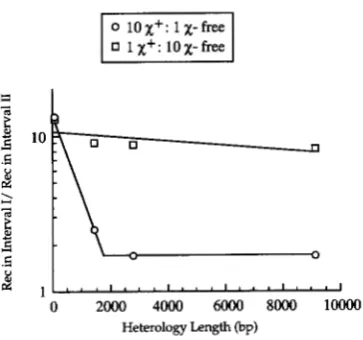
activity is caused by nonproductive exchanges: To determine if X activity decreases with physical distance or genetic distance (ie., as a function of DNA length or homologous DNA length), we vaned the relative multiplicity of homolo- gous and heterologous targets for X-activated exchange. DNA replication was inhibited to maintain a fixed ratio of homologous and heterologous phage in the crosses diagrammed in Figures 5 and 6. In Figure 5, the crosses were conducted at MOIs of 10 X + to one X-free phage and one X + to 10 X-free phage.0
x
buried in heterology0 x- free control
0 XA control (not buried in heterology)
Q
I " " " " " " " " " " ' 1
0 2000 4OOO 6000 8000 l o o 0 0
Heterology Length (bp)
FIGURE 4.-Decay of X activity in freely replicating crosses conducted in ret+ cells. A' RC recombinants were selected, and individual plaques were isolated and tested to determine whether the crossover occurred in interval I (the X-stimulated interval) or interval I1 (the X-free control interval). For a given cross, interval I events were summed and divided by interval I1 events to assess the influence of X in the cross. Each cross was conducted three times and the arithmetic means and standard deviations were determined. These val- ues were plotted us. the size of the heterology across which X must act to stimulate recombination in interval I (Figure 3). (Recombination frequencies fluctuate to a greater extent than
x
activity measurements, but the trends are consistent. Recombination frequencies, determined for freely replicating crosses, were as follows: Het 84, 5.4 ? 1.6%; Het 1436, 4.8 i2.2%; Het 2798, 4.2 ? 0.9%; Het 3147, 3.9 ? 1.8%; Het 5114, 1.7 ? 0.8%; Het 5993, 0.9 ? 0.3%; Het 9140, 0.9 ? 0.4%.) X-free crosses employing derivatives of Het 1436 and Het 5993 phage and XA control crosses employing derivatives of Het 5993 phage were plotted to establish the limits of X activity.
In crosses in which the X-containing phage was in relative excess,
x
activity declined sharply when the het- erology length was increased from 84 to 2798 bp and then less sharply to a heterology of 9140 bp. In contrast, thex
activity in crosses in which the X-free phage was in excess was barely inhibited by increasing the heterology length. These results indicate that the decrease inx
activity caused by DNA sequence heterology is due to matings of no genetic consequence (ie., exchanges be- tween phage with identical genotypes inhibitsx
activity in these crosses).Varying the relative MOIs of the X-containing and the X-free phage in the above experiment alters not only the opportunity to recombine close to X but also the number of available
x
sites in the cell. In light of evidence that x can act in trans to stimulate recombina- tion (KOPPEN et al. 1995; MYERS et al. 1995), we devised an additional test that did not vary the number of X sites involved in the crosses.To further test the model that DNA sequence heterol-
ogy at
x
inclines DNA unwound by RecBC into nonpro-A
Decay of
x
ActivityA
809
10 1
1 10
10 1
1 10
10 1
1 10
10 1
1 10
B
. R >
\
>A
b2 int 'L>
I
0 l o x + : 1x-freea 1x+:
lox-free
EI
E
s.ti
e: 0 2
3
L
2
0 2000 4OOO 6000 8000 loo00
Heterology Length @p)
FIGURE 5.-x activity declines due to nonproductive ex- changes. (A) Design of crosses without DNA replication. A
were crossed in the absence of DNA replication to control in individual cells the numbers of phage with homology right up to
x
and phage that are heterologous in the vicinity ofx.
The relative MOI ofx+
and X-free phage were varied asindicated. (B) Phage were crossed in rec' dnuRts E. coli cells at 42.5" to inhibit DNA replication. Crosses employed 84, 1436, 2798, and 9140-bp DNA sequence heterologies. The results are plotted as in Figure 4.
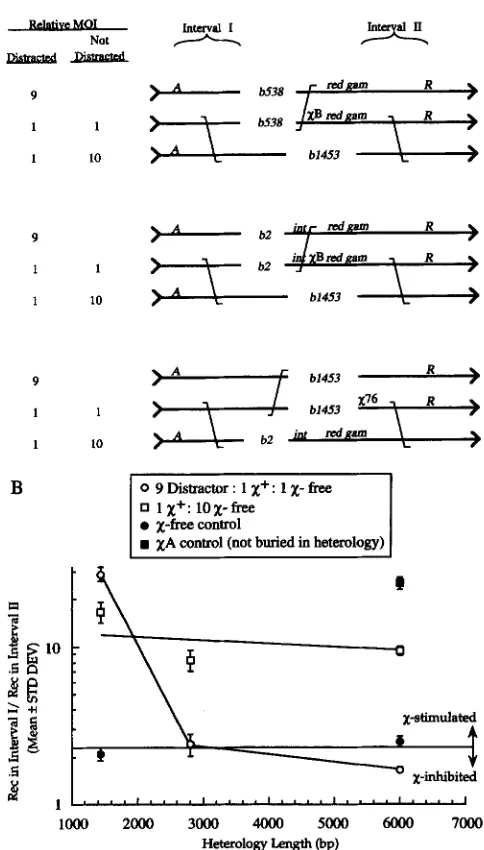
rental, with one Xcontaining phage, nine doubly marked "Distractor" phage a n d one heterologous phage. Distractor phage were doubly marked with mu- tant alleles to eliminate contributions of the distractor phage to the wild-type recombinant titer. Distractor phage and the X-containing phage are homologous in the vicinity of
x.
In contrast, the heterologous phage is heterologous atx
and shares sequence homology only distant fromx.
"Undistracted" crosses were bipa- rental, with one Xcontaining phage and 10 heterolo- gous phage.Heterology lengths were varied as illustrated (Figure
6A), a n d the results are summarized in Figure 6B. In Distracted crosses,
x
activity declined sharply when the heterology length was increased from 1436 to 2798 bp and then less sharply to a heterology of 5993 bp. InNot
RiaREmiDiStraacd
9
1 1
1 10
9
1 1
1 10
9
1 1
1 10
B
b1453
b1453 R b1453
0 9 Distractor: 1
x+:
1x-
free0 x-freecontrol
rn xA control (not buried in heterology)
0 1
x+:
1ox-freeI
I
.ti "
i!
I ~ " ' " ' ' " " ' " " " " ' ' " " ' ' "1000 2000 3000 4OOO 5000 6OOo 7000
Heterolow Length @P)
FIGURE 6.-x activity declines only when homologous dis- tractor phage are present. (A) Design of Distracted and Undis tracted crosses. A were crossed in the absence of DNA replica- tion as in Figure 5. Distracted crosses were triparental with one x + , one X-free and nine distractor phage added per cell. Most opportunities to enjoy X-stimulated exchange will be with phage that cannot contribute to the formation of A+ R+
recombinants. Undistracted crosses were biparental with one
X' and 10 X-free phage added per cell. Most opportunities to catalyze X-stimulated exchange will be with phage that can contribute to the formation of A' R+ recombinants. (B) Phage were crossed in rec' dnuBts E. coli cells at 42.5" to inhibit DNA replication. Crosses employed 1436, 2798, and 5993 bp DNA sequence heterologies. X-free crosses employing de- rivatives of Het 1436 and Het 5993 phage and XA control crosses employing derivatives of Het 5993 phage were plotted to establish the limits of
x
activity. Each cross was conducted three times and the arithmetic means and standard deviations were determined. These values are plotted as in Figure 4.of cells being infected by more than one X-containing phage.) The results demonstrate that the reduction in
x
activity with length of heterology is due to nonproduc- tive exchanges between phage of the same genotype.The role of ssDNA exonucleases in the
x
activity gradient: It has been proposed that the function ofx
is to convert RecBCD enzyme from a destructive exo- nuclease (ex0 V) to a recombinagenic DNA helicase (RecBC). ROSENBERC and HASTINGS (1991) noted that ssDNA exonucleases acting on DNA unwound by RecBC might alter the distribution of exchanges in the vicinity ofx.
RINKEN et al. (1992) provided evidence that dsDNA unwound by the RecBC helicase is degraded by ssDNA exonucleases encoded by the sbcB and recJgenes. To assess the possible impact of exonucleases on the decay ofx
activity, heterology crosses were repeated as in Figure 3 in a sbcB reg double mutant background. The results are summarized in Figure 7A.As in reef cells, the 8 4 b p heterology did not diminish
x
activity. However, the 1436-bp heterology caused a pronounced decrease inx
activity, and the 2793-bp heterology reducedx
activity to a level below that of X-free control crosses. In crosses of phage with heterolo- gies of 84 and 1436 bp,x
activity decreased by a factor of 2.0 for each 550 bp, a twofold increase in the decay rate ofx
activity as a function of heterology length in sbcB regcells when compared toret+
E. coli. These results support the proposition that ssDNA exonucleases en- coded by the sbcB and/or reggenes act on the products of X-activated RecBCD.To determine the relative contributions of the ssDNA exonucleases encoded by the sbc3 and/or recJgenes to X-activity decay, heterology crosses were repeated in isogenic
ret',
sbcB, re4 sbcB recJ cells. The results are summarized in Figure 7B. We conclude that the sbcBencoded exonuclease I assists
x
in acting across a DNA sequence heterology, whereas the recfencoded exo- nuclease gives no evidence of being involved in the gradient ofx
activity.Our crosses conducted in sbcB cells reveal a role for exonuclease I, a 3' + 5' ssDNA exonuclease, in promot- ing
x
activity distant fromx.
Previous in uivo studies(SIMMON and LEDERBERC 1972; RINKEN et al. 1992) indi- cated that this exonuclease degrades DNA unwound by RecBC helicase activity. There are two ways, not mutu- ally exclusive, of thinking about the role of exonuclease I in helping
x
to act across a heterology. (1) The posi- tion of exchange may be dictated by the position of the 3' end, and exo I translates that end across the heterology. If that is so, we must enlist another nuclease (exonucleaseVI?)
that can translate ends across heter- ology in sbcB mutant cells. (2) The half-life of DNA unwound by RecBC opposite the heterology may be greater in exonuclease I-deficient cells. This increased longevity might increase the chance that the DNA will be decoyed into nonproductive exchange, thus decreas- ing the chance that it will be competent to recombine beyond the end of the heterolo<gy.A
X-stimulated
X-inhibited 6 6
0 2000
B
4000 6OOo 8000 loo00
Heterology Length @p)
0 rec+
0 recJ2001 red284
o d 2 8 4 sbcB15
e sbcB15 N o 2
sbcB15
xA
A sbcB15
C
-
. .E
102
0 2000 4000 6000 8000 l o o 0 0
Heterology Length @p)
FIGURE 7.-The decay of
x
activity is modulated by SbcBprotein (exonuclease I ) . Crosses were conducted and plotted
as in Figures 3 and 4. (A) Phage were crossed in sbcB15 recJZ001::Tn 10dKn cells Each cross was conducted three times and the arithmetic means and standard deviations were deter- mined. (B) Phage were crossed in rec+, sbcB15, recJZ84::TnIO, recJ2001::TnlOdKn, and sbcB15 recJ284:TnlO cells. X-free crosses employing derivatives of Het 1436 and Het 5993 phage
and XA control crosses employing derivatives of Het 5993 phage were performed in sbcB15 cells.
Decay of
x
Activity 811u
0lox+:
1x-free
0 1x+:
lox-free
Y i
0 2000 4000 6OOO 8000 l o o 0 0
Heterology Length @p)
FIGURE 8.-The decay of
x
activity in sbcB15 cells is due tononproductive exchanges. Crosses were conducted as in Fig-
ure 5 except in sbcBl5 dn& cells.
8) indicate that the decrease in
x
activity caused by DNA sequence heterology in sbcBl5 mutant cells, as inrec+ cells, is due to exchanges of no genetic conse- quence.
DISCUSSION
Our crosses demonstrate that
x
activity decreases notas a function of physical distance from
x,
but rather with genetic distance. Whenx
is opposite a long heter- ology, nonproductive exchanges preempt productive exchanges, leading not only to a decrease inx
activity, but to an inhibition ofx
activity when nonproductive exchanges approach saturation.Our results also suggest that a given X-activated RecBC molecule catalyzes but one recombination event
(or coupled pair of events) (STAHL et al. 1990) when acting on a given chromosome. This single act of ex- change can be distant from
x.
In the Undistracted crosses, ~76-activated RecBCD travelled 5993 bp and retained the ability to catalyze exchange. The ability of X-activated RecBCD to act across a 6-kb heterology suggests thatx
sites do not act directly in recombina- tion, but rather modify the activity of RecBCD enzyme. The ability ofx
to act in trans (KOPPEN et al. 1995; MYERS et al. 1995) has previously established this view.In crosses between phage that are homologous in the vicinity of
x,
x
activity decreases as distance fromx
increases. In light of our results with heterologous crosses, we conclude that the decay ofx
activity reflects the high probability of exchange in the vicinity ofx,
with consequent loss of the ability to enjoy downstream exchanges.x
activity persists unabated over distances greater than had been previously recognized. Apparently, RecBC enzyme unwinds as much DNA as is required to catalyze exchange. The limits of DNA unwinding i n vivoare unknown for RecBC, but i n vitro RecBC enzyme unwinds, on the average, 2.8 kb of DNA in a single pass [our estimate from the data of KORANCY and JLJLIN
(1993)
1.
What is the origin of the upward curvature of the dependence of
x
activity on heterology length (Figures 4-8)? Our demonstration that decay ofx
activity to the left ofx
depends on the availability of homology sug- gests an explanation. Some of the infecting X-con- taining phage may find themselves in circumstances where there are few or no homologues available to dis- tract the exchange reaction. The random adsorbtion of phage to cells plus the failure of some infecting chro- mosomes to replicate (MESELSON and WEIGLE 1973) could contribute to such a circumstance. For these phagex
activity will be relatively distance-independent; at long distances these phage will contribute dispropor- tionately to the enumerated recombinants. A second contribution to the concavity is likely to be from the rather frequent failure of RecBCD to recognize an en- counteredx
(STAHL et al. 1990). On those occasionsx
activity will mimic the X-free control.Our crosses conducted in sbcBI5 cells revealed a role for exonuclease I, a 3‘ + 5’ ssDNA exonuclease, in
promoting
x
activity distant fromx.
PHILLIPS et al.(1988) previously determined that the sbcBI5 mutation greatly reduces (but does not eliminate) exonuclease I activity. Our results suggest that the half-life of DNA unwound by RecBC opposite the heterology is greater in exonuclease I-deficient cells and that this increased longevity increases the chance that the DNA will be decoyed into nonproductive exchange, thus decreasing the chance that it will be competent to recombine be- yond the end of the heterology. Since the sbcB15 mutant protein retains some function(s) (PHILLIPS et al. 1988), we cannot rule out the possibility that the enhanced decay in
x
activity is due to some unknown property of the mutant employed.The RecJ nuclease also degrades DNA unwound by RecBC helicase activity (RINKEN et al. 1992). However, we did not observe that RecJ nuclease activity altered the distribution of X-mediated exchanges. This result is consistent with two possibilities: (1) the 5’-tipped ssDNA chain may not participate in X-mediated splices and (2) the 5’-tipped ssDNA chain may participate only in subterminal X-mediated events, which do not require degradation beyond the heterology (see MYERS and STAHL 1994). HACEMANN and ROSENBERG (1991) deter- mined that 5’-tipped ssDNA chains participated in a significant majority of X-mediated patches.
DNA synthesis and/or by the endonucleolytic action of “resolvases”.
KAISER (1955) analyzed recombination in phage X
within the pairwise mating scheme of VISCONTI and
DELBRUCK (1953). In this scheme, two phage chromo- somes pair along their length and, while doing so, may enjoy several exchanges (a mating). Phage may enter into successive pair-wise matings. Our results, relevant only to the RecBCD pathway of recombination, show that the pairwise commitment can be compromised when gratification is excessively delayed by heterology. With somewhat similar experiments, the Visconti-Del- bruck theory has previously been shown to be inapplica- ble to phage T4 (DRAKE 1967).
We appreciate the support and comments, both scientific and aes- thetic, of the members of the laboratory. SUSAN ROSENBERG (Edmon- ton) reminded us that sbcBI5is not a null allele. R.S.M. was supported in part by National Institutes of Health National Research Service Award 5F32GM-14196. This work was supported by National Science Foundation grant MCB-9402695 and by U.S. Public Health Service grant GM-33677. F.W.S. is American Cancer Society Research Profes- sor of Molecular Genetics.
LITERATURE CITED
ANGEL, T., B. AUSTIN and D. G. CATCHESIDE, 1970 Regulation of
recombination in the his-3 locus in Neurospora crassa. Aust. J. Biol. Sci. 23: 1229-1240.
BACHMAN, B. J., 1987 Derivations and genotypes of some mutant derivatives of Escherichia coli K-12, pp. 1190-1219 in Escherichia coli and Salmonella typhimurium Cellular and Molecular Biology, ed- ited by F. C. NEIDHARDT. American Society for Microbiology, Washington, DC.
CHAUDHURY, A. M., and G. R. SMITH, 1985 Role of Escherichia coli RecBC enzyme in SOS induction. Mol. Gen. Genet. 201: 525- 528.
CHENG, K. C., and G. R. SMITH, 1989 Distribution of Chi-stimulated recombinational exchanges and heteroduplex endpoints in phage lambda. Genetics 123: 5-17.
DANIELS, D., J. SCHROEDER, W. SZYBALSKI, F. SANGER and F. BLATTNER,
1983 A molecular map of coliphage lambda, pp. 467-518 in Lambda II, edited by R. W. HENDRIX, J. W. ROBERTS, F. W. STAHL and R. A. WEISBERG. Cold Spring Harbor Laboratory, Cold Spring Harbor, NY.
DIXON, D. A,, and S. C. KOWAI,CZYKOWSKI, 1993 The recombination hotspot,
x,
is a regulatory sequence that acts by attenuating the nuclease activity of the E. coli RecBCD enzyme. Cell 7 3 87-96.DIXON, D. A,, CHURCHILL, J. J. and S. C. KOWALCZYKOW~KI, 1994
Reversible inactivation of the Escherichia coli RecBCD enzyme by the recombination hotspot
x
i n vitro: evidence for functional inactivation or loss of the RecD subunit. Proc. Natl. Acad. Sci.DRAKE, J. W., 1967 The length of the homologous pairing region for genetic recombination in bacteriophage T4. Proc. Natl. Acad. Sci. USA 58: 962-966.
ENNIS, D. G., S. K. AMUNDSEN and G. R. SMITH, 1987 Genetic func- USA 91: 2980-2984.
tions promoting homologous recombination in Escherichia coli: a study of inversions of phage A. Genetics 115: 11 -24.
FOGEL, S., R. K. MORTIMER, K. LUSNAK and F. TAVARES, 1978 Meiotic gene conversion: a signal of the basic recombination event in yeast. Cold Spring Harbor Symp. Quant. Biol. 43: 1325-1341.
GUTZ, M., 1971 Site specific induction of gene conversion in Schim saccharomyces pombe. Genetics 6 9 317-337.
H A G E M A N N , A. T., and S. M. ROSENBERG, 1991 Chain bias in Chi- stimulated heteroduplex patches in the A rm gene is determined by the orientation of A cos. Genetics 129: 611-621.
KAISER, A. D., 1955 A genetic study of the temperate coliphage A.
Virology 1: 424-443.
KOPPEN, A,, S. KROBITSCH, B. THOMS and W. WACKERNAGEI., 1995
Interaction with the recombination hot spot
x
in vivo converts the RecBCD enzyme of Escherichia coli into a X-independent re- combinase by inactivation of the RecD subunit. Proc. Natl. Acad. Sci. USA 92: 6249-6253.KORANGY, F., and D. A. JULIN, 1993 Kinetics and processivity of ATP hydrolysis and DNA unwinding by the RecBC enzyme from Escherichia coli. Biochemistry 32: 4873-4880.
LAM, S. T., M. M. STAHL, K D. MCMILIN and F. W. STAHI., 1974
Rec-mediated recombinational hotspot activity in bacteriophage lambda. 11. A mutation which causes hotspot activity. Genetics
LISSOUBA, P., and G. RIZET, 1960 Sur l’existence d’une genktique polarisCe ne subissant que des exchanges non rkciproques. Comp. Rend. Acad. Sci. Paris 250 3408-3410.
MESEISON, M., and J. J. WEIGLE, 1973 Chromosome breakage ac- companying genetic recombination in bacteriophage. Proc. Natl. Acad. Sci. USA 47: 857-868.
MURRAY, N. E., 1963 Polarized recombination and fine structure within the me-2 gene of Neurospora crassa. Genetics 4 8 1163-
1183.
MYERS, R. S., and F. W. STAHL, 1994
x
and the RecBCD enzyme of Escherichia coli. Annu. Rev. Genet. 28: 49-70.MYERS, R. S., A. KUZMINOV and F. W. STAHL, 1995 The recombina- tion hotspot
x
activates RecBCD recombination by converting E. coli to a recD mutant phenocopy. Proc. Natl. Acad. Sci. USA92: 6244-6248.
PHILLIPS, G. J., D. C. PRASHER and S. R. KUSHNER, 1988 Physical and biochemical characterization of cloned sbcB and xonA mutations from Escherichia coli K-12. J. Bacteriol 1 7 0 2089-2094.
RINKEN, R., B. THOMS and W. WACKERNAGEL, 1992 Evidence that recBCdependent degradation of duplex DNA in Escherichia coli recD mutan@ involves DNA unwinding. J. Bacteriol. 174: 1172-
1178.
ROSENBERG, S. M., and P. J. HASTING, 1991 The splitend model for homologous recombination at double-strand breaks at Chi. Biochimie 73: 385-397.
SIMMON, V. F., and S. LEDERBERG, 1972 Degradation of bacterio- phage lambda deoxyribonucleic acid after restriction by Esche- richia coli K-12. J. Bacteriol. 112: 161-169.
STAHL, F. W., L. C. THOMASON, I. SIDDIQI and M. M. STAHI., 1990
Further tests of a recombination model in which
x
removes the RecD subunit from the RecBCD enzyme of Escherichia coli. Genetics 126: 519-533.THAIXR, D. S., E. SAMPSON, I. SIDDIQI, S. M. ROSENBERG, F. W. STAHL et al., 1988 A hypothesis: Chi activation of RecBCD enzyme involves removal of the RecD subunit, pp. 413-422 in Mechanism and Consequences of DNA Damage Processing, edited by E. C.
FRIEDBERG and P. C. HANAWALT. Alan R. Liss, New York. VISCONTI, N., and M. DELBR~CK, 1953 The mechanism of genetic
recombination in phage. Genetics 38: 5-33.
77: 425-433.