© 2015, IRJET.NET- All Rights Reserved
Page 385
NANOCAVITY BASED OPTICAL PRESSURE SENSOR
Mohankumar B S
1, Mrs.Indira Bahaddur
21MTech (DECS), Dept. of E&C, Malnad College of Engineering Hassan, Karnataka, India
2Asst.Professor, Dept. of E&C, Malnad College of Engineering Hassan, Karnataka, India
Abstract-In this paper, we design and simulation
photonic crystal (Phc) Nano pressure sensor. The sensor is made of two dimensional photonic crystal and consists of hexagonal lattice structure. Photonic crystal structure uses an line defect engineering to create an waveguide. The Nano cavity is formed by changing the radius of a single rod in air structure, which is at the centre of lattice. This sensor supports 1450-1550nm wavelength. Simulation results show that resonant frequency of Nano cavity changed with the increased pressure.
Key words:photonic crystal; waveguide; Nano cavity;
pressure sensor, Nano-pressure.
1 INTRODUCTION
Photonic crystals are periodic microstructure or nano structure affected by the propagation of photon. Based on the geometry of the structure photonic crystal can be classified into one dimensional (1D) two dimensional (2D), three dimensional (3D) structure [4]. PhC have photonic band gap (PBG) manipulates beam of light. Photon travels in these structures with a different wavelength. For the design 2D photonic crystal is used in 2D crystal the permittivity is changed in two directions. Defects can be done either by changing the dimension or removal from the structure and acts as a resonant cavity. Defects modify and control the flow of light inside the photonic crystal [8].
An example of application of photonic crystals is bio sensors, mechanical parameter sensor like pressure, nano displacement, structural health monitoring, chemical sensors and acoustic sensors.
In this paper, we modulate and simulate a Nano pressure sensor with two dimensional photonic crystal Nano cavity resonators. The finite difference time domain (FDTD) method is used to simulate sensor operation for different pressure. When the pressure is applied stress is distributed over the crystal structure and the refractive index is changed.
The pressure can be calculated using P = Aωρ0C P= acoustic pressure
A=displacement amplitude ω= 2πf
ρ0= specific density of medium C= speed of sound under water Thus pressure is proportional to displacement.
2 DESIGN
In this paper uses the two dimensional photonic crystal. First design a hexagonal lattice structure. Line defect engineering isintroducedby removing the rods in hair structure. To create a resonant cavityplace a singlerod in the middle of the lattice with an increased radius and place the neighbouring coordinates with another radius. Introduce the lightsource in one end ofthewave guide and lightis obtained at the detector.
When the pressure is zero, displacement is also zero.The pressureis applied on the resonant cavity the propagationof lightthrough the hexagonal latticechanged and refractive index also changed.
MEEP is the tool used for design and simulation of a photonic crystal. MEEP stands for MIT electromagnetic equation propagation. It is used in solving of Maxwell’s equations in periodic dielectric structure simulation in 1D, 2D, 3D and cylindrical coordinates can be done. The transmitter flux can be obtained at each frequency (ω). This is the integrals of the pointing vector over a plane of the photonic crustal structure [14].
The time domain applications of MEEP consist of transmission and reflection spectra, resonant mode& frequencies and field patterns. The finite-difference time-domain (FDTD) method is used to simulate operation of sensors in different pressures.
MEEP is the tool where we design and simulation of the photonic crystal and parameters are given below. 1) Rods in air configuration
© 2015, IRJET.NET- All Rights Reserved
Page 386
3) Lattice constant ‘a’ = 1nm4) Radius of the rod ‘r’ = 0.19nm
5) Height of the slab is infinity
Fig-1: Layout of PhC structure consists of hexagonal lattice
Fig 2: The layout of sensor structure consists of line
defect waveguide directed couple to Nano cavity.
waveguide directly connected to the Nanocavity. The light enters from the left of waveguide. A photo detectorin the end of waveguide detects the light.
When the pressure is applied on the dielectric slab displacement takes place so that the nature of the electromagnetic waves is altered.
3 SIMULATION RESULTS
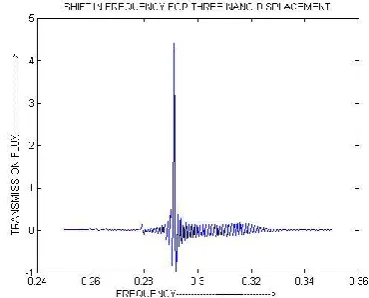
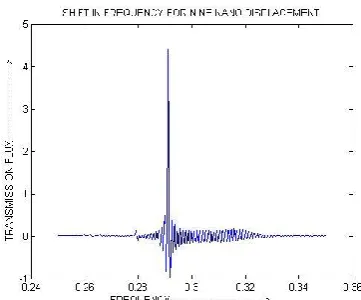
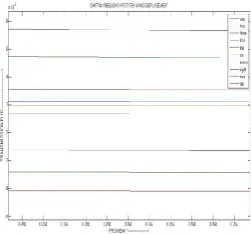
When the pressure is applied on the dielectric slab displacement takes place so that the nature of the electromagnetic waves is altered. Below figure shows the output spectrum for 1nm, 2nm, 3nm, 4nm, 5nm, 6nm, 7nm, 8nm, 9nm, 10nm, displacement. By analysing the curve, the width of resonant peak in cavity is different. Fig.14 shows a linear relationship between applied pressure and resonant frequency.
Fig 3: Transmission spectrum for 1 Nano displacement
Fig 4: Transmission spectrum for 2 Nano displacements
© 2015, IRJET.NET- All Rights Reserved
Page 387
Fig 6: Transmission spectrum for 4 Nano displacement
Fig 7: Transmission spectrum for 5 Nano displacement
Fig 8: Transmission spectrum for 6 Nano displacement
Fig 9: Transmission spectrum for 7 Nano displacement
Fig 10: Transmission spectrum for 8 Nano displacement
© 2015, IRJET.NET- All Rights Reserved
Page 388
Fig 12: Transmission spectrum for 10 Nano
displacement
Fig 13:Shift in frequency for 1to10nm displacement
Fig 14: The linear relationship between resonant
frequency and displacement in the range of 1 to10nm displacement
Fig 15: Shift in frequency for 10 Nano displacements
4 CONCLUSION
In this paper, we have proposed a photonic crystal pressure sensor for Nano pressure measuring. This sensor is constructed with two dimensional photonic crystal waveguide which is connected to Nano cavity resonator. The sensor sensitivity is increased by applied pressure. The refractive index changes when the resonant wavelength of Nano cavity shifts. This sensor can detect small to large amount of pressure.
This paper measures accurate sensitivity of mechanical pressure sensors in terms zero to ten Nano displacement units. These sensors measure other mechanical parameters due to its versatile nature .due to pressure applied shift in frequency and wavelength are obtained. This frequency can be mapped by shift in displacement by using pressure formula. These sensors can be used in applications requiring high accurate sensing results.
REFERENCES
[1] J. D. Joannopoulos, S. G. Johnson, J. N. Winn, R. D. Meade. 2007, Photonic Crystals Molding the Flow of Light.Published by Princeton University Press, ISBN: 978-0-691-12456-8.
[2] S. Olyaee, F. Taghipour, and M. Izadpanah, “Nearly zero-dispersion, low confinement loss, and small effective mode area indexguiding PCF at 1550nm wavelength”, Frontiers of Optoelectronics in China, Vol. 4, No. 4, pp. 420-425, 2011.
[3] S. Olyaee and F. Taghipour, “Design of new square-lattice photonic crystal fibers for optical communication applications”, International Journal of the Physical Sciences, Vol. 6, No. 18, pp. 4405-4411, 2011.
[4] D.Biallo, M.Desario,A.D’Orazio, High sensitivity photonic crystal pressure sensor”,(Journal of European optical society,2007)
[5] S. Olyaee and F. Taghipour, “Ultra-flattened dispersion hexagonal photonic crystal fiber with low confinement loss and large effective area”, IET Optoelectronics, vol. 6, no. 2, pp. 82-87, 2012.
[6] S. G. Johnson, P. R. Villeneuve, S. Fan, and J. D. Joannopoulos, “Linear waveguides in photonic-crystal slabs,” Physical Review B, vol. 62, no. 12, pp. 8212-8222, 2000.
[7] P. Russell, Photonic-Crystal Fibers, J. LightwaveTechnol, Vol .24, No. 12, 2006.
© 2015, IRJET.NET- All Rights Reserved
Page 389
and B. Aspar, ‘‘InP 2D photonic crystal microlaser on Siwafer: room temperature operation at 1.55mm,’’ Electron. Lett.37, 764–765, 2001.
[10] M. Fatih and Y. Fan, “High-contrast all-optical bistable switching in photonic crystal microcavities,” Appl. Phys. Lett., Vol. 83, No. 14, p. 6, 2003.
[11] S. Olyaee and A. A. Dehghani, “High resolution and wide dynamic range pressure sensor based on two-dimensional photonic crystal”, Photonic Sensors, Vol. 2, No. 1, pp. 92-96, 2012
[12] J. Shi, V.S. Hsiao, T. R. Walker, T. J. Huang, “Humidity sensing based on Nanoporous polymeric photonic crystals,” Sensors and Actuators B, Vol. 129, pp. 391–396, 2008.
[13] R. V. Nair, R.Vijaya, Photonic crystal sensors, Vol. 34, Issue 3, May 2010, pp. 89-134.
[14] I. EI-Kady,M.M. R. Taha, and M. F. Su, “Application of photonic crystals in submicron damage detection and quantification,” Appl. Phys. Lett., vol. 88, pp. 253109– 253109, 2006.
BIOGRAPHIES
MOHAN KUMAR B S, PG Student, Department of E&C Engineering, MCE Hassan, VTU Belgavi, Karnataka, India.
E-mail:
INDIRA BAHADDUR, Assistant Professor, Department of E&C Engineering, MCE Hassan, VTU Belgavi, Karnataka, India. E-mail: