doi:10.1155/2010/930414
Research Article
Flow Oriented Channel Assignment for
Multi-Radio Wireless Mesh Networks
Fei Ye,
1Sumit Roy,
1and Zhisheng Niu
2 1University of Washington, Seattle, WA, USA2Tsinghua University, Beijing, China
Correspondence should be addressed to Fei Ye,[email protected]
Received 1 November 2009; Accepted 21 February 2010
Academic Editor: Xinbing Wang
Copyright © 2010 Fei Ye et al. This is an open access article distributed under the Creative Commons Attribution License, which permits unrestricted use, distribution, and reproduction in any medium, provided the original work is properly cited.
We investigate channel assignment for a multichannel wireless mesh network backbone, where each router is equipped with multiple interfaces. Of particular interest is the development of channel assignment heuristics for multiple flows. We present an optimization formulation and then propose two iterative flow oriented heuristics for the conflict-free and interference-aware cases, respectively. To maximize the aggregate useful end-to-end flow rates, both algorithms identify and resolve congestion at instantaneous bottleneck link in each iteration. Then the link rate is optimally allocated among contending flows that share this link by solving a linear programming (LP) problem. A thorough performance evaluation is undertaken as a function of the number of channels and interfaces/node and the number of contending flows. The performance of our algorithm is shown to be significantly superior to best known algorithm in its class in multichannel limited radio scenarios.
1. Introduction
There exists considerable interest in deploying wireless mesh networks (WMNs) as a backhaul in support of ubiquitous broadband wireless access for mobile as well as fixed clients
[1,2]. We study an infrastructure WMN, where a collection
of stationary wireless mesh routers are interconnected as a multihop backbone to provide clients, network access.
As shown in Figure 1, among all mesh routers, some
have client connectivity (mesh access points), and some have Internet gateway capability. The mesh backbone then supports multihop flows amongst mesh routers. These flow
traffics are aggregated from a group of clients, leading to
needed long-term stability for system optimization.
The success of such WMNs largely hinges on their potential for scaling backbone throughput with increasing client density while preserving network coverage. As has
already been noted in [3–5], a crucial element in throughput
scaling is more effective utilization of available multiple
(nonoverlapping) channels. We propose to achieve this by having multiple interfaces per node at incremental hardware cost; for example, note the availability of integrated 802.11 a/b/g transceivers on the same network interface card (NIC).
In the future, such integration of multiple transceivers (such
as different generations of a successful technology such as
802.11) on a single device will be commonplace, and our work is thus well aligned with this trend.
Channel assignment (CA) is a resource management challenge in such a multiradio multichannel paradigm, whereby a particular channel is now assigned to a specific
link and network interface pair. This is a largely under-explored domain with the potential of boosting network throughput as it can mitigate both intra- and interflow interference. Optimal channel assignment would simulta-neously involve the choices of routing metric, rate control, power control, and medium access control (MAC). Such an integrated global approach is ambitious and results in very complex systems optimization; typically, only a partial subset of all available resources are used to obtain insight, and our work is no exception.
Various channel assignment algorithms [6–16] which
are studied in literature can be classified into packet level,
link level and flow levelbased on their granularity.Packet level algorithms are highly dynamic, where channels are
assigned for every packet [6] or every few packets [7].
Internet Wireless mesh
backbone Mesh router with gateway
Mesh router with gateway Mesh router
Mesh router
WiFi network
Wimax network
Mobile ad hoc network
Sensor network
Multihop flows
Figure1: A wireless mesh network.
of these algorithms. In flow level algorithms, channels are
assigned to several successive links which compose a flow
or a set of intersecting flows. In [18], channels are assigned
to flows along with the route establishment in a
single-radio multichannel network. In [19], links from intersecting
flows are assigned the same channels. Flow level algorithms
are free of channel switching and are aware of traffic flows
however, at the cost of spatial reuse, especially in a dense
network. Link levelalgorithms belong to the most popular
category, in which channels are assigned at the granularity of a link. Some optimize link-based metrics, for example,
minimizing accumulated interference among links [8, 9]
and maximizing weighted sum of simultaneously active links
[10]. In networks with stable topology and traffic flows,
end-to-end metrics have been shown to be a better suit [13–
16]. The performance metric in [13] is the cross-section
goodput which is defined as the sum of all useful bandwidth
between traffic aggregation nodes and gateway nodes. In
[14], the minimum throughput that can be routed from a
node to the Internet is maximized. End-to-end throughput
optimizations are studied in [15], however, without concrete
protocol design. In [16], the authors assume that all links
reside in a single collision domain and formulate channel assignment as a game, where players (links) compete for the same pool of channels. Links from a multihop flow form a
coalition, and their payoffis the end-to-end flow rate.
Both flow oriented heuristics proposed in this paper are both link level algorithms that maximize aggregate end-to-end flow rates. The flow oriented graph coloring (FOGC) algorithm is designed for the conflict-free case,
and it is extended to a general flow oriented channel assignment (FOCA) heuristic for the interference-aware case. Both iterative algorithms identify instantaneous bottlenecks of multihop flows based on previous assignment, routing, and topology information. To resolve congestion at each iteration, they first try to assign a new channel to then bottleneck then optimally allocate link rate among a group of contending flows that share this link by solving a linear
programming problem. A simulation example in Figure 2
helps demonstrate the impact of bottleneck and the benefit
of resolving congestion. InFigure 2, three flows f1= {l1,l3},
f2 = {l2,l3,l4}, and f3 = {l5,l3}share a common linkl3.
Each node has three NICs, and there are four nonoverlapping
channels. Let us assume that l1,l2 do not conflict with
l4,l5, and vice versa. Operating under conflict-free condition,
linksl1,l2,l4,l5achieve approximately 23 Mbps per channel,
while l3 has a rate of approximately 10 Mbps per channel.
It can be easily shown that a naive algorithm which simply
assigns channels to high data rate links suffers from the
congestion at bottleneckl3even though the overall link rate
is maximized. By considering the flow/routing information, a better strategy is to favor the bottleneck even though it has a lower per-link reward. In this simple example, resolving congestion increases the overall network throughput by 100%.
In particular, the key contribution of this work is threefold:
(ii) A flow oriented graph coloring (FOGC) algorithm that maximizes the aggregate useful flow rates for conflict-free channel assignment problem,
(iii) A centralized flow oriented channel assignment (FOCA) heuristic for interference-aware cases. It maximizes the aggregate useful flow rates by utilizing cross-layer routing and network topology informa-tion.
The remaining of this paper is organized as follows. System model and problem formulation are presented in Section 2. We first introduce and evaluate FOGC algorithm
for conflict-free cases in Sections 3 and 4. Then this
algorithm is extended to FOCA algorithm in Section 5.
Simulation of FOCA is presented inSection 6, followed by
concluding remarks inSection 7.
2. System Model and Problem Formulation
We model a wireless mesh backbone consisting ofUwireless
routers (nodes), N active links, and K multihop flows.
The connection between mobile clients and wireless access points is out of the scope of this paper. The sets of wireless
routers, links, channels, and flows are indexed as U =
{1, 2,. . .,U}, N = {1, 2,. . .,N}, M = {1, 2,. . .,M} and K = {1, 2,. . .,K}, respectively. Notations li, fk, chm are
used for the ith link, the kth flow, and the mth channel,
respectively. For convenience, all notations are summarized inTable 1with additional explanations as follows.
(i)Channel Assignment Matrix. A = {ai,m}N×M, 0 ≤
multihop flow fkis then defined by the set of links it
traverses, that is,
number of network interface cards on nodeu.
(iv)Interference Matrix.C = {ci,j}N×N,ci,j ∈ {0, 1}, for
alli, and j∈N, representing the binary symmetric
conflicts among links. Entries in C are determined
using a binary two-hop interference model that is widely used in graph modeling of wireless networks
[10,14,20] (whereby links within two hops of each
other deemed to be mutually interfering).
(v)Clique Matrix. P = {ph,i}H×N,ph,i ∈ {0, 1}, for
all h ∈ {1, 2,. . .,H}, andi ∈ N. A clique is a maximum subset of links such that all distinct pairs in this subset would potentially conflict with each other
[21]. Assume the total number of cliques isH; each
row ofP, thus represents one of these cliques. Clearly,
Pdepends on network topology, and links within one
clique must time share a channel if they are assigned the same one:
PA1, (2)
where symboldenotes component-wise inequality.
(vi)Channel Reward. B = {bi,m}N×M, for all i ∈
N, andm ∈ M. Reward bi,m is the maximum
supportable data rate of linkliwhen it exclusively uses
channel chm.
(vii)Achievable Link Rate Vector.θ. A rateθi(for alli∈N)
is the achievable data rate ofliunder a given channel
assignment decision:
where diag(·) returns a column vector formed from all the diagonal elements.
(viii)Flow Rate Vector.γ. A rateγk, for allk ∈ K, is the
supportable end-to-end rate of flowfk. The total rate
of the contending flows traversing a common link cannot exceed the link’s rate
Rγθ. (4)
(ix)Link Rate Allocation Matrix.Φ= {φi,k}N×K. A flowfk
is allowed to use up toφi,kof a linkli’s rate. If fkdoes
not traverseli(ri,k =0),φi,kis set to 0. Equation (4)
is then expressed in a component-wise way:
K
k∈{j|ri,j=1}
φi,k≤θi ∀i∈N. (5)
BothθandΦare hidden variables in the formulation
(7) that we will present soon; however, they will act
as important roles in both heuristic algorithms. (x)Network Interface Constraint. The total number of
channels assigned to links incident to a node can-not exceed the node’s NIC number. Channels are assigned to links while NIC constraint resides on nodes. We introduce a network topology-dependent
matrix V = {vi,u}N×U,vi,u ∈ {0, 1}, for alli ∈
N, andu ∈ U to solve such contradiction. The
entryvi,u=1 denotes that nodeuis one end of link
li. By mapping the channel assignment results to each
wireless router, the NIC constraint is given by:
Card(AtV)ωt, (6)
where the cardinality function Card(·) counts the number of nonzero entries in each column; hence
Card(AtV) is the number of NICs needed at wireless
routers.
(xi)Flow Oriented Metric. f(γ) is a continuously diff er-entiable, increasing, and concave utility function of end-to-end flow rates, that is, the aggregated flow rate
S1
Figure2: A simple network with its flow chart, and two channel assignment decisions.
Given the notations above, the flow oriented channel assignment problem in mesh backbone can be stated as the following convex-cardinality (nonconvex) problem:
max
The optimization variables are channel assignment decisions
Aand supportable flow rates γ. The routing matricesRis
the required cross-layer routing information, while matrix
P and V are computed from the topology information.
Channel reward Bis considered to be a known parameter.
If there always exist sufficient NICs per mesh router, the only
cardinality (nonconvex) constraint is eliminated, making (7)
a convex problem.
3. Flow Oriented Graph Coloring
Algorithm (FOGC)
In some network systems—such as TDMA-based mesh—
conflict-freechannel assignment is required. Then assigning each channel becomes a binary decision:
ai,m∈ {0, 1}, ∀i∈N, ∀m∈M, (8)
and assignment decisions are mutually exclusive among conflicting links:
ai,m+aj,m≤2−ci,j, ∀i,j∈N, j /=i, ∀m∈M. (9)
Table1: Notations in system model and problem formulation.
Notations Description
U The set of the wireless routers.
N The set of the wireless links.
M The set of the wireless channels.
K The set of the multihop flows.
li Theith link.
fk Thekth flow.
chm Themth channel.
A The channel assignment matrix.
R The routing matrix.
C The interference matrix.
P The clique matrix.
B The channel reward matrix.
V The topology matrix.
ω The vector that stores the number of
network interface cards on each node.
θ The achievable data rate vector.
γ The supportable flow rate vector.
Φ The link rate allocation matrix.
η The vector that stores bottleneck links.
Substituting (8) for 0A1 and (9) forPA1 in (7), the
general formulation is reduced to
max
problem by removing the last constraint. Optimal solution for ILP problems can be obtained numerically.
Several past work have demonstrated the effectiveness
of greedy graph coloring algorithms in solving conflict-free
resource assignment problems. A greedy solution,Progressive
Minimum Neighbor First (PMNF), is proposed in [22] for the unified time/frequency/code domain channel assignment
problem. The PMNF is extended to Color-Sensitive Graph
Coloring (CSGC) in [20] to solve the channel assignment problem in a multichannel scenario. In the color-sensitive contention graph, vertices are connected via multiple colored edges that represent multiple channels, and colors may have
different rewards on different vertices.
Following this color-sensitive graph coloring approach, we present a flow oriented graph coloring (FOGC) algorithm
that heuristically solves (10) with the objective function
f(γ) = K
k=1min{γk,γk}, where γk is the requested
end-to-end rate of flowk. FOGC is an iterative algorithm that
resolves instantaneous congestion. In each iteration, FOGC first identifies bottleneck links and assigns a new channel to the most critical one. This heuristic process is carefully designed so that the conflict constraint (the 4th constraint)
and the NIC constraint (the 5th constraint) in (10) are
satisfied. Therefore, the remaining process prior to next iteration is an LP problem that optimally allocat the rate of each link to contending flows that share the link. This iterative algorithm is of low complexity, based on local optimality for each additional assignment.
We use a symbol—vectorη—to store the instantaneous
bottleneck links1 of all K flows. If the end-to-end traffic
demand of a flow has already been satisfied, there is no bottleneck for that flow. The superscript on all notations
denote the current iteration, that is, Anis A’s value in the
nth iteration.
Step 0(initiateA0,Φ0). Assuming no prior knowledge,
A0= {0}
N×M, Φ0= {0}N×K. (11)
Step 1(identify bottleneck Links). There is
ηnk=
where γk is the requested rate of fk. The set of bottleneck
links,ηn, are labeled and sorted in descending order
accord-ing to their unsatisfied traffic demand. An all-zero vector
indicates the end of the algorithm, otherwise the link with the largest label is selected. Future steps may set a label value to zero if the rate of that particular link can not be improved by assigning a new channel.
Step 2 (channel assignment strategy (update An−1 to
An)). Assume that link l
i connecting nodes s andr is the
critical bottleneck selected inStep 1. The channel assignment
decision varies according to the number of available NICs on
sandr.
(1) Ifsandrboth have free NICs and at least one
avail-able channel in common, assign the most beneficial2
available channel in common chmto linkli. Eliminate
chm from the available channel list of alls’s andr’s
conflicting neighbors.
(2) Otherwise, redirect toStep 1, set the label value ofli
to zero, and reselect a link with the largest label.
Step 3 (link rate allocation (solve Φn,γn)). Entering with
thenth channel assignment matrixAn, we next calculate the
link rate allocation matrixΦnand the supportable flow rate
vectorγnvia optimally solving the following LP problem:
max
Thus far, we have a new link rate allocation matrix Φn.
Returning toStep 1, we can determine a new set of bottleneck
linksηn+1(An,Φn) for next iteration. This algorithm
termi-nates when an all-zero label vector appears inStep 1.
Since the 4th and 5th constraints in (10) are satisfied in
the heuristical process in FOGC, the optimal result from (13)
is not necessarily an optimal solution for (10). The following
proposition shows that FOGC achieves optimality in a simple single flow case.
Proposition 1. In the single flow case, FOGC is the optimal channel assignment when channels have identical reward. Proof. Assume thatS= {s1,s2,. . .,sn}is an optimal channel
assignment that assigns a channel to link lsj at its jth
operation. It is easy to verify that exchange the sequence
of terms in S does not affect its optimality. Let SGC =
{s1,. . .,sj−1,sGCj ,. . .,sGCn } be the assignment from FOGC
algorithm which has exactly the same firstj−1 assignments
as S. Here we will show that either SGC agrees with the
optimal assignment on its first j assignments or SGC has
already achieved optimality on the (j−1)th assignment. If
sj=/ sGCj and∃k,j < k ≤n, andsk =sGCj , swapsjandskin
instantaneous bottleneck which is never treated again inS.
ThenSGCachieves optimality at its (j−1)th operation.
In the simplest case, FOGC’s locally optimal strategy leads to global optimality. In general, FOGC’s performance in more complicated scenarios is evaluated through simula-tion in the following secsimula-tion.
4. Simulation Results of FOGC
Figure3: The ring and grid topologies used to evaluate the flow oriented graph coloring (FOGC) heuristic algorithm.
Number of non-overlapping channels
A
Figure4: Compare FOGC, LBGC, and the optimal solution in an 8-node ring topology.
among links can be modeled using distance-based conflict graph, for demonstration purpose, FOGC algorithm is
simulated in ring and grid topologies (Figure 3) using
ideal two-hop interference model. FOGC is compared with two other algorithms. The baseline is a central-ized Link-Based Graph Coloring (LBGC) algorithm which seeks to maximize the overall link rates without rout-ing knowledge. The upper bound is the optimal channel
assignment3(OPT) obtained by exhaustive search. In LBGC,
the flows traversing a common link share this link’s rate fairly.
In anN(N=8) node ring, each link only conflicts with
adjacent 4 links. TwoN/2-hop flows are randomly generated.
Assume that each node has sufficient NICs and the number
of available channels is varied from 2 to 8. An immediate
observation fromFigure 4is that no end-to-end throughput
is obtained when there are less than 3 channels. This is simply due to the conflict-free constraint and the predefined 2-hop interference model. As one can see, FOGC follows
0
Number of non-overlapping channels
A
Figure5: Compare FOGC and LBGC in a 10×10 grid topology with three 8-hop flows.
OPT closely and outperforms LBGC 120% in the case of 8 channels. This demonstrates that resolving instantaneous bottlenecks is a good greedy heuristic to achieve near optimal performance at low complexity.
In an N ×N(N = 10) grid topology, several
source-destination pairs are randomly selected, and the shortest path is randomly selected for each pair. Up to 17, identical
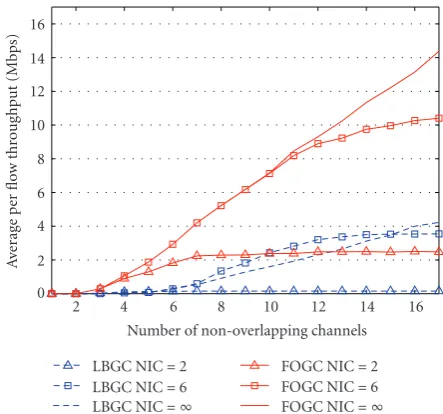
channels are provided to three 8-hop flows. As Figure 5
shows, with sufficient NICs, the average end-to-end flow rate
scales almost linearly with channel resources in presence of 3 or more channels. When the number of NICs on each node is limited, the per flow throughput would saturate at some stage. This saturation point reveals the resource
utilization efficiency of each algorithm. With only 2 NICs,
the FOGC almost fully exploits 4 channels and could partially
utilize up to 8 channels. Overall,Figure 5demonstrates that
FOGC is superior to LBGC in terms of efficiency in utilizing
ch1
Figure6: Channel switching and channel switching propagation in flow oriented channel assignment (FOCA) heuristic algorithm.
Figure7: A sample random network with multiple multihop flows. These random networks are used to evaluate the flow oriented channel assignment (FOCA) algorithm.
5. Flow Oriented Channel Assignment
Algorithm (FOCA)
Due to the broadcast nature of wireless communication, the conflict-free assumption is rarely true in practice and should be viewed as a model approximation. The a forementioned graph coloring algorithm FOGC is extended to a general flow oriented channel assignment (FOCA) algorithm to
heuristically solve (7). Conflicting links are allowed to
time-share the same channel, and in each iteration, apart from assigning a new channel, channel switching mechanism and channel switching propagation are designed to adjust existing assignment decisions.
FOCA has a similar iteration process as FOGC. It first identifies the bottleneck links, then assigns a new channel, or adjusts existing channel assignment to resolve congestion,
0
Number of non-overlapping channels
A
Figure 8: Compare FOCA and LACA in multi-channel 2-radio random networks with three 5-hop flows.
2
Figure9: The impact of number of NICs when there are 6 available channels and three 5-hop flows.
and prior to entering the next iteration, optimal allocation of link rate to contending flows that share this link is computed by solving an LP problem.
Step 0. Same as FOGC.
Step 1. Same as FOGC.
Step 2(channel assignment strategy (updateAn−1 to An)).
Assume that linkli connecting nodessandr is the critical
bottleneck selected by Step 1. The channel assignment
decision varies according to the number of available NICs on
1
Figure 10: Scalability simulation: averaged per flow throughput versus the number of flows. Random networks are of the same size and flows are all 3-hop flows.
5
Figure11: Scalability simulation: aggregate flow rates versus the number of flows. Random networks are of the same size and flows are all 3-hop flows.
(1) At least one free NIC on bothsandr: assign a locally
least occupied channel to a free NIC on s and r,
respectively.
(2) No free NIC onrat least one free NIC ons(or vice
versa): choose locally least occupied channel fromr’s
channel usage list and have one free NIC ofstuned to
that channel to communicate withr.
(3) Neithersnorrhas any free NIC:
(a)s and r have at least one common channel4:
communicate on a least occupied common
channel utilizing the NICs already tuned to that channel.
(b)s and r have no common channel, and the
connectivity betweensandr has already been
satisfied: return toStep 1to set the label of link
lito zero.
(c)sandr have no common channel in use, and
the connectivity betweensandris not satisfied:
channel switching and channel switching prop-agationare needed. A least occupied channel
is selected froms’s and r’s channel usage list,
respectively. Assume they are chs and chr, and
chs carries a lower traffic load. As Figure 6
shows,s’s NIC that originally works on chs is
switched to chr to communicate with r. To
preserves’s connection with its own neighbors
on chs, this switching is propagated to those
neighbors, and then to neighbors of those neighbors, and so on.
At the completion of this step, we have updated the channel
assignment matrixAn−1toAn.
Step 3. Same LP optimization as in FOGC.
6. Simulation Results of FOCA
The flow oriented channel assignment (FOCA) is simulated
using random network topologies (Figure 7) in ns-3 [23]
simulator because (i) node model is architected to support multiple interfaces, (ii) channel model is architected to support multiple channels in ns-3. Customized functions are implemented to install multi-interface on nodes and bind
interfaces to channels according to different channel
assign-ment algorithms5. First, we generate random topologies,
multiple source-destination pairs, and one least hop-count path for each pair. This routing information is stored to assist future channel assignments. Then channel assignment algorithm is performed in a centralized manner before data transmission. All results are averaged over multiple runs on multiple random topologies. The FOCA is compared to a unified one-to-one channel assignment, which assigns the
nth channel to the nth NIC. The unified algorithm is of
zero complexity and performs well when the number of NICs matches with the number of channels. It generates a much better baseline than any random assignment, which is unfortunately always used as an inaccurate benchmark.
Another contrast is an empirical traffic load-aware channel
assignment (LACA). In [13], LACA, a routing algorithm,
as well as the control loop between them are designed.
Assumeing a precalculated routing and fixed injected traffic
load, the LACA assigns channel resources to links in the decreasing order of the expected link load. The original evaluation metric “cross-section bandwidth” is similar to the end-to-end flow rate in this paper.
In real-world applications, the NIC limitation is fre-quently confronted before the number of channels becomes
a limitation. Therefore the multichannel limited-radio
assignment algorithms. We first simulate three 5-hop flows in random networks, where each node has only 2 NICs, and vary the number of channels. Similar to the conclusion fromFigure 5, inFigure 8, FOCA’s throughput saturates at approximately 9 channels and outperforms LACA approxi-mated 50% in the saturated case. Once saturation is reached, increasing the number of channels causes only jitter but not significant increment in flow rate, because now the limitation
is insufficient NICs on some bottleneck links. A good channel
assignment algorithm will efficiently utilize as many channels
as possible with very few NICs by diversifying traffic over
as many channels as possible to avoid intra- and inter flow interference. Hence, the saturation point (in terms of the number of channels) and the saturation flow rate in the multichannel limited-radio scenario are of particular interest to system designers.
Next we evaluate the performance when sufficient NICs
are provided. Three 5-hop flows are injected in random networks with 6 available channels while the number of NICs
per node is varied. As one could see from Figure 9, with
sufficient NICs per node, the simplest unified one-to-one
channel assignment (baseline) will outperform both FOCA and LACA. The region in which FOCA (LACA) stays above
the baseline is FOCA’s (LACA’s) effective operating region.
For example, with these particular parameter settings, LACA should be avoided when there are 4 or more NICs per node, and FOCA is a favorable algorithm only up to 5 NICs per
node.Figure 9clearly justifies that both FOCA and LACA are
designed for multichannel limited-radio scenarios.
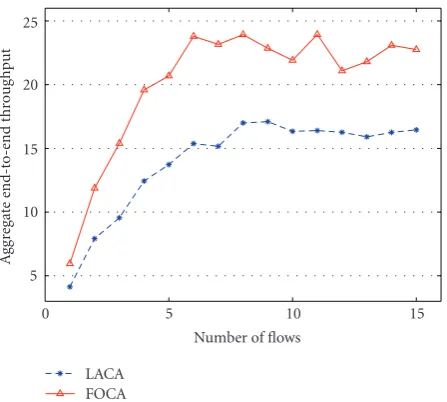
Scalability is a practical challenge for mesh backbone. We simulate the aggregated flow rate as well as the per flow rate by gradually increasing the number of coexisting 3-hop flows. The random networks simulated have 6 channels and 2 NICs per node. As expected, the per flow throughput inFigure 10 decreases steadily as the number of coexisting
flows increases. However, as shown inFigure 11shows, the
aggregated flow throughput increases with diminishing slope till the network becomes saturated. FOCA has a higher
saturated aggregate throughput due to its effective resource
management. Further increasing the amount of coexisting flows leads to more variance in FOCA than in LACA. Fortunately, no significant aggregate throughput drop is observed, showing that FOCA has the acceptable scalability when network becomes overloaded.
7. Conclusion
The fast deployment of WMNs places stringent requirements on end-to-end rates of the underlying multihop mesh backbone, especially in large scale and dense scenarios. This paper studies the channel assignment problem for a multichannel multiradio mesh backbone. We first presented a general optimization formulation, which is nonconvex due to practical constraints. Then a flow oriented graph coloring (FOGC) greedy algorithm was designed for the conflict-free case, and it was extended to a flow oriented channel assignment (FOCA) heuristic for the general case where interference is considered. Both algorithms identify
instantaneous bottlenecks at each additional assignment iteration using routing and network topology information and try to resolve congestion by (i) assigning a new channel, (ii) channel switching (FOCA only), and (iii) optimally allocating link rate to contending flows by solving an LP
problem. Simulation not only demonstrated the effectiveness
of addressing bottlenecks at each additional iteration but also
showed that both FOCA and FOGC can efficiently exploit
multiple channels with very limited number of NICs. Although both heuristics are for a static network, their low complexity as well as the relatively high stability of
traffic flows in mesh backbone allow the channel assignment
decision to be adapted periodically or once the accumulated changes exceed a certain threshold. While the proposed algo-rithms pursue local optimality at each additional assignment, this does not lead to global optimality. An option is to extend this heuristic (at cost of additional complexity) by looking several steps ahead, that is, considering more than one critical bottleneck link at each iteration. This framework can be applied towards other utility functions as well.
Endnotes
1. In case that a multihop flow has several bottleneck links, one link is randomly selected to break the tie.
2. The most beneficial channel is the one which provides the highest reward (data rate).
3. Since the complexity of exhaustive search scales expo-nentially with the number of links and channels, we only present OPT in a ring topology.
4. A common channelis the channel that bothsandrare using to communicate with neighbors other than each other.
5. Simulation code available athttp://www.ee.washington
.edu/research/funlab/mrmc/index.html.
References
[1] R. Bruno, M. Conti, and E. Gregori, “Mesh networks: com-modity multihop ad hoc networks,”IEEE Communications Magazine, vol. 43, no. 3, pp. 123–131, 2005.
[2] I. F. Akyildiz and X. Wang, “A survey on wireless mesh networks,”IEEE Communications Magazine, vol. 43, no. 9, pp. S23–S30, 2005.
[3] P. Kyasanur, J. So, C. Chereddi, and N. H. Vaidya, “Multichan-nel mesh networks: challenges and protocols,”IEEE Wireless Communications, vol. 13, no. 2, pp. 30–36, 2006.
[4] P. Kyasanur and N. H. Vaidya, “Capacity of multi-channel wireless networks: impact of number of channels and inter-faces,” inProceedings of the 11th Annual International Confer-ence on Mobile Computing and Networking (MobiCom ’05), pp. 43–57, 2005.
[5] R. Vijaykumar, A. K. Das, S. Roy, and H. Ma, “Multi-radio multi-channel mesh networks,” inWireless Mesh Networking: Architectures, Protocols and Standards, Auerbach, 2006. [6] J. So and N. Vaidya, “Multi-channel MAC for ad hoc networks:
on Mobile Ad Hoc Networking and Computing (MobiHoc ’04)), pp. 222–233, 2004.
[7] P. Bahl, R. Chandra, and J. Dunagan, “SSCH: slotted seeded channel hopping for capacity improvement in IEEE 802.11 ad-hoc wireless networks,” inProceedings of the 10th Annual International Conference on Mobile Computing and Networking (MobiCom ’04), pp. 216–230, 2004.
[8] K. N. Ramachandran, E. M. Belding, K. C. Almeroth, and M. M. Buddhikot, “Interference-aware channel assignment in multi-radio wireless mesh networks,” inProceedings of the 25th IEEE International Conference on Computer Communications (INFOCOM ’06), 2006.
[9] A. P. Subramanian, H. Gupta, and S. R. Das, “Minimum interference channel assignment in multi-radio wireless mesh networks,” in Proceedings of the 4th Annual IEEE Commu-nications Society Conference on Sensor, Mesh and Ad Hoc Communications and Networks (SECON ’07), pp. 481–490, 2007.
[10] A. K. Das, H. M. K. Alazemi, R. Vijayakumar, and S. Roy, “Optimization models for fixed channel assignment in wireless mesh networks with multiple radios,” inProceedings of the 2nd Annual IEEE Communications Society Conference on Sensor and Ad Hoc Communications and Networks (SECON ’05), pp. 463–474, 2005.
[11] P. Kyasanur and N. Vaidya, “Routing and link-layer protocols for multi-channel multi-interface ad hoc wireless networks,”
ACM SIGMOBILE Mobile Computing and Communications Review, vol. 10, no. 1, pp. 31–43, 2006.
[12] H. Skalli, S. Ghosh, S. K. Das, L. Lenzini, and M. Conti, “Channel assignment strategies for multiradio wireless mesh networks: issues and solutions,”IEEE Communications Maga-zine, vol. 45, no. 11, pp. 86–95, 2007.
[13] A. Raniwala, K. Gopalan, and T. Chiueh, “Centralized channel assignment and routing algorithms for multi-channel wireless mesh networks,” ACM SIGMOBILE Mobile Computing and Communications Review, vol. 8, no. 2, pp. 50–65, 2004. [14] M. Alicherry, R. Bhatia, and L. Li, “Joint channel assignment
and routing for throughput optimization in multi-radio wireless mesh networks,” in Proceedings of the 11th Annual International Conference on Mobile Computing and Networking (MobiCom ’05), pp. 58–72, September 2005.
[15] J. Tang, G. Xue, and W. Zhang, “Cross-layer optimization for end-to-end rate allocation in multi-radio wireless mesh networks,”Wireless Networks, vol. 15, no. 1, pp. 53–64, 2009. [16] L. Gao, X. Wang, and Y. Xu, “Multiradio channel allocation
in multihop wireless networks,”IEEE Transactions on Mobile Computing, vol. 8, no. 11, pp. 1454–1468, 2009.
[17] C. Chereddi, P. Kyasanur, and N. H. Vaidya, “Design and implementation of a multi-channel multi-interface network,” inProceedings of the 2nd International Workshop on Multi-Hop Ad Hoc Networks: From Theory to Reality (REALMAN ’06), pp. 23–30, 2006.
[18] J. So and N. Vaidya, “A routing protocol for utilizing multiple channels in multi-hop wireless networks with a single transceiver,” Tech. Rep., University of Illinois at Urbana, Champaign, Ill, USA, 2004.
[19] B. Vedantham, S. Kakumanu, S. Lakshmanan, and R. Sivaku-mar, “Component based channel assignment in single radio, multi-channel ad hoc networks,” inProceedings of the 12th Annual International Conference on Mobile Computing and Networking (MobiCom ’06), pp. 378–389, 2006.
[20] C. Peng, H. Zheng, and B. Y. Zhao, “Utilization and fairness in spectrum assignment for opportunistic spectrum access,”
Mobile Networks and Applications, vol. 11, no. 4, pp. 555–576, 2006.
[21] X. L. Huang and B. Bensaou, “On max-min fairness and scheduling in wireless ad-hoc networks: analytical frame-work and implementation,” inProceedings of the 2nd ACM International Symposium on Mobile Ad Hoc Networking and Computing (MobiHoc ’01), pp. 221–231, Long Beach, Calif, USA, October 2001.
[22] S. Ramanathan, “Unified framework and algorithm for chan-nel assignment in wireless networks,”Wireless Networks, vol. 5, no. 2, pp. 81–94, 1999.