Page 1 of 5 Editorial Commentary
Complete revascularisation in STEMI: consider the benefits but do
not forget the risks!
Andreas Mitsis#, Alessandro Spirito#, Marco Valgimigli
Department of Cardiology, Swiss Cardiovascular Centre, Bern University Hospital, Bern, Switzerland #These authors contribute equally to this work.
Correspondence to: Prof Marco Valgimigli, MD, PhD. Swiss Cardiovascular Centre Bern, Bern University Hospital, University of Bern, Freiburgstrasse
4, 3010, Bern, Switzerland. Email: [email protected].
Provenance: This is an invited article commissioned by the Guest Section Editor Dr. Yue Liu (Department of Cardiology, The First Affiliated Hospital of Harbin Medical University, Harbin, China).
Comment on: Kyhl K, Ahtarovski KA, Nepper-Christensen L, et al. Complete Revascularization Versus Culprit Lesion Only in Patients With
ST-Segment Elevation Myocardial Infarction and Multivessel Disease: A DANAMI-3-PRIMULTI Cardiac Magnetic Resonance Substudy. JACC Cardiovasc Interv 2019;12:721-30.
Submitted Aug 11, 2019. Accepted for publication Sep 20, 2019 doi: 10.21037/atm.2019.09.121
View this article at: http://dx.doi.org/10.21037/atm.2019.09.121
Multivessel disease is a common scenario in ST elevation myocardial infraction (STEMI) patients and up to 50% of them may have additional angiographically severe lesions in non-culprit coronaries (1,2). Patients with extensive disease in vessels other than the infract related artery (IRA) are known to have inferior prognosis compared with the
patients with single-vessel disease (3,4). While the benefits
of treating the culprit artery and restoring coronary flow have been extensively and conclusively documented, the evidence of whether to treat other angiographically significant lesions in asymptotic patients outside the IRA or not is less convincing. Indeed, it may be argued that complete revascularisation of significant non-IRA might prevent recurrent ischaemia and adverse cardiac events, while a common counterargument is that this approach might cause periprocedural myocardial infarction (MI) potentially leading to larger infract size and worst prognosis.
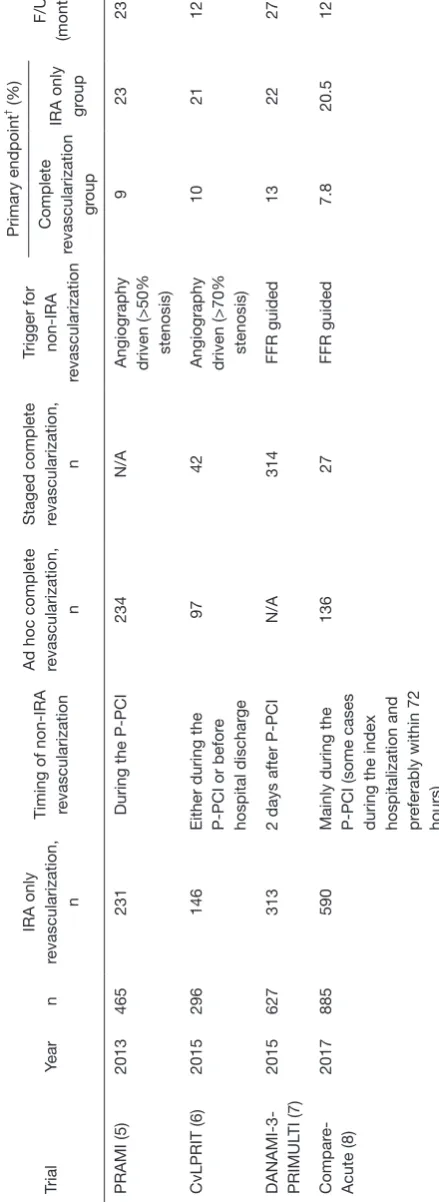
Four major randomised trials have tried to assess the risks and benefits of complete versus incomplete revascularisation in STEMI patients undergoing primary PCI (Table 1). Preventive angioplasty in acute myocardial infarction (PRAMI) trial assigned 465 multivessel disease patients to undergo either preventive PCI (234 patients) or no preventive PCI (231 patients). At an average follow-up of 23 months, preventive PCI in the non-IRA with stenosis
≥50% (i.e., based on lumen narrowing assessed at the time of index angiogram) was associated with lower rates
of the compound primary endpoint of death, myocardial infraction, or refractory angina (9% versus 23%) (HR 0.35, 95% CI: 0.21–0.58; P<0.001) (5). Notably, this is the only study, which observed a strong trend towards a possible
mortality benefit in patients who underwent angiography-based complete revascularisation and a significant reduction
of recurrent MI.
In complete versus lesion-only PRimary PCI pilot study (CvLPRIT) trial, 296 patients have been assigned to either complete revascularisation (n=150) or culprit lesion only primary PCI (n=146). The timing of complete revascularization was after the primary PCI (P-PCI) or during the same hospital stay and as in PRAMI the decision to revascularise or not the non-culprit lesions was based on angiography. The primary endpoint was a compound of death, recurrent MI, heart failure, and ischemia-driven revascularization. The complete revascularisation group was associated with lower rates of the primary endpoint within a 12-month period (10.0 % versus 21.2%) (HR 0.45, 95% CI: 0.24–0.84; P=0.009) (6). In this study, the benefit of complete revascularisation was apparently driven by each component of the primary endpoint being numerically
even if not statistically significant lower in the experimental
group.
(DANAMI-3-PRIMULTI) was the third randomised study to become available. In this study, 627 patients were assigned to only IRA-only revascularisation or FFR-guided complete revascularisation. The primary endpoint at a mean follow up of 27 months, was a compound of all-cause mortality, non-fatal myocardial re-infarction, and ischaemia-driven revascularization of lesions other than the IRA artery and occurred in 68 (22%) patients who had IRA PCI only and in 40 (13%) patients who had complete revascularization (HR 0.56, 95% CI: 0.38–0.83; P=0.004). This advantage was driven mainly by a reduction in repeat revascularization (7), without a cleat impact on mortality or MI rates.
Finally, the Fractional Flow Reserve-Guided Multivessel Angioplasty in Myocardial Infarction (Compare-Acute) trial enrolled 885 patients with STEMI and multivessel disease to FFR-guided complete revascularisation or culprit lesion only treatment. A reduction of the primary endpoint (death, MI, revascularization, or stroke) was observed with multivessel PCI (HR 0.35, 95% CI: 0.22–0.55; P<0.001), which was driven mainly by a reduction in the need for revascularization at a later time point by non-IRA FFR-guided revascularization (8).
A recent meta-analysis of 10 trials (but not included the Compare-Acute study) demonstrated that complete revascularization was related with a lower risk of MACE (RR 0.57, 95% CI: 0.42–0.77). This benefit was driven by a lower risk of urgent revascularization (RR 0.44, 95%
CI: 0.30–0.66), while there was no significant difference in
mortality (RR 0.76, 95% CI: 0.52–1.12) or spontaneous MI (RR 0.54, 95% CI: 0.23–1.27) (9).
The recent 2018 ESC/EACTS Guidelines on myocardial revascularization (10) recommend that routine complete revascularization should be considered in patients with multivessel disease during the same hospital stay (Class IIA, Level of evidence A). Similarly, the 2015 ACC/AHA/SCAI recommendations (11), suggest that non-IRA PCI may be considered in selected hemodynamically stable patients with STEMI and multivessel disease, either during primary PCI or as a staged procedure.
Whether complete revascularisation after STEMI in multivessel disease patients improves LV function and volumes remains unclear. In addition, the risks of inducing peri-procedural MI when attempting at completing revascularisation has not been well documented so far.
The recent publication of the Cardiac Magnetic Resonance Sub-study of the DANAMI-3-PRIMULTI (12) adds new pieces of the puzzle, which, however, does not
yet come together. A non-randomly selected group of 280 patients (136 patients with IRA PCI and 144 with complete FFR-guided revascularization) underwent CMR before receiving (or not receiving) complete revascularisation and at 3 months. The final infract size, myocardial salvage index, LV ejection fraction (LVEF) and LV end-systolic volume (LVESV) remodelling were similar between the two groups. Interestingly, new non-culprit infarctions were numerically more common in the complete revascularization group [6 (4.5%) versus 1 (0.8%); P=0.12]. Therefore, this study may actually suggest that the risks of complete revascularisation, in terms of peri-procedural MI,
may outweigh or at least counterbalance its possible benefit
on LV function and volumes.
However, one may argue that three month-time frames is rather short to allow detecting significant different in LV remodelling. No proper sample size calculation was performed to justify the number of included patients; therefore, study power remains an issue. Moreover, whether FFR or angiography should be used to guide compete revascularisation is still unclear. In the early stage of acute MI, disturbed microvascular function might affect the reliability of FFR measurements. Microvascular dysfunction in the culprit territory is quite often due to distal thrombus embolization and vasoconstriction. This may lead to impaired hyperaemic flow in the non-culprit myocardium, possibly leading to underestimation of real FFR values in the acute setting. Studies using positron-emission tomography and Doppler flow have tested this hypothesis and presumed that during MI the non-infarcted myocardium is also affected (13,14). However, other studies suggest that FFR measurements in non-culprit vessels of patients with myocardial infraction are consistent and therefore FFR may be used to guide revascularization in the acute setting of a STEMI (15,16).
T
able 1
Differences among randomized controlled trials evaluating multivessel revascularization in STEMI
Trial Year n IRA only revascularization, n
Timing of non-IRA revascularization Ad hoc complete revascularization,
n
Staged complete revascularization,
n
Trigger for non-IRA
revascularization Primary endpoint † (%) F/U (months) Complete revascularization gr oup
IRA only gr
oup
PRAMI (5)
2013
465
231
During the P-PCI
234
N/A
Angiography driven (>50% stenosis)
9 23 23 CvLPRIT (6) 2015 296 146
Either during the P-PCI or befor
e
hospital dischar
ge
97
42
Angiography driven (>70% stenosis)
10 21 12 DANAMI-3- PRIMUL TI (7) 2015 627 313
2 days after P-PCI
N/A 314 FFR guided 13 22 27 Compar e-Acute (8) 2017 885 590
Mainly during the P-PCI (some cases during the index hospitalization and preferably within 72 hours)
136 27 FFR guided 7.8 20.5 12
† , primary endpoints wer
e: a compound of death, MI, or r
efractory angina in PRAMI , a compound of death, r
ecurr
ent MI, heart failur
e, and ischemia-driven r
evascularization in CvLPRIT , a compound of all-cause mortality , non-fatal re-infar ction, and ischaemia-driven revascularization in DANAMI-3-PRIMUL TI and a compound of death, non-fatal MI, r
evascularization, and cer
ebr
ovascular events in Compar
e-Acute trial. STEMI, ST elevation myocar
dial infraction; P-PCI, primary PCI; IRA, infract r
elated artery; F/U,
follow-up. Table 2
Differences among randomized controlled trials evaluating L
V volumes, ejection fraction, remodelling and peri-procedural MI
First author
Year
n
CMR complete revascularization
gr
oup
CMR IRA gr
oup
Baseline CMR
Follow up CMR
Baseline median total infract
size (% L
VM)
Follow up L
VEF (%)
Peripr
ocedural r
elated MI
(%)
Complete gr
oup
IRA gr
oup
Complete gr
oup
IRA gr
oup
Complete gr
oup
IRA gr
oup
McCann et al.
(17)
2015
205
98
105
At a median of 3 days post
P-PCI 9 months 13.5 12.6 49.7 50.8 23.8 11.2
Mangion et al.
(18)
2016
84
42
42
During the first week post-MI 7 months (mean period)
14.6 15.6 54.4 51.7 4.8 0 Kyhl et al. (12) 2019 280 144 136
1-day post P-PCI
3 months 15% 16% 59% 58% 4.5 0.8 CMR, car
diovascular magnetic r
esonance; P-PCI, primary PCI; IRA, infract r
elated artery; L
VEF
, left ventricular ejection fraction; MI, myocar
[image:3.595.58.278.105.707.2]other evidence, the infarct size (% LV mass) at baseline and follow-up did not differ in the two study groups. However, in this study the incidence of peri-procedural MI in the
preventive PCI group was uncommon (4.8%), may reflect
the patient selection more than the real risks of competing revascularisation in an unselected patient population.
Therefore, no single study has so far shown an effect of complete revascularisation in STEMI patients on LV mechanics or remodelling whereas all studies have shown a sizable, yet variable, risk of peri-procedural MI. The prognostic implication of clinically silent CMR-detected
MI is unclear. Yet, the benefit of complete revascularization
in patients with STEMI and multivessel disease should be counterbalanced against a coexisting risk for periprocedural myocardial infraction.
Acknowledgments
None.
Footnote
Conflicts of Interest: The following relationships outside the submitted work are disclosed by the authors: Marco Valgimigli reports personal fees from Astra Zeneca, grants and personal fees from Terumo, personal fees from Alvimedica/CID, personal fees from Abbott Vascular, personal fees from Daiichi Sankyo, personal fees from Opsens, personal fees from Bayer, personal fees from CoreFLOW, personal fees from IDORSIA PHARMACEUTICALS LTD, personal fees from Universität Basel | Dept. Klinische Forschung, personal fees from Vifor, personal fees from Bristol Myers Squib SA, personal fees from iVascular. Andreas Mitsis has received a training grant from Medtronik. Alessandro Spirito has no
conflicts of interest to declare.
Ethical Statement: The authors are accountable for all aspects of the work in ensuring that questions related to the accuracy or integrity of any part of the work are appropriately investigated and resolved.
References
1. Park DW, Clare RM, Schulte PJ, et al. Extent, location,
and clinical significance of non-infarct-related coronary
artery disease among patients with ST-elevation myocardial infarction. JAMA 2014;312:2019-27.
2. Dziewierz A, Siudak Z, Rakowski T, et al. Impact of multivessel coronary artery disease and noninfarct-related artery revascularization on outcome of patients with ST-elevation myocardial infarction transferred for primary percutaneous coronary intervention (from the EUROTRANSFER Registry). Am J Cardiol 2010;106:342-7.
3. Halkin A, Singh M, Nikolsky E, et al. Prediction of mortality after primary percutaneous coronary intervention for acute myocardial infarction: the CADILLAC risk score. J Am Coll Cardiol 2005;45:1397-405.
4. Sorajja P, Gersh BJ, Cox DA, et al. Impact of multivessel disease on reperfusion success and clinical outcomes in patients undergoing primary percutaneous coronary intervention for acute myocardial infarction. Eur Heart J 2007;28:1709-16.
5. Wald DS, Morris JK, Wald NJ, et al. PRAMI Investigators. Randomized trial of preventive angioplasty in myocardial infarction. N Engl J Med 2013;369:1115-23.
6. Gershlick AH, Khan JN, Kelly DJ, et al. Randomized trial of complete versus lesion-only revascularization in patients undergoing primary percutaneous coronary intervention for STEMI and multivessel disease: the CvLPRIT trial. J Am Coll Cardiol 2015;65:963-72.
7. Engstrøm T, Kelbaek H, Helqvist S, et al. Complete revascularisation versus treatment of the culprit lesion only in patients with ST-segment elevation myocardial infarction and multivessel disease (DANAMI-3— PRIMULTI): an open-label, randomised controlled trial. Lancet 2015;386:665-71.
8. Smits PC, Abdel-Wahab M, Neumann FJ, et al.
Compare-Acute Investigators. Fractional flow reserve-guided
multivessel angioplasty in myocardial infarction. N Engl J Med 2017;376:1234-44.
9. Elgendy IY, Mahmoud AN, Kumbhani DJ, et al. Complete or culprit-only revascularization for patients with multivessel coronary artery disease undergoing percutaneous coronary intervention: A pairwise and network meta-analysis of randomized trials. JACC Cardiovasc Interv 2017;10:315-24.
10. Neumann FJ, Sousa-Uva M, Ahlsson A, et al. 2018 ESC/ EACTS guidelines on myocardial revascularization. Eur Heart J 2019;40:87-165.
and the 2013 ACCF/AHA guideline for the management of ST-elevation myocardial infarction. J Am Coll Cardiol 2016;67:1235-50.
12. Kyhl K, Ahtarovski KA, Nepper-Christensen L, et al. Complete Revascularization Versus Culprit Lesion Only in Patients With ST-Segment Elevation Myocardial Infarction and Multivessel Disease: A DANAMI-3-PRIMULTI Cardiac Magnetic Resonance Substudy. JACC Cardiovasc Interv 2019;12:721-30.
13. Uren NG, Crake T, Lefroy DC, et al. Reduced coronary vasodilator function in infarcted and normal myocardium after myocardial infarction. N Engl J Med 1994;331:222-7.
14. de Waard GA, Hollander MR, Teunissen PF, et al. Changes
in coronary blood flow after acute myocardial infarction:
insights from a patient study and an experimental porcine model. JACC Cardiovasc Interv 2016;9:602-13.
15. Ntalianis A, Sels JW, Davidavicius G, et al. Fractional flow
reserve for the assessment of nonculprit coronary artery stenoses in patients with acute myocardial infarction. JACC Cardiovasc Interv 2010;3:1274-81.
16. Lee JM, Kim HK, Lim KS, et al. Influence of local
myocardial damage on index of microcirculatory resistance
and fractional flow reserve in target and nontarget vascular
territories in a porcine microvascular injury model. JACC Cardiovasc Interv 2018;11:717-24.
17. McCann GP, Khan JN, Greenwood JP, et al. Complete versus lesion-only primary PCI: the randomized
cardiovascular MR CvLPRIT substudy. J Am Coll Cardiol 2015;66:2713-24.
18. Mangion K, Carrick D, Hennigan BW, et al. Infarct size and left ventricular remodelling after preventive percutaneous coronary intervention. Heart 2016;102:1980-7.