Volume 8, No. 5, May-June 2017
International Journal of Advanced Research in Computer Science RESEARCH PAPER
Available Online at www.ijarcs.info
ISSN No. 0976-5697
Er. Amandeep Singh
M.Tech Scholar, Department of Computer Science & Engineering,
Guru Nanak Dev University, RC Campus Jalandhar, Punjab, India
Performance Evaluation of Lane Detection Images Based on Additive Hough
Transform Algorithm
Er.VarinderKaur Attri
Assistant Professor, Department of Computer Science & Engineering,
Guru Nanak Dev University, RC Campus Jalandhar, Punjab, India
Abstract: This paper represents that lane coloration has become popular in real time vehicular adhoc system. Lane detection is normally helpful to localize path limits. Determine undesired lane variations and to enable approximation of the upcoming geometry of the road. There are different types of methods that are used for detecting lines i.e. Hough transform, clustering and curve fitting. The paper represents that by using these methods working efficiently but problem is that they fail or not give efficient results when there are curved lane road images. The objective of this paper is to improve lane coloration algorithm by modifying the Hough transform i.e. additive Hough transform with different performance metrics to improve the accuracy
1.INTRODUCTION
Passenger's safety is probably one of the most formulated axes concerning exploration in automobile. The vast majority of the vehicle road crashes takes place because of the driver overlooking of the vehicle path so protection is the primary purpose of all of the lane detection methods [1]. The majority of travelling deaths and injuries happen on the country’s highways. According to the fact, improper driving response, high speed as well as U-turn are the main causes behind majority of these incidents. Studies of these accident cases depict that 40% and more mishaps could have been eliminated if perhaps the vehicle had been designed with an alert system [2]. The next generation of driver-assistant system are being developed by consumer analysis organizations, automobile manufacturers and suppliers, as well as other research institutions that will make it possible for vehicles to have more secure tendencies as well as to decrease road injuries and deaths. A computer perspective is involved as one of the primary technologies which become a powerful tool for detection of lanes [4]. Lane detection is normally helpful to localize road boundaries, determine undesired lane variations, and to enable approximation of the upcoming geometry of the road. At Present, two well defined techniques are there for performing lane recognition by making use of video i.e. feature based method and model based method [1, 9] Lane detection enables you to obtain the position as well as direction of the vehicle in addition lane information, as well as an area which includes highways is important to alert a driver associated with lane departure. The lane information is usually used for tracking down other motor vehicles as well as hurdles within the route of the vehicle and which could be placed on additional growth of the barrier avoiding system [7].
1.1 Clustering
.
Keywords: lane detection, clustering, curve fitting, Hough transform and adaptive Hough transform
Partitioning of data in groups of similar elements is called Clustering. This is an crucial approach in different job areas for example pattern recognition as well as machine learning [4].The various types into which Clustering algorithms are
usually classified are grid-based clustering, partitioned clustering , density-based clustering and hierarchical clustering. Unlike partitioning algorithms that have an understanding of clusters but on the contrary side hierarchical algorithms gradually disassemble objects directly into clusters. Several grouped nested clusters are generally sorted like a hierarchical tree.
1.2 Curve Fitting
A mathematical model is designed for the visual characteristics taken out from a specific frame and in this way road recognition is mostly advised in a top-down fashion. Extracting a compressed high-level reflection of the path is the complete goal of this stage further which is often used for decision making. An even route model along with limits on its thickness as well as curvature is realized so that the particular bottom-up route detection is increased [16]. The boundary points and lateral extent at each centerline location is used to depict the path which clearly describes the boundaries. One of the ways to simplify the geometric model is to adjust the framework to bird’s-eye perspective so that the boundaries associated with the road turn out to be identical in curvature and the path’s thickness is approximately consistent.
1.3 Hough Transform
parameter values. The HT switches an recognition issue in picture place right into a quicker resolved regional top recognition issue in a parameter space [16]. The main element some ideas of the technique may be shown by contemplating distinguishing models of collinear factors in a image. A couple of picture factors (x, y) which lay on a direct point may be described by way of a connection, f, in a way that f((vh, e), (x, y)) = b – rhx = 0, (1).
Hough Transform Algorithm: Require: {Binary Image}
Require: δ {Discretization step for the parameter space} 1: Votes ← 0 {Initialization of the voting matrix} 2: for each feature pixel I (x, y) do
3: for 0°≤ Ѳ ˂ 180°, using a δ Discretization step do
4: ρ ← x cos(Ѳ) + y sin(Ѳ) 5: Votes (ρ, Ѳ) ← Votes (ρ, Ѳ) + 1
6: end for 7: end for
2. PROPOSED METHODOLOGY
2.1 Proposed additive Hough Transform Algorithm Step1: Image = imread (jpg);
Image=imresize(Image); imgData=Image(:,:,1); [A,B]=find (imgData~=255); xmin=min(A);
xmax=max(A); ymin=min(B); ymax=max(B); width = xmax - xmin; height = ymax - ymin; Step2: ddd=Image; if ndims(Image)==3 d=Image;
end
scaled=Image*1.2; level = 220;
binary = scaled>level; ops=binary;
Step3: level = graythresh(Image); binary = im2bw(ops,level); binary1 = im2bw(imgSelect,level); Step4: op1=binary;
BW = edge(binary,'canny'); [H,T,R] = hough(BW);
P = houghpeaks(H,5,'threshold',ceil(0.3*max(H(:)))); x = T(P(:,2)); y = R(P(:,1));
Step5: if count~=0 hold on
for k=1:count b = boundaries{k};
if metricn(k) < threshold && metricn(k)>lowthreshold end
end end
[image:2.595.368.493.61.313.2]my_compute_precision_recall_fmeasure(input(:,1)>100, op
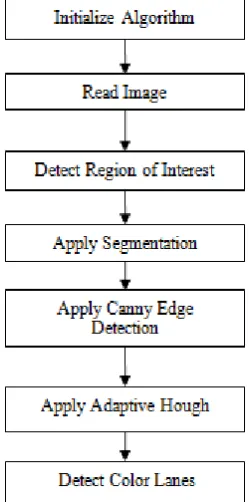
Fig 1: Proposed Methodology
3. RELATED WORK
image capture by a vehicle-mount monocular camera in composite environment, for point rounded arc path initially, a lane borders projective model has been assumed. This lane model not only describes straight-line lane borders, although besides express the tangible pointed rounded arc path borders extremely clearly. Hendrik Deusch et al. [11] proposed that the robust lane colorization has been the prerequisite used for sophisticated driver support system similar to lane departure advice and overtake subordinate.
4. ANSALYSIS OF RESULTS
4.1 Experimental Results
For experimentation and implementation the proposed technique is evaluated using MATLAB tool u2013a. Here
we compare the lane colorization algorithm i.e. Hough transform with additive Hough transform for removing noise from the images on the basis of various image quality evaluation parameters like recall, f-measure, p_recall, bit classification rate (BCR) and g_accuracy. The existing methodology give good results which locate the lane edges without any prior knowledge of the road geometry, and do so in situations where there may be a countless clutter in the road image. Thus it becomes a major issue when noise is present in the input image [16-17]. The proposed approach gives efficient results in improving the existing Lane colorization algorithm. The tabular and graphical comparison has been done between existing and proposed methodology on the basis of parameters recall, f-measure, p_recall, bit classification rate (BCR) and g_accuracy.
[image:3.595.38.525.238.341.2]
Fig 2: Input Image Fig 2 a) Existing result Fig 2 b) Proposed result
1. Recall: Recall (also known as sensitivity) is the fraction of relevant instances that are retrieved. It is defined as collection of positive
cases. Recall can be expressed as: Recall =TP + FNTP
Fig 3: Performance Analysis of Recall
It represents that the increase in recall value of using lane detection images with the use of additive Hough transform.
2. F-measure: F-Measure is also called F1 score. It contains both precision and recall. It is generally use to check the accuracy and reliability.
F-measure can be calculated with using the formula given as:
[image:3.595.333.519.240.501.2]F_Measure = 2∗P + RP∗R
Fig 4: Performance Analysis of F-measure
It represents that the increase in F-measure value of using lane images with the use of proposed additive Hough transform.
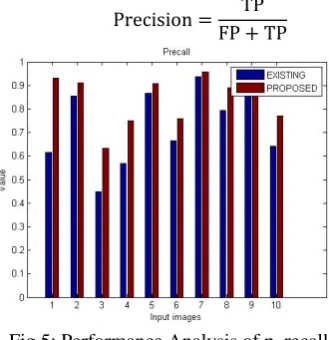
3. P_recall: Precision recall is defined as measurement of all positive cases that are identified when making calculations. Precision is also known as positive predictive value.
Precision =FP + TPTP
Fig 5: Performance Analysis of p_recall
[image:3.595.48.231.403.580.2] [image:3.595.353.518.582.752.2]4. Bit Classification Rate (BCR): Bit classification allows efficient selection and classification codes for each bit are generated by placing the bit style into the category that best describes it so that similar bit types are grouped within a single category.
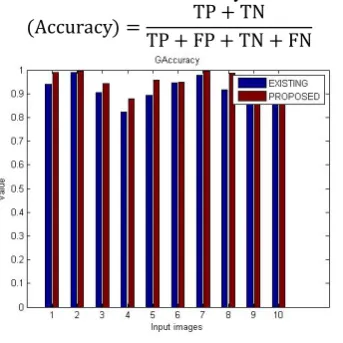
Fig 6: Performance Analysis of Bit Classification Rate 5. G_Accuracy: It is defined as number of instance per classes that have been correctly identified. Correctly classified instances lead to the accuracy of results.
(Accuracy) =TP + FP + TN + FNTP + TN
Fig 7: Performance Analysis of G_accuracy
It showing that the increase in the accuracy by using lane images based on proposed additive Hough transform over the existing technique.
5. CONCLUSION
In this paper the primary technology involved in these takes computer perspective which turns out to be an effective tool for detection of lanes. Lane detection enables you to obtain the position as well as direction of the vehicle along with lane information. There are different types of methods that are used for detecting lines. The methods formulated until now are operating effectively as well as providing beneficial results in scenario when the straight lane images are generally there. However challenge is simply because that they are unsuccessful or otherwise not provide successful outcomes whenever there are curved lane road images. In this modify Hough transform i.e. additive Hough transform is used to improve straight lane as well as curved lane road images. The comparison has been drawn between Hough transform and additive Hough transform by using various parameters recall, f-measure, p_recall, bit classification rate (BCR) and g_accuracy. The proposed technique has been designed and implemented in Matlab simulator 2010 by
using image processing toolbox. The performance evaluation has shown the improvement in g_accuracy.
6. REFERENCES
[1] Lin, Qing, Youngjoon Han, and Hernsoo Hahn. "Real-time lane departure detection based on extended edge-linking algorithm" IEEE Second International Conference onComputer Research and Development,pp. 725-730, May 2010.
[2] Kasai, Tatsuya, and Kazunori Onoguchi. "Lane Detection System for Vehicle Platooning using Multi-information Map”IEEE 13th International Conference on, Intelligent Transportation Systems (ITSC), pp. 1350-1356, Sep 2010. [3] Guo, Chunzhao, Seiichi Mita, and David McAllester. "Lane
detection and tracking in challenging environments based on a weighted graph and integrated cues" IEEE/RSJ International Conference on Intelligent Robots and Systems (IROS),pp. 5543-5550, Oct2010.
[4] He, Jia, HuiRong, Jinfeng Gong, and Wei Huang. “A lane detection method for lane departure warning system" IEEE International Conference on Optoelectronics and Image Processing (ICOIP), vol. 1, pp. 28-31, Nov2010.
[5] Leng, Yu-Chi, and Chieh-Li Chen. “Vision-based lane departure detection system in urban traffic scenes" IEEE 11th International Conference on control Automation Robotics & Vision (ICARCV), pp. 1875-1880, Dec 2010. [6] Chen, Yong, Mingyi He, and Yifan Zhang. "Robust lane
detection based on gradient direction" IEEE 6th Conference onIndustrial Electronics and Applications (ICIEA),pp. 1547-1552, June 2011.
[7] Saeedi Xiaoyun, Wang, Wang Yongzhong, and Wen Chenglin. "Robust lane detection based on gradient-pairs constraint" IEEE 30th Chinese Control Conference (CCC),pp. 3181-3185, July2011.
[8] Li, Jian, XiangjingAn, and Hangen He."Lane Detection Based on Visual Attention"IEEE Sixth International Conference on Image and Graphics (ICIG),pp. 570-575, Aug 2011.
[9] Keyou, Guo, Li Na, and Zhang Mo. "Lane detection based on the random sample consensus" IEEEInternational Conference on Information Technology, Computer Engineering and Management Sciences (ICM), vol. 3,pp. 38-41,Sep 2011.
[10] Li, Hao, and FawziNashashibi. "Robust real-time lane detection based on lane mark segment features and general a priori knowledge" IEEE International Conference on Robotics and Biomimetics (ROBIO), pp. 812-817, Dec2011. [11] Kang Deusch, Hendrik, Jürgen Wiest, Stephan Reuter,
Magdalena Szczot, Marcus Konrad, and Klaus Dietmayer. "A random finite set approach to multiple lane detection" IEEE15th International Conference on Intelligent Transportation Systems (ITSC),pp. 270-275, Sep2012. [12] Singh, Rajandeep, and Prabhdeep Singh. "Integrated Lane
Colorization Using Hough Transformation and Bilateral Filter."International Journal of Engineering Sciences & Research Technology,Oct 2013, pp.
[13] Cassisi, Carmelo, Alfredo Ferro, Rosalba Giugno, Giuseppe Pigola, and Alfredo Pulvirenti. "Enhancing density-based clustering: Parameter reduction and outlier detection." Information Systems 38, no. 3 (2013): 317-330. [14] Wu, Pei-Chen, Chin-Yu Chang, and Chang Hong Lin.
"Lane-mark extraction for automobiles under complex conditions." Pattern Recognition 47, no. 8 (2014): 2756-2767.
[image:4.595.73.245.318.490.2][16] Niu, Jianwei, Jie Lu, Mingliang Xu, Pei Lv, and Xiaoke Zhao. "Robust Lane Detection using Two-stage Feature Extraction with Curve Fitting." Pattern Recognition 59 (2016): 225-233.