Available Online atwww.ijcsmc.com
International Journal of Computer Science and Mobile Computing
A Monthly Journal of Computer Science and Information Technology
ISSN 2320–088X
IJCSMC, Vol. 5, Issue. 1, January 2016, pg.341 – 354
Analysis of Defuzzification
Method for Rainfall Event
Kiran Kumar Uraon
1, Shiv Kumar
21
M.Tech Scholar, Computer Science & Engineering, Mewar University, Gangrar, Chittorgargh-312901, India [email protected]
2
Asst. Professor, Computer Science & Engineering, Mewar University, Gangrar, Chittorgargh-312901, India [email protected]
Abstract: Fuzzy Logic is present trend for decision making, classification and prediction where problem can be formulated by mapping input variable with output variable or where simple solution does not exists. There are three basic steps for fuzzy inference system such as Fuzzification, rule evaluation and Defuzzification. Fuzzification means converting numeric value into linguistic value. Human intuition method is well accepted method for the membership function value assignment throughout the world. Fuzzy inference engine produce the result after rule evaluation also in terms of linguistic value. All results are aggregated and defuzzified by any Defuzzification method. It is very difficult to know which process will be suitable for which type of data.
So, the main objective of this paper is to explore the basic concept of Defuzzification method for the rain fall event with the help of wind speed and temperature variable by simulating on “MATLAB”. And analyze the obtained results for different-different Defuzzification for the rain fall prediction.
1. Introduction
Fuzzy logic is an extension of classical logic. The main difference between fuzzy logic and
classical logic is that fuzzy set using membership function to calculate accuracy of the particular
object. Fuzzy logic has many advantages over classical logic in areas like artificial intelligence
where a simple true/false statement is insufficient.
A fuzzy set operation is an operation on fuzzy sets. These operations are generalization of crisp
set operations. There is more than one possible generalization. The most widely used operations
are called standard fuzzy set operations. These three operations: are fuzzy complements, fuzzy
intersections, and fuzzy unions [2].
There are three main methods or steps of fuzzy inference system as given in figure.
Figure 1(a): Fuzzy Inference System
1.1 Fuzzification
Fuzzification is the first step of the fuzzy inference system which is used to convert crisp values to the linguistic value.
1.2 Rule Evaluation
A fuzzy rule is defined as a conditional statement in the form:
Fuzzyfire Inference
Engine
Defuzzifier Output Input
IF x is A THEN y is B Where:
x and y are linguistic variables;
A and B are linguistic values determined by fuzzy sets on the universe of discourse X and Y, respectively.
1.3 Defuzzification
Defuzzification is the process of producing a quantifiable result in fuzzy inference system. It is
typically needed in fuzzy control systems. These will have a number of rules that transform a
number of variables into a fuzzy result, that is, the result is described in terms of membership
in fuzzy sets [3]. Defuzzification is the process of converting fuzzified result into crisp value.
There are five basic Defuzzification methods as given below:
1. Centroid
2. Bisector
3. MOM
4. LOM
5. SOM
2. Literature Review
Jimoh, R.G. in 2013 [1], "Modeling Rainfall Prediction using Fuzzy Logic" has discussed prediction of likelihood of rainfall and even the volume and also discussed the fact that effective planning leads to high performance does not call for any debate.
Mahbub Hasan, in 2013 [2] "Predicting Rainfall Using the Principles of Fuzzy Set Theory and Reliability Analysis " has modeled fuzzy inference system based on fuzzy set theory.
Sameena Naaz, Afshar Alamand Ranjit Biswas,2011 [4], ―Effect of different defuzzification methods in a fuzzy based load balancing application‖ has discussed Defuzzification methods like Centroid method, bisector method and mean of maximum method for the load balancing application.
Somia A. Asklany, in 2011 [5], "Rainfall events prediction using rule-based fuzzy inference system" has introduced intelligent models for rainfall events prediction for two Egyptian meteorological stations based on fuzzy inference system and proved that when using such technique, it is desirable to merge the experiences of forecasters and theoretical studies to improve accuracy of the computer systems.
Teerawat Thongwan, Anongrit Kangrang and Sahalaph Homwuttiwongin in 2011 [6],"An Estimation of Rainfall using Fuzzy Set-Genetic Algorithms Model" has proposed Genetic based Fuzzy Inference System to estimate rainfall.
M.Kannan, S.Prabhakaran,P.Ramachandran, in 2010 [7], "Rainfall Forecasting Using Data Mining Technique‖ has discussed Rainfall time series. The topic of monsoon-rainfall data series is highly complex; the role that multiple linear regressions might play in this topic is one for future research—it appears, from the evidence here, not to be useful as a predictive model.
Dr. Shipra Banik, Dr. Mohammed Anwer, A.F.M. Khodadad Khan, Rifat Ara Rouf, Farah Habib Chanchary, in 2009 [8], "Forecasting Bangladeshi monsoon rainfall using neural network and genetic algorithm approaches" has discussed Rainfall forecasting is important for many areas of human activities such as agriculture, water resources, hydroelectric power projects, happening of droughts or floods and others using neural network and genetic algorithm.
Gholam Abbas Fallah-Ghalhary, Mohammad Mousavi-Baygi and Majid Habibi Nokhandan 2009 [9], ―Annual Rainfall Forecasting by Using Mamdani Fuzzy Inference System‖ attempted to forecast the rainfall (six month ahead) based on Fuzzy Inference System techniques. The prediction models are reliable.
J. Saade and Hassan B. Diab, 2004 [10], "Defuzzification Methods and New Techniques for Fuzzy Controllers" has discussed the common defuzzification methods; like COG and MOM in the light of the elements of a fuzzy controller.
3. Problem Statement And Objective
The main objectives of this research are following:
Study of Defuzzification method
Prediction of rainfall event on ―MATLAB-7.12.0 R2011a‖ using following Defuzzification method:
o Centroid
o Bisector
o MOM
o LOM
o SOM
Comparative analysis of Defuzzification method for rain fall event.
4. Proposed System
Centroid
There are several Defuzzification methods .The most popular one is the Centroid technique. It finds the point where a vertical line would slice the aggregate set into two equal masses. Mathematically this center of area (COA) can be expressed as [7]:
x*=
…………..(1)
Bisector
The bisector is the vertical line that divides the region into two sub-regions of equal area. It is sometimes, but not always coincident with the Centroid line [7].
……….(2)
MOM
In this method for Defuzzification only active rules with the highest degree of fulfillment are taken into account [7]. The output is computed as:
………(3)
LOM
Largest of maximum takes the largest amongst all z that belong to [z1, z2] as the crisp value called Z
LOM [7].
SOM
It selects the smallest output with the maximum membership function as the crisp value ZSOM. In other words in Smallest of Maximum choose smallest among all z that belong to [z1, z2] [7].
5. Implementation
Proposed system is implemented on the ―Matlab‖. FIS editor will appear on the screen by typing fuzzy on command prompt.
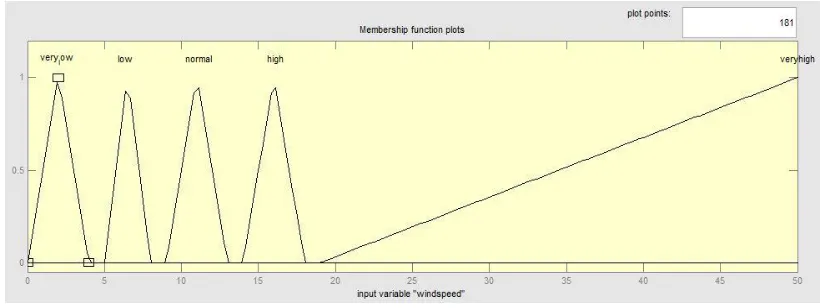
Fuzzification for input variables wind ―speed‖:
LINGUISTIC VALUES RANGE (km/h)
VERY LOV 0-4
NORMAL 9-13
HIGH 14-18
VERY HIGH >18
Table 5(a): wind speed
Fuzzification for input variables ―temperature‖:
LINGUISTIC VALUES RANGE Temp (°C)
VERY LOV 0-10
LOW 11-20
NORMAL 21-30
HIGH 31-40
VERY HIGH >40
Table 5(b): Temperature
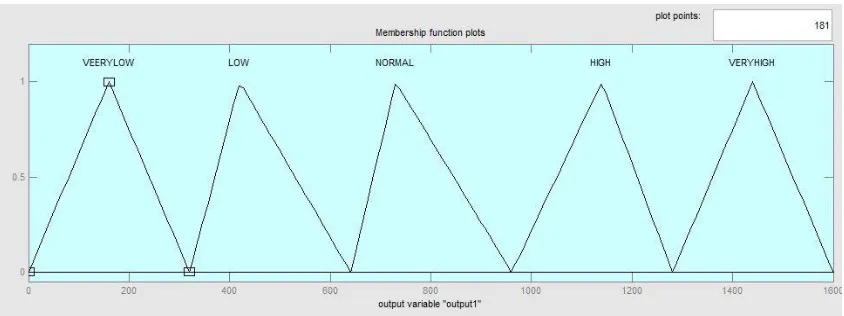
Fuzzification for output variables ―rainfall‖:
LINGUISTIC VALUES RANGE (mm)
VERY LOW 0-320
LOW 321-640
NORMAL 641-960
HIGH 961-1280
VERY HIGH 1281-1600
Table 5(c): Rainfall
MF value construction for input variables ―wind speed‖.
MF value construction for input variables ―temperature‖.
Figure 5(b): Temperature
MF value construction for output variables ―rainfall‖.
Figure 5(c): Rainfall
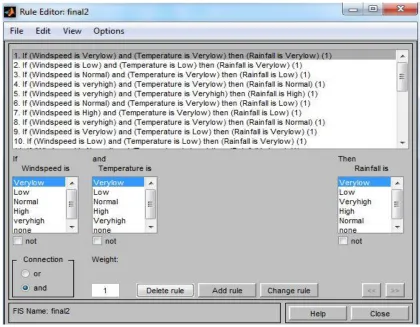
5.1. Rule Creation in FIS Rule Editor We have created following fuzzy rule.
1. If (wind speed is very low) and (temp is very low) then (output is very low) 2. If (wind speed is low) and (temp is low) then (output is very low)
3. If (wind speed is normal) and (temp is very low) then (output is low) 4. If (wind speed is very high) and (temp is very low) then (output is normal) 5. If (wind speed is very high) and (temp is very high) then (output is high) 6. If (wind speed is normal) and (temp is very low) then (output is low) 7. If (wind speed is high) and (temp is very low) then (output1 is low)
12. If (wind speed is high) and (temp is low) then (output is normal) 13. If (wind speed is very high) and (temp is low) then (output is high) 14. If (wind speed is very low) and (temp is normal) then (output1 is low) 15. If (wind speed is low) and (temp is normal) then (output is low)
16. If (wind speed is normal) and (temp is normal) then (output is normal) 17. If (wind speed is high) and (temp is normal) then (output is normal) 18. If (wind speed is very high) and (temp is normal) then (output is high) 19. If (wind speed is very low) and (temp is high) then (output is low) 20. If (wind speed is low) and (temp is high) then (output is normal) 21. If (wind speed is normal) and (temp is high) then (output is normal) 22. If (wind speed is high) and (temp is high) then (output is high) 23. If (wind speed is very high) and (temp is high) then (output is high)
24. If (wind speed is very low) and (temp is very high) then (output is normal) 25. If (wind speed is normal) and (temp is very high) then (output is high)
These rules are added in ―Matlab‖ with the help of fuzzy rule editor as given blow.
6. Result And Analysis
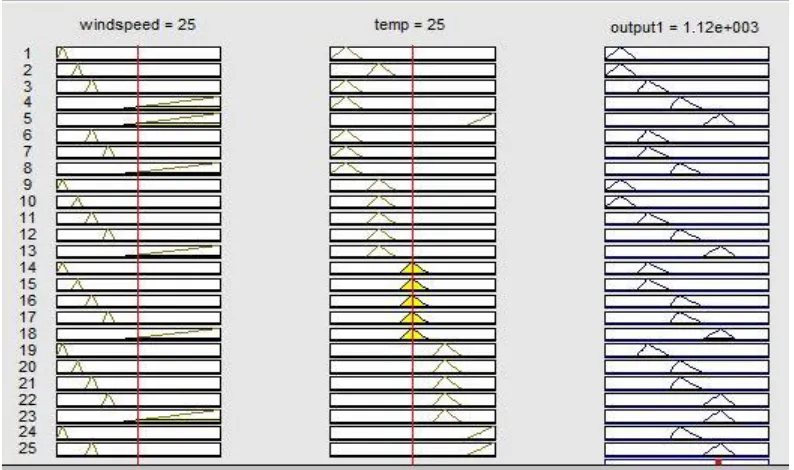
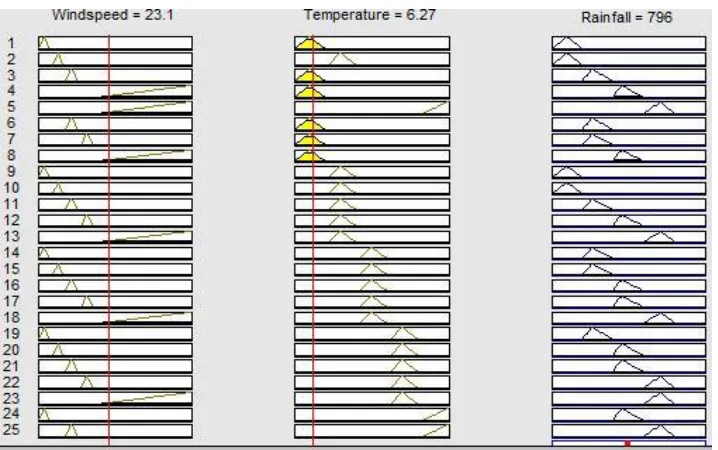
We have tested the result for two cases case1 and case2 for rule18 and rule4 respectively.
Where:
Rule18 is:
If (wind speed is very high) and (temp is normal) then (output is high)
Rule4 is:
If (wind speed is very high) and (temp is very low) then (output is normal)
6.1 Snapshot result for case 1
6.2Snapshot result for case 2
Figure 6.2(a): Result viewer window case 2
6.3Comparative Analysis of Case1 Result
DEFUZZIFICATION METHOD
WIND SPEED (KM./H.)
TEMPERATURE (CELSIOUS)
RAINFALL (M.M.)
CENTROID 25 25 1123
BISECTOR 25 25 1123
MOM 25 25 1133
LOM 25 25 1253
SOM 25 25 1013
Table 6.3(a): Comparative Analysis of Defuzzification Methods for case1
6.4Comparative Analysis of Case2 Result
DEFUZZIFICATION METHOD
WIND SPEED (KM./H.)
TEMPERATURE (CELSIOUS)
RAINFALL (M.M.)
CENTROID 23.1 6.27 796
BISECTOR 23.1 6.27 800
MOM 23.1 6.27 792
LOM 23.1 6.27 928
SOM 23.1 6.27 656
7.
Table 6.4(a): Comparative analysis of Defuzzification method case-2
Chart 6.4(a): Comparative analysis of result case-2
7. Conclusion
8. Future Scope
In future prediction can be done for actual data for any city, state or country and also by adding other parameters like humidity, cloud types etc.
References
[1] Jimoh, R.G. ―Modeling Rainfall Prediction using Fuzzy Logic‖,IJIRCCE,ISSN 2320 – 9801 Vol. 1, Issue 4, June 2013 PP 929-936.
[2] https://en.wikipedia.org/wiki/Fuzzy_set_operations
[3] https://en.wikipedia.org/wiki/Defuzzification
[4] Mahbub Hasan,Salam Md. Mahbubush Khan, Chandrasekhar Putcha, Ashraf Al-Hamdan, Chance M. Glenn "Predicting Rainfall Using the Principles of Fuzzy Set Theory and Reliability Analysis " Journal of Water Resource and Protection, ISSN: 337-348 volume 3 , month -December, 2013, pp 339-348,
[5] Somia A. Asklany, in "Rainfall events prediction using rule-based fuzzy inference system", Atmospheric Research, ISSN:101, volume issue 1, 2011,pp-228-236
[6] Mahbub Hasan1, Xingzhong (Frank) Shi2, Teferi Tsegaye3, Nesar U. Ahmed1, Salam Md. Mahbubush Khan4, "Rainfall Prediction Model Improvement by Fuzzy Set Theory" JWARP, volume 5 , January, 2013, pp 1-11.
[7] Sameena Naaz, Afshar Alamand and Ranjit Biswas ,“Effect of different defuzzification methods in a fuzzy based load balancing application” IJCSI ISSN:1694-0814, volume 8, issue 5, September 2011.PP-261-267
[8] Teerawat Thongwan, Anongrit Kangrang and Sahalaph Homwuttiwongin,"An Estimation of Rainfall using Fuzzy Set-Genetic Algorithms Model" journal name American J. of
Engineering and Applied Sciences,ISSN:1941-7020, volume 4, issue 1, 2011.PP-77-81
[9] M.Kannan, S.Prabhakaran,P.Ramachandran, "Rainfall Forecasting Using Data Mining Technique " International Journal of Engineering and Technology , ISSN:0975-4024, volume 2 issue 6, 2010, PP.397-401.
[10] Dr. Shipra Banik, Dr. Mohammed Anwer, A.F.M. Khodadad Khan, Rifat Ara Rouf, Farah Habib Chanchary, "Forecasting Bangladeshi monsoon rainfall using neural network and genetic algorithm approaches", Academic Global Publication, ABN:77 114 568 115, volume 2, issue1, month, October 2009
[11] J. Saade and Hassan B. Diab, I, "Defuzzification Methods and New Techniques for Fuzzy Controllers", IRANIAN JOURNAL OF ELECTRICAL AND COMPUTER
ENGINEERING, ISSN:1682-0053, volume 3 issue 2, 2004, PP-161-174.
Author Profile
Shiv Kumar received the M. Tech. degree in Computer Science and Engineering from Mewar University Chittorgargh in 2012.During 2007-2013; he stayed in Canon India Private limited Center of Excellence center and India Software Center Noida and Gurgaon of India. He currently is working as Asst. Professor at Mewar University, Chittorgargh, India.