Soft diffraction at LHC
JanKašpar1,2,3,
1INFN - Sezione di Pisa, Pisa, Italy
2CERN, Geneva, Switzerland
3Institute of Physics of the ASCR, Prague, Czech Republic
Abstract.This contribution reviews and compares various LHC results on soft diff
rac-tion, in particular elastic scattering, total, inelastic and elastic cross-secrac-tion, single and double diffraction.
1 Introduction
The aim of this contribution is to compare soft-diffraction results across the LHC experiments, to iden-tify and understand differences and trends that occur in the data. There are measurements from ALICE [1], ATLAS [2], ATLAS-ALFA [3], CMS [4], LHCb [5] and TOTEM [6]. The focus is put on elastic scattering, total, inelastic and elastic cross-section, single and double diffraction. Other interesting topics, e.g. central diffraction, are not covered only due to length restrictions to this contribution.
10−5
10−4
10−3
10−2
10−1
100
101
102
103
104
105
0 0.5 1 1.5 2 2.5 3 3.5
10−5
10−4
10−3
10−2
10−1
100
101
102
103
104
105
d
σ
/
d
t
(mb
/
G
eV
2)
0 0.5 1 1.5 2 2.5 3 3.5
|t| (GeV2) √s= 2.76 TeV
√s= 7 TeV √s= 8 TeV √s= 13 TeV
PRELIMI NARY PRELIMI
NARY
PR EL
IMI
NA
RY
√s= 2.76 TeV (arbitrary normalisation)
TOTEM,β∗= 11 m, VERY PRELIMINARY!
√
s= 7 TeV
TOTEM,β∗= 3.5 m, EPL 95 (2011) 41001
TOTEM,β∗= 90 m, EPL 101 (2013) 21002
ATLAS-ALFA,β∗= 90 m, Nucl. Phys. B 889 (2014) 486
√
s= 8 TeV (scaled 10×)
TOTEM,β∗= 90 m, PRELIMINARY!
TOTEM,β∗= 90 m, Nucl. Phys. B 899 (2015) 527
TOTEM,β∗= 1000 m, Eur. Phys. J. C76 (2016) 661
ATLAS-ALFA,β∗= 90 m, Phys. Lett. B 761 (2016) 158
√
s= 13 TeV (arbitrary normalisation)
TOTEM,β∗= 90 m, VERY PRELIMINARY!
100 101 102 103
0.1 0.2 0.3
100 101 102 103
d
σ
/
d
t
(mb
/
G
eV
2)
0.1 0.2 0.3
|t| (GeV2)
√s= 7 TeV √s= 8 TeV
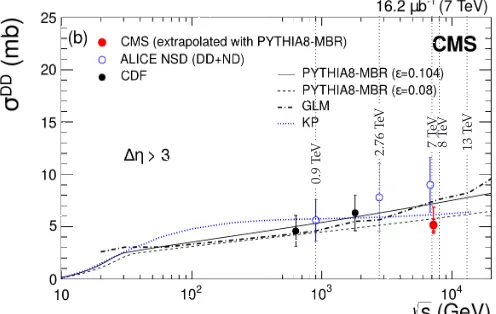
Figure 1.A summary of elastic scattering differential cross-section measurements at LHC. The red and blue lines
refer to measurements by TOTEM and ATLAS ALFA, respectively. The grey lines correspond to preliminary and yet unpublished data by TOTEM. Uncertainties shown are statistical only.
2 Elastic scattering
At the LHC there are two experiments equipped with forward-proton taggers needed to measure elastic scattering: ATLAS-ALFA and TOTEM. Their measurements are summarised in Figure 1. Different regions of four-momentum transfer squared,t, probe different physics regimes of elastic scattering. At very low|t|, the interference between Coulomb and nuclear amplitudes (CNI) takes place. At larger values of|t|up to ≈ 0.4 GeV2, the differential cross-section presents almost exponential decrease
sometimes called diffraction cone. This region is followed by a dip and a bump which are often explained by an interference of different amplitude components. At high values of|t|, where the cross-section exhibits a smooth and uniform decrease, one may expect a transition from non-perturbative to perturbative regime.
The inset of Figure 1 compares the measurements of ATLAS-ALFA and TOTEM which are in general in good agreement, especially for what the shape is concerned. At√s=8 TeV, the measure-ment by ATLAS-ALFA is a little lower than the one by TOTEM which will be further discussed in Section 3.
Figure 1 confirms the phenomenon of “diffraction cone shrinkage” also at LHC energies: the position of the dip moves to lower|t|values with increasing energy. At √s=7 TeV the dip occurs at |t| ≈0.53 GeV2while the preliminary data at 13 TeV indicate it at about|t| ≈0.48 GeV2.
The √s=13 TeV TOTEM cross-section at|t|1 GeV2presents a uniform decrease. Although
this measurement is preliminary, the yet-to-be applied corrections are unlikely to create any struc-tures. This observation contradicts predictions of many theoretical/phenomenological models where secondary dips or oscillations appear (see e.g. [7]). The TOTEM measurement, in turn, excludes all such models. In fact, it rules out all models built on the optical analogy – where multiple dips or oscillations are inevitable. On the other hand, the measurement may be favouring a hypothesis that large|t|elastic scattering is dominated by a perturbative QCD amplitude, e.g. triple gluon exchange proposed by Donnachie and Landshoff[8].
11 12 13 14 15 16 17 18 19 20 21
B
(G
eV
−
2)
101 102 103 104
√s (GeV)
0
.
9
Te
V
2
.
76
Te
V
7
Te
V
8
Te
V
13
Te
V
¯pp pp TOTEM ATLAS-ALFA
Figure 2.Measurements for forward slope,B, as a function of energy. Data for pp and p¯p are drawn in blue and
green, respectively. TOTEM measurements are drawn in red. The dashed line represents a fit of pre-LHC data [9] by TOTEM.
Figure 2 summarises measurements of forward slope,B:
B= d
dtlog dσ
dt
2 Elastic scattering
At the LHC there are two experiments equipped with forward-proton taggers needed to measure elastic scattering: ATLAS-ALFA and TOTEM. Their measurements are summarised in Figure 1. Different regions of four-momentum transfer squared,t, probe different physics regimes of elastic scattering. At very low|t|, the interference between Coulomb and nuclear amplitudes (CNI) takes place. At larger values of|t|up to ≈ 0.4 GeV2, the differential cross-section presents almost exponential decrease
sometimes called diffraction cone. This region is followed by a dip and a bump which are often explained by an interference of different amplitude components. At high values of|t|, where the cross-section exhibits a smooth and uniform decrease, one may expect a transition from non-perturbative to perturbative regime.
The inset of Figure 1 compares the measurements of ATLAS-ALFA and TOTEM which are in general in good agreement, especially for what the shape is concerned. At √s=8 TeV, the measure-ment by ATLAS-ALFA is a little lower than the one by TOTEM which will be further discussed in Section 3.
Figure 1 confirms the phenomenon of “diffraction cone shrinkage” also at LHC energies: the position of the dip moves to lower|t|values with increasing energy. At √s=7 TeV the dip occurs at |t| ≈0.53 GeV2while the preliminary data at 13 TeV indicate it at about|t| ≈0.48 GeV2.
The √s =13 TeV TOTEM cross-section at|t|1 GeV2presents a uniform decrease. Although
this measurement is preliminary, the yet-to-be applied corrections are unlikely to create any struc-tures. This observation contradicts predictions of many theoretical/phenomenological models where secondary dips or oscillations appear (see e.g. [7]). The TOTEM measurement, in turn, excludes all such models. In fact, it rules out all models built on the optical analogy – where multiple dips or oscillations are inevitable. On the other hand, the measurement may be favouring a hypothesis that large|t|elastic scattering is dominated by a perturbative QCD amplitude, e.g. triple gluon exchange proposed by Donnachie and Landshoff[8].
11 12 13 14 15 16 17 18 19 20 21 B (G eV − 2)
101 102 103 104
√s (GeV)
0 . 9 Te V 2 . 76 Te V 7 Te V 8 Te V 13 Te V ¯pp pp TOTEM ATLAS-ALFA
Figure 2.Measurements for forward slope,B, as a function of energy. Data for pp and p¯p are drawn in blue and
green, respectively. TOTEM measurements are drawn in red. The dashed line represents a fit of pre-LHC data [9] by TOTEM.
Figure 2 summarises measurements of forward slope,B:
B= d
dtlog dσ
dt
t=0 . (1)
All measurements for √s < 3 TeV are compatible with a fit linear in logs, see the dashed line. However, this trend is not respected by√s=7 and 8 TeV measurements by ATLAS-ALFA [3, 10] and TOTEM [11, 12] (well compatible between the two experiments). This observation may be indicating an onset of a new scattering regime between √s =2.76 and 7 TeV. Preliminary 13 TeV results by TOTEM support this hypothesis further constraining the break point towards √s≈3 TeV.
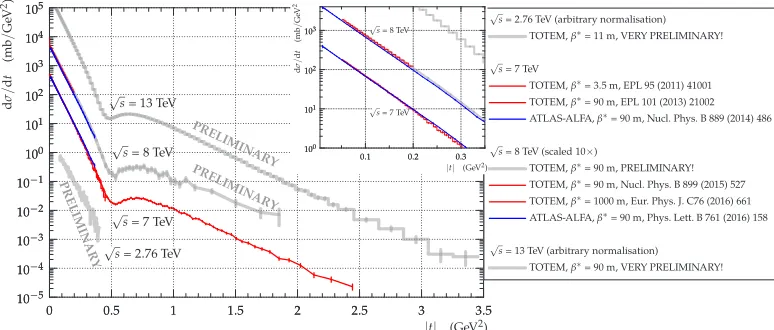
The diffraction cone presents differential cross-section with approximately exponential decrease. To visualise small deviations from this leading behaviour Figure 3 shows the relative difference of measured dσ/dtfrom a reference exponential. All measurements, by ATLAS-ALFA [3, 10] and by TOTEM [11, 13], give a qualitatively similar picture at all available energies. For|t| 0.2 GeV2
one can observe deviations with a “wide U” shape and a significance of more than 7σ in case of TOTEM √s=8 TeV measurement [13]. For|t|0.2 GeV2the slope increases, thus the differential cross-section falls steeper towards the dip.
√s= 7 TeV √s= 8 TeV √s= 13 TeV
TOTEM
−0.1 −0.05 0 0.05
0 0.1 0.2 0.3
−0.1 −0.05 0 0.05
d σ / d t − ref ref , ref = 5 . 03 × 10 2e − 19 . 9 | t |
0 0.1 0.2 0.3
|t| (GeV2) β∗= 90 m
−0.1 −0.05 0 0.05
0 0.1 0.2 0.3
−0.1 −0.05 0 0.05
d σ / d t − ref ref , ref = 5 . 27 × 10 2e − 19 . 38 | t |
0 0.1 0.2 0.3
|t| (GeV2) β∗= 90 m
−0.1 −0.05 0 0.05
0 0.1 0.2 0.3
−0.1 −0.05 0 0.05
d σ / d t − ref ref , ref = 6 . 577 × 10 2e − 20 . 41 | t |
0 0.1 0.2 0.3
|t| (GeV2) β∗= 2500 m PRELIMINARY!
ATLAS-ALFA
−0.1 −0.05 0 0.05
0 0.1 0.2 0.3
−0.1 −0.05 0 0.05
d σ / d t − ref ref , ref = 4 . 623 × 10 2e − 19 . 24 | t |
0 0.1 0.2 0.3
|t| (GeV2)
β∗= 90 m
−0.1 −0.05 0 0.05
0 0.1 0.2 0.3
−0.1 −0.05 0 0.05
d σ / d t − ref ref , ref = 4 . 772 × 10 2e − 19 . 55 | t |
0 0.1 0.2 0.3
|t| (GeV2)
β∗= 90 m
Figure 3.Details of the diffraction cone: relative deviation from a reference exponential. Top row: measurements
by TOTEM, bottom row: measurements by ATLAS-ALFA.
Since the Coulomb scattering amplitude is known from QED, the Coulomb-nuclear interference occurring at very low|t|enables to determine the phase of the nuclear amplitude. This is typically quantified in terms of theρparameter, the ratio of real to imaginary part of the nuclear scattering amplitude:
ρ= A
N
AN
t=0 . (2)
−0.2 −0.15 −0.1 −0.05 0 0.05 0.1 0.15 0.2 0.25
−0.2 −0.15 −0.1 −0.05 0 0.05 0.1 0.15 0.2 0.25 ̺
101 102 103 104
√s (GeV)
0
.
9
Te
V
7
Te
V
8
Te
V
13
Te
V
PDG: ¯pp pp TOTEM:
√s= 7 TeV, indirect, EPL, 101 (2013) 21004 √s= 8 TeV, CNI, Eur. Phys. J. C76 (2016) 661 √s= 13 TeV, expected uncertainty
COMPETE model RRPnfL2u(highest rank):
¯pp pp
Figure 4.ρmeasurements plotted as a function of energy. The pre-LHC data are taken from collection [14]. The
solid lines represent pre-LHC fits by the COMPETE Collaboration [15]. Green and blue colours refer to p¯p and pp scattering, respectively; TOTEM measurements are drawn in red.
accelerator does not provide polarised beams to study polarisation effects. It can neither provide a collision energy similar to the previous accurate p¯p measurement to compare dips/shoulders in pp and p¯p scattering. Finally, the preliminary TOTEM 13 TeV data seem to suggest that high|t|scattering is dominated by a perturbative-QCD amplitude, thus hiding potential Odderon signals.
3 Cross-sections
Figure 5 shows a compilation of total, inelastic and elastic cross-sections. The pre-LHC data are taken from [14], an additional cosmic-ray measurement is by the Auger Collaboration [19]. ATLAS-ALFA [3, 10] and TOTEM [12, 20, 21] have contributed by several measurements of all three cross-sections. Additional inelastic cross-section measurements comprise results from ALICE [22], ATLAS [23, 24], CMS [25, 26] and LHCb [27]. √s=13 TeV results from TOTEM are expected soon, ATLAS-ALFA has collected data at this energy, too. Furthermore, these two experiments aim at measurements at √s=0.9 TeV possibly even at the end of 2017. This will constitute 5 sampling points and thus strong constraint for the energy dependence of the cross-section. The presently available data are compatible with log2sgrowth of all the cross-sections.
It is interesting to compare the total cross-section measurements by ATLAS-ALFA and TOTEM. While the√s=7 TeV points are fully compatible, there is about 2σtension at 8 TeV. It can be traced down to the normalisation (thus to luminosity or inefficiency determination) of the differential cross-section, cf. Figure 1, inset. The two measurements therefore give quite different trends: while the TOTEM points are compatible with the COMPETE fit, the ATLAS-ALFA points give extrapolation to 13 TeV about 10 mb lower. Consequently, the soon-available 13 TeV results will provide important insight for this comparison.
−0.2 −0.15 −0.1 −0.05 0 0.05 0.1 0.15 0.2 0.25 −0.2 −0.15 −0.1 −0.05 0 0.05 0.1 0.15 0.2 0.25 ̺
101 102 103 104
√s (GeV)
0 . 9 Te V 7 Te V 8 Te V 13 Te V PDG: ¯pp pp TOTEM:
√s= 7 TeV, indirect, EPL, 101 (2013) 21004 √s= 8 TeV, CNI, Eur. Phys. J. C76 (2016) 661 √s= 13 TeV, expected uncertainty
COMPETE model RRPnfL2u(highest rank):
¯pp pp
Figure 4.ρmeasurements plotted as a function of energy. The pre-LHC data are taken from collection [14]. The
solid lines represent pre-LHC fits by the COMPETE Collaboration [15]. Green and blue colours refer to p¯p and pp scattering, respectively; TOTEM measurements are drawn in red.
accelerator does not provide polarised beams to study polarisation effects. It can neither provide a collision energy similar to the previous accurate p¯p measurement to compare dips/shoulders in pp and p¯p scattering. Finally, the preliminary TOTEM 13 TeV data seem to suggest that high|t|scattering is dominated by a perturbative-QCD amplitude, thus hiding potential Odderon signals.
3 Cross-sections
Figure 5 shows a compilation of total, inelastic and elastic cross-sections. The pre-LHC data are taken from [14], an additional cosmic-ray measurement is by the Auger Collaboration [19]. ATLAS-ALFA [3, 10] and TOTEM [12, 20, 21] have contributed by several measurements of all three cross-sections. Additional inelastic cross-section measurements comprise results from ALICE [22], ATLAS [23, 24], CMS [25, 26] and LHCb [27]. √s=13 TeV results from TOTEM are expected soon, ATLAS-ALFA has collected data at this energy, too. Furthermore, these two experiments aim at measurements at √s=0.9 TeV possibly even at the end of 2017. This will constitute 5 sampling points and thus strong constraint for the energy dependence of the cross-section. The presently available data are compatible with log2sgrowth of all the cross-sections.
It is interesting to compare the total cross-section measurements by ATLAS-ALFA and TOTEM. While the√s=7 TeV points are fully compatible, there is about 2σtension at 8 TeV. It can be traced down to the normalisation (thus to luminosity or inefficiency determination) of the differential cross-section, cf. Figure 1, inset. The two measurements therefore give quite different trends: while the TOTEM points are compatible with the COMPETE fit, the ATLAS-ALFA points give extrapolation to 13 TeV about 10 mb lower. Consequently, the soon-available 13 TeV results will provide important insight for this comparison.
The comparison is even more complicated for the inelastic cross-section given the large variety of results. One can observe that while ALICE and TOTEM results are compatible with the dashed-dotted line, all others lie below. This can be understood by studying the systematic uncertainties related to each measurement. Those performed with central detectors only necessarily need to correct for events escaping the apparatus in the forward direction. This correction is sizeable and strongly
0 10 20 30 40 50 60 70 80 90 100 110 120 130 140 σel (g reen ), σin el (b lu e) and σtot (r ed) (m b)
101 102 103 104 105
√s (GeV)
0 . 9 Te V 2 . 76 Te V 7 Te V 8 Te V 13 Te V σtot σinel σel ¯pp (PDG) pp (PDG) Auger (+ Glauber) ALICE
ATLAS, ATLAS-ALFA CMS
LHCb TOTEM
best COMPETEσtotfits
11.7−1.59 lns+ 0.134 ln2s
Figure 5. Total (red), inelastic (blue) and elastic (green) cross-section measurements plotted as a function of
energy. For references see text. The solid lines represent the pre-LHC fits by COMPETE [15]. The dashed line
shows aσelfit by TOTEM, including its 7 and 8 TeV and PDG [14] points. The dashed-dotted lines corresponds
to the difference between theσtotfits by COMPETE and theσelfit by TOTEM.
model dependent. For example, the CMS analysis [26] takes a “democratic” approach and uses a mean correction over a handful of Monte-Carlo predictions. In another example, the ATLAS analysis [24] first tunes and compares various models to data and for the final correction selects only those which describe the data well. This procedure tends to select models predicting larger corrections. In other words, naive selection of Monte-Carlo predictions can lead to underestimation of the inelastic cross-section. This conclusion is supported also by σinel measurements by experiments including
forward-proton taggers: ATLAS-ALFA and TOTEM can determine the inelastic cross-section by σtot−σeland the results favour larger values. Finally, at √s=7 TeV TOTEM determined the inelastic cross-section by 3 different methods [20], yielding consistent results compatible with the dash-dotted line.
4 Single diffraction
ALICE has published [22] a diffraction measurement based on counting events with single-sided topology. The surviving protons were not tagged in this analysis and only integrated cross-sections are presented, see Figure 7.
CMS has published [28] a measurement based on counting events with rapidity gaps on one side of the detector. Also in this analysis the forward protons were not identified. The cross-section was presented as a function ofξ, the fractional momentum loss: showing a gentle decrease of the cross-section withξ, where none of the considered Monte-Carlo generators was able describe all the features in detail.
Figure 6.Illustration of TOTEM single diffraction measurement, adapted from material by V. Avati and F
.Olje-mark. The relative uncertainty of cross-sections is estimated to 20 % and 15 % for the slopeB.
This can be complemented with a cross-section of (2.6±2.2) mb which corresponds to events with all
particles more forward than the T2 acceptance [30]. As this cross-section is expected to be dominated by single diffraction, one can estimateσSD = (9.1±2.9) mb. This value corresponds to cut-off ξ0.022 and is represented by the green point in Figure 7.
There is also an ongoing combined CMS+TOTEM analysis at √s=8 TeV which combines the benefits of a central detector and forward-proton taggers. This analysis aims at event classification as non-diffractive, single-diffractive and double-diffractive.
0
.
9
Te
V
2
.
76
Te
V
7
Te
V
8
Te
V
13
Te
V
Figure 7.Single-diffractive cross-section as a function of energy. Plot adapted from [28]. The ALICE data are
from [22]. The green point corresponds to a compilation of TOTEM data, see text.
Figure 6.Illustration of TOTEM single diffraction measurement, adapted from material by V. Avati and F
.Olje-mark. The relative uncertainty of cross-sections is estimated to 20 % and 15 % for the slopeB.
This can be complemented with a cross-section of (2.6±2.2) mb which corresponds to events with all
particles more forward than the T2 acceptance [30]. As this cross-section is expected to be dominated by single diffraction, one can estimateσSD = (9.1±2.9) mb. This value corresponds to cut-off ξ0.022 and is represented by the green point in Figure 7.
There is also an ongoing combined CMS+TOTEM analysis at √s=8 TeV which combines the benefits of a central detector and forward-proton taggers. This analysis aims at event classification as non-diffractive, single-diffractive and double-diffractive.
0
.
9
Te
V
2
.
76
Te
V
7
Te
V
8
Te
V
13
Te
V
Figure 7.Single-diffractive cross-section as a function of energy. Plot adapted from [28]. The ALICE data are
from [22]. The green point corresponds to a compilation of TOTEM data, see text.
ATLAS published a study of events with rapidity gaps [31] at √s = 7 TeV where, however, no attempt was made to disentangle non-diffractive, single-diffractive and double-diffractive components.
5 Double diffraction
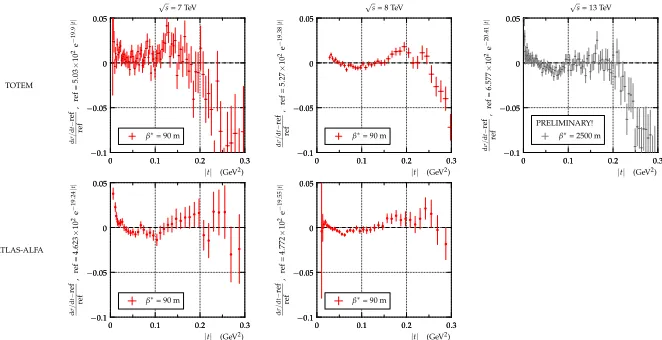
ALICE has published [22] a double-diffraction measurement based on counting events with central rapidity gap∆η >3. Only integrated cross-sections are presented, see Figure 8.
CMS has published [28] a similar measurement, also counting events with central rapidity gap ∆η >3. The results are presented as a function of the rapidity gap, featuring decreasing cross-section
with increasing gap size.
TOTEM made a measurement at √s = 7 TeV [32] however constrained to a narrow fiducial region where background could be controlled and subtracted. Consequently, no attempt was made to extrapolate the results to the full phase space.
As mentioned in Section 4, the combined CMS+TOTEM analysis is expected to provide double-diffraction cross-section at √s=8 TeV.
0
.
9
Te
V 2.76
Te
V
7
Te
V
8
Te
V
13
Te
V
Figure 8.Double-diffractive cross-section as a function of energy. Plot adapted from [28]. The ALICE data are
from [22].
References
[1] ALICE Collaboration, J. Instrum.3, S08002 (2008) [2] ATLAS Collaboration, J. Instrum.3, S08003 (2008) [3] ATLAS Collaboration, Nucl. Phys. B889, 486–548 (2014) [4] CMS Collaboration, J. Instrum.3, S08004 (2008)
[5] CMS Collaboration, J. Instrum.3, S08005 (2008)
[6] G. Anelli et al. (TOTEM Collaboration), J. Instrum.3, S08007 (2008)
[7] J. Kašpar, Comput. Phys. Commun.185, 1081–1084 (2014); http://elegent.hepforge.org/ [8] A. Donnachie, P. V. Landshoff, Phys. Lett. B387, 637–641 (1996)
[10] ATLAS Collaboration, Phys. Lett. B761, 158–178 (2016) [11] TOTEM Collaboration, Europhys. Lett.101, 21002 (2013) [12] TOTEM Collaboration, Phys. Rev. Lett.111, 012001 (2013) [13] TOTEM Collaboration, Nucl. Phys. B899, 527–546 (2015)
[14] K. Nakamura et al. (Particle Data Group), J. Phys. G37, 075021 (2010)
[15] J. R. Cudell et al. (COMPETE Collaboration), Phys. Rev. Lett.89, 201801 (2002) [16] TOTEM Collaboration, Eur. Phys. J. C76, 661 (2016)
[17] C. Ewerz, The Odderon in Quantum Chromodynamics, https://arxiv.org/abs/hep-ph/0306137 [18] R. Avila, P. Gauron and B. Nicolescu, Eur. Phys. J. C49, 581 (2007)
[19] P. Abreu et al. (Pierre Auger Collaboration), Phys. Rev. Lett.109, 062002 (2012) [20] TOTEM Collaboration, Europhys. Lett.101, 21004 (2013)
[21] TOTEM Collaboration, Total cross-section measurement at √s = 2.76 TeV, publication in preparation
[22] ALICE Collaboration, Eur. Phys. J.C73, 2456 (2013) [23] ATLAS Collaboration, Nature Commun.2, 463 (2011) [24] ATLAS Collaboration, Phys. Rev. Lett.117, 182002 (2016)
[25] CMS Collaboration, CMS-PAS-FWD-11-001, https://cds.cern.ch/record/1373466 [26] CMS Collaboration, CMS-PAS-FSQ-15-005, https://cds.cern.ch/record/2145896 [27] LHCb collaboration, J. High Energ. Phys.02, 129 (2015)
[28] CMS Collaboration, CMS-PAS-FSQ-12-005; arXiv:1503.08689
[29] F. Oljemark and K. Österberg on behalf of TOTEM collaboration, Studies of Soft Single Diffrac-tion with TOTEM at the LHC at 7 TeV, ContribuDiffrac-tion to LHC students poster session 2013, https://indico.cern.ch/event/238337/

![Figure 4. ρ measurements plotted as a function of energy. The pre-LHC data are taken from collection [14]](https://thumb-us.123doks.com/thumbv2/123dok_us/8061577.1343640/4.482.64.424.81.247/figure-measurements-plotted-function-energy-lhc-taken-collection.webp)
![Figure 4. ρ measurements plotted as a function of energy. The pre-LHC data are taken from collection [14]](https://thumb-us.123doks.com/thumbv2/123dok_us/8061577.1343640/5.482.75.410.82.242/figure-measurements-plotted-function-energy-lhc-taken-collection.webp)
![Figure 7. Single-diffractive cross-section as a function of energy. Plot adapted from [28]](https://thumb-us.123doks.com/thumbv2/123dok_us/8061577.1343640/6.482.153.329.80.245/figure-single-diractive-cross-section-function-energy-adapted.webp)