Efficient Adaptively Secure Zero-knowledge from
Garbled Circuits
Chaya Ganesh1, Yashvanth Kondi2, Arpita Patra3, and Pratik Sarkar4 1
Department of Computer Science, Aarhus [email protected] 2
Northeastern [email protected] 3
Indian Institute of Science, [email protected] 4
Indian Institute of Science, [email protected] Abstract. Zero-knowledge (ZK) protocols are undoubtedly among the central primitives in cryptography, lending their power to numerous ap-plications such as secure computation, voting, auctions, and anonymous credentials to name a few. The study of efficient ZK protocols for non-algebraic statements has seen rapid progress in recent times, relying on the techniques from secure computation. The primary contribution of this work lies in constructing efficient UC-secure constant round ZK protocols from garbled circuits that are secure againstadaptive corrup-tions, with communication linear in the size of the statement. We begin by showing that the practically efficient ZK protocol of Jawurek et al. (CCS 2013) is adaptively secure when the underlying oblivious trans-fer (OT) satisfies a mild adaptive security guarantee. We gain adaptive security with little to no overhead over the static case. A conditional verification technique is then used to obtain a three-round adaptively se-cure zero-knowledge argument in the non-programmable random oracle model (NPROM).
We draw motivation from state-of-the-art non-interactive secure com-putation protocols and leveraging specifics of ZK functionality show a two-round protocol that achieves static security. It is a proof, while most known efficient ZK protocols and our three round protocol are only ar-guments.
1
Introduction
Zero-knowledge (ZK) proofs introduced in [GMR85] provide a powerful tool in designing a variety of cryptographic protocols. Since then, they have been an important building block in various applications. Zero-knowledge proofs allow a prover to convince a verifier about the validity of a statement, while giving no information beyond the truth of the statement. Informally, an honest prover should always convince a verifier about a true statement (completeness). More-over, a malicious verifier learns nothing beyond the validity of the statement (zero-knowledge) and a malicious prover cannot convince a verifier of a false statement (soundness). In addition to soundness, a ZK protocol in which the prover’s witness can be extracted by a simulator offers proof of knowledge.
prac-tice, and there are few techniques that allow efficient proofs. These tech-niques almost always apply to a restricted set of languages, with a series of works [Sch90,GQ88,CM99,GS08] on proving algebraic relationships like knowl-edge of roots, discrete logarithms etc.
Kilian’s zero-knowledge argument [Kil92] achieves sub-linear communica-tion, but relies on PCP and is of theoretical interest. Groth [Gro10] gave the first constant-size non-interactive ZK proofs. Since then, many construc-tions of SNARKs (Succinct non-interactive arguments of knowledge) have been presented [GGPR13,Lip13,DFGK14,Gro16], and have been implemented as well [PHGR13,CFH+15]. Though SNARKs have short proofs and allow efficient verification, they have shortcomings in prover efficiency. The prover performs public-key operations proportional to the size of the circuit representing the statement. In addition, they rely on a large trusted parameter; for example, a long common reference string (CRS).
Around the same time that ZK was introduced, Yao introduced secure two-party computation (2PC) and garbled circuits (GC) [Yao82]. The problem of general multi-party computation (MPC) [Yao86,GMW87,BGW88] considers a set of parties holding private inputs with the task of computing a joint function while preserving certain desired security properties. An interesting line of re-cent works [IKOS07,BP12,JKO13,HMR15,CGM16,GMO16,HV16,AHIV17] es-tablishes connections between MPC and ZK, and use the techniques of 2PC and MPC for truly efficient ZK protocols. The two main streams of works connecting MPC with efficient ZK protocols rely on “MPC-in-the-head” ap-proach [IKOS07,IKOS09] and garbled circuit based apap-proach [JKO13], as elab-orated below.
1.1 Efficient ZK Protocols
be made non-interactive using the Fiat-Shamir heuristic in the programmable RO model.
Jawurek et al. [JKO13] construct a UC-secure ZK protocol (referred to as ZKGC henceforth) using garbled circuits as the primary building block. The communication required for their protocol is linear in the size of the circuit implementing the NP relation, and is also concretely efficient as it achieves ma-licious security with only one garbled circuit. However, the protocol is inherently interactive. ZKGC is essentially a version of Yao’s original constant-round 2PC protocol where the GC constructor has no input; this yields full malicious secu-rity at little overhead over the semi-honest case as Yao’s protocol in this case is already secure against a malicious evaluator. The protocol uses oblivious transfer (OT). The use of OT in ZK protocols dates back to [KMO89]. Notably, Zero-knowledge, when viewed as a special case of 2PC, allows for a relaxation in the properties required of the underlying GCs, as noted in [JKO13]. This led to the introduction of the notion ofprivacy-free garbling schemes [FNO15], which are optimized for the ZK setting of [JKO13]. A privacy-free garbling scheme only achieves authenticity, and leverages privacy-freeness in order to save on commu-nication and computation costs of garbling. Privacy-free GCs are further studied by Zahur et al. [ZRE15], who construct a privacy-free scheme using the HalfGates approach. Their privacy-free scheme makes use of FreeXOR [KS08] to garble and evaluate XOR gates at no cost, and produces only one ciphertext when garbling an AND gate (along with two calls to a hash function H). Their construction comprises the current state-of-the-art in privacy-free garbling for circuits. When formulaic circuits are of concern, [KP17] shows how to do privacy-free garbling withzerociphertext and with information-theoretic security.
The interactive schemes based on garbled circuits allow for the flexibility of how the keys for the underlying GCs are constructed and how the garbled input (ie. witness) is encoded. This leads to interesting applications making non-blackbox use of ZKGC [CGM16,KKL+16]. For instance, Kolesnikov et al. [KKL+16] introduce a new primitive called “attribute selective encryption” as a method of input encoding in ZKGC in order to construct attribute-based key-exchange. This allows a client to prove to a server that it holds a certificate corresponding to its attributes issued by a trusted authority, and that these at-tributes satisfy a policy constructed by the server. Note that only proving knowl-edge of attributes satisfying a given policy is insufficient in this setting. Another point of comparison is that the PROM assumption required by non-interactive ‘MPC-in-the-head’ based ZK protocols can be used to construct highly efficient adaptively secure garbled circuits [BHR12a] allowing ZKGC and our protocol to be cast in the online-offline paradigm, with all circuit-dependent communication moved to a preprocessing stage.
prac-tical ZK protocols for non-algebraic statements, and zero-knowledge protocols secure against adaptive adversaries.
1.2 Adaptively Secure Zero-knowledge
An adaptive adversary may dynamically decide which party to corrupt as the protocol progresses. Its choice of corruptions may be adapted according to the specific information it sees, possibly even corrupting both the parties. Tolerating an adaptive adversary in a ZK protocol in the UC setting requires a straight-line simulator that can generate a transcript on behalf of the prover without knowl-edge of the witness, and later be able to “explain” the transcript for any given witness (ie. concoct valid-looking corresponding local randomness). In [Bea96a], the authors show that the zero-knowledge proof system of GMW [GMW91] is not secure against adaptive adversaries or else the polynomial hierarchy collapses, and proceed to build ZK arguments. This work is further advanced in [CLOS02] where UC-secure ZK arguments are presented relying on adaptive commitments schemes. In [LZ11], it is shown that adaptive ZK proofs exist for all of NP as-suming only one-way functions. They present constructions of adaptively secure ZK proofs from adaptive instance dependent commitment schemes.
Adaptive ZK via Adaptive MPC. The recent work of Cannetti et al. [CPV17] shows how to construct constant-round two party computation using garbled circuits in the standard model. They solve the problem of equivocating a garbled circuit in order to explain the view of a constructor who has already sent a GC in Yao’s protocol by means of afunctionally equivocal encryption scheme. However this comes at the cost of a GC whose size is quadratic in the size of the circuit that is garbled. Previous adaptively secure constant round secure computation protocols have relied on obfuscation [DSKR15,CGP15,CP16].
Adaptive ZK via 2PC-in-the-Head [HV16]. The work of [HV16] uses the “MPC-in-the-head” technique [IKOS09] to construct adaptive ZK proofs. Their use of interactive hashing [NOVY98] to construct instance dependent commit-ments to equivocate committed views requires a non-constant number of rounds. The overall round complexity of their adaptive ZK protocol isO(µlogµ), where
µis the soundness parameter. The proof size isO(µ|C|poly(λ)) and thepoly(λ) factor is Ω(λ). While their scheme can be made constant round by plugging in the appropriate instance-dependent commitment scheme, it comes at the cost of proofs that are quadratic in the size of the circuit implementing the NP relation. In this work, we explore the possibility of building protocols that lie at the intersection of all of these desirable qualities. Specifically we address the following question:
Can we construct constant-round UC-secure ZK protocols that are secure against adaptive corruptions, with proof size linear in the size of the circuit that implements the NP relation?
1.3 Our Contributions
Inspired by the recent progress in the domain of garbling schemes as primitives and interesting applications of garbled circuit (GC) based ZK protocols, we re-visit ZK protocols from GCs. Recent works including [CGM16,KKL+16] make non-blackbox use of the GC-based ZK protocols of [JKO13], exploiting particu-larly the way the keys for the underlying GCs are constructed and the method by which the garbled input (i.e. witness) is encoded. Such applications will di-rectly benefit from any improvement in the domain of garbled circuit based ZK protocols. Our contributions are listed below.
Next, we focus on reducing the exact round complexity of ZKGC style pro-tocols. We propose a three-round protocol. Since neither zero-knowledge proofs nor arguments can be achieved in less than four rounds without additional as-sumptions [GK96], we devise our protocols in the CRS model where the CRS is short unlike those used in SNARKs. Starting with ZKGC, our three-round protocol cuts down two rounds in [JKO13] using the idea of conditional opening [BP12] of a secret information that enables garbled circuit verification. That is, the key to GC verification can be unlocked only when the prover possesses a valid witness. Though fairly simple, implementing this idea makes the security proof of the resulting protocol challenging and subtle due to a circularity issue. Loosely speaking, when the prover does not hold a valid witness, the authen-ticity of GC should translate to the security of the key and at the same time, the security of the key should translate to the authenticity of the GC. We han-dle this issue by implementing the conditional disclosure via encryption in the Random Oracle Model (ROM). While the ZKGC protocol requires at least 5 rounds in its most round-efficient instantiation, we improve the complexity to three atnoadditional cost of communication (in fact with slight improvement), and little change in computation (one hash invocation versus a commitment in [JKO13]). We show this protocol to be adaptively secure too, when plugged in withRE-OTs.
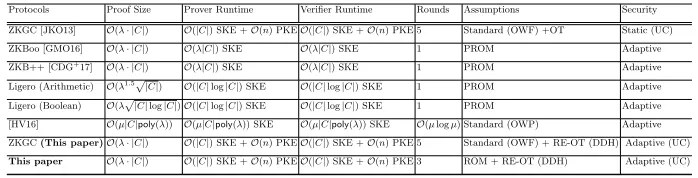
In terms of concrete proof size (communication), our three-round protocol yields a better result than ZKBoo [GMO16] (and even it’s more efficient successor ZKB++ [CDG+17]) both in its interactive and non-interactive form with the right choice of the security parameters. We assume that circuit C computes the statement to be proven. While our three-round ZK needs a communication of λ|C| bits (ignoring the circuit-independent parts), [GMO16] needs at least 3.41λ|C|to achieve the same (21λ) soundness. In the table below, we compare our
protocol asymptotically with the existing efficient constructions. Let ‘PKE’ and ‘SKE’ denote the number of public key and respectively secret key operations. We note thatRE-OTcan be efficiently constructed assuming DDH assumption, with no overhead over the regular OT in the framework of [PVW08].
Protocols Proof Size Prover Runtime Verifier Runtime Rounds Assumptions Security
ZKGC [JKO13] O(λ· |C|) O(|C|) SKE +O(n) PKEO(|C|) SKE +O(n) PKE 5 Standard (OWF) +OT Static (UC) ZKBoo [GMO16] O(λ· |C|) O(λ|C|) SKE O(λ|C|) SKE 1 PROM Adaptive ZKB++ [CDG+17] O(λ· |C|) O(λ|C|) SKE O(λ|C|) SKE 1 PROM Adaptive Ligero (Arithmetic) O(λ1.5p|
C|) O(|C|log|C|) SKE O(|C|log|C|) SKE 1 PROM Adaptive Ligero (Boolean) O(λp
|C|log|C|)O(|C|log|C|) SKE O(|C|log|C|) SKE 1 PROM Adaptive [HV16] O(µ|C|poly(λ)) O(µ|C|poly(λ)) SKE O(µ|C|poly(λ)) SKE O(µlogµ) Standard (OWP) Adaptive ZKGC(This paper)O(λ· |C|) O(|C|) SKE +O(n) PKEO(|C|) SKE +O(n) PKE 5 Standard (OWF) + RE-OT (DDH) Adaptive (UC)
This paper O(λ· |C|) O(|C|) SKE +O(n) PKEO(|C|) SKE +O(n) PKE 3 ROM + RE-OT (DDH) Adaptive (UC)
Table 1: Comparison among Zero Knowledge Protocols
[IKO+11,AMPR14,MR17] except for the following: We do not need the gadgets for input consistency checks of the prover, and input recovery mechanisms in case of inconsistent outputs [Lin13,LR14,RR16,MR17]. Our protocol is a proof, while most known efficient ZK protocols and our three round protocol are only arguments. The two round ZK may be cast as a sigma protocol and by apply-ing the Fiat-Shamir transform, one may obtain NIZK arguments in the random oracle model. Finally, we observe that for the 2-round and NIZK argument we do not rely on the authenticity property of the garbling scheme. However, more efficient garbled circuit constructions by giving up on authenticity is precluded by the result of [AIK10]. While the result of [AIK10] needs to encode a different circuit (the underlying circuit augmented with a MAC computation) to achieve authenticity using a private scheme, we show a similar result while encoding the
same underlying circuit. Both results essentially show that any garbling scheme that satisfies privacy also has authenticity.
1.4 Organization
We begin by briefly discussing definitions and constructions required for this work in Section 2. In Section 3 we show that the ZK protocol of [JKO13] is adaptively secure. Section 4 presents our three-round ZK protocol from condi-tional disclosure. Section 5 discusses our 2-round ZK. We include our result on authenticity-free garbling in Section 6.
2
Preliminaries
Notation. We denote probabilistic polynomial time by ppt. Let λ be the security parameter. [n] and [m, n] for n > m denote the sets {1, ..., n} and {m, m+ 1, . . . , n} respectively. |t| denote the number of bits in a string t. We use || to denote concatenation of bit strings, and write x ← XR to mean sampling a value x uniformly from the set X. A function f(·) is said to be negligible if ∀c ∈ N, there exists n0 ∈ N such that ∀n ≥ n0, f(n) < n−c. Let S be an infinite set and X = {Xs}s∈S, Y = {Ys}s∈S be distribution
en-sembles. We say X and Y are computationally indistinguishable, denoted by
X ≡c Y, if for anypptdistinguisherD and all sufficiently larges∈S, we have |Pr[D(Xs) = 1]−Pr[D(Ys) = 1]| <1/p(|s|) for every polynomial p(·). In the
following, we review few building blocks. The ZK and Oblivious Transfer (OT) functionality are recalled in Appendix B.1.
2.1 Garbled Circuits
circuit evaluation. Majority of the schemes in the literature, including the classi-cal scheme of Yao [Yao86], satisfy the two aforementioned properties. Using the language of [BHR12b] for circuits; the circuit itself is a directed acyclic graph, where each gategis indexed by its outgoing wire, and its left and right incoming wires A(g) andB(g) are numbered such that g > B(g)> A(g). Also, a circuit output wire can not be an input wire to any gate. We denote the number of input wires, gates and output wires usingn, q andmrespectively in a circuitC. At a high-level, a garbling scheme consists of the following algorithms:Gb takes a circuit as input and outputs a garbled circuit, encoding information, and decoding information.Entakes an inputxand encoding information and outputs a garbled inputX.Evtakes a garbled circuit and garbled inputXand outputs a garbled outputY.Detakes a garbled outputYand decoding information and outputs a plain circuit-output (or an error, ⊥). Finally, we use an additional verification algorithm in the garbling scheme that output 1 or 0 based certain validity checks performed on a triple (C,C, e). Formally, agarbling scheme is defined by a tuple of functionsGarble= (Gb,En,Ev,De,Ve), described as follows:
– Garble algorithmGb 1λ, C: A randomized algorithm which takes as input
the security parameter and a circuit C : {0,1}n → {0,1}m and outputs a tuple of strings (C, e, d), where C is the garbled circuit, e denotes the input-wire labels, andddenotes the decoding information.
– Encode algorithmEn(x, e): a deterministic algorithm that outputs the
gar-bled inputXcorresponding to inputx.
– Evaluation algorithmEv(C,X): A deterministic algorithm which evaluates
garbled circuitC on garbled inputX, and outputs a garbled outputY.
– Decode algorithm De(Y, d): A deterministic algorithm that outputs the
plaintext output corresponding toY or⊥signifying an error if the garbled outputYis invalid.
– VerifyalgorithmVe(C,C, e): A deterministic algorithm which takes as input
a circuit C : {0,1}n 7→ {0,1}m, a garbled circuit (possibly malicious) C,
encoding informatione, and outputs 1 whenCis a valid garbling ofC, and 0 otherwise.
A garbling scheme may satisfy several properties such as correctness,
pri-vacy, authenticity and notions of verifiability. The definitions for correctness,
is used in our three round protocol. For the sake of completeness, we give the definitions of these properties in Appendix A.
We are interested in a class of garbling schemes referred to asprojective in [BHR12b]. When garbling a circuitC:{0,1}n 7→ {0,1}m, a projective garbling scheme produces encoding information of the form e = k0
i, k1i
i∈[n], and the encoded input X corresponding to x = (xi)i∈[n] can be interpreted as X = En(x, e) = (kxi
i )i∈[n].
2.2 Hash Function and Random Oracle Model
We use a hash function H : {0,1}∗ → {0,1}poly(λ) which we model as a ran-dom oracle. Namely, we prove the security of our protocol assuming that H
implements a functionalityFRANDwhich for different inputsx, returns uniform random output values from the range ofH(x). In the proof, we rely on observ-ability of H i.e. the reduction can observe the queries made to the H by the distinguisher of certain two views. Note that the simulator does not observe queries to the random oracle.
3
Adaptive Security of [JKO13]
In this section, we show that the garbled circuit based ZKGC protocol is adap-tively secure when instantiated with an OT that satisfies a special property of Receiver Equivocality. We formalize the notion of Receiver Equivocal Oblivious Transfer which is an OT primitive with mild adaptive security guarantees. Es-sentially, we require that the view of a receiver be reconstructable in the case of a post-execution corruption. A similar notion was introduced in [Bea96b]. We show that the OT framework of [PVW08] is already receiver equivocal when it is instantiated with statistical security against a corrupt sender (“decryp-tion mode”). We then show that when the zero-knowledge protocol of [JKO13] is instantiated with RE-OT, it achieves adaptive security without any addi-tional effort. Below, we formulate RE-OT, recall the construction of [JKO13] (the schematic diagram is given in Appendix C), describe the adaptive proof of security of [JKO13] and conclude with an instantiation ofRE-OT.
Definition of RE-OT. An oblivious transfer protocol is said to be receiver equivocal if it is possible to produce the receiver’s message in the protocolwithout
committing to a choice bit. For this to be meaningful, we also require that it be
possible to efficiently generate the local randomness which when combined with either choice bit would make an honest receiver output the same message. This is formalized by requiring the existence of a simulator SRE which can perform
this task, in Definition 3.1.
Definition 3.1 (RE-OT) Let ΠOT = (ΠOTS , ΠOTR ) be a 2-round OT protocol
securely implementing the FOT functionality in the CRS model where S and
R run their respective algorithms as specified by ΠS
ΠR
OT(crs, σ;r
R) respectively. Here, a
0, a1 are the sender’s inputs, σ is the
re-ceiver’s choice bit, rS, rR are the sender’s and receiver’s respective local
ran-domness, and mR is the receiver’s message. Let (crs, t) ← Setup(1n, µ) be the
output of the setup functionality which takes the security parameter and a mode
µ ∈ {0,1}, and t is the corresponding trapdoor which is accessible only to the
simulator S. ThenΠOT is an RE-OTif the following conditions hold:
– Indistinguishability of modes: The CRSs of the two modes are
computation-ally indistinguishable,
crs0
c
≡crs1∀(crs0, t0)←Setup(1n,0),(crs1, t1)←Setup(1n,1) – FOT in mode 0: ∀crs ← Setup(1n,0), ΠOT =
ΠOTS (crs, a0, a1, mR;rS), ΠOTR (crs, σ;r R)
securely implements the FOT
functionality.
– Equivocation in mode1: There exists an algorithmSRE(crs, t)which outputs
mR, rR
0, rR1
such that mR =ΠR
OT(crs,0;rR0) =ΠOTR (crs,1;rR1), and r0R, r1R
s
≈
rR,∀crs←Setup(1n,1).
On the use of a CRS. We note here that there is nothing inherent in receiver equivocation that demands a CRS to implement RE-OT. We are interested in achieving UC-security, and so as to allow the protocol of [PVW08] as an instantiation of our definition, we assume that the protocol realizing RE-OT will make use of a CRS. However, this does not preclude the existence of RE-OT in the standalone model without a CRS, or even a UC-secure RE-OTin the Global Random Oracle hybrid model [CJS14] alone.
3.1 Recap of [JKO13]
We recall the ZKGC protocol below in the (FCOT,FCOM) hybrid model (a
schematic diagram is given in Appendix C). The functionalities are presented in Appendix B.1.
3.2 Proof of Adaptive Security for [JKO13] from RE-OT
In this section we show that instantiating the ZKGC protocol with RE-OT satisfying Definition 3.1 yields a UC-secure protocol realizingFR
ZK(see Figure 12)
tolerating adaptive adversaries.
Recalling Static Proof of Security. The simulator for a corruptPplays the role of an honest verifier V. It constructs and communicates a correct garbled circuit, extracts the witness acting on behalf ofFCOTfunctionality, and accepts
the proof only if the extracted witness is a valid one. On the other hand the real verifier accepts when the opening of the commitment is the correct output wire keyZ. InFCOM-hybrid model, we can show that a malicious prover who is able
ΠZKGC
– Oracles and Cryptographic Primitives:Acorrect, authentic, verifiable gar-bling schemeGarble= (Gb,En,De,Ev,(Ve1,Ve2)) (according to Definition A.5). A committing OT oracleFCOT.
– Common Inputs ofPand V:A security parameterλ, relationRrealized by circuitC, statementz.
– Input ofP:A witnessxof sizen=poly(λ) such thatR(z, x) = 1. – Input ofV:Nothing.
Witness input phase: For alli∈[n],Psends (choose, id, xi) toFCOT.
GC Construction and wire label transfer phase: V garbles the circuit,
C, Ki0, K 1 i
i∈[n], Z
←Gb(1κ, C)a. On receiving messages (chosen, id) for i ∈ [n] from FCOT, V sends transfer, id, Ki0, Ki1
as input toFCOT for all i∈[n].
GC Evaluation and output commitment phase: P receives
(transferred, id, Kxi
i ) for i ∈ [n] from FCOT, and parses X = Kx1
1 · · ·K
xi
i · · ·K xn
n . P obtains Z
0
= Ev(C, X) and sends (commit, id, Z0) toFCOM.
GC verification and conditional output disclosure phase: On receiving (committed, id,|Z0|) fromFCOM,V sends the message (open-all, id) toFCOT. On receiving transfer, id, K0
i, Ki1
for alli∈[n] fromFCOT,Pverifies if the garbled circuitC which sent by the verifier earlier was correctly constructed.
i ifVeC, f,
K0
i, Ki1 i∈[n0]
6
= 1,Paborts. ii elsePsends (reveal, id) toFCOM.
Final verification phase: On receiving the message (reveal, id, Z0) fromFCOM,
VoutputsacceptifZ =Z0.
aInstead of returningd,Gbis tweaked to return the 1-key on the output wire. Fig. 1: Zero-knowledge from Garbled Circuits [JKO13]
authenticity of the underlying garbling scheme. We can use such a malicious prover P∗ to construct an adversary A for the authenticity game of [BHR12b] as follows:
1. Areceives the invalid witnessx∗ fromP∗ on behalf ofFCOT and forwards it
to the authenticity challenger.
2. AreceivesC, X from the authenticity challenger and forwards it toP∗ 3. Areceives forged key Z0 from P∗ on behalf of FCOM and submits it to the
authenticity challenger.
Clearly, the event that A successfully forges an output for the given C, X is equivalent to the event that P∗ convinces a verifier to output ‘accept’ without a valid witness. By authenticity of the garbling scheme, this event occurs with negligible probability.
The simulator for a corruptV receives the encoding information from Von behalf of the FCOT functionality and extracts the the output 1-keyZ using
only after receiving the correct encoding information from V in the open-all phase. Otherwise, it sends⊥to V. Security in this case follows from the verifi-ability (that allows extraction of the output key from encoding information) of the underlying garbling scheme.
Adaptive Proof of Security. The bottleneck faced in simulating garbled cir-cuit based protocols for post-execution corruptions usually lies in “explaining” the randomness of the GC constructor once her input is known. In the case of two-party computation, equivocating the view of the garbled circuit constructor requires heavy machinery such as in Canetti et al. [CPV17]. However in the ZKGC protocol verifier V is the GC constructor and has no input. The simu-lator can therefore run the code of honest V, which includes being an honest sender in the OT protocol (this is also why our OT need not achieve full-fledged adaptive security). On the prover’s side, receiver equivocality of the OT allows a simulator to equivocate an adaptively corrupted prover’s view of the OT proto-col, as per the witness once known. We make the observation thatevery step of
P following the OT is independent of the witness. Specifically, once the output
key Z has been obtained by evaluating the GC sent by V, Pdoes not use the witness again. Note that the simulator does not need the witness to obtainZ; the ZKGC simulator invokes the ΠOT simulator in order to extract all inputs
of V and obtain all keys of the GC. Once the simulator obtains Z, the code of honest Pcan be run to complete the simulation. The implication of this for simulation of a post-execution corruption ofPis that no additional work needs to be done besides equivocating the view ofPin the OT. We now give a formal proof for all the cases:
– Simulation forV.The verifier, until it is corrupted, can be simulated follow-ing the static simulator for the corruptP, irrespective of whenPis corrupted. As recalled above, the simulation can be carried out by running the code of honest verifier (constructing a correct garbled circuit, participating in the RE-OTs with the correct encoding information and sending the correctly constructed garbled circuit). Upon corruption, the simulator can explain to the corruptV the communication by means of the randomness used in its honest execution ofV’s code. The indistinguishability follows from the proof in the static corrupt prover case.
– Simulation for P. If the prover is corrupted at the outset, then the crs is set in mode 0. Otherwise, we consider the worst scenario of post-execution corruption, and set the crs in mode 1. If the verifier is also not corrupt during the construction of the garbled circuit, then simulator acts on behalf of both the honest parties and runs the code of honest verifier. In theFCOM
-hybrid model, the simulator, without having access to the actual witness, runs mR, rR
0, r1R
← SRE(crs, t) to generate the transcript that needs to be
xi to the ith RE-OTinstance can be explained as per any input using the
randomnessrR
xi returned by S
RE of the RE-OTs. On the other hand, if V
was corrupt before the garbled circuit construction phase, then the simulator getsZ via unlocking the GC using encoding information extracted from the corruptV’s communication. The rest remains the same as the previous case. Security in the former case follows via receiver equivocality ofRE-OT. In the latter, it follows additionally from verifiability that ensures the encoding information leads to the correctZ with high probability.
3.3 Instantiation of RE-OT
The OT framework of [PVW08] is already receiver equivocal as per Defini-tion 3.1. The protocol can be constructed efficiently under the Decisional Diffie Hellman, Quadratic Residuosity, or Learning With Errors hardness assumptions. Recall that the constructions of [PVW08] operate in two modes: messy and de-cryption, that corresponds to mode 0 and 1 respectively of our definition. The construction satisfies Definition 3.1 when instantiated in “decryption mode”. In the simulation, when the receiver is corrupted before the first message is sent, the simulator sets the CRS in the messy mode, and no equivocation is necessary. Otherwise, the simulator sets the CRS in the decryption mode. Here we recall the instantiation of ΠPVW under the DDH hardness assumption and describe
SRE
PVW in the decryption mode. (Fig. 2).
Theorem 3.2 The protocolΠPVW in Fig. 2 is aRE-OT, assuming that DDH is hard for G.
Proof. The protocolΠPVW in Fig. 2 is proven to realize theFOT functionality
in the UC model by Peikert et al. [PVW08]. It is easy to see how SRE
PVW allows
for receiver equivocation as per Def. 3.1 when thecrs is generated in mode 1: – The randomnessrR
σ provided is interpreted asR’s secret exponentα.
– Recall that the messagemRis (gr
0, hr0), and candidate randomness output by SRE
PVWis r R
0 =r, andr
R
1 =r
R
0·t−
1=r·t−1
– Correctness of messagemR can be seen as follows:
1. ΠPVW crs,0;rR0
will outputgrR0 0 , h
rR
0 0
= (gr
0, hr0) =mR 2. ΠPVW crs,1;rR1
will outputgr R
1 1 , h
rR1
1
=
g(r·t
−1)
1 , h
(r·t−1) 1
Recall that the trapdoor t relates g0 to g1 as gt0 = g1 and similarly
ht
0=h1. Therefore we have that
g(r·t
−1)
1 , h
(r·t−1) 1
= (gr
0, hr0) =mR – Finally,rR
0, rR1 = r, r·(t−1) are clearly uniformly random, asr is sampled uniformly at random.
ΠPVW
The parties have access to a common reference stringcrs ∈ G4. Operations are over groupGof prime orderq, generated byg.
Setup(1n,0):
crs= (g0, h0, g1, h1) ∈G4. The trapdoor available to the simulator is t= (t0, t1) such thatgt0
0 =h0 andg1t1=h1.
Setup(1n,1):
crs= (g0, h0, g1, h1)∈ G4. The trapdoor available to the simulator is tsuch that g0t=g1 andht0=h1.
ΠPVWR (crs, σ):
– Sampleα∈Zq uniformly at random. – Computeg= (gσ)α,h= (hσ)α – Send (g, h)
ΠS
PVW crs, a0, a1, mR
:
– Sample random elementsr0, s0, r1, s1 fromZq. – Computeu0=g0r0h
s0
0 ,v0=gr0hs0,u1=g1r1h s1
1 ,v1=gr1hs1. – Send (u0, w0=v0a0), (u1, w1=v1a1)
Rcan retrieve the chosen message asaσ=wσ·(uσ)−α
SRE (crs, t):
– Sampler∈Zq and computemR= (gr0, hr0).
– Compute local randomness for both possible receiver inputs as rR0 = r and rR
1 =r·t
−1. – Output (mR, rR0, rR1)
Fig. 2:RE-OTassuming DDH: as per [PVW08]
4
Zero Knowledge in Three Rounds
In this section, we present a 3-round ZK protocol against a malicious verifier requiring just one GC in the non-programmable random oracle model, with no
increase in communication complexity. Our protocol achieves this by a
4.1 High-Level Idea
The high round cost of ZKGC makes it undesirable for many applications. How-ever its usage of only one GC for an actively secure protocol is an attractive feature, prompting us to examine whether we can improve on the number of rounds required to realize ZK with only one GC. We now describe our intuition behind the protocol, beginning with informal observations about the number of rounds in ZKGC. Assuming the ZKGC paradigm to be broadly characterized by a protocol where the verifier Vconstructs a GC which is then evaluated by proverP, we make the following (informal) observations:
– AsVconstructs the GC,P’s witness bits must be encoded as garbled input and delivered by means of an OT. The most efficient UC-secure OT in the literature [PVW08] requires 2 rounds to instantiate.
– Assuming the underlying GC to be statically secure in the terminology of Bellare et al. [BHR12a], the GC can at best be sent to Palong with the final message of the OT (if not after the OT).
– Pmust communicate some information as a ‘response’ toV’s GC ‘challenge’; for instance the garbled output obtained as a result of evaluating the GC with her witness. This must necessarily be after she receives the GC, adding at least one more round after the OT.
In summary, it appears that the ZKGC paradigm requires at least 2 rounds for the OT, plus the GC transmission, and one round following that. Therefore, a 3-round ZK protocol appears to be optimal in the ZKGC paradigm, informally suggesting the optimality of our protocol. In the following, we make several observations that are instrumental to our protocol.
Conditional Verification of Garbled Circuits. We begin by making the following observation about the original ZKGC protocol: even a prover who does not have a witness is given the chance to first commit to her garbled output and verify that the GC she received was correctly generated. Verification of the GC is a process that takes two additional rounds of interaction in their protocol. We ask, can we use conditional disclosure of secrets to reduce the number of rounds:“can we provide some additional information with a GC that will allow an evaluator to non-interactively verify that the GC was correctly constructed
only when it possess a valid witness?”We answer this question in the affirmative,
Qualitatively, their protocol is not a full-fledged ZK, is in the plain model, has a non-black-box simulator and relies on strong assumptions such as obfuscation. Our ZK protocol is proven UC-secure with a black-box simulator and relies on standard assumptions, albeit assuming a CRS setup.
Interestingly, the intuition behind the ability of [JKO13] to achieve full black-box simulation was that the relaxation in round complexity rendered the four-round barrier in the plain model [GK96] inapplicable. However, our result demon-strates that the trusted setup required to implement a full black-box simulatable two-round OT is sufficient to construct a three round zero-knowledge argument using the concretely efficient [JKO13] technique and a non-programmable ran-dom oracle.
Our intuition is implemented as follows: Given that
C,
(k0
j, k1j) j∈[n],(k0, k1)
← Gb 1λ, C
and an honest P has obtained encoded input X = kxj
j
j∈[n] for a witness x= (x1. . . , xn), she can compute
k1 = Ev(C,X). Now that P has evaluated the GC, we wish to enable her to ‘open’ the GC and verify that it was constructed correctly. To do this, we provide her with a ciphertext encrypting some useful information. Concretely, the ciphertext T = H(k1)⊕rS, where H is a random oracle and rS contains
the randomness used by the sender in the OT instances. Once P gets this randomness, she can unlock
k0
j, kj1 j∈[n] and can verify if the circuit has been
constructed correctly. In the following, we formalize the property needed from the OT protocol, namely that the randomness of the sender reveals the inputs of the sender.
Sender-Extractability of OT. LetΠOT= (ΠOTS , ΠOTR ) be a 2-round OT
pro-tocol securely implementing theFOTfunctionality in the CRS model whereSand
Rrun their respective algorithm as specified byΠS
OTand ΠOTR respectively. Let
crsbe the string that both parties have access to. We denote the first message of the protocol sent by the receiverRbymR=ΠR
OT(crs, σ;rR) whereσisR’s choice
bit andrRhis randomness. Let the input of the senderSbea0, a1; we denote the second message of the OT protocol, sent byS, bymS=ΠOTS (crs, a0, a1, mR;rS). The receiver can now compute the chosen message, xσ = ΠOTR (crs, σ, mS;rR).
We assume that ΠOT has the following sender-extractable property: revealing
the randomness of the sender, allows the receiver to reconstruct the sender’s messages correctly with high probability. That is, there exists a public efficiently computable function, Ext such that Ext(crs,TOT(a0, a1, σ), rS) outputs (a0, a1) whereTOT(a0, a1, σ) refers to the transcript ofΠOTwith sender’s input asa0, a1 and receiver’s input asσ. Namely,TOT(a0, a1, σ) = (mR, mS) wheremR andmS are as defined above.
Definition 4.1 A protocolΠOT is a secure sender-extractable OT protocol if
– it securely implementsFOT in the presence of malicious adversaries, and
– ∀ a0, a1, σ, such that|a0|,|a1| ≤ poly(λ),σ∈ {0,1},∃ a PPT algorithm Ext
such that the following probability is negligible inλ.
Pr (a00, a01)6= (a0, a1) :Ext(crs,TOT(a0, a1, σ), rS) = (a00, a01)
We note that the protocol of [PVW08] is UC-secure in the CRS model, is 2-rounds, and satisfies the sender-extractability property of Definition 4.1. We use such a protocol in our construction.
4.2 Our Construction
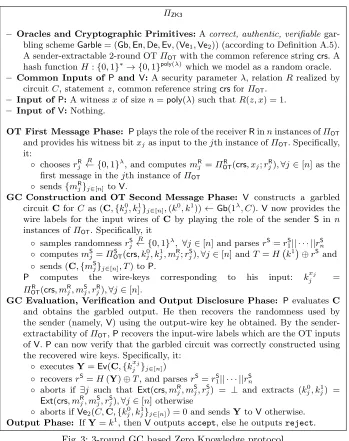
At a high-level, our construction proceeds as follows. The verifier constructs a garbled circuit of the circuitCimplementing the relation. The prover obtains the wire keys corresponding to his witness via an OT protocol. Now, the verifier sends the garbled circuit to the prover, and, in addition, a ciphertext. This ciphertext allows the prover to open and verify the garbled circuit, but only if he possesses a valid witness. The complete description of our protocol ΠZK3 is presented in
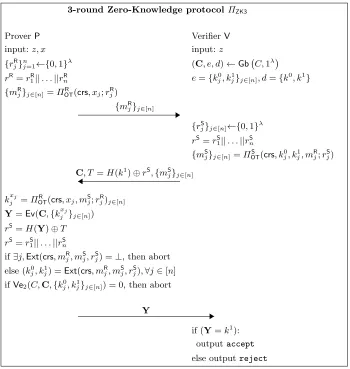
Figure 3. A schematic diagram of the protocol idea is given in Appendix C (Figure 16). We now prove security of ΠZK3 in Universal Composability (UC)
framework recalled briefly in Appendix B. As we do not rely on programming the Random Oracle, we can also adapt our proof in the UC setting to use a Global Random Oracle [CJS14].
Theorem 4.2 LetGarblebe a correct, authentic, verifiable (according to
Defini-tion A.5) garbling scheme, ΠOTbe an sender-extractable OT protocol, andH be
an extractable random oracle. The protocolΠZK3in Figure 3 securely implements
FR
ZKin the presence of malicious adversaries.
Proof. To prove the security of our protocol, we describe two simulators. The
simulatorSP simulates the view of a corrupt prover and appears in Fig. 4. The
simulatorSV simulates the view of a corrupt verifier and is presented in Fig. 5.
Security against a Corrupt ProverP?. We now prove that
idealFR ZK,SP,Z
c
≈
realΠZK3,A,ZwhenAcorruptsP. We begin by noting that the simulated and the
real worlds are identical whenPuses a valid witnessx. The view of a malicious P?who does not possess a valid witnessxis proven to be computationally close
to the simulation through an intermediate hybrid hyb1. The hybrid hyb1 is constructed identically to idealFR
ZK,SP,Z with the exception of the criterion to
output accept. In hyb1, the verifier accepts if P? outputs the correctk1 (as in therealview) regardless of the witness used. We begin our analysis by noting that unless a P? queries the correct k1 to the random oracle H, the string T appears completely random. Therefore, given that aP?attempting to distinguish
between therealview and the view generated byhyb1, we branch our analysis into the following cases:
– P?does not output the correctk1in either world.Here we assume that aP? also does not query the correct k1 to the random oracle H to be able to unlock ciphertextT. If the prover does indeed query the correctk1 toH with non-negligible probability, we move on to the next case. AP? who is
successful in distinguishingrealΠZK3,A,Z fromhyb1in this case can be used
ΠZK3
– Oracles and Cryptographic Primitives:Acorrect, authentic, verifiable gar-bling schemeGarble= (Gb,En,De,Ev,(Ve1,Ve2)) (according to Definition A.5). A sender-extractable 2-round OTΠOTwith the common reference stringcrs. A hash functionH:{0,1}∗→ {0,1}poly(λ)
which we model as a random oracle. – Common Inputs of P and V: A security parameterλ, relationR realized by
circuitC, statementz, common reference stringcrsforΠOT. – Input ofP:A witnessxof sizen=poly(λ) such thatR(z, x) = 1. – Input ofV:Nothing.
OT First Message Phase: Pplays the role of the receiverRinninstances ofΠOT and provides his witness bitxjas input to thejth instance ofΠOT. Specifically, it:
◦ choosesrjR R
← {0,1}λ
, and computesmRj =Π R
OT(crs, xj;r R
j),∀j∈[n] as the first message in thejth instance ofΠOT
◦ sends{mRj}j∈[n] toV.
GC Construction and OT Second Message Phase: V constructs a garbled circuit CforCas (C,{k0j, k1j}j∈[n],(k0, k1))←Gb(1λ, C).Vnow provides the wire labels for the input wires of C by playing the role of the sender S inn instances ofΠOT. Specifically, it
◦ samples randomnessrSj R
← {0,1}λ
, ∀j∈[n] and parsesrS=r1S|| · · · ||r S n
◦ computesmSj=ΠOT(S crs, kj0, kj1, mRj;rSj),∀j∈[n] andT =H k1
⊕rS and
◦ sends (C,{mSj}j∈[n], T) toP.
P computes the wire-keys corresponding to his input: kxj
j =
ΠOTR (crs, m R
j, mSj, rjR),∀j∈[n].
GC Evaluation, Verification and Output Disclosure Phase: PevaluatesC and obtains the garbled output. He then recovers the randomness used by the sender (namely,V) using the output-wire key he obtained. By the sender-extractability ofΠOT,Precovers the input-wire labels which are the OT inputs ofV.Pcan now verify that the garbled circuit was correctly constructed using the recovered wire keys. Specifically, it:
◦ executesY=Ev(C,{kxj
j }j∈[n])
◦ recoversrS=H(Y)⊕T, and parsesrS=rS1|| · · · ||rnS
◦ aborts if ∃j such that Ext(crs, mR
j, mSj, rjS) = ⊥ and extracts (kj0, kj1) =
Ext(crs, mRj, mSj, rSj),∀j∈[n] otherwise
◦ aborts ifVe2(C,C,{k0j, k 1
j}j∈[n]) = 0 and sendsYtoVotherwise.
Output Phase: IfY=k1, thenVoutputs
accept, else he outputsreject. Fig. 3: 3-round GC based Zero Knowledge protocol
for the OTs) as the sender’s input. The reduction then extracts the inputx
ofP? and forwards to the OT challenger as the choice bits of the receiver.
The response of OT challenger who computes the sender’s message either by invoking a real sender i.e. asmS
j =ΠOTS (crs, kj0, k1j, mRj;rSj),∀j∈[n] or by
invoking a simulator i.e. as mS
j =ΠOTS (crs, k xj
j ,0λ, mRj;rjS),∀j ∈ [n] is sent
to the reduction who further forwards the message toP? along withC and
SimulatorSP
The simulator plays the role of the honestVand simulates each step of the protocol ΠZK3as follows. The communication of theZwith the adversaryAwho corruptsP is handled as follows: Every input value received by the simulator fromZis written onA’s input tape. Likewise, every output value written byAon its output tape is copied to the simulator’s output tape (to be read by the environmentZ).
OT First Message Phase: SPinvokes the simulator ofΠOTfor corrupt receiver and extractsP’s input bit to thejth instance ofΠOT, namely thejth witness bitxj.
GC Construction and OT Second Message Phase: SP emulates an honest
V if the extracted witness xis valid i.e.R(z, x) = 1. Otherwise,SP does the following:
◦ It constructs a garbled circuit C forC as (C,{(k0j, k1j)}j∈[n],(k0, k1)) ←
Gb(1λ, C).
◦ It samplesrSuniformly at random and parses it asrS=r1S|| · · · ||rn,S
◦ It computes mS
j =ΠOTS (crs, k xj
j ,0 λ, mR
j;rSj),∀j ∈ [n] and samples T uni-formly at random and
◦ It sends (C,{mSj}j∈[n], T) toP?.
GC Evaluation, Verification and Output Disclosure Phase: SPdoes noth-ing in this step.
Output Phase: SP sends xto FZKR on behalf of P? ifR(z, x) = 1. Otherwise, it sends⊥.
Fig. 4: Simulator SP
identical tohyb1, whereas when the OT challenger uses a real execution of
ΠOTthe view ofP?is identical toreal(T is random given that the correctk1
is never queried toH). Therefore, the probability of distinguishing between the REAL and hyb1 view translates to the probability of distinguishing between the real and the simulated view of the OT protocols for the case when the receiver is corrupt.
– P? outputs the correct k1 in realΠZK3,A,Z with significantly higher
probability than in hyb1.This case is similar to the previous case in that P? can be used to break sender security of the OT by computing C locally in the reduction. IfP?outputs a correctk1, the reduction is interacting with
ΠOTwhereas if not, the challenger must have invoked the simulator forΠOT.
The advantage of this reduction is the difference in probabilities with which P? forgesk1 successfully in the
realandhyb1 worlds.
– P?outputs the correctk1in both worlds with almost the same prob-ability. The corrupt P? can be used directly to break authenticity of the
Note that in Cases 2 and 3, we consider aP?who outputsk1to be equivalent to aP?who queries the random oracle onk1 to unlockT in its effort to distin-guishrealfrom hyb1. Instead of receivingk1directly fromP?, our reductions will observe its query to the random oracle.
FinallyidealFR
ZK,SP,Zdeviates fromhyb1only in its criteria to outputaccept.
Only a corruptPwho is able to outputk1will be able to distinguishhyb1 from
idealFR
ZK,SP,Z. Such aPcan be used directly to forge an output key for a givenC
with the same probability (which by authenticity of the garbling scheme, must be negligible).
SimulatorSV
The simulator plays the role of the honestPand simulates each step of the protocol ΠZK3as follows. The communication of theZwith the adversaryAwho corruptsV is handled as follows: Every input value received by the simulator fromZis written onA’s input tape. Likewise, every output value written byAon its output tape is copied to the simulator’s output tape (to be read by the environmentZ).
OT First Message Phase: SV invokes the simulator ofΠOTfor corrupt receiver to simulate the first OT message.
GC Construction and OT Second Message Phase: SV uses the OT simula-tor to extractV’s inputs to thejth instance ofΠOT, namely (kj0, kj1).
GC Evaluation, Verification and Output Disclosure Phase: On receiving the garbled circuitCandT fromV,SVrunsVe2(C,C,{kj0, kj1}j∈[n]). It aborts if the output ofVe2 is 0. Else, it sendsk1 toVwherek1←Ve1(C, e,1). Output Phase: It does nothing in this step.
Fig. 5: SimulatorSV
Security against a Corrupt VerifierV?. We now argue thatidealFR ZK,SV,Z
c
≈
realΠZK3,A,Z whenA corrupts V. The above two views ofV
∗ are shown to be indistinguishable via a series of intermediate hybrids.
– hyb0: Same as realΠZK3,A,Z.
– hyb1: Same as hyb0, except that OT First Message phase is emulated by invoking the simulator ofΠOT for corrupt receiver.
– hyb2: Same ashyb1, except thatk1is computed in the following way instead of runningEv(C,X). The simulator of ΠOT for corrupt receiver is used to
extract (k0
j, k1j) forj∈[n]. ThenVe2(C,C,{k0j, k1j}j∈[n]) is run. If the output is 0, the prover aborts. OtherwiseVe1(C, e,1) is run to extractk1 and the prover runs the rest of the protocol usingk1.
– hyb3: Same ashyb2, except that the following check for abort inGC Eval-uation, Verification and Output Disclosure Phase is removed: On computingrS
1|| · · · ||rnS =rS =T ⊕H k1
Clearly, hyb3 = idealFR
ZK,SV,Z. Our proof will conclude, as we show that
every two consecutive hybrids are computationally indistinguishable.
hyb0
c
≈ hyb1: The difference between these hybrids lies in the way OT first message is generated. In hyb0, the message is generated by a real receiver that possesses the choice bits x, whereas in hyb1, the simulator for ΠOT for
the corrupt receiver generates the message. The indistinguishability follows via reduction to the sender security ofninstances of OT.
hyb1
c
≈hyb2: The difference between these hybrids lies in the wayk1 is com-puted. In hyb1, k1 is computed as a real prover does. On the other hand, k1
is extracted usingVe1 and the encoding information extracted from the OTs in
hyb2. By the verifiability property (Definition A.5) of the garbling scheme, the view of V? in
hyb2 andhyb1 are indistinguishable.
hyb2
c
≈hyb3: The difference between these hybrids lies in the conditions checked by P for abort in GC Evaluation, Verification and Output Disclosure Phase. In the former, the protocol is aborted when one of the invocations to Ext returns messages different from corresponding input labels which does not happen in the latter as the check is removed. By the sender extractability of the OT protocol (Definition 4.1), the hybrids are indistinguishable except with negligible probability.
u t
4.3 Making ΠZK3 Adaptively Secure
The challenge in achieving adaptive security for ΠZK3 is essentially the same
as ZKGC; once the GC output key Z has been retreived, all of P’s steps are independent of the witness.
Simulation for P. Consider the worst case scenario of post-execution corrup-tion. The simulator runs mR, rR
0, rR1
← SRE(crs, t) to generate the first message
ofP, and obtains the GC output keyZ either by extracting the encoding infor-mation fromV’s response (ifVis corrupt) or using the key it picked itself when simulatingV. The rest of the simulation is straightforward, as the code of honest P can be run from this point. In case the adversary chooses to corrupt P, the simulator hands over the randomnessrR
xifor each OT instance encoding witness
bitxi.
5
Zero Knowledge in Two Rounds
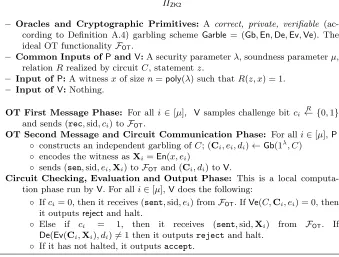
As discussed in Section 4, it seems unlikely that we can do better than three rounds to obtain a zero-knowledge from only one garbled circuit. Therefore, we explore whether we can save on the number of rounds when constructing ZK protocols by allowing multiple garbled circuits. In this section, we adopt a ‘cut-and-choose’ approach in order to construct a GC-based ZK protocol that requiresonlytwo rounds.
Our protocol is similar in spirit to the protocol of [HV16], who extend the technique of “MPC-in-the-head” [IKOS07]. The “MPC-in-the-head” is a tech-nique introduced by Ishai et al. that allows a generic transformation of an MPC protocol into a zero-knowledge proof. In [HV16], the authors extend this idea, and give a generic transformation from a secure two-party computation protocol to a ZK proof.
The protocol is essentially a special case of general cut-and-choose. Since the verifier has no input, we do not have to handle selective failure where the evaluator’s abort could leak a bit of his input, or ensure input consistency of the garbler, again, since the circuit is evaluated on an input entirely known to the garbler. While in [HV16], the protocol is seen as “2PC-in-the-head”, we cast our protocol as cut-and-choose, and apply a standard transformation based on OT. Loosely speaking, choosing to reveal P1’s view in “2PC-in-the-head” in [HV16] is equivalent to choosing a circuit to be a check circuit in our proto-col; and choosing to revealP2’s view corresponds to a circuit being an evaluation circuit. Taking this view, we get a zero-knowledge argument whereas the “2PC-in-the-head” of [HV16] gives a zero-knowledge proof. We note that we do not need to enforce output recovery when two evaluated circuits result in different outputs. The output recovery mechanism that is used in general 2PC protocols [Lin13,LR14,LR15,AMPR14,MR17] relies on authenticity property of the under-lying garbling scheme. Our protocol can be compiled into a NIZK using standard techniques and transformations.
Once more, we consider the scenario where a proverPwould like to prove to a verifierVthat she knows a witnessxfor instancezsuch thatC(x) = 1, where
C is the circuit implementing the relationR(z, x).
5.1 Our Construction
Informally, P garbles C to produce µ independent garbled circuits, and sends them toV, where µis a statistical security parameter. Meanwhile,V samples a challenge stringc← {0R ,1}µ. The positions at which bit stringcis 0 will indicate which circuits V would like to verify (check circuits), whereas the positions at whichcis 1 indicate which circuitsVwould like to evaluate (evaluation circuits). If all the check circuits are valid, and all the evaluation circuits decode to the correct output, V believes thatP indeed has a witness xfor the instance z. P would have to correctly guess V’s entire challenge string in order to cheat and avoid detection.
Intuitively,P constructsµ independent garbled circuits ofC, and for each instance acts as a sender in the OT protocol with messages corresponding to verification and evaluation information, respectively of the garbled circuit C, while sending the garbled circuit and decoding information directly toV (with the final message of the OT). V acts as the receiver in the OT protocol with choice bit ci in the ith OT instance. She receives the first message to check
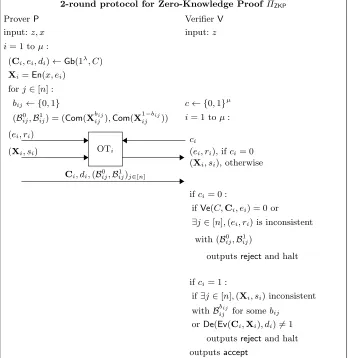
or the second message to evaluate a given circuit, as per her challenge. When instantiated with the UC-secure OT in the framework of [PVW08], our protocol requires only 2 rounds. Our 2-round ZK protocol ΠZK2 is described in Fig. 6,
and proven UC-secure in theFOT-hybrid model in Appendix D.
The zero knowledge protocolΠZK2 is not a zero knowledge proof. It is only
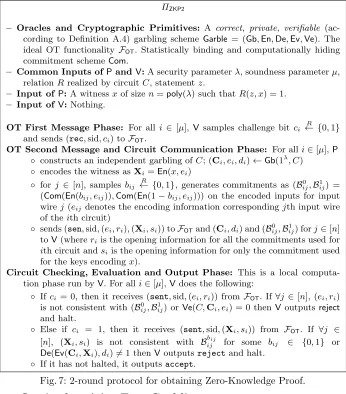
an argument. We may obtain a proof using the idea of [HV16], resulting in a 2-round zero-knowledge proof. We outline the approach below for completeness.
5.2 Our construction for ZK proof
The zero knowledge protocolΠZK2is not a zero knowledge proof. It is only an
ar-gument. We may obtain a proof using the idea of [HV16], resulting in a 2-round zero-knowledge proof. For a legitimately constructed garbled circuit C imple-menting an unsatisfiable circuit (implying there is no witness for the statement), an unboundedP? can find a set of keys, completely unrelated to the legitimate encoding informatione, (say, by breaking the security of the underlying crypto-graphic primitive used in the garbled circuit) which evaluatesCto the legitimate key corresponding to one. For instance, by breaking the collision-resistance of the hash function used to garble the gates. With such a circuit, the verification will always pass when legitimate encoding information is passed on. On the other hand, the other set of keys will allow to evaluate to 1 despite the fact that C
is unsatisfiable.P? can thus convinceVof a false statement. To preventPfrom
ΠZK2
– Oracles and Cryptographic Primitives: A correct, private, verifiable (ac-cording to Definition A.4) garbling scheme Garble= (Gb,En,De,Ev,Ve). The ideal OT functionalityFOT.
– Common Inputs ofPand V:A security parameterλ, soundness parameterµ, relationRrealized by circuitC, statementz.
– Input ofP:A witnessxof sizen=poly(λ) such thatR(z, x) = 1. – Input ofV:Nothing.
OT First Message Phase: For alli∈[µ], Vsamples challenge bit ci R
← {0,1}
and sends (rec,sid, ci) toFOT.
OT Second Message and Circuit Communication Phase: For alli∈[µ],P
◦ constructs an independent garbling ofC; (Ci, ei, di)←Gb(1λ, C)
◦ encodes the witness asXi=En(x, ei)
◦ sends (sen,sid, ei,Xi) toFOTand (Ci, di) toV.
Circuit Checking, Evaluation and Output Phase: This is a local computa-tion phase run byV. For alli∈[µ],Vdoes the following:
◦ Ifci= 0, then it receives (sent,sid, ei) fromFOT. IfVe(C,Ci, ei) = 0, then it outputsrejectand halt.
◦ Else if ci = 1, then it receives (sent,sid,Xi) from FOT. If
De(Ev(Ci,Xi), di)6= 1 then it outputsrejectand halt.
◦ If it has not halted, it outputsaccept.
Fig. 6: 2-round Zero-Knowledge protocol.
to the encoding information in a randomly permuted order. Formally, for circuit
iand input wirej, Pmust prepare and send the following commitments where
eij denotes the encoding information corresponding tojth input wire of theith
circuit:
(B0ij,B
1
ij) = (Com(En(bij, eij)),Com(En(1−bij, eij))), forbij R
← {0,1}
The commitmentComis statistically binding and computationally hiding com-mitment scheme ensuring the binding property against an unbounded powerful P?. An ElGamal based commitment scheme suffices for our requirement.Vchecks if the commitments (B0
ij,B
1
ij) opens to legitimate encoding information if theith
ΠZKP2
– Oracles and Cryptographic Primitives: A correct, private, verifiable (ac-cording to Definition A.4) garbling scheme Garble= (Gb,En,De,Ev,Ve). The ideal OT functionality FOT. Statistically binding and computationally hiding commitment schemeCom.
– Common Inputs ofPand V:A security parameterλ, soundness parameterµ, relationRrealized by circuitC, statementz.
– Input ofP:A witnessxof sizen=poly(λ) such thatR(z, x) = 1. – Input ofV:Nothing.
OT First Message Phase: For all i ∈[µ],V samples challenge bit ci R
← {0,1}
and sends (rec,sid, ci) toFOT.
OT Second Message and Circuit Communication Phase: For alli∈[µ],P
◦ constructs an independent garbling ofC; (Ci, ei, di)←Gb(1λ, C)
◦ encodes the witness asXi=En(x, ei)
◦ forj ∈ [n], samples bij R
← {0,1}, generates commitments as (B0
ij,B1ij) = (Com(En(bij, eij)),Com(En(1−bij, eij))) on the encoded inputs for input wirej(eijdenotes the encoding information correspondingjth input wire of theith circuit)
◦ sends (sen,sid,(ei, ri),(Xi, si)) toFOTand (Ci, di) and (B0ij,B1ij) forj∈[n] toV(whereriis the opening information for all the commitments used for ith circuit andsiis the opening information for only the commitment used for the keys encodingx).
Circuit Checking, Evaluation and Output Phase: This is a local computa-tion phase run byV. For alli∈[µ],Vdoes the following:
◦ Ifci = 0, then it receives (sent,sid,(ei, ri)) fromFOT. If∀j∈[n], (ei, ri) is not consistent with (B0
ij,B1ij) orVe(C,Ci, ei) = 0 thenVoutputs reject and halt.
◦ Else if ci = 1, then it receives (sent,sid,(Xi, si)) from FOT. If ∀j ∈ [n], (Xi, si) is not consistent with B
bij
ij for some bij ∈ {0,1} or
De(Ev(Ci,Xi), di)6= 1 thenVoutputsrejectand halt.
◦ If it has not halted, it outputsaccept.
Fig. 7: 2-round protocol for obtaining Zero-Knowledge Proof.
6
On Authenticity-Free Garbling
As we have seen earlier, garbling schemes that achieve privacy alone are well-motivated. Along the lines of [FNO15] one might ask the question, “can we leverage the lack of an authenticity requirement in order to construct more effi-cient garbling schemes?”
compos-ability, then the scheme is necessarily authentic. Intuitively, any garbling scheme that does not treat output gates differently from intermediate/input gates will be composable. This definition covers state-of-the-art constructions such as those of [ZRE15,GLNP15], and the basic Yao garbling scheme itself [LP09]. We show that an adversary who is able to forge a garbled output for a GC produced by a composable garbling scheme, can be used to break privacy of a slightly larger circuit garbled by the same scheme. Intuitively, forging the output key of the sub-circuit enables multiple evaluations on the larger sub-circuit. As a simulated garbled circuit is constructed to simulate only one ‘path’ of garbled evaluation, it will most likely not permit multiple correct evaluations. We begin with the formal definition of composable garbling in the section below. In Section 6.3, we present how an AND gate can be garbled with just one ciphertext non-composably.
6.1 Composable Garbling
We restrict our model to projective garbling schemes which work by associat-ing keys k0
i, ki1 corresponding to semantic values 0 and 1 respectively for each
input/output wirei in the circuit being garbled. Note that referring to the key corresponding to semantic 0 ask0
i is done for notational convenience; our proof
is unaffected by point-and-permute style optimizations. We further focus on the garbling schemes where the decoding algorithm Desatisfies the following prop-erty: if De does not output ⊥ for a given garbled output Y, then the garbled output keys that compriseYare necessarily drawn from the pre-defined output wire keys. Namely, forY= (Yi)i∈[n+q+1,n+q+m]:
De(Y, d)6=⊥ =⇒ ∀i∈[n+q+ 1, n+q+m], Yi∈ {ki0, k
1
i}
wheren, q, mdenote the number of input wires, gates and output wires respec-tively in circuit C. Placing the above requirement allows us to ignore garbling schemes that do not achieve authenticity only because the De routine never outputs⊥5.
Informally, a composable garbling scheme allows the output keys of a pre-viously garbled gate to be the input keys to an instance of garbling another gate in the circuit. A Gb routine that directly uses the output keys of a gate as the input keys to a child gate, and does not distinguish between output and non-output gates, will make the garbling scheme composable. A bit formally, a schemeGarbleis said to be composable if it can be used to define a new garbling schemeGarble? that can compose garbling of a circuit C and a gateC0 accord-ing toGbofGarbleto produce a GC for a larger composed circuitC?defined as
follows. Circuit C?:{0,1}n
7→ {0,1}mis interpreted as the composition of the sub-circuit C: {0,1}n−1 7→ {0,1}m andC0. One of the output wires of C acts as the left input wire of gate C0. The last input wire ofC? serves as the right input wire ofC0. C0 provides an output wire in circuit C?.
5
Our way of defining composability is sufficient for the purpose of our proof, while capturing most practical garbling schemes [ZRE15,GLNP15]. We note that the template of Gbof the scheme Garble? can be extended to more accurately reflect garbling for general composed circuits by removing the constraints on the input wires of C0. Namely, that the right wire of C0 is an input wire, whereas the left wire is an intermediate wire. While not required for our proof, we pro-vide such a template capturing gate-by-gate garbling schemes in Section 6.4 for completeness. The tradeoff for a more precise template is a loss of generality in the garbling techniques captured; as an example, the work of [MPs16] abandons the gate-by-gate approach to garbling. The composability requirement as stated formally in Fig. 8 for our proof is meaningful for any projective garbling scheme, which we believe will be relevant beyond current garbling techniques. We now formalize the notion of composable garbling scheme.
Definition 6.1 A garbling scheme Garble = (Gb,En,Ev,De) is composable if
there exists a garbling routineGb? as per Fig. 8 such that the composed garbling
schemeGarble?= (Gb?,En,Ev,De)is correct and private.
Given a garbling schemeGarble= (Gb,En,Ev,De) of a garbling schemeGarble, we construct a garbling algorithm Gb? for a given circuit C? : {0,1}n 7→ {
0,1}m , which is subject to certain restrictions as given below. CircuitC?is interpreted as the composition of a sub-circuitC:{0,1}n−17→ {
0,1}m
and a single 2 fan-in gate C0. The gateC0provides an output wire in circuitC?. The left and right incoming wires toC0are indexedLandRrespectively. ClearlyLis an output wire ofC, and Ris an input wire ofC?.
Gb? 1λ, C?
1. ParseC andC0fromC?, whereC0 is the last gate inC?. 2. UseGbto garbleC, i.e. (C, e, d)←Gb 1λ, C
3. Extract keysk0L,k 1
Lusing (C,C, e) a
. 4. Choose fresh keysk0
R,kR1. For garbling schemes such as FreeXOR which require a certain key structure, choose fresh input keys appropriately. Otherwise, two independent randomλ-bit strings will suffice.
5. Compute (C0, e0, d0) =Gb 1λ, C0such thate0= k0L, kL1
, k0R, kR1
6. SetC?=C||C0,e?=e||e0[2] andd?=d[1]||d[2]|| · · · ||d[m−1]||d0whereeand e0 are perceived as arrays withith entry containing the encoding information for theith input wire. Similar notation is used fordandd0.
7. return C?, e?, d? a
6.2 Relating Composability and Privacy to Authenticity
We now show that a garbling scheme Garblewhose composed garbling scheme Garble? is private and correct as per Def. 6.1 must necessarily be authentic. Theorem 6.2 If a private and correct garbling scheme Garble = (Gb,En,Ev,De)is composable as per Definition 6.1, then it is also authentic.
Proof. Given black-box access to an adversaryAautwho is able to forge a garbled
output for some (C, x) garbled usingGarble, we construct an adversaryAprvwho
can distinguish between a legitimate and simulated garbling of some larger circuit (C?, x||x0) as per composed garbling schemeGarble? (as per Def. 6.1). The idea
is to create C? fromC so that the output wire ofC is an intermediate wire of
a circuit C?. A
prv then uses Aaut to forge the missing output key of the output
of C. Now, possession of both the keys of the output wire of C allows Aprv to
perform multiple evaluations of output gateC0 in a garbling ofC?. This in turn
allows to verify if the gate has been garbled legitimately or via a simulator.
Assuming black box access to an adversaryAautwho can forge a garbled output for some circuitC:{0,1}n−1 7→ {
0,1}and inputx∈ {0,1}n−1
as perGarble, we con-struct adversaryAprv who can distinguish whether a given (C,X, d) corresponding to a larger circuitC?:{0,1}n7→ {
0,1}as perGarble?is produced legitimately, or simulated.
Aprv 1λ
1. receiveC, xfromAaut. Letybe the output wire label ofC. 2. ConstructC?as follows:
– if C(x) = 0thenC?=C||(y∧x0) – elseC?=C||(¬y∧x0
) 3. Sample bitx0← {R 0,1}
4. send C?, x||x0 as the function and input to the challenger of the privacy ex-periment, andreceive C?,X?, d? as a response.
5. From the above response, parseC||C0 =C?, whereC ∈Gb(1λ, C) andC0 ∈
Gb(1λ,∧), as well asX||X0
=X?whereX∈En(x,·) andX0
∈En(x0,·) 6. ComputeY=Ev(C,X)
7. send(C,X) toAautandreceive Y0as a candidate forged output. 8. ComputeZ=Ev(C0,Y||X0) andZ0=Ev(C0,Y0||X0)
9. Check the consistency of the final garbled gate to determine whether it was garbled legitimately, as follows:
– if De(Z0, d) =⊥then outputguess← {R Real,Ideal}
– else if(Z0=Zandx0= 0) or (Z06=Zandx0= 1)then outputguess=
Real
– else outputguess=Ideal
Fig. 9: Reduction of authenticity ofGarbleto privacy ofGarble0
Concretely, (C?, x||x0) is constructed from (C, x) as follows. IfC(x) = 0, then
![Fig. 1: Zero-knowledge from Garbled Circuits [JKO13]](https://thumb-us.123doks.com/thumbv2/123dok_us/7988116.1325617/11.612.136.480.110.451/fig-zero-knowledge-from-garbled-circuits-jko.webp)
![Fig. 2: RE-OT assuming DDH: as per [PVW08]](https://thumb-us.123doks.com/thumbv2/123dok_us/7988116.1325617/14.612.137.478.251.470/fig-re-ot-assuming-ddh-as-per-pvw.webp)

![Fig. 15: ZKGC: Zero-knowledge from one GC [JKO13]](https://thumb-us.123doks.com/thumbv2/123dok_us/7988116.1325617/44.612.136.480.113.488/fig-zkgc-zero-knowledge-from-one-gc-jko.webp)