Homomorphic Autocomplete
Gizem S. C¸ etin1, Wei Dai1, Yarkın Dor¨oz1, and Berk Sunar1
Worcester Polytechnic Institute {gscetin,wdai,ydoroz,sunar}@wpi.edu
Abstract. With the rapid progress in fully homomorpic encryption (FHE) and somewhat homomorphic encryption (SHE) schemes, we are wit-nessing renewed efforts to revisit privacy preserving protocols. Several works have already appeared in the literature that provide solutions to these problems by employing FHE or SHE techniques. These applications range from cloud computing to computation over confidential patient data to several machine learning problems such as classifying privatized data. One application where privacy is a major concern is web search – a task carried out on a daily basis by billions of users around the world. In this work, we focus on a more surmountable yet essential ver-sion of the search problem, i.e. autocomplete. By utilizing a SHE scheme we propose concrete solutions to a homomorphic autocomplete problem. To investigate the real-life viability, we tackle a number of problems in the way towards a practical implementation such as communication and computational efficiency.
Keywords: Homomorphic encryption, privacy preserving applications, oblivi-ous keyword search.
1
Introduction
during homomorphic computation. Dor¨oz, Hu and Sunar (DHS) [13, 14] used an LTV SHE variant to evaluate AES using windowing in 12 seconds. In early 2015, Gentry, Smart, Halevi (GHS) [21] published significantly improved AES runtime results with a 2 seconds amortized per block runtime. More recently, Ducas and Micciancio [16] presented the FHEW scheme that achieves bootstrapping in half a second for HElib on a common PC.
complexity and provided implementation results for privately sorting an array of integers. The scalability of various sorting algorithms is studied using an LTV [29] variant also proposing new depth optimized sorting algorithms.
All of the aforementioned works develop versatile tools that take us closer to developing practical privacy preserving applications. Although proposed as the prime example of blind computation by Gentry in his very first FHE con-struction [17], the privatized web search problem, where encrypted keywords are submitted to a server that blindly computes and returns the search result, has not been investigated yet with the new homomorphic tools developed in the last few years. While there are still quite a number of practical challenges that need to be tackled before the search problem can be solved in a practical manner. Here we take the first step by studying a similar yet more tractable problem, i.e. the autocomplete feature. From a privatization point of view, autocomplete provides the perfect micro example of a search. In both applications, we wish the server to privately match keywords in a dictionary and accordingly return the matching results. A search engine compiles the results page from a vast list of precomputed and presorted results optimized for extremely efficient retrieval. Instead, in autocomplete the list is significantly smaller and therefore does not need to be structured and optimized as much. This provides us an opportunity to study the search problem in a simpler setting. Finally we note that, autocom-plete is a more generic tool and is also used in other applications such as such as form fills in web browsers, and in e-mail clients etc.
Our Contribution.In this work, we
– first model the autocomplete problem in the client/server setting. When-ever the client starts typing a keyword, the server performs a lookup in the database, predicts the rest of the word and provides a number of popular keywords to the user;
– we convert this model into a homomorphic circuit, so that it can be evaluated using encrypted input/outputs. In this scenario, when a user starts typing a keyword, it is first encrypted under an SHE scheme with the user’s own public key on the client side, then the ciphertexts are sent to the server. The server evaluates the autocomplete circuit and returns the predicted words still in encrypted form to the user;
– we consider a realistic scenario where the size of the lookup table, i.e. the database can be fairly large, hence we provide a batched scheme suitable for a real-world application;
– we give a detailed analysis on the noise growth during the evaluation of our circuit depending on different application variables. Furthermore, we explain the parameter selection process with respect to both noise management and the cryptographic security.
GPU support to accelerate the SHE evaluations. We provide run-time results for the proposed methods for both CPU and GPU implementations.
2
Background
In this work, we use a single-key SHE construction which is a modified version of DHS in [14]. The DHS scheme was derived from the multi-key FHE scheme LTV in [29] and LTV construction uses a variant of NTRU Encryption proposed by Stehl´e and Steinfeld in [36] as a base point. (see Appendix)
2.1 The DHS Library
DHS is a customized single-key version of the LTV scheme that was proposed in [14] by Dor¨oz, Hu and Sunar. The source code is available in C++ and the library is implemented using NTL [32] with GMP [23] support. The library contains some special customizations that improve the efficiency in both run-time and the memory requirements. The library can perform 5 main operations as well as a packing method;KeyGen,Encryption,Decryption,Modulus
Switchand Relinearization andBatch. Due to the fact that our finalized
circuit, that will be defined later in Section3, is shallow enough to execute with a SHE scheme, we will not useRelinearization. By disregarding relinearization, we need to update our decryption key according to the circuit to be evaluated. The details of the DHS customizations, that will be used in our implementation, are as follows:
– Encryption. In the previous section 7.1, we defined encryption and de-cryption primitives as bit operations. But in the library, we can encrypt a message m from a larger message domain Zp for the ith level, using
c(i)=h(i)s+pe+mas the encryption function. Similarly decryption works as Decrypt c(i)=c(i)f(i) modp=m. With word size-pmessage domains, all homomorphic properties are preserved and we gain the ability to homomor-phically multiply and add integers via simple ciphertext multiplication and additions. As stated earlier, we will use a function of the secret key on the decryption step for our SHE implementation.Decrypt c(i)=c(i) f(i)`and the exponent of the secret key` depends on the number of multiplications in the circuit.
– Batching.The new domain is defined as Rq=Zq[x]/Ψm(x) whereΨm(x) is
themthcyclotomic polynomial. The specially selected cyclotomic polynomial
is used to batch multiple messages into the same polynomial for parallel evaluations as proposed by Smart and Vercauteren [33, 34] (also see [14]). When Zp is the plaintext space, the polynomial Ψm(x) can be factorized
over Fp (if we have a prime p), into equal degree polynomials Fi(x). The
degree of these factors will be the smallest integertthat satisfiesm|(pt−1).
The degree n of Ψm(x) is equal to the Euler Totient function of m, i.e.
defines a separate message slot. As a result, S messages can be embedded into a single polynomial using the Chinese Remainder Theorem (CRT). – Modulus Switching.Previously, we definedqis as a decreasing sequence of
primes for each leveli. In this construction,qiis created as the product of a
number of primes for each level. It starts with setting the last levelq,qdto a
selected primeρ, i.e.qd=ρ, then for the rest of the sequencei=d−1,· · · ,0,
it generates the newqi as,qi=qi+1ρi. The valueρi is a prime number that
cuts (κ= logρi)-bits of noise in each level.
2.2 CUDA GPU Support
We adopt the cuHE library [11] to implement our design on CUDA GPUs. The library features fast polynomial ring operations and is designed for a homomor-phic evaluation of a leveled circuit. A ciphertext on GPU can be represented in three ways: straightforward representation of a polynomial with very large coefficients, a set of polynomials with small coefficients converted with the CRT or a set of vectors achieved with number-theoretic transform. The latter two are essential for efficient computation. They adopt a different method than DHS to generate coefficient moduli, featuring efficient modulus switching. We trimmed the cuHE library to better fit our need, such as removing relinearization.
3
Our Autocomplete Scheme
In autocomplete schemes, expensive computations and massive user-server band-width requirements stays a challenge towards a real time SHE based applications. In this section, we present a homomorphic autocomplete algorithm that can han-dle practical scenarios. Here, we provide optimizations and propose a lightweight algorithm, to push our design closer to a real-life application. In the following we first explain an autocomplete scheme briefly and later give details of the homomorphic autocomplete.
server facing a computationally difficult problem (decrypting without decryp-tion key) to extract any significant knowledge of his intendecryp-tion, which is identical to a computational private information retrieval (cPIR) problem [10]. Based on those definitions we are now able to provide a general model to the problem and explain our solutions.
Headers Words
a amazon, abc, abc news. . .
b bank of america, best buy. . .
. .
. ...
z zillow, zappos, zipcar. . .
0 0 to 100, 0 divided by 0. . .
1 1800flowers, 1800contacts. . .
2 2048, 21 day fix. . .
. .
. ...
1100001 97 109 97 122 111. . .
1100010 98 97 110 107 32 . . .
. . .
1111010 122 106 108 108 111. . .
0110000 48 32 116 32 49 . . .
0110001 49 56 48 48 102 . . .
0110010 50 48 52 56 0 . . .
. .
. ...
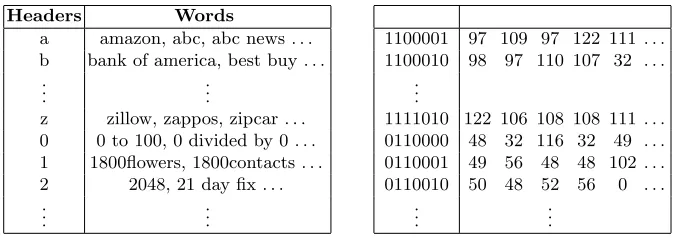
Table 1. An example database where headers have a single character and the corre-sponding words are ordered according to their search ranks. Their ASCII representation on the right.
3.1 Setup
We first setup an LTV instance for our application as the base homomorphic encryption module with the following preliminaries:
Plaintext space :P =Zp1
Depth of the circuit to be evaluated : d
Ciphertext space :C=Zqi[x]/hΨm(x)i, i∈Zd+1 Number of message slots : S
Batching domain :B:ZS
p →Zp[x]/hΨm(x)i
This generic setup will be used throughout this section for building our ho-momorphic circuits. Later in Section 4, we will give detailed information about selecting the parameters (p, q, m, S) with respect to the depth (d) of the cir-cuit. Before constructing our homomorphic circuit, we also need to define some
1
terminology and set the following preliminaries for the design:
Bit size of the user input/headers : L
Number of rows in the database : E
Number of logp-bit chunks to be returned : R from the word list
User input as an array of bits : UL
Database headers as a matrix of bits : HE×L Database words as a matrix of logp-bit chunks : WE×R
The parameters, L,E,R, determines the number of input/output data that is transfered between the server and the client. Therefore they have an effect on both the circuit size and the bandwidth, thus they are significantly important for the runtime of the application. We will design our circuits for generic cases and later in Section 5, we will choose different values and observe their effect on the LTV setup and consequently on execution time.
Database elements are accessed using an array notation, hence we have H [i] [j]∈ Z2, ∀i ∈ZE, ∀j ∈ZL for database headers and W [i] [j] ∈Zp, ∀i ∈
ZE, ∀j ∈ ZR for the word list. For example, for the database in Table 1, H [0] [0] = 1 which is the first bit of the first row, H [0] [1] = 0 which is the second bit of the first row, and so on. Similarly, W [0] [0] = 97 which is the first character of the word list on the first row. User input is hold in the same structure, i.e. we have U [i]∈Z2,∀i∈ZLand for example for a user input ’b’ = 1010110 in ASCII representation, we will have U [0] = 1, U [1] = 0. Similarly, whenever we have a vectorv =hv0, v1,· · ·vk−1iwe access its elements using the notation,v[i] =vi
for anyi. If we have an array of such vectors, A= [v0,v1,· · · ,vl], we will use
A[i] =vi andA[i][j] =vi[j] for somei andj.
3.2 The Autocomplete Circuit
The autocomplete problem is identical to PIR problem, thus we can contract the same circuit to evaluate the autocomplete. The algorithm will be consisting of a number of comparisons for the lookup and a multiplexer to generate the end result is given in Algorithm 1.
Algorithm 1Auto-Complete 1: functionAutocomplete (U) 2: fori←0 to E-1do
3: if U equals to H[i] then
4: returnW[i]
5: end if
6: end for
7: end function
inputs, i.e. a homomorphic circuit. We build a boolean comparison circuit using a binary tree of XNOR gates, as can be seen in the first line of Algorithm 2. Since we need to access each bit of the inputs we encrypt each of the user input bits separately. After performing the comparison step, the intermediate results will still be in an encrypted form, the server will still be blind. Hence, it cannot perform any branch operation. Thus, we need to implement a multiplexer circuit for the branching step. The overall circuit is summarized in Algorithm 2.
Algorithm 2Auto-Complete Circuit 1: functionCompare(U, H[i])
2: output←1
3: forj←0 to L-1do
4: output←output∗(U[j] + H[i][j]−1 mod 2) 5: end for
6: returnoutput 7: end function
8: functionAutocomplete (U) 9: output←0
10: fori←0 to E-1do
11: output←output + (Compare(U,H[i])∗W[i]) 12: end for
13: returnoutput 14: end function
Even though the circuit we defined in Algorithm 2 is shallow enough to op-erate on a homomorphic domain, considering a real world scenario where we have a really large database in which we perform the lookup, we cannot ex-pect a practical application unless we have parallel evaluations. Batching, as described in Section 2.1, is one the most useful techniques in order to reduce the cost of homomorphic applications. Placing multiple data into message slots and packing them into a single polynomial using CRT allows us to do paral-lel addition/multiplications on each message slot. In our scheme, since we have 2-dimensional arrays to represent the database, we have two options, packing row-wise or column-wise. Packing database matrix row-wise means that we are batching bits of an header, therefore we also need to batch the user input by placing each bit into a message slot. But, notice that our comparison circuit in Algorithm 2 takes the product of bitwise comparisons, i.e. XNOR operations. Hence, even if we perform the bitwise XNORs in parallel, we will need to apply multiplication across different message slots in order to compute the product. Permuting the message slots by rotating and manipulating the packed polyno-mial is possible, yet inconveniently expensive for a real-time application. There-fore, the latter batching method, i.e. packing the database elements column-wise is a better approach for our scheme. Since we only have S message slots, we need
λ=dE
for word lists. How we construct the batched database elements can be seen in Equation 1 and Equation 2.
h[i][j] =hH[iS+ 0][j],H[iS+ 1][j],· · · ,H[iS+S−1][j]i
h[i][j] =Batch(h[i][j]),
h[i][j]∈Domain(B), h[i][j]∈Image(B), ∀i∈Zλ, ∀j∈ZL (1) w[i][j] =hW[iS+ 0][j],W[iS+ 1][j],· · ·,W[iS+S−1][j]i
w[i][j] =Batch(w[i][j]),
w[i][j]∈Domain(B), w[i][j]∈Image(B), ∀i∈Zλ, ∀j∈ZR (2)
In case of client side message batching, we want to compare an arbitrary user input bit U[i] with ith bit of every header. Therefore, we place the same bit U[i] in each message slot of a single vector, so that comparison can be per-formed in parallel. When we batch a vector consisting of the same elements, the mapping will be to a constant polynomial with the corresponding element being the constant term. This means that, we will not spend any time for batching in the runtime and this is the perquisite of the column-wise packing method. The operations in the user side are
u[i] =hU[i],U[i],· · ·,U[i]i
u[i] =Batch(u[i]) =U[i] c[i] =Encrypt(u[i]),
u[i]∈Domain(B), u[i]∈Image(B), c[i]∈ C, ∀i∈ZL (3)
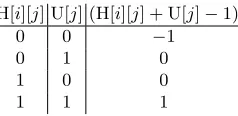
After retrieving the encrypted user bits c[i], the server can follow the steps of the homomorphic circuit in Algorithm 2. First step will be the comparison as in Equation 4. After this step, the server will have an array of ciphertext polynomials r which holds the comparison results in distinct message slots for all header entries. And we know that there is only one entry in the database that is equal to user input, hence when decrypted only one message slot will have 1 orp−1 and the rest will be 0. The reason we may havep−1 is due to the fact that in the plaintext domain we may use a primeplarger than 2. There are three possible outcomes for bitwise comparison as shown in Table 5. (See Appendix) Focusing on the particular case where the H[i] equals to U, for some
i∈ZE, note that whenever there is a bit 0 in the user input U, there will be a (−1) in the product. Let the number of zero bits in the user input beω, then we will have QL−1
j=0 (H[i][j] + U[j]−1) = (−1)
ω
(1)L−ω. If there are odd number of zeros in the user input, then after the decryption this result must be multiplied by−1, otherwise it will have the value−1 =p−1∈Zp. For other cases where
H[i]6= U, there will be at least one zero in the product vanishing the “−1”s as well as “1”s, thus the output will be zero nonetheless.
r[i] = L−1
Y
j=0
(h[i][j] +u[j]−1), r[i]∈ C, ∀i∈Zλ (4)
we need to AND it with the word lists. Then we can take the cumulative sum of the rows. Since only one of them will hold a value different than 0 the sum will evaluate a row lookup.
The server sends R encrypted word chunks i.e. for each columnjof the word list, it sends ad[j] to the user:
d[j] =
λ−1 X
i=0
(r[i]∗w[i][j]), d[j]∈ C, ∀j∈ZR (5)
Let k∈ ZS, be the offset of the row i in the packed vector, again for the case H[i] = U. This means that eachd[j] will have (−1)ωW[i][j] in thekthmessage
slot and it will be the only non-zero element of the output vector unless the word list is not empty, for the corresponding header. Otherwise all outputs/message slots will be zero and this can be checked by seeking a non-zero value in the first vector. The operations for the decryption process in the client side can be seen in Equation 6 and the final output, i.e. the autocompleted word list can be seen in Equation 7.
v[j] =Decrypt(d[j]),
v[j] =Batch−1(v[j]),
v[j] =h0,0,· · ·,∓W[i][j],· · · ,0,0i
v[j]∈Image(B), v[j]∈Domain(B), ∀j∈ZR
∃i∈ZE, s.t. U = H[i]. (6)
V = (
[(−1)ωv[0][k],· · ·,(−1)ωv[R−1][k]] if∃k∈ZSs.t.v[0][k]6= 0
[∅] otherwise. (7)
Notice that the multiplicative depth of the scheme comes from the comparison operation (Equation 4), where we compare bits of the user input to database entries, because it is the only operation that involves ciphertext-ciphertext mul-tiplication. Even though Equation 6 also has multiplications, it is only between a ciphertext and a plaintext which is a constant multiplication. For further opti-mization, we will try to drop this equality check in the next section by switching from using ASCII representation to a special encoding.
3.3 A Simpler Circuit
decryption will fail). Also we abandoned relinearization, because it would be impractical to require clients sending huge evaluation keys to the server. We choose to let the client perform decryption with a power of the secret key, e.g.
f24, consequently this significantly increase the coefficient moduliq
i’s.
Autocomplete without Comparison With a small assumption on client’s side, provided that there is a unique index in the database for each possible input combinations, an abbreviated circuit solves the problem. For example, the database has 26 entries with headers: “a”, “b”,..., “z”; the entry with header “p” has index “15”. The client, acknowledge of indexing rules, is then able to send an encrypted index to the server. With one-hot encoding, the encrypted index can be used as input to the multiplexer. Assume that the client intents to retrieve the entry with indexα∈ZE. Create a matrix of bitsRE such that
∀i∈ZE, R[i] =
(
1 ifi=α
0 otherwise. (8)
Apply batching and encrypt batched vectors to ciphertexts:
r[i] = L−1
Y
j=0
(Encrypt(Batch(hR[i·S], R[i·S+ 1], . . . , R[i·S+S−1]i))),
where r[i]∈ C, ∀i ∈Zλ. The client sends those ciphertexts to the server. The
process follows the previous circuit from Equation 5 to enter the multiplexer. The abbreviated circuit consists of multiplications only between ciphertext and plaintext. More importantly, we work with much smallerqi’s, of which an detailed
analysis is provided in the next section.
4
Coping with Noise
In this section, we explain our method to manage the growing noise along the homomorphic evaluation of levels of the circuit. Our goal is to minimize com-putational burden by minimizing ciphertext size, i.e. degree n and coefficient moduliqi’s, so that correct decryption is ensured with very high probability. In
our homomorphic encryption scheme, the decryption key isf =pf0+ 1 and the encryption key ish=pgf−1, whereg, f0∈χ
B andpdenotes the message space.
Autocomplete with Comparison The comparison step has multiple levels. Therefore noise in ciphertexts grows rapidly. Recall the construction. LetL de-note the number of input bits, and let d=dlog2Ledenote the depth of circuit givenLbatched plaintextsMj∈Rpwherej∈ZL. The plaintexts are encrypted
asCj(0)=Enc(Mj) =hsj+pej+Mj, wheresj and ej are sampled fromχB.
To estimate the noise growth, we track operations in each level and denote the norm of decrypted ciphertexts entering thei-th level asBi. Before entering
dictionary headersHj:Cj0 =Cj+Hj−1 =hs+pe+M+H−1 , wherej∈ZL
and Hj ∈ χp. Those are the ciphertexts entering the 0-th level of circuit (for
simplicity assumingc=C00 =C10 =· · ·=CL0−1), then
B0≤ kcfk∞≤n[(B2+ 2B)p2+ (B2+ 2B+ 2)p+ 1].
Then in each level, we perform multiplication on ciphertexts. And remember, since we don’t have relinearization in our scheme, to decrypt a ciphertext in the
i-th level (ci), we performDec(ci) =ci·f2
i
modp. Moreover, after each level of circuit, a modular switching is performed on ciphertexts to reduce the noise growth. As proposed by Dor¨oz et al. in [14], assume qi+1/qi ≈ κ, ∀i ∈ Zd. A
decrypted ciphertext entering thei-th level is presented as:
c2if2i = (. . .((c2κ+1)2κ+2)2. . . κ+i)f2
i
,
where1, 2, . . . , i are parity fixing values inχp. This yields
Bi ≤ kc2
i
f2ik∞=k(c2 i−1
f2i−1)2κ+if2
i
k∞≤κnBi2−1+pn2 i
(pB+ 1)2i.
If we set 1/κ=ε(nB2) +pn(pB+ 1) whereε >1 is a small constant, the growth of the norm is nearly constant over the levels of evaluation.
At last, the multiplication tree yields a ciphertext as output of comparison. However, so far we only focus on a single batched output ciphertext out of a total number ofλ. Taking the number of batched results λinto consideration, we havey=y0=y1=· · ·=yλ−1andBd−1≥ kyk∞. Given the suggested words (batched in polynomials)w=w0=w1=· · ·=wλ−1∈Rp, the final step before
decryption computesras:r=Pλ−1
i=0 yiwi=λyw.
For a general multiplication tree withdlevels, ifqd/2>krf2
d
k∞is satisfied, there will be no wraparound on the ciphertext coefficients during decryption. Hence the scheme will be correct. To be precise, y =cL and 2d−1 ≤L < 2d.
qd/2 would only need to be larger than the upper bound of normkrfLk∞. Let [L0, L1, . . . , Ld−1] be the bitwise expression ofL, such thatL=Pdi=0−1Li2i and
Li∈Z2∀i∈Zd andLd−1= 1. Then we have
krfLk∞=kλwcLfLk∞
≤λpn
d−1 Y
i=0
kc2if2ikLi ∞·
d−2 Y
i=0
nLi ≤λpn
d−1 Y
i=0
BLi
i · d−2 Y
i=0
nLi.
In conclusion, to ensure the correctness of our scheme, the following condition must be satisfied:
qd/2> λpn2
d−L+1
(pB+ 1)2d−L
d−1 Y
i=0
BLi
i · d−2 Y
i=0
nLi.
Autocomplete without Comparison This construction is derived from the previous one after we computed comparison results (y). The circuit is as simple as r=Pλ−1
i=0 yiwi =λyw. And to decrypt rwe computerf. Note that y is the
index encoded and encrypted by user, hence, y =hs+pe+mwhere m∈Rp.
We can estimate norm ofrf in the worst case as:
krfk∞=kλw(hs+pe+m)k∞≤λn2p2(pB2+pB+B2+B+ 1).
In conclusion, to ensure correct decryption, the following condition must stand in the worst caseqd/2> λn2p2(pB2+pB+B2+B+ 1).
Average Case Behavior However, a smallerqd results in less computational
burden, of which we would like to take advantage. When viewed as a distribution, the norm of polynomial multiplicationkuvk∞grows much more slowly. And the probability of the norm reaching the worst case is exponentially small. Dor¨oz et al. explained in [14] that kuvk∞ ≤
√
n· kuk∞· kvk∞ is a sufficiently good approximation of the expected norm. We obtain new formulas by substituting
n with√n. The construction with comparison decrypts correctly if (set 1/κ=
√
nB2+p√n(pB+ 1) to stabilize the norm growth):
qd/2> λp
√
n
d−1 Y
i=0
BLi
i · d−2 Y
i=0
√
nLi
Bi≤κ
√
nBi2−1+p√n2
i
(pB+ 1)2i
B0≤
√
n[(B2+ 2B)p2+ (B2+ 2B+ 2)p+ 1].
The construction decrypts correctly ifqd/2> λnp2(pB2+pB+B2+B+ 1).
5
Parameter Selection
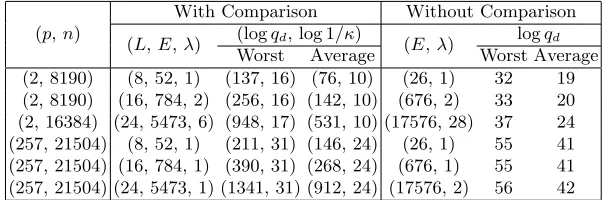
We provide the selected parameters for polynomial dimension and coefficient size in Table 2. In the parameter selection process, we use the noise analysis in Section 4 to determine the coefficient size log(q) and the cutting size 1/κ
As explained in Dor¨oz et al. [14], the LTV scheme has a lattice dimension of 2n for a polynomial degreen. For polynomial degree nbeing equal to 8190, 16384 and 21504, the lattice dimensions are roughly 15000, 30000 and 40000 and the Hermite factors δB are equal to 1.00826, 1.00846 and 1.00851 respectively
for 80-bit security. In our case we have the Hermite factors as 1.0037, 1.0061 and 1.0083 for degrees 8190, 16384 and 21504 respectively. The evaluated Hermite factors gives us more than 80-bit of security in all the cases.
(p,n)
With Comparison Without Comparison
(L,E,λ) (logqd, log 1/κ) (E,λ) logqd Worst Average Worst Average (2, 8190) (8, 52, 1) (137, 16) (76, 10) (26, 1) 32 19 (2, 8190) (16, 784, 2) (256, 16) (142, 10) (676, 2) 33 20 (2, 16384) (24, 5473, 6) (948, 17) (531, 10) (17576, 28) 37 24 (257, 21504) (8, 52, 1) (211, 31) (146, 24) (26, 1) 55 41 (257, 21504) (16, 784, 1) (390, 31) (268, 24) (676, 1) 55 41 (257, 21504) (24, 5473, 1) (1341, 31) (912, 24) (17576, 2) 56 42
Table 2.Coefficient modulus size logqdto ensure correct decryption (based on cutting
size log 1/κ), in worst and average cases, for both constructions with different message spaces.
6
Implementation
CPU Implementation. We implemented both of the proposed algorithms in C++ using DHS-SHE Library [14]. All simulations were performed on an Intel Xeon @ 2.9 GHz server running Ubuntu Linux 13.10. We compiled our code using Shoup’s NTL library version 9.4.0 and with GMP version 5.1.3.
GPU Implementation.We introduced some optimization to achieve an effi-cient implementation on CUDA GPUs. We basically adopt the cuHE library [11] to build the SHE scheme and both autocomplete algorithms, yet make modifi-cations to accommodate our parameter settings.
– Pre-computation. The cuHE library [11] handles polynomial multiplica-tions in NTT domain. The overhead of NTT conversions on those plaintexts can be spared if they are performed during pre-computation. We then store those data in either CPU or GPU memory. There is no difference in terms of performance, since the memory transfer between CPU and GPU can be fully hidden behind computation tasks, as we monitored. Hence, the requirement on GPU memory size is minimized.
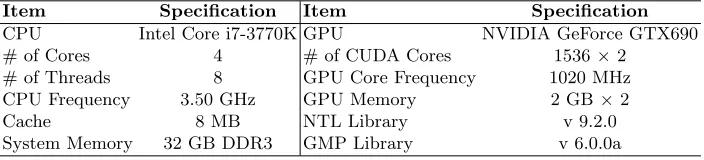
We use an NVIDIA GeForce GTX 690 Graphic Card for development and test. The card comes with two GTX 680 GPUs. Therefore, we have the implementa-tion designed to test either on a single GPU or on both GPUs. The specificaimplementa-tion of the graphic card is listed in 3.
Table 3.Testing Environment
Item Specification Item Specification
CPU Intel Core i7-3770K GPU NVIDIA GeForce GTX690 # of Cores 4 # of CUDA Cores 1536×2
# of Threads 8 GPU Core Frequency 1020 MHz CPU Frequency 3.50 GHz GPU Memory 2 GB×2
Cache 8 MB NTL Library v 9.2.0
System Memory 32 GB DDR3 GMP Library v 6.0.0a
6.1 Timing Results
We offer two encryption modes for 1-bit (p= 2) or 8-bit (p= 257) message sizes. Theoretically, encryption mode with p= 257 would save 7/8 memory required for the database, reduce the number operations by 8 times and consume only 1/8 bandwidth, compared to those of encryption mode withp= 2. The increase ofp
leads to a larger coefficient size and a higher polynomial degree, the consequence of which is a significant drop of performance. Fortunately the polynomial degree 21504 we selected creates more message slots S for batching. Remember the number of batched polynomialsλmatters in terms of computational complexity. When the number of entriesEis fairly small,λ=dE/Seis 1 in both encryption modes. However, when E is large, a largerS yields a smaller λ, which reduce the number of computations greatly. Therefore, setting p= 257 only improves performance when the number of entries is sufficiently large.
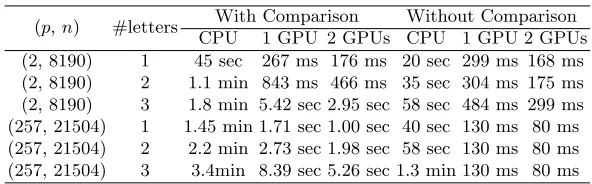
The timing results in Table 4 are measured with respect to parameters se-lected for each case in Table 2. For autocomplete without comparison, we mon-itored that 85% of overhead is caused by launching CUDA kernels. Hence, due to the inefficiency of cuHE for this case, we recorded exactly the same timing results for (p= 257, n= 21504) cases.
7
Conclusion
Table 4.Performance of Auto Completion with At Most 20 Suggested Characters
(p,n) #letters With Comparison Without Comparison CPU 1 GPU 2 GPUs CPU 1 GPU 2 GPUs (2, 8190) 1 45 sec 267 ms 176 ms 20 sec 299 ms 168 ms (2, 8190) 2 1.1 min 843 ms 466 ms 35 sec 304 ms 175 ms (2, 8190) 3 1.8 min 5.42 sec 2.95 sec 58 sec 484 ms 299 ms (257, 21504) 1 1.45 min 1.71 sec 1.00 sec 40 sec 130 ms 80 ms (257, 21504) 2 2.2 min 2.73 sec 1.98 sec 58 sec 130 ms 80 ms (257, 21504) 3 3.4min 8.39 sec 5.26 sec 1.3 min 130 ms 80 ms
the performance (hence the practical relevance) of our schemes, we implemented both approaches on both CPU and GPU platforms. With the GPU implementa-tion, for certain database sizes, we achieve a performance of less than a second which is close to what is desired in real-time interactive applications.
References
1. Bos, J.W., Lauter, K., Loftus, J., Naehrig, M.: Improved security for a ring-based fully homomorphic encryption scheme. In: Stam, M. (ed.) Cryptography and Cod-ing, Lecture Notes in Computer Science, vol. 8308, pp. 45–64. Springer Berlin Heidelberg (2013)
2. Bos, J.W., Lauter, K., Naehrig, M.: Private predictive analysis on encrypted medical data. Tech. Rep. MSR-TR-2013-81 (September 2013),http://research. microsoft.com/apps/pubs/default.aspx?id=200652
3. Brakerski, Z., Gentry, C., Vaikuntanathan, V.: Fully homomorphic encryption without bootstrapping. Electronic Colloquium on Computational Complexity (ECCC) 18, 111 (2011)
4. Brakerski, Z., Gentry, C., Vaikuntanathan, V.: (leveled) fully homomorphic encryp-tion without bootstrapping. In: Proceedings of the 3rd Innovaencryp-tions in Theoretical Computer Science Conference. pp. 309–325. ACM (2012)
5. Brakerski, Z., Vaikuntanathan, V.: Fully homomorphic encryption from ring-lwe and security for key dependent messages. In: Advances in Cryptology–CRYPTO 2011, pp. 505–524. Springer (2011)
6. Brakerski, Z., Vaikuntanathan, V.: Fully homomorphic encryption from ring-LWE and security for key dependent messages. In: Rogaway, P. (ed.) CRYPTO. Lecture Notes in Computer Science, vol. 6841, pp. 505–524. Springer (2011)
7. Brakerski, Z., Vaikuntanathan, V.: Efficient fully homomorphic encryption from (standard) lwe. SIAM Journal on Computing 43(2), 831–871 (2014)
8. C¸ etin, G.S., Dor¨oz, Y., Sunar, B., Sava¸s, E.: Low Depth Circuits for Efficient Homomorphic Sorting. In: LatinCrypt (2015)
9. Cheon, Jung, H., Miran, K., Kristin, L.: Secure dna-sequence analysis on en-crypted dna nucleotides. (2014), http://media.eurekalert.org/aaasnewsroom/ MCM/\-FIL\_000000001439/EncryptedSW.pdf
10. Chor, B., Gilboa, N.: Computationally private information retrieval. In: Proceed-ings of the twenty-ninth annual ACM symposium on Theory of computing. pp. 304–313. ACM (1997)
12. van Dijk, M., Gentry, C., Halevi, S., Vaikuntanathan, V.: Fully homomorphic en-cryption over the integers. In: Gilbert, H. (ed.) EUROCRYPT. Lecture Notes in Computer Science, vol. 6110, pp. 24–43. Springer (2010)
13. Dor¨oz, Y., Hu, Y., Sunar, B.: Homomorphic AES evaluation using NTRU. IACR Cryptology ePrint Archive, Report 2014/039 2014, 39 (2014)
14. Dor¨oz, Y., Hu, Y., Sunar, B.: Homomorphic AES evaluation using the modified LTV scheme. Designs, codes and cryptography, Springer Verlag (2015), https: //eprint.iacr.org/2014/039.pdf
15. Dor¨oz, Y., Sunar, B., Hammouri, G.: Bandwidth efficient pir from ntru. In: B¨ohme, R., Brenner, M., Moore, T., Smith, M. (eds.) Financial Cryptography and Data Security, Lecture Notes in Computer Science, vol. 8438, pp. 195–207. Springer Berlin Heidelberg (2014)
16. Ducas, L., Micciancio, D.: Fhew: Bootstrapping homomorphic encryption in less than a second. In: Advances in Cryptology–EUROCRYPT 2015, pp. 617–640. Springer (2015)
17. Gentry, C.: A Fully Homomorphic Encryption Scheme. Ph.D. thesis, Stanford Uni-versity (2009)
18. Gentry, C.: Fully homomorphic encryption using ideal lattices. In: STOC. pp. 169– 178 (2009)
19. Gentry, C., Halevi, S.: Fully homomorphic encryption without squashing using depth-3 arithmetic circuits. IACR Cryptology ePrint Archive 2011, 279 (2011) 20. Gentry, C., Halevi, S., Smart, N.P.: Homomorphic evaluation of the AES circuit.
IACR Cryptology ePrint Archive 2012 (2012)
21. Gentry, C., Halevi, S., Smart, N.P.: Homomorphic evaluation of the AES circuit (updated implementation) (2015)
22. Graepel, T., Lauter, K., Naehrig, M.: Ml confidential: Machine learning on en-crypted data. In: Kwon, T., Lee, M.K., Kwon, D. (eds.) Information Security and Cryptology ICISC 2012, Lecture Notes in Computer Science, vol. 7839, pp. 1–21. Springer Berlin Heidelberg (2013)
23. Granlund, T., the GMP development team: GNU MP: The GNU Multiple Precision Arithmetic Library (2012),http://gmplib.org/
24. Halevi, S., Shoup, V.: HElib, homomorphic encryption library. Internet Source (2012)
25. Hoffstein, J., Pipher, J., Silverman, J.H.: NTRU: A ring-based public key cryp-tosystem. In: Algorithmic number theory, pp. 267–288. Springer (1998)
26. Lauter, K., Naehrig, M., Vaikuntanathan, V.: Can homomorphic encryption be practical. Cloud Computing Security Workshop pp. 113–124 (2011)
27. Lauter, K., Lopez-Alt, A., Naehrig, M.: Private computation on encrypted genomic data. Tech. Rep. MSR-TR-2014-93 (June 2014), http://research.microsoft. com/apps/pubs/default.aspx?id=219979
28. Lepoint, T., Naehrig, M.: A comparison of the homomorphic encryption schemes fv and yashe. In: Progress in Cryptology–AFRICACRYPT 2014, pp. 318–335. Springer (2014)
29. L´opez-Alt, A., Tromer, E., Vaikuntanathan, V.: On-the-fly multiparty computation on the cloud via multikey fully homomorphic encryption. In: STOC (2012) 30. L´opez-Alt, A., Naehrig., M.: Large integer plaintexts in ring-based fully
homomor-phic encryption. in preparation (2014)
32. Shoup, V.: NTL: A Library for doing Number Theory, http://www.shoup.net/ ntl/
33. Smart, N.P., Vercauteren, F.: Fully homomorphic encryption with relatively small key and ciphertext sizes. In: Nguyen, P.Q., Pointcheval, D. (eds.) Public Key Cryp-tography. Lecture Notes in Computer Science, vol. 6056, pp. 420–443. Springer (2010)
34. Smart, N.P., Vercauteren, F.: Fully homomorphic SIMD operations. IACR Cryp-tology ePrint Archive 2011, 133 (2011)
35. Smart, N.P., Vercauteren, F.: Fully homomorphic simd operations. Designs, codes and cryptography 71(1), 57–81 (2014)
36. Stehl´e, D., Steinfeld, R.: Faster fully homomorphic encryption. Cryptology ePrint Archive 2010/299 (2010)
37. Stehl´e, D., Steinfeld, R.: Making NTRU as secure as worst-case problems over ideal lattices. In: Advances in Cryptology–EUROCRYPT 2011, pp. 27–47. Springer (2011)
Appendix
7.1 The LTV Scheme
In 2012 L´opez-Alt, Tromer and Vaikuntanathan proposed a multi-key FHE scheme, LTV [29]. It is based on a variant of NTRU encryption proposed by Stehl´e and Steinfeld [36]. The introduced scheme uses relinearization and modu-lus switching techniques on top of NTRU for noise control and in order to make the scheme somewhat homomorphic and leveled fully homomorphic, respectively. The operations are performed in Rq = Zq[x]/hxn+ 1i where n is the
polyno-mial degree and q is the prime modulus depending on a security parameter κ. The scheme also defines an error distribution χ, which is a truncated discrete Gaussian distribution, for sampling random polynomials that are B-bounded. These parameters n, qand χ are public. The termB-bounded means that the coefficients of the polynomial are selected in range [−B, B] withχdistribution.
– KeyGen. A sequence of primes q0 > q1 > · · · > qd is to use a different
qi in each level. A public and secret key pair is computed for each level:
h(i)= 2g(i)(f(i))−1 andf(i)= 2u(i)+ 1, where{g(i),u(i)} ∈χ.
– Encrypt/Decrypt. To encrypt a bitb for theithlevel we compute:c(i)=
h(i)s+ 2e+b, where {s, e} ∈ χ. In order to compute the decryption of a ciphertextc(i)for a particular level iwe compute:m=c(i)f(i) mod 2. – Eval. The gate level logic operations XOR and AND are done by
comput-ing the addition and multiplication of the ciphertexts. In case of c(1i) = Encrypt(b1) andc
(i)
2 =Encrypt(b2); XOR is equal to Decrypt
c(1i)+c(2i)=
b1+b2 and,AND is equal toDecrypt
c1(i)·c2(i)= (b1·b2).
– Modulus Switch. The multiplication creates a significant noise in the ci-phertext and to cope with that a technique called modulus switching was introduced. From theith level ciphertext c(i), we compute the new level ci-phertextc(i+1)with the reduced noise performingc(i+1)(x) =b qi
qi−1c
This operation decreases the noise by log (qi/qi−1) bits by dividing and multi-plying the new ciphertext with the previous and current moduli, respectively. The operationb·e2refers to rounding and matching the parity bits.
H[i][j] U[j] (H[i][j] + U[j]−1)
0 0 −1
0 1 0
1 0 0
1 1 1