University of South Carolina
Scholar Commons
Theses and Dissertations
2015
Assessing The Magnitude and Impact of Seawater/
Pore Water Exchange in Salt Marsh Systems
Carrie Lee Milliken
University of South Carolina
Follow this and additional works at:https://scholarcommons.sc.edu/etd Part of theChemistry Commons
This Open Access Thesis is brought to you by Scholar Commons. It has been accepted for inclusion in Theses and Dissertations by an authorized
Recommended Citation
ASSESSING THE MAGNITUDE AND IMPACT OF SEAWATER
/
PORE WATER EXCHANGE IN SALT MARSH SYSTEMSby
Carrie Lee Milliken
Bachelor of Arts
Washington and Jefferson College, 2009
Submitted in Partial Fulfillment of the Requirements
For the Degree of Master of Science in
Chemistry
College of Arts and Sciences
University of South Carolina
2015
Accepted by:
Timothy Shaw, Director of Thesis
Susan Richardson, Reader
A
CKNOWLEDGEMENTSI would like to acknowledge Dr. Shaw, my lab mates, Dr. Ferry and his lab group,
A
BSTRACTSubmarine groundwater discharge is a hydrological process that is important to
study and understand as it impacts biogeochemical processes and hydrological cycles.
Particularly in coastal salt marsh systems, it is an important process to analyze as these
systems serve as crucial interfaces between terrestrial and marine waters and particulates.
There is evidence that these systems, typically thought to have little exchange across the
interface due to impermeable sediments, could actually allow for significant flow of
water and particulates at shallow depths. In order to measure and quantify this flow, a
method using 224Ra as a tracer has been tested. The extensive, gas-filled root system
present in salt marshes could be a significant factor in an increased water/particulate
circulation. This root system could also allow for oxygen gas exchange between roots
and sediment and lead to rapid redox oscillations. Metal binding onto iron oxide
nanoparticles under ambient conditions was studied using centrifuge filtration and
ICP-MS (inductively coupled plasma mass spectrometry) to better understand the potential
T
ABLE OFC
ONTENTSACKNOWLEDGEMENTS ... iii
ABSTRACT ... iv
LIST OF FIGURES ... vi
CHAPTER 1 INTRODUCTION ...1
CHAPTER 2EXPERIMENTAL ...6
2.1 DESCRIPTION OF FIELD SITE ...6
2.2 ANALYTICAL METHODS ...6
CHAPTER 3 RESULTS AND DISCUSSION ...9
3.1 WATER FLUX ...9
3.2 MODELING ROOT VOLUME CHANGES ...13
3.3 IMPLICATIONS OF REDOX OSCILLATIONS ...15
CHAPTER 4 CONCLUSION ...19
L
IST OFF
IGURESFigure 1.1 Simple schematic of hydrological processes in a marsh tidal creek ...3
Figure 3.1 Sediment loading results...10
Figure 3.2 December cores ...11
Figure 3.3 April cores ...12
CHAPTER
1
I
NTRODUCTIONSubmarine groundwater discharge (SGD) is a combination of hydrological
processes that control the flow of freshwater and seawater at the land/ocean interface.
SGD is an important factor in understanding coastal biogeochemical processes,
hydrological cycles, and the release and/or trapping of particles and is in turn affected by
factors such as hydraulic gradients, tidal pumping, waves, storms, and sediment
permeability. In systems with highly permeable sediments, such as sand, water can flow
easily and thus there is rapid groundwater/freshwater circulation and high particle
turnover (Thibodeaux and Boyle 1987; Huettel and Rusch 2000; Huettel et al. 2007;
Santos et al. 2012). Conversely, systems characterized as having low permeability
should have a restricted circulation of water and particulates between the sediment and
the overlying water (Blair and Aller 2012; Bianchi 2011). Salt marshes, which have fine
grained, muddy sediment, are therefore assumed to have a low exchange of water and
particulates. Another characteristic of salt marshes is their function as a repository for heavy metals due to characteristic land use practices and unique phase change reactions
that occur within these transitional zones (Breitbarth et al., 2010). These metals
accumulate in the sediment as solid metal-sulfide phases and are considered stable as
long as they are left undisturbed; that is, as long as redox conditions remain anoxic.
However, exposure of anoxic sediments to oxygen through processes such as dredging,
of sulfides and potential mobilization of associated metals. The assumption that the
sediment has low permeability implies that groundwater flow is not a significant factor in
the mobilization of metals in salt marsh systems.
However, studies have provided evidence that there is greater advective flow in
salt marsh sediments than thought and that this flow can cause redox reactions and
mobilize contaminants. Despite low permeability, high hydraulic conductivities have
been measured in salt marsh systems containing marsh grass, allowing for significant
shallow horizontal and vertical advective flow and implying that sediment permeability
does not directly correlate with hydraulic conductivity (Osgood and Zieman 1998;
Osgood 2000). Another study found that particle mixing in marsh sediments can occur
deeper than bioturbation alone would account for (Smoak and Patchineelam 1999).
Altogether, there is potential for significant advective flow and particle transport in
shallow marsh sediments. This higher than assumed circulation could be because of the
high root mass and burrows that are typical of salt marsh systems (Gribsholt et al. 2003;
Daleo and Iribarne 2009). Marsh grasses, like many wetland plants, have adapted to
living in aquatic environments by developing aerenchyma. These spaces or channels
extend throughout the plant and allow for the exchange of gasses between the top and
bottom of the plant (Sundby 2005). As the tide rises and falls, the gas spaces in the roots
may expand and contract as a consequence of pressure changes due to loading. This
process could lead to channeling of water along roots as the marsh systems fills and
drains with the tidal cycle. The roots may become conduits that could facilitate water
plant debris, the extensive and highly porous root system, and the presence of burrows
could provide the means for increased advective flow throughout the system.
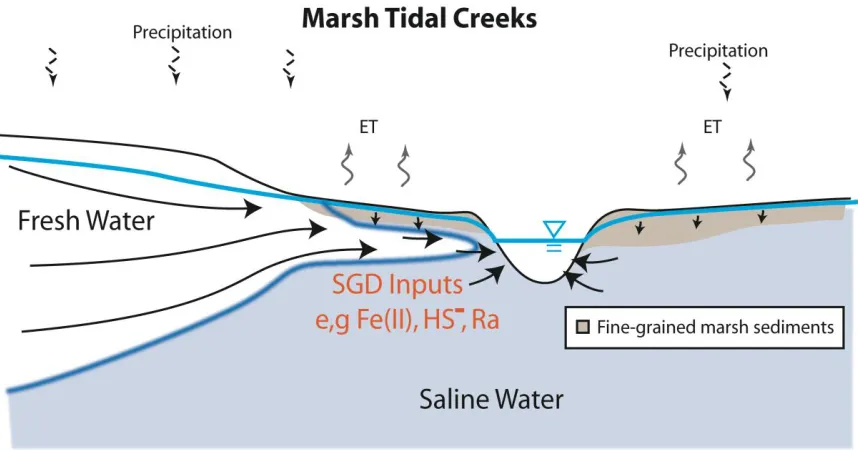
Figure 1.1. Simple schematic of hydrological processes in a marsh tidal creek. Water and particle flow through the sediment could create a batch reactor within the system. (ET stands for evapotranspiration.)
In addition to facilitating advective flow in the upper sediment column, the marsh
grass root system could allow for oxygen gas exchange between the roots and the
surrounding sediment (Koop-Jakobsen 2015). This gas exchange could lead to the
oxidation of sedimentary sulfide and iron phases and cause rapid redox oscillations
capable of mobilizing and transporting pore water species (Thursby 1984; Lee et al.,
1999; Lee 2003; Koretsky et al., 2008; Winkel et al., 2011). Recent laboratory studies
have demonstrated that such oscillations can cause changes in the redox speciation of a
suite of redox sensitive trace elements (Couture et al., 2015). When the metals are
mobilized, they are transformed into different phases including dissolved “free” ions,
in coastal marsh systems has been found to be the colloid associated phases (Duncan and
Shaw 2003). These colloid associated phases are a consequence of redox dependent
transformations of the metal containing iron sulfide phases that predominate in salt marsh
systems; rapid redox oscillations could therefore increase the significance of iron cycling.
Reduced iron sulfides in coastal sediments rapidly undergo a redox transition to
Fe(III) phases upon exposure to oxygen (Burns 2011). The iron can continue to cycle
between Fe(II) and Fe(III) phases or some iron can leave the cycle through the formation
of solids, typically iron oxide, potentially in the nanoscale (Guo 2013; Charette 2002;
Burns 2011; Rose 2003). The resultant colloidal (nano) ferric oxide phases adsorb metal
cations mobilized by the phase sulfide oxidation. It has been shown that iron oxides are
capable of adsorbing metals under environmentally relevant pH and ionic strength ranges
and that natural organic matter (specifically, humic acid (HA) as representative of NOM)
is also capable of adsorbing both metals and iron oxides (Lion 1982; Lowry 2012;
Baalousha 2008; Maurer-Jones 2013; Jirsa 2013). It has even been shown that humic
acid complexed with iron oxides can still bind metals (Kretzschmar 2005; Manciulea
2009). A study conducted by Plathe and colleagues (2013) concluded that approximately
80% of nanoparticles analyzed in a river system were associated with heavy metals and
that iron oxides represented the largest portion of this percent. Thus, association and
transport of these iron phases are critical to the mobility of heavy metals in these systems.
The importance of burrows in redox oscillations in marsh sediments has been well
established (Aller and Aller 1998), but the root gas system could be an additional
method to quantify the advective exchange rate of water and particulates through the
system and then assess the reactivity of redox sensitive elements in the system. This
study uses 224Ra as a tracer to determine the volume of water that flows through shallow
(20-50 cm) salt marsh sediments. Filtration and ICP-MS techniques are used to study
metal binding to iron oxide nanoparticles and the potential for subsequent transport. The
field site chosen for this investigation is the Folly Creek watershed in South Carolina,
CHAPTER 2
E
XPERIMENTAL2.1 Description of field site
Studies were conducted within the Folly Creek Watershed, a salt marsh system in
South Carolina, USA. The Folly Creek watershed is primarily comprised of the Folly
River, the Folly Creek, and other small creeks that branch off of these waterways that
have little fresh water input from nearby river systems. The watershed sits in a zone of
depression causing it to receive little deep SGD. The main land formation is Folly
Beach, a barrier island on the southeastern side of the watershed. The total area of Folly
Creek watershed is 8162 acres. About 74% of this is comprised of water cover including
bay/estuary and non-forested wetland (Carter 2010). The Folly Creek Watershed shares
an inlet with the Stono River Watershed. The Stono River is a tidal channel in
southeastern South Carolina, southwest of Charleston. Similar to the Folly system, the
Stono system receives little to no fresh water input that is not generated by runoff in the
watershed. Due to the above conditions, contributions to the Folly system from rivers or
groundwater sources other than near surface circulation through permeable marsh
sediments are at a minimum, making it an ideal site to study near SGD circulation.
Samples were collected in one location dominated by Spartina alterniflora marsh grasses
Sediment cores about 25 cm deep were collected from the field site, immediately
transported to the lab, and cut into 1-cm slabs at 2-4 cm intervals. Half of the slab was
transferred to Teflon large mouth bottles for 224Ra/228Th analysis. To each of these
bottles, 150 mL of 18 MΩ water was added to form a slurry which was then
ultrasonicated for 5 minutes. The pH was then adjusted to 8-9 by the addition of
concentrated ammonium hydroxide. Next, a suspension of MnO2 was formed by adding
1.0 mL of KMnO4 (3.0 gL-1) and 1.0 mL of MnCl2 (8.0 g MnCl2·4H2O L-1); any radium
present absorbs onto this surface. The slurry was then filtered onto 142 mm GF/F filters
and loaded into a modified recirculation chamber (Cai et al. 2012) for the counting of
220
Rn and 219Rn on the radium delayed coincidence counter (RaDeCC) developed by
Moore and Arnold (1996). Samples were measured a second time two weeks later and a
third time six weeks later in order to differentiate between supported and excess 224Ra.
The other half of the sediment core slab was transferred to pre-weighed petri
dishes, weighed, dried, and weighed again in order to determine porosity.
To examine the implications of redox oscillations, a metal binding experiment
was conducted. Iron oxide nanoparticles were synthesized under ambient conditions
using a procedure adapted from Karaagac (2012). Ten mmol of ferrous chloride and 15
mmol of ferric chloride were combined with 6.25 mL of 18 MΩ water and stirred for
approximately 10 minutes. Then 6.25 mL ammonium hydroxide was added and the
mixture was heated gently and stirred for an hour. A diluted sample was centrifuge
filtered and analyzed by ICP-OES (inductively coupled plasma optical emission
spectroscopy) to determine if there were free iron ions present. A set of 8 solutions were
Suwannee River humic acid, and M = metals. Metals used were a mixture of Al, Cr, Cu,
Fe, Pb, and Zn. Where present, the concentration of FeO was 10 ppm, HA was 16 ppm,
and M was 1 ppm. The eight solutions prepared were: FeO, FeO + M, FeO + HA, FeO +
HA + M, HA, HA + M, M, and a blank. All solutions were 0.5 M NaCl and all were
separated into 3 portions of 16 mL each and adjusted to pH 6, 8, and 10 resulting in 3
solutions for each of the 8 stock solutions. These pH adjusted solutions were then
separated into 3 portions so the experiment could be conducted in triplicate resulting in a
total of 72 samples. These samples were centrifuge filtered (using 30 kD filters), stored in
CHAPTER 3
R
ESULTS AND DISCUSSION3.1 Water flux
The advective water movement in the sediments was determined using the
224
Ra/228Th disequilibrium approach developed by Cai et al. (2012; 2014). 228Th is the
daughter of 228Ra whose activity in seawater is supported by the decay of the abundant
232
Th parent. 228Th generated in seawater and sediments remains strongly bound to
sediment particulate phases and when left undisturbed, the 224Ra/228Th in the sediments
will reach 1, indicating secular equilibrium (for every decay of the parent there is a decay
of the daughter). However, the 224Ra daughter ion is more soluble than the parent in
saline waters and can be mobilized from the sediment if seawater flows through the
sediments at rates comparable to the decay rate of the daughter (3.6 days). Thus,
advective flow can result in a disequilibrium as a change in the 224Ra/228Th ratio. This
disequilibrium indicates the extent of the sediment permeability; at a depth where there is
no longer water flowing through, the isotopes will be in secular equilibrium.
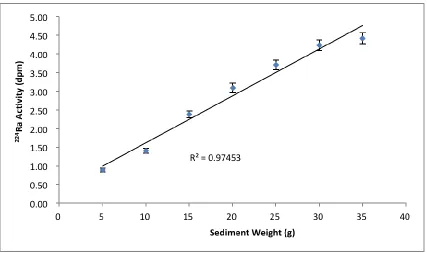
The method validation included a loading experiment to determine an upper limit
of how much sediment could be placed in the RaDeCC sample holders without blocking
air flow and depressing the number of counts detected. The goal was to find the greatest
sample size that could be measured in order to yield the highest number of counts while
remaining within the linear response of the instrument. The detector response remained
Figure 3.1. Sediment loading results.
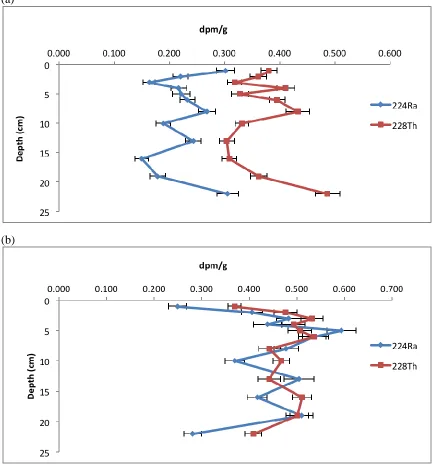
Two sediment cores were collected in December 2014; one core was taken from a
location dominated by marsh grasses and the other was taken from a location with many
burrows and no grass. In the grass dominated core, a distinct 224Ra deficit can be seen
throughout the length of the core representing disequilibrium between parent and
daughter and suggesting advective flow of water out of the sediment. However, in the
burrow dominated core, this deficit is not as extensive, with narrow zones of deficiency at
points throughout, near the surface, and at the bottom of the core. The zones may
indicate exchange around burrows. In April 2015 another two cores were collected from
a location next to the grassy area the December core was taken from. Both of these cores
show distinct deficits in the top and, more importantly, the bottom layers. There is,
(a)
(b)
(a)
(b)
Figure 3.3. April cores. Both cores (a) and (b) were collected from a site adjacent to marsh grasses.
These results provide evidence of advective water flow through the fine grained,
pore water export of 224Ra in disintegrations per minute (dpm) gram-1day-1, λ224Ra is the
decay constant for 224Ra (0.189 day-1), and A228Th and A224Ra are the activities of 228Th
and 224Ra in dpm gram sediment-1. To convert this flux to units of Lm-2day-1, a pore
water 224Ra activity estimate of 10 dpmL-1 was used along with a particle density of 2.6
gcm-3 and the known sediment porosity at each depth. This resulted in a pore water flux
of approximately 10-40 Lm-2day-1, depending on the specific core and depth.
3.2 Modeling root volume changes
One possible mechanism for the higher than expected advective flow in these
sediments may be related to the overall compressibility of the sediments due to changes
in root volume. For comparison, clay sediments typically have a compressibility of no
greater than 1% so a maximum change in volume associated with the fine sediments can
be easily calculated. Given a measured porosity of about 70% by mass for the non-root
containing muds collected from the marsh, the sediments account for about 30% of the
total mass. Corrected for a density of approximately 2.6 gcm-3, they only account for
about 14% of the volume for these muds when saturated. Compression of these
sediments by 1% would only account for a 0.1 percent change in volume or about 0.5
Lm-2 in the upper 50 cm of the sediment column per tidal cycle, a small fraction of the
calculated flow. Some draining of the non-vegetated sediments has been observed at low
tide as cracks in the surface mud, but these do not represent a large volume.
While the sediment compressibility alone is only a small fraction of the volume
change, the compressibility of roots within the sediment could add a significant amount.
An estimate of the total root volume in a typical marsh system can be made from
account for 40% to 60% of their volume (Winkel 2011) so an estimate of root density
while gas filled of 0.5 gcm-3 is reasonable (half of the root being air). If the roots are
considered as gas filled balloons and are at 1 atm due to gas transport across exposed
leaves in the air being at 1 atm, then compressibility under different tidal heights is likely
to result in significant volume changes. Sundby found in a separate but similar
environment that root biomass accounts for up to 25% dry weight of the total mass 20 cm
deep in the summer and about 1% in the winter (2005). Taking the root mass to be 25%
of the sediment mass and the density ratio of the sediments versus the roots yields a
relative volume estimate for the roots of about 15%. A compression of the roots by 10%
would then result in an overall change in volume of 1.5%, or 7 Lm-2 in the upper 50 cm
(the typical root depth in this system). Assuming two tidal cycles per day, this would
then be 14 Lm-2day-1. This conservative estimate is on the order of the low end of the
disequilibrium based estimates from the field study and support the hypothesis that the
root system could allow for advective flow of water in the sediment due to root volume
changes.
A related study by Winkel measured root oxygen levels in Spartina anglica and
found oxygen pressure changes of 20-65% depending on the time of day (2011). So there
is a fluctuation of oxygen levels in the total gas within the roots, with less oxygen being
present at night. In a preliminary study conducted by our lab group, a correlation was
Figure 3.4. Fe (II) and 224Ra levels over an extended time period.
While the flux of 224Ra is high at low tide stands during both the day and night, the
nighttime flux of Fe(II) corresponds with lower oxygen levels in the root system and
reduction of solid Fe(III) phases surrounding the roots. This is consistent with
observations of orange, presumably Fe(III) rich, zones around the roots of the cores
collected for this study. The oxygen exchange would lead to redox cycles between
reduced and oxidized phases in the sediments. This conceptual model of redox mediated
iron mobility is supported by the correlation between 224Ra flux and Fe (II)
concentrations at night. As it appears the root volume changes can create channels deep
into the sediment and that oxygen can be exchanged, sulfides deeper in the sediment can
be oxidized and the mobilized metals can transported out of the sediments. These redox
sensitive species may continue to react within a redox cycle or they may precipitate out
of the cycle as solids capable of binding and transporting reservoirs of other metals.
Initial characterization of the synthesized iron oxide nanoparticles found that the
particles were in the range of 600-900 nm over a pH range of 2-12 with a polydispersity
of approximately 0.5. The addition of humic acid helped to decrease the aggregation at
higher pHs; however, the particles are still largely aggregated. This was expected since
the particles were synthesized in a manner to imitate a natural formation and as such were
not treated with any sort of capping agent. No imaging techniques were used; however,
the particles appeared to be a reddish brown color indicative of the maghemite form of
FeO (Fe2O3). After centrifuge filtration of a diluted portion there was no Fe detectable by
ICP-OES in the filtrate indicating that all of the iron present in the particle solution was
in the form of particles and not dissolved Fe ions. This measurement was conducted one
month after synthesis signifying good stability of the particles. Table 3.1 shows the result
Table 3.2 Metal concentrations in the presence of iron oxide nanoparticles and humic acid. The metal concentrations present in each of the seven solutions (eighth solution is blank, subtracted out) after centrifuge filtration at pH of 6, 8 and 10. The blue highlights a decrease in metal concentration from the solution of metals alone (M).
pH Metal M FeO+M HA+M FeO+HA+M FeO HA FeO+HA
Al 0.0027 0.0064 0.0063 0.0052 0.0054 0 0
Cr 0 0 0 0 0 0 0
Cu 0.015 0.040 0.12 0.024 0 0 0
Fe 0.0018 0.00094 0.00031 0.0013 0.0010 0.0011 0.00097
Pb 0.033 0.042 0.17 0.032 0 0 0
Zn 0.16 0.26 0.25 0.21 0 0 0
Al 0.041 0.015 0.0034 0.0025 0 0 0
Cr 0.044 0.0015 0 0 0 0 0
Cu 0.00076 0 0 0 0 0 0
Fe 0 0.011 0.0094 0.0096 0.011 0.0097 0.0098
Pb 0.071 0 0.027 0.0058 0 0 0
Zn 0.087 0.0086 0.056 0.018 0 0 0
Al 0.17 0.16 0.14 0.14 0.00091 0.0031 0.0030
Cr 0.013 0.0066 0 0 0 0 0
Cu 0 0 0 0 0 0 0
Fe 0.0054 0 0 0 0 0 0.014
Pb 0.012 0.0034 0.0061 0.0026 0.0015 0.0064 0.010
Zn 0 0 0 0 0 0 0
6
8
10
Average Metal Concentrations in Solutions (ppm)
As can be seen, the concentration of metals in the solution of just metals (and 0.5 M
NaCl) is more or less in the ppb range. It was expected that these metals would filter
through and be detected in the filtrate with a high recovery resulting in a concentration
close to the 1 ppm that was initially added. The metals may have complexed with the
chloride present in the solution or may have interacted with the filter. With such small
concentrations, it is difficult to make comparisons; however, some trends may be
proposed. At pH 8 and 10 the blue font highlights a decrease in metal concentration in
the filtrate after additions of FeO and HA. In the solution containing both FeO and HA
with M, this decrease is compounded. This demonstrates that FeO and HA are capable of
binding metals separately and together. It appears that FeO is capable of binding Pb and
concentration is actually seen to increase upon addition of FeO and HA. This could
simply be due to increased solubility of metal complexes at lower pHs. As the particles
were largely aggregated (FeO particles alone were 600-900 nm), they are not as mobile
as smaller particles would be. However, due to the rapidity of the redox oscillations that
take place in the marsh sediments and the volume of water flowing through, smaller
CHAPTER 4
CONCLUSION
Salt marshes have traditionally been thought to serve as repositories for
contaminants, specifically metals, and have little shallow groundwater flow. However,
previous studies have provided evidence that significant flow may occur. This flow
could, in part, be due to the extensive salt marsh grass root system. These roots have
developed gas-filled aerenchyma in order to survive in a wetland environment and this
gas can compress and expand according to the weight of the overlying water and of the
saturated sediments as a function of tidal height. These changes in the gas volume can
cause channels to form throughout the sediment that allow water and particulates to flow.
Experiments in this study used 224Ra as a tracer to quantify water flux in sediment cores
about 25 cm deep and found a flux of 10-40 Lm-2day-1 in cores that were taken from
grassy areas. A rough model of gas compression in these sediments is consistent with the
disequilibrium based estimates of advective flow. Another effect of the root system is
that it allows for oxygen gas exchange between the roots and the surrounding sediment.
The amount of oxygen fluctuates depending on factors such as light intensity and tidal
height and causes rapid redox oscillations to occur. These redox reactions cause
metal-containing sulfides to oxidize, releasing the metal and initiating a redox cycle. These
sulfides are mainly iron sulfides and when oxidized can form iron oxides that are capable
metals. Due to the greater than expected groundwater flow, these particulates could be
more mobile than previously thought, challenging the concept of these sediments as a
R
EFERENCESAller, R. C.; Aller, J. Y. The effect of biogenic irrigation intensity and solute exchange on diagenetic reaction rates in marine sediments. J. Mar. Res.1998, 56, 905-936
Baalousha, M. Aggregation and disaggregation of iron oxide nanoparticles: Influence of particle concentration, pH and natural organic matter. Sci. Total Environ. 2008, 407, 2093-2101
Bianchi, T. S. The role of terrestrially derived organic carbon in the coastal ocean: A changing paradigm and the priming effect. PNAS2011, 108, 19473-19481
Blair, N. E.; Aller, R. C. The Fate of Terrestrial Organic Carbon in the Marine Environment. Annu. Rev. Mar. Sci.2012, 4, 401-423
Breitbarth, E.; et al. Iron biogeochemistry across marine systems – Progress from the past decade. Biogeosciences2010, 7, 1075-1097
Burns, J. M.; Craig, P. S.; Shaw, T. J.; Ferry, J. L. Short-term Fe cycling during Fe(II) oxidation: Exploring joint oxidation and precipitation with a combinatorial system. Environ. Sci. Technol. 2011, 45, 2663-2669
Cai, P.; Shi, X.; Moore, W. S.; Dai, M. Measurement of 224Ra:228Th disequilibrium in coastal sediments using a delayed coincidence counter. Mar. Chem.2012, 138-139, 1-6
Cai, P.; Shi, X.; Moore, W. S.; Peng, S.; Wang, G.; Dai, M. 224Ra:228Th disequilibrium in coastal sediments: Implications for solute transfer across the sediment-water interface. Geochim. Cosmochim. Ac.2014, 125, 68-84
Carter, J. B. Using Geographic Information Systems (Gis) as a tool for characterizing the Charleston-North Charleston urbanized area to guide stormwater education and outreach programming. Master’s Thesis, Clemson University, 2010
Charette, M. A.; Sholkovitz, E. R. Oxidative precipitation of groundwater-derived ferrous iron in the subterranean estuary of a coastal bay. Geophys. Res. Lett. 2002, 29, 85-1–85-4
Daleo, P.; Iribarne, O. The burrowing crab Neohelice granulata affects the root
strategies of the cordgrass Spartina densiflora in SW Atlantic salt marshes. J. Exp. Mar. Biol. Ecol.2009, 373, 66-71
Duncan, T.; Shaw, T. J. The mobility of rare earth elements and redox sensitive elements in the groundwater/seawater mixing zone of a shallow coastal aquifer. Aquat. Geochem.
2003, 9, 233-255
Gribsholt, B.; Kostka, J. E.; Kristensen, E. Impact of fiddler crabs and plant roots on sediment biogeochemistry in a Georgia saltmarsh. Mar. Ecol. Prog. Ser.2003, 259, 237-251
Guo, H.; Barnard, A. S. Naturally occurring iron oxide nanoparticles: morphology, surface chemistry and environmental stability. J. Mater. Chem. A 2013, 1, 27-42
Huettel, M.; Cook, P.; Janssen, F.; Lavik, G.; Middelburg, J. J. Transport and degradation of a dinoflagellate bloom in permeable sublittoral sediment. Mar. Ecol. Prog. Ser.2007, 340, 139-153
Huettel, M.; Rusch, A. Transport and degradation of phytoplankton in permeable sediment. Limnol. Oceanogr.2000, 45, 534-549
Jirsa, F.; Neubauerb, E.; Kittingera, R.; Hofmannb, T.; Krachlera, R.; von der Kammerb, F.; Kepplera, B. K. Natural organic matter and iron export from the Tanner Moor, Austria. Limnologica 2013, 43, 239-244
Karaagac, O.; Kockar, H. Iron oxide nanoparticles co-precipitated in air environment: Effect of [Fe+2]/[Fe+3] ratio. IEEE Trans. Magn. 2012, 48, 1532–1536
Koop-Jakobsen, K.; Wenzhofer, F. The dynamics of plant-mediated sediment
oxygenation in Spartina anglica rhizospheres – A planar optode study. Estuaries Coasts
2015, 38, 951-963Koretsky, C. M.; Haveman, M.; Cuellar, A.; Beuving, L.; Shattuck, T.; Wagner, M. Influence of Spartina and Juncus on saltmarsh sediments. I. Pore water geochemistry. Chem. Geol.2008, 255, 87-99
Kretzschmar, R.; Schäfer, T. Metal retention and transport on colloidal particles in the environment. Elements2005, 1, 205-210
Lee, R. W. Physiological adaptations of the invasive cordgrass Spartina anglica to reducing sediments: rhizome metabolic gas fluxes and enhanced O2 and H2S transport.
Mar. Biol.2003, 143, 9-15
Lion, L. W.; Altmann, R. S.; Leckie, J. O. Trace-metal adsorption characteristics of estuarine particulate matter: Evaluation of contributions of Fe/Mn oxide and organic surface coatings. Environ. Sci. Technol.1982, 16, 660-666
Lowry, G. V.; Gregory, K. B.; Apte, S. C.; Lead, J. R. Transformations of nanomaterials in the environment. Environ. Sci. Technol. 2012, 46, 6893-6899
Manciulea, A.; Baker, A.; Lead, J. R. A fluorescence quenching study of the interaction of Suwannee River fulvic acid with iron oxide nanoparticles. Chemosphere2009, 76, 1023-1027
Maurer-Jones, M. A.; Gunsolus, I. L.; Murphy, C. J.; Haynes, C. L. Toxicity of engineered nanoparticles in the environment. Anal. Chem.2013, 85, 3036-3049
Moore, W. S.; Arnold, R. Measurement of 223Ra and 224Ra in coastal waters using a delayed coincidence counter. J. Geophys. Res. 1996, 101, 1321-1329
Osgood, D. T. Subsurface hydrology and nutrient export from barrier island marshes at different tidal ranges. Wetl. Ecol. Manag.2000, 8, 133-146
Osgood, D. T.; Zieman, J. C. The influence of subsurface hydrology on nutrient supply and smooth cordgrass (Spartina alterniflora) production in a developing barrier island marsh. Estuaries 1998, 21, 767-783
Plathe, K. P.; et al. The role of nanominerals and mineral nanoparticles in the transport of toxic trace metals: Field-flow fractionation and analytical TEM analyses after
nanoparticle isolation and density separation. Geochim. Cosmochim. Ac.2013, 102, 213-225
Rose, A. L.; Waite, T. D. Kinetics of iron complexation by dissolved natural organic matter in coastal waters. Mar. Chem. 2003, 84, 85-103
Santos, I. R.; Eyre, B. D.; Huettel, M. The driving forces of porewater and groundwater flow in permeable coastal sediments: A review. Estuar. Coast. Shelf S.2012, 98, 1-15
Smoak, J. M.; Patchineelam, S. R. Sediment mixing and accumulation in a mangrove ecosystem: Evidence from 210Pb, 234Th and 7Be. Mangroves and Salt Marshes1999, 3, 17-27
Sundby, B.; Caetano, M.; Vale, C.; Gobeil, C.; Luther, G. W. III; Nuzzio, D. B. Root-induced cycling of lead in salt marsh sediments. Environ. Sci. Technol.2005, 39, 2080-2086
Thursby, G. B. Root-exuded oxygen in the aquatic angiosperm Ruppia maritime. Mar. Ecol. Prog. Ser.1984, 16, 303-305