Available online: https://edupediapublications.org/journals/index.php/IJR/ P a g e | 314
IoT Based Embedded Smart Lock Control System
Timmapuram Srinivas & Mr J Krishna Chaithanya
PG Scholar, Dept of ES Vardhaman College Of Engineering(Autonomous) Shamshabad,Hyderabad Telangana,India Associate Professor Dept of ECE Vardhaman College Of Engineering(Autonomous) Shamshabad,Hyderabad
Telangana,India
[email protected] & [email protected] Abstract:
Smart home security and remote monitoring have become vital and indispensable in recent times, and with the advent of new concepts like Internet of Things and development of advanced authentication and security technologies, the need for smarter security systems has only been growing. The design and development of an intelligent web-based door lock control system using face recognition technology, for authentication, remote monitoring of visitors and remote control of smart door lock has been reported in this paper. This system uses Haar-like features for face detection and Local Binary Pattern Histogram (LBPH) for face recognition. The system also includes a web-based remote monitoring, an authentication module, and a bare-bones embedded IoT server, which transmits the live pictures of the visitors via email along with an SMS notification, and the owner can then remotely control the lock by responding to the email with predefined security codes to unlock the door. This system finds wide applications in smart homes where the physical presence of the owner at all times is not possible, and where a remote authentication and control is desired. The system has been implemented and tested using the Raspberry Pi 2 board, Python along with OpenCV are used to program the various face recognition and control modules.
Keywords: Raspberry Pi, Face Recognition,Python,
OpenCV, PHP
I. INTRODUCTION
With the advent of various smart technologies, the need for better and more intelligent security
and monitoring has been growing. In recent times the need for security and surveillance has become vital in many areas such as homes, offices, banks, etc. In the recent past, various authentication techniques have been designed and implemented, passwords, patterns, RFID to name a few, these technologies have their advantages and disadvantages, the passwords and patterns once traced may compromise the security, the fingerprint-based systems are regularly prone errors arising due to external factors and mismatches.
Hence, arises a need for more efficient and effective way of authentication. The authentication based on Face Recognition has played a pivotal role over the years providing unmatched levels of efficiency and accuracy but was limited to a few high-security establishments and large corporations as the design, and implementation costs are high. Today, thanks to ongoing research and development, the algorithms have become more accessible and find a broad range of applications.
Available online: https://edupediapublications.org/journals/index.php/IJR/ P a g e | 315 remote authentication and control of the door
lock using email and basic IoT concepts.
1.1 Face Recognition
In the proposed system, we introduce a low-cost extendable framework for embedded smart home security system, which consists of a face recognition module. This system uses Haar-like features for face detection and Local Binary Pattern Histogram (LBPH) for face recognition. The system a cascade classifier in face detection and face recognition is carried out in three stages, namely feature extraction, matching, and classification. The distinctive and at the most important options are extracted, and the face image is compared with pictures in information throughout the last stage (classification).This native binary pattern for person's face recognition takes into account each form and texture information for analysis.
The image given is segregated into little elements from which the Local Binary Patterns are adopted and clubbed into one vector feature. This feature vector helps in measuring similarities between pictures by forming an associate in nursing economical illustration of a face. The algorithms are implemented using the OpenCV library of Python programming language running on the Raspberry Pi 2.
1.2 Remote Monitoring & Control
In addition to the face recognition-based authentication, the proposed system also includes an intelligent web-based embedded server for remote authentication and control of the door lock.
This technology plays a crucial role in enabling remote access to a person/ persons if required and if deemed necessary by the owner, who is not required to be present in-person. When an unauthorized person is detected by the system, it emails the owner a live picture of the
individual along with as SMS notification and waits for his command.
If the owner recognizes the person and would like to provide them with access, he can do so by sending a predefined security code to the server via email, the server, in turn, checks the authenticity of the code and unlocks the door accordingly. The server also maintains a web page which can only be accessed by the owner to bypass the face recognition system in case of error. This subsystem is implemented using Python programming language along with the Linux server and PHP scripts running on the Raspberry Pi 2.
II. SYSTEM DESIGN&ARCHITECTURE
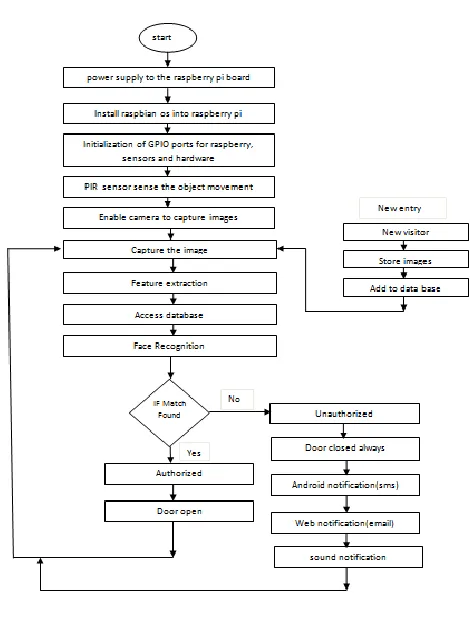
Fig. 1 Flow Chart
Available online: https://edupediapublications.org/journals/index.php/IJR/ P a g e | 316 effectively done using a flow chart, above is a
graphical representation of the proposed system.
2.1 System Architecture
The proposed system is a combination of various modules namely, imaging module, core module and the door lock module. The figure below represents the block diagram. The imaging module is responsible for capturing the images of visitor/ visitors and forwarding it to the core module for further processing; this is realized using a USB web camera.
The door lock module is a combination of driver circuitry and a DC motor to drive a lock, responsible for locking and unlocking the door as required.
Fig. 2 Block Diagram
The heart of this system is the core module which is realized using the Raspberry Pi 2, its responsibilities include, acquiring images from the camera, processing the acquired image as required, maintaining the facial image database, comparing the acquired image with the database, sending commands to the door lock module, etc. The core module also acts as an embedded web server responsible for sending and receiving emails, sending out SMS notifications and backend access.
III. SYSTEM DESCRIPTION
This section gives an overview of the various concepts, components and modules of the proposed system.
3.1 Imaging Module
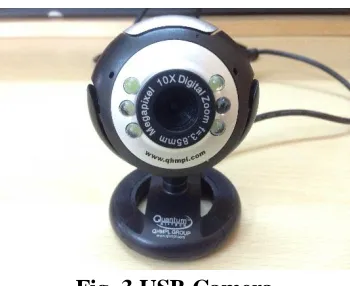
The imaging module in the proposed system is realized using a USB web Camera, the main reason behind choosing USB Camera over the Pi camera is the cost effectiveness. The camera features a high-quality CMOS sensor, with an image resolution of 25 MP (Interpolated), an adjustable lens for focus adjustment, a frame rate of 30 fps and f2.0 lens.
The USB camera also is equipped with night vision for low light photography. The camera interfaces with the Raspberry Pi via the USB 2.0 port and is responsible for capturing images when requested, the pictures are captured by using the command fswebcam.
Fig. 3 USB Camera
3.2 Raspberry Pi Core Module
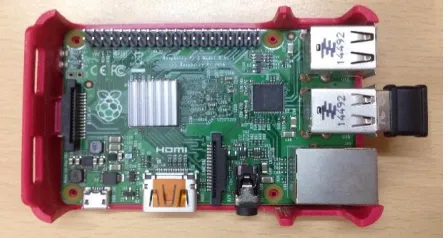
Available online: https://edupediapublications.org/journals/index.php/IJR/ P a g e | 317 USB ports for peripherals and 40 Pin General
Purpose Input Output (GPIO) pins for interfacing the Pi with external electronic circuits, these GPIO pins are used to interface the Pi to the door lock module. The Raspberry Pi is designed to run various Linux based operating systems and has Raspbian as its official operating system and Python as its official programming language.
Fig. 4 Raspberry Pi 2 Module
In this system the core module plays a highly pivotal role and is responsible for various functions, the core module is responsible for acquiring the images from the camera, processing and storing. It’s also responsible for maintaining the facial database which consists of pictures of all the authorized persons for reference. It is in charge of employing the face detection and recognition algorithms and has to decide whether is a person is authorized or not. It’s responsible for controlling the door lock module by sending lock/ unlock commands using Python code via GPIO to the motor driver.
3.3Embedded Server & IoT
Another crucial function of the core module is to act as an embedded web server, the primary responsibilities of this server include, transmitting the visitor/ visitors images via email to the owner, SMS notifications, look for emails
from the owner and find the security code from the emails for authorization.
This system employs an embedded server approach for communicating with the user and with the internet/ intranet. Python code is used to program certain aspects of this system such as sending and receiving emails and text messages. Standard Python libraries corresponding to the web such as urlib2, cookielib for online SMS service; imaplib, poplib, email, smtp, etc. for sending and receiving emails are imported and used accordingly.
This system uses web-based SMS client way2sms to send SMS alerts to the owner; it’s also configured with a dedicated gmail id to send and receive emails.
The system is also configured using Apache to act as a server, which is useful to remotely monitor the conditions. The owner can log in to the server using a dedicated static IP assigned to the Raspberry Pi, another important function of this server is to provide a secure back door to lock/ unlock the door by bypassing the face recognition feature in case of a failure or emergency. This is a secret feature and is only accessible by the owner.
3.4Face Detection and Recognition
Many kinds of face detection algorithms are used in many appliances, surveillance systems, gaming, human-computer interaction, etc. Paul Viola and Michael Jones devised a formula for object detection using Haar-feature based cascade classifiers. It’s a machine learning based algorithm in which some positive and negative images are employed to train the cascade classifier. Once the classifier is trained, features are extracted which is in turn used for object/ face detection.
Available online: https://edupediapublications.org/journals/index.php/IJR/ P a g e | 318 For face recognition to be carried out,
various face recognition algorithms such as Eigenfaces, Fisherfaces, LBPH Algorithm, etc. are available. This system uses Lower Binary Pattern Histograms method to perform face recognition. The Eigenfaces and Fisherfaces methods employ a holistic approach to recognitions, the data in these techniques are treated as a vector in high dimensional space which is not always ideal, hence in the LBPH algorithm the idea is to look at the lower dimensional subspace for useful information.
In this method, the local structure in an image is summarized by comparing the pixels with their corresponding neighbors. Consider a pixel. It’s surrounded by eight other pixels as neighbors. Now comparing the intensity of the center pixel with that of the neighbors if the intensity of the center pixel is higher than or equal to that of the neighbor under consideration then it’s denoted by 1, else with 0. Thus, for each pixel a binary representation is formed, which leads to a total of 2^8 possible combinations, these combinations are termed as Local Binary Patterns.
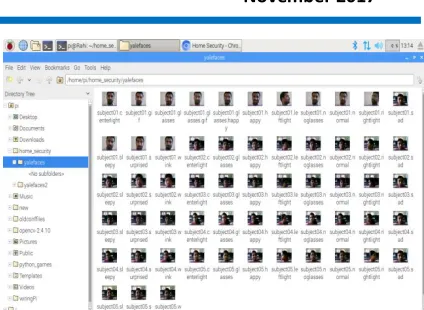
The OpenCV library of Python features a rich variety of face recognition algorithms through its FaceRecognizer class. The LBP algorithm is enabled by using the command createLBPHFaceRecognizer(). This system uses the LBP algorithm paired with the Yale Facedatabase or Yalefaces.
3.5Door Lock Module
The door lock module of this system is simulated using a DC motor to demonstrate the locking and unlocking function. This module is a combination of a relay driver circuit and a DC motor; this system uses an HFD27 Series 5V 1A 125 Ω (DPDT) Through Hole SubMiniature DIP Relay to control the DC motor. The driver circuit is also provided with leads for a 9V battery to drive the motor when triggered. The driver is
triggered by the core module through the GPIO pins.
IV.HARDWARE IMPLEMENTATION
This section emphasizes on the actual hardware implementation of the proposed system, the various modules, components, peripherals and the interconnections between them are discussed here.
The first stage of the implementation is to prepare the Raspberry Pi 2 module for its first boot; this is done by downloading the latest version of the Raspbian operating system from the official Raspberry Pi website. A microSD card is the formatted using SD Formatter; it’s
then flashed with the Raspbian OS using Win32 Disk Imager. The first boot is then completed on the Raspberry Pi connecting the required
Fig. 5 Door Lock Module
Available online: https://edupediapublications.org/journals/index.php/IJR/ P a g e | 319 peripherals, such as power supply, keyboard,
mouse, Ethernet cable, etc.
The Raspberry Pi for optimal operation requires a quality power supply; the Pi can be driven by using any Micro USB based mobile phone chargers with a good current rating, and this system is powered by a 5V 2A power bank for uninterrupted operation.
Since the Raspberry Pi doesn’t natively support wireless internet a USB WiFi dongle is used for connectivity; the Pi also has an Ethernet port which can be used to gain wired internet access.
Using Python programming language preinstalled on Raspbian the source codeof the system is provided and tested appropriately. The USB Camera is interfaced, the GPIO pins are programmed using commands in Linux and Python in this stage. The camera is interfaced to the Pi via the USB port and the door lock module is interfaced via the GPIO pins on the Pi.
V. EXPERIMENTAL RESULTS
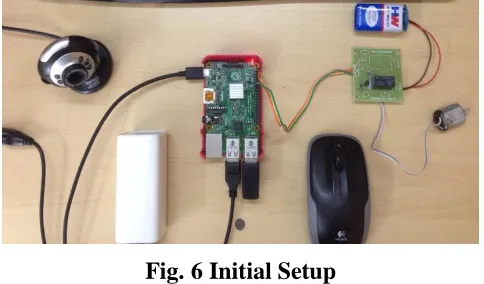
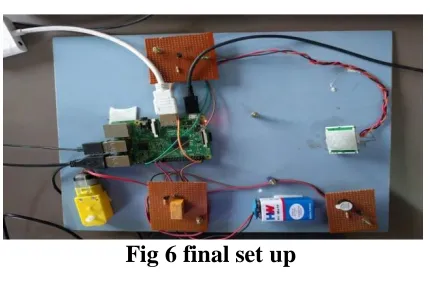
Fig 6 final set up
VI. PROJECT RESULTS:
VI.1 The Wi-Fi configuration:
Fig7:Wifi Configuration.
VI.2 The camera resolution:
Fig8: Camera Resolution Checking.
VI.3 Manual home page:
Fig 9 Manual Home Page.
Available online: https://edupediapublications.org/journals/index.php/IJR/ P a g e | 320 Fig 10: When Authorized User Entered.
Fig 11.When Authorized User Entered
Database.
VI.5.when unauthorized user entered:
Fig 12 When Unauthorized User Entered
Fig 13 When Unauthorized Person Entered
Database.
VII.SMS AND MAIL OUT PUT:
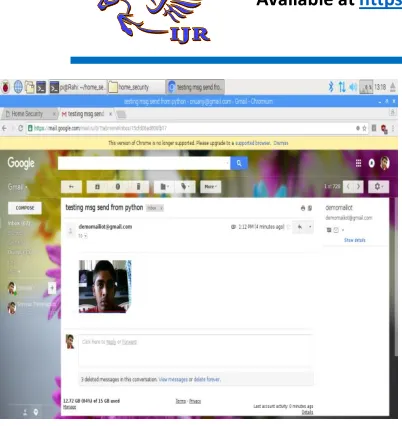
Available online: https://edupediapublications.org/journals/index.php/IJR/ P a g e | 321 Fig 15.Mail Output.
This section emphasizes on the final results of the proposed system, the system has been configured to recognize one of the author’s face, and thus some face images are taken in varying light conditions and are added to the database which is already populated with faces from Yale database.
The system correctly recognizes the face and unlocks the door which is simulated by the DC Motor along with an SMS alert. In the case of an unauthorized person, the algorithm reports non-availability of the face in the database to the core module, which in turn forwards the live snapshot to the owner’s email address for manual authentication along with an SMS alert.
The owner now has to manually provide access to the person if he/ she recognizes the person, this is done by replying to the Pi’s email with a secure code as its subject, this code can be changed by the owner. Once the Pi receives this code, it validates it and unlocks the door.
VI. CONCLUSION
This paper presents the design and implementation of an intelligent home security system using a robust, low-cost, low power single chip approach with the Internet as its backbone. This paper also explores the immense
potential of computer vision in general and face recognition, in particular, the possibilities of IoT in home security and automation. The versatility and prowess of Linux operating system, the Python programming language, and the OpenCV library have also been explored, in depth.
VIII. REFERENCES
[1].G. F. Zaki, et al., ”Using the hardware/software co-design methodology to implement an embedded face recognition/verification system on an FPGA”, IEEE Conference Proceedings, on 2007.
[2].Yuksekkaya, B.; Kayalar, A.A.; Tosun, M.B.; Ozcan, M.K.; Alkar, A.Z., "A GSM, internet and speech controlled wireless interactive home automation system," Consumer Electronics, IEEE Transactions on , 2006.
[3].R. Ibrahim and Z. M. Zin, ”Study of automated face recognition system for office door access control application”, IEEE 3rd International Conference in Communication Software and Networks (ICCSN),2011.
[4].H. T. Ngo, et al., ”A flexible and efficient hardware architecture for real time face recognition based on eigenface”, IEEE Computer Society Annual Symposium Proceedings in VLSI, 2005.
[5].M. Turk and A. Pentlands, “ Eigen faces for Recognition”, Journal Cognitive Nero-science,1991.
Available online: https://edupediapublications.org/journals/index.php/IJR/ P a g e | 322 [7].Mo Guan; Minghai Gu, "Design and
implementation of an embedded web server based on ARM," Software Engineering and Service Sciences (ICSESS), IEEE International Conference on , 2010.
[8].Il-Kyu Hwang, and Jin-Wook Baek, “Wireless access monitoring and control System based on digital door lock”, IEEE Transactions on Consumer Electronics,2007.
[9].Erdem, H.; Uner, A., "A multi-channel remote controller for home and office appliances," Consumer Electronics, IEEE Transactions on ,2009.
[10].Chia-Hung Lien; Ying-Wen Bai; Ming-Bo Lin, "Remote-Controllable Power Outlet System for Home Power Management," Consumer Electronics, IEEE Transactions on 2007.
[11]. Jinsoo Han; Chang-Sic Choi; Ilwoo Lee, "More efficient home energy management system based on ZigBee communication and infrared remote controls," Consumer Electronics, IEEE Transactions on , 2011.
[12].Vernon, S.; Joshi, S.S., "Brain–Muscle– Computer Interface: Mobile- Phone Prototype Development and Testing," Information Technology in Biomedicine, IEEE Transactions on ,2011.
[13]. Faundez-Zanuy, M. Are inkless fingerprint sensors suitable for mobile use? IEEE Aerospace and Electronic Systems Magazine, 2004.
[14].IFaundez-Zanuy, M.,2005, Technological evaluation of two AFIS systems, IEEE Aerospace and Electronic Systems Magazine. [15].Faundez-Zanuy, M., February 2005, Privacy issues on biometric systems, IEEE Aerospace and Electronic Systems Magazine.
[16].P. B. Saurabh and D.S.Chaudhari,”Principal Component Analysis for Face Recognition”,
International Journal of Engineering and Advanced Technology.2012.
[17].S. M. Prakash and C. J. Kalpna,”Face Recognition Using PCA”,International Journal of Artificial Intelligence Knowledge Discovery.2011.
[18].A. M. Martinez and A. C. Kak, ”PCA versus LDA” , LOS ALAMITOS, 2001.
[19].J. Mazanec, et al.,”Support vector machines, PCA and LDA in face recognition”, Journal of Electrical Engineering-Electrotechnicky CASOPIS,2008.
[20].K. H. Pun, et al.”A face recognition embedded system”, Biometric Technology for Human Identification II,2005.
[21]. Faizi A (2008), “Robust Face Detection using Template Matching Algorithm,”University of Toronto, Canada.