89
Evaluation on Self Curing and Durability of Concrete
Using Super Absorbent Polymer
Sona K. S
1., Irin Mary Martin
2.
P.G. Student1, Asst. Professor2 , Structural EngineerinG , Universal Engineering College, Vallivattom, Thrissur, Kerala.
Email: [email protected] , [email protected],
Abstract- Internal curing or self curing is a technique that can be used to provide additional moisture in concrete for more effective hydration of cement and reduce self-desiccation. Prediction of the influence of internal curing on the concrete and on its final mechanical properties is an important issue in concrete research. Internal curing can be done by using either light weight aggregate (LWA) or super absorbent polymer (SAP). This study focuses on using of the SAP in plain concrete. The SAP has the ability to absorb relatively large amount of water and convert it into gel at the same time and volume increases proportionally. These properties are found to be very useful and effective in plain concrete. The grade of concrete selected was M25 and M30.The super absorbent polymer is water lock 93.Water lock is cross linked poly acrylamide copolymer that absorb water. The absorbing capacity is variable depending on the quality of the water. The effect of variation in strength parameters i.e., compressive strength, split tensile strength, flexural strength and durability were studied for different dosage of self curing agent (0.3% - 0.7% weight of cement) and compared with that of conventional cured concrete. 0.5% of SAP give the better result.
Index Terms-: Self curing, Self curing agent, Self-desiccation, Super absorbent polymer, Light weight aggregate.
1. INTRODUCTION
Concrete is a basic civil engineering material used in the most of the civil engineering structures. Its popularity as basic building in construction is because of its economy of use, good durability and ease with which it can be manufactured in site. The ability to mould it into any shape and size, because of its plasticity in green stage and its subsequent hardening to achieve strength is particularly useful. Curing is the process of maintaining the sufficient moisture content and temperature in concrete for a period of time after the placing and finishing, so that the desired properties may develop. Proper curing can improve strength, durability, abrasion resistance, resistance to freeze–thaw cycles and also reduce concrete shrinkage. Traditionally, concrete cured externally either through the use of water curing or sealed curing. Good curing is not always practical. Several investigations give an answer to that problem, it will be self-curing concrete.
Internal curing or self curing is a technique that can provide additional water in concrete for an effective hydration of the cement and reduced self desiccation. Self curing implies the introduction of a curing agent into concrete that will provide this additional moisture. Now a days there are two major methods available for self curing of cement. The method uses satuarated porous light weight aggregate (LWA). It will be an internal source of water, which can replace the water consumed by chemical shrinkage during the process of cement hydration. This internal curing water is naturally move during cement hydration from
the relatively large pores of the light weight aggregate into the smaller pores of the cement paste. The second method uses super absorbent polymer (SAP), these particles can absorb a very large amount
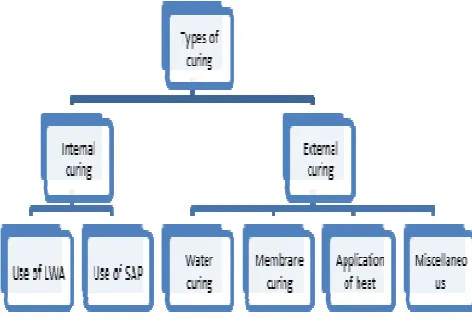
Methods of self curing (Internal curing)
Fig. 1. Methods of curing
90 consumed by chemical shrinkage during the process
of cement hydration. This internal curing water is naturally move during cement hydration from the relatively large pores of the light weight aggregate into the smaller pores of the cement paste. The second method uses super absorbent polymer (SAP), these particles can absorb a very large amount of water during concrete mixing and form large inclusions containing free water, thus preventing self desiccation during cement hydration. The large absorption characteristics of SAP is shown in fig.1
Fig. 1. Super absorbent polymers
Self curing provides extra curing water uniformly throughout the entire microstructure of the concrete. The use of self curing admixtures is very important from the point of view that water resources are getting valuable every day. (ie ., each 1m3 of concrete requires about 3m3 of water for construction most of which is for curing). The benefit of self curing is more effective in desert areas (eg: Rajastan) where water is not adequately available. Super absorbents are synthetic polymers with water retention properties. The SAP used in this study is water lock 93. Water lock is cross linked poly acrylamide copolymer that absorbs water. Its action is similar to a sponge except that while a sponge retains its size with or without water. Water lock swells and shrinks as it hydrates and dehydrates. It has the ability to absorb as much as 200 to 300 times its mass in water. It is used extensively in the agricultural industry and also used in many potted plants to help them retain moisture. Florists commonly use SAP to help keep flowers fresh.
2. EXPERIMENTAL INVESTIGATION
2.1. Materials used
2.1.1. Cement
In this experimental work, Portland pozzalona cement (PPC) 53grade conforming IS: 1489:1991 was used. Specific gravity 3.1. Fineness 0.85%, Normal consistency 32%, Initial setting time 120 minutes, Final setting time 310 minutes
2.1.2. Fine aggregate
Locally available Msand belonging to zone II of IS: 383-1970 was used for the project work. Specific gravity 2.5, Bulk density 1725kg/m3.
2.1.3. Coarse aggregate
Locally available crushed aggregates conforming to IS: 2386-1963 (I, II and III) specifications. Specific gravity 2.8. Bulk density 1690 kg/m3
2.1.4. Water
Water fit for drinking is generally considered fit for making concrete. Water should be free from acids, oils, alkalis, vegetables or other organic impurities.
2.1.5. Water lock 93
It is cross linked poly acrylamide copolymer that absorbs water. It was purchased from acuro organics limited, New Delhi.
2.1.6. Super plasticizer
Super plasticizer used in this study was CONPLAST SP 430 in the form of sulphonated naphthalene polymer confirms to IS: 9103-1999 and ASTM 494 type F was used to improve the workability of concrete.
2.2. Mix proportion of the concrete
Two mix designs M25 and M30 were carried in the work according to IS: 10262 – 2009. The work is designed to study the mechanical properties and durability property of concrete. Various percentage of SAP (0.3% to 0.7%) was added in the concrete
.
The material required per cubic meter of concrete is shown in table 1.Table 1. Materials required per cubic meter of concrete
Mix M25 M30
Cement (kg) 378 340
F.A (kg) 655 683
C.A (kg) 1246 1248
W/C ratio 0.48 0.45
Ratio 1:1.7:3.3:0.45 1:2:3.7:0.5
2.3. Preparation of specimens
93
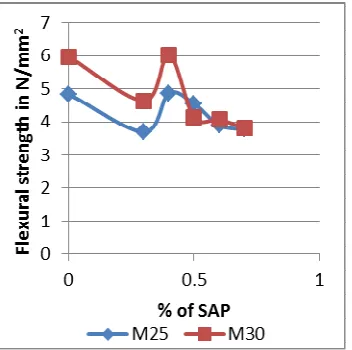
Fig. 4. Flexural strength for M25 and M30 grade
3.4. Marine attack on concrete cubes
The durability study was done by using marine water. The specimens were kept in marine water for 56 days after the 28 days self curing. Then tested the compressive strength and calculated the loss in percentage of compressive strength compared to the conventional concrete.
Table 5. Loss in compressive strength (%) after 56 days immersion in marine water
Mix % of SAP Loss in
compressive strength (%)
M30
0 25
0.3 19.8
0.4 15.8
0.5 11.7
0.6 10.54
0.7 12.34
M25
0 18
0.3 16.78
0.4 14.37
0.5 12.7
0.6 8.18
0.7 11.23
4. CONCLUSIONS
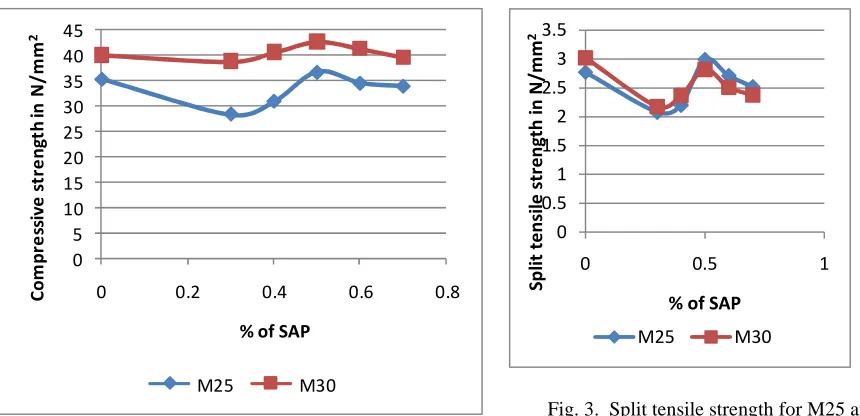
• Compressive strength of self curing concrete was increased by applying the self - curing agents.
• The optimum dosage of SAP for maximum compressive strength was found to be 0.5% of weight of cement for M25 and M30.
• The optimum dosage of SAP for maximum split tensile strength was found to be 0.5% of weight of cement for M25 and M30 grades of concrete. • For M25 and M30 concrete the maximum
flexural strength was found to be 0.4% of weight of cement.
• Self curing concrete was the best solution to the problems faced in the desert region and faced due to lack of proper curing.
REFERENCES
[1] Hijazin, G. E., Paul, A., and Lopez, M. (2012): Concrete containing natural pozzolans : new challenges for internal curing. Journal of Materials in Civil Engineering, ASCE, 24(8), 981-988.
[2] IS 5816:1970 [3] IS 10262:2009
[4] Joseph, G. and Ramamurthy, K. (2011). Autogenous curing of cold-bonded fly-ash-aggregate concrete. Journal of Materials in Civil Engineering, ASCE, 23(4), 393-401.
[5] Mezencevova, A., Garas, V., and Nanko, H. (2012): Influence of thermo mechanical pulp fiber compositions on internal curing of cementitious materials. Journal of Materials in Civil Engineering, ASCE, 24(8), 970-975
[6] Mousa, M. I., Mahdy, M. G., and Yehia, A. Z. (2014): Physical properties of self curing concrete. Housing and Building National Research Centre, ELSEVIER, 1-9.
[7] Sensale, G. R., and Goncalves, A. F. (2014): Effects of fine LWA and SAP as internal curing agents. International Journal of Concrete Structures and Materials, 8(3), 229-238
[8] Suzuki, M., Meddah, M. S, and Sato, R. (2013): Use of porous ceramic waste aggregates for internal curing of high performance concrete. Cement and Concrete Research, ELSEVIER, 373-381