CHULA TTS: A Modularized Text-To-Speech Framework
Natthawut Kertkeidkachorn
Supadaech Chanjaradwichai
1
Department of Computer Engineering
Faculty of Engineering, Chulalongkorn
University Bangkok, Thailand
2
Department of Informatics
The Graduate University for Advanced
Studies, Tokyo, Japan
[email protected]
Proadpran Punyabukkana
Department of Computer Engineering
Faculty of Engineering, Chulalongkorn
University Bangkok, Thailand
[email protected]
Department of Computer Engineering
Faculty of Engineering, Chulalongkorn
University Bangkok, Thailand
[email protected]
Atiwong Suchato
Department of Computer Engineering
Faculty of Engineering, Chulalongkorn
University Bangkok, Thailand
[email protected]
Abstract
Spoken and written languages evolve constantly through their everyday usages. Combining with practical expectation for automatically generating synthetic speech suitable for various domains of context, such a reason makes Text-to-Speech (TTS) systems of living languages require characteristics that allow extensible handlers for new language phenomena or customized to the nature of the domains in which TTS systems are deployed. ChulaTTS was designed and implemented with a modularized concept. Its framework lets components of typical TTS systems work together and their combinations are customized using simple human-readable configurations. Under .NET development framework, new text processing and signal synthesis components can be built while existing components can simply be wrapped in .NET dynamic-link libraries exposing expected methods governed by a predefined programming interface. A case of ChulaTTS implementation and sample applications were also discussed in this paper.
1
Introduction
A Text-to-Speech (TTS) system is a system which artificially produces human speech by converting a target text into its corresponding acoustic signal. TTS systems are crucial components to many kinds of computer applications, particularly applications in assistive technology, E.g. applications for assisting the visually-impaired to access information on the Internet (Chirathivat et al. 2007), applications for automatically producing digital talking books (DTB) (Punyabukkana et al. 2012), and etc.,
3
The Modularized Framework
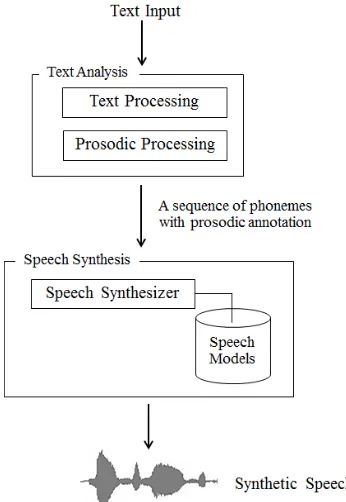
Typically, TTS systems have a common architecture similar to the illustration shown in Figure 1. This architecture consisted of two parts: the text analysis part and the speech synthesis part. An input text is fed into a text analysis block to generate its sequence of phonetic representation comprising phoneme and prosody annotation and then the sequence is passed to the speech synthesis block in order to generate real signal associated with the sequence of phonetic representation. Algorithms implemented in each processing step usually vary from system to system. According to the architecture in Figure 1, there are components whose underlying algorithms could be varied or allowing options in applying different algorithms to different portions of the text input. These components involve how the input texts are processed in order to obtain both underlying phonetic sequences and their suprasegmental information such as prosodic information governing how each phonetic unit in the sequence should be uttered and how speech signal should be generated. Typically, algorithms used for each component in a TTS system are predetermined and developed as an entire system.
Figure 1. An architecture of a typical TTS system
Contrary to the architecture of a typical TTS system, we proposed a modularized TTS framework called ChulaTTS in which implementation of different text and speech signal processing are considered modules that can interoperate with one another. The aim of the framework is to provide flexibility in experimenting with different algorithms that could affect only a part of the whole system as well as to enable interoperability of multiple modules responsible for similar tasks of the TTS process. The latter makes a TTS system extensible when a new module is introduced and incorporated among existing ones in the system. Programming-wise, neither shuffling modules of a system nor adding additional modules to the system requires re-compiling of the source code of any modules already deployed in the system. To build a functional TTS system with the ChulaTTS framework, ones implement the TTS system by exposing components involving in the TTS process in the forms of modules consistent with the framework’s specification and configuring the
framework to utilize them.
Before elaborating on the classes of module in
ChulaTTS, let’s consider the typical architecture in
3.1
Segment Tagging StageSegment Tagging in ChulaTTS is dedicated to segmenting an input text into smaller pieces of text, each of which with a proposed tag. Segment tags identify which modules process the tagged segments in later stages of the TTS process. Three steps are performed in this segment tagging stage: 1) Segmentation step, 2) Segment tagging step, and 3) Tag selector step.
Segmentation: The segmentation step inserts word or phrase boundaries into the input text string. Portions of texts located between adjacent
boundaries are called “segments”, each of which
will then be marked with a tag in the next step. In an implementation of the ChulaTTS framework, one segmentation module can be selected via the corresponding configuration. All modules performing as a segmentation module must provide at least one segmentation function that receives the input text in the form of a string of characters and returns its corresponding sequence of segments.
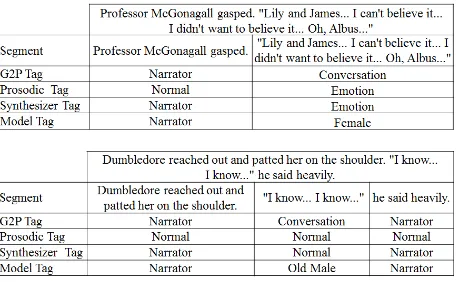
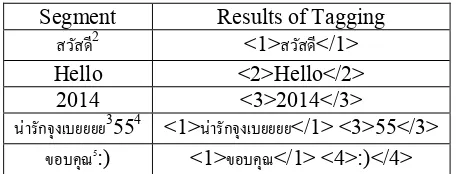
Segment tagging: The segment tagging assigns an appropriate tag to each segment. Modules performing this step can have their own set of tags and conduct the tagging independently from other modules. An implementation without alternative algorithms for steps of the TTS process needs only a single tagger. Figure 3 depicts a conceptual example of the need for the later steps of the TTS process to heterogeneously handle different parts of input text motivates the inclusion of segment tagging. In the figure, segment tags can be used to process and synthesize speech with different personalities or expressions.
Figure 3. Conceptual examples of tags for the later stages1
All modules performing as a segment tagging module must provide at least one tagging function that receives a sequence of segments and provides a single tag for each of the input segment.
Tag selector: In cases of conflicting segment tags due to multiple segment tagging modules, this step decides on which of the conflicting tags should be kept and used as parameters in selecting modules in the later steps of the TTS process. A single tag selector module capable of handling all tags produced by all active segment tagging modules is required in a ChulaTTS implementation. The tag selector modules provide at least one function returning a sequence of tagged segments.
3.2
Text Analyzer StageThe text analyzer stage is for producing a sequence of phonetic units with prosodic parameters. It consists of two steps: 1) G2P conversion, and 2) Prosodic annotation. The first step produces
1 The example text from Harry Potter and the Sorcerer's Stone
phonetic units from the input sequence of segments. One or more G2P conversion module can be deployed in a single ChulaTTS implementation providing that they cover all possible tags in the implementation. Each segment tag must be associated with a G2P module while each G2P module can handle multiple segment tags. Segments are fed to G2P modules according to the implementation configuration. For a segment, the G2P module responsible for the segment produces a sequence of corresponding phonetic units, each of which can be declared by the module itself. Different phonetic units must use unique symbols. Phonetic units with similar symbols are considered the same type of units regardless of which modules handle the G2P conversion.
Prosodic annotator modules are deployed in the prosodic annotation step. Different modules are activated based on the segment tag according to the configuration of the implementation. Similarly to the phoneme units, prosodic markers produced by the modules must be supported in the Speech Synthesizer stage of the implementation.
3.3
Speech Synthesizer StageThe role of this stage is to generate synthetic speech signals based on the phonetic representation and the prosodic parameters provided by the Text Analyzer stage. This stage involves three configurable parts: 1) Pre-processing, 2) Synthesizer Engine, and 3) Acoustic Models. A pair of Synthesizer Engine module and its corresponding Pre-processing module, responsible for adjusting the format of the phonetic representation and prosodic parameters so that they are consistent with the input interface of the Synthesizer Engine, must be configured to handle all segments tagged with a segment tag, while Acoustic Models can also be selected by the configuration, providing that their phonetic units and file formats are supported by the associated Synthesizer Engine module. All modules performing as a Synthesizer Engine module must provide at least one signal synthesis function that generates a waveform file that will be treated as the final synthesized speech by the ChulaTTS framework.
3.4
Module DevelopmentAn option that we chose in order to maximize interoperability of modules and, at the same time, avoid steep learning curves for researchers who wish to evaluate algorithms in ChulaTTS is to adhere to the .NET development framework on Windows platform for module development. The framework was written in C# and all classes of modules (described in Section 3.1 to Section 3.3) to be integrated to an implementation of the framework are expected to be in the form of .NET Dynamic-Link Library (DLL) exposing functions whose signatures are consistent with the contractual interface defined by the framework according to their module classes. New modules can be developed using any .NET targeted programming languages while existing executables can be wrapped inside .NET
3.5
Implementation ConfigurationsConfiguring the ChulaTTS implementation is performed by modifying three key configuration files: Segment Tagging configuration which determines how the framework should execute steps in the three stages listed in Section 3. Configuration files are all in plain text format read by the framework at run-time. In each configuration file, the name of the DLL file together with the name of the function residing in that DLL file associated with its corresponding step in the TTS process must be specified in a pre-defined format. The framework checks for the consistency of these functions with their corresponding contractual interface defined by the framework.
The next section reports an example case of the implementation of the ChulaTTS framework. The case showed a sample scenario in which a newly developed algorithm was evaluated via subjective tests in a complete TTS system using the ChulaTTS framework.
4
Implementation
4.1
System ImplementationZeynep Orhan and Zeliha Görmez, The framework of the Turkish syllable-based concatenative text-to-speech system with exceptional case handling. 2008. In WSEAS Transactions on Computers, 7(10):1525-1534.
Mario Malcangi and Philip Grew. 20009 “A framework
for mixed-language text-to-speech synthesis, In Proceedings of CIMMACS 2009: 151-154.
Zhiyong Wua, Guangqi Caoa, Helen Menga and Lianhong Caib. 2009. A unified framework for multilingual text-to-speech synthesis with SSML specification as interface, In Tsinghua Science and Technology, 14(4): 623-630.
PukiWiki. HMM-based Speech Synthesis System (HTS) http://hts.sp.nitech.ac.jp/ 2013.
Choochart Haruechaiyasak and Sarawoot Kongyoung, 2009. TLex: Thai Lexeme Analyzer Based on the Conditional Random Fields, In Proceedings of 8th International Symposium on Natural Language Processing 2009.
Chatchawarn Hansakunbuntheung, Virongrong Tesprasit and Virach Sornlertlamvanich. 2003. Thai tagged speech corpus for speech synthesis, In processing of O-COCOSDA 2003: 97-104.
Mustafa Zeki, Othman O. Khalifa and A. W. Naji. 2010. Development of an Arabic text-to-speech system, In Proceedings of ICCCE 2010: 1-5
Nectec. 2009. BEST 2009 : Thai Word Segmentation
Software Contest”, http://thailang.nectec.or.th/best/